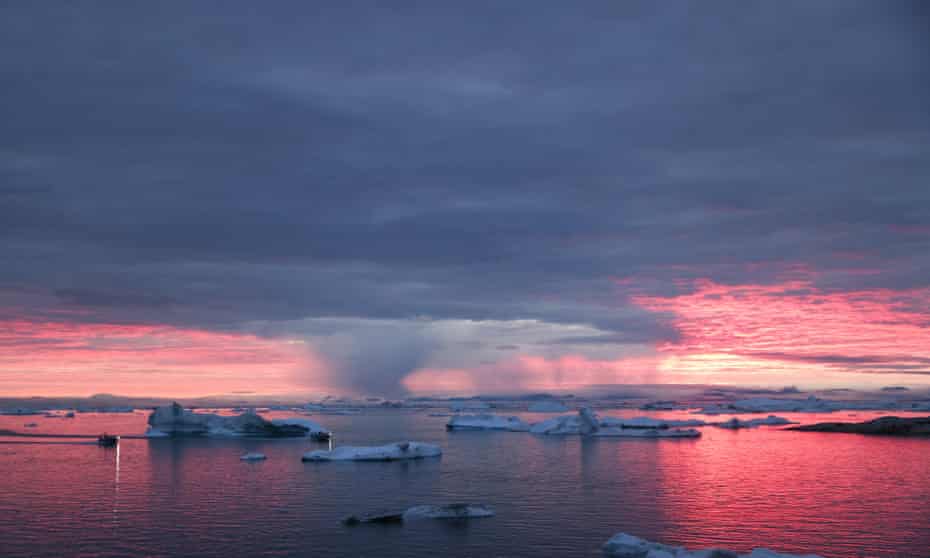
Rain will replace snow as the Arctic’s most common precipitation as the climate crisis heats up the planet’s northern ice cap, according to research.
Today, more snow falls in the Arctic than rain. But this will reverse, the study suggests, with all the region’s land and almost all its seas receiving more rain than snow before the end of the century if the world warms by 3C. Pledges made by nations at the recent Cop26 summit could keep thetemperature rise to a still disastrous 2.4C, but only if these promises are met.
Even if the global temperature rise is kept to 1.5C or 2C…
KARACHI, Pakistan (AP) — The head of a team of vets on Tuesday called for urgent medical care for a pair of elephants in Pakistan’s port city of Karachi.
Dr. Frank Goeritz, whose team was dispatched by a global animal welfare group to examine four elephants in total, reported that one the elephants needs a “complicated” surgery to remove damaged and infected tusks. A second elephant has dental problems and a medical issue with a foot, according to the vets dispatched by Four Paws.Manhattan Fruitier Deluxe Organic Gift Basket By Harry & David – Gift Baskets DeliveredAdHarry and David
Such “diseases are very painful and can lead to life-threatening situations in elephants,” the vets said, according to a report prepared by Goeritz, who was sent to Pakistan with the help of Four Paws. The group said a Pakistani court in Karachi had asked for the animal welfare experts to assess the wellbeing of the four elephants in Karachi Zoo and Karachi Safari Park.
Overall, Goeritz said, the health of the two elephants, plus two more he examined, is good.
Goeritz also submitted his medical report about the condition of elephants to a local court, which sought help from the animal welfare organization to determine if any of the elephants suffered from disease.
The visit by the vets comes a year after the rescue of an elephant named Kaavan, who was transferred from Islamabad to Cambodia and now lives in an elephant sanctuary. Kaavan had languished in the Islamabad zoo for 35 years, most of that time in chains, and it lost his partner in 2012.Start the conversation
Henry Gee is a paleontologist, evolutionary biologist and editor at Nature. His latest book is A (Very) Short History of Life on Earth (St. Martin’s Press, 2021).
Cast your mind back, if you will, to 1965, when Tom Lehrer recorded his live album That Was the Year That Was. Lehrer prefaced a song called “So Long Mom (A Song for World War III)” by saying that “if there’s going to be any songs coming out of World War III, we’d better start writing them now.” Another preoccupation of the 1960s, apart from nuclear annihilation, was overpopulation. Stanford University biologist Paul Ehrlich’s book The Population Bomb was published in 1968, a year when the rate of world population growth was more than 2 percent—the highest in recorded history.
Half a century on, the threat of nuclear annihilation has lost its imminence. As for overpopulation, more than twice as many people live on the earth now as in 1968, and they do so (in very broad-brush terms) in greater comfort and affluence than anyone suspected. Although the population is still increasing, the rate of increase has halved since 1968. Current population predictions vary. But the general consensus is that it’ll top out sometime midcentury and start to fall sharply. As soon as 2100, the global population size could be less than it is now. In most countries—including poorer ones—the birth rate is now well below the death rate. In some countries, the population will soon be half the current value. People are now becoming worried about underpopulation.
As a paleontologist, I take the long view. Mammal species tend to come and go rather rapidly, appearing, flourishing and disappearing in a million years or so. The fossil record indicates that Homo sapiens has been around for 315,000 years or so, but for most of that time, the species was rare—so rare, in fact, that it came close to extinction, perhaps more than once. Thus were sown the seeds of humanity’s doom: the current population has grown, very rapidly, from something much smaller. The result is that, as a species, H. sapiens is extraordinarily samey. There is more genetic variation in a few troupes of wild chimpanzees than in the entire human population. Lack of genetic variation is never good for species survival.ADVERTISEMENT
What is more, over the past few decades, the quality of human sperm has declined massively, possibly leading to lower birth rates, for reasons nobody is really sure about. Pollution—a by-product of human degradation of the environment—is one possible factor. Another might be stress, which, I suggest, could be triggered by living in close proximity to other people for a long period. For most of human evolution, people rode light on the land, living in scattered bands. The habit of living in cities, practically on top of one another (literally so, in an apartment block) is a very recent habit.
Another reason for the downturn in population growth is economic. Politicians strive for relentless economic growth, but this is not sustainable in a world where resources are finite. H. sapiens already sequesters between 25 and 40 percent of net primary productivity—that is, the organic matter that plants create out of air, water and sunshine. As well as being bad news for the millions of other species on our planet that rely on this matter, such sequestration might be having deleterious effects on human economic prospects. People nowadays have to work harder and longer to maintain the standards of living enjoyed by their parents, if such standards are even obtainable. Indeed, there is growing evidence that economic productivity has stalled or even declined globally in the past 20 years. One result could be that people are putting off having children, perhaps so long that their own fertility starts to decline.
An additional factor in the shrinking rate of population growth is something that can only be regarded as entirely welcome and long overdue: the economic, reproductive and political emancipation of women. It began hardly more than a century ago but has already doubled the workforce and improved the educational attainment, longevity and economic potential of human beings generally. With improved contraception and better health care, women need not bear as many children to ensure that at least some survive the perils of early infancy. But having fewer children, and doing so later, means that populations are likely to shrink.
The most insidious threat to humankind is something called “extinction debt.” There comes a time in the progress of any species, even ones that seem to be thriving, when extinction will be inevitable, no matter what they might do to avert it. The cause of extinction is usually a delayed reaction to habitat loss. The species most at risk are those that dominate particular habitat patches at the expense of others, who tend to migrate elsewhere, and are therefore spread more thinly. Humans occupy more or less the whole planet, and with our sequestration of a large wedge of the productivity of this planetwide habitat patch, we are dominant within it. H. sapiens might therefore already be a dead species walking.https://3d755c5546e77b8906bbd5f8c1a05840.safeframe.googlesyndication.com/safeframe/1-0-38/html/container.htmlADVERTISEMENT
The signs are already there for those willing to see them. When the habitat becomes degraded such that there are fewer resources to go around; when fertility starts to decline; when the birth rate sinks below the death rate; and when genetic resources are limited—the only way is down. The question is “How fast?”
I suspect that the human population is set not just for shrinkage but collapse—and soon. To paraphrase Lehrer, if we are going to write about human extinction, we’d better start writing now.
The warning follows a 3km and 10km Temporary Control Zone being put in place in Charnwood District, affecting many villages west ofMelton, after a case was found in a poultry farm at Barrow upon Soar.
These are among a number of confirmed cases of avian influenza across Great Britain in recent weeks and from today (Monday) onwards it will be a legal requirement for all bird keepers to keep their birds indoors and to follow strict biosecurity measures in order to limit the spread of the disease.
All poultry and captive bird keepers must also continue taking extra precautions to keep their flocks safe, including regularly cleaning and disinfecting…
Waterworks Park, Belfast.(Image: Justin Kernoghan/Belfast Live)
Stay on top of the headlines from Belfast and beyond by signing up for FREE email alertsSign me up!We use your sign-up to provide content in ways you’ve consented to and to improve our understanding of you. This may include adverts from us and 3rd parties based on our understanding. You can unsubscribe at any time.More info
A public health warning has been issued after two birds died from avian flu at Belfast Waterworks.
While human infections of avian influenza viruses are rare – they are possible and can cause a fever, cough, muscle pain, a sore throat, runny nose and conjunctivitis.
Published November 28, 2021•Updated onNovember 28, 2021at4:05 pm
Two men were found dead following a reported shooting inside a home in Alburgh, Vermont on Saturday night.
Police say the shooting occurred following a weeklong dispute between two men over access to a property for hunting.
Police responded to a home on Cameron Drive around 10p.m. after multiple calls reporting of a shooting. Police found two men — one in his early 50s, and another in his early 40s — dead outside of a home belonging to one of the men.
A third man, in his late 20s, was found injured at the scene and was taken to a nearby hospital for treatment, according to police.
by: Jared WeaverPosted: Nov 28, 2021 / 04:20 PM EST / Updated: Nov 28, 2021 / 08:25 PM ESTjavascript:false
CAMBRIA COUNTY, Pa. (WTAJ)– A man is dead after being shot in a hunting accident that occurred in the morning Saturday in Jackson Township, according to Cambria County Coroner Jeff Lees.
William Tripp, 71, of Elizabethtown, was in the area hunting off of Buckhorn Road in Cambria County with friends and family on a gas line when at about 10 a.m., a minor who was also hunting on the same gas line shot a deer and missed.
The coroner said that the bullet then went approximately 300 yards and hit Tripp in the head.
“This is a heart-wrenching, unfortunate accident that has happened,” Lees said
Officials say that the manner of death is ruled accidental and the minor was related to Tripp.
An 82-year-old man was shot in the leg during an apparent hunting accident in New Hampshire over the Thanksgiving weekend, officials said. The man from Wilton had been out hunting with an 83-year-old from Lyndeborough in Lyndeborough on Saturday evening, New Hampshire Fish and Game said. As they returned to their vehicles, a bolt-action hunting rifle fired while the older man was placing it into his vehicle. The older man failed to remove all the rounds from the gun, a .300 Remington Model 722, officials said. The bullet traveled across the vehicle and into the 82-year-old’s leg, then out through the door on the driver’s side. The man was seriously injured and his companion provided aid while an ambulance came, but he has since been released from the hospital, officials said.







 Exposing the Big Game