Zebras have distinctive black-and-white hides, and the stripes are unique to each individual.(Image credit: Manoj Shah via Getty Images)
Zebras are iconic for their distinctive coats, but have you ever wondered whetherzebrasare white with black stripes or black with white stripes?
The stunning black-and-white coloration of the zebra’s hide stands out in stark contrast with the dry, brown-and-green, treeless grasslands and savannah woodlands of their home territories of East and southern Africa, according to theAfrican Wildlife Foundation.
These stripes are unique to each individual. There are three zebra species living today — the plains zebra (Equus quagga), the mountain zebra (E. zebra) and the Grevy’s zebra (E. grevyi) — and each of those species has a different striping pattern, too. For some, the darker portions of their hide…
5NEWS Daily Headlines | November 18, 2021https://imasdk.googleapis.com/js/core/bridge3.489.0_en.html#goog_353512661Volume 90%Author:5NEWS Web StaffPublished:1:55 PM CST November 18, 2021Updated:1:59 PM CST November 18, 2021
MOUNTAINBURG, Ark. —Update:First responders were able to locate the man and he was flown to a hospital in Northwest Arkansas. His condition is still unclear.
Original article:
Right now Crawford County deputies and first responders are trying to rescue a hunter that fell from a tree in Mountainburg.
This is happening in the area of Shepard Springs Road.
At this time we do not know the name of the hunter or their condition. The rescue to get the hunter out of the woods and to a hospital is still underway.
Since their removal from the Endangered Species Act, wolves are suffering under state-sponsored persecution in Montana, Idaho, and a handful of other states — and we may already be seeing their population plummet again as a result. As described in this article, USDA Wildlife Services killed eight wolf pups last month belonging to a pack that had been adopted by Boise highschoolers.
We know that the majority of people are with us, but we have to get their attention. Can you help raise public outcry about this massacre by writing a Letter to the Editor (LTE) to your local newspaper? Speak out against the wasteful killing of wolves by Wildlife Services in your region.Use the talking points below, and check out our tips on how to write LTEs here.
Talking Points (please personalize):State where you live in Idaho, or your regional residency, and that you condemn the federal government killing wolf pups in your area. You can also acknowledge local conservationists and Timberline High School students for their advocacy on this issue.
Wolf populations remain at risk, despite being delisted from the Endangered Species Act. When wolves were removed from the Endangered Species Act earlier this year, they only occupied 15% of their historic range. Since then, some state governments have endorsed wanton killing of wolves, putting their population under even more dire threat.Non-lethal methods are more effective at preventing potential conflict. Non-lethal methods already being practiced are vastly more effective at protecting ranchers’ livelihoods and the welfare of native wildlife, all at lower long-term cost compared to lethal control. The Wood River Wolf Project, mentioned in this article, is one great example.Stable wolf packs are vital to the health and biodiversity of our native ecosystems. But wolves cannot fulfill their important environmental role when their young are being slaughtered by federal agents.
Thank you for acting today to protect Idaho’s wolves and wild ecosystems!
Don’t forget to forward this action alert to friends and family, and encourage them to take action on behalf of wolves. We need every voice raised to save them.
By WCAX News TeamPublished: Nov. 18, 2021 at 5:19 AM PST
SWANTON, Vt. (WCAX) – A missing hunter has been found safe.
Swanton police say they got a call just before midnight from a concerned family member that Brian Lazarski, 66, of St. Albans, hadn’t been seen all day Wednesday.
Police say Lazarski’s vehicle was found unoccupied on French Hill near the Fairfield Swamp trailhead in Swanton. Search teams found Lazarski near the Fairfield Swamp.
Police say he lost his bearings while hunting and couldn’t find his way back to his vehicle.
Arecord number of human cases with avian flu (H5N6) have been reported from China with onset in 2021, with 22 cases reported in the last 10 months. Before 2021, the largest number of cases of avian flu in China was in 2016 when 9 human cases of infection were reported.
Most cases reported by China have involved close contact with an infected bird (dead or alive). Markets where live birds are sold can also be a source of infection. China has not reported any spread of H5N6 from person to person.
Though the risk to the UK public is very low,UKHSAand the National Travel Health Network are reminding UK travellers to China to protect themselves from avian flu by minimising exposure to wild birds and poultry while in China.
Dr Gavin Dabrera, a Consultant in Acute Respiratory Infections atUKHSAsaid:
“Anyone visiting China should avoid exposure to any birds or live…
Bruce Y. LeeSenior ContributorHealthcareI am a writer, journalist, professor, systems modeler, computational and digital health expert, avocado-eater, and entrepreneur, not always in that order.FollowListen to article4 minutes
Recently, Europe has experienced over 100 outbreaks of avian influenza. (Photo: Getty)GETTY
Here’s some fowl news. Outbreaks of highly pathogenic avian influenza have recently been occurring in various parts of Europe and Asia. Highly pathogenic avian influenza ain’t just your run-of-the-mill bird flu.TheMerriam-Websterdictionary defines“pathogenic” as “causing or capable of causing disease.” Therefore, being called “highly pathogenic” by your friends would not be a compliment. Similarly, highly pathogenic avian influenza is essentially bird flu that is either highly capable of causing disease or can cause severe disease. Or both. That’s why these outbreaks have been a bit of an “oh cluck” problem for poultry and poultry farmers.
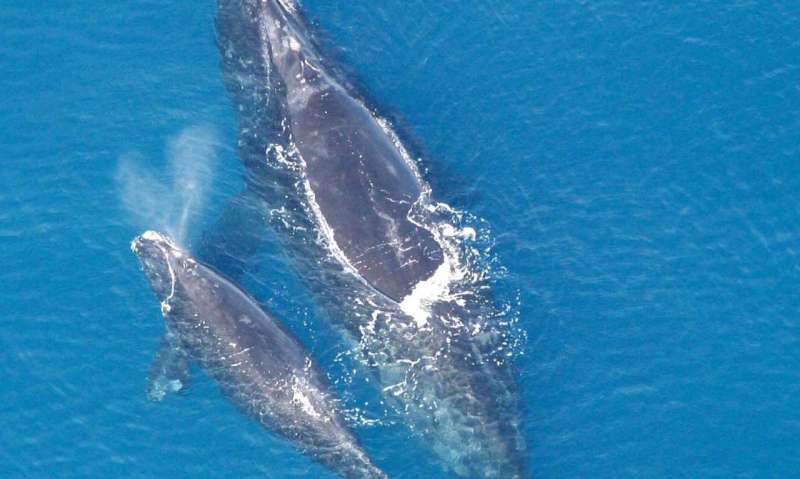
A female North Atlantic right whale with her calf. Credit: Public Domain
It has long been known that ship strikes involving large vessels pose one of the greatest threats to North Atlantic right whales, whose coastal habitats and tendency to stay close to the water’s surface make them vulnerable to such deadly collisions.
New research by Dal scientists suggests that the endangered animals can also suffer fatal injuries if struck by small boats or by large vessels travelling at slow speeds.
“We’ve shown clearly that small vessels can be a threat to whales. We’ve shown that very light, but fast-moving vessels like trans-oceanic racing sailboats can cause potentially lethal injuries to whales, so it means if you’re in a vessel on the ocean, you may be a threat to these animals,” says Sean Brillant, an adjunct in the Department of Oceanography.
“We also showed that there is indeed no safe speed for large vessels when it comes to whales and we are not going to solve the whale death problem from ship strikes simply by reducing speeds.”
Beyond broken bones
Dr. Brillant worked with Dan Kelley, a physical oceanographer at Dal, and former Dal student James Vlasic to construct biophysical models that predict the stresses whales experience during collisions. To do that they used information about right whale anatomy and simple Newtonian physics, along with damage measures gleaned from a database of 40 ship strike events for which pertinent data were available. One observation that prompted their study was that data showed that many whales killed by vessel strikes did not have broken bones. Instead, the 30 to 50-tonne animals suffered from massive internal hemorrhaging, a finding that suggested that collisions can be fatal even if they don’t break bones but sufficiently damage the circulatory system of the whale.
Users can input a ship’s speed and mass, as well as the species of whale, its weight and length, and the thickness of its blubber, bone and skin. The model will then determine the probability that the resulting strike would be fatal for the whale.
The model shows that vessels of all sizes can cause stresses greater than the critical (lethal) level, and that large vessels produce stresses much larger than this even when travelling at reduced speeds, like 10 knots.
“The analysis for large vessels reveals that the speed limits commonly under discussion in the research and management communities (i.e. 10 knots) will provide only small reductions in the probability of lethal ship strikes,” the paper states.
“Thus, for large vessels, the only practical way of reducing the risk of lethal collisions is to reduce the co-occurrence of these whales with vessels.”
Reducing risk
The researchers hope their model can be used to show fisheries managers and shipping companies how collisions with marine mammals harm the animals and how they can reduce the risk of lethality.
In a demonstration, Dr. Kelley inputs vessel speed and size, along with the whale species, weight, length, and the thickness of its tissues to determine whether the strike will likely be fatal for the whale. In this case, the vessel—a 45-tonne fishing boat—is travelling 10 knots when it strikes a 13.7-metre right whale, whose blubber is 16 centimetres thick. The model shows the extent of the impact on the whale’s skin and blubber and where it falls on the lethality index: about 70 percent probability of lethality.
“Our idea for making this tool is that it can allow policy makers to actually see in practice how ship strikes work,” says Dr. Kelley. “We can make predictions about ship strikes without waiting for an accumulation of observed deaths. We don’t have time to wait for that since there are so few of these animals left.”
In the last five years, roughly 25 North Atlantic right whales have died in Canadian waters, reducing the global population to about 350. It is believed that all those fatalities were caused by ship strikes and entanglements in fishing gear. Last year, researchers struggled with a particularly difficult loss—the death of a 40-year-old grandmother named Punctuation who had given birth to eight North Atlantic right whale calves before being hit by a vessel and then found floating off the Magdalen Islands.
DECATUR, Mich. (AP) — The discovery of nine poached trophy bucks in a barn has led to 15 state wildlife charges against a southwestern Michigan man, authorities said.
The Michigan Department of Natural Resources said the man is suspected of driving his truck through fields, shining a light on the deer and shooting them.OUR BIGGEST SALE! 6 MONTHS FOR 99¢: Unlimited Digital AccessACT NOW










/cloudfront-us-east-1.images.arcpublishing.com/gray/U2GM7EMRDJOOPBRHK2NLP57D3I.jpg)

 Exposing the Big Game