
By Charles Q. Choi published 1 day ago
These key building blocks of life were found in space rocks, scientists confirm.
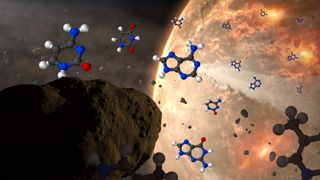
In this conceptual image of meteoroids delivering nucleobases to ancient Earth, the nucleobases are represented by structural diagrams with hydrogen atoms as white spheres, carbon as black, nitrogen as blue and oxygen as red. (Image credit: NASA Goddard/CI Lab/Dan Gallagher)
Key building blocks of DNA that previous research mysteriously failed to discover in meteorites have now been discovered in space rocks, suggesting that cosmic impacts might once have helped deliver these vital ingredients of life to ancient Earth.
DNA is made of four main building blocks — nucleobases called adenine (A), thymine (T), cytosine (C) and guanine (G). DNA’s sister molecule, RNA, also uses A, C and G, but swaps out thymine for uracil (U). Scientists wondering whether meteorites might have helped deliver these compounds to Earth have previously looked for nucleobases in space rocks, but until now, scientists had only detected A and G in space rocks, and not T, C or U.
Nucleobases come in two flavors, known as purines and pyramidines. The nucleobases previously seen in meteorites are both purines, which are each made of a hexagonal molecule fused with a pentagonal molecule. The ones missing in space rocks until now are pyramidines, which are smaller structures each made of just a hexagonal molecule.
 Exposing the Big Game
Reblogged this on Committee to Abolish Sport Hunting Blog.