China’s population is set to get smaller for the first time since the great famine struck 60 years ago. Why? And how will this affect the rest of the world?
T
The world’s biggest nation is about to shrink.
China accounts for more than one-sixth of the world’s population, yet after four extraordinary decades in which the country’s population has swelled from 660 million to 1.4 billion, its population is on track to turn down this year, for the first time since thegreat famineof 1959-1961.
According to the latest figures from China’sNational Bureau of Statistics, China’s population grew from 1.41212 billion to just 1.41260 billion in 2021 – a record low increase of just 480,000, a mere fraction…
How do you spot an optimistic pig? This isn’t the setup for a punchline; the question is genuine, and in the answer lies much that is revealing about our attitudes to other minds – to minds, that is, that are not human. If the notion of an optimistic (or for that matter a pessimistic) pig sounds vaguely comical, it is because we scarcely know how to think about other minds except in relation to our own.
Here is how you spot an optimistic pig: you train the pig to associate a particular sound – a note played on a glockenspiel, say – with a treat, such as an apple. When the note sounds, an apple falls through a hatch so the pig can eat it. But another sound – a dog-clicker, say – signals nothing so nice. If the pig approaches the hatch on hearing the clicker, all it gets is a plastic bag rustled in its face.
What happens now if the pig hears neither of these sounds, but instead a squeak from a dog toy? An optimistic pig might think there’s a chance that this, too, signals delivery of an apple. A pessimistic pig figures it will just get the plastic bag treatment. But what makes a pig optimistic? In 2010, researchers at Newcastle University showed that pigs reared in a pleasant, stimulating environment, with room to roam, plenty of straw, and “pig toys” to explore, show the optimistic response to the squeak significantly more often than pigs raised in a small, bleak, boring enclosure. In other words, if you want an optimistic pig, you must treat it not as pork but as a being with a mind, deserving the resources for a cognitively rich life.
Sign up to our Inside Saturday newsletter for an exclusive behind-the-scenes look at the making of the magazine’s biggest features, as well as a curated list of our weekly highlights.
We don’t, and probably never can, know what it feels like to be an optimistic pig. Objectively, there’s no reason to suppose that it feels like anything: that there is “something it is like” to be a pig, whether apparently happy or gloomy. Until rather recently, philosophers and scientists have been reluctant to grant a mind to any nonhuman entity. Feelings and emotions, hope and pain and a sense of self were deemed attributes that separated us from the rest of the living world. To René Descartes in the 17th century, and to behavioural psychologist BF Skinner in the 1950s, other animals were stimulus-response mechanisms that could be trained but lacked an inner life. To grant animals “minds” in any meaningful sense was to indulge a crude anthropomorphism that had no place in science.
Some caution was warranted. If other animals behave like us, that’s no basis to assume that they do so for the same reasons and with the same experiences and mental representations of the world. But as countless careful experiments like this study of pigs reveal ever more about the inner world of animals, there comes a point where it looks far more contrived to suppose that their behaviour just happens to look like ours in all kinds of ways while differing utterly in its explanation. Maybe, instead, they have minds that are not really so different after all. Primatologist Frans de Waal warns that, while we must avoid anthropomorphising other animals such as great apes, sometimes their actions “make little sense if we refuse to assume intentions and feelings”.
After all, as Charles Darwin pointed out, we all share an evolutionary heritage – and there is nothing in the evolutionary record to suggest that minds were a sudden innovation, let alone that such a thing occurred with the advent of humans. “There is,” Darwin wrote in The Descent of Man, “no fundamental difference between man and the higher mammals in their mental faculties”.
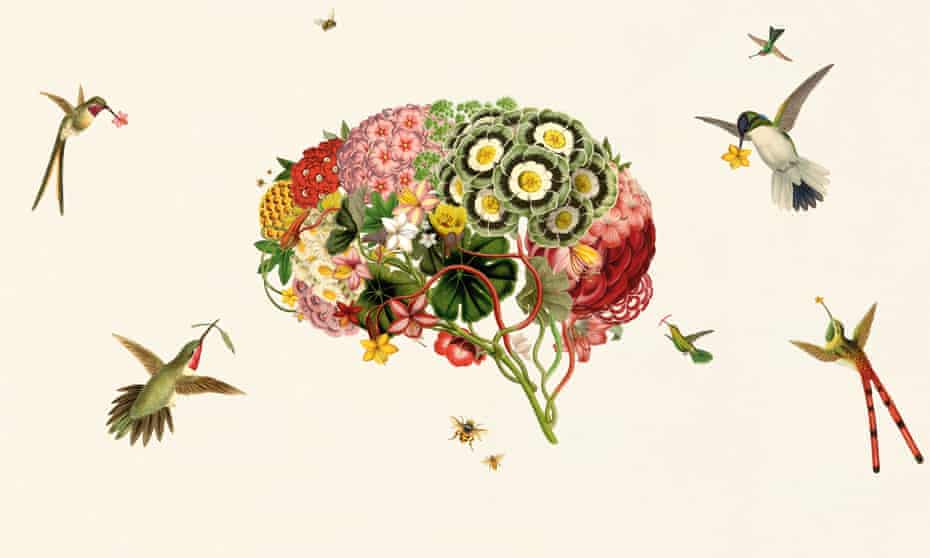
The challenge, then, becomes finding a way of thinking about animal minds that doesn’t simply view them as like the human mind with the dials turned down: less intelligent, less conscious, more or less distant from the pinnacle of mentation we represent. We must recognise that mind is not a single thing that beings have more or less of. There are many dimensions of mind: the “space of possible minds” (a concept first proposed in 1984 by computer scientist Aaron Sloman) has multiple coordinates, and we exist in some part of it, a cluster of data points that reflects our neurodiversity. We are no more at the centre of this mind-space than we are at the centre of the cosmos. So what else is out there?
Some birds will design custom-made hooks for foraging, and even make tools with multiple parts
Consider the often maligned bird brain. Compared with bird neurodiversity, humans are a monoculture. Birds’ minds are scattered widely in mind-space, their differences and specialities tremendously varied. Some birds excel at navigation, others at learning complex songs or making elaborate nests. Scrub jays are expert food storers, able to stash hundreds of caches around their habitat and find them all flawlessly, returning first to the most perishable items. They are cunning: cache thieving is common, and the birds might employ deceptive measures such as returning soon after depositing a store to move it to another location – but only if they know they were observed while caching it. Or even more remarkably, pretending to do so, suggesting that they have what psychologists call a “theory of mind”: the capacity to acknowledge the existence of other agents with motives and knowledge different from their own. (Human children only acquire this around the age of three or four.) In contrast to the common view that other animals live in a perpetual present, scrub jays may store food in anticipation of the circumstances they are likely to face later: experimenters found that they will do this when placed in a cage that the birds know from experience is likely to contain no food tomorrow.
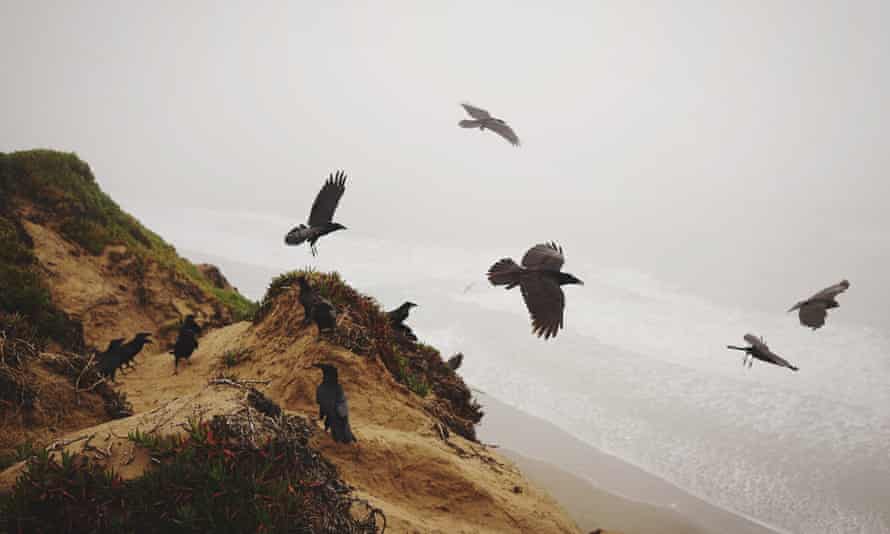
Ravens are among the tool-using species of birds. Photograph: Markus Spiering/Getty Images/EyeEm
We award pride of place in the hierarchy of bird minds to tool-using species, especially corvids (crows, ravens, rooks). The most masterful of them is the New Caledonian crow of the south Pacific, which will design and store custom-made hooks for foraging, and even make tools with multiple parts. Among animals, great apes, dolphins, sea otters, elephants and octopuses are the only others known to use tools. The challenge is to figure out which qualities of mind corvids bring to bear on the task. Young children acquire an “intuitive physics”: they understand that objects don’t simply vanish, that they have properties like hardness and brittleness, and (eventually!) that cups that are tilted or precariously balanced may topple. They become able to execute multi-step tasks, keeping the end in mind at each stage.
It’s not yet clear what the “rules” are that govern a bird’s ability to deploy a tool. There’s a distinction, for example, between “ritualistic” and “mechanistic” thinking: “if I move the stick like this, bugs appear” versus “the stick pokes out the bugs”. Generally you need the latter view to adapt tools to new uses. You need a basic grasp of cause and effect.
We’re gradually teasing out what bird behaviour reveals about the way they represent the world internally: to what extent they, like us, can deduce the possibilities and affordances it offers for achieving goals. What’s harder to determine is how all this feels for the bird. It was long assumed that the anatomy of the bird brain (lacking a neocortex) is too different from ours to support any conscious experience, but recently those differences have been found to be less pronounced. How do you test, though, if another animal has a sense of self? One approach is to see if it shows an ability to assess its own state of knowledge: can a bird “look into” its own mind and acknowledge what it doesn’t know? Recent experiments with crows suggest they can.
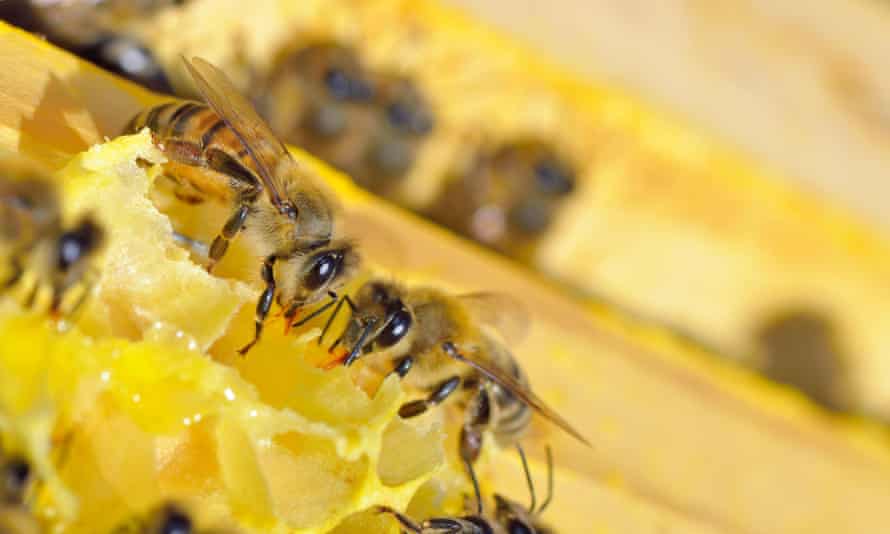
If we’ve sometimes been ungenerous to birds, bees and other insects were often seen as the epitome of mindless automata blindingly following programmes. Naturalists in the 18th century suggested that bees execute the perfect geometry of comb-building by “divine guidance and command”; today we recognise that this exquisite hexagonal mesh demands only that each bee follow simple construction rules. Hive-building is, then, no more a sign of advanced rationality in bees than chess-playing is in humans – there, computers can defeat us with not a glimmer of sentience.
Bees execute the perfect geometry of comb-building by ‘divine guidance and command’, according to 18th-century naturalists. Photograph: Magdalena Iordache/Alamy
Football, however, is another matter. Lars Chittka of Queen Mary University of London and his colleagues have trained bees to manipulate a small ball into a hole at the centre of the “pitch” for a sugary reward. Bees can train one another in the task, and can find better solutions than their demonstrator: they don’t blindly follow rules but adapt them to the circumstances.
Although animal communication can be subtle and complex, it’s generally thought that no animal besides a human uses symbolic communication, where one concept is represented by another, as it is in writing. None, that is, except perhaps the honeybee, which conveys information about a distant food source to its hive members by dancing. The bee treads out waggling movements on the comb, and watchers deduce the distance to the source from the number of waggles, and the direction to the source from the orientation of dance relative to the downward arrow of gravity. It sounds like a weird problem in a geometry exam, requiring protractors and conversion of units: “If each waggle equals 10 metres … ” and so on. The waggle-dance code even has regional dialects that might take into account the local terrain. And each bee interprets the instructions in the light of its own internal map of the surroundings, gathered and refined by previous forays. All this happens in a bee brain about the size of a large grain of sand.
There may even be such a thing as an optimistic bee. The equivalent of the pig experiment uses flowers: blue ones carry a sugar reward, green ones don’t, but will a bee interpret an ambiguously blue-green flower optimistically or pessimistically? Again, behaviour seems to be coloured by experience: bees that have just been given an unexpected sugar treat seem more inclined to optimism, as though put in a good mood. Again, we can’t know if the behaviour is accompanied by a “feeling” – but machines don’t do stuff like this.
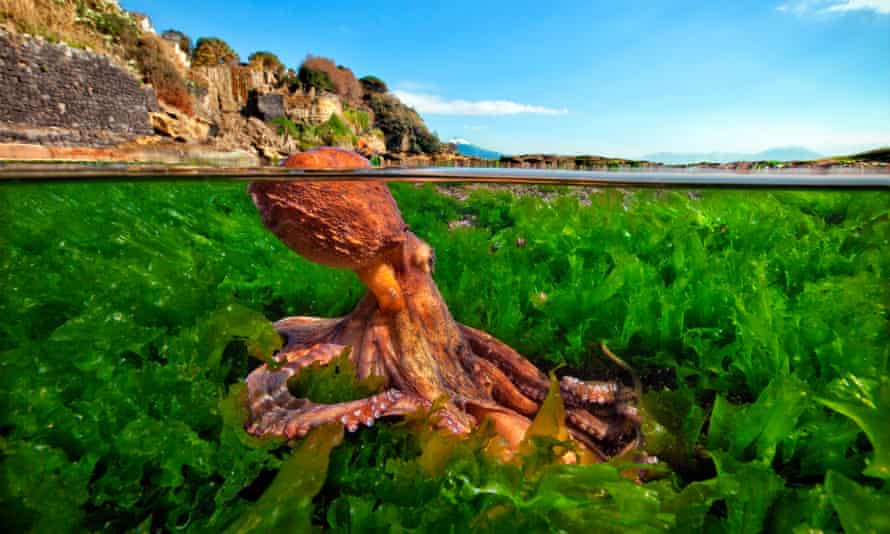
‘The octopus is probably the closest we will come to meeting an intelligent alien.’ Photograph: Pasquale Vassallo/Getty Images/Biosphoto
Time now to journey further afield in mind-space. Philosopher Peter Godfrey-Smith says that the octopus is “probably the closest we will come to meeting an intelligent alien.” Octopuses interact with us, apparently with neither fear nor aggression. But in contrast to a dog or a chimpanzee, it’s hard to fathom what the agenda might be. They are great problem-solvers: they unscrew jars, navigate mazes in the murky gloom of the seabed, and fuse bright laboratory lights with jets of water. They seem playful – but who knows, really, what the antics are for?
If this is perplexing, we should hardly be surprised. Our evolutionary lineage diverged from that of octopuses (which are molluscs) around the dawn of complex multicellular life 600m years ago; our common ancestor was a mere flatworm. So octopuses represent an entirely distinct evolutionary path to making a mind – and how different it looks! The octopus has a similar number of neurons as a dog, but instead of being mostly collected in a central brain they are distributed throughout the body in a ladder-like network. There is a centralised brain in the head, but more than half of the nervous system is in the arms, gathered into clusters called ganglia that seem to operate largely autonomously: the arms do things of their own accord while the brain watches, perhaps as if observing another creature.
If there is any kind of consciousness in the octopus mind – thanks to the advocacy of marine biologists and other experts, they were recently admitted into the category of sentient beings under UK law – it might not be unified. Some researchers suggest that octopuses have dual or even multiple consciousness: each individual creature might be a loosely integrated community of minds. “When I try to imagine this,” Godfrey-Smith says, “I find myself in a rather hallucinogenic place.”
Even this, however, might sound tame compared to the idea that plants have minds. Yet that proposition is no longer confined to the fringes of new-age belief; you can find it discussed (relatively) soberly in august scientific journals. There, it often goes by the name of “plant neurobiology” or, in a more extreme form, “biopsychism” – which supposes that every living being from bacteria up has sentience of a sort.
Plants don’t have a nervous system, or even neurons. But their cells, like many non-neural cells, do communicate with one another electrically, and there’s evidence that cellular channels in plants called phloem can transport not only sugars but also electrical pulses. Some plants show distinctly animal-like behaviour: witness the carnivorous jaws of the Venus flytrap, which even displays a primitive ability to “count” the number of impulses it senses before closing on an insect.
Plants can sense and respond to stimuli, as when flower heads move to track the progress of the sun across the sky. The South American “sensitive plant” Mimosa pudica, a member of the pea family, folds its leaves when touched and displays a kind of learning called habituation, where it eventually ignores a repeated stimulus that proves harmless. Pea plants can be trained in an almost Pavlovian fashion to associate a neutral signal such as the flow of air with a beneficial signal such as light.
The mimosa pudica folds its leaves when touched. Photograph: Anuj Nair/Getty Images/Moment Open
All this justifies a view of plant behaviour as “cognitive”. Where it becomes more controversial is in suggestions that the plant behaviours are accompanied by sentience or feeling. On that, arguments still rage.
Conceiving of a universe of possible minds can discourage human hubris, and advises erring on the side of generosity in considering the rights and dignity of other beings. But it also enables a literally broad-minded view of what other minds could exist. Mindedness needn’t be a club with rigorously exclusive entry rules. We might not (and may never) agree about whether plants, fungi or bacteria have any kind of sentience, but they show enough attributes of cognition to warrant a place somewhere in this space. This perspective also promotes a calmer appraisal of artificial intelligence than the popular fevered fantasies about impending apocalypse at the hands of malevolent, soulless machines. There is no reason to suppose that today’s AI has any more sentience or experience than the rocks from which its silicon is extracted. But it, too, shows intelligence of a kind, including the ability to learn and predict.
To suppose that something like artificial consciousness will emerge simply by making computer circuits bigger and faster is, as one AI expert put it to me, like imagining that if we make an aeroplane fly fast enough, eventually it will lay an egg. Computers and AI are taking off in the “intelligence” direction of mind-space while gaining nothing on the “experience” axis: their trajectory is heading not towards us but somewhere else entirely. If we want AI to be more human-like, many experts believe we will need explicitly to build human qualities into it – which in turn requires that we better understand what those are and how they arise.
Likewise, most of our fantasies about advanced alien intelligence suppose it to be like us but with better tech. That’s not just a sci-fi trope; the scientific search for extraterrestrial intelligence typically assumes that ET carves nature at the same joints as we do, recognising the same abstract laws of maths and physics. But the more we know about minds, the more we recognise that they conceptualise the world according to the possibilities they possess for sensing and intervening in it; nothing is inevitable. We need to be more imaginative about what minds can be, and less fixated on ours as the default. As the biologist JBS Haldane once said: “The universe is not only queerer than we suppose, but queerer than we can suppose.” Our only hope of understanding the universe, he said, “is to look at it from as many different points of view as possible.” We may need those other minds.
The Book of Minds: How to Understand Ourselves and Other Beings, from Animals to Aliens by Philip Ball will be published by Picador on 23 June.
U.S. Defense Secretary Lloyd Austin speaks during a plenary session at the 19th International Institute for Strategic Studies (IISS) Shangri-la Dialogue, Asia’s annual defense and security forum, in Singapore, Saturday, June 11, 2022. (AP Photo/Danial Hakim)
SINGAPORE (AP) — U.S. Secretary of Defense Lloyd Austin stressed American support for Taiwan on Saturday, suggesting at Asia’s premier defense forum that recent Chinese military activity around the self-governing island threatens to change the status quo.
Speaking at the Shangri-La Dialogue in Singapore, Austin noted a “steady increase in provocative and destabilizing military activity near Taiwan,” including almost daily military flights near the island by the People’s Republic of China.
“Our policy hasn’t changed, but unfortunately that doesn’t seem to be true for the PRC,” he said.
The fight to end the indiscriminate killing of countless wild animals for entertainment and money in the United States.
The West Texas Big Bobcat Contest requires an entry fee of $250 per team and the fresh carcasses of at least five foxes or five coyotes for teams to qualify to win the ultimate prize, awarded for the heaviest bobcat killed.
KIM FRANK IMAGES BY FILIPE DEANDRADE
THE JANUARY SUN IS WEAK by early afternoon. The grass, brittle and brown. Low-lying cactus punctuate the open area strewn with small rocks and a smattering of mesquite trees. Jake and his friends use an ATV to drive far from town along a well-used dirt road. “What’s the plan?” one of the guys in the backseat asks. There’s a slight pause before Jake responds: “Kill shit; get money.”
Jake (whose last name has been withheld for privacy) and his three buddies are participating in the January 2020 West Texas Big Bobcat Contest. Over the next 23 hours, this foursome will compete against hundreds of other teams for cash, equipment, and other prizes to kill as many foxes, coyotes, and bobcats as they can within the regulation timeframe.
Jake parks the vehicle. The group, dressed in full camouflage, unloads several rifles, ammunition, and calling apparatus. Then, with five words, he aptly describes this whole affair: “It’s about to get nuts.”
GET THE JOURNAL IN YOUR INBOX.
Sign up for our monthly newsletter.
Sign up
It is predator-hunting contest season across the United States. These popular, legally sanctioned events take place on private, state, and federal lands in 42 of the 50 states every year and draw unknown thousands of participants. Tonight’s contest in San Angelo, Texas, is taking place simultaneously with another local hunt, one that includes raccoons. With 717 teams of about four members each participating in Big Bobcat, and upwards of 400 teams of four in the neighboring contest, there are a few thousand hunters out there within two hours driving distance of the weigh-in site, shooting for sport.
Jake and his team have been out every weekend for two months participating in nearby contests. From the multiple high-purse ones like the Gatesville Varmint Contests and the West Texas Big Bobcat Contest, to a myriad of local and church-sponsored competitions, they have been hitting all of them, except the ones for children.
The West Texas Big Bobcat requires an entry fee of $250 per team and the fresh carcasses of at least five foxes or five coyotes for teams to qualify to win the ultimate prize, awarded for the heaviest bobcat killed. In 2020, teams entered 18 “qualifying” cats.
Legally sanctioned wildlife killing contests take place on private, state, and federal lands in 42 of the 50 states every year and draw thousands of participants.
Contest participants often use specialized equipment like game call systems, which can blast out hundreds of animal calls, including distress calls of coyote pups, mating calls, and distressed prey sounds, all designed to draw specific animals towards the hunting blind.
“When I first began, the contests were not as common as they are now, maybe one a month,” Jake says. “Now we’ve had one every weekend for the last eight weekends and we have four more to go. It’s a sport that has grown immensely because everyone is getting into it, and everyone enjoys it.”
States typically hold predator-hunting contests over the winter season. Pennsylvania, for example, held approximately 30 hunts from January to March in 2019, including the Mosquito Creek Sportsmen’s Contest, the largest coyote hunt in the US. In the 2019 Mosquito Creek event, 4,836 registered hunters brought in 193 coyotes, with a 53-pound coyote breaking club records. The top two prizes were more than $9,000 each, and the total hunt purse was more than $48,000, according to the Centre Daily Times.
Killing enough animals to have a chance at a purse requires strategy and specialized equipment. Back in West Texas, Jake sets up a game call system featuring a motorized fake fur tail attached to the top of a remote-controlled speaker that blasts out hundreds of animal calls, including distress calls of a wounded coyote pup, mating calls, and various distressed prey sounds all designed to draw specific animals towards the hunting blind. As the simulated cacophony of pain starts, the team waits. The ploy works and a fox approaches the area. One of the guys fires a shot. “One down,” he says, carrying the carcass by the tail and tossing it into the back of the vehicle.
Jake’s team doesn’t end up killing enough foxes or coyotes to beat out their competitors, but they are not deterred. Their weekends are booked out with contests through the end of March, when the season is over.
Two years on, by the end of the West Texas Big Bobcat’s latest three-contest season, a total of 1,715 teams (approximately 4,000 hunters or more) had competed for a cumulative pay-out of $393,950 in prize money. The contest has paid out a total of $3,140,810 since its 2008 inception. The cost to wild animals? Incalculable.
MOST PREDATORS HAVE LONG been convicted as malevolent in Western folklore, media, and fairytales. As far back as the Middle Ages, the Catholic church associated wolves with the Devil and false prophets. In Little Red Riding Hood, a fairytale dating back to the seventeenth century that has stoked fear of wolves in the hearts of generations of impressionable young minds, the “Big Bad Wolf” lies in wait, tricking an innocent child he wants to gobble up. In the old Looney Tunes cartoons, Wile E. Coyote, Bugs Bunny’s nemesis, continuously fails to catch and kill the rabbit. Instead, he is consistently outwitted, and suffers humiliating and painful defeats in every episode.
Society has been conditioned to believe that carnivores are evil troublemakers, their lives worthless.
Coyotes, foxes, and wolves have been vilified to such an extent that society has been conditioned to believe that carnivores are evil troublemakers, their lives worthless, and that killing them in mass numbers is for the greater good.
It is no surprise, then, that early wildlife-management reasoning in this country advocated wholesale eradication of predators. Or that, since the earliest domestication of animals in the United States, the government has been called upon to help control predators to protect livestock, domestic pets, crops, and game supply for hunting. To this day, the federal government operates a program known as Wildlife Services within the Department of Agriculture that kills hundreds of thousands of birds and tens of thousands of predators annually in service of ranchers and farmers. In 2019, according to the agency’s own report, it killed 404,538 native animals, including 64,131 coyotes, 433 black bears, 200 mountain lions, 605 bobcats, and 324 gray wolves.
This same logic — that predator eradication is necessary to protect crops and livestock — is often used to justify the countless wildlife killing contests held across the US every year. This approach has taken a steep ecological toll, and research shows it’s also ineffective at achieving its purported purpose.
A 2016 study published in the Frontiers of Ecology, for instance, found that using lethal methods often temporarily increased livestock predation. That is because predators like wolves and coyotes are territorial pack animals. Breaking up a pack allows new animals to come in and often prompts “compensatory reproduction” in what remains of the pack, both of which result in raising the predator population in subsequent years. The study, which analyzed lethal and non-lethal interventions against carnivore predation on livestock in North American and European farms, concluded that nonlethal predator control strategies such as guard animals, chemical repellents, and fladry lines (strips of colored fabric strung along fences), were more effective at preventing livestock loss than lethal methods like killing contests and government culls.
But despite having access to a growing body of rigorous scientific research that could help them adopt more ecologically sound wildlife management policies, the federal and the majority of state governments have been slow on the uptake.
Wildlife conservation groups have been pushing to change that. A nationwide campaign by a coalition of more than 55 animal rights and conservation groups, as well as scientists, hunters, ranchers, and local representatives, has been working since 2018 to educate federal and state government agencies about why predator hunting does not work as a wildlife management tool and how it damages ecosystems. The campaign, which is led by Project Coyote and the Humane Society of the United States (HSUS), has also been advocating for a permanent ban on all wildlife killing contests. (Project Coyote is a project of Earth Island Institute, which publishes the Journal.)
“Predator management as currently practiced doesn’t work for a variety of reasons,” says Dave Parsons, carnivore conservation biologist with the Rewilding Institute, which is a member of the national coalition. “But trying to tell people that you can have fewer coyotes if you don’t shoot them is really hard.”
So far, the coalition’s efforts have resulted in eight states outlawing indiscriminate wildlife killing contests, derbies, and tournaments.
Still, the contests have strong support and enthusiastic participation in many states throughout the nation.
THE FIRST THING YOU NOTICE is the smell, a strong musty stench that wafts with the release of heat from the low winter sun. Imagine a decaying mouse under the porch and multiply that by a hundredfold. On approach, the odor grows stronger; there is a gaminess now. When you are close enough to see the source — row upon rows of dead animal carcasses — you sense the added smell of fresh blood. Grey foxes, coyotes, and bobcats. Each animal stretched out to facilitate counting. Pickup trucks rigged with hunting stands, racks, and swivel high seats line the gravel parking lot alongside the animals.
The idea that predator eradication is necessary to protect livestock is often used to justify killing contests, but research shows this wildlife management approach is ineffective.
Time is up for participants of the January 2020 West Texas Big Bobcat Contest. Contestants are gathering in the parking lot of the 4-H club. Of the 717 teams, only those who believe they have a chance at a prize park their rig. Groups of contestants cluster in their teams, waiting with their carcasses. Bleary-eyed from being up all night, cups of coffee in some hands, beers in others, the participants mingle within a sea of dusty boots and dirt-caked tires. Whatever adrenaline fueled the long hours of the hunt is now wearing off. A loudspeaker in the background makes announcements, calls out raffle prizes, and plays music. A commentator sends out “thank yous” to an extensive list of national and local supporters. Hunters stroll around checking out their competition.
On the far side of the armory, two young men in camouflage sweatshirts and jeans stand with hands in front pockets watching while an inspector thrusts a meat thermometer into every inert body — rules require each kill to be fresh, a safeguard against cheating. They stand proudly behind rows and rows of dead foxes.
“How did it go out there?” I ask, “It looks like you guys did really well.”
The men grin. “Yeah. We’ve been working at this for a long time,” one says, wiping his forehead with the back of his hand.
“It used to be a small guy thing to help out the ranchers. Now it is a massive sport.”
“We have a secret spot,” says his partner, voice confident with impending success. “We only went for foxes, no bobcats. We got 94. I haven’t seen anyone else near that today.”
Those competing for the largest bobcat drag their kills by the neck through the dirt lot and into the arena with pocket chains: a metal cuff and chain link lead, small enough to keep in your pocket and then hook to the animal so you don’t have to bear the weight of it. Pocket chains are being given as prizes inside.
The cats are weighed in the arena. Names are called for potential winners to go in for their polygraph tests, another way to ensure against cheating. Families have gathered to greet their hunters and community members take seats on the bleachers to watch the show. Raffle prizes are handed out, with sponsors ranging from hunting gear companies to taxidermy shops to the local farm supply stores. The team with the heaviest bobcat will take home $50,000. With one of the highest purses in the nation, teams now fly in from other states to compete in this event. The vibe is festive and anticipatory. Contestants have a second wind and are regaling each other with stories.
“Then I realized it was a German Shepard,” one young man is telling another, “but I had already shot it.”
A middle-aged couple is watching the raffle. The man has a short, scruffy beard that he runs his hands through as he talks. He has been involved in these contests since they began. “It was always a lot of fun,” he says. “But now, this thing has gotten so big that people are coming in and buying out landowners for hunting rights, pushing other people out of it. The competition has gotten pretty intense.” He looks around, down at his feet, then fixes a stare at his raffle ticket. (A growing trend in bigger contests is contestants paying for exclusive hunting rights pre-contest, pushing out locals and driving up the financial stakes.)
Teams now fly in from other states to compete in the West Texas Big Bobcat Contest, which offers one of the highest purses in the nation. In 2022, a total of 1,715 teams competed for a cumulative payout of $393,950 in prize money.
“I find it exhilarating,” says his wife, who appears to be one of the only female team members here. “I set the lights and wait.” Her voice shifts up an octave, “When the lights shine on the animals and I can see their eyes, that is what is thrilling. I don’t even care about the killing part.”
Her husband looks up from his ticket, his number still not called. “It used to be a small guy thing to help out the ranchers. Now it is a massive sport.” As if he senses he might be stepping into the wrong territory he adds, “The PETA people don’t understand. It’s all good for them to live in their cities with their little poodle dogs — but they don’t know the real issues that people face with predators killing their livestock.”
It’s true: It’s easy for those with limited perspective to criticize the contests. Still, even some ranchers say killing contests aren’t the answer.
The two teenagers were killed in Ranchi, Jharkhand state, as police fired shots to quell protests against insulting comments.
Muslims hold a banner during a protest demanding the arrest of suspended BJP leader Nupur Sharma for her insulting comments against Prophet Muhammed [Rupak De Chowdhuri/Reuters]
New Delhi, India– Two teenagers were killed in violence as police cracked down on protests that erupted across the country over derogatory remarks against the Prophet Muhammad by two members of the governing Bharatiya Janata Party (BJP).
The families of Mudasir, 14, and Sahil Ansari, 19, confirmed the deaths to Al Jazeera, alleging the police used disproportionate force against the protesters who marched in Ranchi, capital of eastern Jharkhand state, after Friday prayers demanding the arrest of two BJP officals.
On Monday, fending off what threatened to be a crippling blow to growth in the rooftop solar energy industry, President Biden announced a set of executive actions intended to protect the industry. That — if it isn’t successfully challenged in court — may be a modest success in Biden’s effort to transition the U.S. economy into one that runs on clean energy. But such successes have been fewer than what environmentalists had hoped for.
Despite assuming office with what activists describe as the most ambitious climate change agenda in history, Biden has experienced a series of setbacks that threaten to leave him with little progress on the issue, showing just how hard contending with climate change can…
A motorist had a narrow escape recently when he avoided a wild boar which ran across a road in Kuala Kangsar suddenly.
KUALA KANGSAR: Perak police have suspended hunting licences, to curb poaching and misuse of firearms, but farmers say wild animals, especially wild boars, are proliferating and destroying their crops and produce.
Padi, fruit and vegetable farmers claim that the population of wild boars has grown quite a bit with hunters not being allowed to shoot them, with the animals also causing road accidents on roads in the interior.
Last week Perak police chief Mior Faridalathrash Wahid told district police chiefs to continue the suspension of hunting licences, introduced in 2020 to prevent illegal hunting and misuse of firearms.
“Applications for hunting licenses would not be accepted until further notice,” he said in the directive.
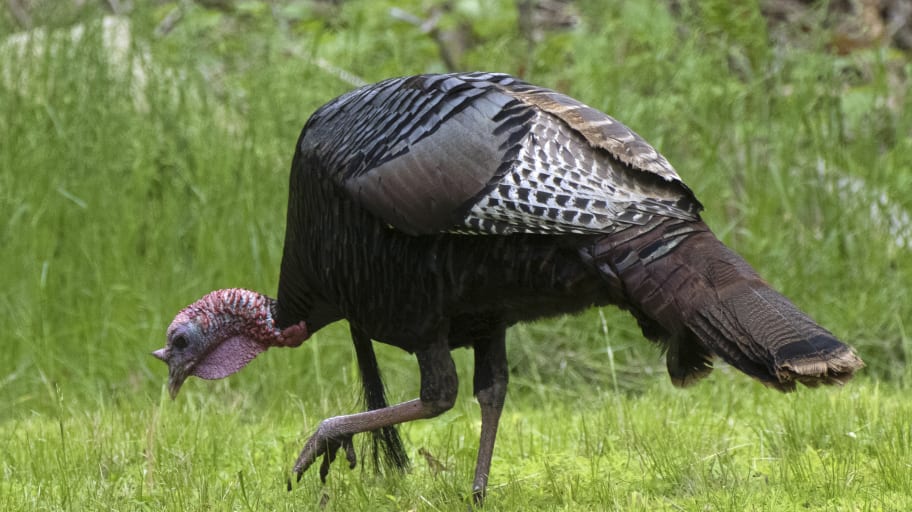
A Vermont man shot a 14-year-old boy rather than the turkey he was attempting to take down,according to state police. Brent Lehouiller, 52, was hunting with the teen on Sunday when the incident occurred. The unnamed victim was Lehouiller’s son, Vermont Fish & Wildlife officials told local CBS affiliate WCAX, explaining that the two split up to locate a turkey the son had shot and wounded. When Lehouiller tried to finish the turkey off, he shot his son instead, authorities said, adding that the shooting “appears to be accidental.” The boy was treated at an area hospital for non-life-threatening injuries and was released. The Windsor County State’s Attorney’s Office is reportedly reviewing the matter as to any potential criminal charges.
The blog referencesastudyrecentlypublished in the journal JGR Atmospheres.
However, the claim misrepresents the study.
Thestudyauthorssay their paper does not showthat warming has significantly slowed overthe last 20 years. Further, the paper, which introduces a new data processing technique, only tangentially addresses the issues raisedin the post.
















 https://www.freemalaysiatoday.com/category/nation/2022/06/11/hunting-suspended-farmers-complain-of-growing-wild-boar-menace/
 42
42 29
29 14
14
 Exposing the Big Game
