New system sends earthquake warnings through an app and the wireless system that issues Amber Alerts; insight from Richard Allen, director of the UC Berkeley Seismological Lab.
A new study from geologists at the Washington State Department of Natural Resources (DNR) has found that the impact of a magnitude7.5 earthquake on the Seattle Fault could cause tsunami waves as high as 42 feet tall.
According to the department’s simulation, those waves wouldreach the greater Seattlearea within just three minutes, extending inland as far as Lumen Field and T-Mobile Park.
In addition, the waves would hit the shoreline during that…
Shinzo Abe was the longest-serving prime minister in Japanese history, a staunch conservative and a critical voice against China’s growing potential in the region.
Fox News contributor and former Secretary of State Mike Pompeo reflects on the assassination of former Japanese Prime Minister Shinzo Abe and the effect his death could have on diplomatic policy on ‘The Story.’
Emphasizing the moral value of animal life, she states that the goal of such regulation would be to ensure that the whales are treated as ethically as possible and that their suffering not be prolonged. Svandís said that since slaughterhouses face strict regulations under the government, that whaling ships should also be held accountable for the ethical treatment of their catch.
Under the new system, a crew member from each whaling ship would be appointed as an animal rights observer and trained by veterinarians at MAST. These observers would then be responsible for documenting the whale hunt, from the moment the whale emerges to the moment the whale is loaded off the boat. Video documentation will then be submitted to MAST for review.
These new regulations would allow the Ministry of Food, Agriculture, and Fisheries to exercise greater control over the practice of whaling, without requiring further legislation to be passed through Alþing.
The comments come in response to the beginning of Iceland’s whaling season when the first whale in three years was caught on June 24. The quota for this year, set by Iceland’s Marine and Freshwater Research Institute, includes 161 fin whales and 217 minke whales.
Previously this year, Svandís stated that she saw little justification to extend the whaling permits which expire in 2023. If the permits are to be renewed, then whaling must be shown to be economically justifiable. As it stands, according to her, the economic benefits of whaling are marginal, and perhaps detrimental to Iceland’s international image.
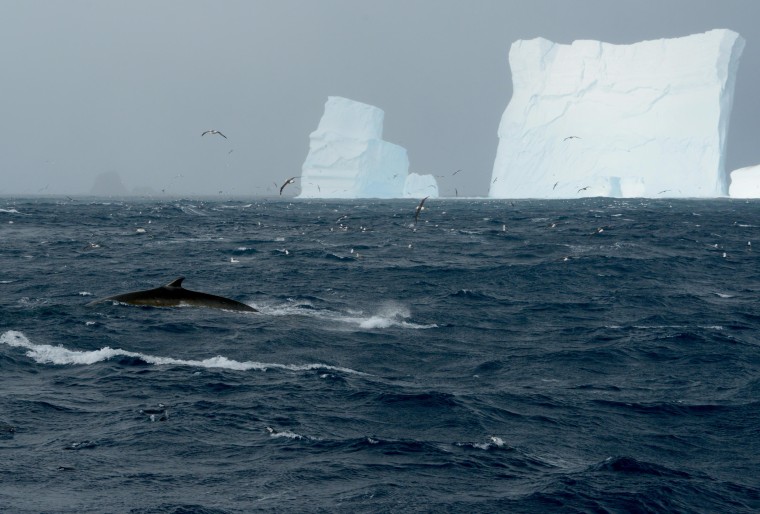
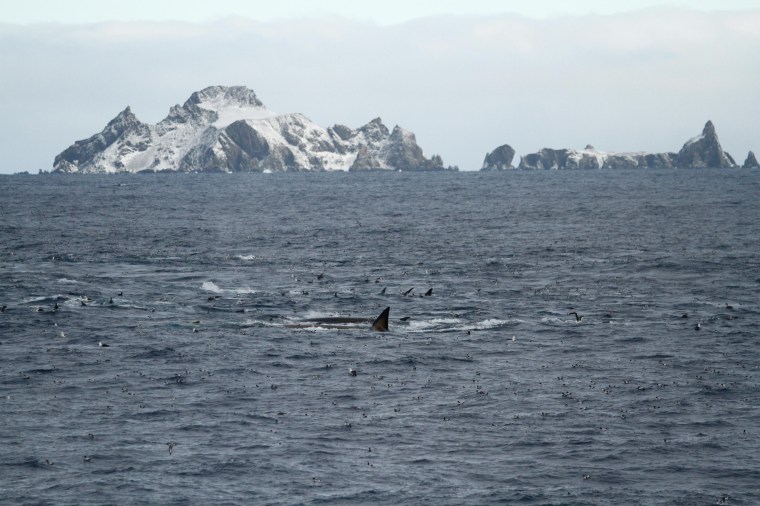
Researchers revealed massive feeding frenzies among fin whales near Elephant Island, Antarctica, with about 150 whales seen more than once — lunging and diving with mouths wide open — gulping down krill.
The whales, which were nearly hunted to extinction, have returned in huge numbers to their ancestral feeding grounds off the coast of Antarctica, according to research published Thursday.
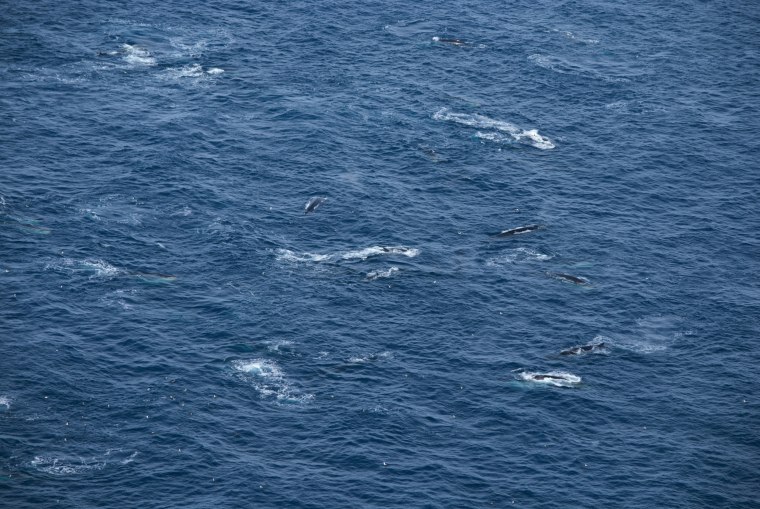
In the journal Scientific Reports, researchers for the first time shared details of massive feeding frenzies among fin whales near Elephant Island. More than once, they observed about 150 whales — lunging and diving with mouths wide open — gulping down krill.
The scientists also completed abundance estimates, finding a higher concentration of fin whales there than in other regions known for sightings, including off the coast of California.
Previous research suggests only 1% to 2% of fin whales survived commercial whaling, which took off in the Southern Hemisphere in the early 20th century and continued until restrictions in the 1970s.
Documentation of feeding frenzies in densely-populated waters where whales gathered generations ago and before they were hunted at industrial scale suggests that the species has rediscovered an important habitat and that the population is recovering.
An aerial view of a fin whale aggregation.Helena Herr
The species’ strong return to the feeding grounds rich with krill is “raising hope that fin whales are on their way to pre-exploitation numbers,” the researchers wrote in the Scientific Reports paper.
Video footage of the fin whale “aggregation,” as the researchers call it, first caught public attention in a 2019 BBC documentary series called “Seven Worlds, One Planet” that was narrated by David Attenborough, the famous British naturalist and broadcaster. The researchers on the Scientific Reports paper, who collaborated with the documentarians, added new data and further analysis of the whales.
Get the Morning Rundown
Get a head start on the morning’s top stories.SIGN UPTHIS SITE IS PROTECTED BY RECAPTCHA PRIVACY POLICY | TERMS OF SERVICE
“I’d never seen so many whales in one place before and was absolutely fascinated watching these massive groups feed,” Bettina Meyer, a co-author of the study who is a biologist and professor at the Alfred Wegener Institute, said in a news release.
Scientists and other observers began to notice an increase in fin whale sightings in the waters between South America and Antarctica beginning in the early 2000s, and have long suspected that the area near Elephant Island was becoming a hot spot for fin whales.
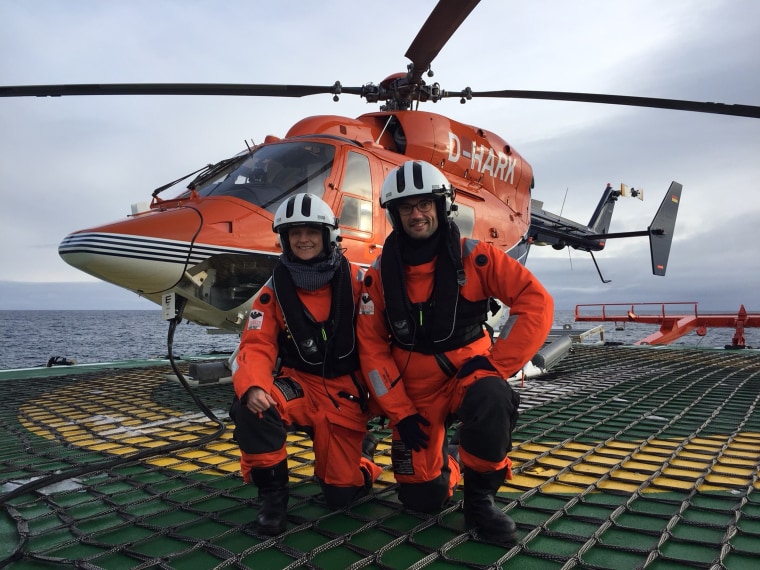
In the Scientific Reports study, the researchers quantified fin whales’ presence by using a helicopter aboard an icebreaker ship. Flying allowed researchers to survey and collect data about the whales from above and determine the creatures’ density.
Fin whale researchers Helena Herr, left, and Sacha Viquerat pose on the RV Polarstern after returning from a helicopter survey flight.Bertie Gregory
Many whale species pass habits or information about feeding sites through generations. Research suggests whales pass this information through mothers.
The location of the Antarctic feeding sites might have been lost to generations of fin whales until now because their populations were so decimated and disconnected by whaling, the study suggests.
“… This could be a good sign that, nearly 50 years after the ban on commercial whaling, the fin whale population in the Antarctic is rebounding,” Meyer said.
The study says the whales’ presence could have environmental benefits because they recycle nutrients in their waste that benefit the growth of phytoplankton, which forms the foundation of the food web in the waters off Antarctica.
Hot temperatures for the South as Great Salt Lake sees historic low02:43
(CNN)The third heat wave of the still-early summer is scorching the US South, and “it will get worse … before it gets better,” warns the National Weather Service.
Over 65 million people across 16 states are under heat alerts Thursday, with triple-digit heat indexes — or “feels like” temperatures — expected in cities including Dallas; St. Louis; Memphis, Tennessee; Little Rock, Arkansas; Birmingham, Alabama; Atlanta; and Raleigh, North Carolina.
The latest heat wave continues a trend playing out in recent weeks on every continent in the Northern Hemisphere — and something that will be more frequent with human-induced climate change, experts with the Copernicus Climate Change Service said Thursday.
Above-normal temperatures will soar Thursdayinto the upper 90s and…
Russian President Vladimir Putinaccused the West of waging a proxy war in Ukraine on Thursday and said that the world should know the war is just beginning, nearly five months after launching the invasion.
“Everybody should know that largely speaking, we haven’t even yet started anything in earnest,” Putin told parliamentary leaders.
“The course of history is unstoppable, and attempts by the collective West to enforce its version of the global order are doomed to fail.”
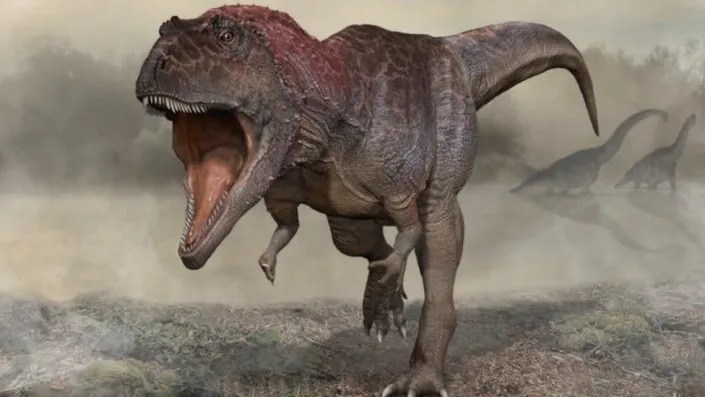
Meraxes gigas was about 36ft (11m) long, with a 4ft skull – but its arms were only 2ft long.
The scientists believe small limbs gave the carnivorous survival advantages.
“I’m convinced that those proportionally tiny arms had some sort of function. The skeleton shows large muscle insertions and fully developed pectoral girdles, so the arm had strong muscles,” said Juan Canale, lead author of the study.
Malte Clausen, a partner at BCG: ‘Widespread adoption of alternative proteins can play a critical role tackling climate change.’ Photograph: Nathaniel Noir/Alamy
Investments in plant-based alternatives to meat lead to far greater cuts in climate-heating emissions than other green investments, according to one of the world’s biggest consultancy firms.
The report from the Boston Consulting Group (BCG) found that, for each dollar, investment in improving and scaling up the production of meat and dairy alternatives resulted in three times more greenhouse gas reductions compared with investment in green cement technology, seven times more than green buildings and 11 times more than zero-emission cars.
Investments in the plant-based alternatives to meat delivered this high impact on emissions because of the big difference between the greenhouse gases emitted when producing conventional meat and dairy products, and when growing plants. Beef, for example, results in six-to-30 times more emissions than tofu.
Investment in alternative proteins, also including fermented products and cell-based meat, has jumped from $1bn (£830m) in 2019 to $5bn in 2021, BCG said. Alternatives make up 2% of meat, egg and dairy products sold, but will rise to 11% in 2035 on current growth trends, the report said. This would reduce emissions by an amount almost equivalent to global aviation’s output. But BCG said meat alternatives could grow much faster with technological progress resulting in better products, scaled-up production and regulatory changes making marketing and sales easier.https://interactive.guim.co.uk/charts/embed/jul/2022-07-07-10:45:05/embed.html
“Widespread adoption of alternative proteins can play a critical role tackling climate change,” said Malte Clausen, a partner at BCG. “We call it the untapped climate opportunity – you’re getting more impact from your investment in alternative proteins than in any other sector of the economy.”
“There’s been a lot of investments into electric vehicles, wind turbines and solar panels, which is all great and helpful to reduce emissions, but we have not seen comparable investment yet [in alternative proteins], even though it’s rising rapidly,” he said. “If you really care about impact as an investor, this is an area that you definitely need to understand.”
Meat and dairy production uses 83% of farmland and causes 60% of agriculture’s greenhouse gas emissions, but provides only 18% of calories and 37% of protein. Moving human diets from meat to plants means less forest is destroyed for pasture and fodder growing and less emissions of the potent greenhouse gas methane produced by cattle and sheep.
Europe and North America will reach “peak meat” by 2025, at which point consumption of conventional meat starts to fall, according to a separate BCG report in 2021. Another consultancy, AT Kearney, predicted in 2019 that that most of the meat products people eat in 2040 will not come from slaughtered animals.
“Alternative proteins have received only a fraction of the investment deployed in other sectors,” the BCG report said. “Buildings have received 4.4 times more mitigation capital than food production, even though building emissions are 57% lower than those tied to food production.” Switching from conventional meat to alternatives is also much less disruptive to consumers than flying less or retrofitting their homes, the report said.
The estimates of the differing emissions cuts resulting from investments in different sectors were made by BCG using a methodology developed with the Global Financial Markets Association. Blue Horizon, an investor in alternative proteins, also contributed to the new report.
Bjoern Witte, at Blue Horizon, said: “The products consumers are seeing on the shelves today will be followed by a wave of cleaner, healthier and tastier alternative proteins, as technology allows for increasing innovation. We’re just at the beginning, really.”
Dr Jonathan Foley, at Project Drawdown, said: “About a quarter of the world’s greenhouse gas emissions comes from food, land use, and agriculture and more than half of that is from beef alone. So this is a very big area to focus on, and one that has been relatively under-invested in.”
“[Alternative proteins] are a potentially large climate solution,” Foley said. “But it shouldn’t be seen as a stand-alone solution and could be combined with many others, including cutting food waste overall, shifting to more plant-rich diets, and farming the meat and dairy products we still might eat better.”
Malte said a move towards plant-based meats could also help alleviate food crises. “You are cutting out the ‘middleman’, whether it’s a cow, a pig or a chicken. It’s just mathematics: if instead of feeding all of these crops to animals, and then eating the animals, you just use the crops directly for human consumption, you need less crops overall and therefore alleviate the constraints on the system.”
The report also included a survey of more than 3,700 people in the UK, US, China, France, Germany, Spain, and the United Arab Emirates. It found 30% of consumers would switch to alternative protein products if they had a positive climate impact. About 90% of people said they liked at least some of the alternative-protein products they had tried. But the survey found that consumers expected the products to cost no more than those they were replacing.
Japan’s Prime Minister Shinzo Abe attends a news conference to announce snap election at his official residence in Tokyo, Japan, September 25, 2017. REUTERS/Toru Hanai
Register now for FREE unlimited access to Reuters.com
Register
TOKYO, July 8 (Reuters) – The assassination of former Prime Minister Shinzo Abe on Friday stunned and saddened people in a country where firearms are strictly regulated and political violence is extremely rare.
Abe was fatally shot while giving a campaign speech on a street corner in the western city of Nara. His death was announced later in the day.read more
From Prime Minister Fumio Kishida, a protege of Abe, to ordinary people on social media, there was an outpouring of grief. The last time a former or sitting prime minister was killed was nearly 90…
ANCHORAGE, Alaska (AP) — Alaska wildlife officials have killed four black bears in a campground recently reserved for people in Anchorage who are homeless after the city’s largest shelter was closed.
Employees from the Alaska Department of Fish and Game on Tuesday killed a sow and her two cubs and another adult bear that was acting separately, stealing food from tents inside Centennial Park, which is managed by the city, officials said.
Anchorage is Alaska’s biggest city, with nearly 300,000 residents, but it is also bear country.
The park is located in east Anchorage, nestled between Chugach State Park and Joint Base Elmendorf-Richardson, which state wildlife officials describe as a vast bear habitat.
The Department of Fish and Game said Anchorage residents share the municipality with up to 350 American black bears and up to 65 brown bears.
“Certainly it’s a busy bear time for us all across Anchorage,” said department spokesperson Cynthia Wardlow.
This part of Anchorage “does tend to be a pretty active bear area because of the high- density housing,” she said.
The city closed its pandemic mass shelter at Sullivan Arena on June 30. The arena had housed hundreds of homeless people throughout the last two years, Alaska Public Media reported.
Related video: Young black bear hit and killed in Hale Interchange
interchange. She tells 12 news. She even drove around a second time
Loaded: 87.66%Play
Current Time 0:29
/
Duration 1:42LOCaptionsFullscreen
Young black bear hit and killed in Hale InterchangeUnmute
0
When the shelter closed, some people who are homeless moved to Centennial Park, grabbing the 84 available spots after the campground stopped taking reservations from the public.
Corey Allen Young, a spokesperson for Anchorage Mayor Dave Bronson, said there are 210 people living at Centennial Park, and the city has provided enhanced security for camp users.
The city “has also brought in 60 bear proof food storage containers, 20 bear proof 32 gallon containers and is doing hourly clean up efforts to mitigate the trash and food. We also continue to inspect camps and educate campers about bear safe practices,” Young said in an email.
The campground, just off the Glenn Highway, is “an ideal jumping-off point for Alaska travelers,” the city’s website says. But it also warns campers not to store food inside tents or outside in coolers so bears are not attracted to campsites.
Wildlife officials said before the bears were killed, they were entering tents to get food, personal hygiene items and trash.
When bears go inside tents or structures, they pose a risk to human life and are considered a public safety threat, and they may be killed.
“Centennial Campground staff are doing the best they can to manage the campground and minimize attractants, but there are still a lot of tents with food in them,” Dave Battle, the Fish and Game department area biologist in Anchorage, said in a statement. “Until that changes, more bears are going to come into the campground and get into tents.”
“Killing any particular bear is a very temporary solution, “Battle said. “There are always going to be more bears in that vicinity because of its location, and we can’t teach bears not to eat what they can find.”








 Exposing the Big Game