The only form of either “hunting” or “self defense” that concerned the 2nd Amendment authors was catching fugitive slaves & quelling slave revolts
No part of the U.S. Constitution seems better known to hunters and other gun owners, or is more vehemently defended by pro-hunting and pro-gun organizations, than the single sentence that is the whole of the Second Amendment:
“A well-regulated Militia being necessary to the security of a free state, the right of the people to keep and bear arms shall not be infringed.”
Rabbit hunting with a ferret and hounds, painted by Gaston Pheobus, the Count of Foix and Viscount of Bearn, circa 1387-1391.
Yet the Second Amendment includes no mention of either hunting or a right to self-defense, either direct or implicit.
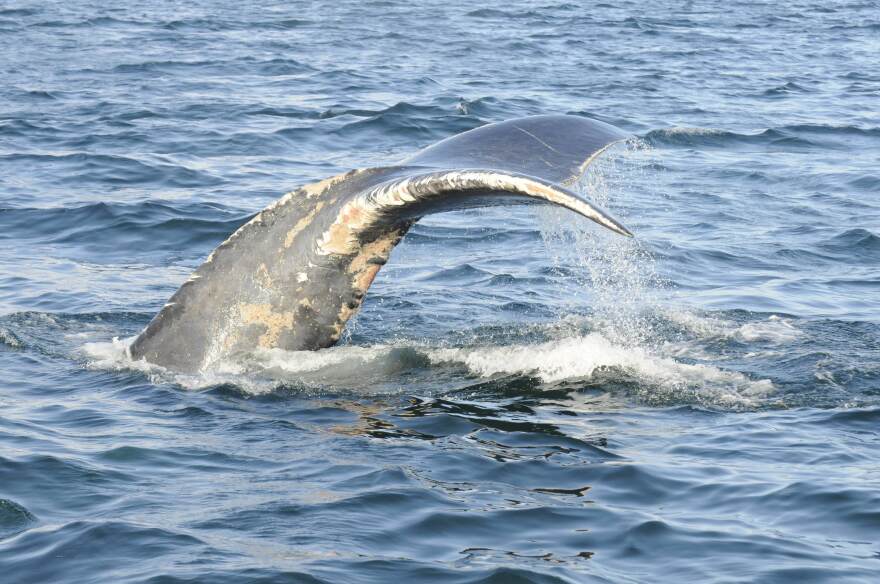
This whale was last seen in 2011 with severe entanglement injuries. She was never seen again.
Fishing gear puts rare right whales in more danger than previously thought, according to new research from Duke University and the New England Aquarium.
Ropes attached to unattended fishing equipment can entangle and kill whales. The recent study found that even when whales survive an entanglement, they are less healthy and less likely to reproduce.
For the North Atlantic right whale, this is very bad news. The whale population has recovered from a low point of 25 to 50 individuals to about 350 worldwide. But this precariously low population is declining fast again, and the new research supports claims that fishing equipment – particularly gear that stays in one place, like gillnets and lobster traps – is the biggest risk to the whales. North Carolina is one of the only states that still allows commercial gillnetting.
Michael Moore, veterinary scientist at the Woods Hole Oceanographic Institution, describes fishing ropes as “a whale trap.”
“Essentially, the vertical lines from these gear types become like some giant floss, and they run into them with their mouths open,” he explained. “That startles them. On the basis of what we see in the mortalities and the trauma that’s evident, we imagine that they spin and wrap the gear around their heads or their flippers and also the tail sometimes.”
Rope entanglement can cause everything from superficial scarring to death by drowning
The study used three decades’ worth of photos of right whales to track entanglements and health over time. Most whales with severe entanglement injuries didn’t survive beyond three years.
The deadly consequences of entanglement are well documented, but this latest research shows that the whales that survive an entanglement are less healthy and less likely to breed. The health impacts of entanglement were worse for female whales, which is particularly worrying for the survival of the population.
Entanglement isn’t the whole story. Even the minority of whales that avoid entanglements have been less healthy in recent years, the researchers found, possibly due to climate change causing the whales’ food sources to be less predictable. Collisions with fast-moving ships are also a major cause of death. Still, the new study indicates that fishing gear is the largest and most immediate risk to this critically endangered species.
Robert Schick, research scientist at Duke University and co-lead author of the new study, maintains that it’s not too late for the North Atlantic right whale population. Their survival would require big changes to the kinds of fishing gear that are used in the whales’ habitat. But if the threats from fishing ropes and fast-moving boats can be reduced, says Schick, “they’ve shown and proven that they can recover from really low numbers.”
Larry Rudolph built an empire in strip-mall suburbia, and a reputation as a gun-culture hero. Then came the love triangle, the allegations of fraud, and a mysterious death in Africa. Was it a tragic accident? Or murder?
To catch a leopard, the trophy hunter must track itsprey. Lure the big cat with wild dogs. With hedgehogs. With a vanishing species of antelope as bait. Slaughter a southern impala, hang it high in the Mutondo trees, then wait. If you are careful and you are quiet, the camouflaged victim will leap up and succumb to the rifle. Experienced game scouts, though, recommend keeping a shotgun in the truck; once that cat is down, you’d best finish her off, before she runs away.
Over the course of a fortnight in the early autumn of 2016, Bianca…
The Human Meat Plant-Based Burger was developed by European company Oumph! Photo: YouTube / Eat_Oumph
A plant-based meat brand decided to take an unusual — and cannibalistic — route to sway people to try their product.
European company Oumph! developed the Human Meat Plant-Based Burger — a burger they say tastes just like people — for those willing to indulge in fake human flesh.
“We developed this burger in no time as soon as we knew what taste and texture we were after,” Oumph! Co-Founder Anders Linden said in a YouTube video.
During Halloween last year, the company set up a food truck in Stockholm, Sweden, serving the “scariest plant-based food ever”.
The company released a short advertisement, complete with a sinister voiceover depicting dark scenes in a kitchen as a a chef develops the human-based meat. The commercial then dares people to try it.
LOLA MullenLowe, the agency behind the campaign, said they wanted to “convince” meat-lovers that plant-based products could “replicate the taste of any meat”.
“And of course, a solution was to make a tasty plant-based human meat burger,” Tomas Ostilglia, Creative Director at LOLA MullenLowe said.
The campaign won a Silver Prize at the Cannes Lions Festival, an international festival for the creative marketing community.
DAILY
SCMP Today: Intl Edition Newsletter
By submitting, you consent to receiving marketing emails from SCMP. If you don’t want these, tick here
China’s appetite for protein developed through fermentation grows, amid drive to boost demand for meat alternatives, net-zero goal
Investors’ interest in alternative protein has extended to fermentation and cell-based protein technologies, which are more suitable for long-term deployment, think tank saysAt a meeting in March, Chinese President Xi Jinping said that it was necessary for China to develop proteins from plants and microorganisms or fermentation
Fermentation can also be used to fix the shortcomings of plant-based meat products, for example, to add nutritional value and enhance texture and flavour, according to GFI APAC. Photo: Shutterstock
Chinese investors and policymakers are showing a growing interest in fermentation and cell-based protein technologies, with the expectation that they can diversify China’s protein supply, reduce food-related carbon emissions and overcome the challenges of current plant-based meat products.
The country’s fermentation alternative proteins sector has recorded eight investment deals since 2020, with total financing of more than 80 million yuan (US$11.9 million), according to GFI Consultancy, the Shanghai-based strategic partner of Good Food Institute Asia-Pacific (GFI APAC), Asia’s leading alternative protein think tank.
Fermentation-enabled and cell-based proteins are expected to play an integral role in a more self-sufficient food system in China. The country’s “alternative protein industry has ushered in a critical transition period, from rapid expansion to quality development”, the consultancy said in a report published on Wednesday.
“Investors’ interest in alternative protein has extended to fermentation and cell-based protein technologies, which are more suitable for long-term deployment,” it added.
Industry studies show that interest in plant-based meat and other alternative proteins is on the rise. China’s plant-based meat market has been continuously growing in the past few years, reaching 748 million yuan in market size in 2020, up 10.6 per cent from 2019, according to the latest research released by market research firm Euromonitor International last year.
The plant-based meat sector, however, faces several key hurdles in the Asia-Pacific region. According to a consumer survey conducted by leading global food company Kerry Group last year, consumers in the region believe current plant-based meat products still have much room to improve, especially in terms of taste, texture and nutrition.
As far as China is concerned, a transition to diversified protein sources is crucial, as the country has pledged to reduce carbon emissions in all sectors, including animal agriculture, to reach carbon neutrality by 2060. The country could also face a total meat deficit of more than 53 million tonnes in the 10-year period from 2021 to 2030, according to GFI Consultancy.
“With adequate investment and support, fermentation-enabled proteins could almost single-handedly resolve the global protein deficit, while simultaneously mitigating ecological degradation and delivering the familiar tastes and flavours that Chinese consumers crave,” said Mirte Gosker, acting managing director of GFI APAC.
Fermentation uses microbes to break down compounds and create proteins. It can also be used to fix the shortcomings of plant-based meat products, for example, to add nutritional value and enhance texture and flavour, according to GFI APAC.
According to a 2019 report by global consultancy AT Kearney, by 2040, up to 60 per cent of meat will be alternative proteins, with cultivated meat comprising 35 per cent and plant-based meat reaching 25 per cent. Plant-based proteins will take the market share in the short term, but cell-cultivated and fermented technologies will dominate the market in the long term.
Last month, China released its latest five-year plan for bio-economy development, which included a particular call to expand the production of “synthetic proteins” to “reduce the pressure on environmental resources brought about by conventional animal agriculture” from 2021 to 2025.
EVERY SATURDAY
SCMP Global Impact Newsletter
By submitting, you consent to receiving marketing emails from SCMP. If you don’t want these, tick here
At a joint meeting in March with agriculture, social security and social welfare advisers, Chinese President Xi Jinping also said that it was necessary for China to develop proteins from plants and microorganisms or fermentation.
Building a thriving research and manufacturing landscape for fermentation-enabled proteins can help China diversify its protein supply and reduce its reliance on overseas imports of soybeans, corn and other crops traditionally fed to farmed animals raised for meat, according to GFI APAC.
“It allows the nation to produce more food with fewer resources – the quintessential win-win,” said GFI APAC’s Gosker.
Singapore is one of the world’s densest urban spaces, but parts of the country are undergoing a rewilding transformation. The Mandai Wildlife Bridge reconnects two parts of a nature reserve containing dozens of rare species, such as the sambar deer and the common-palm civet.
Hide Caption
5 of 8
Photos:Wildlife crossings around the world
The turtles of Kobe, Japan, once faced a perilous journey across the city’s railways to access a pond: when the rails switched, they often got trapped between them and killed. These shallow tunnels free up just enough space for the turtles to freely pass beneath the tracks.
Hide Caption
6 of 8
Photos:Wildlife crossings around the world
With deforestation eating into their natural habitats, it’s harder for sloths in…
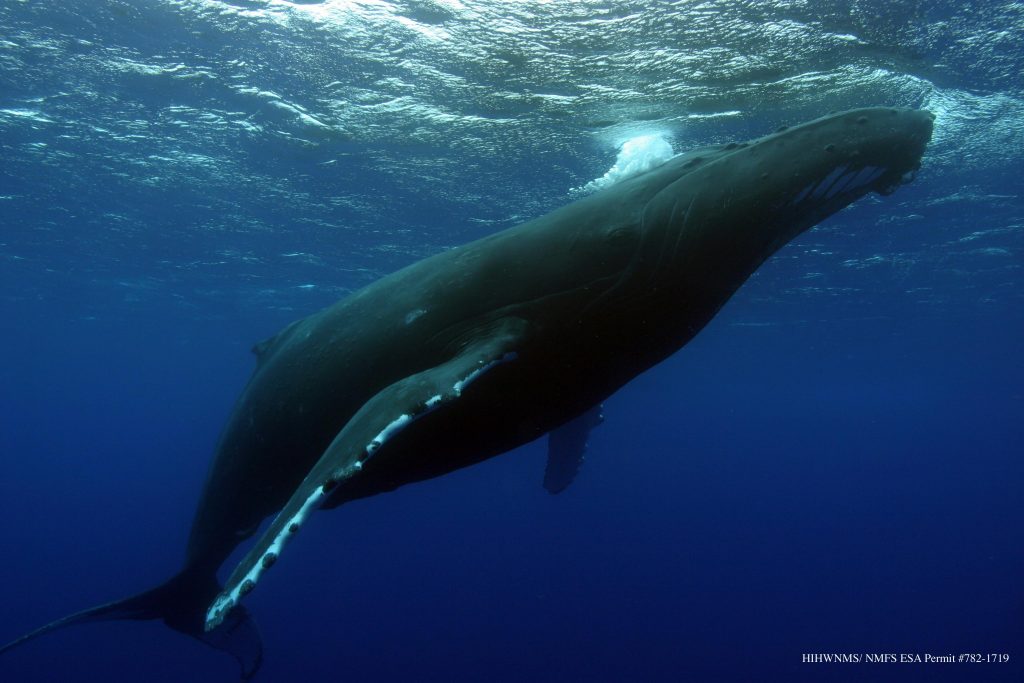
Humpback whales may one day avoid Hawaiian waters due to climate change and rising greenhouse gasses, according the findings of anew paperpublished in Frontiers in Marine Science by a team of researchers including three University of Hawaiʻi at Mānoa graduate students.
The students include: Hannah von Hammerstein and Renee Setter from theDepartment of Geography and Environmentin theCollege of Social Sciences, and Martin van Aswegen from theMarine Mammal Research Programin theInstitute for Marine Biology.
Humpback whales are known to migrate toward tropical coastal waters, such as Hawai‘i’s, where they give birth to their calves. These areas lay in regions with sea surface temperatures ranging between 21 and 28 degrees Celsius (approximately 70–82 degrees…
Dinosaurs may have outsurvived other creatures living alongside them during a largescale extinction preceding the period where they became dominant due to their ability to survive in frosty conditions, according to a new peer-reviewed study published in Science Advances on Friday.
In general, the world was hot and steamy during the Triassic Period, when dinosaurs first showed up as a small group of species that stayed mostly in the polar…


























 Exposing the Big Game
