A Dillingham hunter was mauled by a brown bear on Friday. Alaska State Troopers spokesperson Tim DeSpain said in an email that 40-year-old John Casteel was hunting up the Nushagak River, 20 miles by air from Dillingham, when he was mauled.
Casteel’s aunt, Marjorie Nelson, said he came upon the bear while moose hunting. The bear attacked and Casteel called out to his hunting partner, who shot and killed the bear. His partner sent a satellite message requesting help, saying that Casteel had injuries on his arm and leg. He was conscious but couldn’t move.
“They had a nurse with them and other hunting parties that helped stabilize him and control his wounds,” she said. “He stayed out in the wilderness for four hours, laying on the tundra. … The hunting party that he was with, they started a fire and they tried to keep him warm and keep…
A man from Żabbar has been fined €3,000 and had his hunting licence suspended after being found guilty of having hunted birds during the closed season, 5 years ago.
The case dates back to Sunday 23 April 2017, when the police had received a report of hunting activity near Xgħajra, from BirdLife volunteers who had been observing the annual Spring bird migration.
As the hunting season had officially closed 9 days before, and seeing two men with hunting shotguns, the volunteers had started filming, capturing footage of a large bird overflying the hunters’ hide and one of the men standing up and firing a shot at it.
Despite finding nobody at the scene when they arrived, the police had subsequently arrested Simon Camilleri after…
Image by Andrew Skowron of 4-week-old hens destined for an existence as egg machines.
I can’t count how often I’ve seen declarations from people who claim to be vegan despite indulging in some form of avoidable use of members of other animal species. However before I go any further I must stress the word ‘AVOIDABLE’.
Living in a nonvegan world, completely surrounded by a regime of oppression that runs almost entirely on the exploitation of other individuals, I sincerely can’t imagine how anyone can claim that they have absolutely no involvement in exploitation either directly or indirectly. For the avoidance of doubt, this is not some controversial claim that veganism is impossible – far from it. I’m only mentioning this because I’ve seen so many vegans attacking or sniping at others as if they, themselves, were completely free of the taint of corruption that nonveganism brings. Examples of this sniping…
A moose that attacked a hunter on Tuesday, resulting in life-threatening injuries to the man, won’t be euthanized, according to Colorado Parks and Wildlife.
The attack occurred after a bow hunter in the Trap Creek area of Larimer County took a shot at a bull moose and missed. The moose then turned and charged, goring and trampling the man. The man sustained serious and life-threatening injuries.
“His ability to stay cool after being mangled by a moose, to have that presence of mind, is pretty impressive,” said wildlife manager Jason Surface of the hunter. “Having an emergency beacon device contributed to this hunter’s rescue and it is always good to have a plan when in the woods by yourself.”
CALIFORNIA – Tyree Johnson loved his apartment that overlooked the Pacific Ocean — until it started to crumble down a cliff into the sea.
For 15 years, he could enjoy sunsets over the water from his back porch in Pacifica, a few miles southwest of San Francisco.
Pods of dolphins swam by and hang gliders floated overhead. But all that splendor came with a risk: The bluffs were weakening and ocean was gnawing away below.
“In that last year, it just started giving way,” he said. ”It wasn’t a gradual thing.”
When a loud noise startled him around4:30 in the morning, it was the ground giving out a fewdoors down. In April 2010,the authorities told him he needed to move before the…
By Mark Heinz, outdoors reporter Mark@CowboyStateDaily.com
Though it’s long been a killer of wild waterfowl and domestic poultry, bird flu has started taking a toll on Wyoming’s raptors. It’sstill uncertain how badly it will spread among birds of prey, a wildlife disease expert said.
“These viruses are always re-sorting and reorganizing,” Michael Pipas, a wildlife disease biologist with USDA Wildlife Services, told Cowboy State Daily. “In this case, instead of just killing waterfowl and poultry it (avian influenza) has started killing birds of prey.”
So far, up to 100 eagles, hawk and falcons are known to have died of the disease in Wyoming, he said. The infections are thought to have begun this spring.
“It’s not like birds of prey are falling offbranches…
Fishing, Hunting And Trapping Market report provides the comprehensive analysis of the industry including new start-ups and strategy for future opportunities and growth. The research report offers exact assessments on the CAGR, market size and share, key regions and countries. Major market players include HuntOnly.com, Bottle Cap Lure Company, B & C’s Mount Lake Lodge, Double U Hunting Supply, Gulf Coast Oil Disaster Network, etc.
“Final Report will add the analysis of the impact of COVID-19 on this industry.”
The global current market size estimation, market scenario, structure, products, top industry players, segmentation by types, and applications are all included in the “Fishing, Hunting And Trapping Market” research report. The Fishing, Hunting And Trapping market study focuses on the factors that are important to the market and could have a big impact on its future development. The research also provides information on the…
“While about 6% of land mammals have gone extinct in that time, we estimate that more than 50% of mammal food web links have disappeared,” said ecologist Evan Fricke, lead author of the study. “And the mammals most likely to decline, both in the past and now, are key for mammal food web complexity.”
A food web is comprised of all the connections between predators and their prey in a given region. Complex food webs are essential for managing populations in a manner that allows more species to coexist, hence promoting the biodiversity and stability of ecosystems. But animal losses may diminish this complexity, thereby reducing the resilience of an ecosystem.
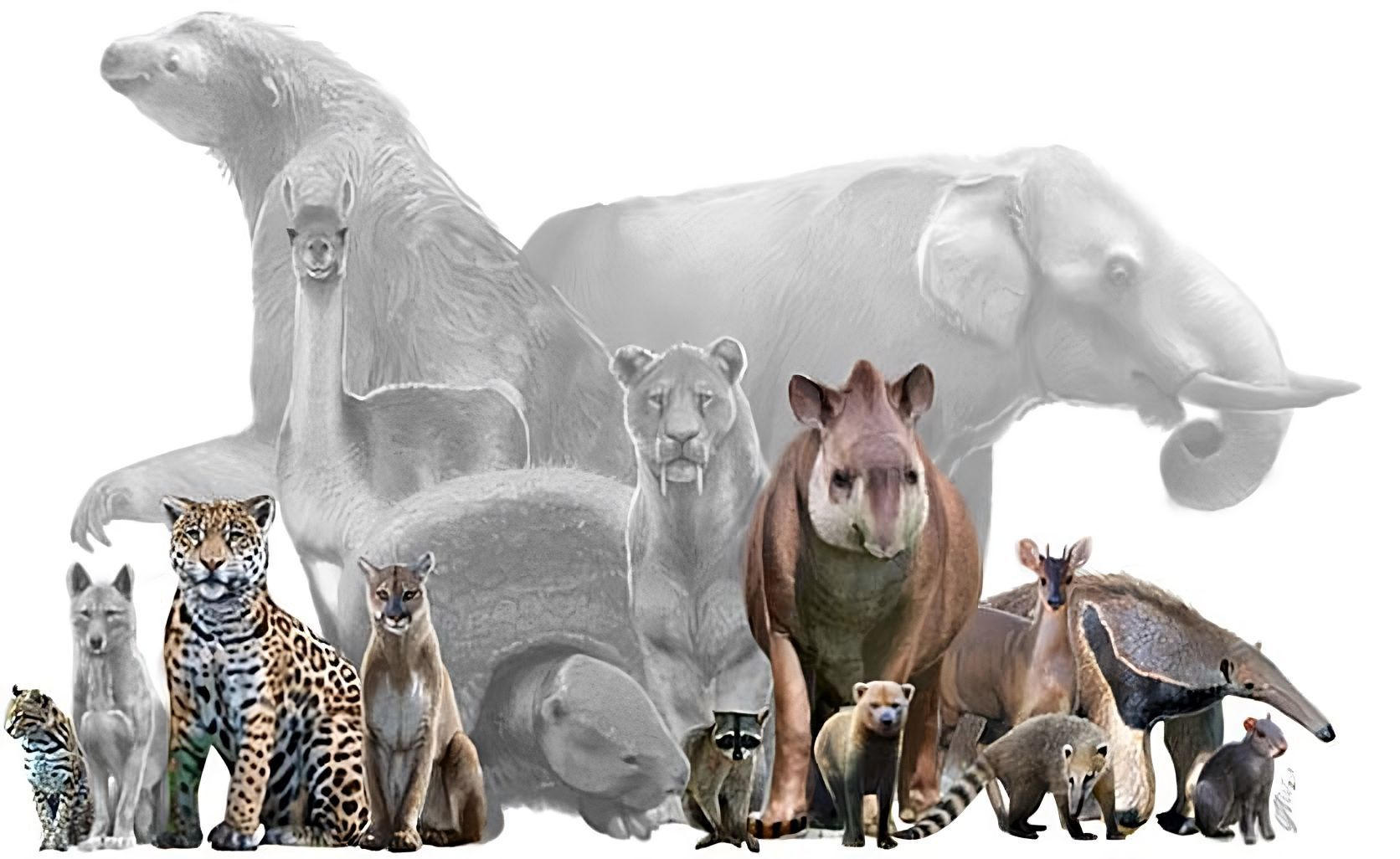
Illustration depicting all mammal species that would inhabit central Colombia (left), Southern California (middle), and New South Wales, Australia, (right) today if not for human-linked range reductions and extinctions from the Late Pleistocene to the present. Credit: Oscar Sanisidro/University of Alcalá
Although declines of mammals are a well-documented aspect of the biodiversity crisis, with many animals either extinct or surviving in a small portion of their historic geographic ranges, the extent to which these losses have impacted the world’s food webs has remained unclear.
To understand what has been lost from food webs linking land mammals, Fricke led a team of scientists from the United States, Denmark, the United Kingdom, and Spain in using the latest techniques from machine learning to determine “who ate who” from 130,000 years ago to today. Fricke conducted the research during a faculty fellowship at Rice University and is currently a research scientist at the Massachusetts Institute of Technology.
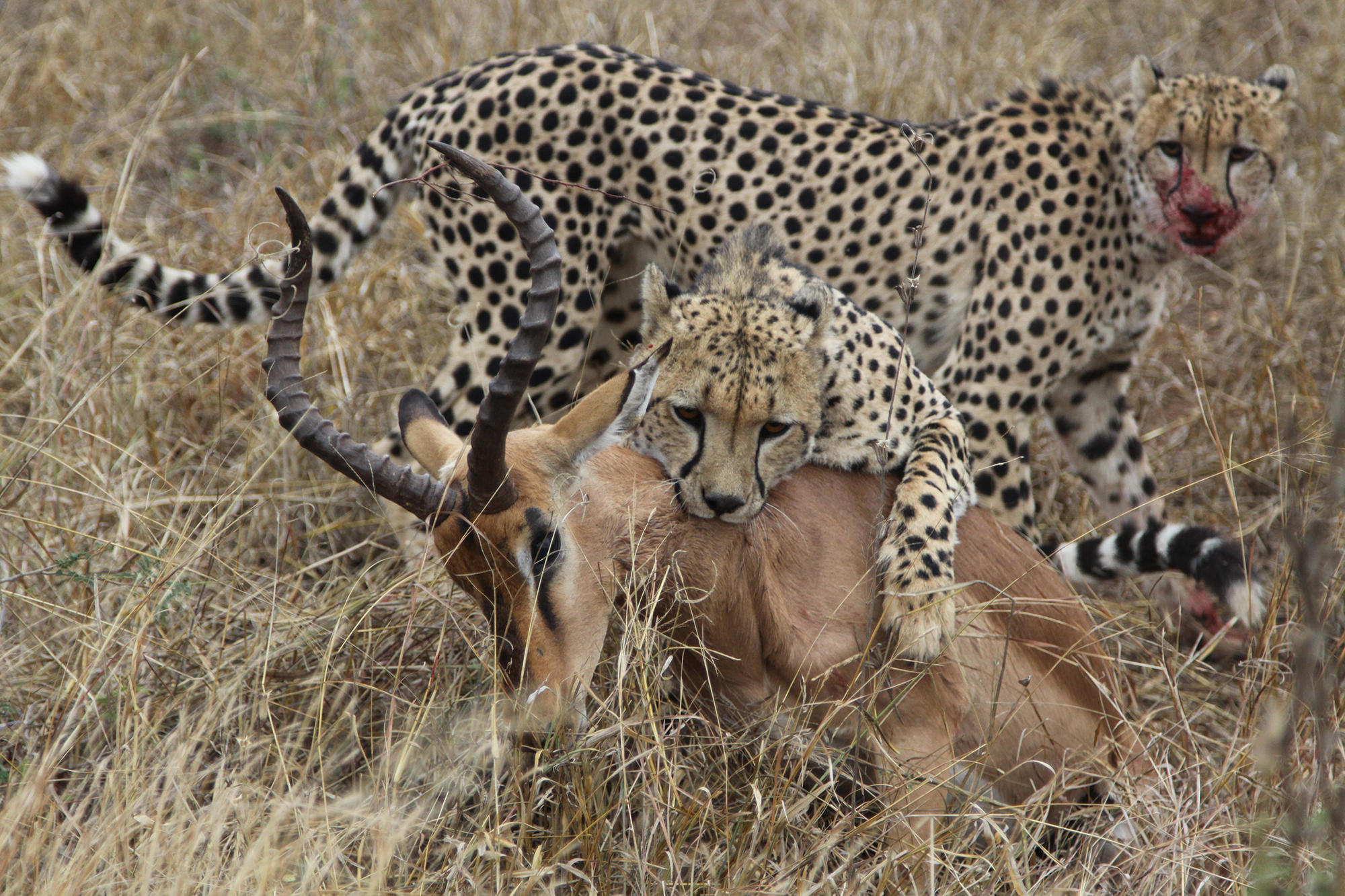
A predator-prey interaction between cheetahs and an impala in Kruger National Park, South Africa in June 2015. Credit: Evan Fricke
Using data from modern observations of predator-prey interactions, Fricke and colleagues trained their machine learning system to determine how species characteristics impacted the probability that one species would prey on another. Once trained, the model could predict predator-prey interactions between species pairings that have not been seen directly.
“This approach can tell us who eats whom today with 90% accuracy,” said Rice ecologist Lydia Beaudrot, the study’s senior author. “That is better than previous approaches have been able to do, and it enabled us to model predator-prey interactions for extinct species.”
The research offers an unprecedented global view into the food web that linked ice age mammals, Fricke said, as well as what food webs would look like today if saber-toothed cats, giant ground sloths, marsupial lions, and wooly rhinos still roamed alongside surviving mammals.
“Although fossils can tell us where and when certain species lived, this modeling gives us a richer picture of how those species interacted with each other,” Beaudrot said.
By charting changes in food webs over time, the analysis revealed that food webs worldwide are collapsing because of animal declines.
“The modeling showed that land mammal food webs have degraded much more than would be expected if random species had gone extinct,” Fricke said. “Rather than resilience under extinction pressure, these results show a slow-motion food web collapse caused by selective loss of species with central food web roles.”
The study also showed all is not lost. While extinctions caused about half of the reported food web declines, the rest stemmed from contractions in the geographic ranges of existing species.
“Restoring those species to their historic ranges holds great potential to reverse these declines,” Fricke said.
He said efforts to recover native predator or prey species, such as the reintroduction of lynx in Colorado, European bison in Romania, and fishers in Washington state, are important for restoring food web complexity.
“When an animal disappears from an ecosystem, its loss reverberates across the web of connections that link all species in that ecosystem,” Fricke said. “Our work presents new tools for measuring what’s been lost, what more we stand to lose if endangered species go extinct and the ecological complexity we can restore through species recovery.”
Reference: “Collapse of terrestrial mammal food webs since the Late Pleistocene” by Evan C. Fricke, Chia Hsieh, Owen Middleton, Daniel Gorczynski, Caroline D. Cappello, Oscar Sanisidro, John Rowan, Jens-Christian Svenning and Lydia Beaudrot, 25 August 2022, Science. DOI: 10.1126/science.abn4012
The study was funded by Rice University, the Villum Fonden, and the Independent Research Fund Denmark.


 Image by Andrew Skowron of 4-week-old hens destined for an existence as egg machines.






 Sep 12, 2022 9:52 AM
 Top Articles


 Exposing the Big Game