MINNEAPOLIS —A judge has sentenced a central Minnesota man accused of killing a 500-pound black bear in his backyard to probation and temporarily stripped him of his hunting privileges.
Morrison County District Judge Leonard Weiler sentenced Michael Theilen, 42, on Wednesday after Thielen pleaded guilty to taking and possessing big game out of season, a misdemeanor,the Minneapolis Star Tribune reported.
Weiler gave Theilen two years’ probation and stripped him of his hunting privileges in Minnesota and across most of the rest of the country for three years.
His loss of hunting privileges extends to every state that is part of the Interstate Wildlife Violators Compact. The only states Thielen could hunt in are Massachusetts and Hawaii, according to the National Association of Conservation Law Enforcement Chiefs.
The judge also ordered Thielen to pay $800 in restitution and $685…
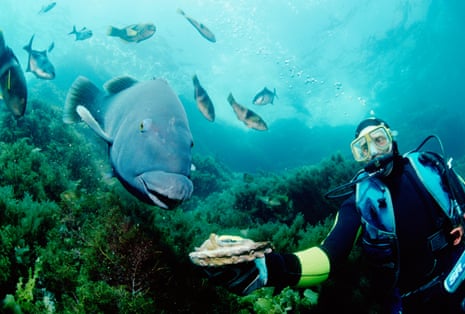
The movie adaptation of Tim Winton’s novel Blueback is out this week. It focuses on a friendship with a big friendly fish – the blue groper; and the powerful response to humans threatening the animal. As with My Octopus Teacher, it’s a highly emotive story, and seen by most people as unusual or unique. Because humans only befriend domestic animals such as cats and dogs. Or do they?
Let’s start with the blue groper. This is a charismatic Australian native, with many interesting characteristics. They are protogynous hermaphrodites, starting life as juveniles with the potential to be male or female; and always starting as green-coloured females. The dominant male has a harem and, if he dies, the largest female will become male and adopt the striking blue hue which gives the fish its name. These fish can live up to 70 years and are the state emblem of New South Wales.
Beyond the science, these are extraordinarily curious and friendly fish. As a regular snorkeller and diver, I am often greeted by a groper who will shove his face in my camera, rub up against my hands, bop me with his lips and follow me around. Gropers appear to recognise divers and are curious about what we are doing. It is illegal to spear these animals in my home state but such is my emotional response to their friendliness, I can imagine jumping in front of a weapon aimed at one of my friends.
Octopuses are similarly interactive and interested in us. They are invertebrates who have developed unique, extraordinary intelligence, diverging from us evolutionarily more than 600m years ago. They use tools and mimicry, construct shelters, steal things and are known to be escape artists when kept in captivity.
In Sydney we primarily interact with the gloomy octopus (Octopus tetricus). One of my life’s highlights was the first time one of these creatures unfurled a tentacle and explored my hand. Since then I’ve had many interactions, including octopuses riding on my hand, trying desperately to steal my camera, and some who tell me to go away by blowing sand at me. Unfortunately, octopuses don’t live long – usually becoming senescent after breeding and lasting only one to two years. The ones we see regularly are often eaten by smooth stingrays in the blink of an eye. It’s hard to get too fond of them as the end is always near.
Once you have a relationship and an attachment to another living creature, they become part of your sphere of compassion
Moving to the land, and most of us are familiar with wild birds seeking human company. Yes, they are often after food, but who isn’t? My neighbourhood is dominated by sulphur-crested cockatoos, but it only takes a little patience to have a rainbow lorikeet or a king parrot work up the courage to stand on a human hand.
Even tiny insects can notice humans and change their behaviour to interact with us. Jumping spiders are in almost everyone’s garden but you might miss them if you don’t look hard. Most are less than half a centimetre long. Lock eyes with one, however, and there’s no doubt that they see you, moving their bodies to make eye contact. Also fans of cameras, they sometimes jump right at you!
Relationships with wild animals are possible and common – you can have your own Blueback or My Octopus Teacher experience. Return to the same place often enough and you’ll get to know the regulars. Getting to know animals as individuals with varying personalities and behaviour grants them elevated importance. But be aware that it is likely to push you closer to vegetarianism and inspire you towards conservation. Because once you have a relationship and an attachment to another living creature, they become part of your sphere of compassion. And then there is no choice but to protect both the animal and its environment. A “pet” blue groper or a labrador? You can have both, and it will probably make you a better human.
Kate Ahmad is a neurologist and diver with an interest in human and animal behaviour and conservation
Katelyn Armstrong who aspires to teach others about hunting documents her journey on TikTok (Katelyn Armstrong/ Instagram)
COLUMBUS, OHIO: A 31-year-old woman from Ohio, Katelyn Armstrong claims that her “passion is killing”, in a shocking video that’s going viral online. She has millions of viewers on social networking sites where she displays herhunting prowess. Notably, the nail technician followed in the footsteps of her father. Armstrong watched her father hunting animals when she was a child andhad her first shotat a deer when she was just 12 years old. Apparently, last year she killed around 200 deer.
She hasn’t stopped ever since herfirst hunt. For her, “nothing goes to waste” as she processes all the meat herself and turns it into steaks, pot roasts, burgers, and breakfast sausages. Armstrong, who aspires to…
A lawyer representing an Alberta man convicted in the killings of two Metis hunters says his client was defending himself and his family, while prosecutors argue he was one of the aggressors.
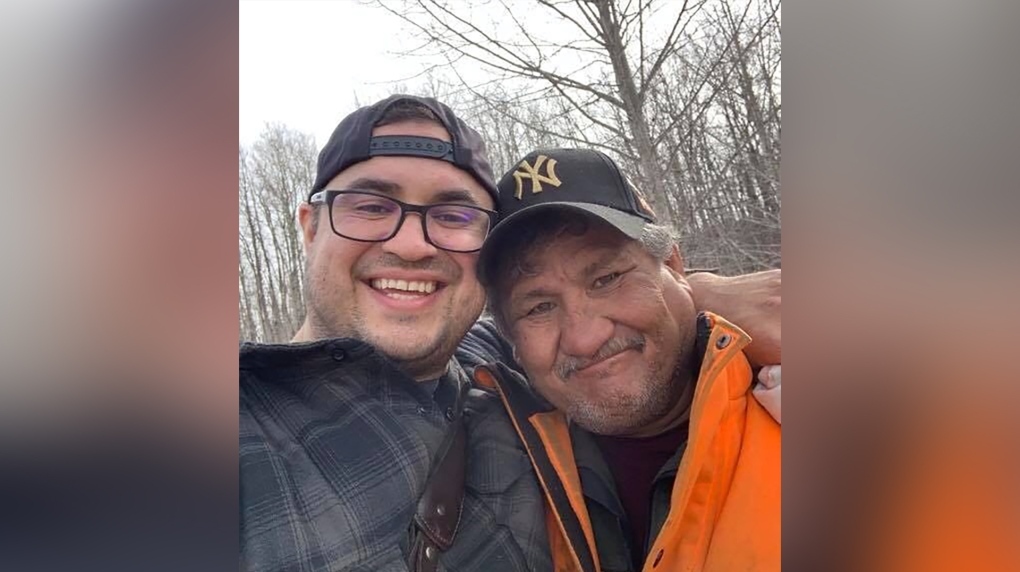
The sentencing hearing began today in Edmonton for Anthony Bilodeau, who was found guilty in May of second-degree murder in the death of Maurice Cardinal and manslaughter in the death of Jacob Sansom.
Sansom, who was 39, and Cardinal, who was 57, had been moose hunting in March 2020, before they were shot and left on the side of the road near Glendon, Alta., a rural community about…
Montana Fish, Wildlife and Parks is opening wolf trapping season in specific areas of occupied grizzly bear habitat in west, northwest and south central Montana due to reduced grizzly bear activity.
The areas of occupied grizzly bear habitat now open include areas in FWP Region 1, elk and deer hunting districts 100, 101, 103, 104 120, 121, 122, 123, and 124. In Region 2, occupied grizzly bear habitat south of Interstate 90, or HDs 210, 211, 212, 213, 214, 215, 216, and 217. The occupied grizzly bear habitat in FWP Region 5 is also open. This includes areas northeast of Yellowstone National Park (See map).
The rest of the occupied grizzly bear habitat in Montana remains closed to wolf trapping due to grizzly bear activity.
In August, the Montana Fish and Wildlife Commission approved wolf hunting and trapping regulations for the 2022 season, which ends March 15, 2023. The regulations include a floating start date for wolf trapping in occupied grizzly bear habitat. The intent of the floating start date is to avoid conflict with grizzly bears that have yet to den for the winter. Wolf trapping in these areas opens Dec. 31 unless FWP opens it early due to a decline in grizzly bear activity.
FWP makes a decision opening trapping in occupied bear habitat each Monday in December with input from field staff on bear activity.
Wolf trapping is open in all other areas of the state. Hunters and trappers should note that wolf harvest quotas exist in each FWP trapping district and wolf management unit 313. Those harvest quotas can be viewed and followed on the FWP Wolf Dashboard.
Wolf hunters and trappers should make sure to be familiar with the 2022 Furbearer, Wolf and Trapping Regulations, which include maps of occupied grizzly bear habitat.
Note: For the purpose of this blog, the term plant-based is used to describe items composed entirely of plants. This is to differentiate from those unscrupulous suppliers that disingenuously use the term to describe products which contain animal derivatives but which are comprised MOSTLY of plants.
Veganism – it’s not a diet
In the month of January, a massive capitalist food festival takes place in Britain with a breath-taking array of plant-based food items flooding the shops. They call it ‘Veganuary’. Over the years this extravaganza has provoked me; not because of the plant-based food selection because let’s be honest, food fascinates me as much as it does the next person, but because of the way it’s marketed and promoted. It irks me that all the promotion is very suggestive of…
“It was about 9:30 in the morning, we looked outside and there she was,” said Jen Lindahl, a Florida native who now lives in Colorado. “It was amazing.”
Lindahl and her daughter, 6-year-old Reagan, just sat on the balcony of their Hutchinson Island condo and watched the whale, about 46 feet long and weighing more than 100,000 pounds, swim by.
“I grew up in Florida. It’s one of the marine animals I’ve never actually seen in Florida,” Lindahl said. “You expect them in California and Hawaii but not here.”
“It’s amazing to see a whale at any point but let alone something so close to the beach,” said ocean conservationist Jim Abernethy.
Abernethy has been diving with and studying whales for years. He said what the Lindahls saw was a North Atlantic right whale.
“We have whales here,” Abernethy said. “But to see it from land is really, really rare.”
Video below: A look at another viewer’s video of the endangered whalePlay Video
Lindahl’s video showed a paddleboarder very close to the whale. NOAA pointed out that the law requires people to remain 500 yards away from whales to allow them space to bond with their calves.
That’s because the right whale is endangered. NOAA said the coastal waters off of Florida and Georgia are the only known calving area for these whales and have been designated as critical habitat by NOAA Fisheries.
NOAA estimates there are now only about 350 right whales left in the world.
And one of them swam right in front of the Lindahls.
“It was incredible. People started lining up on the beach,” Lindahl said. “It was just so special.”
Watch: Video of the mother and calf from a third WPBF viewerPlay Video
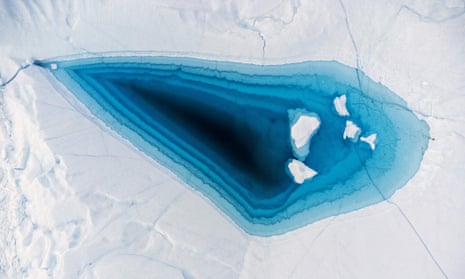
A large melt hole on top of an iceberg in Disko bay, Ilulissat, western Greenland, in June 2022. The iceberg originates from Jakobshavn glacier, the most productive in the northern hemisphere.Photograph: Odd Andersen/AFP/Getty
Half the planet’s glaciers will have melted by 2100 even if humanity sticks to goals set out in theParis climate agreement, according to research that finds the scale and impacts of glacial loss are greater than previously thought. At least half of that loss will happen in the next 30 years.
Researchers found 49% of glaciers would disappear under the most optimistic scenario of 1.5C of warming. However, if global heating continued under the current scenario of…
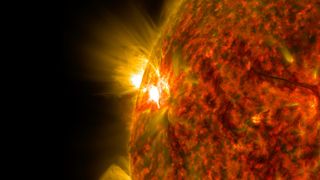
A solar flare captured by NASA’s Solar Dynamics Observatory in extreme ultraviolet light. Here we see a fiery orange and black orb and at one point a white-hot explosion taking place.(Image credit: NASA/SDO)
On Jan. 4, Earth will reach its closest point tothe sunall year in an annual event called perihelion. The precise distance varies from year to year, but perihelion 2023 will see our planet orbiting 91.4 million miles (147 million kilometers) from the sun — or roughly 3 million miles (4.8 million km) closer than Earth’s aphelion, its farthest point from the sun, which will occur…


 Katelyn Armstrong who aspires to teach others about hunting documents her journey on TikTok (Katelyn Armstrong/ Instagram)
 Jacob Sansom, 39, and Maurice Cardinal, 57, were shot and killed on a rural road near Glendon, Alta. on March 28, 2020.
 Animals as entertainment. Image by photojournalist Andrew Skowron from Delefinarium Nemo – Odessa Ukraine from a series at


 Exposing the Big Game