A Miami-Dade police officer has been caught on video wrangling an alligator insouthern Florida.
Thenuisance alligatorwas brought under control by officer Manuel Orol in the Kendall area on Feb. 21, according to TMX News.
“My concern was that the gator needed to be contained so that it wouldn’t leave the area and possibly harm a child or someone walking their dog,” Orol told WSVN after Florida Fish and Wildlife Conservation Commission officers arrived to take the reptile away. “They were saying, ‘Wow, I can’t believe you did that,’ you know, ‘Good job,’ ‘You’re crazy.'”
This tree standis in woods on the outskirts of Altamont. Four hunters in New York State died after falling from tree stands. The Department of Environmental Conservation says it is not always notified when falls occur.
The 2022 hunting seasons tied with 2021 for the safest year, with the lowest number of hunting-related shooting incidents since record-keeping began, according to a Monday release from the state’s Department of Environmental Conservation.
The DEC’s environmental conservation police officers investigated nine hunting-related shooting incidents in 2022, including one fatality.
However, four hunters died in 2022 after falling from tree stands.
For the past several years, the DEC has tracked and investigated elevated hunting incidents, formerly called tree-stand incidents. These incidents are underreported, the release said, and the DEC is not always notified when falls occur.
A gentleman out hunting for deer in Connecticut killed two German shepherds with a crossbow instead, mistaking the dogs for coyotes. (As if killing coyotes is okay.)
The inept hunter – 61-year-old Michael Konschak – then texted photos of the dead dogs to a taxidermist in hopes of tanning their hides,according to the Miami Herald. To get a head start, he skinned the dogs at his home in New York before realizing he did a crappy job and tossing the pelts in the trash.
Meanwhile, the taxidermist was skeptical as to whether these canines were really coyotes or actually a couple of dogs, and shared the texted photos with others who might be able to better identify the animals. Someone then forwarded the…
The high and damaging winds in parts of the southern U.S. unfolded as mountainous areas of Southern California remained buried under several feet of snow that has left people trapped.
TAP TO UNMUTE
Link copiedSAVECreate your free profile or log in to save this article
March 2, 2023, 7:49 PM PST / Updated March 3, 2023, 3:18 AM PST
Thousands across Texas are waking up Friday morning without power following a night of tornado sirens and heavy winds, as a “potent” winter storm is expected to bring heavy snow from the Upper Midwest through New England this weekend.
More than 170,000 homes and businesses were left without power across Texas on Thursday night after severe weather struck parts of the state and others, the Texas utility Oncor said.
As of early Friday, power had been restored to some, with at least 110,000 utility customers still facing outages.
Tornadoes reported in multiple counties
Tornado sirens sounded in Dallas and other parts of Texas on Thursday, and high winds overturned multiple tractor-trailers, officials said. No deaths had been immediately reported.
Tornadoes were reported in Franklin and Hopkins counties in Texas, which are east of Dallas, and in the Shreveport, Louisiana, area, the National Weather Service said.
Storm surveys are being done to confirm whether reported tornadoes actually occurred.
Tornado watches covered around 3.5 million people in Texas and the South on Thursday night, according to the weather service. The watches stretched from east of Dallas into Arkansas and northern Louisiana.
By early Friday, watches had expired for Texas but tornado watches covered northern Louisiana, large parts of Missouri and into Mississippi. The storm was forecast to move into the Ohio and the Tennessee valleys Friday and then continue northeast, the weather service said.
Louisiana State University Shreveport suffered minor damage after a storm hit around 5:45 p.m. There were no injuries, but the winds were powerful enough that two shipping containers parked in a campus parking lot were moved, university Communications Director Erin Smith said.
The weather service in Shreveport said it would investigate possible damage in the region to see whether tornadoes had developed. Video shared by the agency appeared to show one in Shreveport.
NBC Dallas-Fort Worth reported that its crews spotted five overturned tractor-trailers on highways north and east of Dallas.
Parts of California buried under snow
The high and damaging winds in parts of the southern United States occurred as mountainous areas of Southern California remained buried under several feet of snow that has trapped people, authorities there said.
Gov. Gavin Newsom has declared a state of emergency for 13 counties, and the San Bernardino County Sheriff’s Office said ready-to-eat meals would be flown by helicopter to affected communities. The California National Guard said Thursday that a UH-60 Blackhawk was being sent to help.
“We know that roofs are starting to collapse,” Dawn Rowe, chair of the San Bernardino County Board of Supervisors, whose district includes some of the hardest-hit areas, said Wednesday.
County Fire Chief Dan Munsey said Wednesday that the fire department had responded to almost 100 calls for rescue.
The weather service said the snow total for Snow Valley in the San Bernardino Mountains was 120 inches, or 10 feet, from Feb. 22 to Wednesday. In Crestline, where a grocery store roof collapsed this week, it was 91 inches.
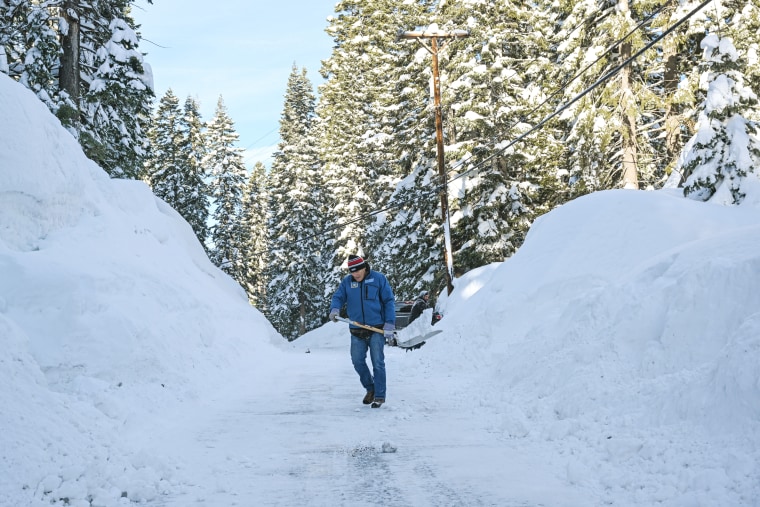
A man clears snow from a driveway near Donner Lake in Truckee, Calif., on Thursday. Tayfun Coskun / Anadolu Agency via Getty Images
‘This storm kind of kept coming’
Andrew Braggins, 43, told The Associated Press that the ceiling in his kitchen in Crestline began to bow from the weight of all the snow, prompting him to shovel his roof — where 5 feet had accumulated.
“I’ve got friends just a few roads away, and they’ve been without power for days,” he said. “You can stock up for a storm. But this storm kind of kept coming.”
Some regions now ‘free of drought’
While the recent severe weather has caused chaos for many, central California’s Sierra Nevada and foothills are now “free of drought and abnormal dryness for the first time since January 2020,” according to a new report released by the U.S. Drought Monitor.
“The rain has improved California soil moisture and streamflow levels, while the snow has increased mountain snowpack to much above-normal levels,” it said. “Abnormal dryness and moderate to severe drought were contracted across much of California to reflect the above-normal precipitation of recent months, above-normal snowpack, and improved reservoir levels.”
Meanwhile, abnormal dryness and moderate to extreme drought were also eased in Montana, New Mexico and Utah, while abnormal dryness and moderate drought were pulled back in Arizona, the report said.
‘Potent’ storm to bring weather hazards
Meanwhile, a “potent system” was forecast to produce a “multitude of weather hazards” throughout the eastern third of the country Friday and Saturday, the weather service said.
The storm was expected to rapidly deepen as it approaches “all-time record low sea level pressure values for portions of the Ohio and Missouri valleys,” it said.
“The ongoing severe weather and flash flood risk associated with the system will continue through the early Friday morning hours across the Lower Mississippi Valley, with the threat shifting northeastward throughout the day as the strengthening low lifts northward into the Ohio Valley,” the weather service warned.
Thunderstorms were also expected to have the potential to produce damaging wind gusts, as well as small hail and the possibility of isolated tornadoes Friday, prompting the weather service’s Storm Prediction Center to issue an enhanced risk of severe thunderstorms warning for eastern parts of the Tennessee Valley.
The weather service also warned of the possibility of flash flooding throughout much of the mid-Mississippi and the Ohio valleys, as well as eastward into the mid-Atlantic. A moderate risk of excessive rainfall was possible in parts of northeastern Arkansas, southeastern Missouri, southern Illinois and southern Indiana, it said.
A hunter is facing criminal charges for killing and skinning two pet German Shepherds he allegedly mistook for wild coyotes in Connecticut.
Accused dog killer Michael Konschak allegedly struck the two canines with a crossbow while he was out hunting last November, according to the arrest warrant application. After the 61-year-old killed the animals, he then allegedly skinned them to keep their pelts.
Konschak, of Putnam County, NY, claimed to authorities he mistook the pups…
Many of you have seen wolves in Idaho, perhaps have gone on wolf outings with Boulder-White Clouds Council over the past 18 years, and now wolves need your help, again.
A draft management plan that will govern Idaho wolves for the next six years has been proposed by Idaho Dept. of Fish and Game. It’s terrible. IDFG claims there are 1500 wolves in our state. The goal is to reduce wolf numbers to 500, meaning 60% of the wolves IDFG says are on the landscape would be killed. By just about any means possible.
The rationale that IDFG uses isn’t based on science or biology, but politics. We live with 20,000 black bears in Idaho and at least 4000 mountain lions. Elk numbers exceed 120,000 and there are 400,000 deer. The plan doesn’t say one good word about wolves. Non-lethal is not an option for the current IDFG. They fail to recognize the Wood River Project’s success in proving there can be co-existence between wolves and sheep.
So far, big game units 48 and 49 in Blaine County are the only ones in Idaho where wolf trapping and snaring are not allowed. We can thank our county commissioners and other officials. The Idaho Trappers Association based in Fairfield is pushing hard to be able to trap where we hike, bike, ski, camp, fish and simply walk our dogs. Remember the minute you drive over Galena into Unit 36, be wary of wolf traps and snares. This means the Sawtooth Valley, Stanley area, Salmon River canyon, Valley Creek and points in-between.
IDFG is advocating wolf hunting year around with no limit on tags or wolves taken. That’s how much the agency disregards wolves. No other species is so over mismanaged. Manage = kill.
Looking back: I’ve lived in Idaho since 1981and remember ten years later in 1991, when IDFG participated in the sockeye vigils that the Sawtooth Wildlife Council organized at Redfish Lake weir. Some of you were there. Char Roth led us in an inspirational musical mantra. Will Caldwell filled the night with the rhythm of his drums. IDFG spoke and educated us about Redfish Lake sockeye, which were near extinction. But, one sockeye – to be named Lonesome Larry – showed up one morning at the weir, I took a photo that went out across Idaho media. Redfish Lake sockeye were given a chance. BWCC board president Pat Ford has worked decades on the salmon issue and continues.
My point is, I remember a time when IDFG was our ally, now the agency is consumed with killing wolves, even contributing to bounties. Powerful interests who don’t care for salmon or wolves are forcing this.
Note – I was a founding board member of the Idaho Watersheds Project in 1993 along with Jon Marvel and Linn Kincannon. We worked on grazing including state leases. Wolves had yet to be reintroduced. I walked every stream and spring in the Upper East Fork Allotment along with Herd Creek and also Warm Springs Meadow in the White Clouds. Those allotments are now retired, benefitting fish and wildlife. Wolves could have a refuge if not for unlimited hunting, trapping and snaring.
Also, I spent many summers at Cape Horn next to sheep bands and chasing off wolves when they came by, nearly nightly. That allotment is now closed. Wolves no longer will tangle with sheep there. Some of the Wildhorse Allotment over Trail Creek also is no longer grazed. I spent more days than I care to remember walking, documenting grazing overuse, until snow drove me out. Perseverance pays off. Ranchers couldn’t meet grazing standards, so when offered a buyout they took it. Works goes on to retire more allotments. Less livestock means less conflict with predators.
Why bring up this history? These “wins?” So we can remember that hard work and advocacy does make a difference. Local, state, regional and national groups care about Idaho wolves. Lawyers are trying to stop the madness governing wolves in Idaho, Montana, Wyoming. It takes money, I’ve worked many days in the past decades without pay, to try and make a difference and would do it again. Please help groups working to help wolves.
Other ways to help:
– being in touch with our elected officials – city, county, state
A gentleman out hunting for deer in Connecticut killed two German shepherds with a crossbow instead, mistaking the dogs for coyotes. (As if killing coyotes is okay.)
The inept hunter – 61-year-old Michael Konschak – then texted photos of the dead dogs to a taxidermist in hopes of tanning their hides,according to the Miami Herald. To get a head start, he skinned the dogs at his home in New York before realizing he did a crappy job and tossing the pelts in the trash.
Meanwhile, the taxidermist was skeptical as to whether these canines were really coyotes or actually a couple of dogs, and shared the texted photos with others who might be able to better identify the animals. Someone then forwarded…
Mike Rinaldo was hunting with his son, Michael, one Saturday in late November when he heard a single gunshot echo through the woods. It came from the direction of his son’s tree stand, about half a mile away.
Mike texted his son, got no reply, and went to investigate. He hoped to find Michael gutting the big buck they’d been tracking. At first Mike couldn’t find him — not in his stand, not in the woods.
Then Mike noticed his son’s seat cushion dangling from the top of the tree strand. And directly below the stand, lying motionless on the ground, was Michael.
The latest breaking updates, delivered straight to your email inbox.Your Email AddressSUBMITPrivacy Notice
DES MOINES, Iowa —
Mountain lions, pumas, cougars, panthers. We all have our own way to identify these big cats that are being spotted across Iowa.
One big cat, officially known as Cougar NE 110, recently traveled more than 700 miles across three states from August to October. Part of that journey included nearly two months across southern Iowa through Adams, Union, Clarke, Lucas, Monroe and Wapello counties.
“It’s not uncommon for young male mountain lions when they hit the kind of teenage years to really take off and go hundreds and hundreds of miles,” said Sam Wilson, with the Nebraska Game and Parks Commission.
NE 110’s journey started in Nebraska. We know that because Wilson and his team trapped and attached a GPS tracking collar to the cat before releasing him.
“Being able to watch these animals move across the landscape, doing what they naturally do, is really fascinating,” said Wilson.
Technology is what allows Iowa Department of Natural Resources biologist Vince Evelsizer to trace this cat’s every step.
“That helps with longevity of tracking, ease of tracking, efficiency of tracking with getting, you know, remote location points on an animal that’s very secretive,” said Evelsizer.
Many of you are also monitoring these cats’ whereabouts, Iowans regularly share with KCCI their own pictures and video of mountain lions captured on trail cameras. NE 110 himself may have even been caught on camera in Van Buren County. The people who spotted him say they’re always on the lookout for these beautiful creatures.
They’re beautiful, but are they dangerous? The DNR says there have been 63 documented injuries nationwide in the past 110 years but none in Iowa. If you come across one, the DNR says you should look as big as possible so spread your jacket, wave your arms while facing the mountain lion and yell at it. Evelsizer explains it’s because the creatures typically do not pursue something that already sees them.
But why are we seeing these big cats more often, anyway? The DNR says mountain lions were once native to our state, but the population was wiped out when European settlers moved to the Midwest in the 1850s and started killing them. The population in states like Nebraska and South Dakota finally started to rebound 20 years ago.
“When that happens, the odds of getting a dispersing animal mountain lions from the western states coming east to the Midwest is higher,” said Evelsizer.
The males are looking for a new place to settle down in hopes of finding a habitat with a lot of female cats. When they’re passing through Iowa, it’s often just a place to stop and get a good meal.
“The number one prey animal for mountain lions is known to be deer,” said Evelsizer.
Evelsizer hopes his research can lead to answers on the why the animals go where they go and eat what they eat. If researchers get their hands on a carcass, it can answer the most questions about these elusive creatures.
As for NE 110, his trip ended in Illinois when the DNR there decided he was a public safety threat and trapped him. He was sent to the Exotic Feline Rescue Center in Indiana, where he’s been living since October.
“It’s sad and unfortunate that he has been brought in into captivity. And so we are we are trying our very utmost to provide him with a life that will be as comfortable as possible,” said Joe Taft, the founder of Exotic Feline Rescue Center.
Taft says the mountain lion was covered with ticks and parasites when he arrived but is now okay.
They’re building him an enclosure and hope to give NE 110 a new identity based on where he’s been. Among the choices: Omaha, Neil for Nebraska, Illinois, little buddy and Springfield.
GRAND JUNCTION, Colo. (KKCO) – The Delta County Sheriffs Office says that it has found the remains of a duck hunter who went missing in December of last year.
Wayne Phillips, a 51-year-old Montrose resident, went missing while on a hunt on Dec. 21, 2022 in the area of South River Road. His truck, hunting dog, and some personal items were found by his wife and son and an extensive search was performed by foot and by air, but search efforts were called off due to weather nine days later.
Close to two months later, the Delta County Sheriff’s Office says it received a 911 call reporting a body in the Gunnison River. The body was confirmed to be Phillips’ following its recovery. The cause of…


 Image: Rita_Kochmarjova / shutterstock.com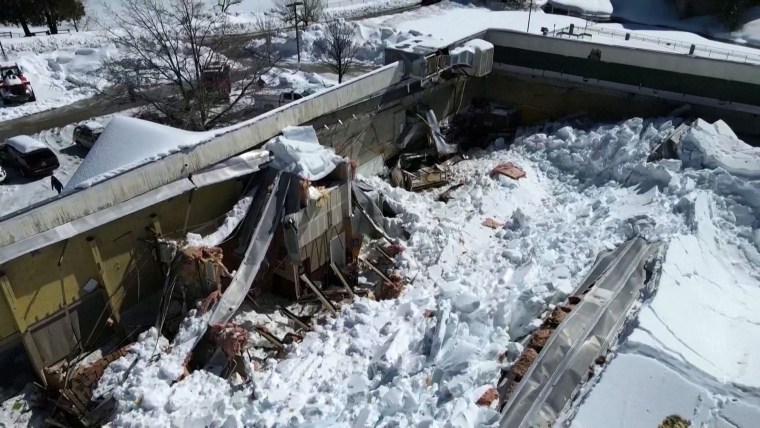






/cloudfront-us-east-1.images.arcpublishing.com/gray/XC52PFPXHBKU5INEN744AEFJ2M.jpg)
 Exposing the Big Game