
- Isabel Hicks Chronicle Staff Writer
- Apr 13, 2023
- https://www.bozemandailychronicle.com/news/agriculture/bird-flu-infects-a-dozen-mammals-as-outbreak-in-montana-continues/article_c0e8cc66-d883-11ed-bf3a-3f6d5282fc59.html
Support Local Journalism
If you value these stories, please consider subscribing.
Officials are warning Montanans to keep themselves and their pets away from dead birds, as a bird flu outbreak now in its second year starts to infect more mammals.
In Montana, close to 82,500 domestic birds have been culled from the ongoing outbreak of highly pathogenic avian influenza, or HPAI, since the state saw its first case in a poultry flock last April.
But on top of the losses for farm-raised birds, the outbreak has also taken a harder toll on wild birds than in years past. That’s led at least 12 mammals in Montana to succumb to the disease, which experts say they likely got from eating infected wild birds.
RELATED NEWS: – “Inflation has peaked”: Colombia Finance Ministermenuvolume_off volume_up
Next
Stay


volume_off
-2:50
sd
share
fullscreen
Auto (225p)
225p
360p
Subtitles Off

RELATED NEWS: – “Inflation has peaked”: Colombia Finance Minister
Colombia’s Finance Minister, Jose Antonio Ocampo, believes annual inflation, which accelerated for a 10th straight month to 13.34%, peaked in March. He spoke with Bloomberg’s Shery Ahn from DC.
“Inflation has peaked”: Colombia Finance Minister
Business |
2:52

US Charges 21-Year-Old for Classified Documents Leak
Business |
1:56

Summers Sees ‘Troubling’ Signs of Fading US Influence
Business |
1:58

Recession Is on the Way, Longview’s Watling Says
Business |
2:42

What the UMich Sentiment Survey Signals About US Economy
Business |
5:59

BofA’s Harris Sees Signs of Recession in US Retail Data
Business |
1:17

Fed’s Waller: Still More Work to Do on Inflation
Business |
0:57

US Retail Sales Decrease More Than Expected in March
Business |
0:52

JPMorgan’s Q1 Revenue Beat ‘Amazing,’ RBC’s Cassidy Says
Business |
1:04

Fed’s Emergency Bank Loans Fall for Fourth Straight Week
Business |
1:22
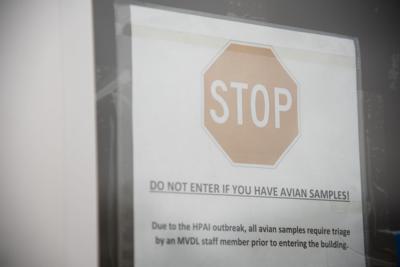
It’s meant a busy year for Montana Fish Wildlife and Parks and the state’s Veterinary Diagnostic Lab, which are sampling and testing animals to see how the H5N1 strain has spread across species.
According to lab data as of March 31, employees have confirmed one black bear, two grizzly bears, two raccoons, one red fox, and six striped skunks as “non-negative” for bird flu. The samples are then sent to a national lab in Iowa where they are confirmed positive.
The lab also confirmed the influenza strain in three bald eagles, five turkey vultures, 13 red-tailed hawks, and 21 great horned owls.
The situation is much different than the last time an HPAI outbreak roiled the country, said Erika Schwarz, the clinical veterinary microbiologist who’s in charge of leading the bird flu testing for the state lab.
That outbreak, which spanned from December 2014 to June 2015, killed more than 50 million birds across the country. Cases went down as the weather got warmer.
But this time around, animals continued to contract the virus through the summer. A year later, the outbreak has killed 58 million domestic birds in the U.S. and counting, and impacts to wild birds and mammals have been more severe too, Schwarz said.
Montana’s lab didn’t test mammals for bird flu during the last HPAI outbreak or at start of this one, according to Schwarz.
That changed in October, when Montana officials started hearing of mammals contracting bird flu in other states.
The lab had saved samples from two grizzly bears, and a black bear originally misidentified as a grizzly, who were all euthanized for neurological problems. Originally, officials thought the bears had rabies, but those tests were negative.
Schwarz said a few weeks later, on a whim, the lab thought to test those samples for bird flu and were startled to see them come back positive.
Clinically, the symptoms for rabies and bird flu are the same, Schwarz said. Animals will show signs of neurological distress, like abnormal movements and circling, tremors, seizures, and not fearing humans.
Since the bears, the lab has started to test any animals with those symptoms for both rabies and bird flu.
It’s a heavy workload for the lab’s employees, but Schwarz said they’re trained to handle high amounts of testing. Cases have slowed a little this winter, but they’re expecting them to pick back up again, Schwarz said.
“This outbreak and how long it’s persisted is unusual,” Schwarz said. “It’s left a lot of scientists just baffled.”
In the last outbreak, Montana didn’t see wild bird die off so there weren’t infected dead birds on the landscape for other animals to get into, said FWP wildlife veterinarian Jennifer Ramsey. That’s changed now.
Last week, three domestic cats — two in Nebraska and one in Wyoming — contracted the virus after eating wild birds. A dog in Canada died of bird flu the week prior.
“It’s not something new — mammals have been infected with avian influenza viruses in the past,” Ramsey said. “We just haven’t dealt with it to this extent here before. It’s concerning.”
People should make sure to keep their pets away from dead birds, and always wear gloves if they have to handle a carcass, Ramsey said.
U.S. health officials are monitoring how the virus is changing overtime, Ramsey said. The longer the virus circulates and the more species it infects, the easier it is to mutate.
So far, there’s no evidence of the virus spreading from mammal to mammal, which would cause significant concern, Ramsey said. A handful of humans who worked closely with infected birds got the virus in 2022 but recovered.
The threat of mammal to mammal spread was amplified when animals at a Spanish mink fur farm died from bird flu in January. But Schwarz said those animals were in such close proximity to each other, allowing a greater opportunity for the virus to spread quickly through many animals.
“When we think about the types of mammals that we see acquiring the virus here, they are mostly solitary or semi-solitary carnivores and mesocarnivores,” Schwarz said. “So the risk of seeing this kind of rapid mammal-to-mammal spread would probably be quite a bit lower.”
People should report any unexplained animal mortalities to FWP, Ramsey said. While the state has limited resources, and tries to focus testing on areas and species where bird flu hasn’t been confirmed yet, reports help officials better understand where the virus is.
Cases in mammals have been concentrated in places like Bozeman and Missoula, where there are more people to report mortalities. But that’s not to say other parts of the state don’t have similar amounts of virus that’s going undetected, Ramsey said.
“Montana is a very large, rural state… if I’m sitting here at my desk in Bozeman, I have no idea what somebody may be seeing in another town,” Ramsey said. “So having those calls and reports is helpful.”
 Exposing the Big Game
Reblogged this on Exposing the Big Game.