
There is no special place in our cosmos, as far as we can tell.
DR. ALFREDO CARPINETI
Senior Staff Writer & Space Correspondent
 PublishedMay 29, 2023
 63Comments
 1.9kShares
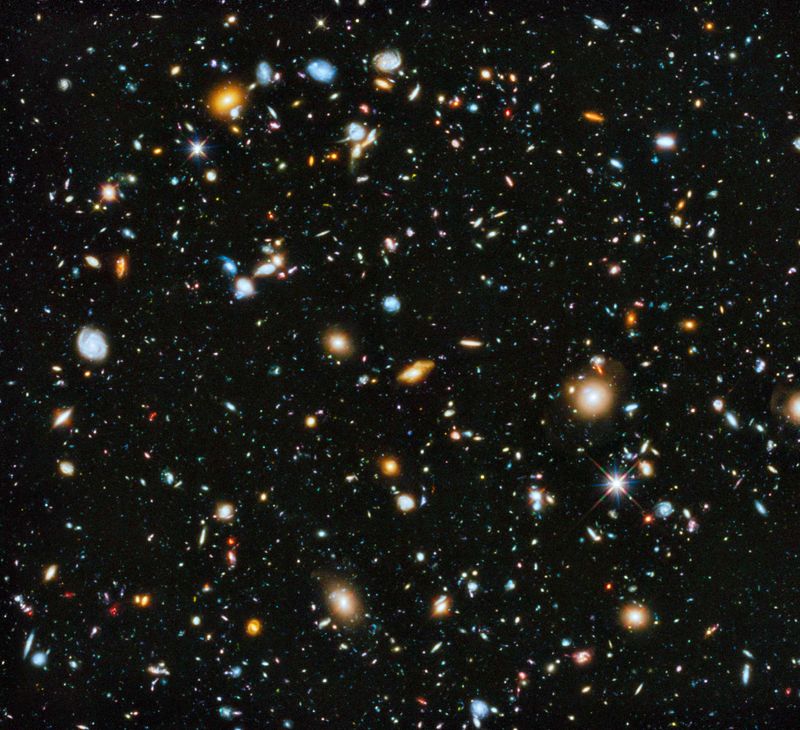
About 14 billion years ago, everything we know of started with the Big Bang. A common misconception, however, is to envision it as an explosion. The actual event did not explode into anything; space and time were created as the universe began. Picturing it as an explosion makes us also think that it started at a single specific point – but this is not the case.
https://imasdk.googleapis.com/js/core/bridge3.575.0_en.html#goog_461915233
https://imasdk.googleapis.com/js/core/bridge3.575.0_en.html#goog_553714507
https://imasdk.googleapis.com/js/core/bridge3.575.0_en.html#goog_333954242
https://imasdk.googleapis.com/js/core/bridge3.575.0_en.html#goog_1238903802
https://imasdk.googleapis.com/js/core/bridge3.575.0_en.html#goog_1238903803 Top Stories01:0301:12


 Oldest Evidence Of Plague In Britain Identified Via4,000-Year-Old Teeth
The Big Bang happened everywhere. In your right hand and your left hand. In the town of Whynot, North Carolina, and in the Andromeda Galaxy. When astronomers say everywhere they really mean everywhere; because there was no single point where it began, all distances in the universe were zero, so every point in the universe was effectively in the same place: everywhere.
Is there a center of the universe?
The short answer is no. The longer answer is as follows.
The visible universe is about 94 billion light-years across. It is everything that we can see. If we consider that, we are at its center. It is the visible universe after all. What we see has two very important properties defined by cosmologists: it is isotropic and uniform. Isotropic means it looks the same in whatever direction you look at and uniform means that at the largest scale it’s the same everywhere.
These facts inform us a little about the universe as a whole, which is much bigger than the universe that we can see. We don’t know how much bigger yet or what the whole universe is like, so our patch of the universe might be special or might be representative of the whole.
To infinity and beyond
The easiest scenario to deal with is that the universe is infinite. Something that is infinite doesn’t have a center. Now, our little ape brains did not evolve to visualize the concept of infinity but if something goes on forever we can consider there is no special middle point.
However, it’s not certain that the cosmos goes on forever, it could well be finite. Our experience with the world tells us that if something is of a finite size then there is a center, for example think of a cube or a sphere. Unfortunately, our experience doesn’t translate to the universe as a whole because the geometry that we are most familiar with is not the geometry of a finite universe. We have to deal with the concept of curvature, and once again our brains are not built to deal with curvature in three dimensions.
An easier (but imperfect) analogy is this: “If you think about the surface of a sphere, if that’s all there is it doesn’t have a center. The center of the sphere is outside of that space, right? It’s not a real thing,” Professor Peter Coles, a theoretical physicist at Maynooth University, told IFLScience.
“You think of a sphere as being embedded in a three-dimensional space, and the center is in that three-dimensional space. But if all there is the two-dimensional space, it doesn’t have a center.”
This is all to say, the universe doesn’t have a center. Our physics, as far as we can tell, operates in the four-dimensional space-time continuum. Looking at it with more dimensions the curvature might imply a central position. But if there is one, it is not part of our universe, as we can understand it.
 Exposing the Big Game
Reblogged this on The Extinction Chronicles.