
Researchers are making discoveries that show that horses persisted in North America well beyond the end of the Ice Age, the period long thought to be when horses became extinct on the continent.
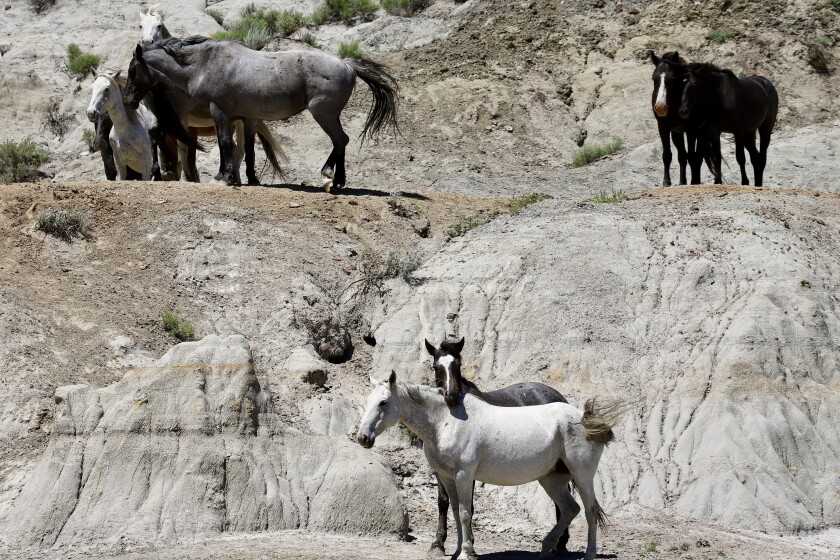
June 19, 2023 at 4:26 AM
News reporting
MEDORA, N.D. — The wild horses at Theodore Roosevelt National Park have a mark against them in the eyes of the National Park Service: Park officials don’t consider them a native wildlife species.
Native species status is given to the bison, elk, pronghorn, white-tail and mule deer as well as prairie dogs among species of grazing mammals. Park officials say their mission is to conserve native species and their natural habitat.
Therefore, “invasive” species not recognized as native are given a lower status and priority — and, in the case of the wild horse herd and longhorn steers, both now categorized as “livestock,” have been proposed for gradual elimination from the park.
For years, the scientific consensus has been that horses became extinct in North America more than 10,000 years ago, and that horses were reintroduced to the continent about 500 years ago by Spanish explorers.
But that long-held belief is coming under increasing scrutiny, and in light of recent findings some scientists are challenging the widely accepted view that horses aren’t a native species.
Extinct, then reintroduced
Horses indisputably originated in North America, with the species today emerging 1.5 million years ago. Their equid predecessors date back much earlier — 55 million years, making them one of the earliest mammals to roam the continent.
Although scientists widely agree that the horse became extinct in North America around the time of the last Ice Age, evidence shows they migrated across the Bering Land Bridge to Europe and Asia.
Descendants of those migrant horses then were reintroduced to North America, where the species originated.
Advances in techniques for examining ancient DNA from permafrost samples reveal that horses were in the Yukon several thousand years after they were believed to have gone extinct in North America.
That evidence — just one of a string of recent discoveries — shows the lasting connection horses had to the continent, said Ross MacPhee, curator emeritus of vertebrate zoology at the American Museum of Natural History in New York.
“Horses were present in that area right up to about 6,000 years ago,” he said.
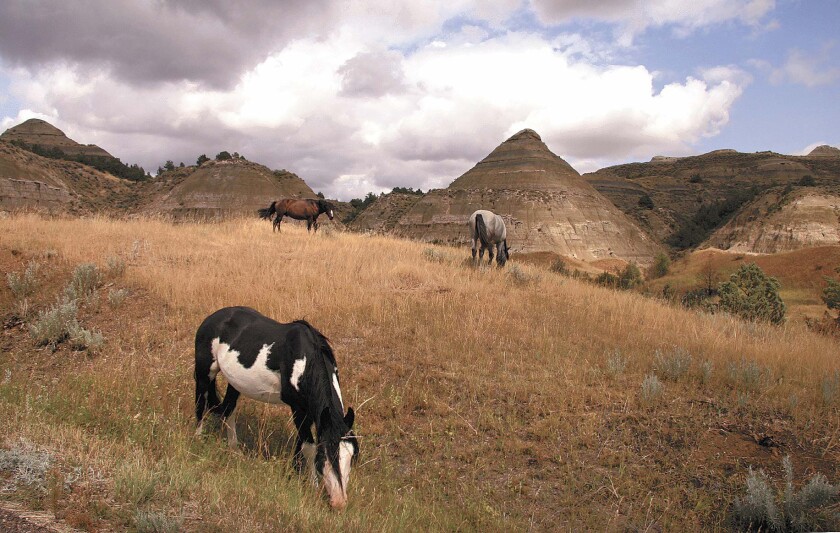
That means that, given the current knowledge of the fossil record, there is a gap of only 5,500 years where the horse was absent from North America, a blink of an eye in the biological time scale, MacPhee said.
In fact, more recent discoveries indicate the gap in the fossil record between the presumed extinction of horses in North America and their introduction is even narrower.
More recent research published last year has uncovered DNA samples from Yukon sediments dating to about 3,800 years ago , narrowing the gap until the Spanish reintroduced horses to about 3,500 years.
Also last year, a team of researchers published findings of DNA from fossilized horse bones in Mexico dating back 1,800 years , leaving a gap of 1,500 years between the last horse evidence and their reintroduction by the Spanish.
The bone samples from Mexico, however, might not be for Equus caballus, the species of modern horses, but related Equus mexicanus or Equus giganteus, a giant horse breed in North America. Taxonomic work to classify the specimens continues.
Researchers have noted that dental patterns, often used to identify ancient horse species, are variably and not always reliable in determining a specimen’s species.
Equus caballus, the species that survives today, probably was the most common large land mammal in North America during the Ice Age, and their fossils have been discovered from southern Mexico to Alaska.
The team of researchers that analyzed the Mexican horse specimens noted that there is “ongoing confusion” in identifying closely related Ice Age horse species. They concluded that “horses may have persisted” in the region of Mexico they studied “well after” the late Ice Age extinction period.
The authors of the study noted that a “small contingent of researchers” has held the opinion that horses survived “well beyond” the end of the Ice Age. The researchers also noted that “more and more evidence seems to imply” that certain mammals “persisted through the presumed extinction event.”
‘Mind-boggling’ disparity
In public comments in support of keeping horses in the park, people have cited the growing body of research calling into question the extinction of horses in North America, or noting the decreasing gap in the fossil record between the time horses became extinct and were reintroduced.
Modern horses share a common general inheritance with ancestral horses that lived in North America, making the claim that horses are not a native species tenuous and not meaningful, MacPhee said.
“Why not say they’re in the same lineage?” he said. “For most people, that should be enough.”
Equus caballus — all surviving species of the horse family tree — originated in North America about 5 million years ago and lived on the continent until about 5,500 years ago — a period that far predates the migration from Eurasia of the ancestors of the modern bison about 180,000 years ago, considered the national mammal, he said.
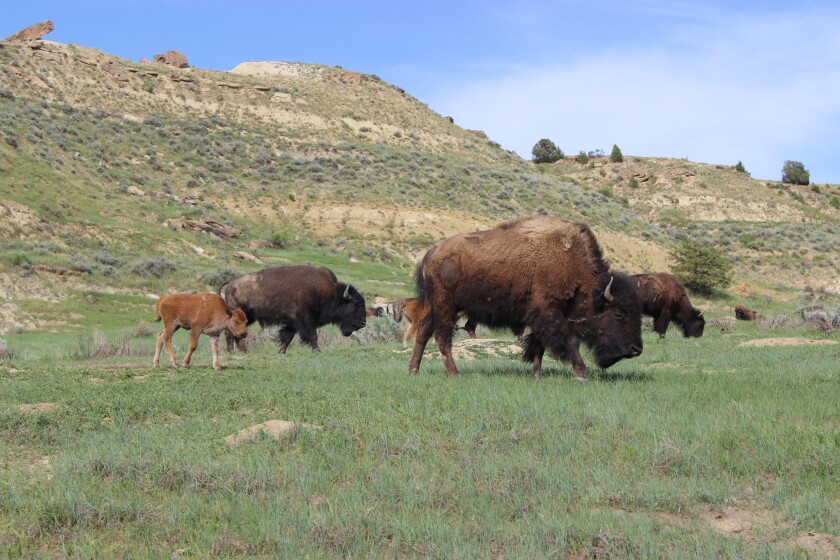
“I’m just flabbergasted that we can consider the buffalo as our native species,” MacPhee said.
He added: “Horses have been part of the landscape, or at least equids have been part of the landscape, for millions and millions of years.”
Many other species have disappeared since then, making the horse’s long tenure significant, he said.
MacPhee was quick to add, however, that he isn’t bothered by the bison, which has been declared the United States’ national mammal, but is troubled by the “disparity,” which he finds “mind-boggling.”
As for Theodore Roosevelt National Park’s determination that horses are not a native species, and shouldn’t be kept in the park, MacPhee has a question: “What is it that you don’t want about horses on the landscape? They’re ours.”
The horses in the park, which descended from ranch stock and stray Indian ponies, with part of the herd’s lineage traced to horses surrendered by Sitting Bull and his followers, also have historical value, MacPhee said.
“Why are you suppressing this particular species?” MacPhee asked. “What’s the point of doing that?”
Park officials have declined to answer The Forum’s questions, but have said they have “no basis” to allow horses in the park because they consider them livestock — a designation horse advocates have said is baseless.
Removing the horses, park officials have said, would allow grazing species they consider to be native, including elk, pronghorns and deer, to be more resilient with less competition for grass.
MacPhee rejects arguments that horses are tougher on grass than other browsers. Unlike bison, horses can’t digest seeds, which pass through their digestive tracts whole and are deposited on the soil, where they can grow, he said.
“They’re gardeners in a way cattle will never be,” he said.
Native status a ‘gray area’
Gus Cothran, an equine geneticist at Texas A&M University who has studied the ancestry of the horses at Theodore Roosevelt National Park, agreed that horses originated in North America and said “all evidence points to their extinction about 10,000 years ago.”
He added: “There is no evidence that the horse did not go extinct in North America. Trying to prove a negative is a very difficult thing.” Before going extinct in North America, horses crossed the Bering Land Bridge and made their way to Asia, Cothran said.
“All modern horses derive from the horses that were domesticated in western Asia about 4,000 years ago,” he said. “However, there is evidence that other wild horses contributed to the population, probably to a very limited extent.”
Cothran said there is no direct, unbroken link between the horses that originated in North America and modern horses.
“We have no evidence of North American horses after 10,000 years existing and contributing to the modern horse,” he said. “There are no bone discoveries that I’m aware of that are absolutely certain to be after extinction but before Columbus.”

Erik Molvar, a wildlife biologist who is executive director of the Idaho-based West Watershed Project, said the question of whether horses can be considered a species native to North America isn’t clearcut.
“Horses are in kind of a gray area with regard to this,” with differing views of whether they went extinct on the continent, he said.
In his view, given the current state of scientific knowledge, it’s not possible to say whether horses are a native or non-native species.
They are an indigenous species. “They are from here, they evolved here to this species,” Movar said.
It’s important to note, he added, that there is not an agreed-upon scientific definition of native species. “Native is not a rigorous scientific term,” he said. “It’s loose. It means what people want it to mean.”
Still, Molvar said, it’s important to acknowledge that horses and their ancient ancestors have a deep history in North America — they’re known to have been present for 53.995 million years, with an apparent absence of 0.005 million years, he said.
But new paleontological evidence keeps surfacing. “They’re making new discoveries all the time,” he said. “What you don’t know is what hasn’t been discovered so far.”
 Exposing the Big Game
Reblogged this on The Extinction Chronicles.