Back in college, as part of a misguided foray into the study of “Natural Resources Technology,” I volunteered to help at a local Wildlife “Recreation” Area (as it was designated), in hopes of spending more time around animals. The first thing I was asked to do was go into their pheasant pen and help herd some of the birds into a portable cage (which it turned out was going to be trucked over to a shooting zone and released as targets for hunters).
As 20 birds were being crammed into the cage barely big enough for 2, one of the frightened birds got away and flew off to the imagined freedom of the “refuge.” But within seconds, a shotgun blast rang out. A hunter “recreationally” shot and killed the pheasant before it could get safely away from the insane situation.
Needless to say, I left and never returned to volunteer there again, and quickly abandoned all thoughts of working in the field of “wildlife recreation.”
Two threatened lynx were accidentally captured by bobcat trappers in northwest Montana, resulting in one mortality and a state citation. The case has drawn attention to an obscure set of regulations that anti-trapping organizations say runs counter to the conservation mission.BY TRISTAN SCOTTJANUARY 13, 2024
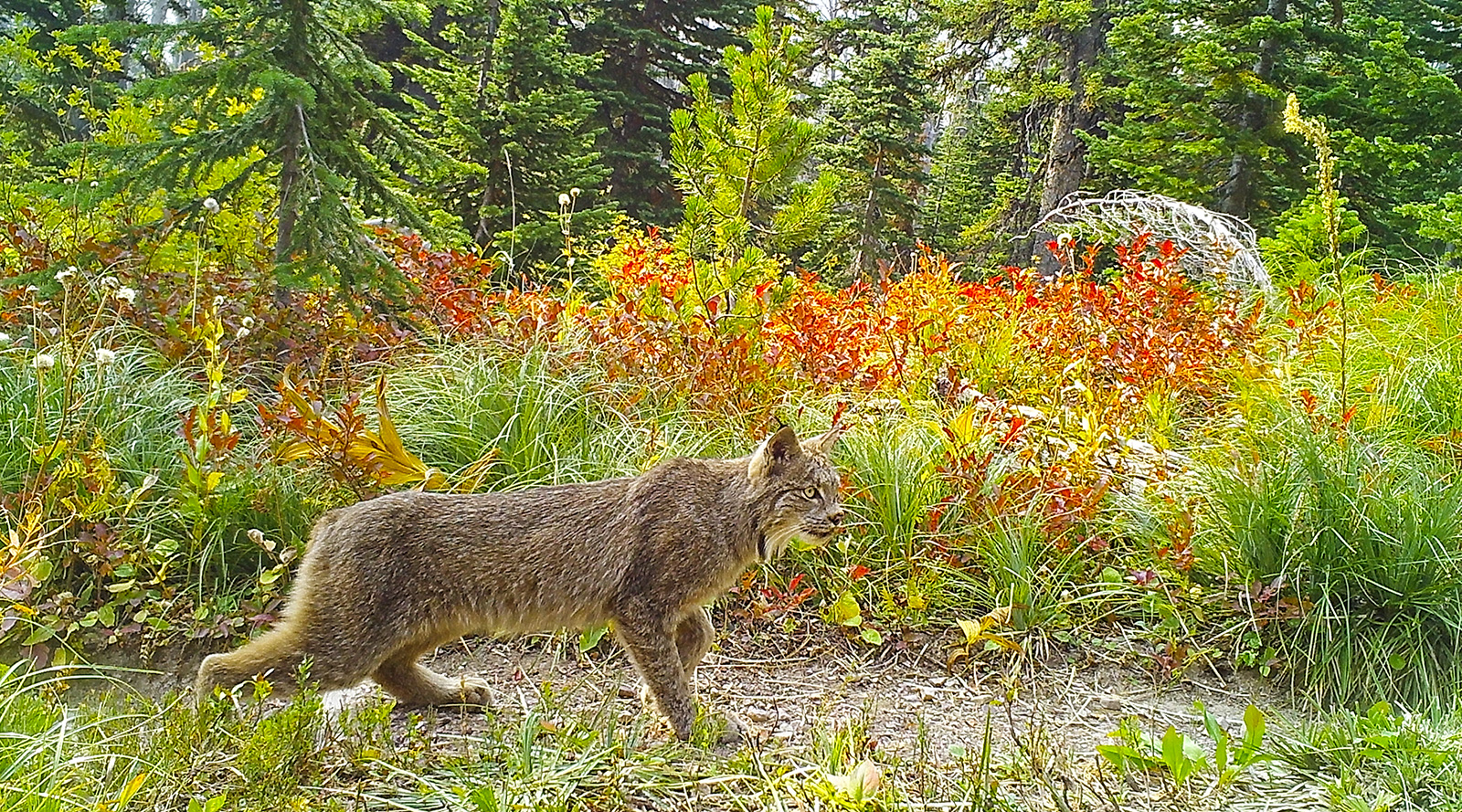
A lynx caught on remote camera in Glacier National Park on Sept. 17, 2020. Courtesy of Glacier National Park
Due to Montana’s participation in an international pelt export program, wildlife management officials have adopted exceptions for bobcat and wolf trappers whose legally set trap lines result in the “incidental take” of endangered Canada lynx, with separate allowances and guidelines surrounding the trapping seasons for both wolves and bobcat.
Essentially, the U.S. Fish and Wildlife Service (USFWS) has established an allowable incidental take for lynx in the lower 48 states. The concept of “allowable take” acknowledges that in states with bobcat trapping seasons, some incidental capture of lynx is possible. With “allowable take,” the USFWS establishes a number of incidental captures that would be “allowable” and still provide for the conservation of the species, which in the contiguous United States was listed as threatened under the Endangered Species Act in 2000.
And while debate has swirled around the state wildlife commission’s decision to lengthen the 2023-24 wolf trapping season by over a month, with litigants successfully challenging the extended season on the grounds that it increases the likelihood of incidental captures involving grizzly bear cubs, it’s rare that the bobcat trapping season results in the allowable take of Canada lynx.
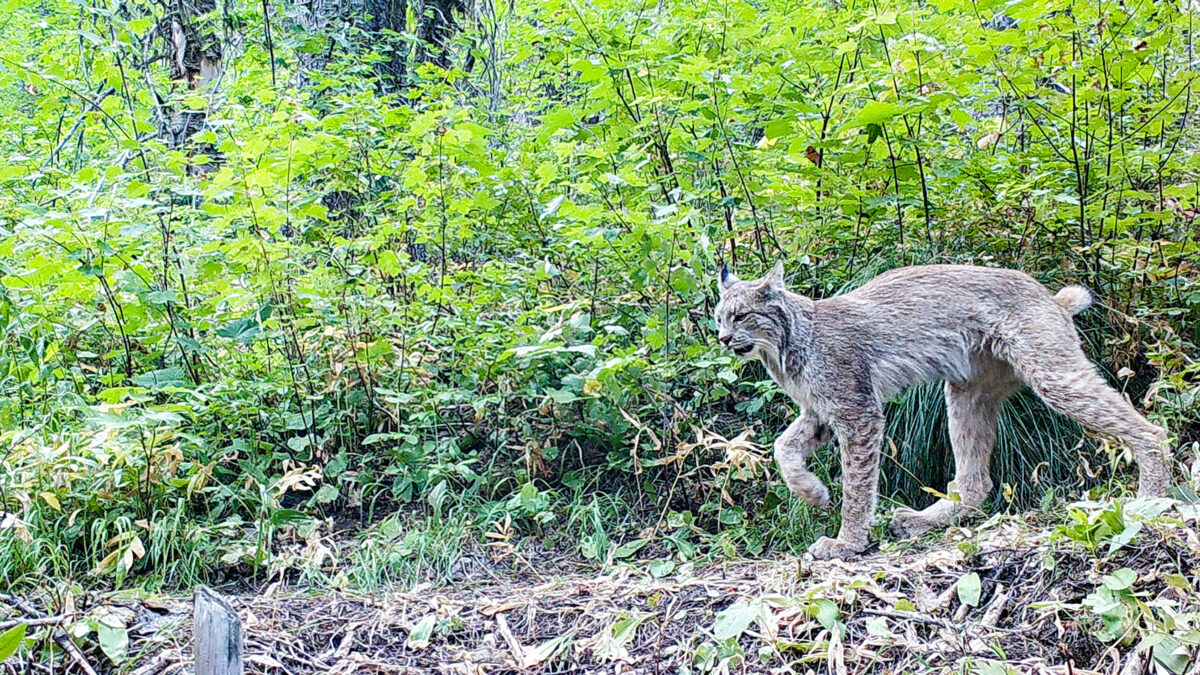
A lynx caught on remote camera in Glacier National Park on Aug. 4, 2021. Courtesy of Glacier National Park
But last month, the issue reared its head for the first time in more than a decade when not just one but two lynx were captured in rigs set for bobcat, and while one of the critters was released uninjured, the other animal died. Because the trap that resulted in the killed lynx was an illegal set, the trapper was issued a citation by a Montana Fish, Wildlife and Parks game warden, and the death won’t count toward the state’s “allowable take” tally because, well, it wasn’t allowable.
“This gets complicated, but under CITES, Montana has a permit that allows for legal bobcat trapping in Montana and for legally harvested furs to be sold. And under that permit is this allowable take for lynx killed or captured in legally set traps,” explained Greg Lemon, FWP’s statewide communication and education division administrator. “That allowance is for six captured and released bobcats and/or three killed bobcats within a three-year window in the lower 48. And that is in legally set bobcat traps. We believe that the bobcat trap that killed the lynx was an illegal set, so it won’t count toward the allowable take total.”
Lemon said the last incidental lynx captured before the two in December was back in 2013. He said data on whether that incident involved a lynx that was killed or released was not available.
Allowable take of lynx in the lower 48 states is six trapped/captured or three killed/captured as a result of legal bobcat trapping within three consecutive years. The state of Maine operates under its own allowable take permit and so is not included in the remaining lower 48 states. Recently, a lynx in Minnesota was killed in a trap, and two lynx were trapped in Idaho but were released during the 2021 trapping season. Under that arithmetic, and excluding the recent death in Montana, the current number of lynx incidentally trapped in legal sets stands at four captured and one killed in the three-year window.
If the allowable take number is met, the USFWS would initiate a review to ensure conservation of the species.
On Jan. 8, the Beacon submitted a public records request to obtain a copy of the citation issued to the trapper by FWP, which Gail Eblen, FWP’s public records team lead, said can take up to 30 days to fulfill. The citation was filed in Flathead County Justice Court, but without a case number, the name of the game warden that issued the citation or the violator’s name and date of birth — information that FWP declined to provide — court officials could not fulfill the Beacon’s request for the records.
According to Lemon, both captures were self-reported to state wildlife officials and occurred in a lynx protection zone in the Flathead Valley; however, the illegal set that killed the lynx and resulted in a citation was a technical violation. Traps set using an anchor chain greater than 12 inches in length are required to have a “swivel” attached at the trap and another attached within 12 inches of the trap, a requirement aimed at reducing the risk of injury or death to a captured critter writhing in a trap.
The FWP warden issued a citation to the trapper because the configuration of the set was missing one of the swivels, Lemon said.
“With the two swivels, an animal can rotate and rotate and rotate and the anchor chain isn’t likely to bind up and cause injury,” Lemon said. “But that wasn’t the case here.”
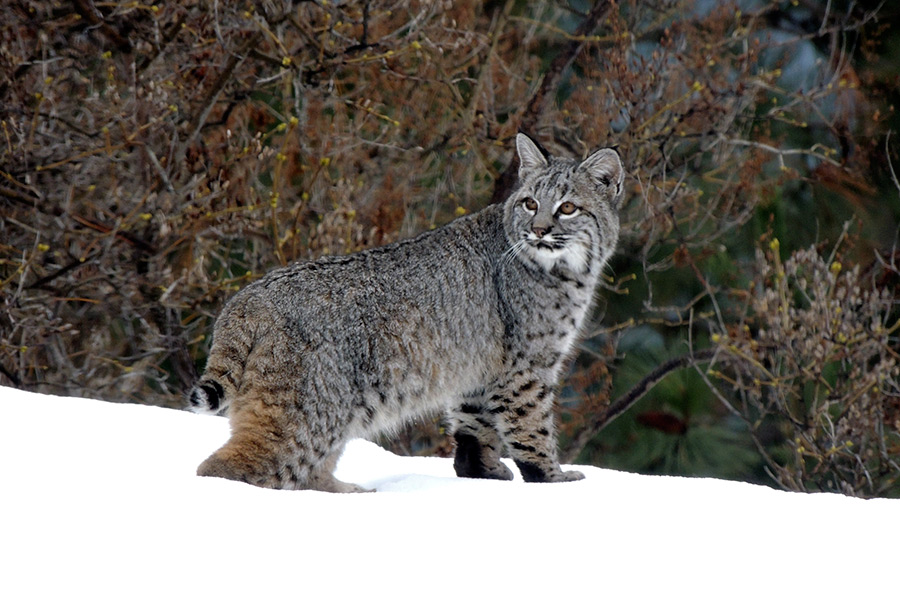
A bobcat along the Swan Range. Courtesy photo
In the 2023 Wolf and Furbearer Regulations, the state wildlife commission recognized lynx protection zones and special restrictions for trapping within those zones to minimize incidental capture of lynx. Trappers who inadvertently capture a lynx must release it unharmed if possible and report it to FWP within 24 hours, or if it’s wounded contact FWP immediately to “determine disposition and/or collection of the animal.”
Montana also has specific trapping regulations to reduce the potential capture of lynx. For example: Lynx protection zones (LPZ) prohibit wolf snaring on public lands; wolf foothold traps in Regions 1 through 5 are required to have a minimum of 10 pounds of pan tension; no natural feathers or pieces of fur can be used in the LPZs so that lynx are not visually attracted to the set intended for another species; bobcat and wolf traps set in the LPZs are required to be checked every 48 hours. Regulations for conibear traps are also more restrictive in the LPZs to mitigate the potential of catching a lynx, and all snares in the LPZs are required to have a relaxing lock, which decreases the lethality of the device.
“We are dedicated to and have demonstrated dedication to the conservation and protection of lynx in particular, and those CITES rules are there for a reason,” Lemon said. “We want to keep a close eye on what’s happening so that if things change we can go to the commission to look for a course adjustment or changes that are needed to stay within the rules and protect lynx.”
But critics of “allowable take” say those rules shouldn’t be at play on landscapes where threatened and endangered species like lynx occupy large chunks of habitat.
“When the USFWS is allowing incidental take, they are allowing the hunting of lynx,” said Jessica Karjala, executive director of Footloose Montana, a nonprofit organization that opposes trapping. “Why claim to protect a species if incidental take is allowed? The USFWS have no real way of monitoring traps and trapping, so there is no telling how many lynx are being killed by traps and/or not reported. In a similar manner, Montana FWP can claim they are ‘watching the circumstance very closely’ but it’s lip service. Trapping is indiscriminate and kills animals in the most cruel way – by design. The bottom line is that when the USFS allows incidental take and the FWS allow self-reporting, lynx are not being protected.”
SÃO PAULO, Brazil — Vegans are less susceptible to contracting COVID-19, a new study concludes. The research indicates that individuals adhering to a mostly plant-based or vegetarian diet have a 39-percent lower risk of infection from this potentially fatal virus.
Published in BMJ Nutrition Prevention & Health, the study proposes that a diet rich in vegetables, legumes, and nuts, and low in dairy products and meat, could contribute to reducing the risk of contracting COVID-19.
Previous studies have implied that diet might significantly influence both the development of a COVID infection and the severity of its associated complications. Brazilian researchers assessed the impact of dietary patterns on the prevalence, severity, and duration of COVID-19 among 702 adult volunteers. These participants were asked about their typical dietary habits, lifestyle, medical history, and COVID-19 vaccination status.
The study authors categorized the volunteers into two dietary groups: omnivorous (424 participants) and predominantly plant-based (278 participants). They also subdivided the latter group into flexitarians or semi-vegetarians, who consume meat a maximum of three times a week (87 participants), and vegetarians including vegans (191 participants). Those on plant-based or vegetarian diets typically consumed more vegetables, legumes, and nuts, and less or no dairy and meat.
(Bloomberg) — President Joe Biden said the US did not support independence for Taiwan, after voters there defied China and returned the governing Democratic Progressive Party — which has sought to limit Beijing’s influence — to a third consecutive term.
“We do not support independence,” Biden told reporters Saturday as he departed the White House for Camp David.
The president’s comment appears intended to assuage concerns in China, who had hoped Taiwan’s current vice president, Lai Ching-te, would not be elected president. Results showed Lai, who has maintained close ties with the US, edging out Hou Yu-ih of the opposition Nationalist Party, who had pledged to expand trade and diplomacy with China.
China has long claimed that the island of Taiwan is its territory, and President Xi Jinping has advocated for unification and refused to rule out a military intervention.
The US has traditionally adopted a policy of strategic ambiguity, where it acknowledges China’s historical claims to sovereignty over Taiwan and maintains only unofficial relations with Taiwan while pledging defense assistance to the island. Still, suggestions by Biden that the US would intervene militarily if China were to invade Taiwan have roiled the relationship between the US and Beijing.
Related video: Taiwan Elections 2024: Voting underway with China eyeing more power in strait (WION)
that politician would suffer great weaknesses in any election in
Loaded: 72.39%Play
Current Time 1:51
/
Duration 4:00Quality SettingsCaptionsFullscreen
WION
Taiwan Elections 2024: Voting underway with China eyeing more power in straitUnmute
US Secretary of State Antony Blinken said the election shows the strength of Taiwan’s “robust democratic system” and reiterated that the US “is committed to maintaining cross-Strait peace and stability, and the peaceful resolution of differences, free from coercion and pressure.”
The US will work with Lai and all party leaders in Taiwan “to further our longstanding unofficial relationship” consistent with the US’s one-China policy, he said in a statement.
House Speaker Mike Johnson will ask a delegation of House lawmakers to travel to Taipei after Lai’s inauguration in May, he said in a post on X, formerly known as Twitter.
–With assistance from Ashleigh Carrington Fields.
(Updates with Blinken, Johnson statements starting in sixth paragraph.)
The number of fish who die annually from human activities surpasses that of any other vertebrate, and yet many people still believe that it’s more ethically permissible to kill a fish than, say, a pig or a cow. This may be because fish look and behave so radically differently from humans; the underwater, otherworldly life of a fish is so distinctly inhuman that it’s difficult to believe that their experiences are in any way like ours. But their experiences are like ours — at least, as far as the scientific proof that fish also feel pain goes.
Multiple studies have demonstrated that fish both possess the anatomy necessary to produce pain and exhibit all of the standard biological responses to noxious stimuli that we would expect if they could feel pain. And if fish can feel pain, that means the fishing industry is inflicting mass suffering on an almost inconceivable scale.
“Be it recreational angling, large-scale fisheries, ornamental fish — any way that we use fish, we need to consider treating them better, as if they experience pain,” Dr. Lynn Sneddon, director of Bioveterinary Science at Liverpool University, tells Science Focus. “We should treat them with the same consideration we afford to mammals and birds.”
When one considers the sheer scale at which fish are being killed, the suffering of fish is worth dwelling on.
Are Fish Capable of Feeling Pain?
The simple answer is yes. Many scientific studies over many years have demonstrated that fish feel pain. To be precise, this doesn’t just mean that fish physically react to potentially injurious stimuli, but rather, that they actually experience a sensation of pain.
To begin with, fish have nociceptors, also known as pain receptors. These receptors, which humans and many other species also possess, are activated when the body is injured or exposed to potentially dangerous stimuli, such as extreme temperature or pressure. The purpose of nociceptors is to communicate to the brain, via a pain sensation, that the body is experiencing a potential threat, so that the person or animal may respond accordingly.
When fish are pricked with a pin behind their gills, their nociceptors produce a rush of electrical activity to the brain. This activity doesn’t just head to the parts of the brain that are responsible for involuntary reflexes, which is what one might expect if fish responded physically to painful stimuli but didn’t actually experience pain. The nociceptors also stimulate areas of the brain that are crucial for conscious sensory experiences, like the cerebellum, the tectum and the telencephalon.
Experiments That Prove Fish Feel Pain
In addition to their biology, fish behavior also suggests that they feel pain. In a study conducted by the University of Liverpool, zebrafish were given a choice of two tanks: One was barren, while the other was enriched with pleasant views of other fish and foliage. Initially, the zebrafish chose to be in the enriched tank. However, some of the fish were then injected with acid, while the barren tank was pumped full of painkillers. The fish who’d been injected with acid moved to the tank with the painkillers.
A similar study, conducted by Sneddon in 2002, sought to test fishes’ psychological states, not just their physical reactions, when exposed to pain. This time, the subjects were rainbow trout.
First, Lego blocks were dropped into their tank; under normal circumstances, a trout will avoid an unfamiliar object in its presence. But the trout in this study were injected with acid, and once they were, they stopped trying to avoid the Legos — presumably, because they were distracted by their own pain. Meanwhile, a second group of trout was injected with acid and then morphine, a powerful painkiller. The trout who received the acid and the morphine behaved as they normally would have (that is, by avoiding the Legos).
Crucially, morphine does not eliminate the source of pain, just the experience of it. The trout who received the morphine weren’t in any less danger from the acid than the other trout, and yet their behavior was completely different. This disparity in behavior only makes sense if the two groups of trout were having different experiences; the difference, Sneddon’s team concluded, is that one group of fish was experiencing pain, while the other was not.
“When subject to a potentially painful event, fishes show adverse changes in behaviour such as suspension of feeding and reduced activity,” Sneddon wrote in a 2019 meta-study of existing research, “which are prevented when a pain-relieving drug is provided.”
Effects of Analgesics on Fish
Naloxone is a drug that reverses the effects of morphine and other opioids. Studies have shown that when naloxone is administered to fish who’ve previously been given opioids, the effects of the opioids are inhibited or reversed, and nociception becomes active in the fish again. This further cements the fact that fish have a sensitive nervous system, whereby nociception causes a pain response in the brain that is suppressed by painkillers, and which returns if the painkillers are negated with naloxone.
Avoidance Learning in Fish
Fish have also demonstrated avoidance learning, meaning that they can remember indicators of noxious stimuli and avoid them. In one 2003 study, a light was shone into a rainbow trout’s tank ten seconds before a dip net was plunged in, frightening the fish. Over a five-day period, all thirteen fish from the study learned to flee once they saw the light, but before the net actually entered the tank. This, the researchers concluded, demonstrated that fish are capable of fear, and as such, that “they are sentient animals, more complex than previously thought.”
Do Fish Feel Pain When They Get Hooked?
Fish havenociceptors in their mouths, so it stands to reason that they’d feel pain when their lips are pierced with a metal hook. The science backs this up as well; in her 2019 study, Sneddon wrote that “when the fish’s lips are given a painful stimulus, they rub the mouth against the side of the tank, much like we rub our toe when we stub it.”
Do Fish Feel Pain When They Suffocate?
Suffocation is a common form of death for farmed fish. It can be an incredibly drawn-out process, with some fish speciestaking over an hour to die from asphyxiation. It also produces a severe stress reaction: Fish will flap, gasp, wriggle and flail while they’re asphyxiating, as they accumulate lactic acid in their muscles and succumb to rigor mortis.
But before any of this, the fish has to be lifted from the water into the air, and it’s likely this part of the process that causes them the most pain. Fish have a series of organs spanning the lengths of their bodies called the lateral line system. These organs are responsible for detecting minute changes in pressure and movement in the surrounding water, which fish use in order to navigate.
Thanks to the lateral line system, fish are extraordinarily sensitive to changes in water pressure. The rapid pressure change that occurs when a fish is pulled from the water into the air is so severe that it can rupture their organs, and is undoubtedly an excruciating process for them to endure.
Why Do People Believe That Fish Can’t Feel Pain?
Scientists have reached a consensus on the issue of fish pain, concluding that their suffering is real. But even without mountains of supporting scientific data, it would make little sense for fish to not feel pain. After all, pain avoidance is a survival mechanism, and fish seek to survive and pass on genetic material just like every other living being. They have brains, central nervous systems, and all the receptors needed to feel pain, and they exhibit all the same physiological and neurological reactions to noxious stimuli that other sentient animals do. In light of this, one would need particularly strong scientific proof to think that they don’t experience pain.
No such proof exists, and yet some people still deny the pain of fish. This is likely in part because they look and act so radically differently from humans, which makes them more difficult to relate to and empathize with. Fish are also a cornerstone of many peoples’ diets, which means it’s very inconvenient to seriously consider the possibility that they feel pain. It’s also worth noting that fish nociceptors weren’t discovered until 2002, so the science establishing that fish feel pain is relatively new.
Some have argued that because fish don’t have a neocortex — the part of the brain necessary for producing pain in humans — they must be incapable of feeling pain. But this point of view is “grossly anthropomorphic,” says Ed Yong, science reporter and author of “An Immense World: How Animal Senses Reveal The Hidden Realms Around Us,” as it “blithely assumes that the neocortex must be necessary for pain in all animals, since that’s the case in humans.” As Sneddon told Bon Appetit, the logical conclusion of this line of thought would be that “no animals except primates can experience pain.”
More to the point: for humans, the neocortex is responsible for learning, attention and sight, as well as pain. If lacking a neocortex meant fish didn’t feel pain, that would also mean they weren’t able to learn or see — which they most definitely are.
Is Fishing Cruel?
“It is clear that there is ample evidence for pain in fish,” Sneddon wrote in the Guardian. “We need to safeguard the welfare of these important animals and treat them with the same consideration that we give mammals.”
The word “cruel” denotes actions that willfully cause pain to others, and an indifference to their suffering. When we consider this definition, and mull on the fact that one does not have to eat fish to have a nutritionally sufficient and delicious diet, fishing and the consumption of fish — especially at the industrialized scale at which it occurs today — becomes much harder to justify. It causes unnecessary suffering, whereby people are willingly hurting animals when alternatives exist.
That said, there may be parts of the world where people must fish to survive.There’s also no denying that the amount of suffering caused by a single sports fisherman is minuscule when compared to that of an industrial trawler, which may kill thousands and thousands of fish — not to mention seals, birds, dolphins, and turtles who get snagged in its nets.
Yet any time someone hurts an animal when they don’t need to, they are arguably behaving cruelly. Due to humans’ affinity for seafood, fish continue to die gruesome deaths in overwhelming numbers, without any consideration for their welfare or experiences. Given the evidence that fish experience pain, the fact that humans kill trillions of them every year just might be a fact worth dwelling on.
A firefighter burns a pile of wood to reduce the amount of fuel in California’s Sequoia National Forest.
Benji Jones is a senior environmental reporter at Vox, covering biodiversity loss and climate change. Before joining Vox, he was a senior energy reporter at Insider. Benji previously worked as a wildlife researcher.
This story is part of a group of stories called
The biodiversity crisis, explained
In the dry mountains east of Fresno stands a pine tree that’s more than 4,800 years old. The tree, a bristlecone pine with a thick trunk and cartoonish branches, was alive when Egyptians built the pyramids, when Romans constructed their capital city, and hundreds of years before English settlers arrived on the East Coast.
Known as Methuselah, the pine is perhaps the planet’s oldest living organism, though it’s just one of the nation’s many ancient trees. Some giant sequoias, found elsewhere in California, are more than 2,000 years old. So are certain bald cypress trees in North Carolina. These trees are true elders, and our lives are but a blip in theirs.
An ancient Great Basin bristlecone pine tree known as Methuselah in California’s Inyo National Forest.
Old trees like these are now at the center of a longstanding controversy over how to manage the nation’s forests — and the valuable resources they contain.
In December, the Forest Service, a federal agency that manages about a fifth of all forested land in the US, proposed to sharply limit commercial logging in its old-growth forests, which cover nearly 25 million acres across the country. The Service aims to finalize the proposal by 2025. (Should the White House switch hands, the proposal may go nowhere.)
On the surface, the proposal — rooted in an executive order signed by Biden on Earth Day in 2022 — sounds straightforward. Old-growth forests, which are typically home to older trees and cover only a small chunk of the US, are important refuges for birds and other wildlife, many of which are threatened with extinction. They also store and absorb huge quantities of carbon that would otherwise accelerate climate change. Old-growth forests are worthy of protection, and that’s what this proposal aims to do.
Yet in reality, what it takes to protect old-growth forests isn’t clear-cut.
Many environmental advocates say it requires banning commercial logging, not only in old-growth forests, but also in those that are “mature,” the stage before old-growth. That’s well beyond what the government has proposed. The timber industry, meanwhile — and to an extent the Forest Service itself — argues that logging can make forests healthier and more resilient.
Complicating this dispute is the shifting threat to the nation’s forests. While logging eroded most old-growth forests in centuries past, climate change now threatens to destroy what little of these habitats remains.
A stand of giant sequoia trees in Sequoia National Forest in south-central California.
What exactly is an “old-growth” forest?
An old-growth forest is basically a forest with lots of old trees. From here, most explanations tend to fall off a cliff of interpretability.
The main challenge in defining old-growth is in defining “old.” Some trees, like redwoods, can live for thousands of years. Others, like dogwood, only live for decades. There’s no universal old age, no universal marker of old-growth.
Instead, scientists typically look for proxies of old-growth. These include things like the diameter of trees and their branches, the number of layers in the canopy, and the amount of dead wood on the forest floor. But again, these attributes vary by region. Some old forests, for example, are adapted to frequent fires, so they look very different.
Ultimately, this means that various research teams define old-growth somewhat differently and, in turn, come up with different estimates for the extent of old-growth forests in the US.
In this case, what matters most is the estimate by the Forest Service, which could determine where the government will restrict logging. In a report last spring, commissioned by the Biden administration, the agency estimated that there are nearly 25 million acres of old-growth forest on Forest Service land — or about 17 percent of the agency’s forested land — based on a complex set of definitions tailored to some 200 forest types. These forests include everything from the sprawling pinyon and juniper woodlands of the West to the oak and hickory forests to the east.
The Forest Service also identified an additional 68 million acres of “mature” forests — i.e., forests that are old but don’t yet meet the definition of old-growth. The Biden administration’s proposal doesn’t add logging restrictions to these forests.
Why these old trees matter so much
Before European settlers arrived, old forests covered vast stretches of the US and were managed in many regions by Indigenous tribes. Beginning in the 1600s, however, the timber industry emerged and ate its way through old-growth forests, from east to west. By World War II, much of the remaining old-growth forest was within public lands managed by the Forest Service.
Then, following the war, demand for housing surged. Companies — at the government’s behest — began logging national forests, too, including old-growth. This wasn’t scandalous. Historically, the Forest Service and timber industry were allies; they tended to view old-growth forests as unproductive and wasteful. National forests, then and now, were meant to be managed for multiple uses, including the production of timber.
Today, only a small fraction of the country’s old-growth forests remain. And they are precious. Scientists now know that these ecosystems as they naturally exist — with or without consideration for human wants and needs — are far from unproductive. Indeed, the health of the planet depends on them.
For one, old trees are exceptionally good at capturing and storing carbon. Old-growth forests tend to have larger trees than younger stands, and larger trees are made of more carbon-rich wood. They also typically have larger leaf-filled canopies, which operate like sponges, sucking in carbon dioxide from the air, helping to offset the impacts of greenhouse gas emissions. (There’s disagreement among scientists about whether, on a per-area basis, old-growth forests absorb more carbon than new-growth; it likely depends on the kinds of trees. What’s clear is that old-growth forests store more carbon than younger forests.)
Northern spotted owls are among the many animals that depend on old-growth forests.
Old forests are also tremendously important for wildlife. Birds like the marbled murrelet and mammals like the red tree vole need them to survive, said Matthew Betts, a forest ecologist at Oregon State University. It has to do with the forest structure. Big branches unique to older trees, for example, provide support for nests, and the thick layers of canopy help retain water. Many lesser known species including types of mosses, lichens, and insects — which help maintain these systems — rely on these habitats, too, Betts said.
As the planet warms, old-growth forests will become even more important for the nation’s wildlife. In 2017, Betts published a study showing that old-growth forests likely help buffer the negative impacts of rising temperatures on birds, likely, in part, because big trees with large canopies help cool the landscape.
“You walk into these places and it’s like outdoor air conditioning,” said Dominick DellaSala, chief scientist at Wild Heritage, a project of the nonprofit Earth Island Institute, who was not affiliated with the study.
These and other reasons — the cultural significance of old tree groves, the role they play in water cycles, and so on — are why environmental advocates have for years been fighting to stop commercial logging within remaining stands of old-growth forests. To that end, the Biden administration’s proposal is a start. Yet some say it doesn’t go far enough. Critically, it leaves out forests that are mature and will become old-growth in time, yet are not technically old-growth today.
“Just protecting the existing old growth when almost all of it has already been eliminatedis just not even a half measure,” said Jim Furnish, a forester who formerly oversaw the national forest system at the Forest Service. “The Forest Service views that entire landscape of mature forests as the playing field for timber industry now.”
In an interview with Vox, Chris Swanston, the Forest Service’s climate adviser and director of the agency’s office of sustainability and climate, emphasized that mature tree stands in national forests will — assuming they’re not intensively logged — eventually become old-growth forests. At that point, they’ll receive added safeguards under the new proposal. Old-growth is a status, not a place on the map, he told Vox.
Firefighting helicopters fly above the Patton Meadow Fire near Lakeview, Oregon, on August 14, 2021.
Representatives of the timber industry, meanwhile, say that further restricting logging in these habitats will backfire. The new proposal could actually put these forests at an even greater risk of disappearing, they say, by making them more likely to burn. This claim is not entirely unfounded.
Wildfire makes the debate over logging old-growth even more complicated
It’s not surprising to see environmental advocates and timber companies at opposite sides of a debate about logging. Climate change (and meddlesome humans), however, adds a bit of a twist.
As summers get warmer and dryer, especially in parts of the West, forests become more likely to burn. Past decades of intentional fire suppression by the US government have only added fuel. Between 2000 and 2017, the annual average area burned by large fires more than doubled, compared to the period between 1984 and 1999, according to the Forest Service. “The total area of high-severity fires, as well as the volume of trees killed annually by fire, is expected to increase further by 2070,” the Service reported.
Fire — not logging — is now the main threat to old-growth forests, according to the Forest Service.
Scientists have long known that, in certain forests, manually removing some trees and clearing out brush in the understory can help protect forests from burning down by essentially removing excess fuel. This process, known as thinning, is sometimes followed by controlled burns. Thinning to reduce the risk of fire is allowed in old-growth forests under Biden’s proposal.
Foresters aligned with the timber industry point out that logging can be used as a kind of thinning, even if the objective may be different. If done right, logging removes flammable fuel wood from the forest, some of which has only accumulated because of fire suppression (meaning it arguably wouldn’t be there had the government not suppressed fires in the first place).
“The Forest Service’s approach here is baffling,” Bill Imbergamo, the founding executive director of the Federal Forest Resource Coalition, an industry group, said in a statement after the Biden administration announced the proposal. “Congress has made it clear that job one is reducing the threat of catastrophic fires by thinning our National Forests, something our industry is more than capable of doing.”
There are cases when commercial logging has helped reduce the intensity of fires. Parts of the southern Sierra Nevada mountains, for example, have been spared from large blazes because they were selectively logged, according to a federal forest scientist. (The scientist asked to remain anonymous because he wasn’t authorized to speak to the press.) Similarly, some national parks, which are more narrowly focused on preserving the natural environment, have logged some of their lands and sold the wood to reduce wildfire risk, the scientist said.
Smoke from a prescribed burn rises above Sequoia National Forest.
There are even examples of when logging old-growth forests has apparently benefited wildlife, particularly species that are more dependent on younger trees. Following decades of fire suppression in parts of Michigan, jack pine forests aged into old-growth stands with fewer, larger trees. That was a problem for Kirtland’s warbler, according to the Forest Service, perhaps because the bird requires dense young stands of pine that help hide its ground-level nests. Logging the old forest and planting saplings created an environment that helped the species recover.
The upshot: Logging is not always bad, though it depends on how you define it and what purpose it serves. Removing a small number of trees in a dense understory, especially in places with a long history of fire suppression, may help forests avoid catastrophic blazes. Again, these sorts of actions would be allowed under Biden’s proposal. (Commercial logging also helps fund other activities within the Forest Service, according to Greg Aplet, a forest ecologist and director of special projects at The Wilderness Society, an environmental nonprofit.)
“As we are fostering old growth that is resilient to climate change, and all of the various threats associated with climate change, logging is a piece of that,” Swanston said. “It can help reduce hazardous fuels. It’s really not about locking out management.”
What’s more clearly a problem — from a carbon and biodiversity point of view — is logging for the primary purpose of commercial gain. That could include clearcutting a section of old-growth forest or taking out larger, older trees, actions that tend to be more profitable. This sort of logging typically doesn’t benefit forests or prevent them from burning, according to several forestry experts. Plenty of studies show that old trees and many old forests, like those comprising coast redwoods, areresilient to wildfires.
History matters, too. In some cases, past logging has made forests more likely to burn today, said Peter Fulé, a professor of forestry at Northern Arizona University. Younger trees that spring up after removing old growth have branches closer to the ground that can function as “ladder fuels,” helping flames rise into the canopy.
Do you have tips about the Forest Service or thoughts about how the US manages its forests? Get in touch with the author at benji.jones@vox.com.
In a sense, Biden’s proposal is subtle. It doesn’t so much ban logging in old-growth forests as it does put a big asterisk on it — should anyone cut down trees, they must do so with the primary objective of protecting them from wildfires, disease, and other threats. It’s also worth noting that only a small portion of commercial timber in the US comes from old-growth forests. This proposal, at face value, isn’t a major blow to the timber industry.
Yet it represents a significant shift in the way the US views the role of its forests. Long aligned with the timber industry, the Forest Service historically valued trees as a source of timber. It still does, but now more than ever the agency acknowledges a suite of other benefits trees provide to the American public, such as their role in reining in climate change by providing carbon storage — and that requires keeping them in the ground.




 Related video: Taiwan Elections 2024: Voting underway with China eyeing more power in strait (WION)
 WION
WION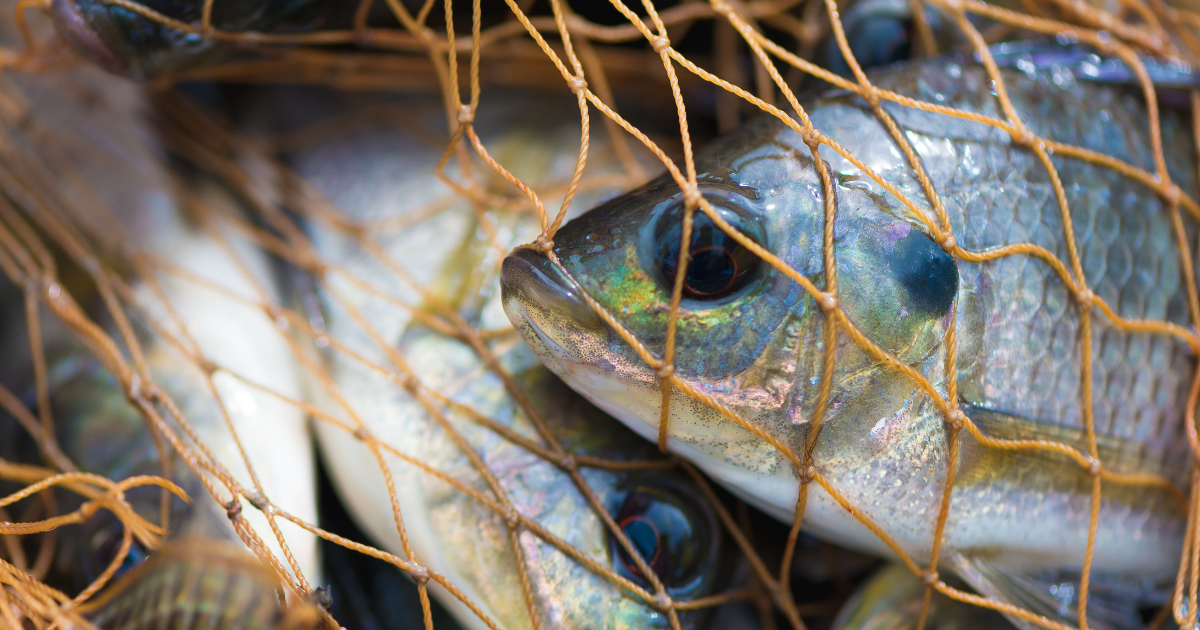
/cdn.vox-cdn.com/uploads/chorus_image/image/73048311/GettyImages_1467826143.0.jpg)
:no_upscale()/cdn.vox-cdn.com/uploads/chorus_asset/file/25219329/GettyImages_1236903015.jpg)
:no_upscale()/cdn.vox-cdn.com/uploads/chorus_asset/file/25217632/GettyImages_1418154353.jpg)
:no_upscale()/cdn.vox-cdn.com/uploads/chorus_asset/file/25218871/GettyImages_1338023794.jpg)
:no_upscale()/cdn.vox-cdn.com/uploads/chorus_asset/file/25218874/GettyImages_1234687779.jpg)
:no_upscale()/cdn.vox-cdn.com/uploads/chorus_asset/file/25219341/GettyImages_1467805293.jpg)
 Exposing the Big Game
