Wooly mammoth movements tied to earliest Alaska hunting camps
Reply

The groups allege that new rules, which were approved in December, do not go far enough to protect people and pets from risks associated with two activities: trapping and hunting coyotes with dogs.
By Emma CottonJanuary 17, 2024, 5:46 pm

Animal welfare groups have followed through on their promise to sue the state after the Vermont Fish & Wildlife Board moved forward with new hunting and trapping rules that, the groups allege, don’t align with the laws that spurred them.
Protect Our Wildlife Vermont, Animal Wellness Action, Center for a Humane Economy and the Vermont Wildlife Coalition filed the lawsuit Tuesday in the civil division of Washington County Superior Court.
It takes aim at the Vermont Fish & Wildlife Board — which approves hunting, fishing and trapping rules — along with the state Fish & Wildlife Department and Chris Herrick, the department’s commissioner. All three entities are named as defendants.
The groups allege that new rules, which the Fish & Wildlife Board approved in December, do not go far enough to protect people and pets from risks associated with two activities: trapping and hunting coyotes with dogs.
In 2022, state lawmakers passed two laws that required the state to update its rules governing both activities.
Lawmakers sought to make trapping more humane by passing Act 159, which requires the department to change the types of traps allowed and the locations where they can be used.
They approved Act 165 to establish the state’s first regulations on hunting coyotes with dogs, and, in particular, require hunters to have more control over their hounds. The goal was to reduce conflicts with property owners, recreators and domestic animals, and the law placed a moratorium on the activity until the new rules were in place.
Last month, the Legislative Committee on Administrative Rules objected to four pieces of the board’s new regulations, arguing that they did not go far enough in ensuring that the rules would keep animals and the public safe, as the laws had intended.
The lawmakers filed a formal objection, making the Fish & Wildlife Department more vulnerable to lawsuits. In the case of a lawsuit, without the full approval from the Legislative Committee on Administrative Rules, the burden of proof shifts to the state body — in this case, the Vermont Fish & Wildlife Department — which must then defend itself and prove that it acted within its legal authority when it approved the rule. If it is not successful, a court could reverse the regulation.
While the Legislative Committee on Administrative Rules argued that its objection should prevent the department from lifting the moratorium on hunting coyotes with dogs, the department recently opened permit applications for the activity. The animal welfare groups have asked the court to immediately reinstate the moratorium while the lawsuit is pending.
The lawsuit requests that the court declare both sets of regulations “contrary to the intent of the Legislature” and to nullify the rules.
For example, in the case of coyote hunting, the lawsuit points to GPS collars, which the new rules require. The practice of equipping dogs with such collars “has long been the usual practice and was widely employed by most coyote dog handlers” before the rules were passed, according to the suit, which argues that it does not solve the problem of keeping control over the dogs because handlers can still be miles away.
The suit contains a number of statements from people who have had negative encounters with dogs hunting coyotes — most of which involve the dogs coming onto land that is posted against hunting to attack a coyote or to harass domestic animals on the property.
In the case of the trapping rules, the groups argue the rules do not include adequate setbacks. For example, while the rules require that trappers don’t set traps near “public trails,” the definition of public trails did not include trails on private land used by the public, according to the lawsuit.
“Public hiking trails in Vermont often traverse private land, including many of the nearly 100 (Green Mountain Club) access trails, trailheads for the Long Trail, Appalachian Trail, and Kingdom Heritage trail, as well as many other publicly used trails on private lands in the state,” the lawsuit states.
Brenna Galdenzi, president of Protect Our Wildlife Vermont, told VTDigger that the Fish & Wildlife Board had not cooperated with animal welfare groups.
“This was their opportunity. Like, let’s clean up some of the really serious concerns we have with trapping and coyote hounding,” she said. “They did not meet the bare minimum, and they fought us every step of the way on it. It causes us to kind of reassess our path forward with these activities.”
In response to a request for comment, Herrick, the Fish & Wildlife commissioner, referred VTDigger to the Vermont Attorney General’s Office, which defends lawsuits against the state. Lauren Jandl, chief of staff for Attorney General Charity Clark, said the office had not yet been served the lawsuit and therefore was unable to comment.

Five years ago, Katie Dolan found a mountain lion cub in her backyard in Wolcott.
The animal was on the verge of death, orphaned and struggling to find food. Dolan said in inquiring about possible explanations for the cub being stranded with no mother to care for it, she learned that it was possible that the lion’s mother had been killed by a hunter.
“It was just so sad,” she said. “It made me realize this is so unsporting and inhumane, and that I needed to get more involved.”
The incident sent her on a quest to learn more about mountain lion hunting in Colorado, and she was bothered by what she discovered. She said more than the hunting itself, it’s the means by which animals are hunted that she finds disturbing.
Oftentimes, lions are hunted using electronic devices that mimic deer in distress, or packs of radio-collared hounds that chase the cougars up trees, allowing trophy hunters to locate the dogs on a tracking device and simply walk up to the tree and shoot the lion.
“Oscar Wilde once said about fox hunting, which I think applies perfectly to mountain lions, ‘The unspeakable in pursuit of the uneatable,’” she said. “And I really think that that’s the crux of what we’re looking at today.”
Dolan also said that the valuable role the apex predators have in the ecosystem is reason enough to prohibit the trophy hunting of mountain lions.
“They target sick animals as prey, which is very different than a hunter’s approach to killing mule deer and elk,” Dolan said. “They play a part in controlling chronic wasting disease … and they only eat 40% of their kills, so a huge number of birds, mammals and small bugs have been found to benefit from mountain lion carcasses.”
In 2020, Dolan testified before the Colorado Parks and Wildlife Commission in opposition to a plan to increase hunting quotas on the Western Slope. In the Eagle River Valley, hunting quotas were doubled.

Dolan published a children’s book about mountain lions, “Charles, the Crowded Cougar,” and became a member of Cats Aren’t Trophies, a political committee in Colorado that was formed in September. Cats Aren’t Trophies filed 2024 ballot language to ban trophy hunting of mountain lions and fur trapping of bobcats.
Cats Aren’t Trophies points to a July 2020 independent public opinion poll that interviewed thousands of likely voters, 80% of whom felt that mountain lions help maintain Colorado’s natural ecosystems and are important for the conservation of other wildlife in our state.
The poll showed that a majority of voters in the sample were in opposition to allowing additional hunting in response to increased mountain lion sightings near communities.
Want the news to come to you? Get the top stories in your inbox every morning. Sign up here: VailDaily.com/newsletter
The efforts of Cats Aren’t Trophies coalition members were magnified on Thursday when the Colorado Parks and Wildlife Commission heard their comments at its monthly meeting. Of prime concern in 2024 is the fact that 44% of the mountain lions killed in Colorado so far this hunting season are female, according to recently released data. Females will be pregnant or have dependent young with them during 75% of their lives, and an orphaned mountain lion cub has only a 4% chance of survival and usually starves to death.
Colorado Parks and Wildlife commissioners, at Thursday’s meeting, voted unanimously to disallow the use of electronic calls starting March 1, and also eliminated the April mountain lion hunting season.
Colorado Parks and Wildlife program manager Mark Vieira said the killing of female mountain lions, in years past, has represented about 39% of the total lions killed, with 17% coming from female lions of breeding age, and 22% being not yet old enough to breed.
Colorado Parks and Wildlife says that adult females should represent no more than 22% of mountain lions harvested each year in order to achieve a stable population level.

Vieira said the use of hounds in mountain lion hunting leads to reduced numbers of females being killed.
Hound hunting “allows hunters to be selective of the lion age and gender … based on which tracks they’re pursuing in the snow, and whether to harvest that lion when it is treed and being visible in the tree,” Vieira said. “States that hunt lions without hound hunting have much higher rates of female harvest than Colorado.”
Vieira described the past 55 years of efforts to sustain mountain lion populations in Colorado as a success story, saying up to 1965, mountain lions were being hunted with few limits, and killing methods included illegal use of traps and poisons.
“It is in the decades since 1965 when lions became a big game species, with well-regulated harvest management, that we began to see lion populations increase,” he said.
Vieira said that by making mountain lions a big game species in Colorado, it created new standards like the development of management plans and the requirement to prepare harvested meat for consumption.
But proponents of the ballot measure aimed at new management practices say that even with the requirement to prepare harvested meat for consumption, mountain lion hunters aren’t killing cougars for the purposes of eating the meat.
The ballot language states that trophy hunting “is practiced primarily for the display of an animal’s head, fur, or other body parts, rather than for the utilization of the meat,” and aims to ban trophy hunting of mountain lions in Colorado, punishable by a fine, imprisonment, or both.
Cats Aren’t Trophies is now in the process of collecting signatures (124,238 in-person, verified signatures are required to get it on the ballot) and is encouraging Coloradans to volunteer to help gather signatures by visiting CatsArentTrophies.org.
WRITTEN BY HOLLY KAYS
WEDNESDAY, JANUARY 17, 2024
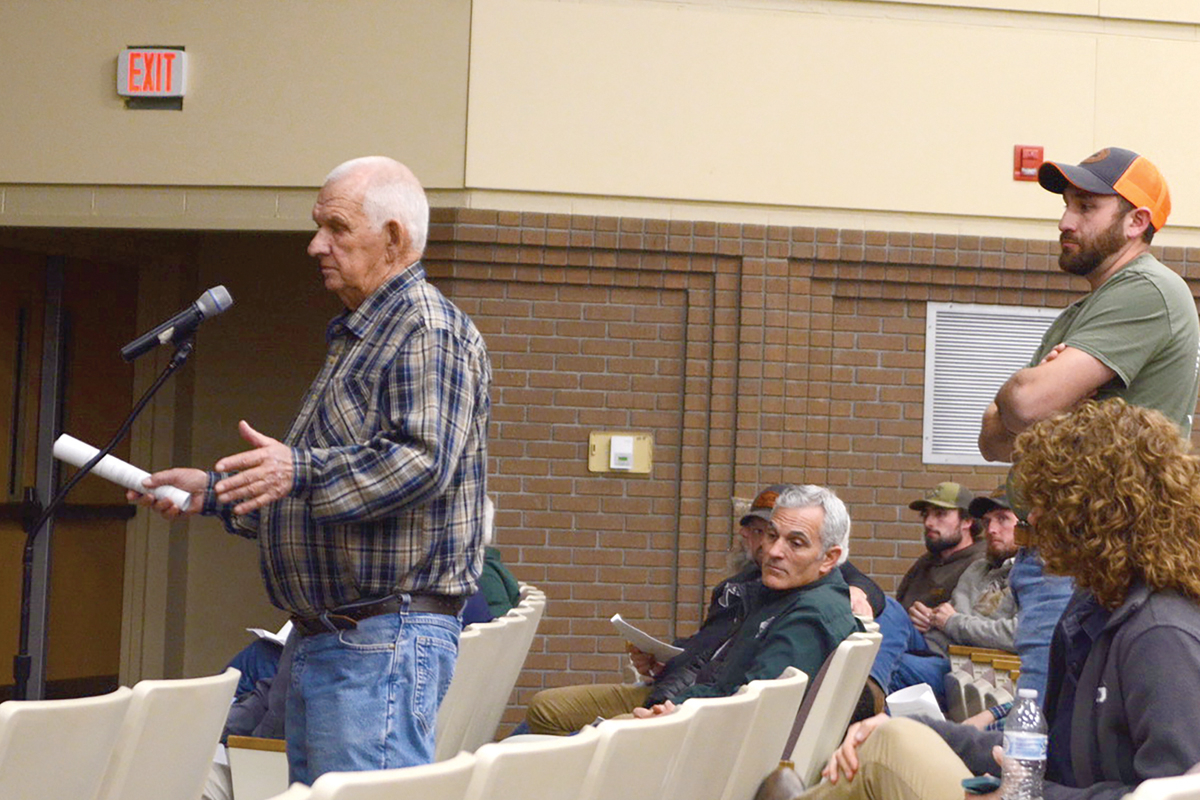 Hunters wait their turn to offer their comments. Holly Kays photo
More than 100 people came to a public hearing Thursday, Jan. 11, at Haywood Community College in Clyde, that took input on what would be the first changes to black bear hunting season dates since the 1970s — and opinions were mixed.
While many of the 21 people who spoke on bear and deer proposals — nearly all of whom identified themselves as hunters — supported the changes, many others expressed concern, with the most common refrain being that the changes would cause bear and deer seasons to overlap, creating opportunities for conflict between hunters and reducing opportunity for youth hunters to bag a deer.
“You need to keep these seasons separate,” said Caldwell County resident David Woods. “I’m telling you, you can mark it down tonight. I would never shoot a man over a dog, but I know people that will. I’m just telling you there will be trouble. If we have meetings next year, we’ll be talking about it, because somebody is stupid enough to do it.”
Back in the 1970s, black bears were rare in Western North Carolina, with fewer than 1,000 of them estimated in the 25 western counties. Thanks to decades of active management from the N.C. Wildlife Resources Commission, that population has steadily increased, to the point that in 2012, the Wildlife Commission adopted a new goal: hold the mountain bear population steady at 4,400 bears.
Despite efforts to halt population growth, black bears continued to multiply. Today, the Wildlife Commission estimates the western population at around 8,000 bears — and continuing to grow at 3% to 4% per year.
In 2022, the Wildlife Commission adopted a controversial measure renaming the bear sanctuaries it established in 1971, during a time of struggle for the bear population, as “designated bear management units,” and to allow hunting permits to be issued in those areas. No such permits have yet been issued, but that’s likely to happen in 2025, said Colleen Olfenbuttel, black bear and furbearer biologist for the Wildlife Commission. Before issuing permits, staff must install new signage around the perimeter of the properties, a process that takes quite a while given the rugged terrain.
 Exposing the Big Game