
- By Buzzy Hassrick Reporter, buzzy@codyenterprise.com
- 23 hrs ago
- https://www.codyenterprise.com/news/local/article_92c57ba2-d4d8-11ee-b095-af1c33c6feda.html
1 of 3
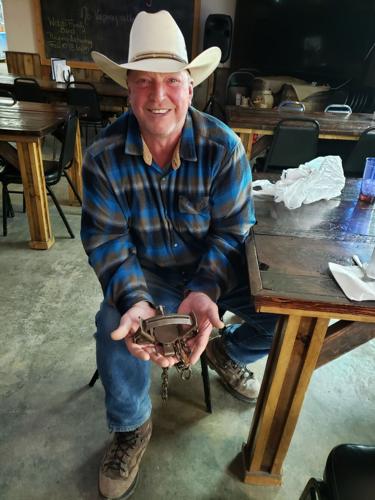
Trapper E.J. Kelly of Clark displays a popular foothold trap with smooth, 5 1/2 inch jaws.
- Photo by Buzzy Hassrick
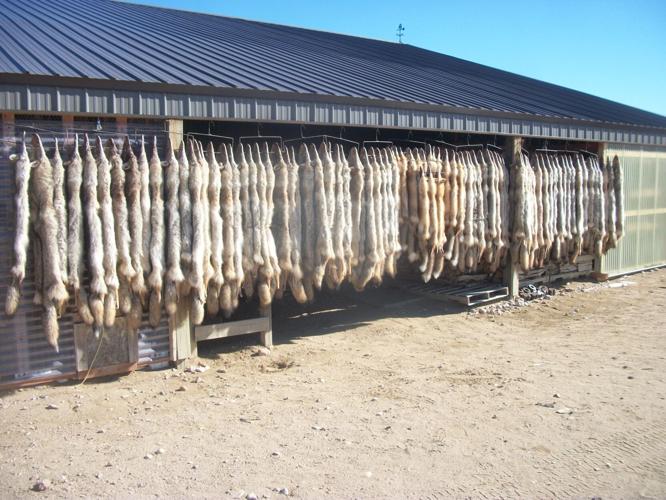
Coyote and fox skins caught through trapping over the 2022-2023 season.
- Courtesy photo
Editor’s note: Because of recent reports of dogs being caught in the Cody area, the Enterprise decided to delve into the issue by presenting three different views of the activity.
Trapping is either respected or detested … or somewhere in between, depending on the commenter.
Sharing their divergent views were a pro-trapper from Clark, a con-trapper from Cody and a retired Cody High School science teacher who calls himself a non-trapper.

Pro-trapping
“Trapper discretion” is a message delivered by E.J. Kelley, who recommends that trappers be sensitive about where they place traps and what types and styles they use, especially in popular recreation areas.
“It makes no sense to put a trap by a trail,” he said.
At the same time, the lifelong professional and certified trapper-educator offers advice to those who recreate in open spaces, especially with dogs and especially unleashed ones.
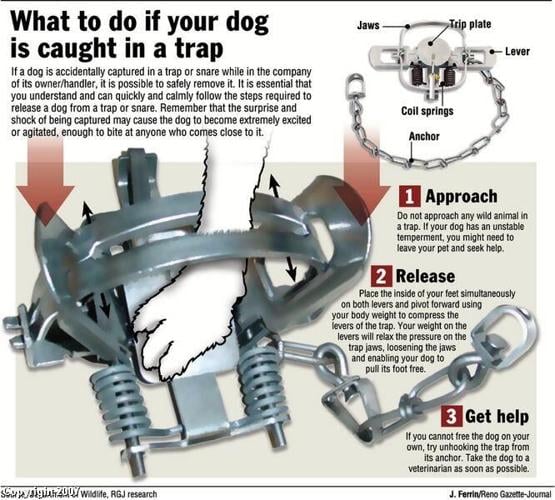
“There’s the need for public awareness that you can encounter traps anywhere in this country, especially fall and winter,” he said. “And you need to know how to release traps.”
Kelley recommends bringing tools such as a cable cutter and trap-release gadget, noting “You can carry most of them in a fanny pack.”
Trapping is legal in Wyoming – “It’s in the constitution,” he said — and subject to regulations, though not every place is appropriate. “because we can doesn’t mean we should.
“There are slobs in every profession — people who don’t adhere to the rules, a small handful.”
However, to him, responsibility lies on both parties.
“Trappers should know the rules and use discretion,” he added. At the same time, there’s the “pet-owners’ responsibility for their animals, to know the risks and know how to release an animal from a trap or snare.”
When using foothold traps to catch furbearers, Kelley said he must check them within 72 hours and will often visit them more frequently to preserve the pelts that he prepares and sells.
“If your dog is caught [in a foothold trap], it doesn’t matter,” because it can be released with no injuries, he said. “They don’t suffer. People have humanized animals. They’re a thousand times tougher than people.”
He compared being caught in a foothold trap to being “foot-cuffed,” adding that the animals won’t chew off their legs to escape, which he called “a myth.” And he’s seen healthy coyotes surviving with stumps on two legs after the other two were shot off.
The best-selling, average-sized foothold trap in the country is an MB 550 with smooth jaws that open 5 ½ inches wide and “don’t cut or break bones,” Kelley said. “Trap manufacturing advancements have come a long way.”
Snares, which can kill quickly, require checking once every seven-day period. They have “break-away devices” so larger animals – such as deer, elk and stock – can pull out of them, he said. Others have a locking device that can be backed off to release a captured animal.
As to the suggestion that trappers post warning signs near their devices, he dismissed the idea because it would invite tampering or theft.
To Kelley, trapping serves as the No. 1 tool for wildlife management – “furbearers are plentiful because of trappers,” he said. “We harvest a surplus of animals to maintain a healthy population. Furbearers are a renewable resource.
“The cruelest thing we can do to wildlife is fail to manage it.”
Trapping’s image, Kelley said, has been negatively influenced by Hollywood’s distortion of the truth and its depiction of huge traps that sever legs. It’s also given a bad image by those who have no knowledge about the practice.
“It’s a profession I’m very passionate about,” Kelley said. “The anti-trapping community is based on emotions and lies. Anti-trappers will never change their minds, and we won’t either.”
Con-trapping
Kathy Kyle of Cody is a dog owner who’s concerned about her pet’s safety during outings in the countryside. She offered a number of reasons to oppose trapping, starting with this scenario:
“Imagine what it’s like for a wild animal to be caught in a trap. The animal, let’s say a mink, is going about her daily business when suddenly immobilized by a sharp pain. She can’t move, and can’t understand why not or what’s happened to her. As she struggles to free herself, the trap or snare cuts deeply into her flesh. Terror, incomprehension and pain fill every hour of the 2-7 days she will remain caught until the trapper is legally required to check his line. “The mink freezes in the cold; she urinates and defecates on herself. She becomes parched and desperately hungry. She may try to gnaw her own paw off if caught in a leg-hold trap. She’ll be helpless if a predator finds her.”
The mink’s experience could be a pet’s, Kyle said.
“Let’s say your dog makes a bad decision to have a day out exploring on his own. He encounters a trap — no hands, so he can’t free himself. He’s too far from home for you to hear him bark. He doesn’t come when called. After days of searching, you still can’t find him. Eventually, a man comes to check his trap and finds a dead dog. He’s not going to go looking for the owner, is he?”
Kyle said she sees no justification for trapping because, “today, demand for furs is met by fur farming, just as demand for meat is met by livestock farming. … But laws and policies in the United States still allow humans to inflict days of torture on wild animals for ‘recreational’ purposes.”
Fur trapping is considered recreational because it doesn’t provide a livelihood in the U.S., she said. Kyle cited a Humane Society International report that in 2018, nearly three million animals were trapped for pelts in the U.S. https://www.hsi.org/news-resources/fur-trade/, although the pelts were sold for pitifully small prices, from $8 for beaver to $50 for coyote in Wyoming.
Compare that to the economic value over $308,000 for a bobcat in Yellowstone National Park (www.wyomingpublicmedia.org/open-spaces/2018-04-06/a-look-at-the-dollar-value-of-a-bobcat-its-pelt-vs-alive), she said, because the chance to see wildlife is the number one reason people visit the park. Further, the National Park Service reports that the money spent by the 4.9 million visitors to Yellowstone in 2021 “supported 8,736 jobs in the local area and had a cumulative benefit to the local economy of $834 million.” www.nps.gov/yell/learn/news/220629.htm
“Trappers prey on wildlife, and also on the rest of us. They consume a public resource — wildlife — for a very small personal gain,” Kyle said. “And they waste a large portion of that resource because their victims are not only the fur-bearing animals they have a license to trap.”
Some national studies estimate the ratio of non-target to target animals trapped at 2 to 1, according to the nonprofit Wyoming Untrapped. https://wyominguntrapped.org/overview-trapping-issues.
Meanwhile, the World Wildlife Fund’s Living Planet Report 2022 found that Earth’s wildlife populations have declined by an average of nearly 69 percent since 1970. https://livingplanet.panda.org/en-US/
“We can’t afford to waste wildlife populations for the sake of allowing a few individuals to continue a cruel, anachronistic and economically irrational activity,” Kyle said.
Civilization has advanced since the days of gladiator contests and bear baiting, she continued.
“We now view those who torture and kill animals or people for enjoyment as psychopaths,” she said. “I am not suggesting that trappers are psychopaths, but that they — and we in permitting their activity — turn a willfully blind eye to the profound, and profoundly unnecessary, suffering that trapping inflicts on wildlife — and sometimes on pets.”
Instead of trapping, Kyle cited various options to experience “… wildness and wilderness, or to test ourselves against nature. Go hiking, climb a mountain, take up skydiving — take a real risk instead of preying on animals without a snowball’s chance in hell of winning against you.
“Trapping uses cruel and primitive technology to kill wild animals whose fur we don’t need and whose meat we don’t eat. It’s not a testament to manliness or tradition. It’s a barbarism that should be outlawed.”
Non-trapper
Trapping is a controversial issue that elicits both positive and negative responses, so “readers should decide for themselves,” said Dan White, retired Cody High School science teacher, who trapped as a teenager. He’s also a self-described “non-trapper,” neither pro nor con the practice.
Trappers are attuned to their locations, to what’s going on in wild places, he said. They’re aware of the animals’ dens, their tracks.
“Trappers enjoy getting out. They see more detail,” he said. “It makes you more aware of your environmental surroundings.”
What they do is “part of the consumptive use of wildlife,” White added. A frequent visitor to Africa, he compared that continent and Wyoming for their shared abundance of and attitudes toward wild animals. “…They put a value on wildlife – economic and social – through scientific management. Successful management has allowed wildlife to thrive.”
Trappers can see an economic benefit. For example, White said, an adult bobcat brings $700, while the price of a coyote pelt has varied, from $20 to $400, depending on trends. “China and Russia are big markets,” he noted.
State Game and Fish officials keep counts of trapped furbearing animals and determine seasons. “Their populations are not at risk,” he said. “If the seasons are set properly, it doesn’t hurt the overall population.
“Babies are born all the time and are available to fill in. “[Trapping] doesn’t make less of the animals.”
Some of the trappers’ prey are very wary about getting caught, and some seem rare because few are sighted, but they can simply be nocturnal and elusive. Still, he admitted, it’s not “fair chase.”
Regardless of whether the prey are hunted or trapped, White noted, “they’re going to die, one way or another. Animals usually die an uncomfortable death.”
If their numbers get too high, disease could invade the population and lead to mortality, he continued. Many good-hearted people think wildlife should be left alone, he said, but they need to understand “it doesn’t work like that.”
For animals considered predators – such as red fox, coyote, raccoon, porcupine and skunk – there are few rules, said White, who noted that the commercialization of the pelts is “distasteful to some people.”
However, name-calling and demonizing are not the answer. “Extremists on both sides are not particularly productive,” he said. “Both sides need to get along better.”
“It wouldn’t be a lot of fun to be caught in a trap,” he noted, but traps pose no danger to people. “Dogs getting caught is another concern.”
He acknowledged that many people feel trapping is outdated, cruel, inhumane and painful, and also oppose wearing fur — “and trappers need to understand that.
“And trappers should know that nobody should be trapping around Newton Lakes” north of Cody.
Trappers need to use common sense about where they trap, White said. Still, on the negative side, they do catch and kill non-target animals.
Both sides should take a broader, more scientific, rather than emotional, view of the issue – in White’s words, “There are different ways of looking at the same thing.”
 Exposing the Big Game
You slaughter entire families in the most cruel way imaginable, you maim and kill because you want to make a buck. You don’t give a damn about what you hurt, you love the fact you harm animals and you do it with a big smug psychotic smile on your face. What a insufferably vile scumbag.
Well said.
Who needs Hollywood to paint them with a bad image when that wall of dead animals and their own uncaring attitude towards killing shows just how evil these people are?
yep.