An El Niño-less summer is coming. Here’s what that could mean for the US

By Mary Gilbert, CNN Meteorologist

 4 minute read 

https://www.cnn.com/2024/04/29/weather/la-nina-summer-forecast-us-el-nino-climate/index.html

Updated 8:25 AM EDT, Mon April 29, 2024

Video Ad Feedback

What exactly is El Niño?

01:56 – Source: CNNCNN — 

It may be spring, but it’s not too soon to look ahead to summer weather, especially when El Niño – a player in last year’s especially brutal summer – is rapidly weakening and will all but vanish by the time the season kicks into gear.

El Niño’s disappearing act doesn’t mean relief from the heat. Not when the world is heating up due to human-driven climate change. In fact, forecasters think it could mean the opposite.

What this summer’s weather could look like

El Niño is a natural climate pattern marked by warmer than average ocean temperatures in the equatorial Pacific. When the water gets cooler than average, it’s a La Niña. Either phase can have an effect on weather around the globe.

By June, forecasters expect those ocean temperatures to hover close to normal, marking a so-called neutral phase, before La Niña builds in early summer, according to NOAA’s Climate Prediction Center.

But the strength of El Niño or La Niña’s influence on US weather isn’t uniform and varies greatly based on the strength of the phenomena and the season itself.

This handout photograph taken and released by the Center for Volcanology and Geological Hazard Mitigation on April 17, 2024 shows Mount Ruang spewing hot lava and smoke as seen
from Sitaro, North Sulawesi. A volcano erupted several times in Indonesia's outermost region overnight on April 17, forcing hundreds of people to be evacuated after it spewed lava and a
column of smoke more than a mile into the sky. Center for Volcanology and Geological Hazard Mitigation/AFP via Getty Images

RELATED ARTICLEA powerful volcano is erupting. Here’s what that could mean for weather and climate

The influence of El Niño or La Niña on US weather isn’t as clear-cut in the summer as it is in the winter, especially during a transition between the two phases, said Michelle L’Heureux, a climate scientist with the Climate Prediction Center.

Temperature differences between the tropics and North America are more extreme in the winter, L’Heureux explained. This allows the jet stream to become quite strong and influential, reliably sending storms into certain parts of the US.

In the summer, the difference in temperature between the two regions isn’t as significant and the obvious influence on US weather wanes.

But we can look back at what happened during similar summers to get a glimpse of what could come this summer.

In short: It’s not cool.

The summer of 2016 was one of the hottest on record for the Lower 48. La Niña conditions were in place by midsummer and followed a very strong El Niño winter.

Summer 2020 followed a similar script: La Niña conditions formed midsummer after a weak El Niño winter but still produced one of the hottest summers on record and the most active hurricane season on record.

Then there’s the fact that these climate phenomena are playing out in a warming world, raising the ceiling on the extreme heat potential.

“This obviously isn’t our grandmother’s transition out of El Niño – we’re in a much warmer world so the impacts will be different,” L’Heureux, said. “We’re seeing the consequences of climate change.”

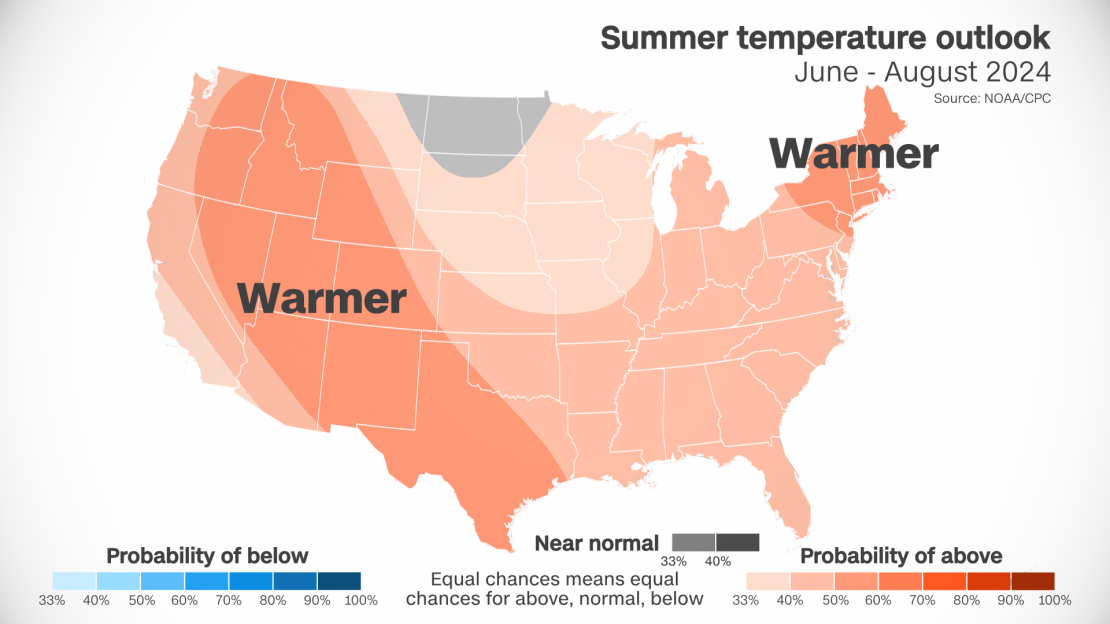
Current summer temperature outlooks for the US are certainly bringing the heat.
CNN digital season outlook temp white summer 042324.png

CNN Weather

Above-average temperatures are forecast over nearly every square mile of the Lower 48. Only portions of the Dakotas, Minnesota and Montana have an equal chance of encountering near normal, above- or below-normal temperatures.

A huge portion of the West is likely to have warmer conditions than normal. This forecast tracks with decades of climate trends, according to L’Heureux.

Summers have warmed more in the West than in any other region of the US since the early 1990s, according to data from NOAA. Phoenix is a prime example. The city’s average July temperature last year was an unheard-of 102.7 degrees, making it the hottest month on record for any US city. It was also the deadliest year on record for heat in Maricopa County, where Phoenix is located.

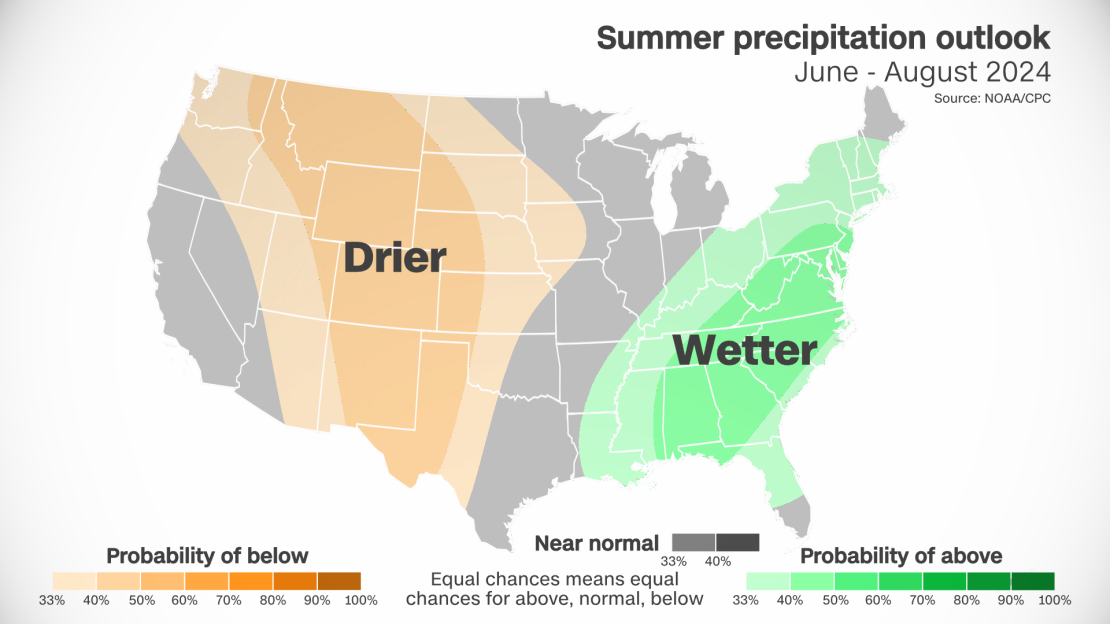
Forecasts also show a worrying precipitation trend for parts of the West.
CNN digital season precip outlook white summer 042324.png

CNN Weather

Large sections of the West and the central US are likely to be drier than normal. This dryness, combined with above-normal heat, which only amplifies the dryness, could be a recipe for new or worsening drought.

Wetter than normal conditions are in the forecast from the Gulf Coast to the Northeast. Stormy weather could be a consistent companion for much of the East – but whether it comes from typical rain and thunderstorms or tropical activity won’t be known for months.

A brutal summer also predicted in the water

Heat isn’t the only threat to look out for.

The strengthening La Niña conditions, coupled with ocean temperatures which have been at record highs for over a year, could supercharge the Atlantic hurricane season.

A warming world generates more fuel for more tropical activity and stronger storms. La Niña tends to produce favorable atmospheric conditions to allow storms to form and hold together in the Atlantic.

Early this month, forecasters at Colorado State University released their most active initial forecast ever.

“We anticipate a well above-average probability for major hurricanes making landfall along the continental United States coastline and in the Caribbean,” the group said in a news release.

Man fatally shot while waterfowl hunting in Iowa

WHO-TV Des MoinesFollow

13.1K Followers

Man fatally shot while waterfowl hunting in Iowa

Story by Linda Cook

 • 5mo • 1 min read

Man fatally shot while waterfowl hunting in Iowa

Man fatally shot while waterfowl hunting in Iowa© Provided by WHO-TV Des Moines

GUTHRIE COUNTY, Iowa — The Iowa Department of Natural Resources (DNR) is investigating a fatal hunting incident in Guthrie County, according to a news release.

Seth Egelhoff, 26, of Chesterfield, Illinois, was killed Saturday while waterfowl hunting at the Bays Branch Wildlife Area in Guthrie County, the release says. These banks in Winthrop Are Offering Super High Returns on Savings Accounts

You Asked MeThese banks in Winthrop Are Offering Super High Returns on Savings Accounts

Ad

Local moms pack holiday cheer for deployed troops

The Guthrie County Sheriff’s Department received an emergency call around 1 p.m. about a hunter suffering a gunshot wound to the face at Bays Branch Wildlife Area.  Egelhoff was transported by Panora EMS. Lifesaving measures were given en route to Life Flight but were unsuccessful, and he was pronounced deceased shortly after leaving the scene.

The incident remains under investigation by the Iowa DNR Law Enforcement Bureau.  

The Guthrie County Sheriff’s Department, Panora EMS, and Iowa State Patrol assisted in the investigation.

The wildlife area is open for public use.

Avian Influenza A(H5N1) U.S. Situation Update and CDC Activities

Español | Other Languages

 Print https://www.cdc.gov/flu/avianflu/spotlights/2023-2024/avian-situation-update.htm

April 26, 2024 – CDC continues to respond to the public health challenge posed by a multistate outbreak of avian influenza A(H5N1) virus, or “A(H5N1) virus” in dairy cows and other animals in the U.S. CDC is working in collaboration with the U.S. Department of Agriculture (USDA), the Food and Drug Administration (FDA), state public health and animal health officials, and other partners using a One Health approachUSDA is now reporting that 34 dairy cattle herds in nine U.S. states, including most recently Colorado, have confirmed cases of A(H5N1) virus infections in cattle. The agency has issued a “Federal Order requiring Testing for and Reporting of Highly Pathogenic Avian Influenza (HPAI) in Livestock [118 KB, 2 pages].” Currently, one human case has been confirmed in a person with exposure to presumably infected dairy cows reported by Texas on April 1, 2024[1][2]. Monitoring people with exposure to animals infected or potentially infected with A(H5N1) viruses is important to help us better understand the risk to human health and potential for spread between animals and people.

CDC’s response to this outbreak of influenza A(H5N1) virus in dairy cattle and other animals most recently includes:

  • An updated H5N1 Technical Report posted on April 26. This report updates a December 29, 2023, report to include seven new human cases of H5N1 reported globally since that time (five in Cambodia, one in the United States (Texas), and one in Vietnam) and recent activity in wild birds, poultry and other animals, including the multistate outbreak in U.S. dairy cattle and other animals, and updated information on monitoring for A(H5N1) virus infections in people in the United States. The report concludes that the current risk to the general public remains low at this time.
  • Updated interim recommendations for worker protection expanded to include people who work in slaughterhouses posted on April 26.
  • Continuing work to better characterize the virus from the human case in Texas.
  • Testing for susceptibility to the commercially available and recommended flu antiviral medications was completed this week. Testing confirmed that the A(H5N1) virus from the human case in Texas[2] is susceptible to baloxavir marboxil, in addition to the neuraminidase inhibitors, which was announced last week. With these findings, the virus from the human case in Texas is confirmed to be susceptible to commercially available FDA-approved and recommended flu neuraminidase and polymerase acidic protein (PA) endonuclease inhibitor antiviral medications. Currently the neuraminidase inhibitor oseltamivir is recommended for antiviral treatment of people with confirmed or suspected A(H5N1) virus infection, and for post-exposure prophylaxis.
  • Looking at antiviral resistance properties of more than 200 H5N1 publicly posted virus sequences from cattle. CDC found one virus from a cow with a marker known to be associated with reduced susceptibility to the neuraminidase inhibitors (a change at NA-T438I). This change has been seen rarely in the past in H5N1 viruses isolated from wild birds and poultry. The detection of this marker in one of more than 200 specimens is not surprising or concerning at this time in terms of the clinical usefulness of these drugs, but it does underscore why this kind of constant monitoring is important.
  • Growing H5N1 virus stock from the one human case in Texas to use for additional laboratory experiments to:
    • Learn how the virus reproduces in both human and cow respiratory tract epithelial cells and cow mammary epithelial cells.
    • Assess the severity of illness and transmissibility of the virus under different scenarios by infecting ferrets and assessing the outcome. Ferrets are used as a model for people because they get sick and spread influenza viruses in a manner similar to humans.
  • Testing human sera (blood) from people previously vaccinated with pre-pandemic A(H5) vaccines to see how it reacts to the virus from the human case in Texas. Data to date – including genetic analysis and testing of ferret antisera from multiple clade 2.3.4.4b candidate vaccine viruses – suggest vaccination will offer good cross-protection against cattle outbreak viruses. (The human case in Texas was a 2.3.4.4b virus.)
  • Continuing to support states that are monitoring people with exposure to cows, birds, or other domestic or wild animals infected or potentially infected with influenza A(H5N1) viruses. Testing of symptomatic people who have exposures is being done by state or local officials, and CDC is conducting confirmatory testing when needed.
  • Maintaining multilingual and multidisciplinary epidemiological field teams ready to deploy for on-site studies to better understand the current outbreak, particularly the public health and One Health implications of the emergence of this virus in cattle.
  • Engaging One Health partner organizations from public health, agriculture, wildlife, milk regulatory officials, and others to share information and ensure preparedness to prevent and respond to this emerging infectious disease threat and for any potential human infections. On April 25, CDC participated in an ASTHO-hosted discussion between public health leaders and scientists leading the U.S. Government’s response to Highly Pathogenic Avian Influenza (HPAI).
  • Continuing to monitor flu surveillance data, especially in areas where A(H5N1) viruses have been detected in dairy cattle or other animals, for any unusual trends in flu-like illness, flu, or conjunctivitis. CDC this week posted a webpage on How CDC is monitoring influenza data in people to better understand the current avian influenza A (H5N1) situation | Avian Influenza (Flu). CDC flu surveillance systems show no indicators of unusual flu activity in people, including avian influenza A(H5N1) for the most recent week.

New Measures to Contain Spread in Cows

The multistate outbreak of HPAI A(H5N1) bird flu in dairy cows was first reported by USDA on March 25, 2024. This is the first time that A(H5N1) viruses have been found in cattle. USDA also has reported that the virus has spread through cattle movement between herds and also from dairy cattle premises into nearby poultry premises and has infected a number of barn cats. Additionally, USDA has reported that APHIS National Veterinary Services Laboratories found virus in a lung tissue sample from a dairy cow without symptoms that came from an affected herd (but that cow did not enter the food supply). This week, USDA issued a “Federal Order Requiring Testing for and Reporting of Highly Pathogenic Avian Influenza in Livestock [118 KB, 2 pages]” to protect livestock health. Prior to interstate movement, dairy cattle are now required to receive a negative test for influenza A virus at an approved National Animal Health Laboratory Network laboratory. For more information regarding this Federal Order visit HPAI Detections in Livestock. Containing spread of this virus in animals will help reduce the number of potential human exposures and thus help contain the public health risk.

Ongoing Surveillance Needed

Because of the potential for influenza viruses to constantly change, continual surveillance and preparedness efforts are critical, and CDC is taking measures to be ready in case the current risk assessment for the general public changes. The immediate goal is to prevent further spread of this virus between animals and people. CDC will continue to monitor these viruses and update and adjust guidance as needed. As a reminder, while CDC believes the current risk of A(H5N1) infection to the general public remains low, people with close, prolonged, or unprotected exposures to infected birds, cattle, or other animals, to unpasteurized (“raw”) milk, or to environments contaminated by infected birds, cattle, or other animals or by raw milk, are at a greater risk of infection.

CDC has interim recommendations for prevention, monitoring, and public health investigations of A(H5N1) virus infections in people. CDC also has updated recommendations for worker protection and use of personal protective equipment (PPE) to reduce their risk of exposure. Following these recommendations is central to reducing a person’s risk and containing the overall public health risk.

This is a rapidly changing situation, and CDC is committed to providing frequent and timely updates.

[1] The first human case of A(H5N1) bird flu in the United States was reported in 2022 in a person in Colorado who had direct exposure to poultry and was involved in the depopulating of poultry with presumptive A(H5N1) bird flu. The 2022 human case was not related to dairy cattle. The person recovered. Learn more at U.S. Case of Human Avian Influenza A(H5) Virus Reported.

[2] The second human case of A(H5N1) bird flu in the United States was reported in 2024 and linked with dairy cattle and reported eye redness as their only symptom, consistent with conjunctivitis, and has recovered. Learn more at Highly Pathogenic Avian Influenza A (H5N1) Virus Infection Reported in a Person in the U.S.