Trophy Status is in the Eye of the Beholder
Reply

A routine tip to Alberta’s Report a Poacher line led to a Fort McMurray hunter being charged with dangerous hunting, and ultimately pleading guilty in court. The incident unfolded when the hunter shot at a moose on a roadway near Boyle, causing a civilian to take cover, and is a sobering reminder of the potential consequences of unsafe hunting practices.
Lexi Freehill
about 8 hours ago

BOYLE — A Fort McMurray-based subsistence hunter learned an expensive lesson after shooting and killing a moose on a roadway last fall, sending a nearby civilian looking for cover.
Trevor Simon, 42, was joined by his wife and two of his daughters as he pleaded guilty to one count of hunting in a dangerous manner in Boyle Court of Justice on June 10. The accepted guilty plea was accompanied by a $3,000 fine and an automatic suspension of recreational hunting licence eligibility for three years.
“For that person in the truck who had to take cover when rifles are being fired in their direction, that’s kind of hard to imagine, and I think this penalty will go some way to impressing that upon you,” said Justice Thomas Achtymichuk.
Six months earlier, on Nov. 9, 2024, Fish and Wildlife officer Lukas Madsen received a tip about unsafe hunting through the Report a Poacher phone line.
The caller told Madsen while he was parked in his truck on a rural road, he noticed a quad drive onto the roadway, facing the caller’s parked vehicle. A moose then walked onto the roadway between the quad and the parked truck.
According to Crown prosecutor Taylor Noble, the caller in the truck watched as the quad’s occupants got off their ride and fired one shot from a rifle.
“The caller then jumped out of his truck and took cover behind it. He was able to see when a second shot was fired and watched as the moose fell on the road, and then as the hunter fired a third round into the moose’s head.”
When Madsen responded to the call, he found Simon field dressing his kill. Madsen seized the moose, which was given to a local family afterwards, and served Simon with a notice to appear for hunting in a dangerous manner.
“Shooting a firearm towards another individual or near another individual while hunting is very serious, could obviously lead to very serious consequences, and this was not just one shot, but multiple. It forced the complainant to head for cover,” said Noble.
Simon admitted to firing the second and third shots, while the first was fired by an unnamed individual hunting with him.
Defence lawyer Frank Carbonara said his client was remorseful about the situation and did not intend to scare anyone. He described Simon as the sole provider for his wife and five daughters who all reside with him, and said the loss of the moose was felt by the Simon household.
“The family does truly rely on his ability to hunt to provide for them. The moose that he catches during the season is used to feed the entire family for the whole year,” said Carbonara.
Despite the automatic cancellation of any recreational licences and a three-year ban on his right to hold a recreational licence, Simon will be able to continue hunting to feed his family thanks to his Treaty hunting rights granted by his Mi’kmaq heritage.
“My understanding is that the recreational licence suspension won’t impact his ability to hunt because he doesn’t rely on a recreational licence to hunt anyways,” said Carbonara.
Simon has until Dec. 23, 2025 to pay or risks spending up to 23 days in custody. One count of careless use of a firearm was withdrawn as part of the joint submission.
PauseUnmute
Loaded: 66.82%
Remaining Time -0:30CaptionsPicture-in-PictureFullscreen

Updated: 12:00 AM EDT Jun 16, 2025
MANCHESTER, N.H. —
Officials are working to return stolen fishing gear after a ship’s captain was convicted of poaching marine species.
New Hampshire Fish and Game said officers received a tip that led them to a ship docked in Newington, where they found ropes connected to stolen lobster traps.
Advertisement
>> Download the free WMUR app to get updates on the go: Apple | Google Play <<
Inside the traps, officers found lobsters, crabs and blue mussels, including an egg-bearing lobster in one of the cages.
Fish and Game officials said the captain pleaded guilty to multiple charges, including lobster and crab fishing without a license, illegal possession of another’s lobster gear and possession of crabs, mussels and a lobster.
Explainer
Environment
A global investigation into industrial egg farming found hens were kept in cramped and filthy cages in more than 35 countries, raising animal welfare and public health concerns. Global animal rights coalition the Open Wing Alliance shares the results of its investigation in a FRANCE 24 exclusive.
Issued on: 16/06/2025 – 07:30
6 minReading time
By:
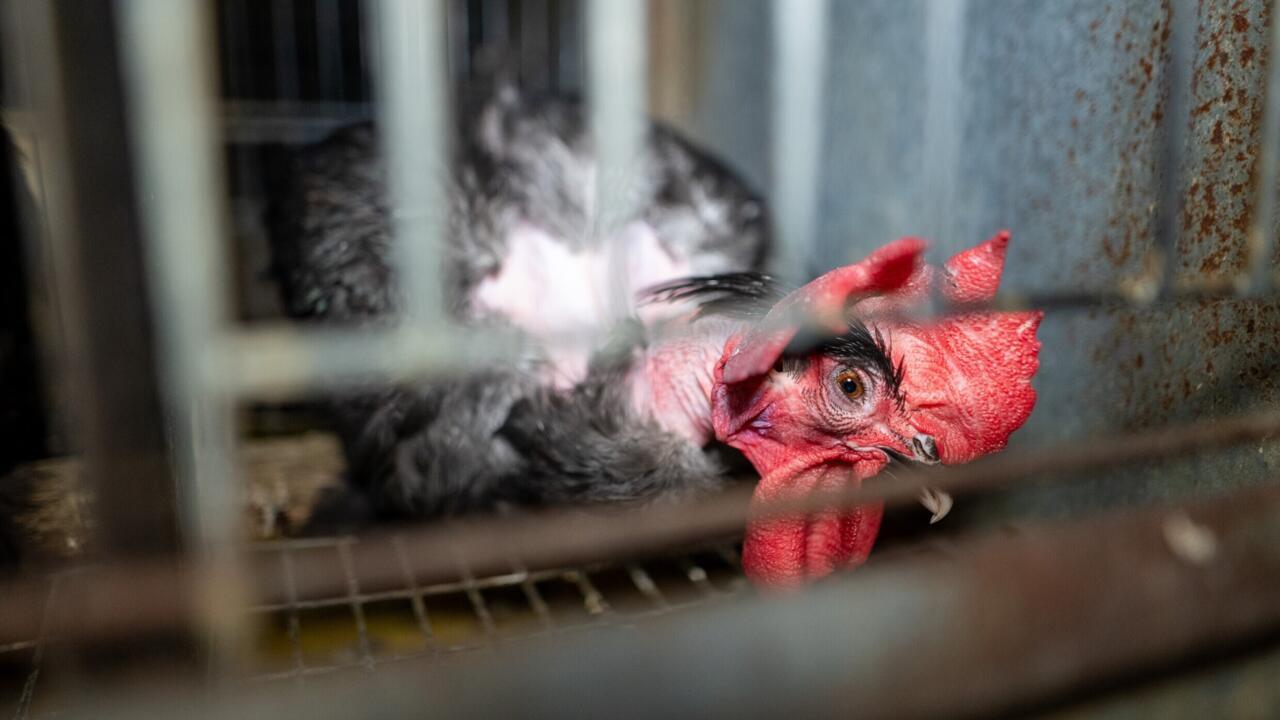
Before they even looked inside the farm building, the animal welfare investigator knew there was a problem. “The second I opened the door, the smell hit me … but the worst part was the heat – this thick, sticky air that clings to your skin,” they said.
Inside the barn, located in Spain, conditions were “disgusting”, with bird cages stacked from floor to ceiling, and the ground covered in animal faeces, feathers and mouldy feed scraps.
The caged hens did not have enough space to spread their wings, and many appeared to be suffering health problems.
“They looked half-plucked, some with raw, red skin and open sores,” the investigator said. “Others were dead, just left there among the living because nobody bothered to remove them.”
Such conditions are present throughout industrialised egg production, according to an investigation seen by FRANCE 24 ahead of its release on June 17, by The Open Wing Alliance, a global coalition of nearly 100 organisations established by animal rights non-profit, The Humane League, in collaboration with We Animals and Reporters for Animals International.
The group spent over three years collecting onsite photo and footage via farm workers, local investigators and drones. In France, the group worked with animal welfare organisations L214 and Anima France.
The investigation found egg-laying hens in more than 35 countries were trapped in filthy, overcrowded cages, with injured birds, rotting carcasses and disease-ridden conditions.
It found poor egg farming practices persist, even as major corporations and governments have committed to phasing out battery farming and removing cages from their egg supply chains.
Factory farming conditions are also likely to exacerbate the ongoing global bird flu pandemic, which has seen cases jump from farmed birds to wild animals and humans.
Read moreFirst severe human case of bird flu in US sparks pandemic concerns
“This isn’t just an animal welfare scandal – it’s a ticking time bomb for public health and corporate risk,” said Ellie Ponders, senior director of global corporate engagement at The Open Wing Alliance.
“Cramming sick, stressed hens into filthy cages is the perfect breeding ground for disease,” she added. “This investigation lays bare the truth: systemic suffering, global inaction, and a betrayal of public trust. It’s a global crisis.”
On all the farms they visited, investigators found birds confined in small cages, either in groups or individually, often leaving them unable to stand upright or spread their wings.
Despite a 2012 European Union law largely banning battery cages – meaning animals in individual cages stacked on top of each other are given less space than an A4 piece of paper – footage collected in France clearly shows hens are still being kept in these conditions.
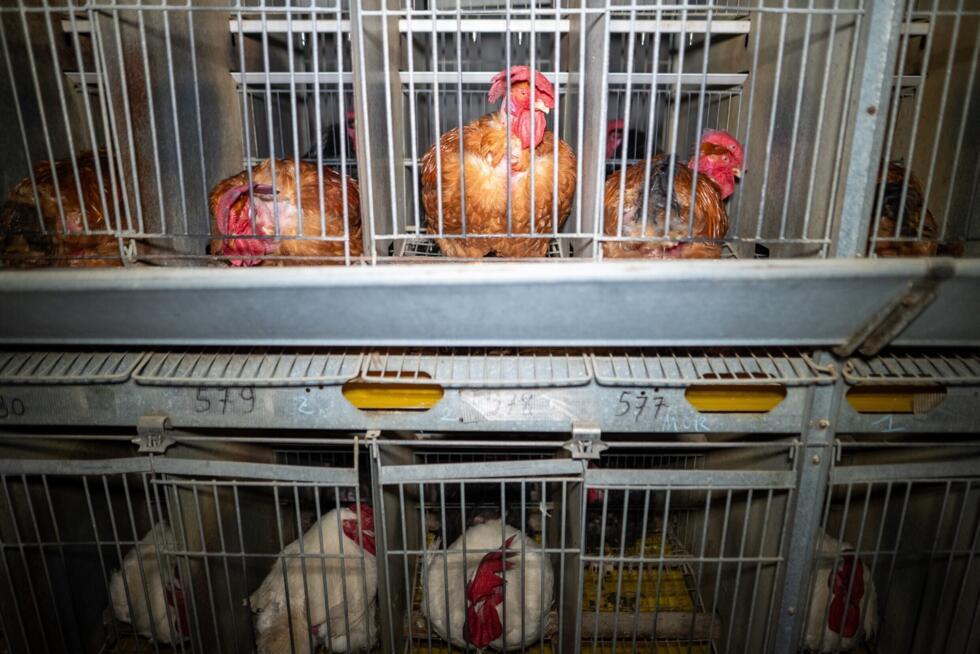
Along with France, the investigations found examples of mistreatment in nine EU countries (Bulgaria, Estonia, Finland, Italy, Poland, Portugal, Romania, Slovenia, Spain) and countries in Asia, Australasia, Africa, and North and South America.
Other footage shows how the automation of farming systems such as feeding and ventilation has reduced in-person monitoring and eroded welfare conditions.
In some videos, dead bird carcasses are trapped in cages with living hens. In others, hens that escaped their cages are abandoned in manure pits used to gather bird droppings.
Some mistreatment may be due to negligence, but there are also inherent problems in the cage farming system, said Mia Fernyhough, senior director of global animal welfare at the Open Wing Alliance.
“A big problem with caged systems is that you’ve got huge numbers of birds stacked in rows, some very high and some at shin level. It’s very difficult to see the birds in certain parts of the system, and so birds get missed,” she said.
“There might be a bird that is suffering that otherwise would be removed, but they’re left, then they die, and they’re still left there,” Fernyhough added.
In most of the footage, hens are kept in dark, cramped conditions, surrounded by filth and the racket of countless other birds – an unsanitary and stressful environment that provides fertile conditions for the spread of disease and viruses such as bird flu.
While bird flus are endemic in wild populations, they are much harder to control among large concentrations of genetically similar species living in tight quarters.
“Then you get a virus with tons of hosts, so it is mutating all of the time,” said Fernyhough.
Mutations have already enabled the current bird flu pandemic to pass to humans, most of whom worked on farms in close contact with infected animals.
But, Fernyhough said, “if there is a mutation that means the virus can pass from human to human, then there’s a really serious risk of a pandemic.”
The World Health Organisation said in a 2022 report that pandemics were becoming increasingly common, in part, due to the intensification of agriculture.
It called for “behaviour and industry change” in settings, such as industrial farms, where animal-to-human disease spill over is common.
European consumers may believe a 2012 ban on battery cages meant an end to cages altogether, but much of the mistreatment documented in the Open Wing Alliance investigation is permissible under EU law.
“A lot of what is in the footage is legal, and that’s probably the most shocking thing about it,” Fernyhough said.
In Europe, battery cages were banned in favour of enriched cages, which place groups of birds in slightly larger spaces with materials to allow for natural behaviours such as a nesting area, perch and litter.
While lauded as a humane progression, enriched cages do not ensure access to natural light or fresh air. They are also still a form of battery farming in that cages can be stacked one on top of another in battery formation.
In practice, they are “ever so slightly larger cages that have a few resources in them but are still entirely inadequate in terms of being able to scratch, forage, or lay an egg in a secluded nest”, Fernyhough said.
“There are still millions of hens still trapped in these cruel systems,” added Loretta Piare, Europe regional lead for the Open Wing Alliance.
Animal rights network End the Cage Age estimates there are 300 million farmed animals, including hens, quails, ducks, geese and rabbits, currently kept in cages across the EU.
The European Commission has pledged to completely phase out cages by 2027, But, Piare said, “there’s still so much work to be done to get there”.
There is evidence that most consumers in France back a total ban on cages.
In many countries, egg stamps and labelling on egg boxes allow consumers to make informed choices about whether they buy eggs produced by caged hens.
In France, 80% of the eggs bought in supermarkets in 2023 and 2024 were from organic, free-range or barn hens – three methods that the Open Wing Alliance see as viable and humane alternatives to battery and enriched cage farming.
The number of eggs sold in France that were produced caged birds has dramatically decreased in the past ten years from 70% in 2015 to less than a quarter today.
However, of the nearly 15 million eggs produced in France each year, 55% are used in products like pre-packaged pasta and cakes or in restaurants, where labelling is much more opaque.
Such eggs are generally bought in vast quantities by corporations, putting them in a position of control over conditions on the ground.
While the ban that the EU is proposing would be “ideal, because it’s universal, unfortunately, it feels very precarious”, Fernyhough said. “There’s a very loud and quite successful industry that will fight against it.”
Many corporations may prioritise their bottom lines over animal welfare, but the impact of one major company enacting change in a positive way can be monumental.
In May 2025, McDonalds said it had achieved a 100% switch to cage-free eggs in its US restaurants – transforming the supply chain for nearly 2 billion eggs each year.
The company is now exploring how to end use of cages across its branches in Asia, starting with a trial in South Korea.
The Open Wing Alliance believes the onus falls on consumers to push corporations to do more.
“It’s so important that we campaign against these companies who still permit these systems,” Fernyhough said.
“We can demand more from corporations,” added Piare. “Consumers should be told the truth about what they’re buying.”
Published 1:38 pm Saturday, June 14, 2025 By DAVID RAINER, Alabama Department of Conservation and Natural Resources David Rainer mug Although complaints about dog deer hunting have fallen dramatically in the past several years, dog deer hunting has continued to cause conflicts, particularly around the Talladega National Forest. The Alabama Conservation Advisory Board provided Conservation Enforcement Officers with the Alabama Department of Conservation and Natural Resources’ (ADCNR) Wildlife and Freshwater Fisheries (WFF) Division another tool to deal with dog deer hunters who cause problems. At the Board’s meeting last week in Montgomery, Board member Kevin Savoy of Abbeville proposed an amendment to the dog deer hunting regulations that passed unanimously. Email newsletter signup Sign up for our daily email newsletter The proposed amendment to the current Dog Deer Hunting Regulation adds the following: It shall be unlawful for any person owning, having the care of, or using any dog, to allow any dog or dogs for the purpose of deer hunting to enter onto, cross or remain upon the property of another without written permission of the landowner or lessee of the property. Written permission, which may be a paper copy, email, text or other electronic form, shall be in the possession of each person using such dog(s) on the property of another person and shall be presented upon the request of any Conservation Enforcement Officer. A first offense of the regulation would result in a written warning. Subsequent violations may result in written citations. The proposed amended regulation also states that without the permission of the owner it is unlawful to remove, tamper with or disable any GPS tracking collar or training correction collar on a dog used for the purpose of deer hunting. “For many years we’ve had people come from different parts of the state that had issues with dogs getting on their property, primarily around the Talladega National Forest, where we’ve seen most of the issues as of late,” Conservation Commissioner Chris Blankenship said. “As I mentioned yesterday in a meeting with the dog deer hunters, I’ve been coming to Advisory Board meetings for close to 30 years. The Board meetings used to last from early in the morning until late in the afternoon because of all the complaints and problems with dog deer hunting around the state. “Most of those have been addressed. It’s in a much different place now than where it was 30 years ago. A lot of that has to do with the responsibility of the hunters and the technology improvements. We have so many less issues that we’ve had in the past. But we are still receiving complaints in certain areas, and, after hearing from the public for several years and talking with Board members, I hate not to address those problem issues that remain. For several years, landowners around the Talladega National Forest continue to have problems with certain folks. So our options are three – one is to do nothing at all and let those people continue to have problems and have their hunts impacted because of a handful of dog hunters not doing it correctly; two is to put more areas on the permit system or do a statewide permit system, which, I think, is not really fair to the dog deer hunters who are doing it correctly; and third is to allow our officers a tool to address the issue with folks who are not doing it correctly and letting their dogs get off on other people’s property. I think this a tool for our officers to be able to handle the remaining problems.” Board member Raymond Jones of Huntsville echoed Commissioner Blankenship’s sentiment and said during the 32 years that he has attended or been a member of the Board that the dog deer hunting issues have changed significantly. “I know many of you who are in this room, you guys are doing it right,” Jones said. “I can’t tell you in the 32 years I’ve been around how much it’s improved. But we still have problems. I think this solution will greatly enhance the ability of you (dog deer hunters) to do what you love to do.” Board member Grady Hartzog of Eufaula said he has fielded fewer and fewer complaints about dog deer hunting over the past two years. “Kevin (Savoy) and I live in the district that generally got the most complaints over the years,” Hartzog said. “Things have gotten tremendously better. Any complaints I’ve gotten, I can call Lonnie (Miller) or Don (Knight) and get the problem handled almost immediately. We appreciate that. I think the dog hunters have come a long way in cleaning up their act.” Board Chair Joey Dobbs added, “It has been a long road with the dog deer hunters. Things are better. We don’t have violence. Fifteen years ago, there were incidents of violence in the field and in our meetings. I commend them for doing what they’re doing and the responsible action of the Alabama Dog Hunters Association. “We’re here to work with everybody, but the resource is our number one goal.” Commissioner Blankenship said the seasons and bag limits proposed by WFF has one change. Because of the legislation passed this year concerning deer breeders, the section that deals with deer breeders in the CWD (chronic wasting disease) zones has been removed. The Board approved the Wildlife and Freshwater Fisheries (WFF) Division proposed bag limits and season dates. One change was made to the deer season framework that deals with the unantlered deer daily bag limit in most of the state. The unantlered deer bag limit was increased to two per day in all zones for the entire season with the exception of Zone C in the north central portion of the state. The antlered deer season limit will remain at three. Marine Resources Director Scott Bannon appreciated the board’s approval of several changes, including the removal of the exception for anglers to keep one redfish larger than 26 inches in total length to protect the brood stock of the species, a reduction in the bag limit for sheepshead from 10 fish to eight because of increased fishing pressure, and an increase in the daily harvest limit for commercial gill net anglers who target flounder from 40 fish per day to 80 fish per day. A bag and size limit for common snook, which is expanding its range into Alabama coastal waters, was established with the limit on snook of one per day per angler with a 28-inch minimum size total length. Another change allows commercial shark anglers to have 2,400 feet of line with a maximum of 50 hooks at least 15/0 in size. The line would be required to be anchored and marked with an identification number, and squid would be outlawed as bait because it can attract sea turtles. Also, the captain and crew of Alabama Commercial Party Boats shall not retain bag limits of fish harvested in state waters. Commissioner Blankenship took the opportunity to share a compilation of accomplishments of the ADCNR staff regarding outdoor recreation with a brochure that will be submitted for the Southern Legislative Conference in Birmingham in July. “When you look at all the types of work we’re doing Department-wide for outdoor recreation, it’s more than $406 million of work that is taking place, and that includes $228 million in State Parks, $56 million in boating access projects, $76 million in beach renourishment and beach access, $10 million for State Lakes, $20 million in shooting sports facilities and $12 million for trail enhancements,” Commissioner Blankenship said. “You put it all together, and that’s a lot of work that our staff is doing statewide. I’m very impressed with the work that has taken place. When you see anyone from our staff, please thank them for the work they are doing, because it’s making a generational difference for our state in outdoor recreation. It’s something we can all be proud of.” Commissioner Blankenship shared that he and his family were able to participate in the opening weekend of the red snapper season for private recreational anglers. “More people fished this opening weekend compared to last year when the weather wasn’t as good,” he said. “It was a great weekend. I got to go with my dad on Opening Day, my son on Memorial Day and with my wife on Saturday. It was nice to get out several days and enjoy the resource with my family.” David Rainer is author of Outdoor Alabama Weekly, a column on hunting/fishing/outdoors in Alabama.
Read more at: https://enewscourier.com/2025/06/14/column-conservation-advisory-board-amends-regulations-on-dog-deer-hunting/
Published: June 12, 2025
The state of Alaska is once again asking the Board of Game to allow wildlife managers to shoot bears from helicopters in a rural part of Southwest Alaska in the interest of increasing caribou numbers.
The board is scheduled to hold a special meeting on July 14 in Anchorage to consider the revised proposal to expand its predator control program east of the Wood-Tikchik State Park from just wolves to include all bears.
The move follows a ping-ponging series of court decisions based less on the program’s merits than on the way it was steered through the public rules-making process back in 2022. Critics, and eventually an Anchorage Superior Court judge, said the management practice was adopted with insufficient public input in a way that denied Alaskans their right to weigh in.
Advertisement
If the Board of Game approves the state proposal, aerial gunning for bears would resume next May and last until early June.
In 2023 and 2024, when the intensive management program around the Mulchatna caribou herd ran its full course, the Department of Fish and Game reported killing 180 bears, almost all of them brown bears.
This March, a judge ruled the program was unlawful.
Fish and Game then quickly went back to the Board of Game and requested an emergency version of the same authorization, which was granted. Weeks later, a different Superior Court judge, Christina Rankin, initially declined to halt to the program, largely on technical grounds, but said it was still not a legal management strategy. Shortly afterwards, the state shot 11 bears in the course of three days.
ADVERTISEMENT
That led Rankin to issue a restraining order sought by the environmental group that had sued the state to halt the bear program.
The Department of Fish and Game has stood behind its approach, and the current proposal is an attempt to cure the program’s legal deficiencies but otherwise replicate what it carried out in recent seasons.
Advertisement
“Our intent is to do it very efficiently and effectively and, frankly humanely‚” said Ryan Scott, head of the ADF&G’s Division of Wildlife Conservation.
Scott said that while some criticism of the program on scientific and conservation grounds has merit, the division is tasked under Alaska law with managing ungulate populations in ways that maximize their numbers, and emphasized that rural subsistence hunters have had no opportunity to take Mulchatna caribou since 2021.
Though the state does not have reliable recent data on the number of bears in the area, which sits about midway between Bethel and Dillingham, he said the overall environmental impact from the predator control effort is minimal.
“While it’s true we don’t know the densities in that small piece of real estate, there are bears all over the place,” Scott said in a brief interview Thursday. “We are trying to do this very surgically … in a very small amount of time.”
Nicole Schmitt is the executive director of the Alaska Wildlife Alliance, which sued the state to block the bear killing after it came to light in 2023 and is still opposed to the program.
“We’re happy to see that The Board of Game is finally following its own rules by having a meeting with bare minimum public notice, but are disheartened that it took the advocacy of hundreds of Alaskans and two judges to get them to comply with their basic constitutional obligations,” Schmitt wrote in an email.
Schmitt’s group has persistently questioned the scientific basis and methods of the department’s bear program. In its latest proposal, the department does not set any limit on the number of bears it intends to take in the coming years, only that the target bear population is however many it takes to bring the caribou numbers up “to a level that results in increased calf survival and recruitment.”
“They have no way of knowing the impact this program has on bears. I’ve never seen the Board of Game open a no-limit season on moose or caribou because they heard there were a lot of moose and caribou around,” Schmitt wrote. “They’re literally shooting in the dark for a solution to the Mulchatna caribou herd decline, and wasting precious state funds to do it.”
Scott said that compared to 2022, when wildlife managers initially proposed expanding predator control to bears, there’s now a clearer link between bears and caribou calf survival.
“Given the data that we have, predation is limiting the growth of the herd,” Scott said.
The division plans to present additional evidence showing that its predator control efforts are having a positive effect on the Mulchatna herd at the special meeting next month.
If the measure is approved, Fish and Game could keep removing bears from the area through June 2028, although the program could be halted if Mulchatna herd numbers rise to the level where harvest can resume, which the state estimates at 30,000-80,000 animals. The herd is currently estimated at around 15,000.
Written comments on the proposal must be submitted to the Board of Game before 5:30 p.m. on July 14. The special meeting will be held that same day at the Coast Inn in Anchorage, with the potential for a second in-person meeting continuing on into Tuesday to accommodate more testimony.
13 Jun 2025Alaska
CommentsShare article https://news.mongabay.com/short-article/alaska-wolves-poisoned-by-mercury-after-switching-to-sea-otter-diet/
Some coastal wolves in Alaska, U.S., have toxic levels of mercury in their bodies after shifting from a terrestrial diet of deer and moose to a marine diet heavy with sea otters, new research finds.
Mercury is a naturally occurring heavy metal found in the Earth’s crust. However, human activities like burning coal and fossil fuels release mercury into the atmosphere, where it can travel hundreds of miles from its source. When mercury enters aquatic ecosystems, it’s converted into methylmercury, a potent neurotoxin that “moves efficiently through a food web,” Ben Barst, study co-author and assistant professor with the University of Calgary, Canada, told Mongabay in a video call.
Methylmercury “biomagnifies,” accumulating in larger amounts higher up the food chain, making it dangerous for predators like wolves and sea otters. Large sea otters (Enhydra lutris) daily eat roughly 11 kilograms (25 pounds) of invertebrates like mussels, clams and sea urchins, all known to accumulate methylmercury.
Gretchen Roffler, the study’s lead author and a research biologist with the Alaska Department of Fish and Game, first learned of mercury poisoning in wolves (Canis lupus) when she investigated the death of an emaciated collared wolf from another study. Roffler’s tests revealed “unprecedented” levels of mercury in the animal’s liver. So, she sent samples to Barst’s lab for further testing.
The mercury concentration in those samples were so high, “at first we thought the instrument was malfunctioning,” Barst said.
Once mercury levels were confirmed — on par with those observed in polar bears, an apex marine predator — the researchers wanted to know how widespread mercury poisoning is in wolves and where the mercury came from.
They examined archived tissue samples starting from the year 2000, along with samples from recently trapped wolves and hair and blood samples from collared wolves.
They looked at two different wolf packs: one on Pleasant Island in coastal Alaksa and another a mile away on mainland Gustavus Forelands. The island pack moved there in 2013 and within a few years wiped out the island deer population. Instead of swimming back to the mainland they stayed and “switched to a very marine-heavy diet dominated by sea otters; up to about 70% of their diet is sea otters,” Roffler told Mongabay in a video call.
The mainland Gustavus pack, despite having access to deer and moose, also began eating more sea otters around the same time.
Roffler said she believes both packs likely made the switch because sea otters, which are easier and safer to kill than a large moose, have recently become very abundant. Once decimated by the fur trade, sea otter populations have rebounded, thanks to conservation efforts including protection under the Marine Mammal Protection Act. They are now “super abundant wolf prey,” Roffler said.
“We expect this to be a broader geographic trend across the former range of sea otters as they recolonize,” she said.
Banner image: of a wolf, courtesy of U.S. National Park Service.
 Exposing the Big Game