Texas real estate tycoon killed by buffalo while trophy hunting in South Africa, safari says
Reply

August072025
Commercial FishingRene LeBretonBaton Rouge
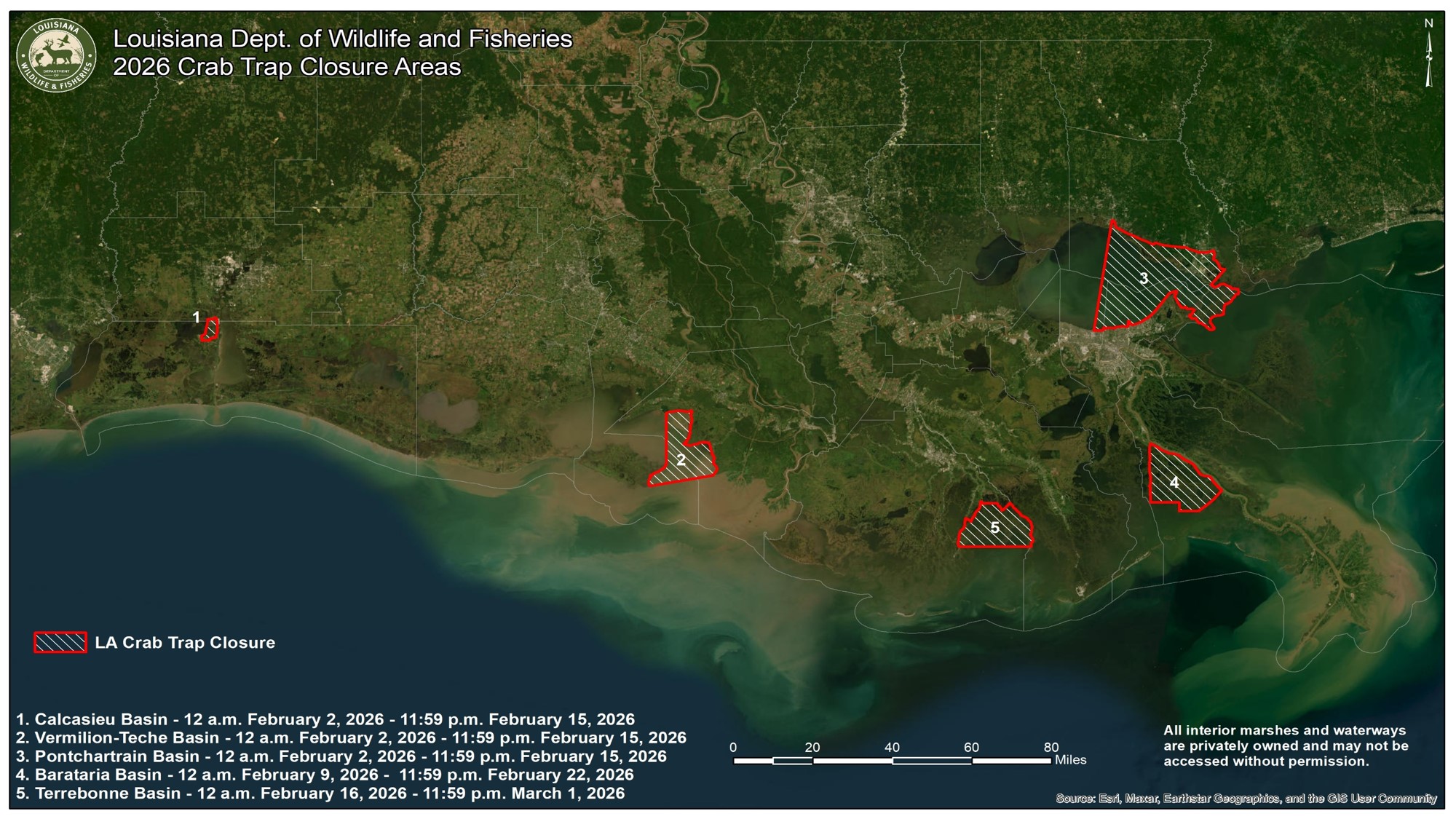
At today’s meeting, the Louisiana Wildlife and Fisheries Commission (LWFC) adopted a Notice of Intent (NOI) allowing the removal of derelict crab traps along Louisiana’s coast from the following five areas in 2026:
Since 2004, the Louisiana Department of Wildlife and Fisheries (LDWF) and individual volunteers and organizations have successfully removed and disposed of over 58,000 abandoned and derelict crab traps. Removing these crab traps is especially important to boating safety and crab harvesting efforts.
All crab traps remaining in the closed area during the specified period will be considered abandoned.
In the weeks leading up to the closure, LDWF will mail* notices to all commercial crab trap license holders and crab buyers within the affected parishes, as well as non-resident licensed crab fishermen who landed blue crab within the previous year from Louisiana waters.
*Please contact our Licensing Department to update your contact information if you have landed crab within the past several years and have not received a letter in the mail from LDWF about the past crab trap closure areas.
These proposed trap removal regulations do not provide authorization for access to private property. Authorization to access private property can only be provided by individual landowners.
Crab traps may be removed between one half-hour before sunrise and one half-hour after sunset. Only LDWF or those designated by LDWF will be authorized to remove derelict crab traps in the closure areas. Abandoned traps must be brought to LDWF-designated disposal sites.
View the closure maps at the derelict crab trap closure website.
Interested persons may submit written comments relative to the proposed rule to Peyton Cagle, Marine Fisheries Biologist, Marine Fisheries Section, 1025 Tom Watson Rd., Lake Charles, LA 70615, or via e-mail to: pcagle@wlf.la.gov prior to October 1, 2026.
Aug 7, 2025
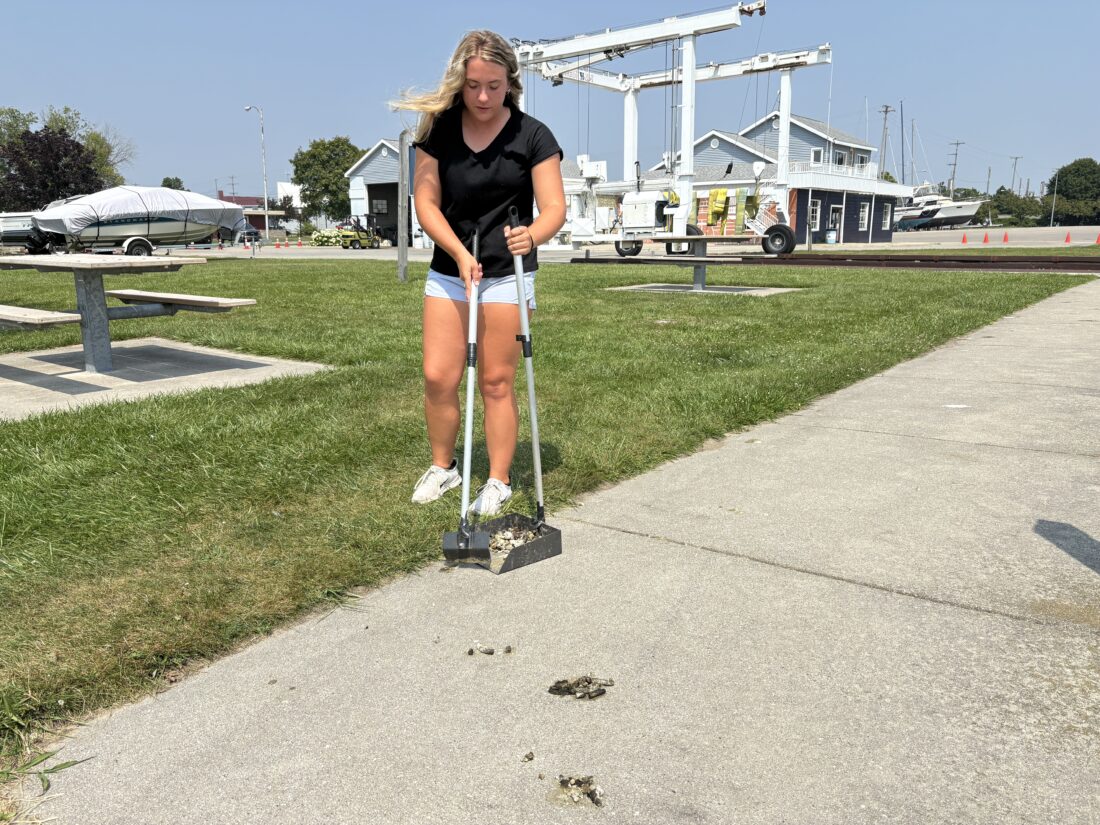
News Photo by Steve Schulwitz Ezrah Williams, a summer employee for the City of Alpena, cleans up goose feces from the sidewalks near the boat harbor in Alpena on Wednesday. The Alpena Municipal Council voted Monday against having the annual goose hunt, which is a tool the city uses to try to reduce the population of the geese. The geese make messes all over Alpena and can become aggressive when people near them.
ALPENA — The Alpena Municipal Council decided Monday to take at least a year off from having the annual goose hunt in the city that is used to help limit the number of local geese in the area.
Council voted 4-1 against a motion to have the hunt this year and instead will continue to implement other population control methods, which has thus far shown only a little success.
The feces from the geese litter the lawns at local parks, ball fields, parking lots, and sections of the bi-path that are near water. The large birds also can become aggressive if people get too close to them, especially if they are near their babies.
By taking a year off, the council hopes to get a clearer picture of whether the hunt is effective and to see if other measures that may help to scare away the water fowl can be as effective.
One member of council, Kevin Currier, even suggested removing the word “hunt” when discussing the population control method and to find an alternate term for future presentations.
It is unknown how much amplified cleanup from the goose droppings and goose egg oiling will cost the city, especially if the canceled hunt leads to an increase in the number of local geese.
Over the past nine years, goose hunts have taken place in the city during the regular Michigan goose hunting season at the fairgrounds adjacent to the Alpena Wildlife Sanctuary, and at Mich-e-ke-wis Beach as part of the effort to control the goose population in and around the city. Last year, the hunt removed a total of 41 geese, which was down significantly from the previous harvest of 118. As another control measure, the City’s Department of Public Works (DPW) is permitted through the USDA APHIS Wildlife Services program to oil Canada goose eggs within the Alpena Wildlife Sanctuary, Lake Besser, each spring. This method involves oiling the eggs with a vegetable-based oil, which prevents the geese from renesting. In late April and early May of this year, the DPW oiled 122 eggs from 15 nests.
Councilwoman Karol Walchak said the council nearly canceled last year’s hunt, but the vote at the time fell in favor of continuing with the local hunt. She said this year is a good time to take a hiatus from the hunt and measure the goose population again next spring to see what the impact was. She added that she also struggles with the thought of the birds being shot and killed.
“Let’s step up the oiling and see if it is more efficient,” she said. “Seeing these geese be killed has kind of scared me for a while. It’s not an easy thing to watch.”
Courier appeared on the fence about how he was going to vote but ultimately voted against the hunt. He said he would like to see the word “hunt” removed from the city’s information about its population control updates and public informational updates.
“Can we call this something besides a hunt?” he said. “Is it possible to just take the word ‘hunt’ completely out of it? A hunt really doesn’t really show what the end result is or what it is really for. To some people it may be just a hunt.”
Councilman Danny Mitchell was the only one to vote in favor of having a goose hunt this year. He said he believes some strides have been made in trying to limit the amount of local and migrating geese settling in Alpena, but as of now, it should still be included as another tool in the city’s toolbox to help control the animal. He added the oiling and mannequins of predators that are placed strategically around the city have produced limited results, including oiling the eggs the unborn birds grow in.
“Destroying the nests and oiling the eggs does not stop the geese,” he said. “They simply rebuild and relay the eggs. It would be great if the harassment tactic worked, but so far they haven’t. It seems for now, to reduce the number, there needs to be a hunt, too.”
Each year, the city conducts a census of the geese in Alpena, but numbers fluctuate and it is hard to tell how accurate the count is. It is also hard to predict how many migratory geese stop in Alpena while enroute north. Changes in weather patterns and things like the smoke from the Canadian wildfires can change migration patterns and skew numbers.
For now at least, the city will bank on the egg oiling, and a few other measures to try to limit the geese and the impact they have on Alpena’s infrastructure.
Wolf watchers in the Lamar Valley of Montana are also watching to see if Colorado’s wolf program will succeed. An architect of Yellowstone’s program says it could — and needs to.
Tracy Ross4:01 AM MDT on Aug 7, 2025

Johnnie LeFaiver took her son to the Lamar Valley in Yellowstone National Park this summer, because the experience of watching wolves there 20 years ago seared into her memory and she wanted Micah to have the same opportunity.
One day, they watched a pack of nine gray wolves feeding on a dead bison, and on another day, two black wolves competing with a grizzly bear for a different carcass. But when they told fellow wolf watchers they were from Colorado, “it unleashed these questions about how things were going with wolf reintroduction here,” LeFavier said, “and there was so much I couldn’t answer.”
That’s because news on Colorado’s wolf front has changed so fast and furiously, she added.
Indeed it has, especially in the last several weeks.
Over Memorial Day weekend, a wolf from the state’s first confirmed pack killed livestock on three ranches in Pitkin County, resulting in Colorado Parks and Wildlife killing the offending yearling. The animal, its parents and littermates had been trapped in Grand County, moved to a sanctuary, and rereleased near the ranches with five wolves from British Columbia in January.
Then, on July 18, CPW confirmed it would kill a second Copper Creek wolf after multiple livestock attacks in the same area — but “the terrain is challenging at best,” spokesperson Luke Perkins said in an email July 31, and staff still haven’t been able to get close to the wolves after multiple attempts. They’re still looking.
And more news broke Tuesday, about CPW’s plans to kill yet another wolf after it preyed on three sheep in Rio Blanco County. This one was uncollared and likely wandered into the state from Wyoming. Wildlife officials haven’t been able to act because a fire is burning in the region.

LaFavier by then had been back home in Boulder County for a while. But even without the most recent developments, in Yellowstone, when she learned “so many passionate wolf people are watching what’s happening with our program,” it made her think more about Colorado’s reintroduction than usual, because at home, “I haven’t really expected to see wolves yet.” But she believes they’re coming.
Plenty of people have referenced the reintroduction of wolves to Yellowstone when discussing Colorado’s wolf efforts. But that release started 30 years ago. It came from a federal mandate versus Colorado’s voter mandate. And the first wolves to roam Yellowstone in 70 years were “soft released” inside a pen in the park before being freed into the park. It was a big contrast to the way Colorado wolves have been released, on state or private land only, and in a state with 6 million people compared to a combined 3.6 million in the Northern Rockies states of Idaho, Montana and Wyoming (and far fewer in 1995).
But on July 30, a biologist involved in the Yellowstone relocation from its inception was at Chautauqua Auditorium in Boulder for a National Geographic Explorer talk about his experiences. Doug Smith led the Yellowstone Wolf Project for nearly 30 years. And in the green room before the show, he offered some insights on wolf recovery to The Colorado Sun, based on his decades of research that started when he read about wolves as a nature-loving kid and felt bad about how they were treated.
Smith gave another Colorado-based wolf talk in June, in Estes Park, where he said wolves are a call to action to humans to “stop paving over everything” and realize that natural resources are finite and need protection.
At Chautauqua he expanded on this premise, saying Colorado, as “a Western state with a lot of public lands, has a wildlife and wilderness heritage that is worth preserving,” and that wolves “go with” that heritage.
“They make you set aside land. They make you preserve wilderness. They make you protect public lands,” he added. “And they’re also what they call an umbrella species, which means, if you protect wolves, you protect a lot of other things.”
4:22 PM MDT on Aug 8, 2025
9:29 AM MDT on Aug 8, 2025
4:06 AM MDT on Aug 8, 2025
Yet he acknowledged that the ideal of a world with wolves is a hard concept for “bread-and-butter people, like ranchers,” who shoulder the burden of reintroduction, to accept. And he said wolf recovery will continue to cause challenges in areas with a lot of livestock until the wolves “self sort” into different territories.
“Now people try and pick those places, but it’s better when the wolves pick them and settle into them,” he added. Then, “if there’s no conflict, if there is conflict, you’ve got to deal with it. And when you have a toehold of a population, you deal with it first and foremost by nonlethal methods.”
But the early part of all wolf recovery work, including in Colorado, “is just going to be messy,” he said. “It’s bad and it’s uncomfortable and it’s crummy. But what you’re going through is not unexpected.”
Much is being made of wildlife agents in Oregon using recording of a scene from “Marriage Story” in which Scarlett Johansson and Adam Driver scream at each other to haze wolves away from livestock, but Smith said effective nonlethal deterrents in “the New West” go way beyond that.
In the Old West, the solution to protecting livestock was to kill all the predators, which led to the extirpation of wolves from Colorado in the 1940s. Once that happened, Smith said, “you just turned your livestock loose for the summer and brought them back at the end.” And if you didn’t have all the livestock you had at the beginning, “it was because they fell in a hole. They got hit by lightning. They died from weather.”
But in the New West, including Colorado, “we can’t just kill the predators, because half the population wants wolves,” he said. “So if you’re a rancher living close to them, you’ve got to modify your practices.”
“It’s night-penning, it’s herding, it’s shepherds, it’s guard dogs. It’s radio-activated guard boxes, which in slang are ‘RAG boxes,’” he said. And it’s having more human presence on the range, which CPW and the Colorado Department of Agriculture have been helping ranchers do through the state’s range riding program.
But there comes a point “after you’ve done all that, underlined three times,” where killing wolves should also be on the table, Smith said. “And the issue so far for Colorado has been you don’t have a large enough wolf population that you can sustain that killing. The wolves aren’t expendable. They’re very much needed for population growth and getting through this low-population phase.”
Colorado Parks and Wildlife says Colorado’s wolf reintroduction will be a success when there are at least 150 wolves anywhere in Colorado for two successive years, or a minimum count of at least 200 wolves anywhere, with no temporal requirement.
Of the 25 wolves introduced since December 2023, nine have died, plus the yearling from the Copper Creek pack that preyed on cattle in Pitkin County. The mother of that pack had five pups in 2024 and a new litter this winter. And of four packs CPW recognizes, including the Copper Creek pack and three this year, it has identified six new pups and believes there are others.

But “once you get over a critical mass, you get rid of the bad apples,” Smith said. “Because the behavior spreads and antipathy towards wolves festers in the ranchers. (They say) ‘I gotta blast livestock-killing wolves on my property, but I can’t do anything about it.’” And that leads to scenarios like the one currently playing out in Pitkin County.
Killing wolves for management isn’t fair chase, Smith added, it’s “they need to die.” And in the Northern Rockies, where the wolf population is now 2,000, “if a wolf looks at a cow cross-eyed” it’s dead, he said.
Idaho, Montana and Wyoming all have trophy hunting seasons on wolves. And Wyoming has a “predator zone” that covers 85% of the state, where wolves can be killed at any time without a license.
But when wolf reintroduction started in the Northern Rockies, federal officials moved any wolf that killed livestock once, Smith said, and killed it only if it preyed on another domestic animal again.
And whenever there was a wolf meeting in those early days, “it was standing room only, with people out the door on the street, TV monitors inside rooms, people yelling, screaming and giving death threats, the whole nine yards,” he said.
“Now you go to a meeting about wolves in Idaho, Montana or Wyoming, and there’s empty seats.”
A recurring narrative among many opposed to wolf reintroduction is that Gov. Jared Polis and CPW Director Jeff Davis have withheld crucial details regarding the efforts or flat out lied about them.
In some instances the former has been true, but Smith said if those perceptions extend to Eric Odell, CPW’s wolf conservation program manager, or Brenna Cassidy, wolf monitoring and data coordinator, they shouldn’t, because he has worked with both and knows “they’re doing the best they can.”
He pointed this out because in several news articles he’s read, sources “like to grandstand … saying ‘everything CPW says is a lie.’ But another thing that happens is things change, so when you say something on day one, on day 10, 20 and 30, the answer is different. And that’s not lying, right?”

He also said repeatedly quoting ranchers saying, “I don’t mind the wolves. I’m doing everything I can to keep them from killing my livestock. But I got to make a living, and they’re just ruining my life,’ gets lots of attention, but it doesn’t help either.”
“The media has literary license. It can do whatever it wants,” he added. “But I go back to what I said at the outset. What we’re living in is the human takeover of the planet. The reason people want to live in Colorado is because of the great outdoors, because of the mountains, because of the space. Wolves are part and parcel with that, and they will help you protect it.
“So to say I want it in a kind of controlled, picture-book way is not what wilderness is really about. It’s about blood and guts and real life. And I think it would be valuable for Colorado people to hear that things are going to go wrong, and things are going to be bad. But in Idaho, Montana and Wyoming, wolves are hardly an issue anymore.”
 Exposing the Big Game