Bloodhound group relieved to escape hunting ban
Reply


Rosie McCall
https://www.iflscience.com/if-bird-flu-spills-over-to-humans-this-is-what-would-happen-in-a-very-short-period-81998
Freelance Writer
Rosie is a freelance writer living in London. She has covered everything from ancient Egyptian temples to exciting medical breakthroughs, but she particularly enjoys writing about wildlife, anthropology and the wonders of the human mind.View full profile
EditedbyJohannes Van Zijl
SHARE


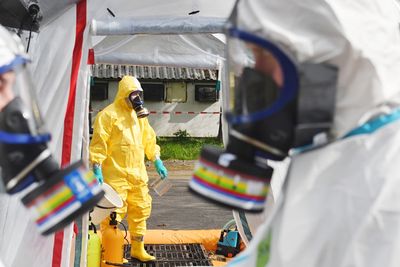
As we all learned in 2020, it does not take long for a disease outbreak to turn into a full-blown pandemic. Zoonotic diseases – such as COVID-19 or bird flu – are prime contenders for a future “Disease X” that could spark a global epidemic.
In a new paper, published in Springer Nature Link, researchers simulated what could happen if highly pathogenic avian influenza (HPAI), better known as “bird flu,” were to spill over into humans. There is more than one strain floating around at the moment, but it is the H5N1 subtype that is the most well-known and that formed the basis of the research.
For the study, the researchers used an agent-based simulation to model a two-step scenario, where the disease is first transmitted from bird to human and then, by human to human. The model was based on a fictional village of 9,667 people in the district of Namakkal in Tamil Nadu, India – a region home to over 1,600 poultry farms and more than 70 million chickens.
The simulation predicted what would happen after the disease was planted at one of two outbreak sites – a poultry farm and a wet market – where primary contacts came into contact with infected birds. These synthetic “agents” would then continue to go about their day, engaging with other agents that existed within a larger network of secondary contacts (such as friends, family and colleagues) and tertiary contacts. Interventions, from culling birds to distributing vaccines to implementing quarantines, could be tested to determine their impact on disease spread.
For a pandemic to ensue, the virus has to first overcome two “bottlenecks” (events that cause the original population to reduce dramatically) – the capacity to infect human hosts and the ability to pass from human to human. Once achieved, the researchers found that infections could quickly be curtailed if cases remained isolated and households were quarantined, but things could quickly spiral out of control as soon as tertiary contacts are infected.
“It is in the very early stages of an outbreak that control measures make the most difference,” the researchers write. “Once community transmission takes over, cruder public-health measures such as lockdowns, compulsory masking, and large-scale vaccination drives are the only options left.”

Explore more from The Vault
AI Aliens: What If Extraterrestrial Life Is Artificially Intelligent?There Will Soon Be A Doomsday Vault For Human Poop
So far, cases of bird flu have been reported in various animals, including sheep, cows, cats, elephant seals and humans. As per the last count, the CDC reports there have been 71 infections – and two deaths – in the U.S. since 2024.
While there is no indication yet that the disease can jump from human to human, scientists have warned we could just be one or two mutations away from this type of scenario.
If we ever do find ourselves in the midst of a potential outbreak, the researchers say their simulations can be run in real-time “responding to initial reports of cases. They can be tuned further as more information is collected.”
The study is published in the journal Springer Nature Link.
 Exposing the Big Game