The blood on my shirt came from a wounded pigeon I picked up. A spectator subsequently assaulted me while trying to take her from me; fans at the shoot preferred to rip the injured birds apart themselves for fun. (One spectator even entertained his friends by biting the head off a pigeon who’d been shot but wasn’t dead.) I was able to get the shot bird I picked up to a veterinarian, but her gunshot wounds ultimately proved fatal.
Today, for the first time in three decades I put on the same shirt again in that bird’s memory. I’ve never washed it, so her blood is still on the shirt.
I remain deeply grateful to my former long-time boss Heidi Prescott and to the many others (see here, here, and here as examples) who’ve devoted themselves to exposing and ending this cruelty. Heidi still works tirelessly to end the barbarity of pigeon shoots as a lobbyist in Pennsylvania.
But 30 years later, live-pigeon shoots are still held in Pennsylvania (here’s a club that regularly hosts them), the only state where they routinely occur. Captive birds are launched into the air and shot as living targets for entertainment.
An excellent book, Our Kindred Creatures, about the birth of the American animal protection movement, details how pigeon shoots were one of the top campaigns waged by animal advocates in the 19th century. In other words, animal protectionists have crusaded against this stain on humanity in the 19th, 20th, and 21st centuries. Yet like the bloodstain on my shirt, pigeon shooting still persists.
Mule deer populations are “languishing” in parts of Wyoming, but with archery season underway, hunters say record trophy bucks are still out there. After an unusually mild 2025-2026 winter, many deer stayed fat and growing larger antler racks.
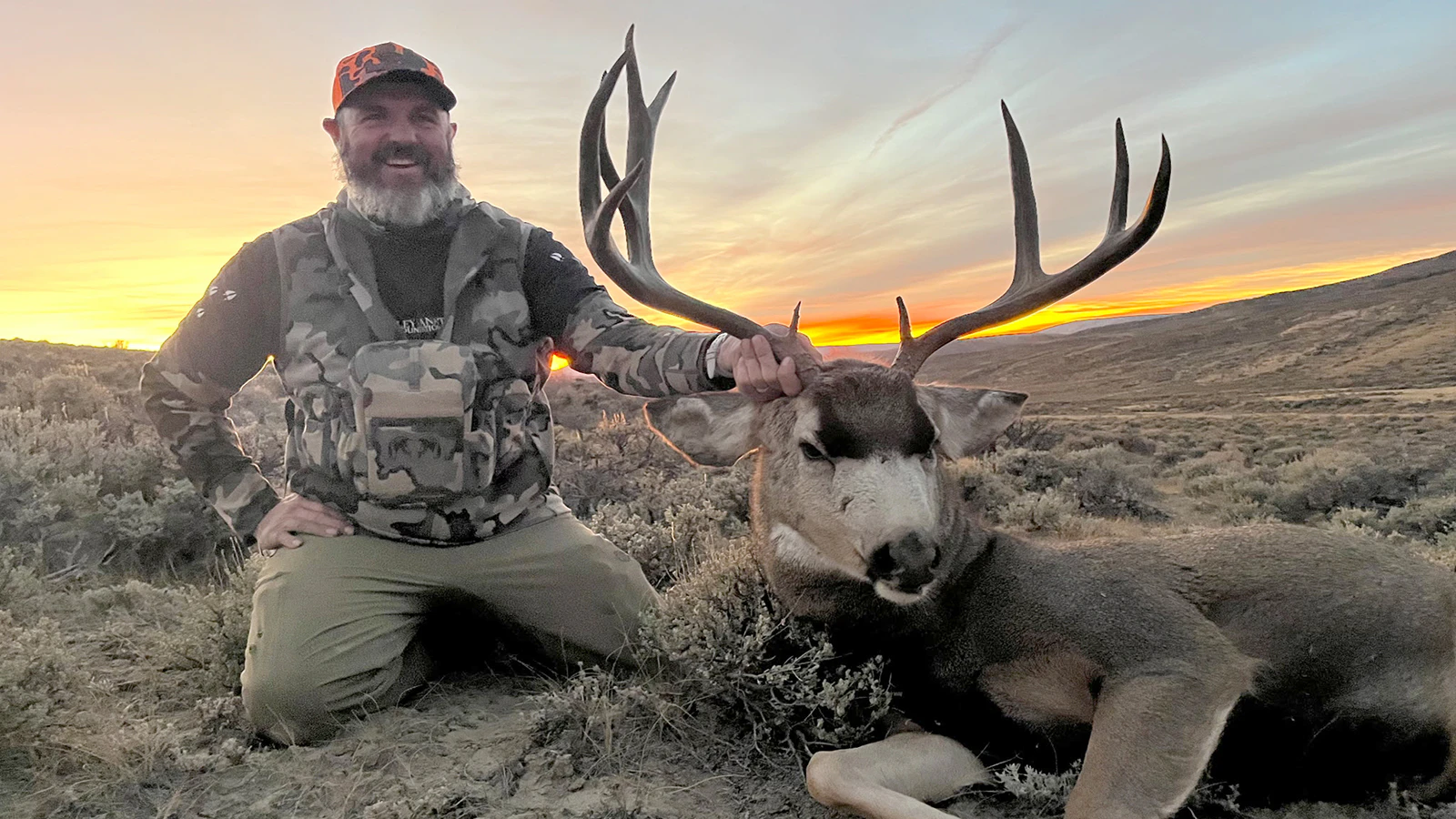
Ryan Hansen got this mule deer buck during a 2025 hunt in southwest Wyoming. Hunters might have to work hard for bucks this year, according to Game and Fish. (Ryan Hansen)
Wyoming’s 2026 deer season could be a matter of quality over quantity in some parts of the state, amid rumors that the vaunted Wyoming Range mule deer herd might once again be producing the sort of monster bucks for which it’s famous.
Overall, mule deer hunters have reason to be cautiously optimistic going into the season, according to the Wyoming Game and Fish Department’s hunting forecast.
Some early archery deer seasons opened Tuesday. Most rifle season will kick off in mid-October.
Monster Buck Comeback
The Wyoming Range mule deer herd is one of the most treasured. It produced the state’s most famous mule deer in the late 1980s and early 1990s — Popeye, Morty, and Goliath — gigantic bucks still well-remembered.
That herd was one of the hardest-hit during the devastating 2022-2023 winter. It lost thousands, including that year’s entire fawn crop.
Avid hunter Zach Key lives in La Barge and keeps close taps on the herd. He’s a co-founder of the Wyoming Range Hunting and Fishing Expo conservation group.
While deer numbers are still down, the herd seems well on the way to recovery, he told Cowboy State Daily.
“The deer quantity is down, but the quality is definitely better this year,” he said.
After an exceptionally mild winter, many deer likely still retained some fat going into spring and were able to “pour more nutrition” into antler growth, Key said.
Scouting reports from local hunters indicate a good number of large bucks, including some in true trophy class, in the 200-inch and up range, Key said.
That’s according to the Boone and Crockett trophy scoring system. It’s based on length and circumference measurements taken at several points along a deer’s antlers, which are compiled for the score.
“A lot of people are seeing some really solid bucks; I think some absolute hammer bucks are going to be killed this year,” he said.
Game and Fish forecasts “modest increases in opportunity” for hunters in the Green River and Pinedale regions.
“Hunters willing to put in the time and effort should be rewarded with an opportunity to harvest a trophy-class mule deer buck from abundant public lands in the Pinedale region,” according to Game and Fish.
Sheridan Area Deer in a Downswing
Mule deer numbers in the Sheridan region have been trending down since 2019 because of poor range conditions, drought, disease, and hard winters, according to Game and Fish.
On public land, more hunters might be competing for fewer deer.
Hunting seasons for 2026 are similar to the previous year. Antler point restrictions are in place for 2026 in some hunt areas. Hunters should expect difficult access to private lands and some overcrowding on accessible public lands, according to Game and Fish.
Hunter Frank Bilek of Buffalo said he’s not worried about finding a buck this year.
He likes to hunt on public land in the mountains above Buffalo.
“I’ve seen enough deer around here to see a difference from last year,” he told Cowboy State Daily.
He said the secret to hunting in the area is to put in the miles and go farther in and higher up than other hunters might be willing.
He likes hunting in the timber along the edges of large meadows, hoping to catch deer moving through in the morning or evening.
It might take more time and effort to find a huge buck this year, Bilek added.
“I haven’t seen super-impressive bucks” that were more common in years past, he said. “The super bucks are going to be harder to find because there are not as many of them and more hunters.”
White-Tails: A Good Alternative
In the Lander region, which includes the deer hunt areas around Riverton, the mule deer population has been “languishing,” according to Game and Fish.
Even so, the department opted to lift point restrictions in some hunt areas there.
“Antler-point restrictions were lifted this year to provide more harvest on proportionally high buck numbers and to potentially guard against the spread of CWD (chronic wasting disease). Hunters will have opportunities for similar harvest success as in past years — mostly with young bucks,” according to Game and Fish.
Jason Crotteau of Riverton said he usually doesn’t hunt mule deer in the area. Instead, he and his wife go for white-tailed deer on private property where they have access permission.
“Where we go, we’ve never had an issue,” finding deer, he told Cowboy State Daily.
While mule deer hunting in Wyoming is almost entirely bucks only, either buck or doe white-tailed deer can be shot in some general tag hunting areas, Crotteau said.
That increases the odds of getting venison in the freezer, he said.
“All of the deer we’ve taken in the last three years, they’ve been fat, and it’s been really good meat,” he said.
Victorian authorities have confirmed the death of a fox from H5 bird flu at Torquay, south-west of Melbourne.
The virus is also suspected to have killed a dolphin at Lorne.
What’s next?
Victorian authorities plan to prioritise threatened species in captivity for vaccination.
Link copiedShare article
H5 bird flu has been detected in a fox in Victoria’s south-west, in the state’s first recorded case in mammals, authorities say.
Authorities also suspect a dolphin found dead at Lorne died of the virus.
Acting chief veterinary officer Cameron Gunn said the infected fox was found dead on Victoria’s Surf Coast.
“We have now confirmed H5 bird flu in a red fox recently found at Torquay collected through our ongoing surveillance and monitoring effort,” Dr Gunn said.
Authorities suspect a dolphin died from bird flu off Victoria’s south-west coast. (Supplied: South Coast Cetaceans)
But authorities are not concerned about foxes spreading the disease.
“Wild foxes and other scavenging pests have not generally been shown to spread the actual virus when they become infected,” Dr Gunn said.
The greater risk was of foxes moving infected carcasses around, he said.
Victoria has recorded 212 positive cases in birds from a total of 892 investigations conducted since June 20.
Victorian authorities have detected H5 bird flu in numerous species, including greater crested terns, magpies and little penguins.
A little penguin on Phillip Island died from the virus last month and the state is in the process of vaccinating the colony.
Little Penguins at Phillip Island are being vaccinated against bird flu. (Supplied: Phillip Island Nature Parks)
Victorian chief biodiversity officer James Todd said detections in seals and dolphins were not unexpected, and the virus was expected to spread to new species and other parts of Victoria.
“Particularly as we head into the spring breeding season, where large numbers of birds typically flock and aggregate around, for example, coastal estuaries and inland waterways and wetlands,” Dr Todd said.
As a result, the government was focusing its surveillance on areas deemed high-risk, including the Mornington Peninsula, Port Phillip Bay, Western Port Bay and the Gippsland Lakes.
Bird flu has been found in many dead crested terns along Victoria’s south-west coastline. (ABC News: Jean Bell)
Vaccinations results
A dead bird found on Sydney’s northern beaches last week has been confirmed as the city’s first case of H5 bird flu, bringing NSW’s total to 20.
Wildlife advocacy group Birdlife Australia said it was concerned about the virus’s effect on endangered species.
Birdlife Australia senior public relations adviser Sean Dooley said the virus could spread “quite rapidly” and he was most concerned about it spreading to breeding colonies of endangered species.
NSW announced a vaccination program in August, and the Victorian government has vaccinated about 1,000 little penguins.
Dr Todd said the vaccinated penguins on Phillip Island and at St Kilda Pier had shown an immune response and no adverse impacts.
“Of course, we know that vaccination is not a silver bullet,” he said.
“It is a tool that can be used in targeted situations, mostly for captive populations and highly managed and well-studied wild populations like little penguins at Phillip Island and St Kilda.”
Threatened species held by Zoos Victoria and other wildlife centres would be prioritised for vaccination, he said.
But he warned Australia was still at the beginning of the spread of the virus and people should expect that wildlife would continue to suffer and die.
“Overseas experience shows that wildlife or impacted wildlife populations can recover from H5 [bird flu] and they can adapt and in some cases they can also build natural immunity,” Dr Todd said.
“But it’s also observed from overseas that the virus can continue to impact on populations even at a time when they might be starting to recover.”
Officials in a New Jersey city set up a net to keep pigeons away from a bridge in an effort to address a nuisance for residents, but the solution is keeping some trapped inside, NBC News 4 New York is reporting.
The net under the bridge at Broadway and West Eighth Street in Bayonne has only been up for a few days, but it has already started to ruffle some feathers for residents, the report said.
Flying Traffic Light Almost Crushes Pedestrian as Severe Storms Wreck Havoc on Toronto
The net was supposed to help cut down the amount of bird droppings under bridges, which they describe as an ongoing public health concern, they told News 4. Residents agree there is a problem to solve.
Eileen Murphy, who frequently passes through the area, told the outlet that she has to cover her nose and mouth whenever she goes by. She says it’s because she has COPD and worries about what she’s breathing in.
“They just put (the nets) up, so we’ll see. But I’m still concerned about it,” said Murphy.
“It’s definitely a lot better. It’s disgusting, we’d have to walk in the street, it was terrible,” said resident Fred Gattuso.
But some questioned the city’s solution.
“It’s horrible what’s happening to these pigeons that are trapped up in there,” Gattuso said. “They could’ve done this a little better to be honest.”
“I mean, I understand what they’re doing or trying to do, but they should incorporate a way so the pigeons have a place to be,” another resident, David Finney, told News 4.
“Since learning about the issue, the administration has been working to determine how the matter could be addressed as quickly and safely as possible,” a city official responded to News 4. “The city’s department of public works and the vendor have been actively engaged to remove the birds as expeditiously as possible. 48-hour checks transitioned to daily checks, with multiple releases being made.”
As of Friday, the city estimates there are only about five remaining birds stuck inside the netting and the plan is to trap and release them shortly, the city spokesperson said.