Proposed Oregon Initiative Would Outlaw Animal Agriculture and Hunting
Reply


KJZZ | By Connor Greenwall
Published January 20, 2026 at 4:29 PM MST
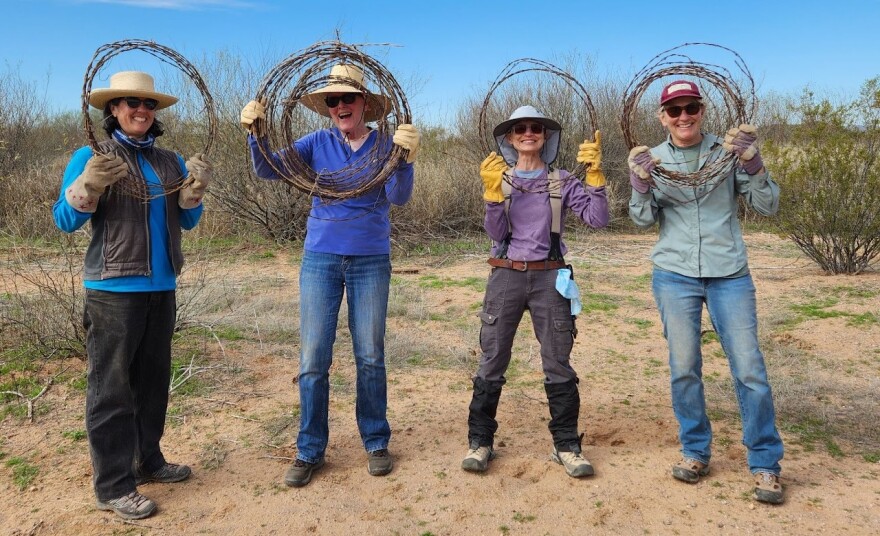
The Desert Fence Busters remove abandoned barbed-wire fences that disrupt wildlife migration.
The Tucson-based volunteer group has made it their mission to remove these fences.
Abandoned fences along former farmland and ranches, some up to 100 years old, get in the way of wildlife migration. The fences can divert animals away from food and water, force them to travel further, and can trap them.
“It’s not serving any useful purpose anymore, and probably was originally put up either to keep cattle in or keep cattle out, depending on whether you were a rancher or a farmer,” said Tom Hannigan with the Desert Fence Busters. “But since it doesn’t serve any productive purpose, all it really does do is get in the way.”
Hannigan said the Desert Fence Busters have already removed 95 miles of fences from the Sonoran desert since the group started in December of 2021.
The Desert Fence Busters work in collaboration with Arizona Game and Fish and Pima County as well as the National Parks service. Most removal efforts are on county and city property, but the group also works with local ranchers and landowners who want similar removal efforts on their property.
“We’ve seen plenty of evidence of animals that have been caught in barbed wire, and it’s a fairly ugly way to die,” Hannigan said. “So we’re trying to promote wildlife connectivity.”
Hannigan said removed barbed-wire fences are taken to a metal recycler. So far, the fence busters have removed 98,000 pounds of fences across 16,000 acres.
More Environment Stories
KUNM | By Bryce Dix
Published January 23, 2026 at 3:22 PM MST

Two bills that aim to strip the Mexican gray wolf of its federal endangered species protections are now snaking their way through the federal lawmaking process.
The Republican-led pieces of legislation – the “Pet and Livestock Protection Act” introduced by U.S. Rep. Lauren Boebert, (R-Colo.) and the “Enhancing Safety for Animals Act of 2025” authored by U.S. Rep. Paul Gosar, (R-Ariz.) – would essentially do the same thing: delist the Mexican gray wolf from the Endangered Species Act.
If successful, the delisting would shift management back to the states of New Mexico and Arizona, potentially create “opportunities” for lobo hunting and trapping (depending on individual state regulations), and halt genetic diversification efforts.
While similar attempts to delist the animal have failed in the past, the current political atmosphere has advocates worried about what might happen if Congress decides the wolf doesn’t need help anymore.
Leia Barnett, a conservation advocate with the New Mexico-based environmental non-profit WildEarth Guardians, said she is stunned these bills are sailing through Congress, and wants politicians to ground themselves in the science of consistent management of the species, not political bickering.
“We’re not going to see that if we’ve got a patchwork management scheme that’s based on individual state agencies determining what’s right, rather than a larger national plan that can work towards meaningful, robust recovery,” Barnett told KUNM.
On Thursday, Rep. Gosar’s bill went through a “committee markup” meant to tweak language before a bill is sent to the House floor.
There, Gosar made the claim that the wolf “has been recovered” and his constituents are “paying the price” for increasing livestock depredations.
“Ranchers are losing cattle, horses and dogs,” Gosar said. “Families who have been stewards for the land for generations are being driven out of business.”
Although the species was almost completely wiped off the landscape from trapping and hunting, the Mexican wolf population has made a significant comeback thanks to coordinated recovery efforts and the broad protections of the Endangered Species Act.
At the same time, as wolf numbers continue to grow, data from the U.S. Fish and Wildlife Service shows that cattle kills have been proportionally dropping since 2019.
Despite these discrepancies, Gosar said the federal management of the wolf is costing taxpayers and ranchers lots of money.
“This is not an anti-conservation bill, it is a pro-science, pro-law and pro-people bill,” Gosar said in support of his own legislation. “It acknowledges success where success has been achieved, and rejects the notion that federal agencies should operate without limits or consequences.”
To conservationists like Barnett, it’s not as black and white.
“There is robust science that tells us what we need to have a healthy, thriving, resilient lobo population,” Barnett said. “That includes 750 wolves at a minimum, dispersed across three interconnected sub populations of 200 wolves.”
A recent survey count estimates there are around 286 wolves in New Mexico and Arizona.
Additionally, research shows that the genetic diversity of the species is dangerously low – so much so, the whole population is as genetically related as siblings.
After the brief debate about the lobo’s recovery – ranging from the population’s growth, to the loss of rancher livestock from depredations, to science – the House Committee on Natural Resources ultimately decided to leave most of Gosar’s bill untouched, and recommended the full House pass the measure when it’s taken up for a vote.
The language of this bill, in particular, is alarming to Barnett because it would make any future attempts to relist the wolf much harder by preventing wildlife managers from considering the recovery status of lobos south of the border.
“That’s vindictive and malicious,” Barnett said. “It’s not based upon the needs of that species.”
Meanwhile, Rep. Boebert’s attempt at delisting the wolf is much farther along in the legislative process. It has already cleared the House and is now moving through Senate committee assignments.
 Exposing the Big Game