Unknown's avatar

About Exposing the Big Game

Jim Robertson

5 Ways Life Would Change If Global Temperatures Increase By 3C

HuffPost UKFollow

75.9K Followers

Story by Kate Nicholson

 • 12h • 3 min read

sorbetto via Getty Images© Provided by HuffPost UK

The United Nations warned last month that the Earth is on track to heat up between 2.6C and 3.1C by the end of the century unless we act.

That’s an increase on the UN’s concerns from last year, when the organisation predicted global temperatures could increase by anything between 2.5C and 2.9C, when compared to the climate we experienced in the pre-industrial era.

The world is already 1.4C hotter than it was before the Industrial Revolution – and gas emissions are only rising.

The 2024 annual Emissions Gap Report, released ahead of the annual UN climate summit COP29, said urgent intervention is needed from global governments.

The UN environment chief, Inger Andersen said: “If nations do not implement current commitments then show a massive increase in ambition in the new pledges, followed by rapid delivery, the Paris Agreement target of holding global warming to 1.5C will be dead within a few years and 2C will take its place in the intensive care unit.”

Similarly, the UN secretary-general Antonio Guterres said last year: “Present trends are racing our planet down a dead-end 3C temperature rise. The emissions gap is more like an emissions canyon.”

The 2015 Paris Agreement saw countries around the world agree to try and limit global warming to 1.5C by cutting carbon emissions.Related video: Could Global Warming Start A New Ice Age? 🧊 (Atlas Pro)

about:blank

This summer I’ll be heading to Europe for about a

Loaded: 2.31%Play

Current Time 0:01

/

Duration 12:58Quality SettingsCaptionsFullscreen

Atlas Pro

Could Global Warming Start A New Ice Age? 🧊Unmute

0

View on Watch

However, the UN has now warned there is just a 14% chance we will be able to stay below the 1.5C threshold, as global greenhouse gas emissions continue to rise year-on-year.

And at 3C, the world will have passed several key catastrophic points – and the change will be irreversible.

So, what would life look like?

1. Droughts

According to carbon accounting firm Greenly, just 3% of the world’s water is drinkable or can be used for crops right now – and global warming would put pressure on that food supply.

This would not only damage the way we live, but will seriously impact local wildlife if they don’t have enough water to survive on.

2. Natural disasters

The world already saw a staggering number of natural disasters in 2023 and 2024 – including floods, earthquakes, hurricane, tornadoes and wildfires – but this will only get worse as global warming ramps up.

That will cause mass, sudden displacement too, as communities in areas vulnerable to extreme weather become inhabitable.

3. Heat

Areas already known for high temperatures will struggle as heatwaves last longer and get more intense – posing yet a serious risk to health.

4. Sea levels

Greenly claims nearly 12% of the entire global population will be impacted by rising sea levels, because there are so many people who live in coastal areas. It warned some cities could even be entirely under water by the end of the 21st Century.

It may worsen natural disasters too, by triggering further hurricanes and typhoons, while also potentially contaminating our water supply by interfering with irrigation systems.Travel Oregon This Fall

Travel OregonTravel Oregon This Fall

Ad

5. Displacement

As the countryside becomes more uninhabitable, cities are likely to become more built up – even though they usually worsen the climate crisis because of industrialisation. That will affect indigenous communities around the world, and worsen overpopulated areas.

The global south is already disproportionately impacted by the climate crisis, particularly any developing countries which do not necessarily have the finances to combat the impact of the climate crisis.
Related…

Historic drought fuels blazes across Northeast as wildfires burn on both coasts

“Not only is the fire burning on top of the ground, it’s burning under the ground,” New Jersey Forest Fire Service Chief Bill Donnelly said.

RESIDENTIAL NEIGHBORHOODS.

>> YOU HAD 60 MILES AN HOUR

0 seconds of 3 minutes, 1 secondVolume 0%

Dangerous wildfires rage across California and New England

Get more newson

  • SaveCreate your free profile or log in to save this article

Nov. 11, 2024, 3:42 AM PST

By Patrick Smith

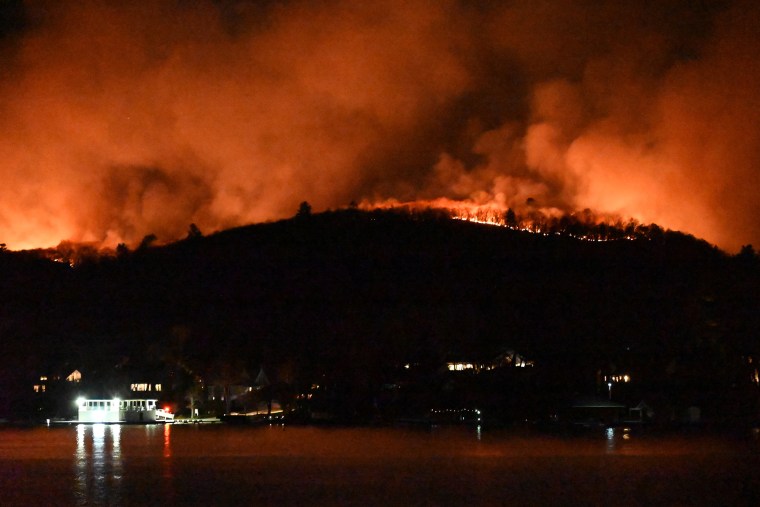
Firefighters from coast to coast are battling wildfires even as the country begins to prepare for the holiday season, with fires in New Jersey covering thousands of acres in tinderbox conditions created by a historic drought.

In California, the so-called Mountain Fire in Ventura County has grown to 20,000 acres, or 31 square miles, and was only 26% contained Sunday night, the Ventura County Fire Department said in an update. Threats remains there to critical infrastructure, highways and communities as the fire “continues to creep and smolder in steep rugged terrain,” a public information officer said.

The blazes in the Northeast have claimed at least one life: Dariel Vasquez, an 18-year-old New York Parks employee, was killed Saturday by a falling tree while battling a fire in Sterling Forest, in New York’s Orange County. A memorial service will be held for him at Ramapo High School on Monday.

The Jennings Creek Wildfire in Passaic County, New Jersey, close to the New York state line, had grown from 2,500 to 3,000 acres — about 4.6 square miles — and was only 10% contained as of 6.30 p.m. Sunday, the New Jersey Forest Fire Service said. At least 25 structures are threatened.

While there was a small amount of rain Sunday night, authorities warn it will not be enough.

“Make no mistake, though, precipitation is forecasted [but] that’s not going to solve the problem that we have here with this wildfire. It’s inevitable that this fire is going to continue to burn up until it reaches our control line,” New Jersey Forest Fire Service Chief Bill Donnelly said at a news conference Sunday.

He said the fire would likely burn through the end of this week, when the service hopes it can secure its control lines and contain the blaze. More than 200 local volunteers joined 75 wildland firefighters yesterday in attempts to battle the flames. 

But he added that it was unlikely homes would need to be evacuated.

Wildfire breaks out in West Milford, New Jersey
A wildfire burns on a mountain in West Milford, N.J., on Saturday.Kyle Mazza / Anadolu via Getty Images

The fire department in Warwick, New York, told residents on Cliff Road, east of Greenwood Lake, to leave but stopped short of a mandatory evacuation order. Power was shut down Sunday night in Greenwood Lake Village as a preventive measure and a local shelter was set up by the American Red Cross, the force said.

“Not only is the fire burning on top of the ground, but it’s burning under the ground, so it’s very labor intense,” he said. “To put these fires out takes a lot of time and energy, and you can see by those numbers, we’ve been running our folks ragged”

Historically dry conditions and strong winds have created the perfect conditions for fires to thrive. Three counties in New Jersey are experiencing a rate “extreme” drought, while the rest of the state has severe or moderate drought conditions, according to the U.S. Drought Monitor at the University of Nebraska-Lincoln.

Recommended

Climate changeSnow patch known as U.K.’s longest-lasting has vanished for fourth straight year

U.S. newsBrush fire breaks out in Brooklyn’s Prospect Park as Northeast drought continues

Donnelly called it the driest fall in New Jersey since records began.

The result is Donnelly’s teams have been called to 537 reports of wildfires in New Jersey alone since Oct. 1, burning through a total of 4,500 acres, or 7 square miles. In New York state, the total is 60 wildfires covering 2,100 acres in the same timeframe.

One blaze, the Hill Fire in Burlington County, has been burning since July 5, he said. Elsewhere, the 181-acre Cannonball 3 Wildfire was 100% contained Sunday.

There was some rain across the tristate area Sunday night, but less than half an inch, the National Weather Service in Mount Holly said.

Much of the Northeast has been experiencing a record lack of rain, with some areas such as Philadelphia without any precipitation for 42 days until Sunday’s shower.

25 monkeys caught but more still missing after escape from research facility in SC

Eric Lagatta

USA TODAY

0:28

0:30

More than half of the monkeys that escaped a primate research facility last week in South Carolina have been recaptured, according to police.

Of the 43 monkeys that broke loose from Alpha Genesis, officials managed to recover 25 of them between Saturday and Sunday, leaving 18 of the animals still at large in Yemassee, a small town about 60 miles west of Charleston. The primates, a bare-faced species known as rhesus macaques, made a break for it Wednesday when a caretaker at the research center failed to lock the doors after a feeding.

Police in Yemassee said Sunday on Facebook that “a sizable group remains active” near the research center’s fence line and had “bedded down in the trees for the night.”

The post, which quoted Alpha Genesis CEO Greg Westergaard, said the company’s recovery process “will continue until all animals are safely recovered.”

43 monkeys on the loose:Animals escaped research facility in South Carolina

43 monkeys escape Alpha Genesis in SC

Since their escape, the monkeys have been spotted in trees among the woods surrounding the 100-acre Alpha Genesis facility.

Alpha Genesis, which houses about 5,00 monkeys of a variety of species at two South Carolina sites for biomedical studies and scientific research, has identified the animals as young rhesus macaques females weighing no more than 7 pounds.

The company, along with law enforcement, has been baiting the primates with food.

Download USA TODAY’s app to get to the heart of newsAre giant rats the future in sniffing out wildlife trafficking? Watch the rodents at workWyoming officials approve $100 million sale of Grand Teton National Park land to governmentMonkeys still on the loose in South Carolina as authorities scramble to recapture them‘I was in total shock’: Woman wins $1 million after forgetting lotto ticket in her pursePie, meet donuts: Krispy Kreme releases Thanksgiving pie flavor ahead of holidays

The monkeys that escaped have not yet been used for testing due to their size and young age, and do not pose a risk to the public since they are too young to carry disease, according to Alpha Genesis.

Still, the town’s 2,200 residents have been asked to keep their doors and windows closed. Anyone who spots the monkeys are warned against approaching the “skittish” animals and are asked to instead call 911, according to police.

Get the Daily Briefing newsletter in your inbox.

The day’s top stories, from sports to movies to politics to world events.

Delivery: DailyYour Email

25 recaptured monkeys are ‘in good health’

The first monkey was caught Saturday, followed by the recapture of 24 others on Sunday, Yemassee police said. Officials have not said where the monkeys have been recovered.

Veterinarians who have evaluated the animals have their capture have indicated that the the recovered monkeys were ‘in good health,’ according to police.

The department’s Facebook post also urged residents not to fly drones in the area after a recent incident “led to the primates becoming spooked, which not only increased their stress but also complicated efforts for their safe return.”

Not first time monkeys escape Alpha Genesis

This is not the first time monkeys have escaped Alpha Genesis.

In 2016, 19 monkeys escaped from Alpha Genesis and were captured almost six hours later, according to The Post and Courier.

Two years prior to that, 26 monkeys escaped in December 2014 and were recaptured within two days. The company was later fined $12,600 by the U.S. Department of Agriculture for failures to contain the animals.

Contributing: Saman Shafiq, Ahjané Forbes, USA TODAY

Officials probing shooting death of California sea lion

By 

Chris Harris

Published Nov. 9, 2024, 7:32 p.m. ET19 Comments

Today’s Video Headlines

0 seconds of 54 secondsVolume 0%

A handsome reward is being offered for information about the shooter who gunned down a California sea lion in Huntington Beach.

The National Oceanic and Atmospheric Administration has offered up $20,000 to anyone who can lead them to the seal lion-shooting culprit.

NOAA has been working on the case with the Orange County Sheriff’s Department since Aug. 7, when the sea lion was discovered clinging to life on Bolsa Chica State Beach. 

A photo showing the seal's carcass.
Officials said the sea lion was shot in the back.AP

A rescue group tried to save the animal, but it died a day later.