Additional district veterinary officer Dr Mrutyunjay Mohanty said there is no reason to panic as the Veterinary department has not detected any H5N1-affected chicken in the area.
KENDRAPARA: Around 200 chickens of a few poultry farms at Narsinghpur village in Derabish block have died in the last two days fuelling fears of bird flu.
“Several chickens died unnaturally on Saturday and Sunday in some poultry farms. While the carcasses were dumped in a canal nearby, we rushed to the spot and buried them,” said additional district veterinary officer (disease control), Kendrapada Dr Mrutyunjay Mohanty.
The 2 km radius of the area where the chicken died is under surveillance. The officials have also taken precautionary steps to detect any sick chickens. People of the affected areas have been instructed not to handle the dead chickens without gloves. They were also instructed to bury the dead chickens by digging deep holes.
Mohanty said there is no reason to panic as the Veterinary department has not detected any H5N1-affected chicken in the area. “To protect the birds from Ranikhet disease and bird flu, we have vaccinated a large number of chickens recently. We have also requested farmers rearing poultry birds to utilise the opportunity and approach the nearest veterinary dispensaries to get the birds vaccinated to prevent the viral disease,” he said.
The department has collected samples of blood, stool, tracheal and cloacal of some birds and dead chickens at Narasinghpur and sent them to Animal Disease Research Institute (ADRI), Cuttack for testing. Several poultry farm owners have been trained to detect any sick birds in their farms. “We have also advised poultry farmers to take bio-security measures like using aerial disinfectant sprays and administering mandatory vaccines to the birds periodically,” added Dr Mohanty.
He informed nine rapid response teams (RRT) have been formed in all blocks of the district. At least 29 veterinary assistant surgeons, livestock inspectors, ZP members and social workers are members of each RRT.
One of Colorado’s reintroduced wolves wandered into Rocky Mountain National Park this month, marking the first time one has been present in the park since the state released wolves in December.
A collared “spent some time” inside the park in August, according to Colorado Parks and Wildlife’s monthly update on wolf locations Wednesday.
The map released Wednesday shows a wolf traveling in watersheds near U.S. 34 in the northwestern corner of the national park. The highway—called Trail Ridge Road inside the park—spans the park from east to west and crosses the high alpine terrain of the Continental Divide.
Rocky Mountain National Park officials expected reintroduced wolves would eventually move into the park, where they previously had been a native species.
At least one wolf also traveled in a watershed along Colorado 14 in the Poudre Canyon south of Red Feather Lakes. All of the state’s known wolves remain north of Interstate 70, CPW officials said.
Eleven adult wolves are known to live in Colorado: nine released in December as part of the state’s voter-mandated reintroduction program and two remaining from a pack that formed after wolves naturally migrated from Wyoming. The state released 10 wolves in December, but one died this spring, likely killed by a mountain lion.
Two of the reintroduced wolves bred and this spring produced at least three pups, but state wildlife officials on Tuesday announced they would capture and relocate the pack following a string of livestock depredations.
It’s unclear where the pack—called the Copper Creek pack—will be moved and whether those wolves will be released into the wild or kept at a sanctuary.
2024 MediaNews Group, Inc. Distributed by Tribune Content Agency, LLC.
More than 700 wild animals, including hippos and elephants, are being culled in Namibia’s game parks to provide meat for the country’s hungry, the government has said, as the arid Southern African region battles its worst drought in 100 years.
A spokesperson for United Nations Secretary-General Antonio Guterres described the situation in the country as a “humanitarian crisis we’ve never spoken much of” at a media conference on Friday.
About 84 percent of the country’s food reserves have been exhausted as a result of the drought, the UN said, with nearly half of the 2.5 million population expected to experience high levels of food insecurity during the lean season from July to September.
“This exercise is necessary and is in line with our constitutional mandate where our natural resources are used for the benefit of Namibian citizens,” a statement on Monday from the country’s environment ministry read.
Here’s what you need to know about the cull-for-meat plan.
Why is there a drought and what are the effects?
Southern Africa is recording its most severe drought in decades, beginning from October 2023.
Rising temperatures in the region have resulted in low rainfall. In February, when the rainy season would normally peak, the region received less than 20 percent of needed rainfall, according to scientists.
While the region is drought-prone, experts say the El Nino weather phenomenon which typically causes higher global temperatures, combined with human-caused climate change, is driving the current worse than usual dry spell. Namibia, Zimbabwe, Malawi and Zambia have declared drought emergencies.
Advertisement
Like its neighbours, Namibia is dependent on agriculture and livestock which need rain to flourish. However, it has recorded several droughts in recent years, affecting food production. Authorities declared drought emergencies three times between 2013 and 2019.
The UN said the current drought is contributing to cases of acute malnutrition – and in some cases, death – in children under five.
Sign up for Al Jazeera
Weekly Newsletter
The latest news from around the world. Timely. Accurate. Fair.Subscribe
The drought also increases the risks of violence against women and girls, the UN said. Women and girls who usually fetch water for their families are having to travel longer distances, making them more vulnerable to assault.
Authorities say diseases like cholera are also spreading.
In addition, the Namibian environment ministry says drier than normal conditions are exacerbating human-wildlife conflict as man and beast compete for water and land resources.
Advertisement
Namibia, like its neighbours, has significant numbers of wildlife, including 24,000 elephants, one of the largest populations in the world.
Elephants in the Mudumu National Park, Namibia [Shutterstock]
Which animals will be killed and where?
Professional hunters and safari operators are being contracted to kill a total of 723 animals, according to authorities.
The animals identified for culling include 30 hippos, 60 buffalos, 50 impalas, 100 blue wildebeest, 300 Zebras, 83 elephants and 100 elands (antelopes).
Already, 56,875 kg of meat from 157 wild animals has been sourced for the government relief programme, according to the government statement. It is not clear which animals have been culled so far and over what period.
The culls are taking place in parks and communal areas that authorities believe have “sustainable game numbers” – that is, where the culling will not adversely affect the animal population, and where the animals may already exceed available water and grazing resources.
Elephants are also being specifically targeted in areas which have become prone to human-wildlife conflict.
Advertisement
Parks in which culling is being carried out include Namib-Naukluft Park, Mangetti National Park, Bwabwata National Park, Mudumu National Park and Nkasa Rupara National Park.
A hippopotamus in the Chobe River on the border between Botswana and Namibia [Shutterstock]
What issues has Namibia faced with wildlife in the past?
In 2023, Namibian authorities resolved to reduce elephant numbers because of rising cases of human-wildlife conflict in the country. The culling program, authorities said on Friday, would help achieve that goal, in addition to providing food.
Countries across Southern Africa say they are struggling with rising elephant numbers.
Botswana, Namibia, Angola, Zambia and Zimbabwe account for more than half of the African bush elephant population. Governments there say the numbers have rapidly increased since the 1990s and now they face an “overpopulation” problem. However, critics say those claims are exaggerated.
While elephants are a popular attraction on safaris, communities living close to them say they are increasingly bearing the brunt of their tempers. Dwindling animal habitat space as a result of human encroachment, as well as lower water and food resources, force more people into contact with the animals.
Without intervention amid the current crisis, conflicts between elephants and humans are expected to worsen, Namibian officials said.
Advertisement
All five of the countries with the most elephants allow trophy hunting to offset their numbers and generate income. Some have also tried to sell off their elephants to private entities. However, those actions have often attracted widespread criticism from animal rights organisations and Western governments.
In a controversial auction in 2021, Namibia tried to sell off 170 elephants but only a third were bought. Officials blamed the failure on a backlash from animal welfare groups.
Last year, Botswana President Mokgweetsi Masisi threatened to send 20,000 elephants to Germany, after authorities there mulled policies to restrict trophies from crossing its borders because of poaching concerns. Botswana hosts about 130,000 bush elephants, the world’s largest population.
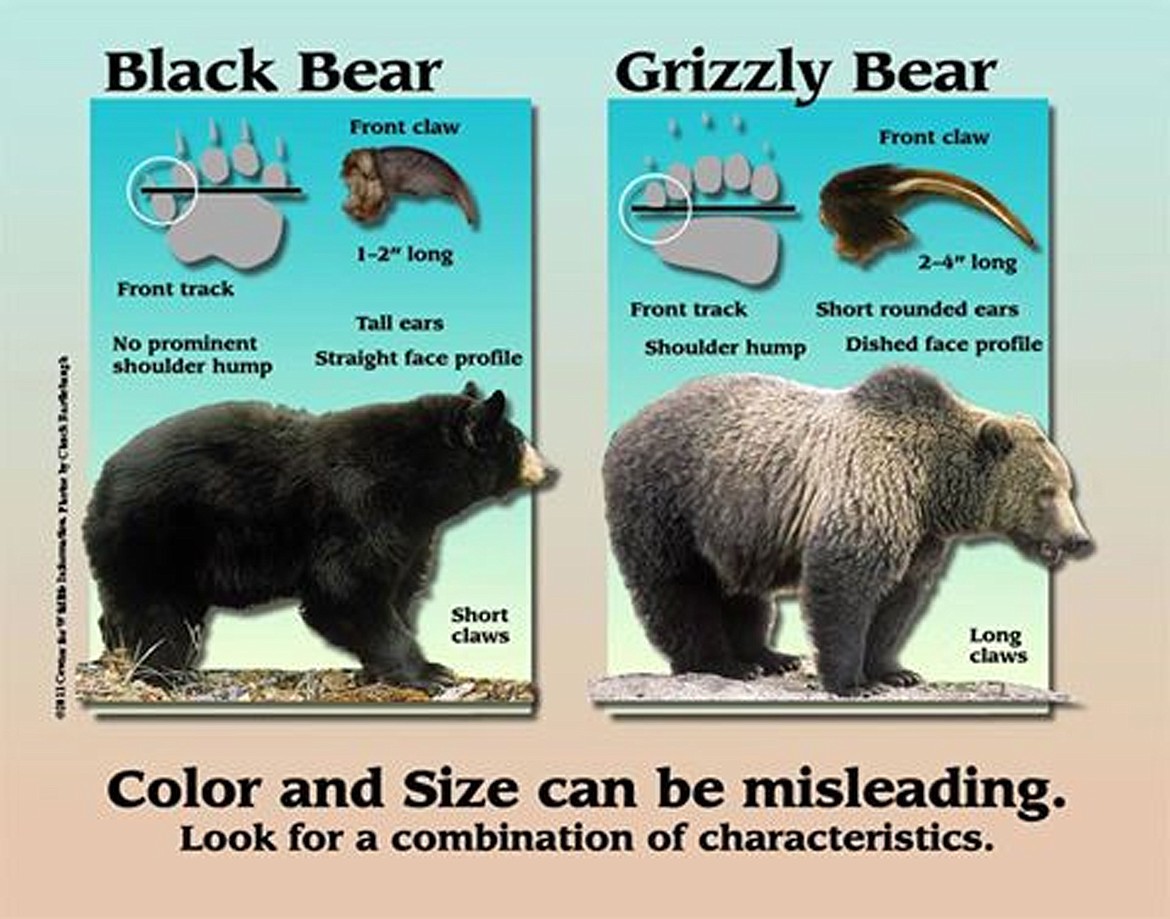
Several useful physical features can help individuals tell the difference between grizzly and black bears. In general, none should not be used alone. Color and size are not reliable indicators and should not be used to identify species. Illustration courtesy IDAHO DEPARTMENT OF FISH & GAME
| August 31, 2024 1:00 AM
Temporary rules are in place for black bear hunting in Idaho after the Idaho Fish and Game Commission approved new requirements for bear baiting and a mandatory bear identification course for hunters.
Starting Sept. 1, any person placing bait to hunt black bears, hunting at a bait site, or witnessing the use of a bait site by a grizzly bear, must immediately report the presence of a grizzly bear at a bait station to a Fish and Game regional office, public information supervisor Roger Phillips said.
They must also stop hunting over that bait site for the rest of that specific hunting season. Phillips said the site cannot be rebaited and must be removed as soon as it’s safe and feasible. As an example, if a grizzly visits a bait site during the spring season, the bait site must be removed for the remainder of the spring season but could be replaced for the fall season.
Starting Jan. 1, 2025, black bear hunters in the state will be required to show they have taken a bear identification test to help them differentiate between black bears and grizzly bears. Further details on how hunters can take a test and show proof will be provided before the new rule takes effect, Phillips said.
“These are temporary rules that will still go through a formal rulemaking process and include public comment,” he added.
Phillips said the state is seeking removal of grizzlies from federal Endangered Species Act protection, and part of the delisting process reviews state regulatory measures rules to protect grizzlies if federal protection is lifted.
“For decades the Commission has prohibited black bear hunters from using bait in occupied grizzly bear recovery areas in the Panhandle and Greater Yellowstone area,” the public information supervisor said. “Idaho’s case for delisting is even stronger by having these additional rules in place.”
Phillips noted that there is no hunting season for grizzlies in Idaho, and grizzly bear death from hunter misidentification is a rare occurrence and has not prevented the remarkable growth and expansion of Idaho’s grizzly bear population.
“Idaho’s grizzly population is increasing, and grizzly bears may wander long distances through areas where people don’t expect to encounter them,” he said.