The illnesses, all in farm workers, have been relatively mild — a contrast to the flu’s deadly effect on many birds and some mammals.
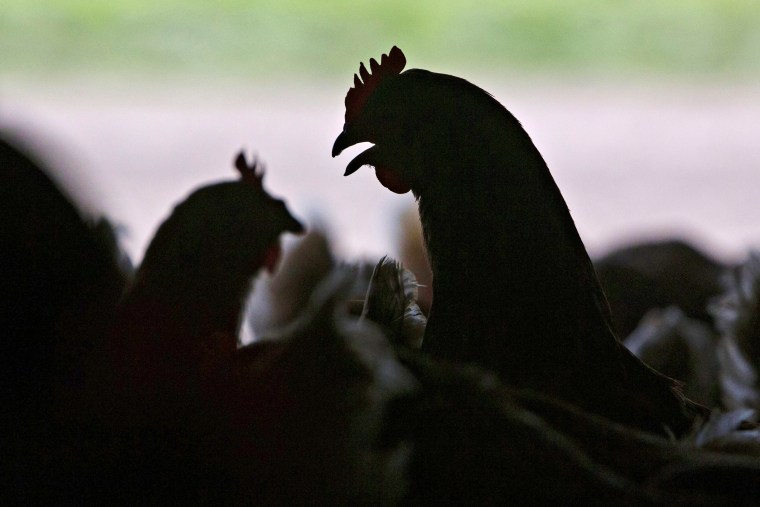
The cases stem from a global outbreak of H5N1, a particular strain of bird flu that took off in 2020.Daniel Acker / Bloomberg via Getty Images file
July 18, 2024, 3:30 AM PDT
By Aria Bendix
The Summary
- Four poultry workers in Colorado recently contracted bird flu, bringing the total of U.S. human cases to nine.
- The infections, nearly all of which have been reported since April, are giving experts a preliminary sense of what the disease looks like in people.
- The cases have been fairly mild, with some typical flu symptoms and several reports of pink eye.
Four poultry workers in Colorado who recently contracted bird flu bring the total of human cases in the U.S. to at least nine.
Though that number is small, disease researchers say commonalities between the cases — all but one of which were reported in the last four months — are enough to start assembling a picture of how the virus may affect people.
The U.S. cases have been relatively mild and limited to farm workers who had handled infected animals — a sign that the virus in its current state isn’t a major threat to humans.
Some patients have reported typical flu symptoms such as fever, chills, cough, sore throat or runny nose. Several have had conjunctivitis or pink eye.
“One thing that we can conclude is that the current strain of the virus isn’t well adapted for human infection, and may not even be well adapted for infecting the lower respiratory tract,” said Matthew Binnicker, director of the Clinical Virology Laboratory at the Mayo Clinic.
The cases stem from a global outbreak of H5N1, a particular strain of bird flu that took off in 2020 and has hit poultry and dairy farms in the U.S.
The country’s first human case was reported in April 2022, in a prison inmate who had culled birds at a farm in Colorado and whose only symptom was fatigue. Texas reported the second case in April, followed by two in Michigan and five in Colorado — the four most recent of which were confirmed over the weekend.
The cases’ mild nature stands in contrast to the flu’s effect on birds and some mammals — including seals, sea lions, foxes, skunks and cats — that have died from the virus. Since January 2022, more than 99 million wild aquatic birds, commercial poultry and backyard flocks in the U.S. have been affected, which means they either died of the virus or were culled to prevent further transmission. And roughly 160 dairy cow herds have been struck since the virus was first detected in cows in March.
This H5N1 strain is considered highly pathogenic, a term that, when used in the context of bird flu, means it has a high potential to kill chickens.
Hearing about such a virus “really scares people, but that term is really a USDA term for what happens in poultry,” said John Lednicky, a research professor of environmental and global health at the University of Florida. “Just because it’s highly pathogenic in birds doesn’t mean it’s highly pathogenic in mammals or humans.”
Lednicky added that some strains of H5N1 are deadly in humans, while others are not.
Of the more than 900 total cases of H5N1 strains in people reported globally since 1997, around half have been fatal. But in the last two years, the global mortality rate has been lower: around 27%. And even then, those numbers largely reflect just the people who were sick enough to seek treatment.
Dr. Peter Palese, a microbiology professor at the Icahn School of Medicine at Mount Sinai, said patients in that tally are those who’ve “been hospitalized and who, in retrospect, have been in contact with large amounts of virus.”
Palese’s 2012 research, which examined blood samples from 12,500 people without a documented bird flu infection, found that 1% to 2% of them may have previously been infected with H5N1.
Experts still worry, though, that the virus could someday mutate into a version that causes more severe disease or that spreads from person to person. (So far, all transmission has been from animals to humans.)
“The concern is that as more animals are infected, and then more people are infected, the virus will change,” Binnicker said.
Why is pink eye associated with bird flu?
Of the nine U.S. bird flu patients, at least four reported pink eye.
That was true in at least one of the recent cases in Colorado, which were linked to an outbreak at a commercial farm in Weld County. The workers had been culling poultry.
The state reported earlier this month that another patient there, a dairy worker who had been exposed to infected cattle, also developed pink eye.
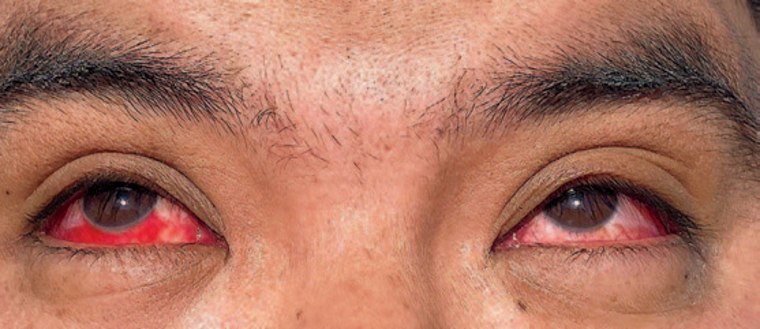
Texas’ one case involved conjunctivitis without other symptoms. That person worked with dairy cows and developed redness and discomfort in their right eye in March. According to a case study in the New England Journal of Medicine, the person reported wearing gloves but no eye protection on the job.
Conjunctivitis isn’t the most common symptom of bird flu in humans, but it has been documented in some people infected with different strains, such as in a 2003 outbreak of H7N7 in the Netherlands.
Scientists said a few factors could explain the symptom’s recent prevalence. One is that farm workers aren’t consistently covering their eyes when dealing with sick animals. As a result, dairy workers could get raw milk — which has been shown to carry the virus — in their eyes.
Recommended

HEALTH NEWSMushroom edibles are rising in popularity. It’s hard to say what’s in them.

HEALTH NEWSA 7th person with HIV is probably cured after stem cell transplant for leukemia, scientists say
That’s likely what happened to a dairy worker in Michigan who developed mild conjunctivitis and was confirmed to have bird flu in May.
The virus may also enter people’s eyes through respiratory droplets or aerosols (tiny airborne droplets). Or, some workers could have touched their eyes after handling infected animals or contaminated raw milk.
“The receptor on the cells that the virus needs to bind to is pretty prevalent in cells in the eye, and that could be one explanation as to why we’re seeing conjunctivitis in individuals infected with avian flu,” Binnicker said.
The Centers for Disease Control and Prevention recommends treating people with bird flu with antivirals. Some of the U.S. patients have received Tamiflu, a drug also used to treat seasonal influenza.
“The studies that have been done so far have shown that Tamiflu is effective at treating the currently circulating strain of avian influenza,” Binnicker said. “It usually needs to get administered within 48 hours of symptom onset to be most effective.”
More spread, more testing, more cases
The reason that all but one of the U.S. cases have been reported since April, scientists say, may come down to two factors. First, the virus is spreading at a rapid clip among birds and sporadically infecting other animals, such as domestic cats, thereby increasing the odds of human exposure. Second, health departments have started monitoring and testing people exposed to infected animals if they develop symptoms.
The CDC estimates that at least 10,600 people have been monitored for bird flu and at least 375 have been tested since the outbreak in commercial poultry started in 2022.
“There probably is a much higher amount of virus out there today compared to a year ago, but we’re also picking up more cases because we’re testing more,” Binnicker said.
Dr. Natasha Bagdasarian, chief medical executive for the state of Michigan, said local health departments there have been screening for even the faintest of symptoms.
“I think that’s why we’re seeing the mild cases,” she said. “It’s because of this active symptom monitoring that we’re doing.”
The Michigan worker who had conjunctivitis, for instance, didn’t even seek out a doctor before being tested for bird flu. Michigan’s other case was a farmworker working with infected cows, who reported a sore throat, cough and congestion to local health officials.
Bagdasarian said the fact that Michigan has only seen two cases after testing roughly 60 people suggests humans need lots of exposure to get sick. The workers who tested positive also weren’t wearing full personal protective equipment and had been involved in tasks like milking cows or administering fluids to them, she said.
“We’re not talking about folks who had transient contact with these animals, who walked past a barn or a pen,” Bagdasarian said. “We’re not talking about people who just touched a cow once.”