Bird flu discovery prompts slaughter of multiple poultry flocks in Sacramento
Reply


October 30, 2026 · 10:00 AM PDT


DOH reports H5N1 avian flu detected in Kauaʻi County wastewater sample : Maui Now
Listen to this Article
3 minutes
A
A
A

The Hawaiʻi State Department of Health is reporting that a wastewater sample from Kauaʻi County tested positive for H5N1 avian influenza. The sample was collected at a site in East Kauaʻi on Oct. 14, 2026. DOH was notified of the result on Oct. 26. This is the first detection of the H5N1 virus associated with this year’s seasonal bird migration and the first detection of genotype D1.1 in Hawaiʻi.
In the United States, genotype D1.1 has become the predominant genotype in infected wildlife and domestic poultry and there have also been isolated events of D1.1 infecting dairy cattle. DOH continues to test milk from the local dairy and there have been no detections of H5N1. A small number of human cases of genotype D1.1 have been reported nationally. Human cases of avian flu are rare, and most cases have not caused severe illness. No human-to-human transmission of H5N1 has been reported. Genotype A3 was the strain previously detected in Hawaiʻi.
“While the risk to the public remains low, avian influenza can cause severe illness and high mortality among certain bird populations, including poultry,” said Deputy State Epidemiologist, Dr. Nathan Tan. “Commercial poultry producers and residents with backyard flocks are strongly advised to increase biosecurity measures to reduce the risk of infection. Avian influenza can also infect dairy cows and while pasteurized milk is safe to consume, raw milk should be avoided.”
For the municipal wastewater sample collected on Oct. 14 by Kauaʻi County, digital polymerase chain reaction (dPCR) testing did not detect H5 avian influenza. However, genomic sequencing identified genetic material from H5N1 avian influenza genotype D1.1. The difference in results is not unusual: dPCR tests for specific genetic targets, while sequencing can identify genetic material present in very small amounts. A subsequent sample collected on Oct. 21 tested negative for H5 avian influenza by dPCR; genomic sequencing results for that sample are still being processed.
It is important to note that the detection of H5 genetic material in wastewater does not mean that live, infectious virus is present. Wastewater testing also cannot determine whether the source of the genetic material is animal, human or environmental contamination. An H5 signal does not confirm a clinical case or indicate community transmission. Instead, it serves as an early indicator that can prompt increased awareness and monitoring. The East Kauaʻi wastewater treatment plant is an open system, meaning the detection could be associated with a variety of sources, including contaminated products or waste from infected animals or people.
Wastewater sampling is routinely conducted across Hawaiʻi to support infectious disease surveillance. Samples are sent to the DOH State Laboratories Division (SLD) for dPCR testing, as well as to the University of Missouri for advanced genomic sequencing to identify bacterial and viral genetic material associated with community infections. Using both methods provides complementary information and strengthens Hawaiʻi’s ability to detect low-level signals in wastewater. In addition to SLD’s testing, H5 avian influenza is monitored in other Hawaiʻi counties through the National Wastewater Surveillance System (NWSS) and WastewaterSCAN.
The Hawaiʻi Department of Agriculture and Biosecurity (HDAB) recommends the following precautions for residents who need to remove a dead wild bird from their property:
To report multiple or unusual illnesses in poultry, livestock or other wild birds or animals on any island in the state, contact HDAB’s Animal Industry Division at 808-483-7100 or email hdoa.ldc@hawaii.gov, Monday through Friday, from 7:45 a.m. to 4:30 p.m. For reports outside business hours or on holidays, call 808-837-8092.
Residents who believe they may have been exposed to sick birds or other wildlife should contact the DOH Disease Outbreak Control Division’s Disease Reporting Line at 808-586-4586 for additional guidance.
Resources on avian influenza:
For more information about wastewater surveillance:
World Lemur Day: How can we save these primates’ forest homes?
30 Oct 2026Africa
More than 100 known species of lemurs live in Madagascar. These primates with large eyes, a pointed snout, and long bushy tails are found only in the island country, where they usually live in large groups on trees.
Lemurs are one of the world’s most threatened groups of primates, under pressure from the loss of their habitat and hunting. On World Lemur Day, celebrated on the last Friday of October, we highlight some recent Mongabay stories about these remarkable animals.
In eastern Madagascar, Andasibe-Mantadia National Park and the Analamazoatra Special Reserve shelter around a dozen species of lemurs, alongside an extraordinary array of other animals and plants, many of which are found nowhere else on Earth.
Once connected by continuous rainforest, the landscape between the two parks was fractured in the 1960s, when large stretches were cleared for agriculture and cattle pasture. What remained was a patchwork of forest fragments separated by degraded land, limiting wildlife movement and threatening biodiversity.
Mongabay’s Marina Martinez reported in April about how a coalition of researchers, conservationists and local communities is rebuilding the forest corridor. Launched in 2023, the reforestation project aims to restore 150 hectares (370 acres) of native forest and reconnect these two critical habitats.
Restoring native forests is critical for lemurs. However, once damaged, forests in Madagascar are vulnerable to takeover by invasive guava trees, whose seeds the lemurs themselves help to spread.
When the delicious strawberry guavas (Psidium cattleyanum), native to Brazil, are in fruit, lemurs will choose them over native fruit, Mongabay contributor Ryan Truscott reported in March.
Conservationists say forest restoration projects for lemurs must account for how strawberry guavas can impact the forests. “[T]he guava lures Madagascar’s remaining frugivores to endanger the very forests on which they depend,” anthropologist Cortni Borgerson, an associate professor at Montclair State University in the U.S., told Mongabay by email.
Madagascar’s dry tropical forests are declining rapidly. However, these forests often don’t get the same attention from conservation groups and funding bodies as their humid rainforest counterparts do.
Contributor Mino Rakotovao reported in September 2025 that NGOs and government representatives pushed for the inclusion of a charismatic inhabitant of Madagascar’s dry forests, the Verreaux’s sifaka (Propithecus verreauxi), to the list of the World’s 25 Most Endangered Primates. This inclusion, they said, would hopefully help the lemur and its critical habitat get more attention needed for their protection.
30 October,2026 08:17 AM IST | Mumbai | Ranjeet Jadhav
Forest officials recover carcass near Airoli Bridge; wildlife enthusiast urges motorists to drive cautiously near natural habitats
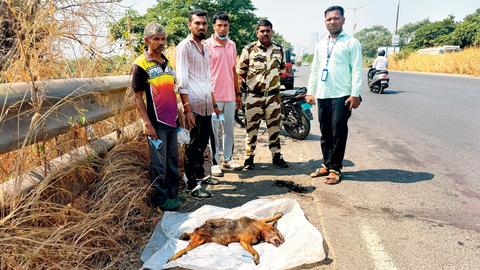
Forest department officials at the spot after reaching the site within five minutes of being alerted. Pics/Mahesh Yadav
An Indian golden jackal, a Schedule I species receiving the highest level of legal protection under the Wildlife (Protection) Act, is suspected to have died after being hit by a vehicle on the Mumbai-bound lane of Mulund-Airoli Road near Airoli Bridge, close to Thane Creek Flamingo Sanctuary.https://d-16457662621353598615.ampproject.net/2608131752000/frame.html
[popcorn number=”80,000″ desc=”Estimated wild population of golden jackal in India” class=”Default”]
Initially mistaken for a stray dog, the carcass was identified by naturalist Mahesh Yadav after a friend sent him a photograph. Yadav rushed to the scene and alerted the Mangrove Cell of the forest department. Range Forest Officer Prashant Bahadure promptly dispatched a team.
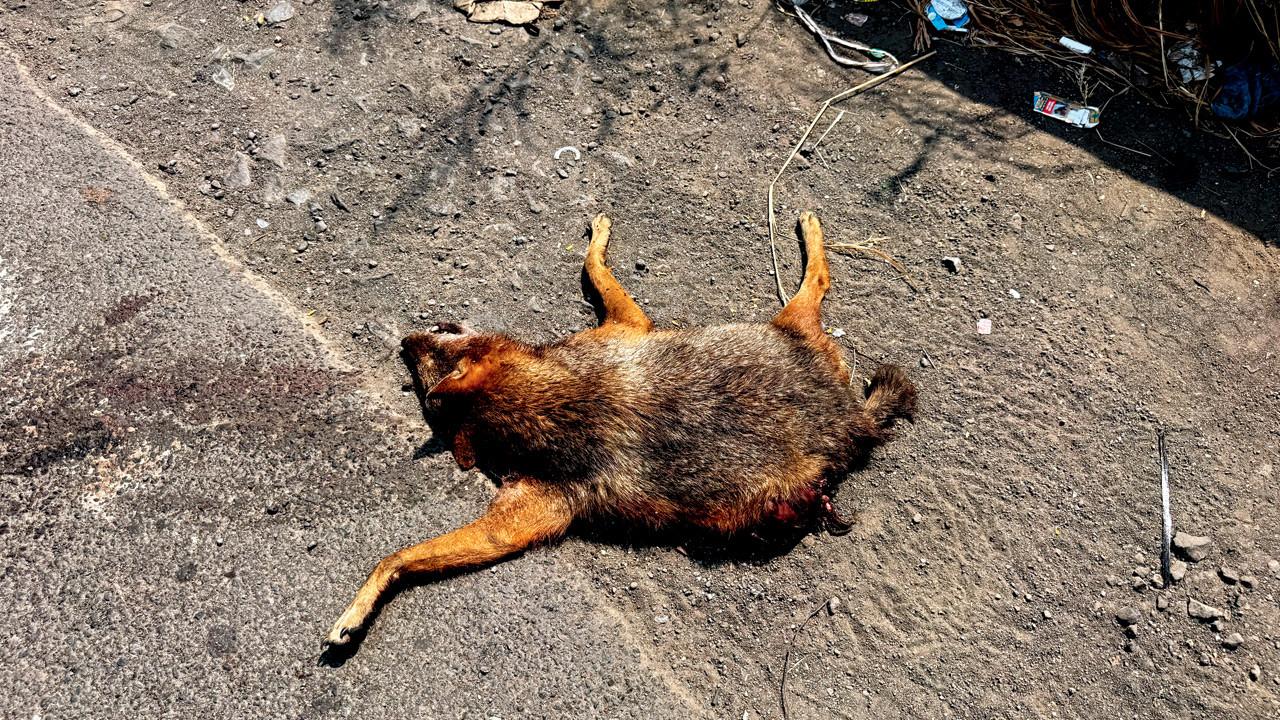
The carcass was found on the Mumbai-bound lane of Mulund-Airoli Road near Airoli Bridge
Golden jackals play a vital role in forest ecology as omnivores feeding on small mammals, birds, fish, rabbits, and fruit. Experts emphasise that their secretive urban lives, diets, and prey bases require detailed study to improve conservation efforts against hunting, trafficking, and highway accidents.
>> Golden jackals are native to the Indian subcontinent
>> They play a vital role in forest ecology
>> As omnivores, they feed on small mammals, birds, fish, rabbits, and fruit.
>> They frequently fall victim to hunting, wildlife trafficking, human-animal conflict, and highway accidents
>> The species is protected under the Wildlife (Protection) Act, 1972
>> They have an estimated wild population of 80,000
“The incident came to light this morning when my friend called to inform me about a jackal lying near Airoli Bridge on the Mumbai-bound lane. I asked him to send a picture, which confirmed that the animal was an Indian golden jackal. I immediately went to the spot.”
As per Yadav, forest department officials arrived within five minutes, completed the roadkill panchnama, and secured the animal’s remains. Yadav expressed distress over urban wildlife road accidents and urged motorists to drive cautiously near natural habitats.
The Mumbai Metropolitan Region hosts a healthy population of jackals surviving in mangrove patches across Mumbai, Navi Mumbai, Thane, Bhandup, Charkop, Versova, Vasai, Mira-Bhayander, and Ghodbunder Road. However, habitat destruction, feral dogs, and roadkill pose major threats.
ByCami Koons-October 29, 2026 9:42 am
Bird flu detected in Iowa commercial flock for first time in nearly a year • Iowa Capital Dispatch

Bird flu has been detected in a Sac County, Iowa, commercial turkey flock. (Photo by Stephen Ausmus/USDA)
A case of highly pathogenic avian influenza has been detected in a commercial turkey flock of approximately 44,400 birds in Sac County, according to the Iowa Department of Agriculture and Land Stewardship.
While the HPAI H5N1 outbreak has been ongoing since February 2022, Iowa has not reported an outbreak of the bird flu in a commercial flock since December 2025. The state has reported seven outbreaks of the virus in backyard, mixed species or game bird flocks in 2026.
Iowa has had more total birds affected by the bird flu than any other state since the start of the outbreak, according to the U.S. Department of Agriculture’s Animal and Plant Health Inspection Service. GET THE MORNING HEADLINES.SUBSCRIBE
Gov. Kim Reynolds issued a disaster proclamation for Sac County Wednesday after IDALS’s announcement. The disaster proclamation allows state and department resources to be more easily deployed to help contain and monitor the outbreak, which typically requires dispatching the affected flock and disposing of the dead birds.
IDALS is encouraging producers and backyard flock owners to “continue bolstering” biosecurity measures to protect their flocks. HPAI is a viral disease that can travel in wild birds and infect wild and domestic birds. Instances of the virus typically rise during bird migration seasons.
Poultry producers must report possible cases of the bird flu to IDALS and should contact their veterinarians if they suspect birds with the virus. Some clinical signs include a sudden increase in bird deaths, lethargy, decreased egg production, swelling of head, difficulty breathing, thin-shelled or misshapen eggs and diarrhea.
Poultry and egg products remain safe to eat and the U.S. Centers for Disease Control and Prevention, continue to rate the public health risk of bird flu as low as there is no known person-to-person spread.

