Exposing the Big Game

Forget Hunters' Feeble Rationalizations and Trust Your Gut Feelings: Making Sport of Killing Is Not Healthy Human Behavior

Exposing the Big Game

Tinder urges singletons to stop posting selfies with ‘drugged up’ tigers after pressure from animal activists

http://www.dailymail.co.uk/news/article-4757948/Tinder-urges-users-stop-posting-selfies-tigers.html

  • The company has pledged to donate $10,000 if people stop posting the pictures
  • It has said the pictures ‘take advantage of beautiful creatures’ torn from their natural environment
  • The move follows pressure from animal rights group PETA, which wrote to co-founder Sean Rad
  • Selfies with tigers are so popular on the site that a number of Instagram accounts have been set up to share them 

Read more: http://www.dailymail.co.uk/news/article-4757948/Tinder-urges-users-stop-posting-selfies-tigers.html#ixzz4qQC3RGfv
Follow us: @MailOnline on Twitter | DailyMail on Facebook

Dating app Tinder has called on its users to stop posting pictures of themselves alongside heavily-drugged tigers.

The company has said it is time for the selfies to go, claiming they take advantage of ‘beautiful creatures that have been torn from their natural environment’.

It follows calls from animal rights activists to act on the images, which they say appear frequently on Tinder.

Animal rights activists have called on Tinder to take action against the number of people pictured posing with tigers

Animal rights activists have called on Tinder to take action against the number of people pictured posing with tigers

The pictures 'take advantage of beautiful animals that have been torn from their natural environment'

The pictures ‘take advantage of beautiful animals that have been torn from their natural environment’

Such is their popularity among those looking for love that a number of Instagram accounts have been set up dedicated to sharing screenshots of users who pose with big cats.

The company says it will donate $10,000 to a conservation charity if the pictures disappear.

In a blog post, Tinder wrote: ‘It’s time for the tiger selfies to go.

In a blog post, Tinder wrote: 'It's time for the tiger selfies to go'

It urged people to post pictures of themselves planting trees instead

In a blog post, Tinder wrote: ‘It’s time for the tiger selfies to go’. It urged people to post pictures of themselves planting trees instead

Pictures of people posing with tigers are widely shared on Instagram, prompting calls for the practice to end

Pictures of people posing with tigers are widely shared on Instagram, prompting calls for the practice to end

‘More often than not, these photos take advantage of beautiful creatures that have been torn from their natural environment. Wild animals deserve to live in the wild.

‘We are looking to you, as part of our Tinder community, to make a change. Take down your tiger photos, and we will make it worth your while by donating $10,000 to Project Cat in honor of International Tiger Day.’

Instead it encouraged singletons to try and attract partners by showing themselves doing things like planting trees or volunteering at animal shelters.

A 22-year-old woman poses with a tiger on the popular dating app, which has asked users to take the pictures down

A 22-year-old woman poses with a tiger on the popular dating app, which has asked users to take the pictures down

Some believe that posting pictures of themselves with tigers makes them look well travelled and projects a positive image

There are growing calls for people to stop posting these images

Some believe that posting pictures of themselves with tigers makes them look well travelled and projects a positive image

And the blog continued: ‘We urge you to take down your tiger photos, tag your friends to do it too, or simply join the conversation on social with #NoTigerSelfies.’

In a letter to Tinder co-founder Sean Rad, animal rights group Peta called for action.

The organization wrote: ‘What might, at first swipe, look like a harmless picture actually means that someone was caged, dominated, and tied down or drugged before their photo was taken and uploaded online.

‘If this happened to one of your users on a Tinder date, you’d block the profile of the person responsible immediately. Unfortunately, this is the reality for tigers, lions, and other big cats who are featured in an alarming number of Tinder profile photos.’

And it continues: ‘Not only are these types of photos cruel to animals, unaware Tinderlings might also mistake them for cute, harmless pictures and be prompted to take part in this abusive industry themselves.’

While some Twitter users congratulated Tinder for taking a stand, another wrote: ‘This.. is really stupid. #NoTigerSelfies is just this organization virtue signalling. It does nothing.’

Read more: http://www.dailymail.co.uk/news/article-4757948/Tinder-urges-users-stop-posting-selfies-tigers.html#ixzz4qQBorUCR
Follow us: @MailOnline on Twitter | DailyMail on Facebook

A big win for Asian bears and a big loss for bear farmers

A Moon bear is seen at Animals Asia’s Vietnam Bears Rescue Centre in Tam Dao, outside Hanoi, Vietnam July 19, 2017. REUTERS/Kham

A Moon bear is seen at Animals Asia’s Vietnam Bears Rescue Centre in Tam Dao, outside Hanoi, Vietnam July 19, 2017. REUTERS/Kham

For thousands of years, cultures in southern and eastern Asia have reached for bear bile to combat a whole range of aliments. Today, science has shown this wasn’t just superstition: bears are the only mammal to churn out large qualities of an acid shown to help the treatment of liver and kidney disease, as well as severe eye problems.

But in the modern age, the potential medicinal effects of bear bile have led to a rapacious underground of “bear farms” where the animals are basically squeezed like lemons for juice – only here, the process involves invasive, unregulated surgeries where bears are repeatedly tapped for their bile while captive in terrible conditions.

On Wednesday, however, opponents of the bear bile industry notched a significant win in Vietnam, one of the currents centers for farming. In Hanoi, representatives of the country’s Administration of Forestry signed a memorandum of understanding with Animals Asia, a Hong Kong-based nongovernmental organization. Per the fine print, the government and organization agreed to work together to rescue and relocate the 1,000 bears believed to be living on bear farms across the country. The agreement comes after years of campaigning by Animals Asia.

“Crucially, the government has agreed to close the loophole that has allowed bile farming to persist for the last decade,” Tuan Bendixsen, the group’s Vietnam director, said in a statement. With the accord, “they have agreed that there can be no bears kept on farms, because as long as they are there, they will suffer extraction.”

But problems remain, including how a cash-poor country like Vietnam can enforce regulation and also care for the rescued bears. This, coupled with a legal and profitable bear bile industry just over the border in China, could upset any full-court press to eradicate the industry.

Two species, the Asiatic black bear and the sun bear, are indigenous to the region. According to 2002’s “The Bear Bile Business: The Global Trade in Bear Products from China to Asia and Beyond,” medical texts reaching back 3,000 years to the Chinese Ming Dynasty first mention Asiatic Black bears as a species with curative properties. Studies would later tie these medicinal effects to the bear liver’s unique amount of ursodeoxycholic acid, a metabolic byproduct of bacteria in the intestine. In traditional medicine, however, the bile – which is sold both pure in small vials as well as an ingredient in other products – has been labeled a cure-all for everything from cancer to hangovers, National Geographic reports.

Traditional medical beliefs haven’t disappeared from the region due to a helping hand from the state. For the last 30 years, the governments in both China and Vietnam have invested in and encouraged traditional medicine as a parallel health system to the modern approach. The trend continues today: “The number of traditional medicine hospitals at provincial level in Viet Nam has expanded from 53 in 2010 to 58 in 2015,” a 2016 study on the bear industry conducted animal rights group TRAFFIC noted. “In 2015, 92.7 percent general hospitals in the country has traditional medicine department which has increased 3.2 percent in comparison with 2010.”

A Moon bear is seen at Animals Asia’s Vietnam Bears Rescue Centre in Tam Dao, outside Hanoi, Vietnam July 19, 2017. REUTERS/Kham

Bear farms reportedly first cropped up in the mid-1980s in China and quickly hopped the Red River south into Vietnam. The practice technically became illegal in the later country in 1992, according to Animals Asia, when the government passed a law requiring state approval to keep bears. A loophole, however, allowed people to have bears as household pets.

The legal gray area, coupled with the state’s inability to enforce the laws, led to a proliferation of bears in captivity on farms. Animals Asia determined that between 1999 and 2005 the number of bears on farms in Vietnam jumped from 400 to 4,000. In 2005, the government again passed legislation, this time outlawing bile extraction. But the agreement again allowed farmers to keep the bears they already had, and the industry continued.

The 2016 TRAFFIC report estimated there were still 13,000 bears in farms across Asia, with 10,000 in China, where the trade is legal. Around 1,000 bears are believed to be still on farms in Vietnam. Anti-bear-bile activists cite the conditions and treatment of animals as ammunition for their arguments. The bile extraction process is ugly stuff. Farmers conduct surgery on the animals to extract the bile, draining the liquid with a catheter or cutting passageways to the gallbladder.

In 2015, when Vice News visited a bear farm in the northern Vietnam “bears sat hunched over in cramped, rusty cages, panting from the heat and humidity. Their excrement sat in piles below each of their cages. The bears were thin and some were missing patches of hair.” A year earlier, Animals Asia toured a facility in Halong City, they found 20 percent of the bears emaciate, many severely malnourished, 20 percent missing a limb, 100 percent suffering from paw injuries from standing on bars.

Wednesday’s agreement between Animals Asia and Vietnam is the second major score for the group in as many years. In 2015, the Vietnamese Traditional Medicine Association promised to stop prescribing bear bile products by 2020. This week’s agreement with the government outlaws the private ownership of bears and calls for the confiscation and resettlement of the 1,000 animals currently living on farms.

The party next must move forward on securing funding for sanctuaries for the rescued bears. Animals Asia does have a location in Vietnam, but the relocation will take more space for the bears. Meanwhile, expert worry the bile market will simply move to nearby Laos or continue to flourish in China.

“This, of course, doesn’t end the work,” Animals Asia Founder and CEO Jill Robinson said in a statement. “Quite the opposite, but it now means we work together with a common goal – to end this cruelty.

PROTECT CALIFORNIA’S ANIMALS

https://secure.humanesociety.org/site/Advocacy?cmd=display&page=UserAction&id=7404


Photo by David Stephenson/iStock.com

California leads the country in laws that require the humane treatment of animals. Nearly 10 years ago, California voters overwhelmingly approved Prop 2 so that California’s egg-laying hens can spread their wings and breeding pigs and veal calves have enough room to turn around. A new bill threatens gains like these and future progress for farm animals and wildlife.

AB 243 proposes the creation of a new state beef commission that would engage in legislative, regulatory and ballot measure advocacy funded by a new tax on all of California’s beef and dairy producers, including small family farmers.

Backed by California’s large beef and dairy industries, AB 243 would exempt all activity of the new commission from the state’s antitrust, unfair practices and public records laws.

Your voice is needed to speak out against Big Ag’s power grab.

TAKE ACTION
Please take a moment to call your state senator now. Look up your legislators’ phone numbers. You can say, “As your constituent, I urge you to vote ‘no’ on AB 243, the California Beef Commission Law, in order to protect consumers, animals and the environment.”

After your call, use the form below to send a follow-up message. Editing your message will help it stand out.

How fear of death affects human attitudes toward animal life

https://www.sciencedaily.com/releases/2017/04/170424170801.htm

Date:
April 24, 2017
Source:
University of Arizona
Summary:
When reminded of death, humans become more likely to support the killing of animals, no matter how they feel about animal rights, researchers have found. Psychology’s terror management theory may explain why. The researchers’ findings could also help scientists better understand the psychological motivations behind the murder and genocide of humans.
Uri Lifshin holds his cat, Chupchik. Lifshin’s own love of animals is, in part, what drove him to study humans’ psychological reasons for supporting killing them.
Credit: Image courtesy of University of Arizona

When reminded of death, humans become more likely to support killing animals, regardless of their existing attitudes about animal rights, according to new research from the University of Arizona.

The research provides new insight into the psychology behind humans’ willingness to kill animals for a variety of reasons, and could also potentially help scientists better understand the psychological motivations behind the murder and genocide of humans, said lead researcher Uri Lifshin, a doctoral student in the UA Department of Psychology.

Lifshin and his colleagues conducted a series of experiments based on their existing work on terror management theory — the idea that humans’ awareness of their own mortality is a strong motivator for behaviors that may help quell the fear of death.

During the experiments, half of participants were presented with a subliminal or subtle “death prime”; either they saw the word “dead” flash briefly on a computer screen or they saw an image of a T-shirt featuring a skull made up of several iterations of the word “death.”

The other half of participants — the controls — instead saw the word “pain” or “fail” flash across the screen, or they saw an image of a plain T-shirt.

Study participants were then asked to rate how much they agree with a series of statements about killing animals, such as, “It is often necessary to control for animal overpopulation through different means, such as hunting or euthanasia,” or, “An experiment should never cause the killing of animals.” The researchers avoided asking questions about some of the more broadly accepted justifications for killing animals, like doing so for food.

In all experiments, those who received the death prime were more likely to support killing animals.

Prior to the start of experiments, participants were asked to report their feelings about animal rights. Surprisingly, it didn’t matter if people self-identified as supporters of animal rights. While those individuals were overall less likely than others to support killing animals, the death prime still had the same effect on them.

“If you’re an animal lover or if you care about animals rights, then overall, yes, you are going to support the killing of animals much less; however when you’re reminded of death you’re still going to be a little bit more reactive,” Lifshin said. Worth noting, the study did not include overt animal rights activists, who might be affected differently. Additional research is needed for that population, Lifshin said.

Gender also didn’t change the effect of the death prime. Consistent with existing literature, male participants were generally more likely than females to support killing animals, but males and females were both affected in the same way by the death prime.

Self-Esteem Helps Us Manage Fear of Death

The UA researchers’ paper, “The Evil Animal: A Terror Management Theory Perspective on the Human Tendency to Kill Animals,” was published in the Personality and Social Psychology Bulletin. Their findings are based on psychology’s terror management theory, which is derived from anthropologist Ernest Becker’s 1974 Pulitzer Prize-winning book, “The Denial of Death.” The theory posits that humans use self-esteem as a buffer against fear of death.

Self-esteem can be achieved in different ways. In a previous study, Lifshin and his colleagues showed that when people who enjoy playing basketball are reminded of their mortality, they improve their performance on the basketball court, and thereby their self-esteem, to manage their fear of death.

In the animal study, researchers think death-primed participants supported killing animals more because it provided them with a sense of power or superiority over animals that indirectly helped them fend off fear of mortality, Lifshin said.

This all happens subconsciously.

“Sometimes, our self-esteem depends on the idea that we are special and not just sacks of meat. We want to feel powerful, immortal — not like an animal,” said Lifshin, a proud pet owner whose own love of animals is, in part, what drove him to study why anyone would do them harm.

To further test the terror management connection, Lifshin and his colleagues designed one of their experiments to look at whether giving participants an alternative self-esteem boost would change the effect of the death prime.

It did.

Before each of the experiments conducted by Lifshin and his colleagues, participants were told a cover story to conceal the researchers’ actual aim. In the self-esteem boost experiment, participants were told they were taking part in a word relationship study, and were asked to identify whether pairs of word on a computer screen were related. During the course of the experiment, the word “dead” appeared on the screen for 30 milliseconds to some participants.

When the experimenters praised those who had seen the death prime — telling them: “Oh wow, I’m not sure I’ve seen a score this high on this task, this is really good” — the effect of the death prime was eliminated when participants went on to answer the questions about killing animals. In other words, seeing the death prime did not make participants more supportive of killing animals if they subsequently received a self-esteem boost from a different source.

“We didn’t find that people’s general state of self-esteem made a difference; it was this self-esteem boost,” Lifshin said. “Once your self-esteem is secured, you no longer need to satisfy the need for terror management by killing animals.”

Those who saw the death prime and were given neutral feedback from the experimenters (“OK you did good, just as well as most people do on this task”) still supported killing animals more. The neutral feedback did not change the effect of the death prime.

Findings Could Contribute to Understanding Psychology of Genocide

When researchers asked participants to rate statements about killing humans under various conditions, the death prime did not have the same effect; those who saw the death prime were not more likely to support killing humans.

Even so, the research could still have important implications for the study of the psychology behind murder and genocide of humans who fall into outgroups because of their race, religion or other characteristics, since those individuals tend to be dehumanized by those who would do them harm, Lifshin said.

“We dehumanize our enemies when there is genocide. There is research in social psychology showing that if you go to places where genocide is happening and you ask the people who are doing the killing to try to explain, they’ll often say things like, ‘Oh, they’re cockroaches, they’re rats, we just have to kill them all,'” Lifshin said. “So if we ever want to really understand how to reduce or fight human-to-human genocide, we have to understand our killing of animals.”


Story Source:

Materials provided by University of Arizona. Original written by Alexis Blue.

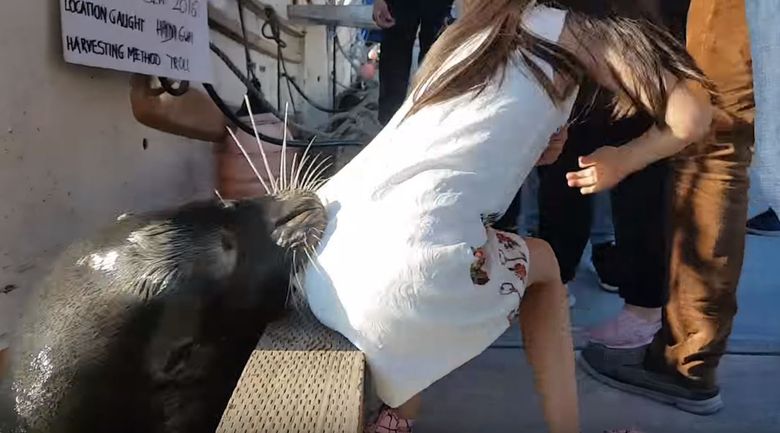
Family of girl snatched by sea lion lambasted for ‘reckless behavior’

“You wouldn’t go up to a grizzly bear in the bush and hand him a ham sandwich,” said an official suburban Vancouver’s Steveston Harbour, where the now-famous incident occurred over the weekend.

The terrifying video of a sea lion snatching a little girl off the edge of a dock and yanking her into murky British Columbia seawater last week is buzzing across the internet and social media today — and drawing some critical insights.

Michael Fujiwara, a college student from Vancouver, B.C., captured the video Saturday at the Steveston Fisherman’s Wharf in the Vancouver suburb of Richmond. It shows the large male sea lion suddenly lurching and pulling the girl into the water, with a man jumping in after the child to save her. There reportedly were no injuries.

Robert Kiesman, chair of the Steveston Harbour Authority, lambasted the girl’s family for reckless behavior, telling the CBC News that signs posted at the popular tourist destination warn people not to feed the sea mammals that frequent the area.

“You wouldn’t go up to a grizzly bear in the bush and hand him a ham sandwich, so you shouldn’t be handing a thousand-pound wild mammal in the water slices of bread,” Kiesman said.

“And you certainly shouldn’t be letting your little girl sit on the edge of the dock with her dress hanging down after the sea lion has already snapped at her once. Just totally reckless behavior.”

Danielle Hyson, a senior marine-mammal trainer at the Vancouver Aquarium, explained to The Vancouver Sun that the animal forewarned of his aggressive behavior.

“You saw him kind of initially lunge out of the water and give a little huff. That’s what we would call an aggressive precursor,” she told The Sun. “So he’s letting the people know that he’s starting to get frustrated. And in that situation, the people should have backed off right away.”

Hyson noted that male California sea lions are powerful animals that can weigh more than 200 kilograms — about 440 pounds.

The powerful animals have big eyes and whiskers that seem cute, she noted.

“They look like they’re water dogs, but they absolutely are not,” Hyson said. “They can do a lot of damage.”

Fujiwara, the college student who shot the video, said in a story carried by NBC News the girl and her family were dumbstruck by the attack.

“They were pretty shaken up,” he said. “Her family were just in shock.”

The family had been feeding the sea lion breadcrumbs, which is probably what attracted the animal to the crowd, Fujiwara said.

“It initially jumped up to the girl to read her, I guess,” he said. “And then it came back up a second time, but this time grabbing the girl by the waist and dragging her down into the water.”

In Washington, the state’s Department of Fish and Wildlife does not keep records on sea-lion attacks, department spokesman Craig Bartlett said in an email Monday.

Sea lions typically only bite when they feel threatened or cornered, according to various news reports. They sometimes also go after the same fish people do, resulting in close encounters.

“I’ve seen reports of sea lions stealing fish from anglers on the Columbia River, but I can’t recall anyone actually being injured,” Bartlett said.

While he knew of no known attacks of people in Washington, Bartlett pointed to a 2013 news report about sea lions that have attacked and eaten dogs at Westport.

But commercial and sports fishermen occasionally have reported attacks by sea lions and seals.

A sea lion caught in a Russian commercial fishing vessel’s net was videotaped tossing a fisherman across the boat deck.

In January, an Alaska fisherman was attacked by a Steller sea lion “heavier than a grand piano” when it jumped onto his fishing boat, slammed him into the deck and tried to drag him into the water, according to the Alaska Dispatch News.

And in 2015, a sea lion bit onto the hand of a sport fisherman as he posed with a yellowfin tuna on his boat off San Diego, pulling the man overboard.

“After 15 seconds, I thought I was going to die,” Dan Carlin, the fisherman, later said in an interview with The Associated Press. “I continued to struggle, but thought this is the way I was going to die. It was unbelievable to me.”

But deadly attacks by seals or seal lions are apparently rare.

The fatal attack of a British scientist snorkeling in Antarctica in 2003 was believed to be the first deadly leopard-seal attack on a human at the time, according to National Geographic.

On Monday, tourists and the curious crowded on to Steveston Fisherman’s Wharf to catch a glimpse of the child-snatching sea lion despite warnings to keep a safe distance.

Signs of Consciousness, Sentience and Intelligence in Nature Demand Our Respect

From: Ecoterra-internalional.org


By
Sofia Adamson (*), Staff Writer WakingTimesMay 10, 2017

Part of our lot as human beings on planet earth is dominion over the plant and animal kingdoms, and as a by-product of our economic and cultural heritage, we have largely become indifferent to the suffering of animals. An indicator of the cruelest aspects of our nature.

This systemic disrespect for nature and her creatures is part of, or symptomatic of, a larger problem with modern society, the institutionalized perception that we are separate and independent of our environment. This dualism is part of the division of consciousness that is often noted in ancient texts as well as contemporary discussions of the characteristics of human consciousness.

Perhaps the most appalling sign of human kind’s dualistic trap is how we treat our friends in the animal kingdom. Yet this destructive idea is a tragic falsehood, as animals and plants alike are conscious, sentient and intelligent. The examples of this are everywhere today, and in this video, we see humpback whales clearly showing their appreciation to the humans who freed them from fishing nets.

WATCH: Saving Valentina.6.8.11.h264.mov

We are now also discovering the deeper lives of plants, and in a research study spanning some 30 plus years, biologists have discovered the songs of plants.

LISTEN: Singing Plants at Damanhur | Des plantes qui jouent de la musique

Forest ecologist Dr. Suzanne Simard of the University of British Colombia has uncovered the subterranean network of organisms that allow trees to communicate with one another.

LEARN: Tree’s found to communicate through Fungi [Avatar!]

It appears that animal consciousness is rising at present here on planet earth, in spite of wholesale neglect. Elephants can understand and correctly interpret human gestures, and chimpanzees are developing new behaviors and skills. Here, Kanzi the bonobo chimpanzee starts a campfire to roast marshmallows.

SEE: Bonobo builds a fire and toasts marshmallows

Chimps have now been observed using tools to fish for food, a sign of their continuing cognitive development.

REALIZE: Chimpanzees fishing for algae with tools in Bakoun, Guinea

Their learning process is now being compared to that of human children, and in the following video, an experiment demonstrates the similarities between the two.

COMPARE: Chimpanzee VS Human child learning

Many of the world’s most majestic animals are under direct threat of extinction today, and while most humans fail to appreciate this for what it really means, others continue to learn from animals, admiring their tenacity in the face of overwhelming pressure from humans. In the following case a pack of Andean bears works together to dismantle remote wildlife cameras.

RESPECT: Remote Cameras Reveal: Andean Bears Hate Paparazzi

Animals display a broad range of emotion as well, as is sometimes revealed in front of cameras, for example here, when a leopard exhibits compassion for the child of monkey it has just killed.

UNDERSTAND: Leopard Kills Monkey and Discovers Baby! INCREDIBLE REACTION!

And animals also like to have fun, as is seen in this clip of dolphins getting high off puffer fish and having a good time in the wide open ocean.

ENJOY: Dolphins on Stimulants – Pass the Puffer!

You don’t have to look to hard to find signs of mankind’s disrespect, disregard, and distrust of nature. Raising awareness of our connection and dependence on the natural world in these materialistic times is the only way to counter the devastation. Fukushima, the Deepwater Horizon, mountain-top removal, deforestation, tar sands, fracking, plastic pollution, depleted uranium, animal cruelty, so on and on… there really is no end to our ignorance and disrespect.

Whatever your relationship to the natural world is, and no matter what kind of dystopian illusions you may have for our future, there is no escaping the truth that we are all products of nature, and as such dependent on the natural world for survival and happiness.

(*) Sofia Adamson is a contributing writer for Waking Times with a keen appreciation for matters of science and the spirit.
Read more articles from Sofia Adamson

This article (Signs of Consciousness, Sentience and Intelligence in Nature Demand Our Respect) was originally created and published by Waking Times and is published here under a Creative Commons license with attribution to Sofia Adamson and WakingTimes.com. It may be re-posted freely with proper attribution and author bio.

____________________________________________________________

– Please send your feedback and comments to africanode[AT]ecoterra.net

All ECOTERRA Media and Disseminations are re-distributable under Creative Commons Non-Commercial Share-Alike Licence, but kindly do not take the ECOTERRA free mailing list services for granted! Become a Friend of ECOTERRA and make a donation NOW to help keep ECOTERRA FREE and INDEPENDENT

“ON THE ROAD”

Poem from Rosemary Lowe:
I HAVE BEEN LYING HERE FOR HOURS, SINCE THE COLD NIGHT’S DEATH WIND HURTLED MY LIVING BODY INTO THE COLD GRIP OF DEATH…
SO SOON  MY  YOUNG LIFE,  TORN FROM ME, TERRIFIED BY THE CRUSH OF METAL UPON MY FLESH–OH, THE BLOOD AND THE PAIN….
THE ROAD– HUMANS CALL IT– WITH THEIR POWERFUL KILLING MACHINES, SO FAST, SO FINAL—GOING WHERE?
MILLIONS OF MY KIND–FOUR LEGGEDS–WITH PLACES TO GO, FAMILIES TO BE WITH, NEVER TO MAKE IT TO OUR DESTINATION…
NEVER TO SNUGGLE AGAIN, AGAINST FAMILIAR FUR, THE WARMTH AND LOVE OF ONE’S OWN KIND…
TOO FAST, TOO BIG–HARD METAL AGAINST A SOFT LIVING BODY–THAT BREAKS AND BLEEDS..DO YOU HEAR MY CRIES?
DO YOU SEE MY SHATTERED, BLOOD-SOAKED BODY ON THE ROAD?— DO YOU EVER SEE?
I AM NOT JUST A BODY, A THING.
I WAS SOMEONE’S MATE, SOMEONE’S CHILD, I WAS SOMEONE.
I WAS AN ANIMAL, JUST LIKE YOU.
——Rosemary Lowe

Oklahoma May Legalize Hog Hunting From Helicopters

https://www.usnews.com/news/offbeat/articles/2017-03-28/oklahoma-may-legalize-hog-hunting-from-helicopters

Oklahoma could soon join Louisiana and Texas in allowing hunters to shoot feral hogs from helicopters.

| March 28, 2017, at 1:06 p.m.

Oklahoma May Legalize Hog Hunting From Helicopters
The Associated Press

FILE – In this Feb. 18, 2009, file photo, the shadow of a helicopter hovers over feral pigs near Mertzon, Texas. Oklahoma lawmakers are considering a bill to allow hunters to shoot feral hogs from helicopters. Aerial gunners are already used to help control feral swine in Oklahoma, but the work can only be done by trained, licensed contractors with support from the Oklahoma Department of Agriculture Food and Forestry. (AP Photo/Eric Gay, File) THE ASSOCIATED PRESS

TULSA, Okla. (AP) — Oklahoma could soon join Louisiana and Texas in allowing hunters to shoot feral hogs from helicopters.

The Tulsa World (http://bit.ly/2neDl3i ) reports that aerial gunners are already used to help control feral swine in Oklahoma. But that work can only be done by trained, licensed contractors with support from the Oklahoma Department of Agriculture Food and Forestry.

Lawmakers are considering a bill to expand the law to private operations.

Under the proposal, private landowners, companies and pilots would have to apply for a state license and be responsible for the activity. But hunters on board the aircraft wouldn’t need a license, nor would they have to provide their names to the state.

The agriculture department says its agents killed more than 11,200 feral hogs, mostly by air, last year.

___

Information from: Tulsa World, http://www.tulsaworld.com

Copyright 2017 The Associated Press

Tags: Oklahoma, Louisiana, Texas

French parliament votes to install cameras in slaughterhouses

January 18, 2017

Amid rising reports of animal abuses at meat processing facilities, France’s parliament has voted that slaughterhouses be required to install surveillance cameras to monitor workers’ interactions with live animals.

The proposed legislation, which was approved by 28 members on Jan. 12, would give the country’s nearly 1,000 slaughterhouses until Jan. 1, 2018 to install CCTV cameras everywhere live animals are handled, including monitoring the transport process and while they’re being held in stables, reports Politico.

FRENCH PEOPLE CAN’T ENOUGH HAMBURGERS

According to the bill, the footage from each slaughterhouse would only be viewable to veterinarians, approved government officials or animal-welfare inspectors and would be kept on government file for a month. The bill also proposes the creations of a national Committee on the Ethics of Slaughterhouses, which would oversee and mete out harsher penalties to facilities caught violating the law.

The move comes amid heightened scrutiny of the country’s meat industry. In 2016, animal rights activist group L214 released troubling footage showing numerous animal abuses at several French meat-processing facilities inclduing workers killing animals without stunning them first, throwing lambs into walls, and hitting live animals.

Though the bill passed in parliament—where just four MPs opposed the legislation—it must still be approved by France’s senate. According to Reuters, the vote could happen as early as February.

More:
Cameras to be installed in all slaughterhouses in Israel (Jerusalem Online)
http://www.jerusalemonline.com/news/in-israel/local/cameras-to-be-installed-in-all-slaughterhouses-in-israel-14480

Israel Moves to Install Cameras in Slaughterhouses to Prevent Cruelty (Haaretz)
http://www.haaretz.com/israel-news/.premium-1.694463

LEBANON’S LUCRATIVE TRADE IN WILD ANIMALS