|
||||||||||||||||||||||||
 |
||||||||||||||||||||||||
Petition to cancel a show that glorifies killing sharks
Reply

|
||||||||||||||||||||||||
|
||||||||||||||||||||||||

Share on gmail Gmail Share on yahoomail Yahoo Share on care2 Care2 More Sharing Services More

Target: Rubén Saavedra, Defense Minister for Bolivian Military
Goal: Criminally charge military instructor who slaughtered a live dog to desensitize trainees
Up until 2009, Bolivian military instructors regularly slaughtered live dogs during training exercises. Meant to “toughen up” and desensitize new cadets, this brutal practice finally became outlawed after tireless protests by the People for the Ethical Treatment of Animals (PETA). Recently, however, an instructor barbarically killed another dog, earning only a four-day suspension following the criminal act.
The New York Times reports the instructor “gutted a 2-year-old mixed breed dog” and “smeared its blood on students’ faces.” He ruthlessly butchered a helpless animal, and in doing so, he also brazenly violated Bolivian law. The ban, or “Resolution 217,” purports to enforce punishments for such violations. Nonetheless, the instructor has only been temporarily suspended, which is an insultingly insufficient penalty. Suspension is typically reserved for minor acts of insubordination, such as mouthing off to a superior officer. This soldier cut open and bled out an innocent creature. Perhaps the scariest part of this story is the idea that he will be allowed to return to the academy. One can’t help but wonder if the Bolivian military only enacted this law to appease protestors while secretly continuing to kill dogs.
There’s a reason butchering live animals desensitizes people: It is inherently cruel and traumatic. If the Bolivian military wants to harden its soldiers, it should use virtual simulations or old war footage to do so. Slaughtering dogs is both illegal and wildly unnecessary. In addition, instructors should earn more than a “slap on the wrist” for violating the ban. Sign the following petition to demand justice for this innocent animal that was brutally killed for the sake of “instruction.”
PETITION LETTER:
Dear Minister of Defense Rubén Saavedra,
In 2009, you approved Resolution 217, which prohibits the abuse or mistreatment of animals in military training exercises. Nevertheless, a military instructor recently slaughtered a two-year-old dog for the sake of instruction. Though Resolution 217 assures punishment for violations of this ban, the instructor has only earned a four-day suspension. This punishment is not only inadequate, it is profoundly unjust.
The “penalty” you have issued sends a clear message that you do not take your ban on animal abuse seriously. More importantly, it conveys that you value a soldier’s training more than the life of an innocent creature. A temporary suspension is not a punishment; it is a slap on the wrist that is commonly enforced for minor acts of misconduct. Employing such a measure in this instance is grossly disproportionate to the crime, and ultimately displays a lack of empathy on the Bolivian military’s part.
This instructor violated official regulation and he should be penalized accordingly. Not only has he senselessly killed an animal, he has directly disobeyed an order. Please seek true justice for the crimes that have been committed, and bring the soldier before a court to answer for his barbaric actions.
Sincerely,
[Your Name Here]
Photo credit: Kristin Miranda
The Deadly Link Trailer 6.11.2014

|
A new trailer for “The Deadly Link” documentary film on the connection between animal abuse and domestic violence/child abuse. Please support our project by donating at http://www.thedeadlylink.com or on…
00:03:47
Added on 6/12/14
61 views
|
 |
More than a million homing pigeons die every year during Taiwan’s seasonal pigeon races, grueling sets of seven races over open ocean from ever-increasing distances. Young birds—not even a year old—are shipped out to sea, released in the middle of the ocean and forced to fly back home even in the midst of typhoon-strength winds. Most often, less than 1 percent of these highly intelligent birds complete each seven-race series; many drown from exhaustion, perish in the storms, or are killed afterward for being too slow.

Click here to see more pigeon-racing images.
Top racers and high-ranking club officials admitted to deadly conditions for the birds, who fly with untreated injuries, without enough rest between races, and through heavy rainstorms. PETA investigators captured video of a race in which tens of thousands of birds disappeared in a matter of hours and were presumed to have drowned. Even birds who survive these extreme conditions may be killed or discarded by their owners if they do not make the qualifying time for the next race in the series. Pigeons are smart, gentle, and loyal birds. They bond for life and can live more than 20 years. Yet almost all of the birds who begin their lives as racing pigeons in Taiwan perish in their first year of life.
“It was raining pigeons—literally. I’ve never seen such a scene. Every one of them crashed onto the boat. … Some crashed into the ocean. … About one hour after the pigeon rain, you could see the whole surface of the ocean filled with dead pigeons.”
—Taiwanese fishing boat captain
Money—not just entry fees, but vast illegal wagers—fuels the multibillion-dollar pigeon-racing industry in Taiwan. Wealthy racers pay upwards of $100,000 for imported breeder birds, and top flyers admitted to making millions on a single race. “Prizes” such as refrigerators are listed on gambling sheets as a cover for the cash bets that are the main draw for these events. Racers boasted that government law enforcement “can’t catch us.” The chance to win staggering sums leads to extortion, drugging of birds, the kidnapping of birds for ransom, and the use of rigorous anti-cheating systems that involve RFID tags, multiple stamps on birds’ wings for identity, covering their leg ring numbers, and meticulously comparing photographs of the birds’ feathers.
An international web of commerce supports Taiwanese pigeon racing: Breeder birds are bought and sold for tens of thousands of dollars from U.S. and international dealers, then kept as “prisoners,” constantly reproducing while their offspring are serially exterminated in race after race. A prominent U.S. racer and breeder who is currently facing felony charges as a result of a previous PETA undercover investigation is involved in selling birds to Taiwan. Bieche Lofts, another top U.S. breeder, recently sold a prize-winning bird to a Taiwanese racer for an undisclosed price. An Idaho company called Dynamite is even producing a specialized pigeon feed for the Taiwanese pigeon-racing market. Millions of dollars fly in this business, but for the pigeons it’s always a losing bet.

Apr 29, 2014
California brown pelicans are a threatened species that is protected by the Migratory Bird Treaty Act.
The pelican, named Pink after the colored band on its leg, was found in the city of Long Beach with a severed throat pouch, the International Bird Rescue (IBR) organization said in a statement.
The emaciated bird’s throat was stapled, so it could feed, and it is now being taken care of in a small Los Angeles aviary. On Sunday, it had a three-hour surgery to repair the laceration and IBR said it would require many more operations and extensive rehabilitative care to fully recover.
“In my 40-plus years as a wildlife rehabilitator, I’ve seen too many of these horrible attacks against innocent animals,” IBR executive director Jay Holcomb said in the statement. “The public is sick of it too, and we hear their frustration.”
The IBR is offering the reward along with the Animal Legal Defense Fund.
The U.S. Fish and Wildlife Service said is was investigating the possible crime, which is punishable by a fine of up to $15,000 and a county jail sentence of up to six months.
(Reporting by Laila Kearney; Editing by Sharon Bernstein and Miral Fahmy)

You might be thinking, who the hell hunts cats or dogs? Well, just yesterday I received a comment from someone who started off, “I already ate a dog, I love dog fights, blood,…” etc., etc., blah blah blah.
There are plenty of psychopaths out there; it’s up to us to put laws in place to keep them in their place (hell preferably).
Please sign these two petitions for domestic animals, one against cat hunting and one on to Prevent cruelty to dogs and cats in China: http://www.change.org/petitions/prevent-cruelty-to-dogs-and-cats-in-china-2?share_id=ACCyzOYrFC&utm_campaign=friend_inviter_chat&utm_medium=facebook&utm_source=share_petition&utm_term=permissions_dialog_true

From ALDF.org 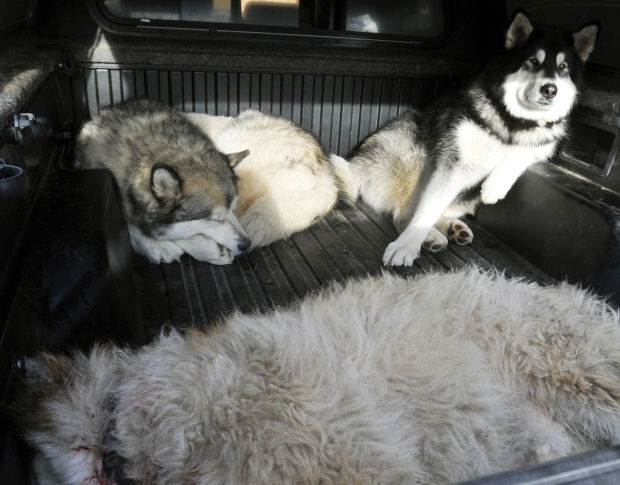
Animals will be harmed during the 2014 Iditarod, this is a fact. Teams of dogs will be forced to pull a sled over a thousand miles across the Alaska wilderness, often running at a grueling pace of up to one hundred miles per day for seven to ten straight days.
Injured or “dropped” dogs may not receive shelter, unless for medical treatment, and must be put back outside once treatment is completed. Furthermore, dropped dogs are left alone at checkpoints on a chain with four pounds of dog food. Dropped dogs — and all participating dogs — remain tethered at all times. Dogs receive one mandatory 24 hour resting period and additional shorter periods for rest — but the event relies upon the honor system, and it’s up to the musher to rest for the entire period.
Since the race began more than forty years ago, more than 140 dogs have died during the event — from heart attacks, pneumonia, muscle deterioration, dehydration, diarrhea, and spine injuries. They are impaled on sleds, drowned, or accidentally strangled.
Please take action to help ALDF speak out for sled dogs by asking the corporate sponsors of events like the Iditarod to withdraw their support.
Kicking off the race, the annual ceremonial start will take place in downtown Anchorage on Saturday, March 1, 2014. The actual start to the competition will be on Sunday afternoon, March 2, 2014, in Willow, despite recent discussions.
Due to the lack of snowcover thus far this winter, race organizers considered moving the race start from Willow to Fairbanks, according to an Alaska Public Media article. However, a construction company offered to help fix the trail with specialized equipment, and as a result, the race will stick to its traditional route through the Rainy Pass of the Alaska Range.
 Musher Michelle Phillips of Tagish, Yukon Territory, Canada, makes the final push on the Bering Sea ice for the finish line a few miles outside Nome, Alaska, on Wednesday, March 13, 2013. (AP Photo/Mark Thiessen)
“It’s been a very unusual winter up across Alaska,” AccuWeather Senior Meteorologist Jack Boston said. “The problem has been frequent mild days, which have been knocking down the snowcover.”
In January, Anchorage’s average temperature was 12 F above normal, causing the city’s snowcover to melt. Farther northwest in Nome, the temperature soared to a record-breaking high on Jan. 27, 2014, hitting 50 F for the first time ever during the winter season. Nome’s average temperature for January was 16 F above normal.

Despite the region’s massive winter warmup, many areas along the path of the race have received near-normal snowfall. So far this winter, Anchorage has received 53.7 inches of snow, or 90 percent of the normal snowfall, while Nome has accumulated 53.9 inches, or 96 percent of the normal snowfall.
As nearly 70 mushers get ready to make the 1,000-mile, multiple-day journey from Willow to Nome, the weather does not seem like it is going to cooperate this year but not because of its normal severity. Typically, the troublesome weather conditions that the race faces include winter storms, blizzards, high winds and subzero temperatures.
“It looks like a mild start to the Iditarod,” AccuWeather Long-Range Forecast Meteorologist Jason Nicholls said. “It looks like there can be a little snow on the ground around March 5, 2014, but it should not amount to much more than a few inches.”

 Exposing the Big Game