Conservation Can Be Enhanced By Human Study of Animal Cognition

Understanding similarities in the cognitive and moral capacities of humans with animals can make humans better conservationists, speakers told journalists at an event organized by AAAS’ program of Dialogue on Science, Ethics, and Religion.

Irene Pepperberg, a Harvard University research associate and lecturer, reviewed her work with African grey parrots at the annual meeting of the Religion News Association in Silver Spring, Maryland, on 23 September, highlighting similarities between children and birds in tests of self-control.  The meeting drew nearly 100 journalists.

“We tend to conserve what’s like us,” said Pepperberg. “The more I can show people that these birds are like us, the more I hope they will be conserved.”

In early October, the triennial meeting of the Convention on International Trade in Endangered Species of Wild Fauna and Flora (Cites), the world’s largest wildlife trade conference, granted the African grey parrot the highest level of international protection, including the prohibition of international commercial trade of the animal.

Pepperberg has studied the grey parrot for three decades. She is recognized for research on a parrot named Alex who learned the names of about 100 different objects, seven colors, five shapes, and quantities up to and including the number eight. Her studies showed how the parrot was able to understand the concept of categories and the meaning of “same” and “different.”

“You could take an object out of your pocket and ask what’s the  ‘same’ or ‘different’ and he would say ‘color,’  ‘shape,’ ‘matter,’ or ‘none’ if nothing were the same or different,” said Pepperberg.

Alex made up words like “banery,” a combination of banana and cherry that he used to identify an apple and “banacker,” a combination of banana and cracker that he used to communicate his dislike for dried bananas.

Pepperberg focused her research on how the avian brain works: “How are resources allocated within the avian brain — a brain that is physically smaller and somewhat differently organized from, but that is still evolutionarily similar to, that of primates?”

Since 2007, after Alex’s death, Pepperberg has continued studying other African grey parrots, including their perception and cognition – optical illusions, delayed gratification, liquid conservation, and probabilistic reasoning.

Her work on delayed gratification is based on the “marshmallow test” designed in 1960s by Stanford psychologist Walter Mischel that offered 4-year-old children two marshmallows instead of one if they could wait to eat the first. The 30 percent of the preschoolers who succeeded at waiting 15 minutes found ways to distract themselves by looking away from the marshmallow, closing their eyes, among other strategies. Years later, Mischel surveyed the same group and found that the children who had exhibited self-control experienced more success as adults.

Variations of the test have been done with non-human animals. Researchers, for example, tried this type of test with African grey parrots for ‘more’ and failed. But Pepperberg’s bird Griffin understood the English word “wait” and did not require the kind of pre-training that hindered others, she said. He was accustomed to waiting for food, but she wanted to determine if he could choose to delay gratification to get something better.

Wait times were randomized and a variety of treats were used so that Griffin was not being trained to wait. He succeeded on almost all of the trials. “He got better at figuring out ways of delaying himself,” Pepperberg said.

In a side-by-side video of Griffin and the children, similarities between the human and non-human participants are obvious. Both birds and young children took a variety of approaches to resisting temptation through distraction, including pushing treats away and closing their eyes.

“Knowing the intelligence of these birds, maybe we will use this knowledge to improve the care of companion animals, use these birds as models for how to teach children with disabilities, and improve our efforts at conserving them in the wild,” she said.

Kelsey Dallas, a Deseret News national reporter, urged journalists to consider how Pepperberg’s research, and studies like it, enhance understanding of the capacities of animals. “I want to encourage you to dive into this intersection of religion and science,” Dallas added. “You can share surprise, joy, and interest with other people.”

A video aired at the meeting also examined traits humans and animals share. Called “To Be Human,” the video was produced for AAAS’ Dialogue on Science, Ethics, and Religion (DoSER) project known as Science for Seminaries.

“Human morality is not something we developed from scratch,” said Emory University primatologist Frans de Waal, noting in the video that building blocks of morality like empathy and reciprocity are found in other species. Chimpanzees, for example, comfort each other after a fight. “Whether other species have the whole thing that we call human morality, that’s a different issue,” he said.

Animal Welfare On The Ballot In November

DANIEL ACKER / REUTERS

When voters go to the polls this November, they won’t only be making critical decisions about who represents them in the White House, Congress and state and local offices. In a number of states, the people will vote on the humane treatment of animals—deciding whether to adopt policies on factory farming, wildlife trafficking and other animal protection issues.

Since the early 1990s, The Humane Society of the United States and allied organizations have been involved in about 50 statewide ballot contests, and voters have sided with animals about 70 percent of the time. They’ve banned cockfighting in three of the last states where it remained legal (Arizona, Missouri and Oklahoma), set humane treatment standards for dogs in the largest puppy mill state (Missouri), stopped extreme confinement of animals on factory farms (Arizona, California and Florida), and adopted new policies to restrict greyhound racing; horse slaughter; body-gripping traps and poisons; trophy hunting of bears, cougars and wolves and more. When politicians in the state legislatures have been held captive by special interests—such as big agribusiness, the trophy hunting lobby or even organized cockfighting groups—animal advocates have petitioned to put these questions directly to the people.

This year in Massachusetts, voters will decide on Question 3, which would phase out the extreme confinement of veal calves, breeding pigs and egg-laying hens in small crates and cages where they are virtually immobilized for their entire lives, and will remove inhumane and unsafe products from the Massachusetts marketplace. Backed by the MSPCA, Animal Rescue League of Boston, Zoo New England and hundreds of Massachusetts veterinarians and family farmers, more than 170,000 Massachusetts voters signed petitions to place Question 3 on the ballot. Question 3 adds momentum to what’s already occurring in the marketplace, with McDonald’s, Walmart and 200 other major food retail brands pledging to change their procurement practices and source only cage-free eggs and meats.

In Oregon, voters will weigh in on Measure 100, which will help save endangered sea turtles, elephants, rhinos and other wild animals threatened with cruel poaching and extinction. Every day close to 100 elephants are brutally killed in Africa, their tusks hacked off to supply the black market for ivory trinkets. Poachers poison watering holes with cyanide, killing hundreds of elephants at once. Organized criminal gangs and armed rebels use military weapons to kill wildlife for the multi-billion dollar illegal wildlife trade. Measure 100 will ensure that Oregon does not provide a market for endangered species products resulting from wildlife poaching and trafficking. If passed, Oregon will join California, Washington, Hawaii and other states in shutting down local markets for those who seek to profit from this destructive wildlife trade.

In Oklahoma, family farmers and animal advocates are opposing State Question 777, a measure referred to the ballot by politicians to amend the state constitution with a so-called “right to farm.” It would protect corporate interests and foreign-owned big agribusiness at the expense of Oklahoma’s family farmers, land and animals. The measure is so broadly worded that it could prevent future restrictions on any “agricultural” practice, including puppy mills, horse slaughter and raising gamefowl for cockfighting. Even the president of the Oklahoma Farm Bureau said the language is flawed, and “I wish that language weren’t in there.”

Those aren’t the only states where voters will see ballot issues related to animals. Californians will vote on Proposition 67, to protect the state’s ban on plastic grocery bags, which wash into our rivers, lakes, streams and ocean, where they are ingested by or entangle sea turtles, otters, seals, fish and birds. Some ocean animals mistake bags for food, fill their stomachs with plastics, and die of starvation. Montanans will vote on I-777, which would restrict the use of cruel traps and snares on public lands. In Colorado, Amendment 71 would make it more difficult for citizens to have a say on future constitutional ballot measures, including those dealing with animal protection. The HSUS favors the California and Montana measures, but strongly opposes the Colorado measure as an attack on citizen voting.

When you enter the voting booth or send in your mail ballot this November, make sure you don’t stop after the candidate races. Continue down the ballot and review the issues at stake, and you could have a role in promoting the humane treatment of animals and protecting these creatures from cruelty and suffering, and preserving your rights to participate in democratic decision-making in future elections.

Michael Markarian is chief operating officer of The Humane Society of the United States, and president of the Humane Society Legislative Fund.

Trial of activist who fed water to pigs en route to slaughter resumes today

Anita Krajnc gives pigs water near a slaughterhouse in Burlington. Krajnc has pleaded not guilty to a mischief charge in the June 2015 incident.

http://www.cbc.ca/news/canada/hamilton/pig-water-trial-1.3788586

Anita Krajnc expected to take the stand to defend herself against mischief charge

By Nicole Thompson, The Canadian Press Posted: Oct 03, 2016 

A woman who gave cool water to hot pigs on their way to slaughter last year is expected to take the stand in her own defence today.

Anita Krajnc, an activist with the group Toronto Pig Save, has pleaded not guilty to a mischief charge in the June 2015 incident.

Krajnc freely admits to feeding water to the pigs, but contends it wasn’t illegal for her to do so.

Today is the third court date in the trial, which started in late August.

On previous days, the court heard from the truck driver who was transporting the pigs to a Burlington, Ont., slaughterhouse.

Jeffrey Veldjesgraaf testified that it wasn’t unusual for Krajnc and other animal rights activists to offer water to the pigs, and the Fearman’s Pork slaughterhouse has never turned away the animals he hauls there because of it.

During cross-examination, Veldjesgraaf said the animals are given water before and after they’re loaded onto the trucks, but not during transit.

Court also watched video of the 2015 incident, in which Krajnc is seen yelling to the truck driver, “Have some compassion, have some compassion!”

“Let’s call the cops,” the driver says, holding his phone.

“Call Jesus,” Krajnc says as she continues to allow the pigs to drink the water.

“Yeah, no. What do you got in that water?” he asks.

“Water,” Krajnc says.

“No, no, how do I know?” he says.

“Trust me,” she says.

Krajnc’s defence lawyers told court that they would argue the activist was acting in the public good, and therefore not breaking the law.

The first day of trial wrapped up with a debate about how to refer to pig waste.

World Animal Day 2016

image
World Animal Day is the international day of action for animal rights and welfare celebrated annually on October 4, the feast day of Francis of Assisi, the patron saint of animals.

We need to raise the status of animals in order to improve welfare standards around the globe.

Building the celebration of World Animal Day unites the animal welfare movement, mobilising it into a global force to make the world a better place for all animals.

Through increased awareness and education we can create a world where animals are recognised as sentient beings and full regard is always paid to their welfare.

Feel free to join these great animal welfare groups on Linkedin !

Animal Welfare Europe
https://www.linkedin.com/groups/2859887

Animal Activists International
https://www.linkedin.com/groups/8140144

DOG International
https://www.linkedin.com/groups/4402412

CAT International
https://www.linkedin.com/groups/8107761

Petitions & Causes Animal Welfare
https://www.linkedin.com/groups/8302325

Animal Rights World Wide
https://www.linkedin.com/groups/1064337

Say NO to animal cruelty !
https://www.linkedin.com/groups/8362833

World Animal Protection ( vh WSPA )
https://www.linkedin.com/groups/2879905

Sea Shepherd International
https://www.linkedin.com/groups/787867

AMCF Animal Medical Care Foundation
https://www.linkedin.com/groups/732977

Jane Goodall Instituut Nederland
https://www.linkedin.com/groups/2879885

AAP Animal Advocacy and Protection
https://www.linkedin.com/groups/1780893

SAFP Stray Animal Foundation Platform
https://www.linkedin.com/groups/3654178

ISAT International Stray Animal Team
https://www.linkedin.com/groups/3148494

HAA Helping Abused Animals
https://www.linkedin.com/groups/1087837

CAS International – against bullfighting
https://www.linkedin.com/groups/1896004

Vrienden van de Olifant – Elephants
https://www.linkedin.com/groups/4392497

SPOTS protection big cats ( lion, tiger, cheetah, leopard )
https://www.linkedin.com/groups/4506499

Oil executive on Trump’s short list for Interior Secretary

http://www.politico.com/story/2016/09/forrest-lucas-trump-interior-secretary-228364
By HELENA BOTTEMILLER EVICH and ANDREW RESTUCCIA 09/19/16
An oil industry executive who has spoken out against animal rights is a leading contender for Interior secretary should Donald Trump win the White House, two sources familiar with the campaign’s deliberations told POLITICO on Monday — a prospect that drew immediate condemnation from environmental activists.
Forrest Lucas, the 74-year-old co-founder of oil products company Lucas Oil, is well-known in his native Indiana, where in 2006 he won the naming rights to Lucas Oil Stadium, the home of the Indianapolis Colts football team, for a reported $121.5 million over 20 years. He and his wife have given a combined $50,000 to the gubernatorial campaigns of Trump’s running mate, Mike Pence, according to Indiana state records.
Story Continued Below

Lucas’ company, California-based Lucas Oil, is a fast-growing manufacturer of automotive oils, lubricants and other additives used in everything from cars to heavy-duty trucks.
One person briefed by the Trump campaign said Lucas is a “front-runner” for the Interior secretary job. The person, who was granted anonymity to talk about private discussions, added that Trump wants a “more business-friendly and business experience-heavy cabinet.”
But environmentalists quickly excoriated the idea of an oil industry executive leading the department that oversees national parks and wildlife refuges, along with decisions about offshore drilling, fracking regulations and protections for endangered species.

“Putting an oil executive in charge of our public lands and precious coasts in places like North Carolina, Virginia and Florida is a virtual guarantee that Trump’s promise to throw open season on drilling in our special places will come true if he’s elected,” said Khalid Pitts, the Sierra Club’s national political director.
David Turnbull, the campaigns director at anti-fossil-fuels group Oil Change USA, worried that Trump’s Cabinet could be full of people with ties to the oil industry. They include Harold Hamm, the CEO of Oklahoma oil company Continental Resources, who has emerged as a possible pick for Trump’s energy secretary.
“Catering to an industry dead-set on continued expansion of oil and gas drilling is not only totally out of step with climate science, but it’s also out of step with the majority of Americans who are calling for a swift transition to clean energy and robust action on climate change,” Turnbull said in an email.
It would be nearly unprecedented for major oil executive to get the top job in the Interior Department. Current Secretary Sally Jewell was an engineer for Mobil Oil early in her career and often touts her experience fracking wells, although she is best known as a conservationist and former outdoor retail executive.
Lucas’ nomination would be a coup for the oil and gas industry, which has battled President Barack Obama’s Interior Department for years over everything from Endangered Species Act listings to access to federal lands for drilling. Trump has cultivated close ties to the oil industry, which was once skeptical of his campaign for president.
“In a lot of ways, having an oil and gas friendly person in the Interior Department is more important to the oil and gas industry than having someone friendly at the Energy Department,” one industry official said.

Nominating Lucas would also break with the long-standing tradition of Interior secretaries coming from Western states.
It would also likely draw rebukes from animal rights groups. Lucas, who owns a ranch and serves on Trump’s agriculture advisory committee, is one of the biggest donors to groups that attack the Humane Society and People for the Ethical Treatment of Animals, and defend animal agriculture, hunting, meat consumption, rodeos and circuses.
Another source with knowledge of the transition operation said Lucas was on a short list of about five names that are under consideration for the post, which has started to attract considerable interest from prominent “anti-conservation zealots.” Donald Trump Jr., an avid hunter, has also publicly expressed interest in the job.
Earlier this year, Lucas financed and produced a feature film called “The Dog Lover,” which portrays dog breeders and puppy mills as being unfairly targeted by animal rights groups. The movie was backed by Protect the Harvest, a nonprofit founded and chaired by Lucas, that says it’s “Keeping America Free, Fed & Fun!” In 2014, Lucas gave $250,000 to the Protect the Harvest PAC, records show.
Roger Ebert’s website called the movie “shamelessly manipulative” and “a pretty bald piece of anti-[Society for the Prevention of Cruelty to Animals] and/or PETA propaganda,” noting that the movie ends with a call to moviegoers to look into animal welfare groups before donating to them.
Animal rights supporters were quick to point out Monday that Lucas had put up hundreds of thousands of dollars into fighting an “anti-puppy mill” ballot measure in Missouri that was approved by voters in 2010.

“Forrest Lucas is a peevish advocate of trophy hunting, puppy mills and big agribusiness, and has never met a case of animal exploitation he wouldn’t defend,” said Michael Markarian, president of the Humane Society Legislative Fund, which backed the measure in Missouri.
Lucas’ wife, Charlotte, who co-founded Lucas Oil, came under fire in 2014 for a Facebook post that criticized Muslims and atheists. “I’m sick and tired of minorities running our country!” she wrote, according to news reports at the time.
Read more: http://www.politico.com/story/2016/09/forrest-lucas-trump-interior-secretary-228364#ixzz4L6NViTXm
Follow us: @politico on Twitter | Politico on Facebook

Should veganism come with a mental health warning?

12 June 2014

by Clare Mann

As a psychologist with over 20 years’ experience, I admit that I have a mental health disorder.

Some professionals might say I have an eating disorder because I am vegan. Others would show concern that I regularly feel anxious, depressed, experience panic attacks and even post-traumatic stress symptoms at what I have and continue to see in society’s abuse of animals.

I say this because, in the past year I have seen an increase in GPs referring people they believe are suffering from mental illness, particularly eating disorders. However, upon meeting them, I find that these preliminary diagnoses follow these patients explaining that they are vegan.

What if their associated symptoms were not signs of mental illness at all, but instead signs of extreme anguish, grief, betrayal and the madness of speciesism?

So if you are reading this and are actively involved in animal advocacy and consider yourself to be an ethical vegan, then perhaps you should be issued with a health warning?

Not a physical health warning because with the proper nutritional advice, your health will positively improve by adopting a plant based diet, but with a mental health warning.

Once you lift the veil on what is going on behind our speciesism, you will most likely reach the same conclusion – that it is a form of madness but not your madness.  The madness of how our society thinks speciesism – our unspoken superiority over the animal kingdom and differing treatment of different species – is ok.

More: http://www.thescavenger.net/social-justice-to-all/social-justice-for-animals/943-should-vegans-be-issued-with-a-mental-health-warning.html

Cows in glass tanks help to reduce methane emissions

https://www.sciencedaily.com/releases/2016/08/160830084325.htm

Date:
August 30, 2016
Source:
Natural Resources Institute Finland
Summary:
In the future, the breeding of the climate-friendly cow can be sped up by using genetic information. A recent study identifies areas in the cow’s genotype which are linked to the amount of methane it produces. Cows subjected to study did not unnecessarily chew their cuds when being placed in glass

Of the greenhouse gases produced by humans, 16 per cent consists of methane, of which one third originates in cattle production: more than one billion cattle graze the planet, and each of them emit around 500 litres of methane every day, thereby warming up the climate.
Credit: Image courtesy of Natural Resources Institute Finland

In the future, the breeding of the climate-friendly cow can be speeded up by using genetic information. A recent study identifies areas in the cow’s genotype which are linked to the amount of methane it produces. Cows subjected to study did not unnecessarily chew their cuds when being placed in glass cases.

Of the greenhouse gases produced by humans, 16 per cent consists of methane, of which one third originates in cattle production: more than one billion cattle graze the planet, and each of them emit around 500 litres of methane every day, thereby warming up the climate.

Could it be possible to produce a cow with lower methane emissions through the means available for breeding? The genotype and feed affect a cow’s microbial make-up and functioning. Microbes in the cow’s intestine and rumen on their part play a key role in the functioning of the cow’s entire biological system. “A similar interaction was previously detected in humans,” says Johanna Vilkki, professor at Luke.

As part of a project named RuminOmics, led by the University of Aberdeen and funded by the EU, the Natural Resources Institute Finland, in collaboration with ten other European research institutes, investigated the interaction between a ruminant’s genotype, feed, and the microbial make-up of the rumen, examining the role these factors played in the energy-efficiency of dairy cattle and their methane emissions.

Significant differences in methane production between individuals

Under the RuminOmics project, one thousand cows were examined in different European countries. One hundred Ayshire cows visited a metabolic chamber, located in Luke’s Jokioinen cowshed, in which their methane emissions were measured. In addition, their digestion, production characteristics, energy-efficiency and metabolism, as well as their microbial make-up, were monitored.

Substantial differences in measurement results were found between different farms and countries, as feeding practices, for example, differ from each other a great deal. It was expected that Finnish and Swedish cows would produce more methane than cows in other countries. This is attributable to their feed which is dominated by silage, not by the climate.

“If the methane emissions from cows are to be reduced, a straightforward approach according to which only cows with low emissions are left in the livestock is perhaps not the best solution. On the contrary, the results indicate that many cows with low methane emissions are inefficient due to the fact that they are unable to make use contained in fodder.

Relative methane emissions of a cow per production unit, kilo of milk or beef are reduced if the production level or production age are increased.

Therefore, it makes sense, from an ethical and environmental perspective, to favour cows with an excellent production capability and keep them in production for as long as possible,” Viikki says by way of recommendation.

Genes reveal a cow with low emission

Information available in the near future will indicate whether or not cows with low emissions and a good production capability can be selected for breeding on the basis of genetic data. The study identified areas in the cow’s genotype, the variation of which was linked to the amount of methane produced per kilo of milk produced.

“We will investigate whether these genes affect the variation in the microbial make-up of cows’ rumen or other characteristics of cows such as the size of their rumen, production level of capability to use fodder.”

Reduced emissions and healthier milk

Cows’ fodder contains a great deal of unsaturated fatty acids, but the microbes in the rumen transform them into saturated fatty acids. Therefore, approximately 70 percent of the fats in milk comprises solid fats.

The make-up of fatty acids in the cows studied was measured, and its connection to the microbial make-up of the rumen was examined. Further research will reveal whether a cow’s fatty acid make-up indicates the cow’s methane emissions.

“By changing the feed of cows, we seek to reduce the proportion of microbes causing methane emissions, the amount of which is also related to the amount of saturated fatty acids in milk. Using this method, we can perhaps also change the nutritional make-up of milk in a healthier direction,” Viikki remarks.

More Information

What is a metabolic chamber?

Methane production of dairy cattle is measured in the four metabolic chambers at Luke’s experimental cowshed in Minkiö. Animal well-being has been taken into consideration in the planning of the chambers.

In order to create an agreeable environment for the cows in their chambers of 20 cubic metres in volume, they have been placed in the vicinity of other cows in the cowshed. The chambers have a steel framework with transparent polycarbonate walls, allowing the cows to see the other cows in the herd. To ensure safety, the chambers have an emergency exit which will open if the equipment experiences a power outage or the carbon dioxide level reaches too high a value.

In the course of studies, air intake and outflow is measured for the concentration of carbon dioxide, oxygen, methane and hydrogen using a gas analyser. The volume of air flow is measured using a mass flowmeter.

Cows’ daily feed consumption and milk production is measured and recorded, and the manure and urine produced is collected. This will enable the analysis of the energy metabolism of dairy cattle in addition to methane measurements.


Story Source:

The above post is reprinted from materials provided by Natural Resources Institute Finland. The original item was written by Ulla Ramstadius. Note: Content may be edited for style and length.

Animal Rights Activist On Trial In Canada For Giving Water To Pigs

An animal rights activist is being tried in Canada on charges of criminal mischief because she gave water to pigs bound for the slaughterhouse.

Anita Krajnc faces a maximum of six months in jail or a $5,000 fine if convicted, and she has pleaded not guilty, according to the CBC. The pigs were on their way to Fearman’s Pork Inc. in Ontario last summer.

Animal rights group Toronto Pig Save posted a video, which you can watch here:

First, it shows Krajnc approaching a truck full of pigs and asking the driver to give one of the pigs some water.

He replies: “Don’t give him anything. Do not put water in there!” She says, “Jesus said if they are thirsty, give them water.”

His response: “No, you know what, these are not humans, you dumb frickin’ broad!” He threatens to call the cops as she repeatedly says, “Have some compassion.” When she attempts to insert the water bottle through a slot in the trailer for the pigs to drink, he threatens to slap it out of her hands.

Speaking outside the courthouse, Krajnc told reporters that this trial is about “putting pigs in the spotlight. … We want people to see them as individuals and not property.”

She told The Washington Post that her defense lawyers will argue she was not breaking the law but acting in the public good.

The trial opened this week and held two sessions. On Thursday, animal welfare expert Armaiti May testified in court that “in all likelihood they were in severe distress,” the CBC reported. May said she couldn’t be sure: “I was not there to examine the pigs, and they’ve been slaughtered now.”

Toronto Pig Save, which Krajnc founded, regularly holds “vigils” in front of Fearman’s and other local slaughterhouses to “bear witness” to the animals’ final moments,according to the group.

The driver, Jeffrey Veldjesgraaf, and hog farmer Eric Van Boekel maintained “the pigs were watered and transported according to industry standards,” as the CBC reported.

Veldjesgraaf testified that “his main concern was over what was in the water that Krajnc’s group gave the pigs, and whether it might contaminate the livestock,” CBC reported.

As the Star reported, Van Boekel told the court that he had other safety concerns: “One of my biggest fears — and it’s not if it’s going to happen, it’s when it’s going to happen — is one of the protesters has their arm in the slat, and the driver pulls away, they’ll get (dragged) under the truck.”

Defense lawyer Gary Grill told the broadcaster that he hopes “Justice David Harris will wear the [virtual reality] gear to experience what it’s like being an animal in a slaughterhouse,” which “will be instrumental in helping Harris understand Krajnc’s viewpoint as an animal rights activist, and why she gives water to pigs outside slaughterhouses.”

The trial will continue on Oct. 3, when Krajnc is expected to testify.

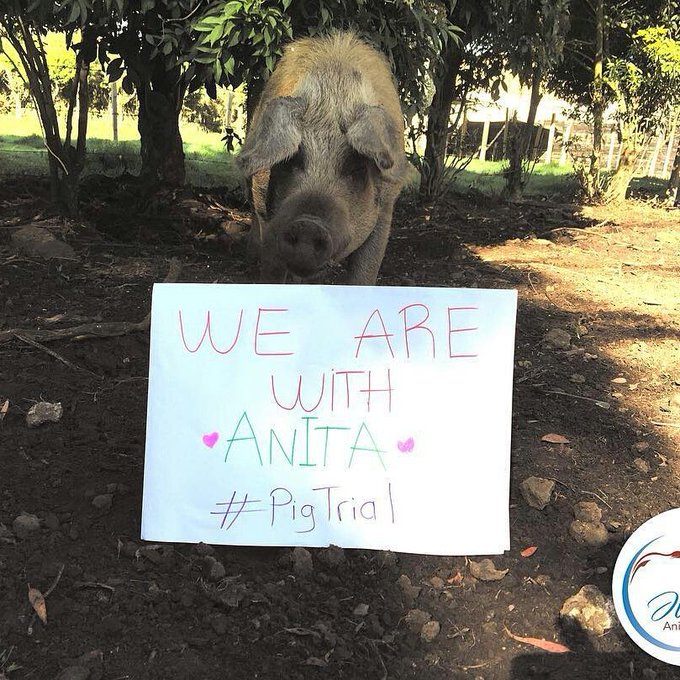
The case has attracted the attention of other animal rights activists, who are tweeting messages of support using the hashtags #PigTrial and #StandWithAnita.

WE ARE WITH ANITA! STAND TALL YOU ARE IN THE RIGHT AND YOU HAVE MILLIONS OF PEOPLE BEHIND YOU! ❤❤❤❤

Animals Aren’t Commodities

“If Animals Matter Morally, Then We Cannot Treat Them As Commodities”

A conversation with animal rights advocate Gary Francione

Gary L. Francione is a controversial figure in the modern animal rights movement, known for his “abolitionist approach” towards animal rights. A professor of law and philosophy at Rutgers University, Francione believes that we cannot morally justify using animals as mere resources and that we should abolish all animal use. He argues that any being that feels pain has a right to not be used as property and that veganism should be the moral underpinning of the animal rights movement. As he puts it, “To not be a vegan is to participate directly in animal exploitation.”

photo of Gary Francione Photo by Vegano Siempre

Francione was the first person to teach animal rights in an American law school when he began teaching a course on animal rights and law at Rutgers in 1989. He has focused nearly four decades of academic scholarship in forwarding a theory of animal rights that posits that sentience alone (and not just cognitive intelligence as defined by humans) qualifies a being for the fundamental right of not being considered the property of another. He links the struggle for animal rights with other social movements and argues that the animal rights movement is the logical progression of the peace movement.

Francione has written multiple books and countless articles on animal ethics and animal law, and is particularly well known for his critical view of the animal welfare movement, which he says serves primarily to make people feel better about animal exploitation. His latest book, Eat Like You Care: An Examination of the Morality of Eating Animals (2013), co-authored with his partner and fellow Rutgers professor Anna Charlton, answers all the “but” questions that any non-vegan could possibly ask about transitioning to a vegan lifestyle.

I recently spoke with Francione via Skype and email about his latest book, his philosophy on animal rights, and his thoughts on both the animal welfare and animal personhood movements.

What event in your life caused you to become an animal rights activist?

In the late 1970s, I visited a slaughterhouse. It changed my life overnight. It became clear to me that our use of nonhumans as human resources presented a most serious moral question that was, for the most part, being ignored.

What is your philosophy concerning animal rights?

My position is that if animals matter morally at all — and I believe that most people believe that they do matter morally — then they must have at least one right: The right not to be used exclusively as human resources. The right not to be chattel property.

Interests can be protected in one of two ways. We can protect an interest only to the extent that to do so maximizes desirable consequences. Or we can protect that interest irrespective of consequences. The latter way of protecting an interest is what we describe as involving a right. To say that I have a right of free speech is simply to say that my speech will be protected even if other disagree with and think that my speech generates undesirable consequences.

If the interest in not being chattel property is not protected by a right, then that interest will be ignored when it is beneficial to do so. We recognize this where humans are concerned. We protect the interest that humans have in not being slaves with a right. We recognize that if humans are going to be members of the moral community, they must have the right not to be chattel slaves. If they are chattel slaves, they exist outside the moral community. They are things and not persons.

The same analysis holds true where nonhumans are concerned. If they are going to matter morally, they must have the right not to be property. If they are property, they are just things that have only extrinsic or external value, and do not have inherent or intrinsic value.

If we recognize this one right, then we are morally committed to abolishing the institutionalized exploitation of nonhuman animals. It’s not a matter of improving the treatment of animals. It’s a matter of abolishing the use of animals.

One of the key tenets of your philosophy is veganism. Could you explain why you think it’s important?

Veganism means that we do not eat, wear, or otherwise use animals.

I maintain that there is veganism and there is animal exploitation: There is no third choice. To not be a vegan is to participate directly in animal exploitation. That is, if we eat animals or animal products, wear wool, leather, fur, etc., or use products made from animals, we are treating animals as things with no morally significant interests.

As an abolitionist, I promote veganism as a moral baseline or a moral imperative and as the only rational response to the recognition that animals have moral value. If animals matter morally, then we cannot treat them as commodities and eat, wear, or use them. Just as someone who promotes the abolition of slavery should not own slaves, an abolitionist with respect to animal slavery should not consume animal products. As far as I am concerned, veganism is a fundamental matter of justice.

Advocating veganism as a fundamental principle of justice is not something that requires large, wealthy animal charities and “leaders.” It is something that we all can do and must do as a grassroots movement. Each of us must be a leader.

Let me say that there is no difference between meat and other animal products. Animals used for dairy and eggs are also treated horribly and they all end up in the same slaughterhouse as their “meat” counterparts. If you do not eat meat but you eat dairy and eggs, you are still directly responsible for animal suffering and death.

Your view on animal rights, particularly your views on animal welfare, has been criticized by some sections of the animal-protection movement, who say that animal welfare does provide some interim protection to animals until their rights can be established. How do you respond to such criticism?

Animal welfare is problematic for moral and practical reasons.

From a moral perspective, if animal use cannot be morally justified, then it is morally wrong to promote supposedly “humane” exploitation. Think about it in a human context. If slavery is wrong, then promoting “humane” slavery is not the answer. The only morally acceptable solution is to promote the abolition of slavery.

From a practical perspective, because animals are chattel property, and because it costs money to protect their interests, we protect animal interests generally only when we get an economic benefit. For example, we have laws that require animals to be stunned at the moment of slaughter because animals who are not stunned can injure workers and they incur carcass damage. Worker injuries and carcass damage cost money. For the most part, welfare reforms make animal exploitation more efficient. They are measures that, for the most part, industry will take anyway because it is beneficial for industry to do so.

As far as I am concerned, the primary purpose of animal welfare measures is to make humans feel better about continuing to exploit animals.

Do you think human society is at a point where it’s receptive to the idea of animal personhood, which would bestow animals with the basic rights to life and liberty?

Absolutely. I believe that most people already accept the idea that nonhumans are not things and are beings with moral value. Most people accept that it is wrong to inflict unnecessary suffering on nonhuman animals. Most people become outraged when they hear about “animal cruelty” cases precisely because they object to the infliction of unnecessary suffering.

The challenge is to get them to see that if they are not vegan, then they are morally no different from the “abusers” they criticize. It is not necessary to eat animal products in order to have optimal health. Indeed, mainstream health care professionals are increasingly recognizing that animal products are detrimental to human health. The best justification we have for inflicting suffering and death on billions of land animals and trillions of sea animals is that they taste good. That is no better a justification than maintaining that the enjoyment of watching a bullfight justifies bullfighting.

I am very optimistic about the future. I think the abolitionist vegan movement — a grassroots movement of people all over the world — is really gathering a great deal of momentum.

Given that you believe that sentience is the only characteristic required for personhood, what are your thoughts on the Nonhuman Rights Projects efforts to get certain animal species like chimpanzees and elephants declared nonhuman persons?

Sentience is subjective awareness. A sentient being is someone who perceives and experiences the world. A sentient being has interests; that is, preferences, wants, or desires. If a being is sentient, then that is necessary and sufficient for the being to have the right not to be used as a means to human ends. The recognition of this right imposes on humans the moral obligation not to use that being as a resource. It is not necessary for a sentient being to have humanlike cognitive characteristics in order to be accorded the right not to be used as property.

Intelligence and humanlike cognition may be relevant for some purposes, but they are not relevant for the basic right not to be used as property. As far as that one right is concerned, there is no difference between a chimpanzee and a mouse. We should not use either exclusively as a human resource.

Again, think about it in the nonhuman context. There are all sorts of differences between a human who is brilliant and a human who is severely mentally disabled. Those differences may be relevant for certain purposes, but we should not use either human as a forced organ donor or as a non-consenting subject of a biomedical experiment.

So if not through incremental efforts, such as getting one species at a time recognized as persons with rights, how do we get around to establishing the abolition of animal exploitation?

We get to the abolition of animal exploitation through creative, nonviolent vegan advocacy. We need to stop the demand for animal exploitation. And we can do that. Assume that we have 1 million vegans in the US. That’s a very low estimate. If every one of those people educated one other person to become vegan in the next year, there would be 2 million vegans. If the process repeated itself every year, the United States would be vegan in eight years.  Each of us can play a role in bringing about a vegan world!

How do you feel about the killing of Harambe the gorilla? Do you think the killing was inevitable, that the zoo had no choice?

A child got into the enclosure. The gorilla was a piece of property. If Harambe had injured the child, the legal liability of the zoo would have been astronomical. So I am not surprised that the zoo had Harambe killed. I object to zoos. And although I thought it was tragic that Harambe was killed, it’s no more tragic than the killing of millions of “food” animals every day. There is no moral difference between Harambe and the nameless chicken that people consumed for dinner last night.

What are you working on at the moment?

Anna Charlton, my co-author on Eat Like You Care, and I are working on a handbook about abolitionist vegan advocacy.

If you had one message to give to all animal lovers, what would it be?

Loving animals is not consistent with harming them. If you love animals — if you believe that animals matter — then stop participating directly in the exploitation of animals. It’s morally wrong. Go vegan!

http://www.earthisland.org/journal/index.php/elist/eListRead/If_animals_matter_morally_we_cannot_treat_them_as_commodities/