


Dear Grist,
Please remove me from your mailing list. Somehow I got sucked into subscribing to your newsletter, under the wrongful assumption that you folks actually cared about the Earth and its non-human inhabitants. Maybe some of you did at one time, but you’re being shouted-down and bullied by the unabashed flesh-eaters in the crowd.
I used to enjoy your articles on overpopulation and climate change, but lately you’ve been wasting my time (and yours) with campaigns urging the consumption of animals (as though meat-eating were a lost art in America; an important tradition in need of a champion).
You may have started your backslide slowly with your eat-all-things-dead agenda, but lately you’ve been pushing meat like it’s going out of style. The last straw was when you started spelling-out the word “Meat” with the body-parts of your dead victims like something that serial killers Ed Gein or Jeffry Dahmer might have done.
But, whoever came up with this idea obviously modeled it after Lady-Gaga’s infamous and equally bad tasting “meat-dress.”

by Veda Stram
July 2015
Some things I wish someone had told me when I was new to activism. And some things I have learned the hard way and some things other activists have told me have helped their activism. And some questions I have found it useful to reconsider from time to time. Imagine a bowl of cherries. This is not about the cherries/animal activism in the bowl, but rather it’s about the bowl where all the cherries/animal activism live.
Please consider the below …and reconsider from time to time……
NEVER FORGET
It is a truly, amazing wonderful commitment to be an animal rights activist. It is truly something to be proud of. It can give you a life worth living.
Margaret Mead: “Never doubt that a small group of committed individuals can change the world; indeed it is the only thing that ever has.” As committed animal rights activists we keep hoping that it’s not just a “small group,” but ya know what….it always has been and always will be a “small group.” THANK YOU for being a part of that small group.
Animal rights IS the most important social justice movement because humanity’s relationship with other-than-human animals is at the heart of and impacts the quality of our food, air, land, water, medicine, holidays, surgeries, religion, affection, pharmaceuticals, entertainment, family relationships, fashion, festivals, companion animals, despair, ethics, morality, personal commitments, the importance of the impacts of our personal choices…and more.
People want to make a difference and are horrified when they realize that means they’ll have to BE different. Be prepared to be different, to become stronger, smarter and more effective…ongoingly. Animal rights and animal liberation demand that you be different than most people you will meet. How can you handle almost always being the “different” one in the crowd? Are you strong enough to be that? If not, figure out what it takes to build those strengths. The animals need committed activists, not fair-weather friends.
Be aware of the fact that the depth and breadth of animal abuse is beyond your personal comprehension. After over 26 years of activism, three or four times a week I learn of three or four NEW horrors toward animals. You need to deal with the reality that you have NOT seen the worst. Brace yourself.
However much of your time and energy you devote directly to working for animal rights, this IS a life-time commitment. Long-term work may or may not result in long-term payoffs. You’re most likely in it for the long haul not as in a few weeks, but as in years and years and decades and decades. Be aware of and appreciate ANY good news for animals.
BALANCE / PERSONAL
Burnout, compassion fatigue, often result when activists have not managed themselves and managed their heartache, their despair, their personal circumstances. Make it a vital part of your activism to find out for yourself what YOU need to do to relax…to disconnect…to refresh yourself…to decompress.
Then DO IT. Schedule it. Do NOT sell out on yourself. You cannot make differences for animals or with people if you are depressed, sick, distracted, disconnected. Be intent on studying what activists have provided about ways to avoid burnout: read books, attend seminars, participate in online sessions, read blogs, search websites. LEARN from all social justice activists.
Reclaiming and reinvigorating your sense of humor is lifesaving. Satire is wonderfully powerful!
Manage your life! Deal with your finances so you can make the greatest difference for animals; don’t be another victim in your life because you aren’t taking care of yourself. It’s great to have the resources to donate to activism you respect and to be able to participate in conferences, seminars, workshops, etc. Providing sanctuary for yourself enables you to provide sanctuary for others….for human animals and other-than-human animals. The more solid your personal circumstances are, the more you will be able to deal from a position of strength.
How often do you NOT say or do something that you KNOW will make a difference for animals because you’re more concerned with being scared or concerned about looking like a fool or more concerned about being “precise” or “chic” or “cool” or “efficient”? When you DO sell out (which you will), forgive yourself and move on! You WILL mistake mistakes. All social justice activists have made terrible errors, and you will follow in their footsteps. Learn from their mistakes and YOURS mistakes and become a better activist.
There are people who can work undercover and document horrific abuses. If you’re not able or willing to do that, FIND what you can do, and do it. And do it well. Use the talents, skills, abilities, training, physical attributes you have and expand and strengthen them. Never diminish what YOU can provide by comparing it to what you think you should be doing or what somebody else is doing.
Let yourself be moved and touched by how much animals mean to you. Never diminish this deep-seated, profound appreciation. Let yourself be touched and moved by the differences you make with humans for animals and thank those people for letting you contribute to them.
Manage your relationships. Do you want to have personal relationships that strengthen OR diminish your commitments to animals? Tough decisions you may need to make in the next week or five or twenty years.
Absolutely take care of yourself in terms of what videos/images you see or horror stories you read. There may be times when you CAN see these and get fired up and get into action, and there may be times when you just cannot see these without becoming angry or debilitated and cannot get into action. Learn to do what works for you, what does not debilitate you and learn what keeps you in action. Do not martyr yourself…it helps no one.
Get on lots of lists so you get to know more about what millions of activists have done and are doing around the world so you can be educated and inspired and be of more use to animals.
Find a few activist friends/family to speak with confidentially (person-to-person or at least on the phone, not just online messaging) to keep empowering your commitments to animals, to keep yourself clear and moving forward, someone you can vent to and who can vent to you to release tension and maybe sometimes someone to laugh with which can be lifesaving, someone who can hear your pain and someone with whom you can share new ideas.
Ask for feedback about how you’re doing from activists you trust. Consider any advice you’re given and be willing to accept criticism. Be willing to CHANGE to make more differences for animals. And, you may not be the first one to notice that you’re about to burn out or if you’re in over your head.
DEALING WITH HUMANS
Never forget that MOST PEOPLE have no understanding of the depth and breadth of animal abuse. They have NO IDEA what we’re upset about. And if they do know, and do not want to change their thinking or their behavior, muster some compassion for them by remembering how you once were.
Always remember that you will be dealing with human beings and we are judgmental, and opinionated, and open-minded, and closed-minded and absolutely marvelous and complete assholes and everything in
between. And always remember that activists are human beings who are judgmental, and opinionated, and open-minded, and closed-minded and absolutely marvelous and complete assholes and everything in between.
Understand that YOUR “ah-ha” moment may resonate with some people AND your “ah-ha” moment may be absolutely meaningless to other people. The most important conversation you can have about making a difference for animals is always that person right in front of you at every moment.
Questions to consider and reconsider from time to time: Do you eat with people who eat animals? Do you allow people to bring animal food into your home? Maybe it’s time to stop attending family gatherings where animals are served.? Maybe you go to those events and bring vegan food? Maybe you get stronger about tolerating negative comments about veganism? THINK for yourself. And always be willing to change whatever choices/decisions you make about what you do in these kinds of situations. What criteria do you think are “the true” measures of being vegan? It’s important that you define that for yourself, and ongoingly relook and maybe change your criteria. Is someone really vegan who feeds dead animals to their companion animals? Invent your own definitions and criteria and stick to them and again, be willing to change them.
As you become more committed to animal rights/veganism, you may run into problems with friends, family and colleagues. A wise man once told me “Your friends are the people you agree with.” If your friends are not in agreement any longer about “food,” and if they’re unkind or unaccepting of your commitments, maybe it’s time for new friends. And, you’ll find that making a vegan statement in places where vegans are rare often has positive outcomes.
You may like some activists while disagreeing with their tactics, methodologies, ideologies; and you dislike some activists while agreeing with their tactics, methodologies, ideologies.
And just because you respect an individual’s or group’s tactics, strategies, methodologies, writings doesn’t mean you need to follow that individual or group blindly in everything they say, write or do…think for yourself.
Be prudent, be cautious, be authentic in your personal relationships; be careful about sexual liaisons that might cause you problems in the future.
Be responsible about what you say about other people’s activism; and be careful who you speak to about other people’s activism. If you don’t know what “loose lips sink ships” means, look it up.
Think carefully about demeaning or bashing other people’s activism; sometimes you may be justified and sometimes not. Just THINK about whether or not it’s a good use of your time in the moment. Understand that all actions and tactics are open to scrutiny and criticism regardless of who initiates or supports them. What looks like a great idea on the surface may be detrimental to animal liberation, while other things that appear to be harmful may indeed be just what is needed given current circumstances. As you gain more knowledge, your ability to analyze a campaign or an action will develop…Grant yourself time to LEARN and CHANGE.
PERSPECTIVE/JUDGMENT
If we “knew” that there were right things to do to cause animal liberation, we would all be doing those things wouldn’t we? There are as many options, choices and behaviors as there are people working to help animals. Consider all of them, try what you will and stay true to your convictions and respect other people’s evolution.
Be open to new thoughts, new tactics, new methodologies. Press yourself to think outside any box you ever believed in – you’ll need to THINK like you’ve never thought before; you’ll find new ways of viewing life and living daily.
Be willing to be wrong; you may be committed to a particular person or group or ideology or line of thinking or methodology for a month or two or 20 years and one day realize they are not as effective as you once believed. You can always take on new ideas and strategies. Trust yourself.
What do you use or refuse to use from an animal-advocacy organization or individual activist because they have quoted, endorsed, done, written, legislated something you disagree with? Do you throw the baby out with the bathwater?
Other questions to deal with: What criteria do you think are “the true” measures of being vegan? It’s important that you define that for yourself, and ongoingly relook and maybe change your criteria. Is someone really vegan who feeds dead animals to their companion animals? Is someone really vegan if they are pro-choice? Is someone really vegan if they are anti-choice? Should vegans have children who may grow up to be non-vegans? Which politicians should vegans support? (etc., etc…)
Learn, study, delve into, question EVERYone and EVERYthing about all animal-related issues so you can be a solid, valid resource to help people make a difference for animals. You have to know more than the “other side.” If you are NOT certain about something regarding animal abuse issues, say “I don’t know” rather than make something up.
Be willing to be bigger than you ever believed you could be… think seriously about the people you admire and how you can be like them. If an activist you truly admire tells you that this course, or this technique, or this seminar or this entertainment made them better activists, believe them. Education will make you more effective and more knowledgeable. Don’t EVER think you will ever “know it all” because there are far too many animal abuse issues to be an expert in many of them. Gain a broad and thorough knowledge of ALL issues, not just those you’re most drawn to in the moment.
You cannot measure making a difference. There are no measures that can accurately reflect the impact you have on people in the moment. There is no way to know if what you said, did, wrote or handed out altered someone’s view or behavior toward animals. Your communication with them may be the next to the next to the next thing that turns their life around. Never forget which humans and which facts and realities you ignored and what justifications you used… until you didn’t.
DO NOT believe that because someone is “a vegan” or “an animal rights activist” that they’re automatically going to be in agreement with you on all social justice issues. How many people in your life have you agreed with about “everything”? Pick your battles.
Some activists think dealing with politics, politicians and legislators is one of the most important things to do to make a difference for animals. And some activists think dealing with politics, politicians and legislators is a huge waste of time. And other activists have varying opinions pro or con those two points of view. This is another example of the importance of learning about and respecting other activist points of view, methodologies and then choosing for yourself what actions to take.
There are several issues in the animal rights movement that cause divisiveness, contention, personal conflicts, and occasionally (like sports fans displaying unwavering loyalty to their home team) …open hostility. It is extremely smart and vital for YOU to be open and learn all YOU can about those issues from all sources. And be open to changing your points of view over time as you learn new things. Thinking these arguments through rigorously and then committing to and sharing openly what you’ve resolved about these issues will give you clarity and power dealing with humans and will really sustain your activism.
TO HAVE MORE VEGAN PRODUCTS WHERE YOU LIVE
Make a note of ALL the numbers under the bar code on your favorite vegan product. You don’t need to know the brand or product name, just that number makes it easy for ordering. Give that number to the ordering manager. Offering to buy a case of a product might increase your chances of getting it. Go into the store regularly and ask if they ordered it yet. Then go in and ask again. Be persistent! It’s about the animals. Once vegan products are in stores, people buy them!

There’s a scene from the movie, Dominion: Prequel to the Exorcist, wherein the local African cattle kill and eat several wild hyenas. Almost immediately after ingesting the animal flesh the cows begin to stumble and drop dead. As gruesome as the whole scenario was, it seems symbolic of the first day, one million years ago (or so), also in Africa, when pre-human primates came across or killed another animal and decided to eat its dead flesh. As with the scene from the installment of the Exorcist, the event represented an innocent plant-eater’s first brush with evil.
Unfortunately for all other life to follow, humans did not have an immediate sickened reaction and drop dead like the cattle in the film. Nothing stopped the greedy proto-humans from continuing with their aberrational carnivorous crimes against nature. Instead, the killing and consumption of their fellow animals, bolstered by the lust for power and control, became routine, tradition, and finally enshrined. Now, here we are today (both the unthinking omnivore and the ethical vegetarian alike) paying the penance for our ancestors’ acts.
Yes, there was an original sin, but it had nothing to do with eating apples or any other fruit, nor anything that grew on trees or in the ground for that matter. It had to do with trying to mimic natural predators who’ve had millennia over us primates to adapt physically and psychologically into the role of carrion scavenger or killer. Not that nature’s carnivores were ever evil, but why would we want to emulate such undesirable and offensive behavior?
That first bloody bite of carrion, the first mouth-watering morsel of tender flesh was all it took; all she wrote. Fast-forward a million years—game over.
The proud human followed a path from hand-to-mouth, from feed lot to oil field, changing everything from Earth’s biodiversity to its very climate.
A lot has been made about humans being the only species to cause a mass extinction. But when all is said and done, some may say that we’re not the first species to have a role in a mass extinction; that the over-population of methane producing microbes, methanogens, might have factored in to the third mass extinction event, the Permian extinction. Still the fact remains that humans have the dubious distinction of being the one species to knowingly bring en entire era (in our case, the Age of Mammals—the most diverse in Earth’s history) to a close. Despite ample warning and time to modify our behavior, our species seems bent on making the same mistakes right up to the living end. Not only did the freeways and highways not miraculously clear at the first sign that our carbon over-output was changing the planet’s atmosphere, but relatively few people (relative to the over-all burgeoning human population, anyway) are swearing off carrion after learning that meat production is responsible for an even greater carbon (and methane) footprint.
And it all leads back to that first fateful bloody bite. Mother Nature was too nice to us. If she had made that early proto-human urp it all back up again, projectile-vomit at the very thought of it, or experience some repellant natural reaction, we could all have been spared a lot of misery at the hands of Homo Horribilus Rex, the two-legged mutant, meat-eating monster.
This steer was ready to die for his freedom. They still wouldn’t give it to him.
The heartbreaking episode happened earlier this week when the frightened animal escaped from his handlers at an Australian dock. He was about to be loaded onto an export ship bound for Vietnam, where he would be slaughtered.
He had already endured a grueling journey, packed onto an overcrowded truck and driven from his home to the busy port, and was stressed and scared by all the new sights and sounds. When officials arrived to recapture him he was “freaking out,” they told Australia’s ABC news.
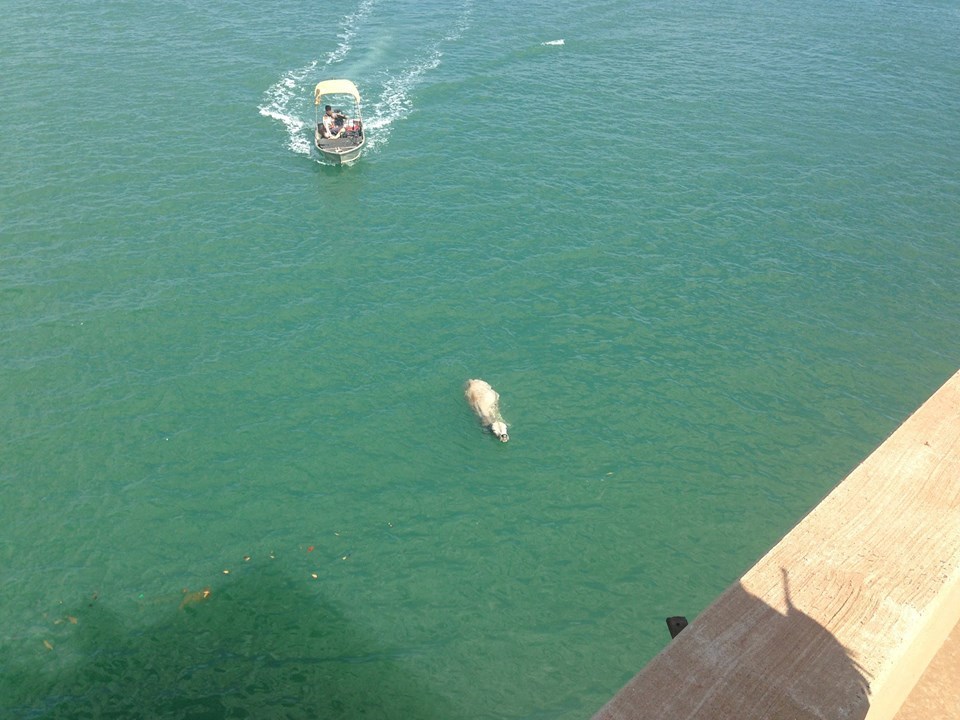
They shot the steer with two sedation darts. But the petrified animal refused to let himself be recaptured. “He took one look at us and was like: ‘Oh no,'” Will Green, a ranger who responded to the incident, told ABC.
Instead, the brave steer turned right around — and hurled himself off the 25-foot tall dock into the crocodile-infested water below. Even as the sedatory drugs began to course through his system, he was determined to do whatever he could to escape.
This sad story raises even more questions about Australia’s live export industry, which has attracted growing concern from animal lovers worldwide. Each year the country exports millions of live animals for slaughter — to countries that have little or no animal protection laws.
More than 2.5 million animals have died over the past 30 years from the terrible conditions during the journey abroad, and those that make the trip face a fate even worse than those of factory farmed animals.
One recent investigation by Animals Australia showed that animals sent to Vietnam, where this unlucky steer was destined for, were being sledgehammered to death; another 2015 investigation revealed that cows sent to Israel were having their throats slit and being strung up while fully conscious.
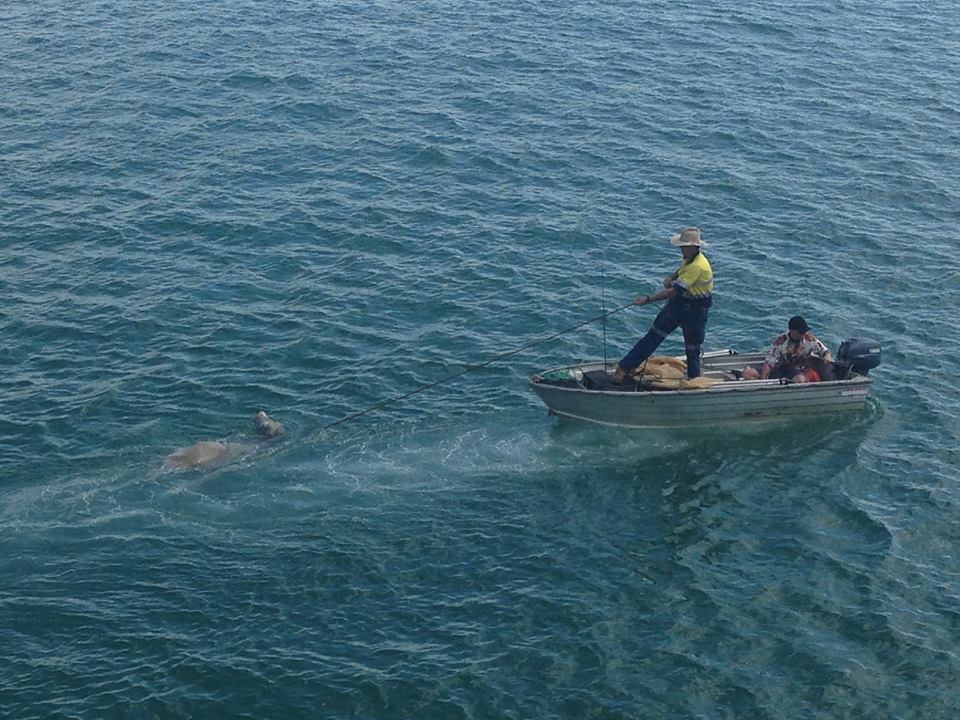
Unfortunately, this steer didn’t have a better fate. With the help of a local fisherman, officials lassoed the frightened animal. When faced with the option of bringing him back to port or hoisting him onto the export ship, they chose the latter.
So they wrapped the scared steer in a fishing net and dumped his tired body onto the ship that would bring him to his death.
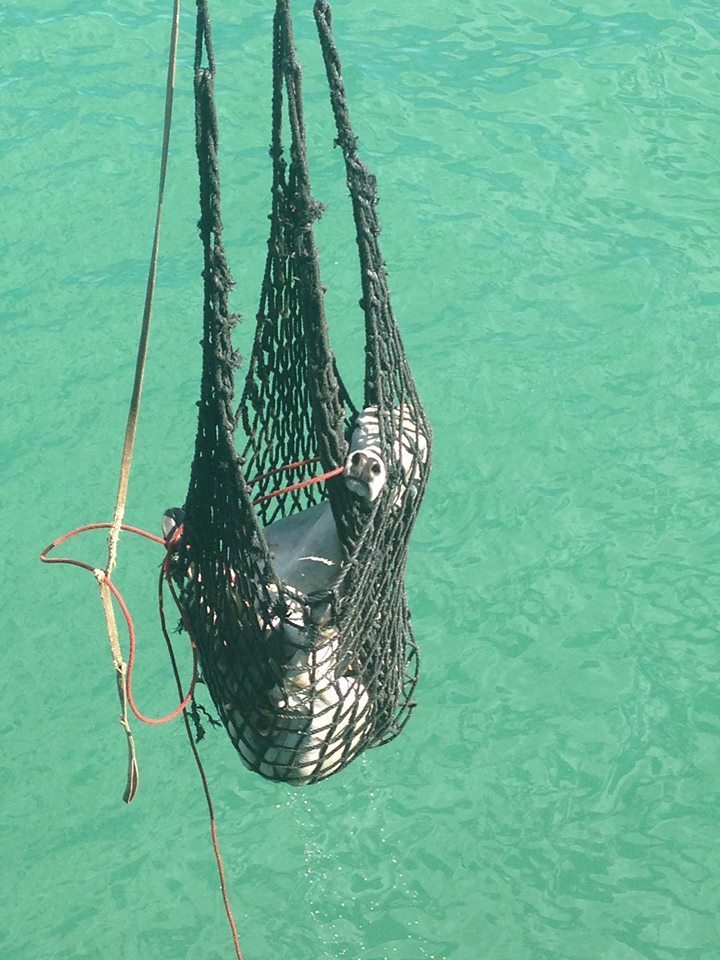
If you’d like to stop Australia’s live export of animals, you can click here to join the nearly 500,000 people who have signed a petition calling for it to end. You can also donate to Animal Australia’s campaign here.
 What is the difference between Certified Humane and American Humane Certified? What’s the difference between free-range and cage-free?
Unfortunately, consumers who care about animals are being misled by deceptive marketing schemes.
Producers have learned that if a label contains buzzwords such as “happy,” “free,” “humane,” or “animal welfare,” concerned customers will often buy their products (with higher prices) without actually understanding their practices.
The result is a confusing proliferation of packaging labels pertaining to farmed animal welfare. But what do these labels really mean?
To start, it’s important to know that there is no legal definition of “humane.”1
Under USDA-approved welfare labels, farms and producers decide independently what practices they will call “humane.” The USDA merely verifies that the company follows its own arbitrary standards.
Some private humane certification labels require third-party auditors to verify compliance with their standards, but even among these programs the term “humane” is not consistently defined or enforced.

For example, Animal Welfare Approved does not allow debeaking, but considers castration and ear notching without pain relief “humane.”
On the other hand, American Humane Certified permits debeaking, but does not allow ear notching and requires anesthesia for castration of some animals.
Furthermore, not only do terms like “humane” and “free-range” mean different things to different producers; they also mean different things depending on the kind of animal.
For instance, while free-range beef cows must have spent some time on pasture, free-range chickens commonly spend their entire lives crammed inside windowless sheds with thousands of other birds.

The term “free-range” is not regulated by the USDA, except for use on chickens and turkeys raised for meat (which only requires “access” to outdoors).
Its use for cows and pigs is neither regulated nor enforced.
Often, free-range labels refer to animals packed into warehouse-style sheds with no access to the outdoors.
This is far from the rolling pasture that the term “free-range” conjures in most people’s minds.
All that is required for free-range labeling of poultry is that the birds have “access” to the outdoors for an unspecified amount of time.
Thousands of birds may be confined inside a warehouse facility with a single exit the size of a cat door, and the door may be opened for a few minutes. This still qualifies as free-range.2
The layers of excrement and urine in which these birds are forced to stand, day after day, cause severe flesh and eye burns, and fill the air with so much ammonia that many birds suffer from respiratory disorders.
Conditions on many free-range operations are so bad that most birds are not even aware of outdoor access, or they are too crowded, ill, or weak to move that far.
Debeaking is standard procedure on free-range poultry farms. Free-range claims on eggs are completely unregulated.

Cage-free labels refer to hens used for eggs and mean only that the chickens are not in cages.
Cage-free egg-laying hens are typically crowded into windowless sheds or warehouse facilities, with thousands of birds on the floor and on stacked wire platforms, with little or no access to the outdoors and no room to perform natural behaviors.
The ammonia laden air is so noxious that hens commonly suffer respiratory disorders, severe flesh and eye burns, and even blindness.
Debeaking is routine and permitted. There is no third-party auditing.

Cage-free labels should only appear on egg packages, as egg-laying hens are the only farmed animals kept in cages. (Veal calves and breeding sows are confined in crates.)
When cage-free labels appear on chicken or turkey meats (as shown in this photo of Harvest Land chicken meat), consumers are being deliberately misled.
Even on factory farms, chickens and turkeys raised for meat are not kept in cages, but are severely confined indoors inside massive sheds.

Cows raised for beef eat grass for at least the first six months of life, then most are shipped to crowded, barren feedlots and fattened (“finished”) on grain to reach slaughter weight more quickly.
Some producers market feedlot-finished beef as higher priced grass-fed beef even though their cows are intensively confined for the last year or more of life.
USDA certified grass-fed animals must have access to pasture from early Spring to late Fall, but may otherwise be confined to pens or sheds.
All of the standard mutilations including castration, dehorning, and branding are permitted without pain relief under generic and USDA grass-fed labels. Hormones and antibiotics are also allowed.
The term “humanely raised” is not regulated or verified, meaning animals can be raised in confinement and mutilated without painkiller.3
Unfortunately, virtually any producer can slap a “humanely raised” label on their animal product, which renders the term nearly meaningless. Even on higher welfare farms, the term is often used deceptively.
Niman Ranch is a useful example, considered by many to be a model of humane pig farming. Their website shows images of happily roaming pigs, and their pork labels read, “Humanely raised on sustainable farms.” The labels also say, “Raised outdoors or in deeply bedded pens.”
That “or” is a loophole that means that Niman Ranch could get away with confining up to 100% of their pigs indoors. According to one writer, they currently confine around 75% of their pigs in warehouse-style barns with straw floors.
The welfare of pigs not given access to the outdoors is markedly lower than that of grazing pigs, yet Niman Ranch enjoys the celebrated reputation of a “pastured pork” operation.


Despite all the feel-good labels to the contrary, happy dairy cows are a myth. The basis of all dairy production is sexual violation and the destruction of motherhood.
These are not overstatements. It is a matter of fact that in order to produce milk, female cows must be impregnated (usually via invasive artificial insemination), carry their babies for nine months (like humans), and give birth.
Also inherent to dairy production is the separation of calves from their mothers in order for humans to take their milk.
This breaking of the mother-calf bond happens on small farms, humane label farms, and factory farms alike. According to the USDA, 97% of dairy calves are permanently removed from their mothers within just the first 12 hours of birth.4
Many humane label farms remove the calves in the first hour, claiming that the longer mother and calf are permitted to bond, the more stressful the separation.
Most calves spend their first 2 to 3 months of life in constant confinement in cramped, individual hutches, and never know the nurturing or warmth of their mother’s care.
Regardless of farm type, male calves of dairy cows are sold to be killed for veal or cheap beef.
When they are no longer optimally productive, dairy cows are slaughtered for cheap beef, usually around five years of age.
See also:

For animal products, the organic label mainly distinguishes animals raised without hormones and antibiotics, which are prohibited under organic standards. Animal feed must also be organic.
Animals must have “access” to the outdoors, with cows, sheep and goats given some access to pasture, but the amount, duration, and quality of outdoor access is undefined.
Organic standards do not provide protection against routine mutilations, severe confinement, rough handling, long transport, or brutal slaughter of animals. Tail-docking, dehorning, debeaking, and castration without painkiller are all permitted.

While the USDA’s grass-fed label allows for confinement of animals, American Grassfed Certification requires continuous access to pasture and a diet of 100 percent forage. Hormones and antibiotics are also prohibited.
However, routine mutilations such as castration, tail docking, branding and dehorning are all permitted without pain relief.
No standards are in place regarding the treatment of breeding animals, animals during transport, or animals at slaughter.

One of the worst certified labels. Access to the outdoors is not required for any animals, and indoor space requirements are the lowest of all the main humane certification programs.
AHC is the only third-party audited welfare program to permit cage confinement of egg hens. The killing of male chicks, debeaking, and tail docking without pain relief are permitted.
Some standards extend to the treatment of breeding animals, animals during transport, and animals at slaughter.

The Animal Welfare Approved certification is a program of the Animal Welfare Institute. They claim to have “the most rigorous standards for farm animal welfare currently in use by any United States organization.”
As proof of this claim, their website includes a useful chart comparing the various practices and provisions of each certified humane label. While there is bias in favor of AWA in the chart and guide, we include them here for reference.
The AWI boasts that the AWA is the only USDA-approved third-party certification program, but as with other humane labels, egregious cruelties are still permitted.
On the upside, animals have “access” to the outdoors and are able to engage in “some” natural behaviors. No cages or crates may be used, and growth hormones and antibiotics are prohibited. Debeaking is also not allowed.
However, the killing of male chicks born to egg-laying hens is permitted, as are other painful mutilations performed without painkiller, including ear notching and castration.
Standards include breeding, transport, and slaughter of animals.

There is no requirement for outdoor access for birds used for meat, egg-laying hens, or pigs. However, minimum space allowances and indoor environmental enrichments are stipulated.
Feedlots are permitted for beef cattle. Killing of male chicks born to egg-laying hens is allowed.
Debeaking of hens and turkeys, tail docking of pigs, dehorning of goats without painkiller, and rubber ring castration without painkiller are all permitted.
Standards include the treatment of breeding animals, animals during transport, and animals at slaughter.

GAP is a step-based rating program used by Whole Foods.
Producers receive one of six ratings, from Step 1 to Step 5+. Step 1 permits industrial style (factory farm) confinement of animals and merely prohibits crates and cages. Feedlots are allowed for beef cattle through Step 4. Debeaking and tail docking are permitted through Step 3.
Standards consider the treatment during transport, but not breeding or slaughter.

Warning: this industry label is intentionally misleading.
The USDA currently allows producers enrolled in its Process Verified Program (PVP) to label their products “humanely raised.”
In reality, producers decide independently what practices they will call “humane,” and the USDA merely verifies that the company follows its own arbitrary standards.
Under such a scheme, industrial producers running large scale confinement operations can simply submit their current practices as “humane,” and display the “Process Verified” and “humanely raised” labels.
Read more about this marketing scheme here and here.

Warning: this industry label is intentionally misleading.
UEPC permits battery cage confinement of egg-laying hens and other routine inhumane factory farm practices.
Hens in these barren cages have 67 square inches of cage space per bird (less than a sheet of paper), and cannot perform any of their natural behaviors, including perching, nesting, foraging, or even spreading their wings. Debeaking is permitted and routine.
See also:
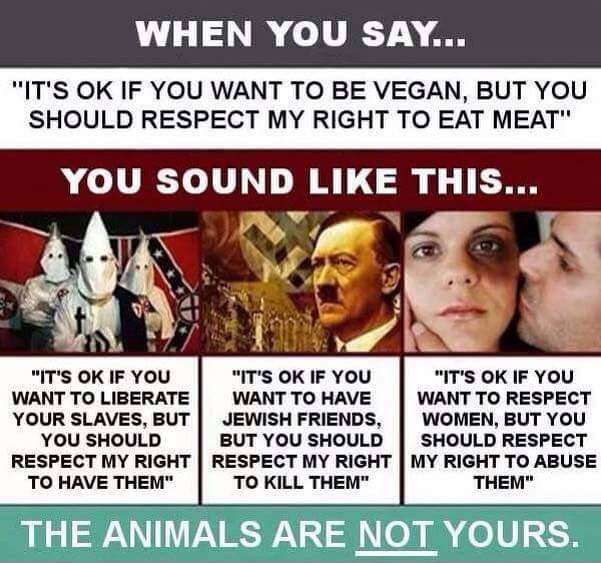
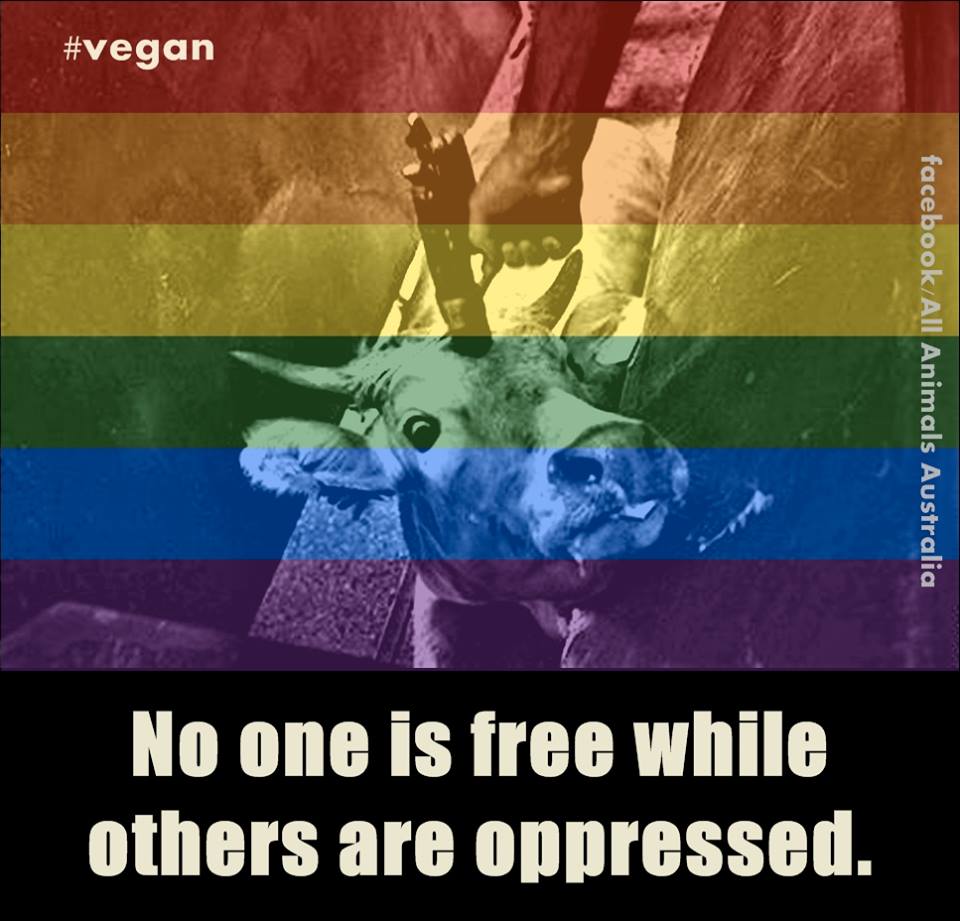
Written by Jace Kai
Congrats to gays in America- you’re now able to endure the plight of marriage and serve the flesh of tortured animals at your wedding like every other entitled American. So glad your ‘suffering’ is over. And before everyone gets all whiny pissy pants on me, let me remind all that since the dawn of this country and even before, every human being has had a far better life than that of the ones suffered by animals due to human interaction and cruelty, and while everyone is dancing around in their rainbow undies, animals are sinking deeper into hell. Every black, white, asian, hispanic, male, female, gay, straight, transgender, jewish, muslim, christian and atheist; every fat person, skinny person, healthy person, sick person, free citizen and even incarcerated prisoner has been able to live with far more rights and freedoms at their lowest than animals have ever had the luxury of at their highest. Even the most sadistic of serial killers in solitary confinement are able to turn around and move their own limbs should they wish to do so, but that is not the case for billions of innocent animals born into humanity’s evil grasp. We turn their skin into shoes that we walk through the mud with. We turn their fat into soap to wash our asses with. We turn their menstruation into breakfast to slowly clog our arteries. We turn their fur into ridiculous looking coats to keep us warm. We turn their newborn babies into nothing more than a midnight snack. Have lesbians ever had to endure being skinned alive and turned into jerky for some redneck trucker to snack on? I think not. Billions upon billions of animals are born into slavery every year. Billions of animals as loving and intelligent as any dog or human child are born into a world where they are raped and beaten and viciously killed within a fraction of their natural life. Billions of animals who never once know the warmth of sunshine on their face or the softness of grass under their feet. Billions of animals who have their babies stolen and beaten to death right before their very eyes, all to satisfy the stupidly ego driven blood lust of humanity. And yet every day there is still some human complaining about THEY don’t have enough rights. The world will stop what they’re doing to protest the waving a flag, or unite to march in a parade to wave more flags and still the stomping of the feet never ends. We’re living in a country that is actively making and vehemently enforcing new laws which protect animal abusers and criminalize the few people who risk their own safety to bring such crimes to light. We’re living in a country that promotes the continued slavery, torture and slaughter of billions of animals every year in order to keep it’s own people sick and unhealthy while destroying the land, sea and air we all need to survive. We’re living in a country that keeps it’s people stupid in order to make them more easily misled by every lie thrown at them, particularly in the dietary department. We’re living in a country where an individual smoking a plant gets thrown in jail for 10+ years but a corporation that brutally rapes and slaughters millions of animals every week gets government subsidies like they’re heroes. Humans are all about ‘me me me’ and never ‘them them them’, and it’s that ego that makes America, as well as every other country far more shit than sunshine. The death of eight humans turns the country upside down but the death of billions of animals is just ‘business as usual’. Has a life with the inability to legally say “I do” or cast a vote for your favorite crooked shitmouthed politician really been comparable to even ONE day of living in the sick hell that factory animals endure? It’s all about the human ego wanting whatever it can get its hands on and then when they do, they want something more, like a kid who constantly gets new toys then gets bored with it by the next day and cares nothing for those who’ve never and will never have any toys at all. Mind you, this has nothing to do with me being a straight white male either because like many people who actually give a damn like myself, my entire existence is pure shit from dusk till dawn, and that’s fine. I speak only for the animal rights, not for my own. Go ahead and take away my ‘right to vote’ , because I can’t think of the last time there was ever a candidate worth voting for and elections are as fixed as a carnival bottle game anyway – take away my ‘right to get married’, because monogamy is about as natural as a 10 pound GMO tomato and almost always ends up in divorce, resentment or just giving up & settling either through sheer laziness or ‘for the kids’ – but don’t blow this happy “love wins” victory smoke up my ass while the only living beings in this country that don’t belong behind bars are the overwhelming majority that are – the animals. Gay or straight, a person knows nothing of love or compassion while there’s a corpse on their plate and I will continue to have zero ‘respect’ for any person, of any race, of any gender, of any sexual orientation, that willingly contributes their money towards the evil human empire over the innocent animal kingdom. I’m sure the 10,000 pigs who were stabbed in the eye with a pitchfork since I started writing this statue give a good god damn that Joe & Bob can have that festive wedding they always wanted now, maybe even catered with their flesh. Any non-vegan holding up a sign for ‘gay rights’ or ‘feminist wawa’ or ‘save the environment’ needs to sit down and take a good look at just how good they have actually have it and maybe try putting a little more effort into being a voice the the voiceless first and foremost, because as Leo Tolstoy said, “As long as there are slaughter houses there will always be battlefields.” Even if caring about non-humans is too much to ask of most shitty humans, remember that factory farming is the number one polluter and destroyer of the environment, so when all the water is too filthy to drink and the air is too polluted to breathe and the land is too toxic to yield crops, don’t expect that ring on your finger to save you.
The day my dog was cooked for dinner

This week about 10,000 dogs and a number of cats were killed at an annual dog-meat festival in south-western China, to celebrate the longest day of the year. For the BBC’s Juliana Liu it was a reminder of one of the most traumatic days of her childhood, in the Chinese city of Changsha.
When I was three years old, after months of begging, my parents finally gave in to my pleas for a puppy.
The day that my uncle, a lorry driver, brought me a fuzzy yellow mongrel from my grandmother’s mountainous, faraway home was the happiest of my young life.
I named him “Doggie”, and we immediately became inseparable.
As an only child born in 1979 at the beginning of China’s one-child policy, I had always been alone, and Doggie became my best friend. He loved running around outside our one-room flat, gobbling up left-over rice and snuggling near the coal fire.
But these halcyon days did not last. After just one winter, my parents told me Doggie had to go.
In Chinese cities in the early 1980s owning a pet was considered highly undesirable, bourgeois behaviour. None of my neighbours had one. It was also not entirely legal. There was no access to animal vaccines or vets, so pets could pose a public health risk.
One day, my mother announced we were going shopping – and when we returned a few hours later Doggie was no more. He had been strung up by the legs in our communal yard, and was soon turned into a stew, complete with herbs and hard-boiled eggs.
No-one paid any attention to my tears. I heard the neighbours say I would soon forget the whole thing.
They, on the other hand, were in a celebratory mood. In the years before China’s economic boom, when some food was still rationed, it was rare to have the chance to feast on a whole animal.
I refused to eat the stew – and I have never eaten dog in my life.

In China, the tradition of dog-eating goes back far beyond written history.
Along with pigs, oxen, goats, horses and fowl, dogs are one of the six animals domesticated during the Stone Age.
On the other hand, it is not the kind of thing that is eaten every day. It is a speciality meat, commonly believed to confer strength, vigour and virility on the eater.

Chinese food expert Fuchsia Dunlop writes:
Judging by the sporadic waves of outrage about dog-eating in China, you might think it was one of the pillars of the Chinese diet. Actually, however, the consumption of dog meat is extremely marginal: it’s seldom seen in markets and on restaurant menus, and most Chinese people eat it rarely, if at all.
Dogs, like pigs, have been reared for their meat in China since the Neolithic age, but in modern times their flesh is regarded as a delicacy in just a few areas, such as Hunan and Guizhou. Even in these places, it tends to be eaten only occasionally, and in certain seasons. According to traditional Chinese medicine, dog is a “heating” meat which can offer a useful energy boost in midwinter, but is best avoided after the lunar new year.
In culinary terms, dog meat is normally blanched or soaked before cooking to dispel the earthier, heavier aspects of its flavour. It is then, typically, made into slow-cooked soups and stews seasoned with ginger, spring onion, rice wine and spices, although it may also be roasted, or served cold as an appetiser. The tender meat of puppies is favoured over that of older dogs.
In the course of many years of studying Chinese cuisine, I’ve only eaten dog meat on a handful of occasions. The first time, it reminded me of pork; the second, in a fiendishly spicy Hunanese stew, it recalled the taste of lamb.
About 716 million pigs are slaughtered in the country every year, and 48 million cattle. The number of dogs slaughtered is far lower – one animal rights group puts the figure at about 10 million.
But where do these dogs come from? According to some researchers, many are pets – like Doggie, except they have been stolen from their owners.
As dogs were arriving for the dog-meat festival at Yulin in Guangxi province this week, Peter Li of Humane Society International saw no animals with quarantine inspection certificates to indicate they had been farmed.
“All of them can be suspected to be stolen urban pets, rural guard dogs and stray dogs and cats,” he says.

A four-year inquiry into the dog-meat industry by Animals Asia also concluded that most dogs eaten in China are stolen.
“During the entire investigation, we found no evidence of any large-scale breeding facilities, where 100-plus dogs were bred and raised,” says the report published earlier this month.
“The difficulty of large-scale breeding of dogs for food and the greed for profit give rise to stealing, snatching from the streets and even poisoning of dogs.”
But Li says there is mounting pressure on Chinese authorities to take action against the eating of pets – and that society is turning against the idea of eating dog altogether.
There were far fewer stalls selling dog and cat meat at the Yulin festival this year than in 2014, he says.
“The overall attitude is against dog eating. China has 130 million dogs, of which 27 million are urban pets. That’s a big number of pet owners.
“The younger generation, born in the 1990s, is not tolerant of animal cruelty.”


In 2014, animal rights activists intercepted 18 lorries carrying dogs intended for eating, resulting in the rescue of some 8,000 animals, he says.
The Chinese media often carries stories of such rescues, in which activists force vehicles to stop and pool money to purchase the animals.
He dates the rise of animal protection activism in China to 2011, the same year when, for the first time ever, more people lived in cities than the countryside.
City dwellers, he says, view dogs and cats more as pets, rather than as working animals – guard dogs, for example – or sources of meat.
In May, on a visit to Shanghai, I saw a sight that delighted me.
While strolling on the Bund, I stopped a young tourist named Yang Yang who was carrying her tiny, fox-like dog in a sling on her chest, the way I normally carry my human baby.
“Oh, this way I can take him into restaurants and on airplanes,” she explained. “Otherwise, he wouldn’t be allowed in with me. Where I go, he goes.”
All three of us posed for a photo in front of Shanghai’s iconic skyline.

How I wish more people had taken this attitude three decades ago.
My parents, now utterly embarrassed about having allowed my pet to be cooked, generally avoid the topic entirely.
But when I was five years old, my father left China to study abroad and the very first gift he sent me was a fuzzy, yellowish stuffed puppy.
I named him Doggie.
To this day, wherever I go, he is with me.

 Exposing the Big Game