I (Can’t) Accept That

Text and Wildlife Photography © Jim Robertson

Text and Wildlife Photography © Jim Robertson

Blame it on animal cruelty overload, or maybe it was the beer (I only had one, in dog years), but the other night at the annual family spring birthday party, I finally came unglued and lashed back at some glib remarks from my brother-in-law.

You see, my wife and I have been vegan for upwards of 15 years now, but we’ve managed to keep get-togethers with corpse munching, secretion gulping extended family members relatively civil—mostly because we’ve avoided talking about the subject, while they’ve “accepted” our being different.

Oh, there were a number of years when they went along with having a mostly vegan meal to humor us (except for their precious cheese). But then came the wisecracks. If there’s one thing I won’t stand for, it’s mockery from meat-eaters who can’t seem to conceive of compassion for non-human animals (besides maybe their own dog or cat).

On the night in question my sister had decided we should all bring lasagna for the birthday dinner. While they had the standard beef dish, ours was a vegan version (of course), with Daiya non-dairy cheese and Tofurky Italian sausage inside. We also had a shaker of dairy-free parmesan cheese on the table. When my sister asked what it was, my brother in law made some crack about it not being “real” and therefore did not contain the good for you things dairy supposedly has in it.

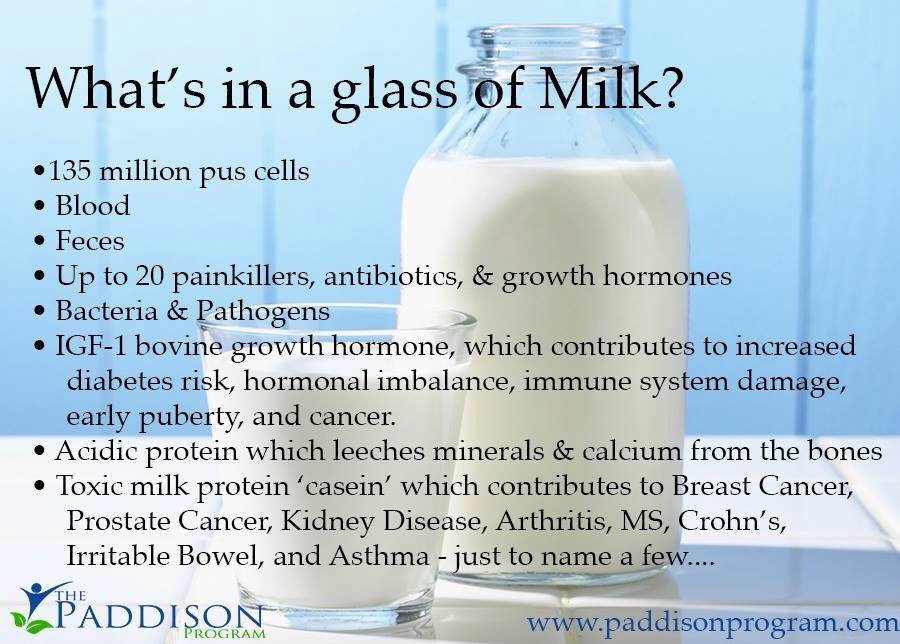
“You mean like pus?” I said, to everyone’s shock. “And then there’s the veal calf who has to suffer for every glass of milk or slice of cheese.” To that my willfully uninformed brother-in-law retorted, “I don’t have any veal in my cheese.”

“Sure you do,” I told him, “dairy cows won’t produce milk without first being impregnated—and the newborn male calves all end up dragged away from their mothers and stuck in tiny crates or chained to the floor in windowless veal barns.”

His only response? “I accept that.”

10150702_10152404415872498_866070308452200420_n

Follow Your Inner Convictions

“[After almost being pressured by other boys to sling rocks at birds.] From that day onward I took courage to emancipate myself from the fear of men, and whenever my inner convictions were at stake I let other people’s opinions weigh less with me than they had done previously. I tried also to unlearn my former dread of being laughed at by my school-fellows. This early influence upon me of the commandment not to kill or to torture other creatures is the great experience of my youth. By the side of that all others are insignificant.” ~ Dr. Albert Schweitzer

Photo Copyright Jim Robertson

Photo Copyright Jim Robertson

Japan takes baby steps toward a proper debate about animal rights

Photo  Jim Robertson

Photo Jim Robertson

http://www.japantimes.co.jp/news/2014/02/22/national/japan-takes-baby-steps-toward-a-proper-debate-about-animal-rights/#.Uwo9mrCYZy1

by Philip Brasor Feb 22, 2014

On Jan. 10, convenience store chain Family Mart started selling a new bentō (boxed lunch) with a heavy-duty name to complement its hefty ¥600 price: Famima Premium Koroge Wagyu-iri Hamburger Bento, which “contains” high-quality Japanese ground beef. For an added touch of extravagance, it also came with a side of foie gras.

A month later, the company withdrew the product after receiving complaints about the foie gras, which is made from the fatty livers of geese. Animal welfare groups claim the manufacture of foie gras amounts to animal cruelty since the birds are force-fed. A Family Mart PR person told Tokyo Shimbun that the company only received 22 complaints, but that it was enough to persuade it to pull the item. The reporter hinted that the company may have actually withdrawn it due to bad sales, but in any case, it’s significant that complaints related to animal rights would be taken seriously by a Japanese business and picked up by the media. It’s not a topic that’s usually covered unless non-Japanese are involved.

Like Caroline Kennedy. The new U.S. ambassador to Japan recently attracted media scrutiny for a tweet expressing her and the U.S. government’s objection to the dolphin “drive hunt” taking place in Taiji, Wakayama Prefecture. Ever since “The Cove” won the Oscar for best documentary of 2009, the world has come down on the whaling town for its yearly cull, which involves scaring dolphins into a cove, separating some for sale to aquariums and marine shows, and killing others for food. Taiji says the condemnation is unfair, since this is how the town makes its living. People who object are hypocrites because humans raise cows and pigs for slaughter. What’s the difference?

Protests are viewed by the Japanese press as a form of cultural bias: Those who complain think dolphins are special, more intelligent than other animals and thus should not be killed for food. But recent editorials in the Tokyo and Asahi Shimbuns, prompted by the Kennedy tweet, downplay the cultural-chasm theory. Asahi says it is more about “how we want to live as human beings.” Why are dolphins special? The feeling is that there is “less distance” between our two species because dolphins are biologically equipped to “communicate,” thus giving them the means to display “intelligence.” And the more an animal “fulfills the condition of being human,” the greater its right to be treated the same way, meaning they should have similar rights as people do in a given society.

However, the logical pillars of this argument as erected by the Asahi were designed to be knocked down. The paper interviewed Koichi Tagami, a lecturer on ethics at Rissho University, who says human rights stem from self-consciousness, which implies “independent reasoning.” If other animals manifest self-consciousness in some way, they deserve to have their rights protected, including the right not to have pain inflicted on them. So if we grant those rights to dolphins, Tagami argues, then all animals that feel pain should have that right, including cows and pigs. Even robots, he reasons, have the right to object to being “controlled” by humans.

The editorial quotes other scholars who point out differing attitudes toward animals in other countries, and how certain animals are protected while others aren’t depending on the culture. The point seems to be that it is impossible to formulate legal guidelines that cover all aspects of animal welfare when there is no global consensus on what is basically a philosophical issue.

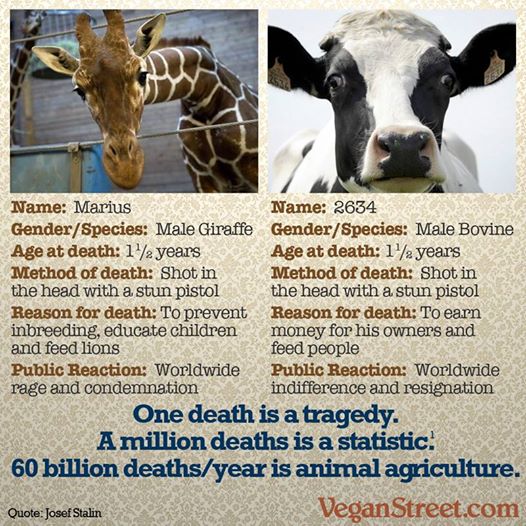
But the Asahi’s academic approach conveniently avoids touching on the most important aim of the animal welfare movement, which is to prevent suffering. Tagami’s theory about freedom from pain is merely a talking point. Though the average person may find advocacy of animal rights too intense at times, the worldwide trend is toward less suffering. Slaughterhouses in Europe must anesthetize livestock before they are killed. Most in the U.S. slaughter animals only after they are stunned. Last week, Denmark outlawed meat-processing techniques used for halal and kosher food, which dictate that animals be conscious when they are slaughtered. The move was met with condemnation from Muslim and Jewish groups. Even nonreligious people wondered about the law after a Danish zoo killed a perfectly healthy giraffe and fed it to lions because the giraffe could not be bred. Its genetic material was already over-represented in the captive environment.

Tokyo Shimbun’s editorial enters this realm by tying animal welfare to commerce. What’s cruel is the mass-production methods of most meat-processing businesses, which are designed to be cheaper and more efficient. Filmmaker Aya Hanabusa made a movie about a Japanese butcher that showed how he raised his livestock from birth and personally killed the animals before processing their meat for sale. She told Tokyo Shimbun that before you can call dolphin culls cruel, you have to apply the same ethical criteria to animals raised “as industrial products.”

In this regard, Taiji fishermen say they have adopted “slaughterhouse methods” to make sure the dolphins they kill “die instantly,” an assertion that anyone who has seen “The Cove” may have a problem with. In any event, they invited Kennedy to witness the cull and see for herself, since what galled them was her suggestion that it is “inhumane.”

Semantics mean something here, and both sides stretch points to their advantage. Taiji claims outsiders are interfering with their “traditional way of life,” but the town didn’t start the drive hunt until 1969, when it needed live animals for its recently opened whaling museum. The anti-cull activists, on the other hand, insist that dolphin meat is dangerous due to high levels of mercury, a contention that is incidental to the cruelty argument. In a world where meat-eating is common, it’s unlikely either side is going to budge unless the Japanese media joins the discussion in a meaningful way.

WillPower vs. Won’tPower — Is it Really Hard to Stop Hurting Animals?

Photo  Jim Robertson

Photo Jim Robertson

by Jack Carone

There is a tendency for some of us who wish to promote veganism—a way of living which excludes the use of animals for food, clothing and other exploitation— to cushion the call to action with a warning/acknowledgement/suggestion that it is a difficult thing to do.

While this is surely the case for some people, for others, including me, it has happened quickly and painlessly when the time was right. To set the stage for interested seekers to expect hardship invites failure or a refusal to even try.

For someone who still really wants to eat animals and their secretions, or still wants to wear a fur coat or a silk shirt, but resists for health or moral reasons understood but not felt, it is certainly hard to do. They have to exert Willpower to resist things they still desire, and this almost inevitably leads to a failure to maintain the “sacrifice”. Someone who gives up meat for “health reasons” very often reverts, occasionally or permanently.

But for someone who has internalized the horror and immorality of subjecting other feeling beings to abuse and slaughter, and who simply refuses to, simply cannot—just won’t— be a part of this any longer, there is no feeling of deprivation, and no enticement which can make them go back to participating in these injustices.

I call this Won’tPower, and in contrast to WillPower, it is effortless to maintain.

Let me tell you what pushed the button in my being and changed my life in an instant.

At the time, I subscribed to the Los Angeles Times newspaper. I sat down one morning and turned to the feature section, and began reading a human-interest story about a man who had become very bitter about life due to some tragic personal experiences. He had become very hard-hearted.

He somehow got a job in a slaughterhouse, killing lambs—baby sheep— as they came by in procession, he took their just-beginning lives with a knife.

One day, a particular lamb passed his station, and he stabbed as before. But before this lamb could fall, mortally wounded, she turned and tenderly licked her own blood from her killer’s hand.

The man broke down, had an instant change of heart, his bitterness melted, he left and became a minister, enriching lives instead of ending them.

I folded the paper, set it down, and have never looked back, except to regret that I had not saved the article!

It is important to note that I had already been thinking about the morality of eating animals, primarily due to my experience of having my first dog as an adult, with all the revelations that living with another species brings, and having met someone’s “pet” turkey, who had expressed as much interest in me as had their Great Dane dog. In other words, the time was right for me, much as the time has to be right to change any ingrained habit, whether it’s smoking, drinking or anything else.

So if you have been wrestling with the ethics of consuming and wearing animals, if you are torn, keep wrestling. Keep thinking and considering. Keep the internal quest alive. When it coincides with the thing—your own personal newspaper article—that pushes your moral button, you may find that it is the easiest and most satisfying thing you have ever done.

If You Eat Meat

1782018_10152293762567498_482181499_n

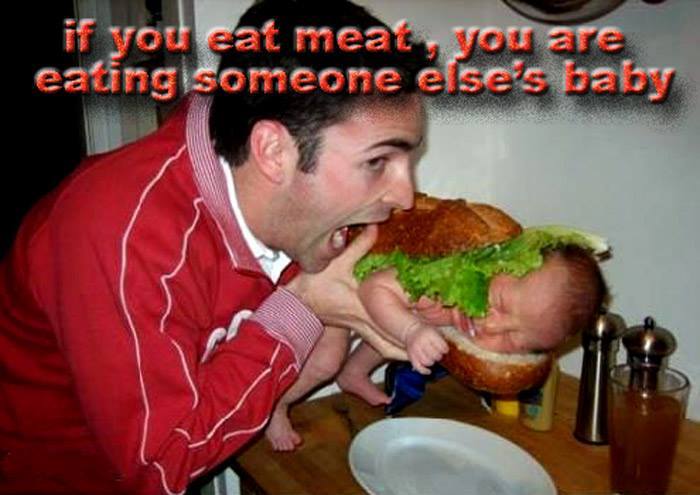
If you eat chicken or pork, you’re supporting extreme animal abuse on factory farms;

If you eat beef, you’re supporting the livestock industry that kills bison, elk and wolves;

If you eat fish, you’re supporting the demise of our living oceans;

If you hunt, your selfish food choice robs a life and cheats a natural predator;

If you eat meat, you’re part of the problem instead of the solution;

1797410_10201246274383855_1764880622_n

Restaurant’s seal-meat burger, named after Brigitte Bardot, sparks threats from animal-rights activists

http://news.nationalpost.com/2013/10/16/restaurants-seal-meat-burger-named-after-brigitte-bardot-sparks-threats-from-animal-rights-activists/

MONTREAL — When Kim Côté and Perle Morency added a seal-meat burger to the menu of their popular bistro in Kamouraska, Que., they decided to have some fun with the name. The Phoque Bardot Burger — combining the French word for seal and the name of the actress known for her campaign against the Canadian seal hunt — became one of the restaurant’s top sellers.

But last month news of the couple’s creation made its way across the Atlantic, and animal-rights activists there failed to see the humour. A French Facebook page called “Defend the animals and protect nature” reported the burger was concocted from “the meat of massacred baby seals” and lamented that its name was disrespectful toward Brigitte Bardot.

“We are receiving a lot of hate messages, and we’re almost inclined to let them win, because we don’t feel like fighting,” Ms. Morency, co-owner of the Côté Est bistro, said in an interview Wednesday. “There is a lot of intimidation. I don’t want my restaurant to be blamed any more, for people to call and say, ‘You are crazy, you are inhumane, you are assassins.’ ”

DSC_0131