
Born on the Wrong Planet
Image
14

Four more cases of deadly bird flu were reported in China on Wednesday, bringing the season’s total in that country to 221. Fifty-seven people have died.
The surge in cases has health officials worldwide watching closely as hundreds of millions of Chinese begin to travel for Chinese New Year.
The H7N9 strain of influenza jumped from birds to humans only last year. It is extremely dangerous, causing severe illness in more than three quarters of people infected and death in more than one quarter, according to Chinese researchers.
It is called bird flu because the virus originated in birds and so far is transmitted to humans only by live poultry. Cooked meat is no risk.
All of this year’s cases have been in China.
The surge in cases comes as China gets ready for what is called Spring Festival in Chinese. Known as Chinese New Year in the West, it begins Jan 31. People customarily travel to spend the holiday with family.
China estimates that 3.6 billion trips will be taken during the two-week holiday — and many of those traveling will be taking or buying live chickens and ducks as gifts.
Humans can be infected by being in close contact with “infected live poultry, mostly in live bird markets or when slaughtering birds at home,” the United Nations Food and Agriculture Organization said in a warning issued Tuesday.
So far, no sustained human-to-human transmission has occurred, according to the World Health Organization.
“Nothing can be predicted with certainty, but on present evidence, none of these viruses shows a potential to spread widely or cause an explosive outbreak,” Margaret Chen, director-general of the World Health Organization, said Tuesday in Geneva.
Flu viruses are notorious for quickly mutating into new forms, but so far genetic analysis by the FAO shows that the H7N9 virus has not changed significantly since its emergence last year.
“We are watching closely the increasing number of confirmed cases that are being reported from China during the past few weeks,” said Joseph Breese, an influenza expert with the Centers for Disease Control and Prevention in Atlanta. “Fortunately, Chinese health officials have not reported changes in the epidemiology of the virus that would lead us to believe it can easily spread between humans.”
The fear is that it could all too easily do so, said Mike Osterholm, director of the Centers of Excellence for Influenza Research and Surveillance at the University of Minnesota in St. Paul. “The clock is ticking but we just don’t know what time it is.”
Several things about H7N9 worry health officials. A major concern is that unlike other flu strains, it doesn’t make infected birds sick, so farmers don’t know their flocks are infected.
Humans are the proverbial canary in the coal mine in this outbreak. “The way we know that we have H7N9 in poultry is that humans start to get sick,” Osterholm said.
When testing shows a flock is ill, farmers have been reluctant to cull their birds because the animals seem healthy.
The birds breathe out the virus. That’s different from other flu strains, which are excreted in feces.
“We don’t know yet if there’s an infectious cloud that comes off the bird markets that can infect nearby humans,” Osterholm said. There have been cases in which people who lived close to a live bird market but didn’t go in still got infected, he said.
The concern is that with so many cases appearing in eastern and southern China, and hundreds of millions of people traveling long distances to get home for the holidays, the virus could find a way to mutate into something that can easily pass between humans.
“We’re in a ‘stay tuned’ moment right now,” Osterholm said. “If that happens, then bets are off. It’s potential pandemic time.”
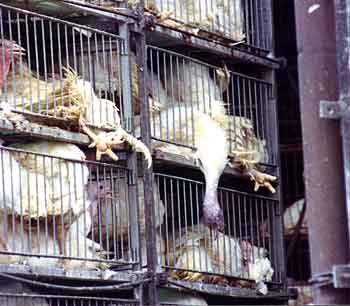
Live chickens at the Baixing Sanniao Wholesale Market in Guangzhou’s Baiyun district, Dec. 20, 2013. (Photo/CNS)
As millions of Chinese prepare to return to their hometowns for Spring Festival, the challenges of containing the latest H7N9 bird flu epidemic have come sharply into focus.
Health authorities are deeply concerned by the resurgent epidemic, with about twenty new cases reported in the first two weeks of 2014, mostly in the eastern costal regions. About 150 cases of H7N9 bird flu have been confirmed in China since the first case in March last year.
Li Lanjuan of the Chinese Academy of Engineering said the virus is more active in winter and spring, and that high density transportation in coaches, trains and aircraft could create favorable circumstances for the epidemic to spread.
Li is China’s leading researcher on bird flu and a member of the H7N9 prevention and control group. She warns that the virus might be spread by migrants returning to their, mainly rural, homes from developed eastern regions.
During the world’s biggest annual human migration in the 40 days around Spring Festival, about 3.62 billion trips will be made this year, according to Tuesday’s National Development and Reform Commission press release.
This year, the highlight of Spring Festival, Chinese Lunar New Year, falls on Jan. 31, which Chinese people traditionally celebrate as a family.
“We are worried about the risk brought by massive numbers of people gathering together in confined spaces,” said Dr Liang Weifeng of the medical college at Zhejiang University.
In Zhejiang, new H7N9 cases have been reported for six consecutive days. As of Tuesday, the eastern province had reported a total of 11, including some fatalities. Zhejiang was also the site of China’s first confirmed human-to-human transmission last November, when a man was infected while caring for his father-in-law.
More alarming still, Guizhou province in the remote southwest of the country confirmed its first H7N9 fatality on Saturday, that of a migrant worker who returned home from Zhejiang on Jan. 4.
Results of research by a Chinese team published in the Lancet, have established that the variation of an amino acid on the H7 gene has made the H7N9 strain more infectious to mammals.
“On the PB2 gene, we have found another variation in a key amino acid. One more variation of a specified amino acid, and human-to-human transmission will become much more likely,” said Liang, indicating his extremely high concern over the possibility.
The team recently identified a new partial variation in the virus, demonstrating its capacity to adapt to its environment.
“It has increased the risk of human-to-human transmission and brought more difficulty in treatment,” Liang added.
“In spite of this, there is no reason to panic. We can confirm that the H7N9 flu virus has not shown scaled variation and human-to-human transmission,” said Gao Hainyu, a member of the team drafting a thesis on the new results.
Another problem facing health authorities is that Spring Festival is also the peak season for poultry sales and consumption.
The Chinese have a long tradition of eating fresh food especially at important feasts and family reunions. Chinese people, especially those in eastern regions, like to buy live chicken and duck and slaughter them at home to serve fresh. Despite a government ban, live poultry markets are reemerging in some regions.
At an open-air market in Zhejiang, Cai, a local senior citizen, and his wife pick several live birds in preparation for cooking the city’s speciality, Hangzhou Roast Duck for the new year. “Dishes of chicken and duck are a must on New Year’s Eve. We can hardly change tradition,” said Cai.
“There is no problem after cooking, and the duck and chicken sold here have been quarantined,” said Zhu Linying, a housewife at Xianlinyuan market in Hangzhou.
Zhejiang and other provinces are cranking up H7N9 control with more inspections and tougher quarantine measures wherever live birds are sold.
Poultry are easily infected by H7N9, and the risk cannot be contained simply by closing live poultry markets, said Li Lanjuan.
“Some deaths were caused by delays in seeking medical advice, as the virus quickly attacks the lungs,” said Li, alerting people to mind their health during the holiday and go to hospital if they have fever or a cough.
The species Homo sapiens woke up this morning to a sudden collective realization that they are plant eating primates, not some Tyrannosaurus-like super predators. Instantly, as if waking with a start from a bad dream, it came to each and every human at exactly 8:00 a.m. that all their problems would be solved if they changed their carnivorous ways.
By day’s end, with the whole of humanity now born again vegan, people begin to feel better than ever—revitalized—with a glow of guilt-free contentment. World hunger eases and peace seems actually attainable since folks have moved beyond their self-centered lust for animal flesh. And the once hunted and farmed animals rejoice, knowing that fleshy two-leggers are over their foolish power trip and are now treating them with fairness and respect.
It’s been a long time coming and not a moment too soon. Starting today, winter solstice, December 21st, 2013 will be known as Happy Vegan Day, a time when all people exchange cruelty-free gifts in honor of the glorious occasion.
______________________
(This has been another installment in EtBG’s “Headlines We’d Like to See.”)
Posted by Michael Mountain on Monday, December 2, 2013

This morning at 10.00 E.T., the Nonhuman Rights Project filed suit in Fulton County Court in the state of New York on behalf of Tommy, a chimpanzee, who is being held captive in a cage in a shed at a used trailer lot in Gloversville.
This is the first of three suits we are filing this week. The second will be filed on Tuesday in Niagara Falls on behalf of Kiko, a chimpanzee who is deaf and living in a private home. And the third will be filed on Thursday on behalf of Hercules and Leo, who are owned by a research center and are being used in locomotion experiments at Stony Brook University on Long Island.
The lawsuits ask the judge to grant the chimpanzees the right to bodily liberty and to order that they be moved to a sanctuary that’s part of the North American Primate Sanctuary Alliance (NAPSA), where they can live out their days with others of their kind in an environment as close to the wild as is possible in North America.
Millions of turkeys are horrifically raised and killed as mere tokens, but why?
November 28, 2013 by Marc Bekoff, Ph.D. in Animal Emotions
Many of you have heard this question over and over again, “Why kill turkeys to celebrate Thanksgiving?” They say repetition is boring conversation but I feel it’s essential to ask this question repeatedly, because there really
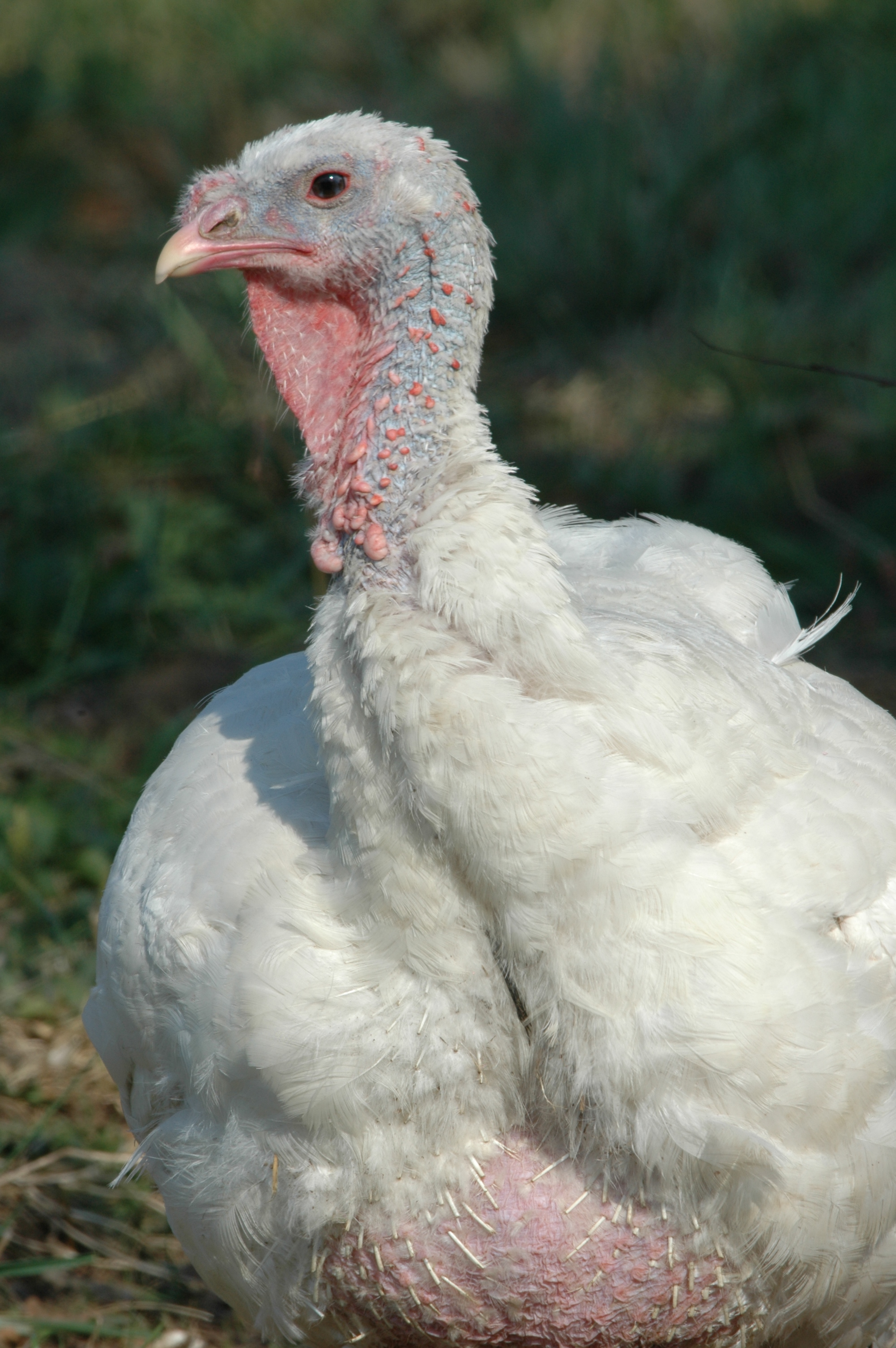
Photo by Jim Robertson
is no reason at all to slaughter and to eat these fascinating sentient beings in the name of a holiday, and turkeys surely are sentient beings (see also). Dr. Ian Duncan, a world-renowned expert on the behavior of food animals notes, based on detailed scientific research, “It is indisputable that poultry are capable of feeling pain. All poultry species are sentient vertebrates and all the available evidence shows that they have a very similar range of feelings as mammalian species. Poultry can suffer by feeling pain, fear, and stress.” More information about the lives of turkeys can be found here.
Turkeys are also very smart and have distinct personalities. People used to write off fish as being unfeeling “lower” animals but we now know, also based on solid scientific research, that they are sentient and feel pain (see also). The more we study other animals the more we learn about how complex their lives are, even for animals previously thought to be unfeeling creatures.
There’s no reason to consume pain and misery: Would you kill and eat your dog?
Holidays should be times for deep reflection. So, please reflect on these facts. More than 45 million turkeys are killed every Thanksgiving. More than 300 million are killed annually. Before they are mercilessly slaughtered individuals are kept in the most inhumane conditions, on the floors of dark, filthy sheds, houses of horrors, where they walk through their own excrement, breathe ammonia-filled air, and are cramped together so tightly they can’t move or get away from one another. As a result there are numerous fights among normally peaceful individuals and they suffer from massive injuries and a wide variety of diseases that humans consume.
Furthermore, when one eats a turkey carcass they are eating a genetically engineered animal and also consuming pain and misery. To keep turkeys from injuring one another their toes and beaks are cut off with hot blades with no anesthetic or analgesic, and when their throat is slit many are still conscious. We know chickens feel empathy and there is every reason to believe that turkeys do too. I know no one would treat their dog like turkeys are treated from birth to their heinous road to death.
There are numerous very tasty non-animal alternatives and even if you don’t think they’re as yummy as a dead bird is it really asking too much to give up something that isn’t a necessary part of your diet? I don’t think so.
Animals shouldn’t be used as token objects of joyous festivities
In order to make changes in the way we live, including who, not what, we eat, we occasionally need to leave our comfort zones. By not turning a blind eye to the incredible suffering that turkeys experience and choosing to forgo eating them, you can add more compassion to the world. You can even adopt a turkey. I urge everyone to try to make this incredibly simple change right now, for this coming holiday and for future celebrations in which animals are consumed as mere token objects of the festivities. I can’t imagine you wouldn’t feel better about yourself. Thank you very much for trying.
Marc Bekoff’s latest books are Jasper’s story: Saving moon bears (with Jill Robinson; see also), Ignoring nature no more: The case for compassionate conservation
It’s a special morning of a special day, but out in migratory bird habitat there’s a massacre going on. Though nearly every family across the country has a turkey thawing out in preparation for a gluttonous banquet a little later in the day,
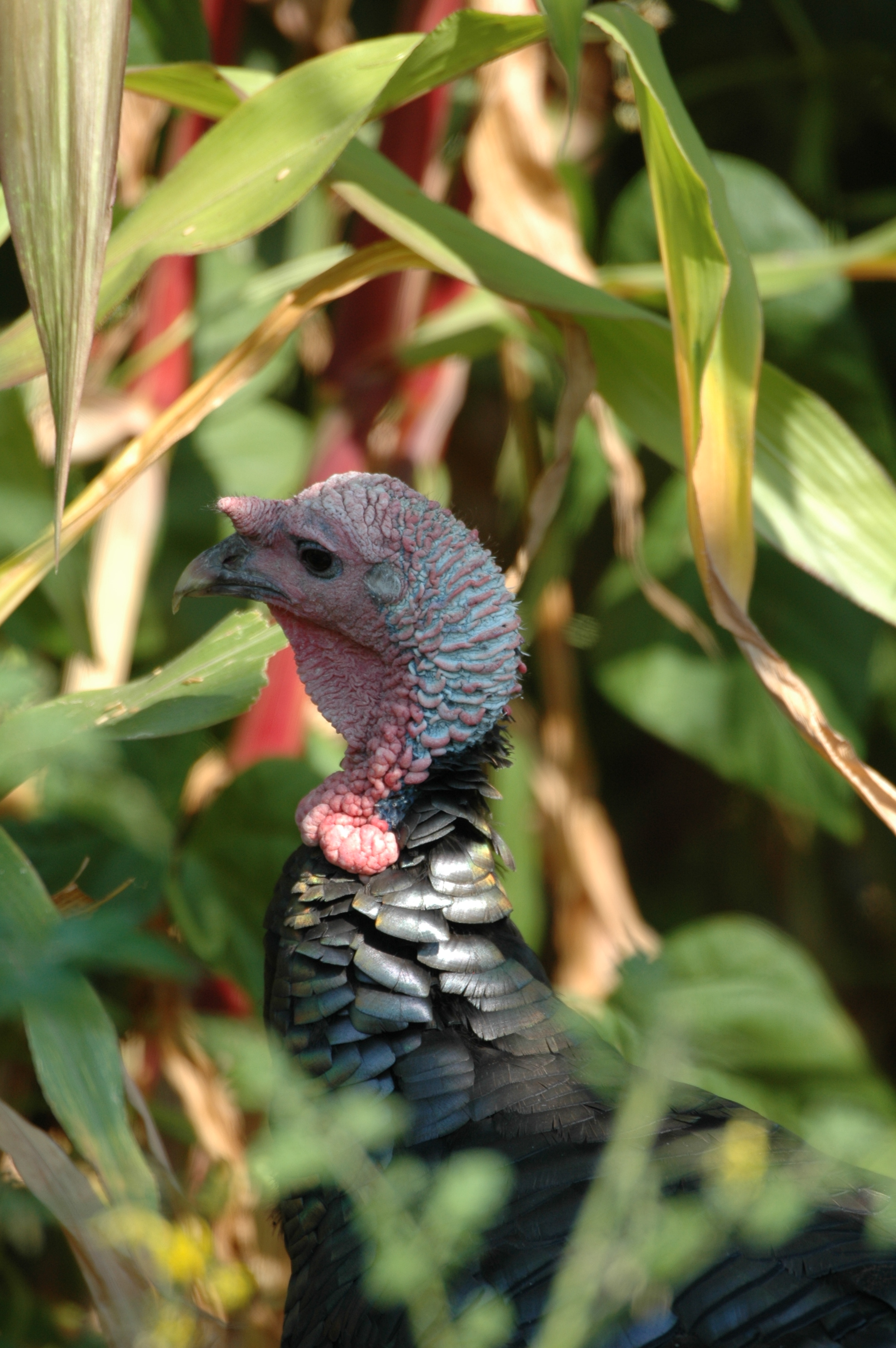
Text and Photography ©Jim Robertson, 2013. All Rights Reserved
recreational meat-pursuers are ringing in the season by blasting away into flocks of wintering geese to make up for the fact that their sacrificial bird-of-the-day came from a grocery store.
Never mind that the poor being was raised in a windowless barn, crowded-in with so many other turkeys that their wings wither away to virtual stumps of appendages, their natural coloration was bred out of them anyway.
Can’t afford your own tormented Thanksgiving turkey this year? Not to worry, chances are some abattoir has donated hundreds of frozen carcasses to your local food bank, in hopes of promoting their own animal industry. Here on the coast, turkeys were donated by a thriving seafood “processing” plant.
Non-human life has very little value in today’s world. Heck, a Montana wolf hunter can go out and mow down a loyal dog walking practically at her beloved master’s side and not face any legal consequences. The value of mass-produced birds is measured by the pound. No charge for their stark white feathers; they come off the body easily and can fetch a penny or so a pound at the pillow factory.
But the mighty hunters out in the tidelands currently shooting up a storm won’t be satisfied until they kill something themselves. There’s nothing like a hands-on blood bath to get you in the mood for a feast, I guess. Some folks haven’t come far from Plymouth Rock; at least they phased out witch burnings.

Text and Wildlife Photography ©Jim Robertson, 2013. All Rights Reserved
We interrupt our regularly scheduled, impassioned, pro-wildlife/anti-hunting rant and steady flow of mainstream media articles about shocking situations, reported on in droll, middle-of-the-road-forget-about-everything-and-just-go-shopping fashion, to bring you the following important announcement: It’s my birthday!
That may not seem so important to you, but it’s kind of monumentous to me. It means I’m a day older (I know they say a year older, but technically today I’m really just a day older).
In any case, starting today, I’m going to do things a little differently around here. My original writings, as well as posts and action alerts from pro-animal groups, will still be seen in full. But lengthy articles from the mainstream will, from now on, be posted with just their title, possibly a line or two of lead-in and the link to the publication where you can find them.
More and more news sources are surrounding their text with so many ads that it’s nearly impossible to copy and paste readable portions of a given story; for some reason it seems they don’t want you to read the story without commercial interruptions.
That way, not only will you be linked to any of their related articles, but you’ll also get a chance to window-shop all the material goods and services they’re trying to sell you on. This will also free up some of my time for other writing projects I’m working on. Of course, anyone hungry for more pro-wildlife/anti- hunting material can always get a copy of my book, Exposing the Big Game; Living Targets of a Dying Sport.
Having my birthday fall so close to Thanksgiving is interesting. Most years the 26th of November comes after that celebration, sometimes they both land on the same day and occasionally there’s a year like this one when it’s before. This gives me time a special opportunity to ask you for a gift. Well, it’s not so much a gift as a simple request for the upcoming holiday: this year, instead of feasting on the traditional turkey, how about just stickin’ to the fixin’s. Or you can substitute Tofurkey or Field Roast for the animal flesh entrée; but either way, if you use your imagination, I guarantee you’ll be sated.
And a side note to those of you who refuse to forego the sacrificial bird–Go stuff it!
Dr. Will Tuttle: Educator & Author
November 20, 2013
Those of us eating a plant-based diet often find our food choices causing more questions and consternation during the upcoming weeks than during the rest of the year. One of the perennial concerns I’ve found people have is that if everyone went vegan, what would happen to all the animals—chickens, turkeys, pigs, and cows? If we stopped eating them, wouldn’t they just take over the Earth, threatening our survival?
For years this question irked me because it seemed patently ridiculous, and worse, would be used to justify the cruelty of eating animal foods. Now, though, whenever I hear this question, I see it as an opportunity to deliver a brief meditation on how our world can be healed.
Imagining the world gradually going vegan is imagining the most positive possible future for our species, for the Earth, and for all living beings. First of all, as we reduce the number of animals we are eating, that will send a message to agribusiness to forcefully inseminate fewer female pigs, turkeys, cows, fishes, and other animals, so fewer animals will be imprisoned, and there will be less mutilation, killing, violence, terror, and suffering. It also means there will be lower demand for GMO corn, soy, alfalfa and other feed grains, and thus less deforestation, monocropping, and pollution. As this continues, there will be more food to feed starving people, and also monocropped land can be returned to being critically-needed habitat for wildlife, whose populations are being decimated by the habitat loss caused by grazing livestock and growing feed grains.
As the vegan trend continues, streams will come back and run cleaner. More birds, fish, and other animals will be able to thrive, there will be far less toxic pesticides and fertilizers needed, and the oceans, which we are devastating, will begin to heal. As studies continually demonstrate, livestock production is the main driving force behind global warming, and this also will decrease. In addition, by eating less animal-based foods, people will be healthier physically as they eliminate the toxic fat, cholesterol, and animal protein that drive obesity, diabetes, arthritis, cancer, kidney disease, heart disease, and drug use. People will become healthier emotionally and spiritually, also, as they cause and eat less misery, and our culture, as its level of violence decreases, will become healthier as well.
As forest, rainforest, and prairie communities come back to life, along with riparian and ocean communities, the devastating mass extinction of species that is going on right now will slow down. To raise and slaughter hundreds of millions animals daily for food on this planet, we are forcing hundreds of species of animals and plants into extinction every week. Because of our appetites for a few species of birds, mammals, and fish, we are destroying the Earth’s genetic diversity, and it seems absurd to be unconcerned about these tens of thousands of species, but to care only about the few that we’re eating. In any event, the animals we imprison today for food lived freely in nature for millions of years and could do so again. The animals that we most intensely enslave for food and products, such as turkeys, ducks, geese, chickens, and fish, are all doing just fine in the wild (aside from being hunted and having their habitat destroyed). They would continue to do so, and this is also true for pigs, sheep, and goats, which even today have substantial wild populations. There is no reason to think that the animals we are eating and using wouldn’t be able to return to their natural lives living freely in nature—they already are!
Cows are the only possible question—their progenitors, the aurochs, were forced into extinction in the 1600s, but it is certainly conceivable that cows could be reintroduced into central Asia and Africa where they lived for millions of years, and with time would return to the ecological niche they inhabited before cruel human enslavement tore them from their ancestral homelands.
So, it’s a refreshing question to ponder. It’s remarkably uplifting and heartening to reflect on “what will happen if we all stop eating meat, dairy products, and eggs?” Contemplating this, we see clearly that there’s nothing stopping us from creating a heaven on this beautiful and abundant Earth – nothing except the culturally mandated, deeply-ingrained, and deluded habits of routinely abusing animals for food. Each one of us can question this, and I hope the next time you hear this question, you’ll welcome it enthusiastically!
We can all discuss this question a few times during the holidays, and by doing so, pull back the curtain to reveal the positive future we can create together. There is no action more powerful anyone can take to subvert the dominant paradigm of exploitation and inequality than to shift to a plant-based diet for ethical reasons. By going vegan, and spreading the vegan message creatively, we take the most effective action to create a world where peace, abundance, sustainability, freedom, and universal joy are not just possible but natural.

 Exposing the Big Game