Unlike most Senators, Cory Booker is a household name. The first African-American United States Senator from New Jersey, this former Mayor of Newark is now making waves in the nation’s capital for being an outspoken advocate for a slew of social justice issues including women’s rights, affirmative action, and animal advocacy. Booker—who just announced that he’s running for President of the United States for 2020—is as hellbent on fighting for the underdog as he is on finding the perfect vegan cheese. VegNews Digital DirectorJasmin Singer sat down with Senator Booker to discover his hopes for legislative change when it comes to animal welfare, the one thing each of us can do in order to be part of a forward-thinking society, and just why he’s so passionate about what he eats.
VegNews: When and why did you go vegan?
Cory Booker: I think my journey started in 1992. I was just coming off from playing varsity football for Stanford, about to start to play varsity basketball for Oxford, and I really believed what Gandhi titled his autobiography, The Story of My Experiments with Truth. So, I tried to experiment with his vegetarian diet and see how I felt. And my body just took off; it was like somebody lifted off a twenty-pound weighted vest. My sleep patterns got better, I felt more energy, better recovery after workouts. I was like, “Oh my gosh, I will never go back to eating meat. I started becoming a vegetarian, but then, it made me insanely curious, like why is my body reacting this way? I just started reading about health and fitness. I found the data that began to reaffirm my vegetarianism. In fact, it led me to more about our environment and cruelty to animals. I began saying I was a vegetarian because, for me, it was the best way to live in accordance to the ideals and values that I have. My veganism started then. I started to cut back on milk and dairy, which includes cheese. I always felt like giving it up cold turkey was going to be too hard for me, but eventually, you know, twenty years later, I remember eating eggs and it was almost like my conditioning had changed. I think so many of our likes and dislikes are childhood memories or family traditions, and you associate the foods you’re eating often with such good emotions—but now, suddenly, eating those eggs for me was something that didn’t align with my spirit, and I could feel it. I finally just made a decision that I was going to become vegan. I remember my last non-vegan meal was Election Day, November 2014.
VN: Many people in your position may play it a little closer to the vest to avoid the kind of defenses so many people display when they find out you’re going vegan. Do you think being vegan for the animals hurts you or helps you politically, or maybe neither? And do you care?
CB: None of us want our government or elected officials preaching to us and telling us what we can or can’t eat. This is the United States of America, and I, for one, believe in our freedom to choose. So, I don’t want to preach to anybody about their diets; that’s just not how I live. But I am who I am. I want to live my life authentically and I don’t want to be one of those people that quiets when I’m excited to have food. I’m like every American: I want to talk about food. We love talking about food, and we love posting our food on social media. I’m not sure if any of my friends aren’t posting on Instagram something they love to eat. I’m not going to somehow mute that fundamental aspect of who we are just because I’m an elected official. The reality is, I just want to live my life in accordance with my values with an unapologetic authenticity. I think that’s what we want from our elected officials. We want authentic people, we want people who are not contorting themselves to fit into what voters might want. We all feel that, we’ve all encountered that before. So, I am who I am. And I remember when I was running for mayor of Newark, a friend of mine who is a Black guy, grew up in an African American community, and he was just laughing at me and goes, “You know, I don’t know if any African American community is going to elect a guy that doesn’t eat ribs.” This was when I was vegetarian. I laughed, you know, and I said, “You know, the great thing about Newark and the great thing about Americans is folks just want to feel you. They want to know your heart and they want to know your spirit, know that you come at it with good intentions.” That doesn’t mean we always need to agree with one another, but I think we like folks who are real. That’s who I am. In all my views, I just want to put my truth out there, and if folk believe in that, if folk want to support that, great.
VN: Taking into account what is reasonably realistic, what would you like to accomplish legislatively for animals and veganism?
CB: You know, look: I think that what we see happening in America is an awareness growing about the negative impacts that our current food system have on animals, and it’s great to see that consciousness and how people are demanding a change. You see very powerful corporate interests trying to fight against that change, when we, as Americans, don’t want to be engaging in activities that don’t support our fundamental ideas of justice and freedom. So, legislatively, I want to continue to be a part of a movement of folk who are fighting against corporate interests that are undermining the public good and the public welfare. So, I’m going to continue supporting bills that are about public health, whether it is pumping in all these antibiotics into animals that are literally threatening the safety of Americans. I believe that Americans do care about the cruelty to animals, and that’s why you see public movement to stop pig crating, which is harmful and violates our collective values as a country. I think that corporate power shouldn’t be snuffing out competition. This why I’ve been standing up. And we shouldn’t be trying to hurt industries—whether it’s the almond milk industry, dairy industry, or Veganaise or Just Mayo which has literally been under attack by the egg industry because they don’t like the competition. They shouldn’t undermine that. So, there’s a lot of bipartisan support for animal welfare bills, including some legislation I have to limit animal fighting. The testing of chemicals on animals is a big victory that I was able to have across party lines. So, I think there’s a lot of legislation we could be doing to stop sort of corporate power from reigning over the power of individuals to have freedom of choice, to see more compassion, to see a focus on public health. There’s momentum to doing the right thing legislatively, and I will continue to be part of a leadership that fights for these things and makes them happen.
VN: Do you think food policy will be a part of that?
CB: I think it has to be a part of it. You see the planet earth moving towards what is the Standard American Diet. We’ve seen this massive increase in consumption of meat produced by the industrial animal agriculture industry. The tragic reality is this planet simply can’t sustain billions of people consuming industrially produced animal agriculture because of environmental impact. It’s just not possible, as China, as Africa move toward consuming meat the same way America does because we just don’t have enough land. The number-one reason for rainforest destruction now is animal grazing land. We see greenhouse producing gases produced; the devastating impact is just not practical. The numbers just don’t add up. We will destroy our planet unless we start figuring out a better way forward when it comes to our climate change and our environment. So when you start seeing places like Duplin County and the severe health impact that the industrial pig farming is having there—literally, people that are living in those communities can’t open their windows, can’t run their air-conditioning, can’t put their clothes out on the clothing lines. Where they have respiratory diseases, there are high rates of cancer because of these massive pig farms where the farmers themselves are now being treated more like sharecroppers than small business people. It is grounding down the livelihood, the environment, the health and safety of folks. And all to do what? To produce pork that is being exported back by a Chinese company, Smithfield, being exported back to China. China is treating us now like a colonized country by outsourcing all of their pollution onto the United States. It’s just not sustainable as their demand for these products grows and the power of the industrial pork industry grows. It’s trampling the rights of others. We have to figure out a sustainable way. This doesn’t mean, in any way, getting rid of animal farming, but in many ways, it means lifting up the voices of small farmers again. Lifting up the voices of midsize farmers who are being beaten and killed by this corporate consolidation that’s taken over, and I mean that metaphorically, beaten and killed, of American farming as we know it because of the incredible power of these large corporate animal agriculture monopolies. It’s just crushing our ideas of family farms, crushing our ideas of the power of the American farmer. It’s something we have to start talking about. It’s small farmers who are treating animals with better care and compassion, who are treating the environment in a more sustainable way that really speak to the farming traditions of our country being destroyed economically because of this corporate consolidation that is unsustainable. So I think that we have a lot of work to do to start fighting again this Big Ag, industrial agriculture that has deep pockets and powerfully influential in places like Washington, but I don’t believe the status quo is going to continue indefinitely because I just think that we know that we’re starting to see the ill that this is having to farm labor, small farmers, to our environment, to the health and safety of folks. So my hope is that these bipartisan efforts are going to continue to facilitate change, and perhaps, help us get back to sustainable farm practices that can prevent against the ills that are so harmful on so many levels.
VN: One of the things we get excited about at VegNews is when these small animal farms transition to produce plant-based food. We’re seeing more and more of this—dairy farms are turning into hemp or almond farms; Elmhurst Milked recently transitioned from being the oldest dairy in New York State to being completely plant-based, for example. This is a way of maintaining the small farmer mindset and bringing in plant-based agriculture, and elevating that. To that end, we’d love to know a little bit more about your veganism. Can you talk a little about the day in and day out of your veganism?
CB: Yeah, but I just want to say something because you hit a really great point there. There’s a guy, Buckminster Fuller, who said—and I’m paraphrasing here—you never change things by fighting what exists in reality; to change something, you gotta build a new model that makes the existing model obsolete. That’s the deal here. American consumers should not be told what to eat, but if you provide viable alternatives, in some cases, that taste even better—and if people have more information, if we consumers are informed about whatever it is—the dangers of the overuse of plastics all the way to the conditions in which animals that we are consuming are being treated. I think if they’re given viable options, whether it’s milk that tastes great … I’ve seen incredible vegan cheese shops popping up across the country, and my friends who are lovers of cheese just can’t tell the difference. You have pizza: I was at the New Jersey VegFest, and Screamer’s Pizza is just phenomenal. My non-vegan friends love it. One of my favorite comfort food vegan places is HipCityVeg, and I started going to it in Philadelphia. They now opened here in DC, and there’s often a line out the door in the Philadelphia one, and I asked people, “Are you vegetarian or vegan?” And they say, “No.” They just love the food. When alternatives like that, like Champs Diner in Brooklyn … It’s one of my favorite places to go eat vegan comfort food. You know, there are lines outside the door and everybody that goes here isn’t vegan, they just love the food. I took Gayle King, the CBS news producer. I posted this online. She was so skeptical, so hating on vegan food. When we choose restaurants, it’s always me saying, “Let’s make sure there are some vegan options for me, Gayle,” when we go out to eat. This time I took her to Avant Garden and she was blown away. I loved when she put the first forkful of the different dishes we tried, just to look at her face. She just couldn’t deny how incredibly good it was. So for me in Newark, there’s Blueberry Cafe that I love in our city, and that’s got amazing vegan food. I just met a guy that told me he’s opening up another vegan restaurant in Newark. I think it’s going to be called The Greedy Vegan. Just, the options are incredible. I just see the growth of vegan brands, the growth of vegan food. Even big meat mobiles like Tyson Foods, for example, they’re investing in all the meat alternatives that are coming because they see this space growing, and it’s not growing because vegans are growing out there. The growth of vegans in America is not proportional to the growth of vegan options that are out there. What’s happening is that Americans are just making the choice for health reasons, they’re making the choice because of their environmental consciousness, they’re making the choice because it tastes incredibly good. I just believe in freedom. Eat what you want, but do everything you can to eat in accordance with your own values, your own views, whatever they are. And eat for taste. The great thing for me, that I’ve found, as a plant-based eater for over 20 years and a vegan for the last five, is that the food options are just getting better and better and better.
VN: If you could give one piece of advice to those wanting to contribute and make a difference for the animals in our current political climate, what would it be?
CB: Well, before I do anything, I just want to make sure to mention a couple more of my favorite places because now you’re making me feel guilty. Philly is one of my favorite vegan cities, so I almost want to do a vegan tour of places in America because there’s a great diner in New Jersey that doesn’t get enough play: The Rutherford Diner. It has vegan pancakes, vegan stuffed French toast. It’s just amazing in New Jersey, one of my favorite places in my own state. In Philly, Vedge. Here in DC, Shouk and Fare Well are just incredible places. When I went to the Asbury Park Vegan Fest, I was hearing about places I haven’t been to. So your last question …
VN: Yes, and you’re making me hungry. If you could give one piece of advice to those wanting to contribute and make a difference for the animals in our current political climate, what would it be?
CB: Let your voices be heard. We live in a democracy where people have to understand our democracy is not a spectator sport. You can’t just get caught up in a state of sedentary agitation and see things that really bother you and not do something to change that. If you’re not voting or confronting your congressperson or your senator on your strong views, then you are actually contributing to the very things you find wrong and unsettling. The opposite of justice is not injustice, it’s inaction. So this is a competitive space down here, the policy space. There are very powerful, wealthy large corporate interests working to do what many of them have done for generations. Destroying our environment, undermining the public interest. And they’re down here shaping tax legislation, shaping regulations. We need you in the game. And if you have views—I don’t care what your views are, liberal or conservative, pro-animal compassion or heck, whatever your issue is—you gotta participate in this democracy. I think that people who care about animals, we’re the majority in this country who care about animals. I’ve seen our country move with its heart. Often, the challenge is just not knowing what’s going on. Again, so much about life is about being engaged, being knowledgeable, finding out what’s going on and then being an activist that lets your voice be heard. So I’m hoping that we start seeing more and more people who are making this an issue they’re voting on. It’s something that, again, I’m proud to stand up here in Washington with non-vegans, with a vow of meat-eaters who agree with me that we should be compassionate and stop animal cruelty, who agree with me that the overuse of antibiotics is one of greatest threats to humanity because of super viruses, that agree with me that we have a real environmental challenge if more and more people are going to be eating what is considered now to be the Standard American Diet. So my advice for anybody is to get informed, get more engaged, fight local laws. Like ag-gag laws, which are the most outrageous things I’ve heard of, trying to block people from knowing what’s going on in industrial animal agriculture. So we’re literally at a point where people are trying to take away fundamental freedoms, freedom of speech, freedom to know, freedom for consumer information. That’s what going on right now. The only way that’s going to stop, the only way we’re going to bring more transparency to government, transparency to society, more compassion, greater health, greater wellbeing, is if we have active, engaged citizenry who are willing to stand up, to speak up, to rise up for the values we all hold dear and treasure.
A portion of this interview was originally published in the September+October 2018 issue of VegNews Magazine.
Jasmin Singer is the Digital Director for VegNews, the cohost of the Our Hen Housepodcast, and the author of the memoir, Always Too Much and Never Enough.




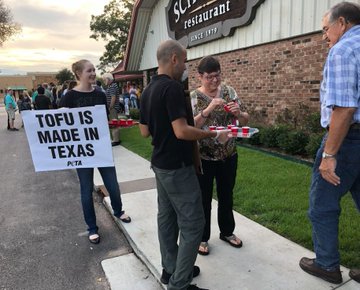
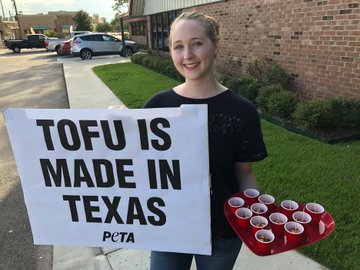
 Tofu is versatile, healthy, and grown right in the Lone Star State, and if Cruz knew this we’re sure he’d want to see tofu in every Texas pot!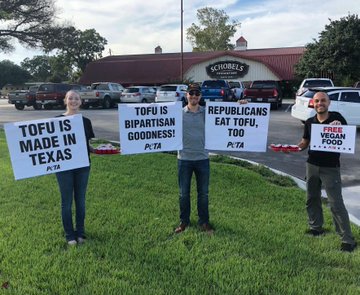






 Exposing the Big Game