Horse Killed For Wolf Bait in Denali

Old news, but still “legal”:

https://www.psychologytoday.com/blog/animal-emotions/201205/horse-killed-and-legally-used-bait-and-kill-wolves

Following up on the good news about the release of two dolphins into the wild, I learned this morning about a most heinous and perverse situation in Alaska. Healy, Alaska trapper Coke Wallace “apparently walked a horse out to an area off the Stampede Trail near the boundary of Denali National Park – an area made famous by the 1996 book Into the Wild – shot the horse, and set snares all around the area hoping to catch wolves attracted to the carcass. Wolves from Denali National Park were drawn to the dead horse, resulting in the killing of a primary reproductive female wolf from the Grant Creek (also called Toklat West) pack from the park, along with at least one other wolf. It is unknown how long the two wolves were alive in the snares before being killed and collected by the trapper. The Grant Creek wolf pack has been one of the three packs most often viewed in Denali National Park.”

All of this happened in a former buffer area where wolves were protected from 2002-2010 when the Alaska Board of Game eliminated the protected area. The loss of these wolves puts the fate of this long-lived and long-studied pack in jeopardy. Observations began on this pack back in the 1930s. Of course, the loss of any wolves due to killing another animal to use as bait is reprehensible, legal or not.

This kind of hearltess slaughter must not be tolerated and it’s important to call attention to it and to protest it loudly and clearly. While “the incident does not violate state law, the Alaska Department of Environmental Conservation (ADEC) is looking at potential violations of state water quality regulations, which prohibit discarding carcasses in surface waters of the state.”


copyrighted-wolf-argument-settled

‘Carnivore cleansing’ is damaging ecosystems, scientists warn

http://www.theguardian.com/environment/2014/jan/09/carnivore-cleansing-damaging-ecosystems?CMP=share_btn_fb

Extermination of large predators such as wolves and bears has a cascading effect on delicate ecological balance

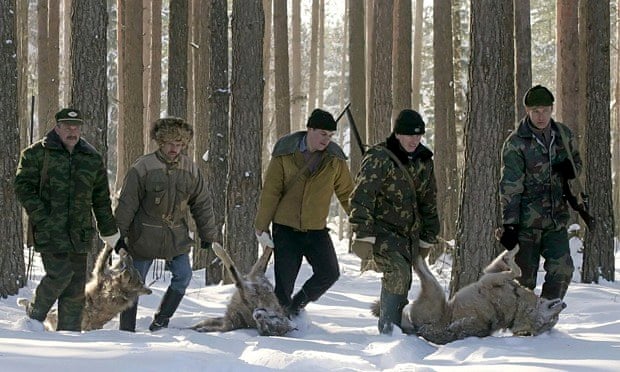
Carnivore extermination damaging ecosystems : hunters drag wolves they killed, Belarus
Belarus hunters drag wolves they killed overnight near village Pruzhanka, some 110 km south-east of Minsk February 8, 2005. Hunting for wolfs in Belarus is legal throughout the whole year with a hunter getting 168,000 Belarus roubles ($77 US dollars) for every wolf killed. Photograph: Vasily Fedosenko/Reuters

Wildlife, fear, and real life

10845948_753530648050147_2981250735903228132_n

Politicians play to the incoherent fears of wimpy folks.
This is bad for protecting the planet and its wildlife-

Just two months ago many Americans feared they would soon be stricken by dread Ebola and those who survived would have their heads lopped off by ISIS. Fortunately a cure was deployed for both Ebola and the bloody blade of ISIS. The November election cured both.

The practice of politics consists mostly of talk –well, it’s best to say “communication.” A surprising amount of this talk is designed to manipulate fear in the public. Raising the fear level appropriately, or lowering it, or misdirecting it, are tools of the trade.

With the coming of the web, however, it isn’t hard to find some objective facts about what needs to be feared. There are statistics that enable us to find the probability of the possible ways of our demise. Now as a result people can know to worry most about heart disease because they can find their chances of dying from it are one in five. Next on the worry list is cancer, one in seven. Third is stroke, one in 23. Some kind of accident is one in 36, auto accidents being one in 112. Assault by firearms is one in 306, while accidental firearms discharge is one in 6500.

We can also learn what is improbable, such as getting hit by an asteroid is estimated at one in 200,000 to 500,000. Fireworks is one in 386,000. Really improbable is death by falling coconut — one in 250-million. Improbable too is death by terrorist attack. It’s one in 9.3-million. We could go on. Perhaps death by one’s lover sitting on your face (a growing concern of the U.K. government). Whoops! That one is not reported.

What about those big, mean animals? Death by shark attack is one in 200-million. I couldn’t find grizzly bear or wolf, but it is not hard to estimate grizzly bear attack for American to be about one in 225-million. I assume about 1.5 deaths by griz a year. The odds of becoming wolf dinner over the last 20 years appears to have been only one in 6-billion (just one case in the USA)! I calculated this using 300-million Americans and the odds of a fatal wolf attack somewhere in the U.S. once every 20 years.

Some anti-wolf activists call them “wildlife terrorists,” but the odds of death by wolf seem to be close to 6500 times less than attack by real terrorists in the United States, the latter still being very unlikely.

So, given that this information is now available at the click of a mouse, do people appropriately worry a lot about heart trouble and nothing about wolves? Do they change their lifestyle to save their heart, but not avoid outdoor recreation so to avoid wolf trouble? No, it turns out. Many people are wimps about about wolves, yet their fear is incoherent because they think little about their cardio, not even to worry how their fear of wolves raises their blood pressure.

Why is this so – people underestimating danger of real threats and overestimating uncommon things, even incredibly rare events like wolf attack? One reason might be, to quote a recent article by Gary Ferguson, the offerings of the Animal Planet and the Discovery Channel. Recent listings there include “North America’s Top 20 Most Fearsome Predators,” a rerun or two of “Shark Attack,” and a couple of episodes of “Nature’s Deadliest,” or “Rattlesnake Roundup,” or “Yukon Men.”

It would be wrong to blame it all on the media because fear is not the media’s intent. The passive fear generated by them is just a way to make money.

Fear is the intent, however, when some cattlemen’s group predicts wolf attacks on people. They want people to fear for their lives, or more likely, those of “the little children,” when they think of wolves roaming in the hills. It is politically beneficial to them. They make similar predictions about other animals they don’t like.

This brings us to the Center for Biological Diversity (CBD) wanting to restart the plan to restore grizzly bears to central Idaho. We can bet this will be met with blatant fear-mongering. After all, the process was well on its way back at the turn of the millennium, when Idaho’s then- governor Dirk Kempthone stated that the grizzly restoration plan “is perhaps the first federal land-management action in history likely to result in injury or death of members of the public.” He continued railing against “bringing these massive, flesh-eating carnivores into Idaho.” He forgot they were already in Idaho, with a small population in both the Panhandle and in Eastern Idaho, in Yellowstone and adjacent country. He also forgot that grizzlies are omnivores, not carnivores . . . kind of like himself.

Kempthorne’s worries at the time, which seemed almost personal, seemed to cause the Bush Administration to stop the process. Now CBD wants a restart. Politicians and groups usually don’t truly fear big animals because they think they will get eaten though, they have other reasons to oppose them. The fear is meant for the public. Do they disrespect us when they use it, or are we as wimpy as they think and hope?

Unrealistic fear has major consequences for the outdoors, for conservation, and more are worrying about these.

Fear of harm coming to children has resulted in children not playing outdoors unsupervised. There is little unstructured access to it. This writer, being of a earlier generation, had almost total unsupervised time in the outdoors. This was during the days when the crime rate was much higher than now. Now, we have traded fun and fearless time in the sun (and familiarity) for watching “killer” fish and wildlife on TV indoors. This kind of child rearing makes it hard to instill love of the wilderness, though this has always been true to an extent, with most Americans never spending a night outdoors in the woods alone.

Climate change is something that should lead to great anxiety. It is very probable and already underway, but as we have seen, more than half relegate it to a low concern. It is perhaps like a smoker’s view of the dangers of cigarettes. “I want to quit, but not right now.”

It is true that those who hate endangered species are more than proportionately folks who say they love a high CO2 emitting economy. It is also likely true that the same are content with our alienation from nature and have no problem is Americans have an unreasonable fear of the outdoors.

So, I am afraid . . .

Wildlife, fear, and real life

FWP investigating after Missoula man runs over wolves

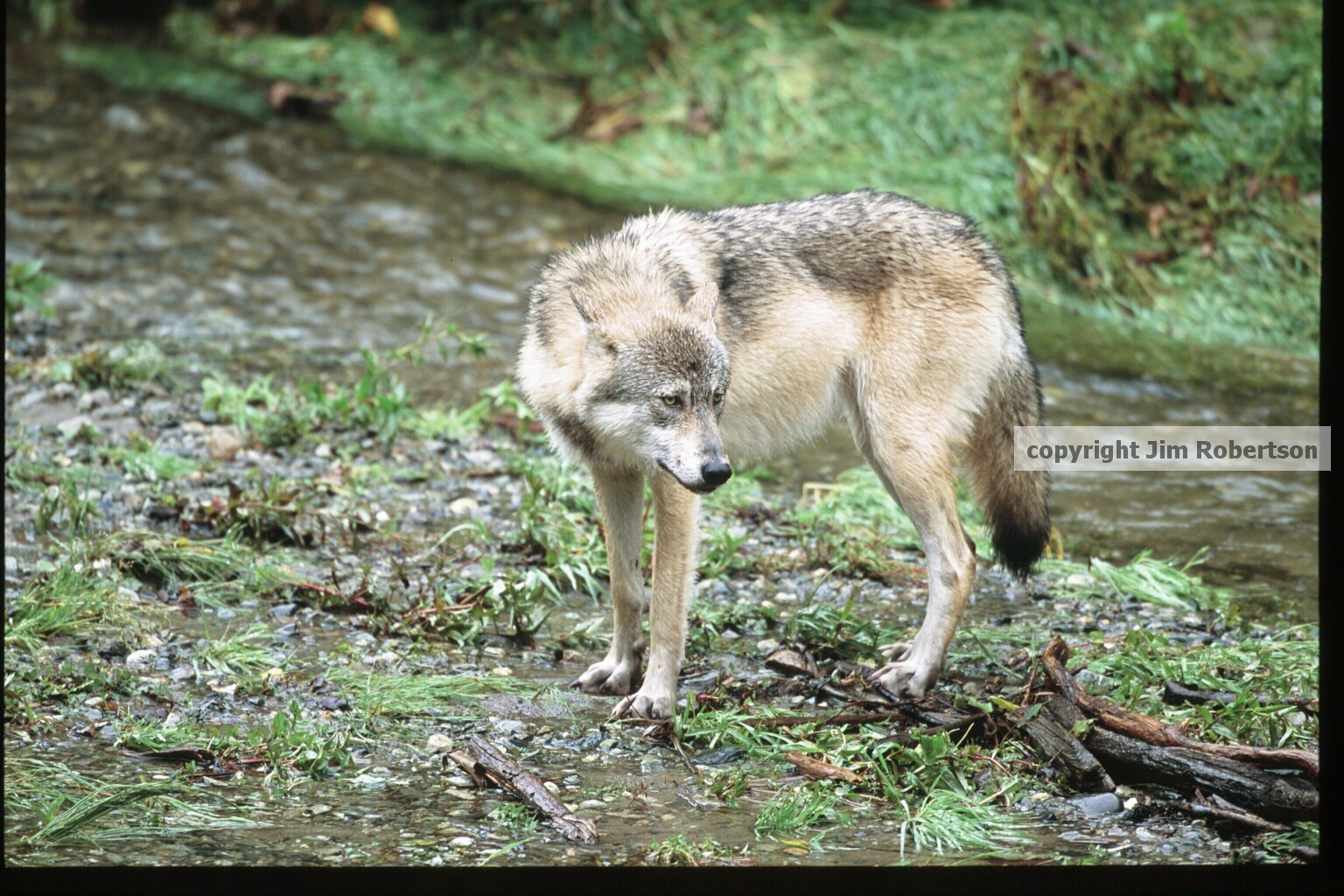
Photo copyright Jim Robertson

Photo copyright Jim Robertson

http://www.kpax.com/news/fwp-investigating-after-missoula-man-runs-over-wolves/

by Robbie Reynold – KPAX News

MISSOULA – A Missoula man is under investigation by Montana Fish, Wildlife, and Parks because of a controversial Facebook posting.

“This is one of the more ghoulish, gorish, postings I’ve ever seen,” said Predator Defense Executive Director Brooks Fahy.

You have to see it to believe it – pictures of a dead wolf posted on a Facebook page titled Lobo Watch, which is an anti-wolf organization.

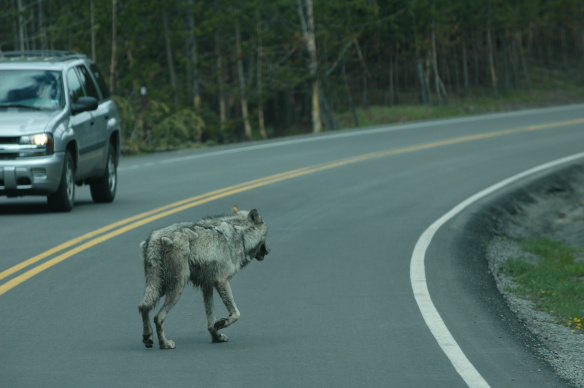
A written message accompanies the pictures, which were posted on Sept. 16 – recounting an Aug. 14 incident in which a man driving his wife’s van ran over two wolves.

“When we first became aware of the post, it was right away something that we knew we needed to take seriously and to look into,” FWP spokesperson Vivica Crowser explained.

FWP is investigating the incident to determine whether or not the wolves were run over intentionally.

The message on Facebook is signed by Lobo Watch’s leader, Toby Bridges, who says he was driving on Interstate 90 near the Idaho-Montana border when he saw a calf, an elk cow, and four wolves.

Bridges wrote that the wolves were going after the calf, and that he decided to let off the brake and hit the accelerator.

The post said, “I was going to save that calf,” and goes on to say he heard two distinct “thumps”. He returned to the scene to find the dead wolf and another hobbling off with a broken leg.

Crowser told MTN news that investigators are now looking for more evidence related to the incident.

“Social media in itself isn’t enough. You have to uncover more through the case as you go along and finding things – like evidence on the scene or through other witnesses,” she said.

Fahy says he believes Montana should do more to protect wolves – especially against an incident like this.

“There’s an archery season, a trapping season, and a general hunting season for wolves. And there is no season to basically run over wolves with automobiles purposely.”

Missoula man runs-down wolves, brags on Facebook

John S. Adams 10:52 p.m. MDT September 19, 2014

Editor’s note: What follows is a graphic description that may be difficult for some readers.

A Montana Fish, Wildlife and Parks law enforcement official said Friday the agency is “looking into” a Missoula anti-wolf extremist’s Facebook claim that he purposefully ran down a pair of wolves on Interstate 90 just east of the Idaho-Montana border.

Montana FWP Region 2 Warden Capt. Joseph Jaquith said they were aware of Toby Bridges’ Facebook post in which he brags about killing two young wolves with his wife’s van.

“We’re trying to determine, first of all, what exactly we can do with something somebody says on Facebook with no other physical evidence,” Jaquith said. “Whether or not it’s true remains to be seen.”

Bridges, who runs an anti-wolf website and Facebook page called Lobo Watch, on Tuesday posted pictures on Facebook and described in graphic detail how he accelerated his vehicle in an apparent attempt to intentionally run down the wolves.

Bridges did not respond to an email seeking comment.

Bridges described a scene in which he claims a group of wolves were chasing a cow and calf elk across the highway about four miles east of Lookout Pass. Bridges said he “let off the brake and hit the accelerator.”

“Just past MM4 (mile maker 4), a cow elk and calf suddenly ran right out onto Interstate 90, and I let up on the gas and had just started to brake — in case more elk followed,” Bridges wrote. “What followed were two adult wolves. The cow jumped over the concrete barrier separating (sic) West and East traffic lanes, the calf stayed on ‘my’ side — and both were running up the highway, toward the pass. The wolves went after the calf … and I let off the brake and hit the accelerator. I was going to save that calf.”

Bridges said his vehicle was driving approximately 55 mph “when suddenly four young wolves shot right out in front of me.

Wolves Under Attack

From HSUS.org (it’s good to see the leading the charge on this issue):

There is an all out war on our nation’s wolves — and in Michigan, they just took another hit.

Last week, in a charade of a vote, the Michigan House passed the unconstitutional “Scientific Fish and Wildlife Conservation Act” — a misleadingly named bill that will allow a group of seven political appointees to open up a hunting season on wolves or any other protected species in the state without citizens having any say whatsoever.

This is a direct attack on citizen lawmaking and another big blow to Michigan’s fragile wolf population.

This is the third time in two years that Michigan lawmakers have voted to authorize a hunting season on Michigan’s small wolf population. It’s a slap in the face to the nearly half a million Michiganders who signed petitions to put two referendums on the ballot, and to all Michigan voters who are being told by the politicians that their votes shouldn’t count when it comes to what animals are hunted.

But we are far from backing down to these politicians. Our coalition partners at Keep Michigan Wolves Protected plan to challenge the “Scientific Fish and Wildlife Conservation Act” in court, and we are confident that Michigan courts will reject this unconstitutional Act and instead respect the voice of the people. And if citizens successfully vote down the two referendums in November, we will block a hunting season this fall and stop dozens or perhaps even hundreds of wolves from being pointlessly killed by trophy hunters.

copyrighted Hayden wolf walking

Animal Planet falsely portrays wolves as killers “who threaten us as never before”

copyrighted wolf in river

You can leave a comment for Animal Planet at this number  1-571-262-4899 begin_of_the_skype_highlighting 1-571-262-4899 FREE  end_of_the_skype_highlighting – it’s the best way to do so – thank you!

http://www.psychologytoday.com/blog/animal-emotions/201405/wolves-have-razor-sharp-teeth-and-hear-your-beating-heart

Blood sells but it shouldn’t

I’ve written many essays about how media (print and film) often offers sensationalist and thoroughly misleading stories about various nonhuman animals (animals). Now, Animal Planet is guilty of putting forth sensationalist lies about wolves. Concerning gray wolves, Brooks Fahy, Executive Director of Predator Defense, alerted that they’ve recently written: “Razor sharp teeth, killer instincts, and senses so precise they hear your beating heart, and your fear. They’re on the hunt, and now with numbers growing out of control, they’re threatening humans like never before.”

These lies — there have been only two verified accounts of wolves killing humans — are to publicize Anmal Planet’s series called Monster Week and their episode titled “Man-Eating Super Wolves.”

As research is anthrozoology has clearly shown, our relationship with other animals is a complex and challenging affair and the least we should expect — and demand — is that media represent animals as they really are, not as some imagine them to be. And, surely, misleading advertisements and stories about animals should not be used to make money or to induce fear when, indeed, existing data show that they are not dangerous at all. Shame on Animal Planet. Blood and lies should not sell.

PLEASE CONTACT ANIMAL PLANET – to protest their reprehensible misrepresentation of wolves and other animals and please find something else to do when these programs air. THIS IS HORRIFIC AND MISLEADING HYPE!

Pure Propaganda: N.M. students take refuge in bus stop ‘kid cages’ as gray wolf population soars

Kid cage at school bus stop.Kid cage at school bus stop.

    By Valerie Richardson

The Washington Times

Thursday, November 28, 2013

DENVER — Canadian gray wolves are by all accounts thriving in the Northern Rocky Mountains and Great Lakes region, but getting the wolf’s removal from the Endangered Species List won’t be easy.

Even as children in rural New Mexico take refuge from wolves in “kid cages” at school bus stops, wildlife lovers and environmentalists are fighting tooth and nail the proposal by the Fish and Wildlife Service to delist the species.

Read more: http://www.washingtontimes.com/news/2013/nov/28/wolves-no-longer-endangered-but-friends-fight-thei/#ixzz2mFO57EJI Follow us: @washtimes on Twitter


Unfuckingbelievable… New Michigan group seeks to protect future wolf hunts

New Michigan group seeks to protect future wolf hunts with citizen-initiated legislation

copyrighted wolf in riverLANSING, MI — With Michigan’s first-ever wolf hunt well underway, a new coalition of conservationists and sportsmen is seeking to protect future hunts from a planned voter referendum.

A group calling itself Citizens for Professional Wildlife Management on Tuesday announced plans to launch a petition drive for citizen-initiated legislation that would affirm the Michigan Natural Resource Commissions’ ability to designate game species and issue fisheries orders.

Full story: http://www.mlive.com/politics/index.ssf/2013/11/new_michigan_group_seeks_to_pr.html

A Hastings-led howl against protecting wolves

http://blog.seattlepi.com/seattlepolitics/2013/11/15/a-hastings-led-howl-against-protecting-wolves/

Friday, November 15, 2013 by: Joel Connelly

Seventy-five members of Congress are demanding that the Obama administration end all protection of the gray wolf as “endangered” or “threatened” under the federal Endangered Species Act, in an effort organized by Rep. Doc Hastings, R-Washington.

The U.S. Fish and Wildlife Service has already de-listed wolves in the Northern Rocky Mountains — leading to big, officially encouraged wolf kills, particularly in Idaho — and in the Great Lakes States.

Wolves have moved south from protected lands on the U.S.-Canada border to repopulate the Washington Cascades.  e Teanaway wolf pack in the Cascade Mountains. (Photo courtesy of Conservation Northwest).

The gray wolf has moved south from protected lands on the U.S.-Canada border to repopulate the Washington Cascades, including the Teanaway Valley. (Photo courtesy of Conservation Northwest).

In Washington, wolves are still under federal protection in the Cascades, but not in the Kettle Range and Selkirk Mountains of Northeast Washington. There, they receive state protection, which is under attack by conservative state legislators.

The lawmakers’ letter uses age-old arguments for removing protection so that wolves can be killed.

“Since wolves were first provided protection under the ESA, uncontrolled and unmanaged growth of wolf populations has resulted in devastating impacts on hunting and ranching and tragic damages to historically strong and healthy herds of moose, elk, bighorn sheep and mule deer,” they wrote in the letter to Dan Ashe, director of the U.S. Fish & Wildlife Service.

Mitch Friedman, executive director of Conservation Northwest, a Washington-based group that has championed wolf recovery, scoffed at the letter’s assertions.

“It’s surprising Little Red Riding Hood isn’t mentioned,” said Friedman.

“The letter acknowledges that ‘federal policy must be based on best available science,’ then goes on to make the false and hyperbolic claim about ‘devastating impacts’ on fishing and ranching,” Friedman added. “Throughout wolf territory, game populations are generally at or above levels desired by state managers.

“These Tea Party legislators have so proven Congress that they’ve resorted to attempting policy by press release.  Their letter is off enough on matters of law, science and facts.”

Rep. Doc Hastings, R-Wash.: Bipartisan legislation to expand the Alpine Lakes Wilderness and protect the Middle Fork-Snoqualmie River, in eastern King County, can't get the time of day in his committee..

Rep. Doc Hastings, R-Wash.: He is lead on a letter, signed by 75 members of Congress, demanding an end to all federal protection of wolves under the Endangered Species Act.

Hastings is chairman of the House Natural Resources Committee.  Rep. Cathy McMorris-Rodgers, R-Wash., who also signed the letter, is a member of the House Republican Leadership.

The gray wolf has returned to Washington’s mountains in recent year.  A killing spree by three Okanogan County residents — who were caught and prosecuted under federal law — nearly destroyed one pack that had established itself in the upper Methow Valley of the North Cascades.

Other packs have located in the upper Teanaway Valley, in the Cascades north of Cle Elum, as well as in northeast Washington.  A majority of the state’s wolf population has the misfortune to live in congressional districts represented by Hastings and McMorris Rodgers.

The letter asking for de-listing of wolves is signed by a who’s-who of Tea Party members in Congress, including such luminaries as Rep. Michele Bachmann, R-Minnesota, Sen. Mike Lee, R-Utah, Rep. Steve Stockman, R-Texas and Rep. Raul Labrador, R-Idaho.

A pair of conservative House Democrats, Reps. Collin Peterson of Minnesota and Jim Matheson of Utah, signed the letter.

The letter also opposes a proposal to list the rare Mexican wolf, found in the Southwest, as a subspecies under the Endangered Species Act. Such a listing would have a “Severe impact on private landowners, including ranchers” in Arizona and New Mexico, the lawmakers claim.

“We believe that state governments are fully qualified to responsibly manage wolf populations and are better able to meet the needs of local communities and wildlife populations,” said the letter.

Friedman argued the reverse, saying that Hastings and his allies are grandstanding and doing nothing to encourage cooperation between local communities and conservation groups.

“Real ranchers and communities — including in Eastern Washington — are stepping up to work with groups like ours on practices that allow wolves and livestock to share the land,” he said.

“There are ways that Doc Hastings and Cathy McMorris Rodgers could help, but I’m still waiting for their call.”