Exposing the Big Game

Forget Hunters' Feeble Rationalizations and Trust Your Gut Feelings: Making Sport of Killing Is Not Healthy Human Behavior

Exposing the Big Game

The Grizzlies Are Coming

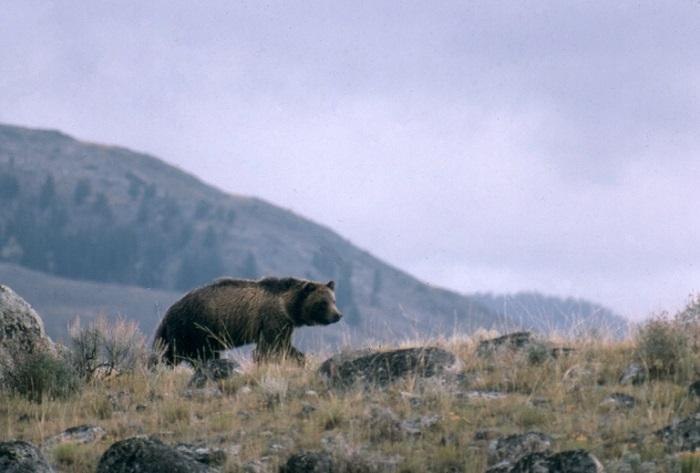
A grizzly bear
MONTANA FISH, WILDLIFE, AND PARKS / AP
The Rolling Stone Ranch lies behind a cluster of deciduous trees on the open, undulating plains of Montana’s Blackfoot Valley. Its green barns sit just outside the tiny town of Ovando, which is home to about 80 residents. As a crisp autumn breeze swept by in early October, Jim Stone, the ranch’s owner, greeted me in front of his house with a firm handshake. From his kitchen, he gazed out the window overlooking the valley and gestured across Highway 200. “My neighbor has 13 grizzly bears on his property,” a 21,000-acre spread, he told me. Just two decades ago, that many bears would have been rare.

To protect their livestock from the booming bear population, many local cattle ranchers have installed electric fences. They require less maintenance than barbed wire does and are safer for migrating elk, Stone explained. Since improving his fencing, he no longer has to worry about grizzlies killing his cows and calves.

As grizzlies continue to expand their range in Montana, more communities will have to face the question of how to coexist with them. Strategies such as installing electric fences, distributing special garbage cans, and encouraging communities to share the lessons they learn can help. But the most effective solution may be one of the hardest to achieve: trust between rural landowners and government agencies.

Back in the early 1800s, there were more than 50,000 grizzlies in the Lower 48. But by 1975, after years of hunting and habitat destruction, the population had dwindled to fewer than 1,000, and the U.S. Fish and Wildlife Service listed the bear as threatened under the Endangered Species Act. With federal protections in place, grizzly bears in the Northern Continental Divide in northwestern Montana have flourished. Currently, there are approximately 1,000 bears in the area, the largest population in the United States outside Alaska. As a result of this rebound, the federal government considered delisting the population, though that process is now paused in light of last year’s court decision to restore federal protections for grizzlies in and around Yellowstone.

But the grizzly boom has brought with it a rise in human-bear conflicts. In September, for example, four hunters were injured in three separate attacks in southwestern Montana. These encounters are bad news for the grizzlies as well: Last year, about 50 bears were killed or removed from the Northern Continental Divide Ecosystem, a record high for Montana.

Nonprofits such as the Blackfoot Challenge, located in the Blackfoot Valley, are helping communities deal with these conflicts. Stone, who chairs the organization’s board of directors, has helped implement its three-pronged approach to managing grizzlies: building electric fences, moving dead livestock to designated compost plots, and employing range riders to protect cattle. All told, conflicts with grizzlies in the Blackfoot Valley dropped by 74 percent from 2003 to 2013, according to a 2017 case study on the Blackfoot Challenge.

But in the small town of Condon, in nearby Swan Valley, where tall conifers rather than rangelands dominate the landscape, the residents face different problems. One of the biggest challenges is teaching people how to manage backyard bear attractants, such as garbage cans and chicken coops, says Luke Lamar, the conservation director at the nonprofit Swan Valley Connections. The organization offers electric-fencing installation, bear-resistant garbage containers, property consultations, and educational events. Once a bear knows where to find free food, it tends to return to the area, Lamar says. “That cycle will most likely continue until the bear is caught and removed by agency bear managers or by other means, such as a resident shooting the bear.”

Communities have different reactions to grizzlies and may need different methods to manage them. Sara Halm, a graduate student at Idaho State University, is interviewing people who live in three Montana communities to learn how grizzlies impact their rural towns. Many locals are scared for their children, who can no longer play outside alone the way their parents once did. For some, electric fences help lessen that fear. But fences make other residents feel confined. “This is deeper than just an economic issue of protecting people’s livelihoods,” Halm says. People have to redefine their relationship with the environment and wildlife.


This post appears courtesy of  High Country News.

Experts project 72 grizzlies will die due to cattle conflicts

‘Really tough decision’ to authorize grazing where there’s chronic conflict, forest ranger says.

Federal wildlife officials foresee and have approved growing grizzly bear bloodshed on a sprawling complex of Bridger-Teton National Forest cattle grazing allotments recently permitted for the long haul.

The Bridger-Teton’s Pinedale District ranger, Rob Hoelscher, signed off in early October on a decision OK’ing the continuation of a historic grazing operation on 267 square miles of forestland that falls in the Upper Green and Gros Ventre river drainages. That decision instituted a number of minor changes, like giving the Upper Green River Cattlemen’s Association more flexibility in rotating its cows, tweaking utilization standards for vegetation heights and authorizing some new fencing.

A larger shift, however, is outlined in an accompanying document called a biological opinion, which estimates the federal action’s impact on a threatened or endangered species — in this case, the Greater Yellowstone Ecosystem’s grizzly bears. The updated overall estimate of grizzly bears that will be “incidentally taken” as a result of the Upper Green grazing, the April 2019 document says, is 72 bruins between the 2019 and 2028 grazing seasons.

Upper Green grazing

Phil McGinnis looks for cattle in one of the Upper Green River Cattlemen’s Association’s Bridger-Teton grazing allotments in 2016. Federal wildlife officials have authorized the incidental taking of up 72 grizzly bears in the area over the next 10 years.

“We had a number of conversations with the grizzly bear recovery coordinator and also with Wyoming Game and Fish,” said Nathan Darnall, the U.S. Fish and Wildlife Service’s deputy supervisor for Wyoming. “When we start talking numbers this large, we all have to pause for a second and ask if this number is sustainable.

“In looking at the grizzly population and looking at the future expansion of the population … we decided that this number, in concert with everything else, was sustainable,” he said.

The Greater Yellowstone grizzly population is estimated at around 700, though an undetermined number of Ursus arctos horribilis dwell on the fringes of the region outside where the species is carefully monitored.

“This is not going to jeopardize the population of bears in the Yellowstone Ecosystem,” Darnall said. “We’re not going to see numbers dipping below recovery levels, and we would still expect the population to increase.”

Darnall and his colleagues at Fish and Wildlife, who oversee grizzlies because they’re currently classified as “threatened” under the Endangered Species Act, produced the biological opinion.

The document points out that not all bears in the Upper Green cause trouble and that the Wyoming Game and Fish Department has documented bears with territories in the allotments that haven’t killed cattle.

“Nonetheless, bear conflicts with livestock increased an average of 10 percent each year,” the opinion says. “We believe this trend is likely to continue within the action area. Within the last nine years 37 grizzly bears were lethally removed from the action area due to conflicts with livestock.”

The all-time high mark for lethal action taken in response to dead cows came in 2018, when Wyoming had jurisdiction over the species during the grazing season, didn’t need Fish and Wildlife authorization, and opted to kill eight depredating grizzlies.

The 72 grizzlies authorized for removal over the coming decade is a large increase from the most recent estimate, in 2014. That year the “take” was set at a maximum of 11 bears over any rolling three-year period.

Grizzly bear removals
Capture locations of grizzly bears removed due to livestock conflicts within the Upper Green Allotment Complex.

The 69-page document puts numbers to the rising rate of ursine-bovine conflict that led to the higher estimate. Although ranchers reported a relative lull this summer in the slaughter of both cattle and bears, since the turn of the century conflict has soared in the Upper Green as grizzly range has expanded and filled in that portion of the Bridger-Teton.

Between 2010 and 2018, Game and Fish and federal wildlife managers confirmed 527 conflicts, almost exclusively cattle that were killed or maimed. The majority, the document says, occurred in the last five years, and they took place “throughout the action area.”

The 1,112-square-mile “action area” assessed in the document is much larger than the actual allotments, taking into account grizzlies estimated to inhabit areas up to 7.5 miles away from the allotments. The more than 9,000 cow/calf pairs and few dozen horses permitted to graze the expansive rangeland have proven a big attractant, according to grizzly bear GPS collar data cited in the opinion. One bear captured after killing cattle on the allotments, grizzly No. 499, denned clear across the mighty Wind River Range, 24 miles away on the Wind River Reservation. Another Upper Green grizzly captured for research, bear No. 754, denned 29 miles away near the east boundary of Grand Teton National Park.

This iteration of Fish and Wildlife’s biological opinion for the Upper Green did not estimate the grizzly population in the “action area” surrounding the allotments. In 2013 the agency put the number at somewhere between 51 and 60 grizzlies.

Fourth-generation Upper Green stockman Albert Sommers, who helps run the Cattlemen’s Association, has tried and failed to change his grazing protocols in a way that reduces grizzly conflict. The operation pencils out, he’s told the News&Guide, only because of Wyoming compensation programs. In 2016 and 2017 Sommers worked with the conflict-reduction group People and Carnivores to test a herding technique that bunched up his bovines at night. It had “no effect on depredation,” the Fish and Wildlife’s opinion said, and was discontinued.

“I still go to conferences,” Sommers told the News&Guide this summer, “and listen to ideas.”

Not all parties paying attention to the chronic conflict in the Upper Green are satisfied with a gruesome status quo that’s forecasted to worsen. Center for Biological Diversity employee Andrea Santarsiere, of Victor, Idaho, said that the Bridger-Teton grazing complex is “good habitat” that’s turned into a “population sink” bound to continually attract more bears, resulting in more conflict.

“It’s just a cyclical problem that they’re not going to be able to resolve without taking some conservation measures on the ground,” Santarsiere said.

Grizzly conflict map
The map compares grizzly bear/cattle conflicts in the Upper Green Allotment Complex between 2010-14 and between 2015-2018.

Mandatory conservation measures in the Bridger-Teton’s decision, she said, are “lacking terribly.”

“Pretty much everything that we asked for was ignored or significantly watered down,” she said.

During the “objection process” with the forest in early 2018, Santarsiere tried to make it mandatory for range riders to carry bear spray, but the language was turned into a recommendation. It was a similar story, she said, with carcass removal requirements that the conservation community sought.

“They have to move carcasses under the new decision if they are too close to roads where the public might be, which protects the public,” Santarsiere said. “But that’s not doing a lot to protect grizzly bears, because all they have to do is move them a little ways from the road.”

Hoelscher, the Bridger-Teton district ranger, said authorizing the mostly business-as-usual Upper Green grazing plans was a “really difficult decision.” He acknowledged that the regulations relating to grizzly conflict are largely unchanged.

“The permittees as well as the state have done a lot of trying to figure out what works, and what doesn’t,” Hoelscher said, “and they’re pretty much already doing about all they can do.”

“I feel it’s very important to maintain the lifestyles and the industry here locally for the permittees,” he said. “We’ll wait and see what comes out of this all.”

Santarsiere, who is an environmental attorney, said she’s considering her options.

Washington state considers importing B.C. grizzlies to re-establish bears in North Cascades

The translocation of bears is likely years away as Washington state and B.C. officials are in the early stage of talks about how that would work, and the province said First Nations have to be consulted first.

Updated: October 15, 2019

The U.S. has dusted off a plan to repopulate the North Cascades area of Washington state with grizzly bears by translocating dozens of Canadian grizzlies to the U.S.

The U.S. parks and fish and wildlife departments are accepting public comments about its environmental impact statement on a grizzly bear restoration plan that could see dozens of young, mostly female, bears flown into North Cascades National Park.

Conservationists in both countries support the plan to establish a grizzly bear population in the vast park that’s on the other side of the border from Manning Park, and where the last sighting of a grizzly was in 1996.

“It would be great,” said Joe Scott, international program director for Conservation Northwest. “It would be a wonderful conservation success story for both the U.S. and B.C.”

The approval process in the U.S. would take at least another year and it would take several years of gradually introducing the bears stateside, about 25 bears over five to 10 years, before the grizzlies ideally would be self-sustaining, he said.

The bears would likely be imported from B.C. because the bears should be from a similar ecosystem (berry eating as opposed to salmon eating, for instance) and would likely be flown in by copter to ensure that they’re delivered a “fair distance from humans, for obvious reasons,” said Jack Oelfke, chief of natural and cultural resources for North Cascades National Park.

He said conservationists and the public have been supportive of bringing grizzlies back to the North Cascades. But some are opposed, such as the ranching industry.

B.C. government has had a representative on one of the U.S. committees contributing to the recovery plan in the past, and supports efforts to restore grizzlies to Washington state.

The province and the state are in the “early planning stages” to determine if grizzlies can be translocated from B.C., and B.C. First Nations have to be consulted, a spokesperson from the B.C. Ministry of Forests, Lands, Natural Resource Operations and Rural Development said in an email.

The ministry said, generally, the province’s grizzly bear population is healthy and stable at around 15,000 bruins.

“The province will be collaborating with Indigenous Peoples in the near future to draft a provincial grizzly bear management plan,” it said.

“We do have bears to spare,” said Nicholas Scapillati, executive director of the Grizzly Bear Foundation. But not in Canada’s North Cascades grizzly bear population unit, where it’s estimated fewer than 10 bears live.

Two years ago, B.C. Auditor General Carol Bellringer, in a report on B.C.’s grizzly bear conservation efforts, said one of the goals of the province’s conservation strategy was to lead the way in international recovery efforts, but that the U.S. was leading the way. The report also said, “it may be that recovery actions have been too little, too late” for the North Cascades’ grizzly population in Canada.

Scapillati said the bears would likely have to come from elsewhere in B.C. If the U.S. recovery plan was successful, it could help the North Cascades’ population recover in Canada, conservationists said.

The U.S. grizzly recovery study was first announced in 2014, halted in 2017, and then restarted last year. The Americans have until Oct. 24 to comment on the plan.

https://vancouversun.com/news/local-news/washington-state-considers-importing-b-c-grizzlies-to-re-establish-bears-in-north-cascades?fbclid=IwAR2wcv3BBfx8oXg0f0tJ5iUSvsh03sKZQ5leP22pHVAEBe-3OD5lsYhDg9Y

Grizzly experts want research into emaciated bears photographed on B.C. coast

Photos of bears concerned scientists, who said they could be suffering due to a poor salmon return. There could be other explanations.

Starving bear walks along the riverside in Thompson Sound on the west coast. Photo: Rolf Hicker. ROLF HICKER / PNG

SHAREADJUSTCOMMENTPRINT

Grizzly experts disturbed by photos of emaciated bears in Knight Inlet are calling for research to determine why they are suffering.

Photos of a sow and two cubs taken by wildlife photographer and tour guide Rolf Hicker raised alarms for some scientists, who said the bears were likely suffering due to an abysmal Pacific salmon return this year. Federal fisheries experts have pointed to climate change as the main reason for the poor return, and salmon are crucial to coastal grizzly bears’ diets.

Longtime grizzly researchers say a salmon shortage is the most obvious explanation for why the bears in Hickers’ photos are suffering, but said there could be other factors.

Dr. Ken Macquisten, a wildlife veterinarian and managing director for the Grouse Mountain wildlife refuge, said he was shocked by the photos. Had only a single bear been suffering, he would have questioned whether it had broken teeth or an intestinal blockage.

“But multiple bears would tend to point to some common reason, and a lack of food would be top of the suspect list, in my mind,” said Macquisten, who is a director for the Grizzly Bear Foundation.

Starving grizzly bear in Hoeya Sound. Photo: Rolf Hicker ROLF HICKER / PNG

Macquisten said grizzly bear researchers are concerned about B.C.’s salmon supply. The fish are crucial to west coast bears during their hyperphagic stage before hibernation, when an adult will eat 50,000-60,000 calories of food and gain three to four pounds each day. They are omnivores and also typically eat whitebark pine nuts, insects and berries.

But if they don’t eat enough before hibernation, they will wake up early and be forced to search for food during winter when it is scarce, he said. They could die of starvation.

“Because they can range over large areas, typically the bears will be able to go to somewhere else where the food is, so it’s a bit surprising why these (photographed) bears are in such a state,” he said. “Either they haven’t been able to find food over a wide area or they haven’t been moving.”

But Macquisten urged caution before drawing the conclusion that a salmon shortage is to blame, and said he hopes someone will locate one of the suffering grizzly bears to determine the exact cause.

The Ministry of Forests, Lands, Natural Resource Operations and Rural Development said provincial biologists can’t confirm why the sow in Hicker’s photo appears to be in such poor shape.

The biologists don’t know its history and whether age, dental issues, injuries, or providing for cubs contributed to its state, the ministry said in an emailed reply to questions.

“The number of bears on the coast are stable to increasing and this often means more competition for resources,” the ministry said. “If salmon runs in the area are lower than expected, this will have an added effect and bears may have to travel further to find food.”

Government representatives are working with the Mamalilikulla First Nation to monitor the welfare of wildlife in the area.

The B.C. government has estimated 15,000 grizzly bears are in the province and said roughly 340 die each year of human-related causes. Of the 56 grizzly populations in B.C., nine are classified as threatened.

Dr. Cole Burton, an associate professor in the Department of Forest Resources Management at the University of B.C., also called for research into whether a poor salmon return and climate change are impacting the wellbeing of some bear populations.

“If we’re concerned about grizzly bears and how they might be responding to these changes, then we should try and support some more study on that, some more monitoring that’s tied to our management actions,” Burton said.

He wouldn’t jump to the conclusion, from the photos, that the suffering grizzly bears represent more widespread suffering, he said.

“It’s certainly consistent with these ideas around a reduction in salmon,” said Burton, who is the Canada Research Chair in Terrestrial Mammal Conservation. “But on its own, I don’t think it provides much evidence of the bigger-picture trends.”

Burton said that grizzly bear populations in B.C. are generally doing okay, but not thriving, mainly due to habitat loss caused by development and roadbuilding.

The government’s ban on grizzly bear trophy hunting in 2017 may have increased the number of bears’ competing for food, Burton said. Prior to the ban, an average of 297 grizzly bears were legally killed by hunters annually, according to provincial data.

“I’m not saying that that’s what we’re seeing here, but certainly we would want to know about the population,” Burton said.

Clayton Lamb, a PhD candidate and Vanier Scholar at the University of Alberta, has been working with grizzly bears for six years and is currently researching their population dynamics.

A poor salmon run is a “reasonable” explanation for the sow to be malnourished, Lamb said. But when salmon populations are low, grizzlies tend to move elsewhere in search of berries, and he wondered whether the bears in the photographs have that option.

“I think a couple of pictures don’t give us that larger population context,” he said.

Lamb said climate models for grizzly populations in B.C.’s Interior suggest that berries and other diet staples could, in fact, become more abundant as the climate changes.

“As far as food and climate change for bears, it’s not immediately concerning,” he said. “There’s undoubtedly going to be winners and losers in climate change, and I think it just so happens that some of those key berry species are going to be winners.”

Bryce Casavant, a former conservation officer who is now conservation policy analyst with non-profit conservation organization Pacific Wild, said Hicker’s photos serves as a reminder that human behaviour can have an impact on wildlife.

“What we do know is there is food scarcity, currently, within the Great Bear Rainforest and coastal regions of B.C., which is causing problems for grizzly bears,” said Casavant, a PhD candidate at Royal Roads University.

“Salmon runs have declined, their ability to access natural food sources has decline. Habitat loss is a serious contributing factor to grizzly bear population recovery and stability.”

Mother bear found dead from gunshot wounds near Keremeos vineyard

A mother black bear was illegally shot in a Keremeos vineyard between the evening of Sept. 30 and the morning of Oct. 1. Authorities are seeking any information related to this event, and B.C. Wildlife Federation is offering a reward of up to $2,000 for info that leads to a conviction. (Photo from Unsplash)

B.C. Wildlife Federation offers up to $2,000 reward for info leading to a conviction

Authorities are seeking the public’s help following the recent shooting of a black bear in a Keremeos vineyard.

According to Conservation Officer (CO) Clayton DeBruin, the sow is believed to have been shot between the evening of Sept. 30 and the morning of Oct. 1. He could not confirm whether the bear was shot in the vineyard, located on the 700 block of Bypass Road in Keremeos, or shot in another location and dumped there as the investigation is ongoing.

“She was a black bear, a light-coloured phased one, that was known to us and known to the community for many months since living in this area. She was shot and killed and basically left to waste,” said DeBruin. “She had two cubs this year and they’re roughly seven or eight months old now.”

DeBruin said there is “no open season for mother bears or a bear in its company, or bears under 2 years of age” and with the sow’s death, the likelihood of the cubs surviving the winter on their own is greatly reduced. This would equal a charge of hunting wildlife out of season.

READ MORE: Black bear kills donkey in Revelstoke, put down by RCMP

“Bear cubs normally spend about 18 months with mom, so the likelihood of their survival is not as good as if they’d have their mom to show them where to find food throughout the seasons of the year and how to choose an appropriate den site through the winter,” said DeBruin. “They may survive but it’s obviously not ideal.”

DeBruin said he couldn’t speak to whether the sow was causing problems in the community such as rummaging through garbage, but did note that the cubs are not dependent on human food or waste in terms of diet. He said conservation officers in the area are currently trying to trap the cubs in order to relocate them to a rescue facility for the winter, but so far have been unsuccessful.

“Because they are at-risk, ideally they could be caught and sent to an orphaned bear rearing facility where they would be held throughout the winter and fed to the appropriate weight, then released into the wild in the spring,” said DeBruin. “We have a rehab facility in the North Interior that is willing to take them. We are actively trying to trap them, however, because they are not food-conditioned or garbage-conditioned, they are much harder to capture in a trap than a bear that is used to walking into human habituated areas, seeking out smelly food. These are just normal bears, so we’re still waiting to capture them since they’ve been sighted in the area after the mother was brought to our attention.”

Because the authorities were not contacted in time, DeBruin said they were unable to salvage any of the meat from the mother bear, adding a charge of failure to retrieve game under the Wildlife Act. These offences are ticket-able, but he said depending on the circumstance, the B.C. Conservation Officer Service can take the individual to court to request a higher fine.

READ MORE: ‘Garbage-fed bears are dead bears’ – Penticton conservation officer

The B.C. Wildlife Federation offers up to a $2,000 reward for any information leading to the conviction of these types of offences. DeBruin said the best way to reach out is to call the Report All Poacher and Polluters line at 1-877-952-7277, and that individuals can choose to remain anonymous.

“We’re hopeful we will track down those responsible. The Bypass Road is a well-travelled road and it’s likely that somebody may have been travelling by at the time of the offence and may have seen something or noticed something out of place, like a vehicle or person,” said DeBruin. “Or maybe they noticed the mother bear lying in the vineyard and can give us additional information on that. Any little tip can help us.”

Fort Nelson residents want grizzly bear gone but conservation officer says it’s ‘not too much of a concern’

‘It’s just sightings; there’s no conflict involved that we’ve been made aware of,’ says officer

The grizzly bear seen in Fort Nelson, not pictured here, is around three years old, weighs 300 pounds and has a brown coat with silver tips. (Jacques Boissinot/The Canadian Press)
28
comments

Fort Nelson resident Linda Mould wants to see the B.C. Conservation Officer Service take action because of a grizzly bear that’s been spotted over the past few weeks.

She’s not the only one either. Social media in the northern Interior community has been abuzz with bear sightings and conservation officer Jeff Clancy said he’s been getting upwards of three phone calls a day about it.

“Right now, it’s just sightings. There’s no conflict involved that we’ve been made aware of,” he said.

However, Mould, 66, who has lived in the area for more than 60 years, said bears are not common in the community and she is worried about the danger the grizzly poses to children.

Social media in Fort Nelson has been abuzz with grizzly bear sightings. Collet Nadon snapped this photo on September 2 of a bear footprint on a trail near Fort Nelson Secondary School. (Photo by Collett Nadon)

“There are numerous people that have their children in school that they are not allowing them to stand outside to take the bus,” said the grandmother of nine.

“They’re severely limited as to what they’re able to do outside right now, because the parents are afraid of this grizzly bear that’s lurking on the outskirts. So, if something’s not done, which I’m quite confident nothing will be done, these kids are basically being held hostage prior to winter even starting.”

People in the area have been talking about bear sightings since the end of August. Mould believes that if a grizzly bear was wandering in a larger city like Vancouver, it would have been removed by now.

“Grizzly bears are not normal to Fort Nelson and all we’re doing is just keeping an eye on them,” she said.

“I just really wish that the COs would take us a little bit more seriously and understand and appreciate that our fear is honest. Just because we have not been educated in the way of the bear does not mean that we don’t have respect for them and are afraid of them,” she added.

Monitoring the situation, says conservation officer

Clancy has seen the bear and describes it as a 300 pound, three-year-old grizzly with a brown coat and silver tips on its back.

Up until now, the bear has mostly been seen on large rural properties on the outskirts of the community, chowing down on fruit and grass, he said.

When Clancy saw the bear and approached, he said it took off.

“It still has its fear of humans which is good. You know it doesn’t show any signs of habituation,” said Clancy.

“It does seem to have some sort of food condition habits right now. It is coming back to the same location, but nothing that’s causing any concern.”

They are currently monitoring the bear and have set out traps for it. “If we can capture it, then we will relocate,” said Clancy.

He added that for those who are concerned it is just him monitoring a large area of northern B.C. as a conservation officer, RCMP officers in the area are also trained to respond if there is an incident with the bear.

However, they have no plans to put it down.

“A unique sighting of a grizzly bear hanging around some rural properties is not enough to euthanize a bear. And I am pretty sure the majority of the public in British Columbia would agree with me on that,” said Clancy.

“It’s just unfortunate that he’s kind of found a nice comfy home next to some residences close to Fort Nelson.”

Daybreak North
Roaming grizzly bear not a threat to Fort Nelson residents, CO says
00:00 10:08

A 300-pound grizzly bear has been seen wandering around a rural Fort Nelson neighbourhood for nearly a month, eating apples and lawn cuttings. The local conservation officer says it’s not a threat, but not everyone feels safe. 10:08

Subscribe to Daybreak North on CBC Listen or your favourite podcast app, and connect with CBC Northern British Columbia on FacebookTwitter and Instagram.

Bear activists: Using snare trap for research is cruel

https://www.njherald.com/news/20190915/bear-activists-using-snare-trap-for-research-is-cruel

WEST MILFORD — Several bear activists are condemning the state Department of Fish and Wildlife for their use of snare traps to capture bears for research purposes after a West Milford resident, on her evening bike ride, found a bear cub screaming and tugging after it had been captured.

“It was horrifying; it’s just torture,” said Shari McAtee, who was riding her bike around 6 p.m. Sunday, Sept. 8, when she heard a loud noise. She investigated and about a half mile into the woods on Schoolhouse Road she found the cub, which she estimated weighed about 40 pounds. McAtee video recorded the distressed bear on her cell phone, showing it pulling on the cable attached to its leg that had been tied about three feet away on a nearby tree.

“I had no idea what was going on. We are near Clinton Road, so I was thinking maybe this was some sort of horrible joke or worship of some sort,” McAtee said.

McAtee said she called 911 and a few friends who are fellow bear activists.

Her friends and two West Milford police officers arrived along with a security guard with Newark’s Pequannock Watershed area, which encompasses portions of Morris, Passaic and Sussex counties. The police officers removed the restrained bear from the tree, McAtee said, but the cable remained on the bear’s leg.

McAtee said everyone dispersed after the bear was released from the tree — still with the cable attached to its leg — but on Monday morning around 8 a.m., she returned to the site and found the cub caught in some brush and crying.

Around 11 a.m. on Monday, Sept. 9, she saw DEP staff come out to the scene, tranquilize the bear and release the trap from its leg, McAtee said.

Caryn Shinske, a spokeswoman with the state Department of Environmental Protection, said via email that the department was notified the bear had been released so DEP staff went to the site, tracked the bear and captured it. They removed the cable, tagged the bear and released it unharmed, she said.

The division, she said, is “investigating” the bear’s release from the restraint but she did not go into further detail.

Shinske told the New Jersey Herald that Division of Fish and Wildlife staff check traps at least once every 24 hours, but may check sooner if a report comes in of an animal capture.

But McAtee believes keeping a bear tied up for 24 hours, or what she thinks may be more, is torture.

“What if someone tied your leg to a tree and you tried moving back and forth and had no idea what was going on with no food and water?” McAtee said.

The Aldrich foot snare is the main method used by the state for trapping and tagging bears, about 150 to 200 in a given year, Larry Herrighty, director of the Division of Fish and Wildlife, told the New Jersey Herald last year. The device, which consists of a spring-activated foot snare, is typically placed in a hole and covered with leaves and then fastened to a steel cable, which usually is attached to a nearby tree to hold it in place.

McAtee said the trapped cub’s mother was nearby on Sunday, along with another young bear, both of whom were “pacing around,”

While Herrighty told the New Jersey Herald in the interview last year that snares are always accompanied by signage to warn would-be hikers or passers-by of the trap, McAtee claims she did not see one.

″(The Division) is torturing these bears, trapping them and leaving them there,” she said, adding that if the division puts out snares, they should be watching them at all times and be right there when a bear is caught.

While she doesn’t believe New Jersey “has the population to hunt bears,” she does think there could be better alternatives to control the bear population, such as contraceptives.

In a statement released Thursday, the New Jersey Outdoor Alliance, a self-described grassroots coalition of outdoorsmen, condemned the actions of McAtee and her fellow bear activists, including Angi Metler, who is the director of the Animal Protection League of New Jersey, for “interfering” with the Division of Fish and Wildlife’s research.

“This is a great example of how violent anti-hunting extremist organizations interfere with valid and badly-needed scientific research,” said NJOA spokesman Cody McLaughlin, “On the one hand, extremists harass Division Of Fish and Wildlife scientists while performing their essential research and promote a ban on traps that assist the division in such research.”

The state, in addition to testing the bears for ticks and various other diseases, uses the ratio of tagged bears taken during the annual hunt as a gauge of hunter success rates and to guide its ongoing bear management programs.

McAtee, however, says there is “no justifiable science basis to study bears for the purpose of hunting.”

Grand Teton National Park Visitors Playing With Fire By Feeding Bears

Some Grand Teton National Park visitors reportedly were feeding bears this week/NPS file

Some visitors at Grand Teton National Park in Wyoming are playing with fire by feeding bears. For now, park staff have temporarily closed the Signal Mountain Summit Road and surrounding area.

What species of bears were being feed by several visitors this past Tuesday evening wasn’t known, but park visitors and staff were bluff charged by a female grizzly with two cubs along the Signal Mountain Summit Road.

“Feeding wildlife is irresponsible, dangerous, and illegal, and we take these incidents very seriously,” said acting Superintendent Gopaul Noojibail. “Please share any information about the feeding of wildlife immediately to a nearby park ranger, visitor center, or by calling Park Watch at 307-739-3677.”

If you have a video of visitors feeding bears, share it with National Parks Traveler atnews@nationalparkstraveler.org or by attaching below as a comment.

Bears are protective of their feeding areas, which include ripening berry patches. All visitors are required to maintain a distance of at least 100 yards from bears and always carry bear spray, as well as make noise and travel in groups.

Bears that obtain human food may lose their natural fear of humans and become dependent on human food. As a result, they may become aggressive toward people and have to be killed. The maximum penalty for feeding park wildlife is a $5,000 fine and up to one year in jail.

Bears, both grizzlies and black, are extremely powerful and dangerous animals.

Every visitor who comes to Grand Teton has the unique opportunity to view bears in their natural habitat. With that opportunity comes the responsibility to protect themselves and the bears, say park staff. It is up to everyone to keep bears wild and alive. Please report any bear activity or human-bear interactions to a nearby park ranger or visitor center.

The proper storage of food items and responsible picnicking are vitally important in bear country. Picnickers should only have immediate use items out so that if a bear approaches, food items can be quickly gathered and the opportunity for the bear to receive a food reward is removed. Visitors should store food and scented items in bear-resistant food lockers that are located throughout the park or in a hard-sided vehicle. Do not burn waste in fire rings or leave litter in campsites.

Grizzly and black bears thrive in Grand Teton National Park and the John D. Rockefeller Jr., Memorial Parkway. Visitors may encounter a bear anywhere and at any time. Some of the most popular areas and trails pass through excellent bear habitat.

3 black bears hit and killed in Banff in span of a week

Parks Canada says ‘unfortunate circumstances’ at play but deaths a reminder to be aware of wildlife

A black bear eats weeds at the side of a highway in this file photo. (Robson Fletcher/CBC)

Three black bears have been hit and killed by vehicles in Banff National Park in the span of a week, in what a wildlife expert describes as a series of “unfortunate circumstances.”

Dan Rafla, a human-wildlife conflict specialist with Parks Canada, says the first death happened on July 29, when a sub-adult black bear was struck and killed on the CP Rail tracks near the Banff townsite.

Then on Aug. 1, a black bear cub was hit by a transit bus on Mountain Avenue in the town.

“That was later in the night, around 11 o’clock in the evening, so it was dark,” Rafla said.

And in the early morning of Aug. 5, a vehicle hit and killed an adult black bear on the Trans-Canada Highway, just west of the Town of Banff.

Rafla said the bear had likely climbed over the wildlife fence meant to keep animals off the highway.

“Black bears are quite adept at climbing, so we assume it climbed over and unfortunately got hit when it was crossing the Trans-Canada,” he said.

‘A lot of animals on the landscape’

Bear-human conflicts tend to be more common around this time of year, Rafla added.

“We have a lot of animals on the landscape and there’s a lot of movement right now. We’re in the berry season and bears are voraciously looking for food to feed on and to put on enough weight for the winter, and they’re maybe not as attentive,” he said.

“It was maybe a bit of unfortunate circumstances to have a flurry of collisions and mortalities all within a week.”

That said, Rafla added the deaths should serve as a reminder to obey speed limits through the national park.

“There’s a reason why it’s 90 km/h and you can have wildlife on the road, despite having a fence there,” he said.

“Slowing down allows for better detection of wildlife and also better reaction time.”

Pair of surviving Banff bathroom bears adapting to new wilderness home

Three black bear cubs found in a Vermilion Lakes washroom in April 2017 have been returned to Banff National Park. Photo by Parks Canada

SHAREADJUSTCOMMENTPRINT

From the bathroom to the backcountry, two orphaned black bear cubs rescued from a public restroom two years ago seem to have successfully re-established themselves in Banff National Park, officials say.

The two sisters were among a trio of three-month-old bear cubs mysteriously abandoned in a public restroom at the Vermilion Lakes rest stop in April 2017, and were sent to the Aspen Valley Wildlife Sanctuary in Ontario in hopes they could successfully be reintroduced into the wild.

Last July, the yearling cubs were returned to the Banff wilds, though within weeks one was killed and eaten by a suspected grizzly bear.

The remaining two, however, managed to avoid a similar fate and hunkered down in dens to hibernate over the winter months.

Blair Fyten, human wildlife coexistence officer with Parks Canada, said there had been some initial concern in the spring that the now two-year-old adolescents had met with an untimely end.

“When they came out of their dens in the spring, one of the collars went into mortality mode,” he said, noting the tracking collars begin emitting the specialized signal when they are stationary for more than six hours.

“A couple of weeks later, mortality mode went on on the second one.”

Orphaned bear cubs pictured at the Aspen Valley Wildlife Sanctuary in Ontario. ASPEN VALLEY WILDLIFE SANCTUARY FACEBOOK

While it took some time to get wildlife officers into the remote area, when they arrived they discovered the bears had managed to shrug off the collars and venture off, free from overt human monitoring.

The collars had initially been set to fall off on their own at the end of summer, but given the bruins were somewhat heavier than their wild counterparts due to their time in the sanctuary, it’s likely they slipped easily out of the tracking gear after losing weight while hibernating, Fyten said.

“We found the collars, but there were no signs of carcasses or predation,” he said.

“The good news is we think these bears are roaming around out there doing what bears do.”

The presumably surviving cubs remain tagged and officials hope they will eventually trip one of the many wildlife cameras that dot the national park to confirm the bears are indeed healthy and thriving.

RELATED

Fyten said despite the positive signs, the duo still face an uphill battle, as do all young bears who strike out from their mothers for the first time.

“It is an age where they are out on their own but they are still somewhat vulnerable at two years old,” he said.

“When you look in a natural setting, a female with three cubs, it’s pretty rare all will survive.”

Fyten said roughly 65 black bears are active in the lush valley bottoms in Banff National Park, where they spend much of their days foraging for berries, which have seen a bumper crop this year.

The optimal conditions for bear feeding has also resulted in a bump in black bear sightings by humans this year, he said.

“It’s been super busy with all kinds of bear activity,” he said, noting grizzly bears, which tend to dwell higher in the park’s mountain rangers, have been quieter than usual.

“Last year we had a very good berry crop, so we’ve seen a lot of cubs getting kicked out by their mothers and trying to find their way.”

slogan@postmedia.com