Exposing the Big Game

Forget Hunters' Feeble Rationalizations and Trust Your Gut Feelings: Making Sport of Killing Is Not Healthy Human Behavior

Exposing the Big Game

‘Dead bears don’t learn anything’ — Biologists balk at notion hunting makes bears wary

Grizzly bear

It’s hard for a grizzly bear to learn anything when it’s dead.

That’s the take of two grizzly bear biologists in northwest Montana on the notion that grizzly bears will learn to fear man if the states of Montana, Idaho and Wyoming allow a limited trophy hunt now that the species’ threatened status in the region around Yellowstone National Park has been revoked by the U.S. Fish and Wildlife Service.

Last week, the National Rifle Association and Safari Club International asked to intervene in a lawsuit that seeks to restore protections for grizzly bears in the Yellowstone ecosystem.

In affidavits, several members of the two organizations said allowing a grizzly bear hunt would improve public safety as well as help the region’s economy and allow states to better manage the animals.

Safari Club International Idaho Chapter President Anthony Hafla of Idaho Falls said that hunting grizzly bears would limit the human-bear conflicts that now occur, especially during bow season.

“Grizzlies are smart animals and as soon as they figure out that man is dangerous, they will avoid such conflict,” Hafla said. “The overall outcome for the bears will be positive as fewer bears will be killed out of self-defense or from culling bears that have been involved in altercations with humans.”

Edwin Johnson, a 70-year-old outfitter from Gardiner, said he would welcome the opportunity both to offer guided grizzly bear hunts to his clients as well as hunt one personally.

“To me, this is a public safety issue,” Johnson said. “In 1996 and 2007, clients of mine were mauled by grizzly bears. More bears are becoming more aggressive. They need to be hunted so that they fear the scent of humans, rather than following as they do now.”

Montana Fish, Wildlife and Parks Libby area grizzly bear management specialist Kim Annis has heard that argument before.

“If the argument is that hunting bears will teach them to be afraid of humans, I don’t understand how that would play out,” Annis said. “Bears are solitary animals. If someone kills one, it’s dead. It would have to stay alive to actually learn something.”

Annis said people have been hunting black bears forever and they still come around people. Alaska has allowed hunting of brown bears — which are called grizzlies in the Lower 48 — and there are still conflicts between bears and humans there.

“I don’t see where there is any evidence that bears learn to fear humans because of hunting,” she said. “If people want to be able to hunt grizzly bears as a trophy, that’s what they should say.”

Confederated Salish and Kootenai Tribes grizzly bear specialist Stacy Courville said he couldn’t say for sure how bears would react to being hunted, but there is one thing he knows for certain.

“Dead bears don’t learn anything,” he said. “Unless there is a bear right there standing next to the one that got shot, I’m not sure how bears would learn anything about being hunted. … Intuitively, that doesn’t make any sense to me.”

Courville’s experience does tell him that grizzly bears are capable of learning to avoid unpleasant situations.

A cornfield surrounded by an electric fence near St. Ignatius has shown him that numerous times.

“We had bears that were patrolling the outside perimeter almost every night in hopes of finding a way in,” he said. “We had bears inside the fence that couldn’t get out. When they finally did decide to leave and the fence was turned off, they still hesitated before going through it.”

The female bear stuck inside the fence had two cubs with her. As the corn patch was harvested and it grew smaller and smaller, Courville occasionally saw her stand up and look around.

When the three finally decided to make a break for it, Courville happened to be there to watch.

“While mom barreled right through the fence, the two cubs hesitated when they got to the fence,” he said. “She was already across the county road before they even attempted to get through the fence. That was learned behavior.”

New Jersey’s latest bear hunt may also be last for a while

http://www.philly.com/philly/news/new_jersey/20171126_ap_5de4b22f54384a99b6cdb511068ad0d9.html

Bear Hunt

Protesters gather not far from a bear hunt check-in station at the Whittingham Wildlife Management Area in Fredon, N.J., in December 2014.

TRENTON, N.J. (AP) – Hunters across New Jersey are making final preparations for the state’s next black bear hunt, which also may be the last one the state holds for some time.

While a formal decision won’t be made until next year, the hunt’s future seemed to be sealed on election night, when Democrat Phil Murphy – who has called for a moratorium on the hunts – won the gubernatorial race.

The state’s firearm-only season is scheduled for Dec. 4 to 9. It comes just weeks after 243 bears were killed during a six-day hunt staged mostly in northern New Jersey. The first three days of the last hunt were reserved for bow hunting, with bows and muzzle-loading guns allowed the final three days.

New Jersey resumed state-regulated bear hunting in 2003 after a ban that lasted more than 30 years. Another hunt was held in 2005, and in 2010 the state made it annual.

___

WHY IS A HUNT HELD?

State wildlife officials have touted the annual hunts as an important part of controlling the bear population and minimizing run-ins with humans.

Black bears serve an important role in healthy ecosystems. They can travel great distances and disperse the seeds of many different plant species while feeding on fruits and berries. They can also clear out small amounts of vegetation while foraging, which opens up space for other plants.

But officials say there are concerns some may be going hungry due to the bear population density being too high.

Animal rights activists and other critics say the hunts are inhumane and unnecessary. They also argue that the number of bear-human incidents is down.

__

FIREARM-ONLY HUNT

The firearm-only bear hunt will be held alongside the six-day firearm deer season. State officials have the option to extend the hunt to the following week if there aren’t enough bears killed.

Hunters must have a permit to hunt in one of the five bear hunting zones. They can obtain permits for two separate zones.

State wildlife officials have estimated that 3,500 bears live in New Jersey north of Interstate 80.

___

FUTURE HUNTS?

Officials expect state policy to change once Murphy takes office in January.

Murphy won the seat earlier this month when he defeated Republican Lt. Gov. Kim Guadagno, who had called for the hunts to continue. During the campaign, Murphy said he would impose a moratorium on the hunt and criticized Republican Gov. Chris Christie for holding hunts every year since he took office.

Murphy says that before authorizing another hunt, the state needs a “fuller understanding and proof” that they work better than nonlethal options in the state’s long-term bear management policies.

___

BEAR AS FOOD

Experts say bear meat should be butchered within hours of the kill. They recommend that people slow-cook it, marinate it or use is as a ground meat.

To help hunters and cooks with their food preparations, the state Department of Environmental Protection has a “bear cookbook” on its website. It includes information on how to butcher the bear and safely cook the meat, along with recipes including spiced bear tenderloin, sweet and sour bear pot roast, spicy bratwurst-style bear sausage and bear gumbo.

Many hunters also donate some or all of the meat from their kills to food pantries, soup kitchens and homeless shelters through state and local programs.

___

MOUNTED BEARS/BEAR RUGS

Once a bear is killed and checked in with state officials at designated sites, most hunters will head to a butcher shop to have the meat removed.

If they also want to memorialize the bear, their next stop is often a taxidermy shop, where the bruins are mounted or their hides are turned into rugs.

Some jobs can take a few months to complete and will cost a few thousand dollars, while some work will only cost the hunter a few hundred dollars.

NRA, hunting group say grizzly bear hunts needed for safety

http://abcnews.go.com/US/wireStory/nra-hunting-group-grizzly-bear-hunts-needed-safety-51380004

PHOTO: This undated file photo provided by the National Park Service shows a grizzly bear walking along a ridge in Montana. National Park Service via AP, FILE
This undated file photo provided by the National Park Service shows a grizzly bear walking along a ridge in Montana.

Interested in Animals?

Add Animals as an interest to stay up to date on the latest Animals news, video, and analysis from ABC News.

Add Interest

The National Rifle Association and a sport hunting group want to ensure their members can hunt grizzly bears in the three-state region around Yellowstone National Park after the animals lost U.S. protections.

Idaho, Montana and Wyoming are considering limited trophy hunts for grizzlies outside the park in future years after the U.S. Fish and Wildlife Service revoked the species’ threatened status in July.

Conservation groups have sued to restore protections, and now the NRA and Safari Club International have asked U.S. District Judge Dana Christensen to let them intervene in the case.

Several of the groups’ members said in affidavits submitted by their attorneys that hunting would help the region’s economy, allow states to better manage the animals and improve public safety.

“Having the ability to hunt grizzlies would be great for business. I would also personally hunt a grizzly if given an opportunity to do so,” said Edwin Johnson, a 70-year-old hunting outfitter who lives in Gardiner, Montana. “They need to be hunted so that they fear the scent of humans, rather than following it as they do now.”

An estimated 700 bears live in and around Yellowstone National Park. Attacks on humans have increased since the animals rebounded from widespread extermination in the last century.

At least six lawsuits to restore protections for grizzlies are pending in Montana and Illinois, although most are expected to be consolidated into a single case in coming months.

An attorney for environmentalists in one of the Montana cases said no decision has been made on whether to fight the attempt by the NRA and Safari Club to intervene.

“We are committed to doing everything we can to stop trophy hunting of grizzly bears leaving Yellowstone National Park,” said Matthew Bishop with the Western Environmental Law Center, who is representing WildEarth Guardians.

———

Grizzly roadmap: Studies show grizzlies finding their way around people

http://missoulian.com/news/local/grizzly-roadmap-studies-show-grizzlies-finding-their-way-around-people/article_265135ca-15b5-5e28-bc2a-bde1e15935c4.html#tracking-source=home-top-story-1

Grizzly bear management has evolved from growing populations to moving them around. And a couple of new reports give mixed signals about how the keystone predators travel.

In the United States, evidence has grown that grizzlies have almost bridged the gap between the Northern Continental Divide Ecosystem north of Missoula and the Greater Yellowstone Ecosystem south of Bozeman. But a British Columbia study released this month raises doubts about the condition of its much larger bear population.

Grizzly movement matters because the rare and federally protected animals must avoid inbreeding for their populations to remain healthy.

Critics of taking Greater Yellowstone grizzlies off the endangered species list say that the recovery area lacks connectivity to other bears, and so risks genetic decay.

The U.S. Interior Department proposed turning Greater Yellowstone grizzlies over to state management in July, and is developing rules for similar delisting of the Northern Continental Divide Ecosystem population within a year.

Montana researchers Cecily Costello of Fish, Wildlife and Parks and Frank van Manen of the U.S. Geological Survey published a report on possible grizzly pathways out of the Greater Yellowstone Ecosystem in the journal Ecosphere. Their work lends hope that the genetically isolated population around Yellowstone National Park may soon get a breeding boost as northern bears shake their family tree.

“There were routes that were not obvious before we started, and a lot more alternatives than we thought initially,” van Manen said.

Some bears leave the Bob Marshall Wilderness Complex via the short but precarious path around Helena through the Big Belt Mountains toward Bozeman and relative security north of Yellowstone. Others loop around Butte to approach Yellowstone from the west.

One counter-intuitive result van Manen observed was that the heavily used routes weren’t necessarily the best ones.

“The concentration isn’t because that’s the great habitat,” van Manen said. “It’s because there’s not a lot of great places to go. Those are pinch-points.”

Knowing that allows land managers and bear advocates to do two things. One is to make sure those pinch-points don’t become too hazardous for grizzlies, such as providing wildlife crossings at freeways.

The other is to protect the qualities of the more dispersed routes.

“Those (dispersed routes) have really good, secure habitat like the Beaverhead and Bitterroot mountains that are already well-protected with little human influence,” van Manen said. “That might make those routes more effective in the long run. We shouldn’t just focus on the ones with highest concentration.”

At least 21 grizzly bears have been tracked moving between the two recovery areas. Almost all have been males. Female bears are much less likely to cross highways or human settlements, the authors noted.

“Our analyses placed much greater emphasis on potential paths following the Rattlesnake, Garnet, John Long, Flint Creek, Anaconda, Pioneer and Highland Mountains,” the authors wrote. “The Tobacco Root Mountains may be a particularly pivotal stepping stone, as many different paths converged on this mountain range.”

***

Three smaller recovery areas in the Cabinet-Yaak, Selkirk and North Cascades mountains of Montana, Idaho and Washington also depend on the movement of grizzly bears. Pathways there cross the international border between the United States and Canada, where British Columbia has a much larger grizzly population.

Last week British Columbia Auditor General Carol Bellringer warned that supply of grizzlies may be at risk as well.

The southeast corner of the province bordering Waterton-Glacier International Peace Park holds B.C.’s greatest concentration of grizzlies. That zone is also the only portion of the B.C.-U.S. border open to grizzly hunting. But three of the four zones just to the west, bordering the small Cabinet-Yaak, Selkirk and North Cascade U.S. recovery zones, were considered threatened populations by the Canadians.

+2 

British Columbia grizzly bear population units
British Columbia Auditor General

British Columbia has slightly more than twice Montana’s area and more than four times its population, although about 2.6 million of the province’s 4.6 million people live in the greater Vancouver area north of Seattle.

It also has more than 10 times the grizzly bears: an estimated 15,000 compared to the 1,500 to 1,800 estimated in Montana and the Greater Yellowstone Ecosystem, which includes Idaho and Wyoming. Alberta had about 580 grizzlies, including about 140 in the region between Waterton Lakes National Park and Banff.

Grizzlies can be hunted in British Columbia, but Bellringer said that was less a threat to their management than loss of habitat.

“The expansion of development in oil and gas, forestry and human settlement makes it more difficult for grizzly bears to mate, and results in food source loss, as well as more human-bear conflict,” Bellringer wrote. “An increase in resource roads — 600,000 kilometers (100,000 miles) existing and more added every year — also leads to more human-bear conflict, and ultimately, grizzly bear deaths.”

British Columbia charges residents $80 for a license to hunt during its grizzly season, while nonresidents pay $1,030. Grizzly hunting brings about $6 million to $7.6 million to the provincial economy. Commercial bear viewing in just one part of the province, the Great Bear Rainforest, was worth $15 million in 2012, according to the auditor’s report.

While sales of resident hunting licenses have stayed steady at around 300 a year, nonresident sales have spiked. They grew from about 800 in 2000 to 1,700 in 2016. The audit did not separate Canadian and foreign purchases in the nonresident category.

The possibility of U.S. states offering grizzly hunting seasons has been a major controversy in the delisting debate. But van Manen noted that the Canadians were borrowing many of the same steps Americans have used in the Endangered Species Act recovery process to maintain their bear populations.

“We’ve certainly been fortunate we have a strong piece of legislation like the ESA,” van Manen said. “Roads are key. Keeping road density below certain thresholds is key to effective grizzly bear conservation.

“In the Yellowstone, that’s accomplished by setting standards for secure habitat that are at the same levels as 1998 or below. The same thing is happening with the NCDE (Northern Continental Divide Ecosystem) conservation strategy. That guarantees that in the core of the ecosystem, the road densities and motorized access will really not change.”

Letter: Time to put a stop to B.C.’s grizzly bear hunt

https://www.pqbnews.com/opinion/time-to-put-a-stop-to-b-c-s-grizzly-bear-hunt/

  • Aug. 11, 2017 10:30 a.m.

Grizzly bears are very important to me and, as the polls show, are very important to a large majority of British Columbians.

I believe NDP Premier John Horgan and Green leader Andrew Weaver made statements opposing the grizzly bear trophy hunt and in acknowledgement of the importance grizzly bear to the ecology and economy of British Columbia.

In 2001, the NDP government implemented a moratorium on grizzly bear hunting, but it was overturned after the B.C. Liberals took office.

In the 2017 provincial election, NDP and Green candidates pledged support to ban the B.C. grizzly bear trophy hunt.

I am part of the very large majority of British Columbians who applaud this position and who did not imagine that we would be waiting with bated breath to hear an announcement from the NDP government to immediately ban this hunt.

Grizzly bears continue to be hunted for no good reason, despite the fact that tourism revenue is far greater than that from grizzly bear trophy hunting.

I believe, as most British Columbians believe, protecting our wildlife is a smart investment in the future.

Ronda Murdock

Parksville

End of the trophy hunt: Proposed B.C. rules on killing grizzlies leave hunters and activists unhappy

http://nationalpost.com/news/canada/end-of-the-trophy-hunt-proposed-b-c-rules-on-killing-grizzlies-leave-hunters-and-activists-unhappy

The province, citing poll results, says it’s taking action because the ‘vast majority’ of people in B.C. take the view that grizzly trophy hunting is not ‘socially acceptable’

Under revised B.C. regulations grizzly bears can still be hunted, but only in restricted circumstances for meat. No trophy parts — hide, skull or paws — can be kept by the hunter.Getty Images

The hunter wearing the camouflage ball cap could barely contain his excitement.

He had just fired his bolt-action rifle at a grizzly grazing in the wilds of northern British Columbia, sending the bear tumbling down a hill to within 10 yards of him.

“Holy, Toledo!” the hunter says in a dramatic 2014 YouTube video of the kill. He flashes a wide grin and fist bumps his son and hunting guide.

“This is a dream come true for me. I’ve been wanting a grizz for a long, long time.”

Such videos could soon become a rarity after B.C.’s NDP government announced plans this summer to ban grizzly bear “trophy hunting” — hunting for thrills and bragging rights — and to restrict the harvesting of grizzlies only for meat.

But the proposed regulation, set to take effect Nov. 30, is drawing rebuke from all sides of the emotionally charged debate — hunters who say they should be able to take home mementos of their kills, guide outfitters who say their livelihoods are at stake and activists who say killing grizzlies for food should also be banned.

“The whole thing hasn’t been thought out,” said Ian McAllister, executive director of Pacific Wild, a non-profit focused on conservation.

Currently, B.C. residents can apply for permits to hunt grizzlies in certain designated areas under a lottery system. Those living outside the province can hunt grizzlies only after they have hired a guide outfitter.

The province says its motivation for ending the trophy hunt is not because the grizzly population is in jeopardy. According to the Ministry of Forests, Lands, Natural Resource Operations and Rural Development, about 250 grizzles are taken by hunters each year out of a “stable and self-sustaining” population of roughly 15,000.

Instead, the province, citing poll results, says it’s taking action because the “vast majority” of people in B.C. take the view that grizzly trophy hunting is “not a socially acceptable practice.”

Under the new regulation, it will be illegal for a hunter to possess “trophy parts” of a grizzly, including the skull, hide and paws. The province has not decided if it will require hunters to leave those prohibited parts at the kill site or require hunters to take them in for government inspection.

But in an open letter signed earlier this month, Humane Society International/Canada, the BC SPCA and numerous other environmental and animal-welfare organizations expressed concern that the trophy hunt ban will be difficult to enforce and that trophy hunting will likely continue “under the guise” of meat hunting.

“People do not travel hundreds or thousands of kilometres, pay tens of thousands of dollars, and risk their lives shooting at grizzly bears to put meat on the table. … Even if the head, hide and claws are left on the ground, or given to a conservation officer, the hunter will take away trophy videos, photographs and bragging rights. The bears will still be killed for sport,” the letter states.

As they called for a complete ban of grizzly hunting, the groups also disputed the province’s claim that the grizzly population is sustainable, saying the species is threatened in some regions due to human conflicts, habitat destruction and hunting.

They would prefer if the province threw its support behind businesses that promote grizzly viewing instead of hunting.

Meanwhile, the province’s guide outfitters worry the new regulation could put a big dent in their business.

“This is not a science-based decision; this is purely an emotional decision,” said Mark Werner of the Guide Outfitters Association of B.C.

Werner pointed out that while current regulations require hunters to harvest edible portions of black bears, they permit hunters to take home other parts of the bear, such as the head and hide. Why allow it for black bears but not grizzlies? It would be such a waste to leave behind those parts of the grizzly, he said.

Werner and other pro-hunting advocates said logging and other big industries do far more harm to the grizzly population than selective hunting.

If the ban proceeds, expect the encroachment of grizzlies into urban centres and attacks on hikers and campers to rise, they added. Sometimes, you need that “human fear factor” to keep grizzlies at bay, Werner said.

Neither the father-son duo in the 2014 YouTube video nor the hunting outfitter they hired, Love Bros & Lee Ltd. of Hazelton, B.C., could be reached for comment. But other hunters say the braggadocio depicted in the video is not representative of their behaviour.

Carl Gitscheff of Dawson Creek, B.C., recalled a grizzly hunt that he did with his 34-year-old son, Krostin, this past spring in the northeast part of the province.

“At this stage in my life, to be honest with you, I don’t care if I kill anything. I just enjoy the hunt. My purpose was to go with him and accompany him on his bear,” Gitscheff said.

But when they spotted a grizzly in the distance on the second day of their trip, Gitscheff’s son let him take the shot.

“He actually proved himself as the man and extended his compassion, his love, by insisting that I take it. … It was the gentleman thing to do, which really for a father, touched my heart in a way that’s hard to describe.”

The end result was a “picture perfect” one-shot kill.

Gitscheff said he harvested the entire bear and is in the process of tanning the hide.

“Upon my expiry, perhaps one of my grandchildren may hang it in their home and say this belonged to Papa,” he said.

“You’ll never see a picture of my bear on social media. If you walked into my home, you’ll never see that bear. It’s not on display. I’m not beating my chest over this animal.”

Comment: Why not a complete ban on grizzly hunting?

JUDY MALONE / TIMES COLONIST

OCTOBER 15, 2017 12:58 AM

I recently had the pleasure of visiting grizzly-bear country, inside the traditional Bute Inlet territory of the Homalco Nation.

Deep in the dense forest, with impossibly massive bears fishing the shores of a salmon-packed river, it was a page out of National Geographic. We saw nine grizzlies, including a female with her spring cubs, and a newly independent juvenile gamely trying to catch his lunch.

I come to see family and friends in your province often. I also come, as do so many from around the world, to see iconic wildlife in their natural settings.

Many of us deeply concerned for threatened wildlife were impressed when the people of B.C. made trophy hunting of grizzlies an election issue. When the new NDP government promised to end it, we looked forward to seeing that promise delivered quickly. The ban would be precedent-setting, with far-reaching implications. In a post-Cecil-the-lion world, people everywhere are agreeing that we will no longer tolerate the relentless killing of animals for what some people call sport.

Instead, the promised B.C. ban was both inexplicably delayed until after a full fall hunt season, then when delivered was incomplete. It was and is critically compromised by allowing the killing of grizzlies for meat. Safari Club International has actively interfered in this matter since the campaign for the ban began, even calling on rank-and-file members to crash and load media opinion polls and comments. But the reality is that while U.S. trophy hunters and local outfitters are angered by this ban, it is all too clear they see it as interference, and not as an end to the killing.

Your government has both dismissed science and insulted public intelligence by stating the hunt is sustainable and the ban was only in response to a shift in public attitudes. In a classic example of ethical doubling, Premier John Horgan once agreed grizzlies are struggling to survive habitat disruption and loss, and need our full protection.

Once elected, he then promptly announced a trophy hunt ban with a meat-hunt loophole big enough to drag a grizzly through. But the fact is that few Canadians hunt grizzly at all, and fewer still — if any — hunt grizzly for meat. Now, of course, many seem to have developed an appetite, or so they claim.

A public consultation period was announced, through Nov. 2. But the consultation is about how to manage the meat hunt, not if there should be a meat hunt. Now our media are headlining the results of a second poll. It shows what people asked for before the election and what they still want, is a complete ban. No hunting for trophy, for meat, no killing of any grizzly for any reason.

It shows something else. The public has been consulted and the answer is loud and clear. British Columbians and all Canadians are the key stakeholders on this issue. The people who elected your government want a complete ban. Polls have found that 91 per cent of British Columbians and 84 per cent of Albertans, including those living in rural areas, oppose trophy hunting.

There is no question these numbers would play out across Canada and elsewhere. It would certainly be tough to come up with another issue on which 80 to 90 per cent of people polled would agree.

A new report has told us that more than half of Canada’s wildlife species are dying off at an alarming rate. Trophy hunting is unethical, insupportable and an easily eliminated threat. Canadians and tourists stand with the citizens of B.C. We demand and expect the NDP government to oppose the killing of any grizzly for any reason.


Judy Malone of Toronto is a frequent flyer to British Columbia, and founder of Tourists Against Trophy Hunting, an international coalition of conservationists, ecologists, travellers, travel agents, writers and bloggers.

Opinion: Only ban on all grizzly hunting will ensure the slaughter ends

http://vancouversun.com/opinion/op-ed/opinion-only-ban-on-all-grizzly-hunting-will-ensure-the-slaughter-ends

Grizzly bear No. 122 feeds on a moose carcass in 2013.

SHAREADJUSTCOMMENTPRINT

Last month, a hunter shot and killed a female grizzly bear after she wandered from Alberta into neighbouring B.C., where grizzly trophy hunting is still legal. Bear 148 was moved in July from the Bow Valley just outside Banff National Park to Kakwa Wildland Park, closer to the B.C.-Alberta border. According to the B.C. Conservation Service, the hunter who shot Bear 148 was well aware that the bear was wearing a research tracking collar but killed it anyway, which isn’t illegal.

Bear 148 wasn’t the first grizzly from a neighbouring jurisdiction to be killed by hunters after entering B.C. In 2014, a hunter near Golden legally killed Bear 125, which was part of a monitoring program in Banff National Park, after it travelled from the Upper Bow Valley in Alberta across the continental divide to B.C.’s Upper Blaeberry Valley. As with Bear 148, killing Bear 125 in B.C. was legal, even though both bears came from a highly threatened population in and around Banff National Park. Alberta banned grizzly-bear hunting in 2006, but in B.C., resident and foreign hunters legally kill about 300 grizzlies every year.

That hunters in B.C. can kill bears from Alberta, or other neighbouring jurisdictions like Montana, after they step to the other side of the border reveals how ineffectual our wildlife policies are for species that roam across vast areas of territory. Grizzlies don’t recognize political borders. They have huge ranges that extend well outside parks and protected areas. This puts them at great risk of encountering not just hunters but other threats, such as confrontations with people at townsites or workers’ camps in remote areas.

Polls show that most B.C. residents oppose trophy hunting of grizzlies. And many First Nations have banned the practice in their territories. The trophy hunt was even a major issue in the recent B.C. election. Now in government, the NDP has announced a plan to end all grizzly hunting in B.C.’s Great Bear Rainforest, but to allow a regulated “food hunt” of grizzly bears in place of the trophy hunt elsewhere.

A food hunt wouldn’t prevent the killing of “protected” transboundary grizzlies. Although no one legitimately hunts grizzlies for meat, such a policy has a built-in loophole that would allow recreational hunters to kill grizzlies as long as they surrender the animal’s head, pelt, claws, teeth and other “trophy” items to a government official and/or remove the meat from the carcass and pack it out. These proposed changes to hunting regulations are semantics. Grizzly bears will continue to suffer pain and deaths at the hands of hunters, regardless of whether hunters hand the head, pelt, paws, teeth and claws to a government bureaucrat after killing the animal, or keep them to be stuffed and mounted on a wall or made into a rug. We remain concerned that recreational hunters could continue to kill grizzlies under the guise of food hunting.

Grizzlies have already lost over half of their historical range in North America because of habitat loss and earlier periods of over-hunting. South of the border, the Trump administration has removed protection under the Endangered Species Act for a threatened grizzly population in the Greater Yellowstone Region, and several U.S. states have begun the process to allow grizzly-bear hunting again.

We commend the B.C. government’s commitment to stop grizzly hunting throughout the Great Bear Rainforest, as it will finally ensure that the iconic namesake of this vast coastal region will be fully protected. And while we appreciate the B.C. government’s desire to end grizzly-bear trophy hunting throughout the province, the proposed food-hunt policy fails to address significant conservation and ethical problems with the grizzly hunt. Only a ban on all grizzly hunting will ensure that the slaughter ends.

David Suzuki is a scientist, broadcaster, author and co-founder of the David Suzuki Foundation. Faisal Moola is the foundation’s director general for Ontario and northern Canada. Chris Genovali is executive director of the Raincoast Conservation Foundation.

Wyoming sets next steps for grizzly control

By Angus M. Thuermer Jr. October 4, 2017

The Wyoming Game and Fish Department plans to propose its plans for grizzly bear management — including potential hunting seasons — by April, the state’s chief game warden said Tuesday.

With newfound authority over Ursus arctos horribilis following its removal from the federal threatened species list this summer, Game and Fish will begin canvassing the state in November, to gauge citizens’ sentiments regarding the bear, Brian Nesvik said. Delisting gives Wyoming the ability to enact hunting seasons within federal limits.

Nesvik said the department will approach the public input process “not with any preconceived ideas or a proposal, but just with a kind of open mind.

“We would like to … go out and talk to Wyoming folk and hear what they want to see with grizzly bear management,” he told WyoFile. “Then, after we hear from folks, go to round two where we develop some proposals and take them back out again for some additional feedback.”

The first outreach is scheduled for regional meetings in the second half of November and the first week of December, he said. Proposals — which could include hunting seasons — would emerge for public comment in January.

The goal would be to put a plan in front of the Wyoming Game and Fish Commission for its April meeting, during which it typically acts on changes to hunting and other regulations, Nesvik said.

The chief warden said he hopes “science and the desires of the public can come together to do the best thing for the future of the grizzly bear.” But, he cautioned, “some people might be disappointed.”

“There isn’t anything we make decisions on or manage in this state that has an absolute consensus,” Nesvik said.

Federal limits would apply to hunting

As a precondition to delisting the grizzly bear in the Yellowstone ecosystem, the U.S. Fish and Wildlife Service required Montana, Wyoming, and Idaho to agree on a memorandum of understanding that would limit the total annual human-caused bear mortality —  including from hunting — and split the total number of authorized deaths among the three states. The MOU would allow Wyoming the bulk of the so-called “discretionary” mortality quota, at 58 percent. Montana would get 34 percent and Idaho 8 percent.

Exact numbers would be determined annually, based on grizzly population numbers, sex and age classifications, and other factors.

A Game and Fish Department review of grizzly bear activity in Wyoming in 2016 shows that 22 grizzlies were killed of the 40 captured for conflicts. Those euthanized were killed for “a history of previous conflicts” or “a known history of close association with humans.” Several were killed for being “unsuitable for release into the wild.” Those included orphaned cubs, bears in poor physical condition, or bears that caused worries about human safety. One death was inadvertent.

http://www.wyofile.com/wp-content/uploads/2017/10/Griz-conflict-captures-2016.jpg

The bears captured for conflicts with people or property in 2016 tended to be on the fringes of occupied bear country. The red border circles the primary conservation area, the black surrounds the demographic monitoring area. There were 40 conflict captures in 2016, Game and Fish reported. (Wyoming Game and Fish Department)

There were 223 “conflicts” between grizzlies and people, a category that ranges from attacks by bears — there were four people injured — to eating apples and chickens. Most of the conflicts occurred on the edges of bear country, according to the report of 2016 activity.

Grizzly bear delisting in the Yellowstone ecosystem represents “a huge success story,” said Dan Thompson, the Game and Fish large carnivore section supervisor. With restoration of the species in the ecosystem came “just an overall expansion of bears…the overall distribution of grizzly bears,” he said.

Debate continues regarding whether the expansion of occupied grizzly country is due to more bears or changes in the environment that drives them to seek meat — like livestock — farther from their core habitat. Regardless of the cause, “we’re starting to see potential conflicts with people,” Thompson said.

In fiscal year 2015, the Wyoming Game and Fish Department paid $457,516 for livestock and other property losses from grizzly bears, according to department data. The agency continues to wrestle with depredation by bears and to compensate ranchers for damage. The agency publishes a weekly grizzly bear update for those interested in keeping up.

The department spent an average of $2.06 million on grizzly bear conservation between FY 2012-2016, Thompson said. That includes a host of activities, from capturing to relocating, tracking, counting and so on.

Two lawsuits challenge Yellowstone delisting

Conservation groups sued after Yellowstone-area grizzlies came off the threatened species list this summer. Two complaints focus on the government’s decision to delist the Yellowstone population of bears while other populations remain in peril.

The future of Yellowstone bears themselves is uncertain, the suits contend. That’s in part because of climate change that critics say is driving bears farther from the core of the ecosystem as traditional food sources disappear.

Read a WyoFile story about worries regarding grizzly hunting

One suit pits the Northern Cheyenne tribe, Sierra Club, Center for Biological Diversity, and the National Parks Conservation Association against U.S. Secretary of the Interior Ryan Zinke and colleagues. The Alliance for the Wild Rockies, Native Ecosystems Council, and Western Watersheds Project filed another action.

“The [U.S. Fish and Wildlife] Service acknowledged that grizzly bears have shifted to meat in response to the decline in whitebark pine; that more bears die due to human conflicts during years of poor whitebark pine production; and that human-bear conflict mortality has spiked in recent years,” the Northern Cheyenne and their fellow plaintiffs contend. “But the Service did not address or evaluate the logical conclusion arising from these facts: that is, grizzly bears’ shift to meat has brought bears into more frequent contact with hunters and livestock and, therefore, caused the recent upsurge in mortality.”

http://www.wyofile.com/wp-content/uploads/2017/10/Griz-rangeGF-maps.jpg

Game and Fish illustrates expansion of grizzly range with these maps from 2010 and 2016. Debate continues regarding the reason for bears expanding their territory. Regardless, wildlife officials say chances for conflicts increase, conflicts they seek to diffuse with their Bear Wise Wyoming program. (Wyoming Game and Fish Department)

The Alliance and its co-plaintiffs made a similar claim. Conservationists have also complained, although not specifically in the lawsuits, that authorities have established boundaries where grizzlies will be tolerated based in part on social tolerance or acceptability. They say that interjects political bias into what’s supposed to be decisions based on science.

Game and Fish seeks to increase social tolerance, and support for grizzly bears in general, through an 11-year-old program called Bear Wise Wyoming, Thompson said. “It’s so vital to management of large carnivores,” he said.

In the parlance of bureaucracy, Game and Fish is “creating a social conscience regarding responsible attractant management and behavior in bear habitat.” Bear Wise seeks to raise awareness, reduce access to things like food and garbage, and educate people about both grizzly and black bears.

http://www.wyofile.com/wp-content/uploads/2017/10/BearWiseLOGO-Model-1-300x232.jpg

Game and Fish brands its Bear Wise Wyoming program with this logo.

Among the efforts undertaken by the program have been the free give-away of hundreds of cans of bear spray to licensed hunters. In Cody last year the effort was supported by Wyoming Outdoorsmen, Bow Hunters of Wyoming and Yellowstone Country Bear Hunters Association, Game and Fish said. One hundred cans of spray were given away in less than an hour.

A similar event in Jackson last month saw a line of some 30 or more hunters waiting before the 8 a.m. give-away began. With the Greater Yellowstone Coalition, Game and Fish also has installed more bear-proof food storage boxes in campgrounds.

Game and Fish also seeks to protect those who travel into bear country as part of their job. It put on a workshop last year titled “Working Safely in Bear Country” in Park County that targeted national forest employees, among others.

Don’t miss a WyoFile story — sign up for our free weekly newsletter

Game and Fish admits there is some resistance in sharing ground with grizzlies, including in the Wapiti and Pinedale areas. There, Game and Fish says, efforts are hampered by the lack of ordinances, regulations and laws, by seasonal residents, and by scant community organizations. Another factor is “decreased public tolerance for grizzly bears due to record numbers of human-bear conflicts and continued federal legal protection,” the report for 2016 said.

Game and Fish said it would announce the schedule of the November and December meetings soon.

8 Bears Already Killed in NV Bear Hunt

OCT 5, 2017 — Friends,

We are sad to share that since the Nevada bear hunt began on September 15th, 8 bears have already lost their lives to despicable trophy hunters.

Up to an additional 12 are slated to be killed before the season ends on December 1.

In the Spring, we will be calling on all of you to speak out against the Nevada bear hunt during the annual Nevada Board of Wildlife Commissioners meeting to set the quota for number of bears to be killed in 2018. We will be demanding that the wildlife commissioners set a zero quota.

If you are wondering why we don’t simply ask for the hunt to come to an end, the reason is that the Nevada bear hunt is mandated in NV law. The law was made to protect the “rights” of those who want to slaughter animals for fun, despite Nevada’s small bear population of just 3-400 and despite the fact that the majority of Nevadans oppose trophy hunting. We hope to circumvent the “necessity” for a hunt by asking for the hunt to continue…with zero bears killed.

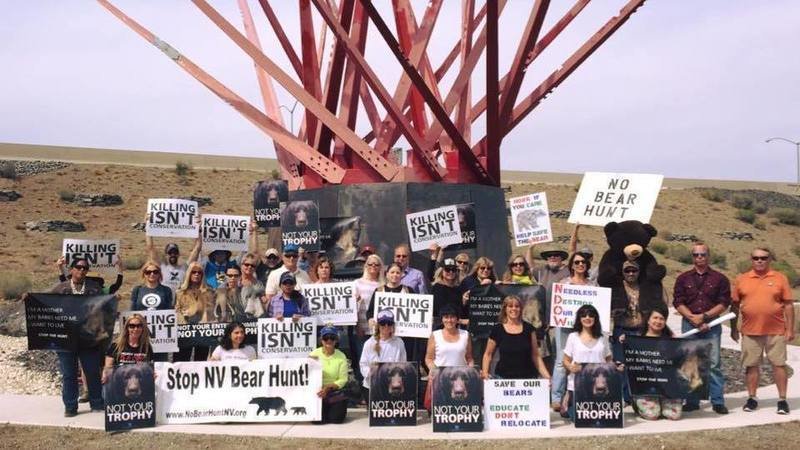
We are pleased to share that many individuals are rising up against the bear hunt. Alongside No Bear Hunt NV, CompassionWorks International held a very successful and well-attended protest in Reno, NV on September 16th that gained ample media coverage.

Also, having successfully raised the funds, in the next two weeks we will be distributing a postcard encouraging residents to be “bear smart” to 15,000 homes in the Tahoe basin where human/bear encounters are frequent. We hope this will curb encounters that result in bears being relocated or killed.

Finally, here in Nevada we are suffering from the tragedy that occurred just days ago in Las Vegas. Unbelievably, the Las Vegas Convention and Visitors Authority are continuing with their plan to host the annual conference of Safari Club International in Las Vegas next January/February. To host a vile group of “thrill killers” after what Las Vegas has just endured is beyond the pale. Please join us in speaking out against Safari Club International (the world’s largest group of trophy hunters) and their conference in Las Vegas by signing this petition: https://www.change.org/p/las-vegas-convention-and-visitors-authority-stop-supporting-guns-and-killing-ban-sci.

Finally, we are grateful to all who donated to our postcard campaign. If you would like to support our efforts to hold protests, petition for a zero quota, and do other outreach aimed at saving the lives of Nevada’s precious bears, please visit www.cwint.org/donate to make your secure, tax-deductible donation online.

Thank you, as always, for your friendship and support, and for your care for Nevada’s wildlife.

For the Animals,
Carrie LeBlanc, M.A.
Executive Director
CompassionWorks International