Blood and Beauty on a Texas Exotic-Game Ranch

Photo

A giraffe named Buttercup moved closer to Buck Watson, a hunting guide, as he looks on from a vehicle at the Ox Ranch in Uvalde, Tex.CreditDaniel Berehulak for The New York Times

UVALDE, Tex. — On a ranch at the southwestern edge of the Texas Hill Country, a hunting guide spotted her cooling off in the shade: an African reticulated giraffe. Such is the curious state of modern Texas ranching, that a giraffe among the oak and the mesquite is an everyday sort of thing.

“That’s Buttercup,” said the guide, Buck Watson, 54.

In a place of rare creatures, Buttercup is among the rarest; she is off limits to hunters at the Ox Ranch. Not so the African bongo antelope, one of the world’s heaviest and most striking spiral-horned antelopes, which roams the same countryside as Buttercup. The price to kill a bongo at the Ox Ranch is $35,000.

Continue reading the main story

Photo

Water buffaloes walked across a dam at the Ox Ranch. CreditDaniel Berehulak for The New York Times

Himalayan tahrs, wild goats with a bushy lion-style mane, are far cheaper. The trophy fee, or kill fee, to shoot one is $7,500. An Arabian oryx is $9,500; a sitatunga antelope, $12,000; and a black wildebeest, $15,000.

“We don’t hunt giraffes,” Mr. Watson said. “Buttercup will live out her days here, letting people take pictures of her. She can walk around and graze off the trees as if she was in Africa.”

The Ox Ranch near Uvalde, Tex., is not quite a zoo, and not quite an animal shooting range, but something in between.

Continue reading the main story

Photo

Mr. Watson points out a Roan on the Ox Ranch. Roan, originally from Africa, never shed their horns, making them attractive trophies for hunters any time of year.CreditDaniel Berehulak for The New York Times

The ranch’s hunting guides and managers walk a thin, controversial line between caring for thousands of rare, threatened and endangered animals and helping to execute them. Some see the ranch as a place for sport and conservation. Some see it as a place for slaughter and hypocrisy.

Continue reading the main story

The Ox Ranch provides a glimpse into the future of the mythic Texas range — equal parts exotic game-hunting retreat, upscale outdoor adventure, and breeding and killing ground for exotic species.

Ranchers in the nation’s top cattle-raising state have been transforming pasture land into something out of an African safari, largely to lure trophy hunters who pay top-dollar kill fees to hunt exotics. Zebra mares forage here near African impala antelopes, and it is easy to forget that downtown San Antonio is only two hours to the east.

Continue reading the main story

Photo

A worker replaces a light bulb at the Ox Ranch. CreditDaniel Berehulak for The New York Times

The ranch has about 30 bongo, the African antelopes with a trophy fee of $35,000. Last fall, a hunter shot one. “Taking one paid their feed bill for the entire year, for the rest of them,” said Jason Molitor, the chief executive of the Ox Ranch.

To many animal-protection groups, such management of rare and endangered species — breeding some, preventing some from being hunted, while allowing the killing of others — is not only repulsive, but puts hunting ranches in a legal and ethical gray area.

“Depending on what facility it is, there’s concern when animals are raised solely for profit purposes,” said Anna Frostic, a senior attorney with the Humane Society of the United States.

Continue reading the main story

Photo

Mr. Watson inspects an Axis buck shot the day before by an 8-year-old boy. Trophy carcasses are hung in a cooler room before being transported from the ranch.CreditDaniel Berehulak for The New York Times

Hunting advocates disagree and say the breeding and hunting of exotic animals helps ensure species’ survival. Exotic-game ranches see themselves not as an enemy of wildlife conservation but as an ally, arguing that they contribute a percentage of their profits to conservation efforts.

“We love the animals, and that’s why we hunt them,” Mr. Molitor said. “Most hunters in general are more in line with conservation than the public believes that they are.”

Beyond the financial contributions, hunting ranches and their supporters say the blending of commerce and conservation helps save species from extinction.

Continue reading the main story

Photo

Various bovine species, including Watusi cattle and buffalo, eat from a hay drop at the Ox Ranch. CreditDaniel Berehulak for The New York Times

Wildlife experts said there are more blackbuck antelope in Texas than there are in their native India because of the hunting ranches. In addition, Texas ranchers have in the past sent exotic animals, including scimitar-horned oryx, back to their home countries to build up wild populations there.

“Ranchers can sell these hunts and enjoy the income, while doing good for the species,” said John M. Tomecek, a wildlife specialist with the Texas A&M AgriLife Extension Service.

Animal-rights activists are outraged by these ranches. They call what goes on there “canned hunting” or “captive hunting.’’

Continue reading the main story

Photo

To ensure a healthy herd, the Ox Ranch introduces fresh blood lines using animals bred on other ranches. April Molitor watches with her father, Jason Molitor, the chief executive of the Ox Ranch, as newly arrived blackbuck antelope are released from a trailer. CreditDaniel Berehulak for The New York Times

“Hunting has absolutely nothing to do with conservation,” said Ashley Byrne, the associate director of campaigns for People for the Ethical Treatment of Animals. “What they’re doing is trying to put a better spin on a business that they know the average person finds despicable.”

A 2007 report from Texas A&M University called the exotic wildlife industry in America a billion-dollar industry.

At the Ox Ranch, it shows. The ranch has luxury log cabins, a runway for private planes and a 6,000-square-foot lodge with stone fireplaces and vaulted ceilings. More animals roam its 18,000 acres than roam the Houston Zoo, on a tract of land bigger than the island of Manhattan. The ranch is named for its owner, Brent C. Oxley, 34, the founder of HostGator.com, a web hosting provider that was sold in 2012 for more than $200 million.

Continue reading the main story

Photo

Three kangaroos that live in front of the Ox Ranch lodge are mainly for attraction purposes and are not hunted. They greet arriving guests and are often fed corn by the newcomers and by guides. CreditDaniel Berehulak for The New York Times

“The owner hopes in a few years that we can break even,” Mr. Molitor said.

Because the industry is largely unregulated, there is no official census of exotic animals in Texas. But ranchers and wildlife experts said that Texas has more exotics than any other state. A survey by the state Parks and Wildlife Department in 1994 put the exotic population at more than 195,000 animals from 87 species, but the industry has grown explosively since then; one estimate by John T. Baccus, a retired Texas State University biologist, puts the current total at roughly 1.3 million.

Continue reading the main story

Photo

A hunting blind stands among trees near a game feeder at the Ox Ranch. CreditDaniel Berehulak for The New York Times

The Ox Ranch needs no local, state or federal permit for most of their exotic animals.

State hunting regulations do not apply to exotics, which can be hunted year-round. The Fish and Wildlife Service allows ranches to hunt and kill certain animals that are federally designated as threatened or endangered species, if the ranches take certain steps, including donating 10 percent of their hunting proceeds to conservation programs. The ranches are issued permits to conduct activities that would otherwise be prohibited under the Endangered Species Act if those activities enhance the survival of the species in the wild. Those federal permits make it legal to hunt Eld’s deer and other threatened or endangered species at the Ox Ranch.

Continue reading the main story

Photo

Mr. Watson petted Buttercup the giraffe. Hunters are not allowed to shoot the ranch’s giraffes. CreditDaniel Berehulak for The New York Times

Mr. Molitor said more government oversight was unnecessary and would drive ranchers out of the business. “I ask people, who do you think is going to manage it better, private organizations or the government?” Mr. Molitor said.

Lawyers for conservation and animal-protection groups say that allowing endangered animals to be hunted undermines the Endangered Species Act, and that the ranches’ financial contributions fail to benefit wildlife conservation.

“We ended up with this sort of pay-to-play idea,” said Tanya Sanerib, a senior attorney with the Center for Biological Diversity. “It is absolutely absurd that you can go to a canned-hunt facility and kill an endangered or threatened species.”

Continue reading the main story

Photo

Wildebeest run free on the Ox Ranch’s rangeland. CreditDaniel Berehulak for The New York Times

The creatures are not the only things at the ranch that are exotic. The tanks are, too.

The ranch offers its guests the opportunity to drive and shoot World War II-era tanks. People fire at bullet-ridden cars from atop an American M4 Sherman tank at a shooting range built to resemble a Nazi-occupied French town.

“We knew the gun people would come out,” said Todd DeGidio, the chief executive of DriveTanks.com, which runs the tank operation. “What surprised us was the demographic of people who’ve never shot guns before.”

Continue reading the main story

Photo

A World War II-era M4 Sherman tank. The ranch also has a shooting range built to resemble a Nazi-occupied French town. CreditDaniel Berehulak for The New York Times

Late one evening, two hunters, Joan Schaan and her 15-year-old son, Daniel, rushed to get ready for a nighttime hunt, adjusting the SWAT-style night-vision goggles on their heads.

Ms. Schaan is the executive director of a private foundation in Houston. Daniel is a sophomore at St. John’s School, a prestigious private school. They were there not for the exotics, but basically for the pests: feral hogs, which cause hundreds of millions of dollars in damage annually in Texas.

“We are here because we both like to hunt, and we like hunting hogs,” Ms. Schaan said. “And we love the meat and the sausage from the hogs we harvest.”

Continue reading the main story

Photo

Joan Schaan takes a photo of her son Daniel Schaan, 15, as he prepares for a night boar hunt. CreditDaniel Berehulak for The New York Times

Pursuing the hogs, Ms. Schaan and her son go off-roading through the brush in near-total darkness, with a hunting guide behind the wheel. Aided by their night-vision goggles, they passed by the giraffes before rattling up and down the hilly terrain.

Daniel fired at hogs from the passenger seat with a SIG Sauer 516 rifle, his spent shell casings flying into the back seat. Their guide, Larry Hromadka, told Daniel when he could and could not take a shot.

No one is allowed to hunt at the ranch without a guide. The guides make sure no one shoots an exotic animal accidentally with a stray bullet, and that no one takes aim at an off-limits creature.

One of the hogs Daniel shot twitched and appeared to still be alive, until Mr. Hromadka approached with his light and his gun.

Continue reading the main story

Photo

Larry Hromadka, a hunting guide, fires his pistol to end the suffering of a feral hog shot and wounded during a night boar hunt. CreditDaniel Berehulak for The New York Times

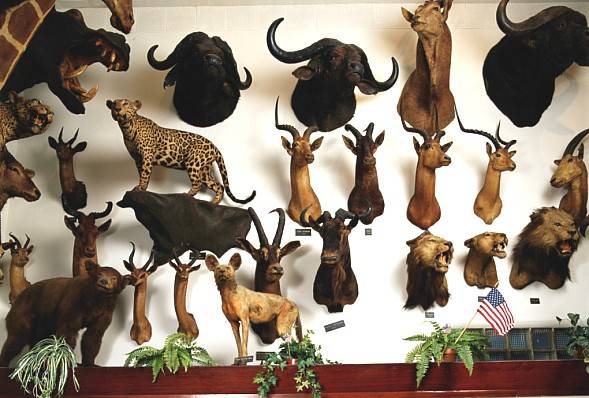
Hundreds of animals shot at the ranch have ended up in the cluttered workrooms and showrooms at Graves Taxidermy in Uvalde.

Part of the allure of exotic game-hunting is the so-called trophy at the end — the mounted and lifelike head of the animal that the hunter put down. The Ox Ranch is Graves Taxidermy’s biggest customer.

“My main business, of course, is white-tailed deer, but the exotics have kind of taken over,” said Browder Graves, the owner.

Continue reading the main story

Photo

Many trophy carcasses from the Ox Ranch are taken to Graves Taxidermy in Uvalde for mounting. Meg Rowland, a newly hired assistant, works on a customer order in the workshop.CreditDaniel Berehulak for The New York Times

He said the animal mounts he makes for people were not so much a trophy on a wall as a symbol of the hunter’s memories of the entire experience. He has a mount of a Himalayan tahr he shot in New Zealand that he said he cannot look at without thinking of the time he spent with his son hunting up in the mountains.

“It’s God’s creature,” he said. “I’m trying to make it look as good as it can.”

Continue reading the main story

Photo

White stags and white elk graze on the ranch at sunset. CreditDaniel Berehulak for The New York Times

Small herds passed by the Jeep being driven by Mr. Watson, the hunting guide. There were white elk and eland, impala and Arabian oryx.

Then the tour came to an unexpected stop. An Asiatic water buffalo blocked the road, unimpressed by the Jeep. The animal was caked with dried mud, an aging male that lived away from the herd.

“The Africans call them dugaboys,” Mr. Watson said. “They’re old lone bulls. They’re so big that they don’t care.”

The buffalo took his time moving. For a moment, at least, he had all the power.
Stop Canned Hunting!

https://help.four-paws.org/node/336

Help us to save lions from trophy hunting in South Africa and ask for a ban on Canned Hunting!

We need 250,000 signatures.

Already 202,500 of 250,000 signed the petition.

#FOURPAWSgowild

The most extreme variety of trophy hunting is “Canned Hunting”. Most of the victims are lions, which are served to their hunters on a silver platter: The animals which are born in captivity are taken away from their mothers within hours of being born so they can be used in petting zoos. When they become of age they then spend the rest of their life in caged compounds waiting to be released in a larger compound for the so called ‘canned’ hunt.

Anyone can go and hunt lions in South Africa – a hunting licence or proven hunting experience isn’t usually necessary. This means that many lions aren’t killed by the first shot which results in them experiencing an agonising death, this is often the case when hunters choose to kill the lion using a bow and arrow.

For trophy hunting in South Africa there are approximately 6000 lions currently be held in the countries 200 breeding farms and neighbouring properties where they will be killed.

Ask the South African President Jacob Zuma and the South African Minister of Environmental Affairs Edna Molewa, to oppose the powerful lobby of the lion breeders and to ban the cruel Canned Hunting at last!

Honourable President, honourable Minister,

South Africa has been an attraction for tourist hunters from the USA and Europe for decades. Its concept, a grim reality. Young lion cubs are taken from their mothers at birth. They are then raised by hand and bred in captivity, as commodities, for the sole purpose of being targeted in an enclosed hunting ground, where they have no chance to evade their hunters. Often times they are drugged or even baited with food.

There are currently more than 6000 lions in 200 breeding farms across the country, and more than 1000 lions are hunted each year. Along with the hunters who participate in this barbaric ‘sport’, are tourists who are unknowingly, and misleadingly contributing to the Canned Hunting industry through their volunteerism at these breeding farms. Since the breeding farms don’t disclose the true reasons as to why they have the cubs, nor why there is a need to nurture them, these volunteers are essentially contributing to raising the cubs just so that they can be shot once they reach maturity.

I ask you to prohibit Canned Hunting in your country once and for all.

With kind regards,

Matthew McConaughey’s Canned Hunt Operation

http://theirturn.net/2015/02/04/TMZ-McConaughey-hunt

February 4, 2015 by

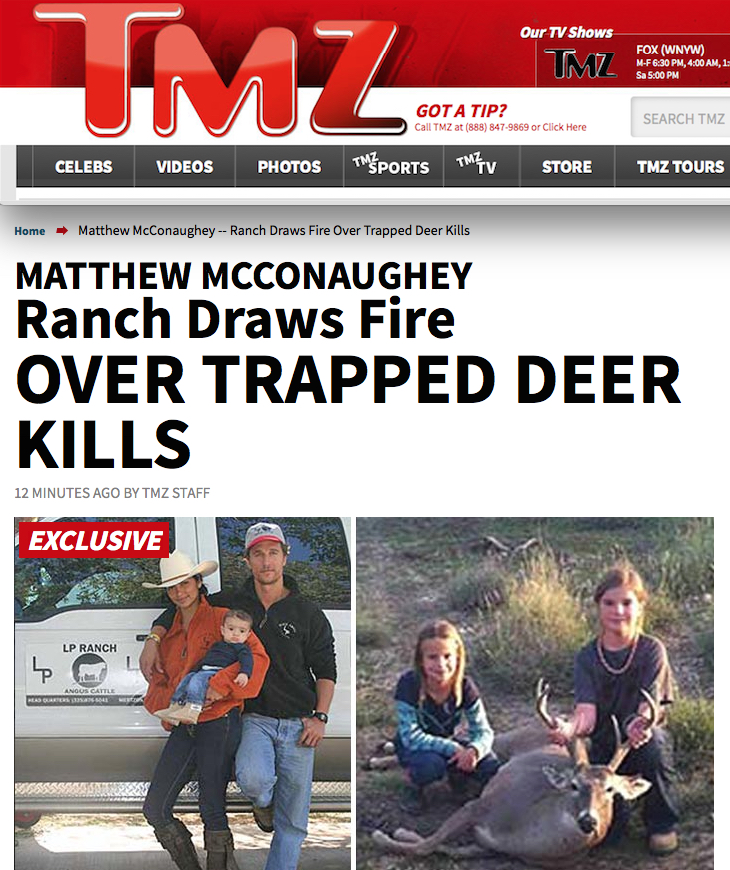
After TheirTurn’s story about Matthew McConaughey’s hunting business went viral, TMZ, the celebrity gossip website with millions of subscribers, published a story about peoples’ outrage: “Matthew McConaughey Ranch Draws Fire Over Trapped Deer Kills.”

McConaughey_TMZ_hunting

TMZ spoke to McConaughey’s nephew Madison, who runs the ranch:

“We reached out to Matt’s rep … so far no word back. But the actor’s nephew, Madison McConaughey — the ranch cattle manager — tells TMZ they’ve had death threats from people who don’t understand the nature of what they do. He says, ‘People are disgusted with us but we’re disgusted with them.’ Madison adds, people who come there do so for the ‘hunting experience’ and he says ‘We’re proud of what we do.’

The TMZ story has been updated with a video interview with Madison McConaughey.

In canned hunts, animals are confined to a fenced in area with no way to escape from the recreational killers and their weapons.

Your Turn

Contact Mr. McConaughey through his TwitterFacebook and Google Plus pages to let him know what you think about his canned hunt enterprise.

Contact McConaughey’s publicist Nicole Perez-Krueger at PMK*BNC at 310.854.4800 or info@pmkbnc.com.

Boycott his movies until he eliminates canned hunts.

Armed Agriculture

by   http://foranimals.org/armed-agriculture/

The current issue of New Mexico Stockman, the official publication of the New Mexico Cattle Growers’ Association, shows the close connection between hunting and public lands ranching. In an article titled “Hunting – Another Arm of Agriculture,” the executive director of the New Mexico Council of Outfitters and Guides describes the New Mexico Game and Fish Department’s E-plus and A-plus programs allowing ranchers to profit from elk and pronghorn (“antelope”) hunting, respectively. “While it’s not widely spoken of,” the article says, “for many in production agriculture, hunting revenues can mean the difference between staying on the land or moving to town.” The article cautions ranchers that this state giveaway technically only applies to the privately owned portion of a ranch, but, they acknowledge, “sometimes landowners agree to hunting arrangements that violate state and federal regulations.”

While hunting and ranching organizations are well aware of need to support each other, conservation organizations remain blissfully ignorant of the connection between the two. Some conservationists hope to “reform” game department by seeking out areas where there are minor disagreements between the livestock industry and their hunting comrades in arms. Others appeal to “ethical hunters” to oppose “unsportsmanlike” coyote hunting contests.

What sort of ethic promotes killing wild animals for pleasure? This is not a rhetorical question, as it has a clear answer. Conservationists who look to Aldo Leopold’s “land ethic” for guidance should be aware that Leopold literally wrote the book on Game Management. As a long-time hunter and government bureaucrat, Leopold defined wildlife as a resource to be managed for human use. Like his bosses at the U.S. Forest Service who managed forests for the benefit of the logging industry, Leopold sought to make hunting sustainable, i.e. to assure that future generations would be able to enjoy killing animals.

We should heed the final words of advice in the New Mexico Stockman article: “It’s time we realize hunting is really just an extension of the agricultural industry and vice versa.”

Wildlife Photography ©Jim Robertson

Wildlife Photography ©Jim Robertson

Petition: No More Canned Hunts!

South Africa: No More Canned Hunts!

Lions are being trapped and bred for trophy hunting in South Africa. Stop the savagery!

13149_1579394132279452_7361363579790857895_n

Sponsored by:The Animal Rescue Site

Canned hunting is a type of hunting in which animals are placed in a confined area, then followed and gunned down by hunters. Also called trophy hunting, canned hunts are popular in South Africa, where lions are often bred for this purpose alone. Hunters come to these “canned” areas and pay large fees to hunt the lions.

With canned hunting, the animal is sure to die since it’s being held in an enclosed area with no chance for escape. It’s a completely unfair and brutal practice, and only exists for the entertainment of morally challenged hunters.

Sign the petition asking the head of the South African Department of Agriculture, Forestry, and Fisheries, Peter Thabethe, to put a stop to these cruel canned hunts for good.

<div class=”scriptWarning”>JavaScript is required to sign this petition!</div>

Sign Here  http://theanimalrescuesite.greatergood.com/clickToGive/ars/petition/CannedHunting


Email *
First name *
Last name *
Don’t display my name
Comments (used 0 of 255 chars max)

‘Breeding factory for trophy hunters’

http://www.timeslive.co.za/thetimes/2014/09/09/breeding-factory-for-trophy-hunters

Gareth Wilson | 09 September, 2014

Lions and tigers from Port Elizabeth’s Seaview Predator Park are being sold to game farms known for hunting and the exporting of animal bones.

And one of the farms has been linked to Laos-based Xaysavang Network, which has been described “as one of the most prolific international wildlife trafficking syndicates in operation”.

Although the park has refused to comment, Eastern Cape department of economic development, environmental affairs and tourism MEC Sakhumzi Somyo has confirmed that:

  • The park has sent 22 lions to Cradock hunting reserve Tam Safaris since 2008; and
  • Two tigers have been sent from the park to the country’s leading bone exporter, Letsatsi la Africa, in the Free State since 2008. Nine lions were sent last year.

Last week, Somyo responded to questions by the DA’s chief whip in Bhisho, Bobby Stevenson, regarding the transportation of lions and tigers in and around South Africa.

The revelations come after the Nelson Mandela Bay Municipality refused to give Seaview Predator Park an annual rates rebate earlier this year, saying it could not be sure the park was not participating in “canned hunting”.

Earlier this year, the Weekend Post revealed television show hosts, major league sports stars, wealthy entrepreneurs and a former US Congressman were among those who had hunted at the family-run Tam Safaris.

Departmental permits indicate there have been 86 lion hunts at the reserve over the past six years.

Tam Safaris owner Irvin Tam confirmed it had bought lions from Seaview Predator Park, owned by Janice and Rusty Gibbs.

“I have an agreement with them but can assure you that none of these lions from Seaview are used for hunting.

”They are specifically used to breed and bring new blood into our breeding projects,” he said.

“Those lions are then either sold or used for hunting.

“I must stress again that all our hunts are legal and completely by the book.”

Tam Safaris exported 32 lion carcasses to Vietnam in 2011, 738kg of lion bones and teeth in 2012 and 459kg of lion bones, claws and teeth last year.

Letsatsi la Africa has been linked to the Laos-based Xaysavang Network by former Environmental Affairs Minister Edna Molewa.

The network has also been described as “one of the most prolific international wildlife trafficking syndicates in operation” by US Secretary of State John Kerry.

Letsatsi la Africa owner Jacobus van der Westhuizen refused to comment on his company’s links with Seaview Predator Park.

“It has nothing to do with you. Ask them [Seaview] if you want to know why.”

Several requests for a meeting with Seaview Predator Park were turned down but park owner Janice Gibbs said in an e-mail: “I trust you enjoyed your visit to the Park yesterday. We do not wish to comment to the media who publish untruths and are very biased.”

The department’s findings come as no surprise to Chris Mercer of the Campaign Against Canned Hunting, who said the lion trade was fuelled by parks that disguised “lion breeding factories” as petting zoos and wildlife sanctuaries.

“We have proved that the entire industry is corrupt, full of liars and just toxic. This now proves the known link between bone exporters, canned hunters and the petting industry.

“The bottom line is that these breeders are outsourcing their lions to petting zoos to generate money and when the lions are big enough they get exchanged with cubs and sent to hunting farms,” Mercer said.

“This proves that cub petting parks sell their lions for canned hunting and are fuelling the market. They constantly hide behind smoke screens but we all know that cub petting is feeding the canned industry.

“What else happens to the lions? They [predator parks] are breeding factories who pose as conservationists but are really feeding the lion bone and canned industry.”

10527782_10152510443027086_4248475377290093494_n

Bill Maher to Hunters: ‘There’s Something Wrong With You’

MONSTER HOG SHOT DEAD IN NORTH CAROLINA

http://www.real-time-with-bill-maher-blog.com/index/2014/3/27/bloody-funday

March 27, 2014/

By Bill Maher

[By the way, the wild boars are escapees from canned hunting compounds, like the kind that raises deer and elk for fenced-in hunting that I posed on earlier.]

New Rule: If you’re delighted to take a life, there’s something wrong with you. This photo has gone viral on the Internet because, well, just look at the size of the wild boar Jett Webb bagged in the woods of North Carolina. That’s some specimen of a pig. And the boar’s pretty big too.

It’s an 8-foot, 500-pound beauty that just moments ago was roaming proudly in the wild, and now it’s dead and I’m holding up my gun and pressing my cock against it! “This might be the best day ever!”

Now, I don’t want to blame this guy too much, because I think, if you’re from rural North Carolina and you have a name like “Jett Webb,” you’d be hard pressed not to end up in a photo like this. Plus, it’s pointed out in the article that wild pigs are an invasive species and that North Carolina is being overrun by boars – just like “Fox and Friends.”

And I get the argument that “a man’s gotta eat” and that sometimes you have to take a life to feed yourself and your family – but shouldn’t it be more of a solemn occasion?

We kill people too, when we carry out executions, but afterwards the warden and guards don’t high-five and pose with the corpse. That’s what bothers me: the trophy aspect, the absolute glee, the beaming with pride. Get over yourself. You pointed at something, pushed a button, and it died.

_______________________________________________________________

The first comment to his blog, from Dominique Osh, is also worth reading:

You know, Hunters are sociopathic killers, simple as that..you match criminal profilers analyze of sociopathic murders of life. There is no need to kill anything to survive these days. There is education available to even the most rural residents that humans do not need meat to survive, not only do they not need to eat meat, we are designed not to. There are many, many alternatives, most vegetables have more calcium and protein than fat laddened flesh, that science has proven to be harmful to human health, if that’s all you care about. And if you think that organic meat from your kills is better, there are many prions in meat that are eating your brains..haha, go figure, huh..no, really, CDC keeps quiet, because the Industrial Meat market does not want you to know these things, when some old man in AK has worms in his brains from eating pigs, or “Mad Cow” & Bird Flu disease isn’t transferable to humans..right..wink, wink..It is gross abomination to eat the flesh of any animal, humans are animals too, It’s cannibalism, a serious crime against nature that we will suffer from. EVOLVE!


Buck Fever

Robert Scheer/The Star

This is X-Factor, an Indiana deer that in his prime was worth an estimated $1 million.

His value as a stud comes not from research and not from the quality of his venison. Instead, his value is in those freakish antlers, the product of more than three decades of selective breeding.

In less than 40 years, a relatively small group of farmers has created something the world has never seen before — a billion-dollar industry primarily devoted to breeding deer that are trucked to fenced hunting preserves to be shot by patrons willing to pay thousands for the trophies.

An Indianapolis Star investigation has discovered the industry costs taxpayers millions of dollars, compromises long-standing wildlife laws, endangers wild deer and undermines the government’s multibillion-dollar effort to protect livestock and the food supply.

To feed the burgeoning captive-deer industry, breeders are shipping an unprecedented number of deer and elk across state lines. With them go the diseases they carry. Captive-deer facilities have spread tuberculosis to cattle and are suspected in the spread of deadly foreign deer lice in the West. More important, The Star’s investigation uncovered compelling circumstantial evidence that the industry also has helped accelerate the spread of chronic wasting disease, an always-fatal deer disease similar to mad cow. CWD now has been found in 22 states.

CWD’s spread roughly coincides with the captive-deer industry’s growth. In half of the states where CWD was found, it first appeared in a commercial deer operation. Officials in Missouri, Nebraska, New York and Canada think captive deer or elk introduced the disease to the wild.

So far, government programs have failed to halt CWD’s spread, largely because there is no reliable way to test live animals for the disease. So infected deer may be shipped into disease-free states, where they can infect other animals, captive or wild. The Star’s investigation uncovered examples of deer escaping from farms, shoddy record keeping and meager penalties for those caught breaking the rules, which further undermine state and federal efforts to contain the disease. Plus, in less than a decade, more than a dozen people have been charged with smuggling live deer across state lines.

More: http://www.indystar.com/longform/news/investigations/2014/03/27/buck-fever-intro/6865031/


FoA challenges Congress’ betrayal of endangered antelope

Today international animal protection organization Friends of Animals filed
a Complaint challenging the constitutionality of a provision that was buried
in the 2014 Federal Budget by Congressman John Carter of Texas that seeks to
eliminate Endangered Species Act protection for three species of African
antelope held captive on U.S. sport-hunting ranches.

“After the better part of a decade on the losing end of Friends of Animals’
efforts to protect these amazing antelope, private hunting ranch operators
that profit on the killing of these animals chose to show their disrespect
for our justice system by turning to their Congressional pawn,
Representative John Carter,” said Priscilla Feral, president of Friends of
Animals. “Fortunately for the antelope, Friends of Animals won’t let them be
killed so easily and will continue to fight on their behalf in the
courtroom.”

Mike Harris, director of Friends of Animals’ Wildlife Law Program, explains
that the provision in the Federal Budget, Section 127, purports to undo
Friends of Animals’ 2009 victory in which a federal judge told the U.S. Fish
and Wildlife Service that it could not exempt these hunting ranches from theHuntingTrophiesJamieKripke600
permitting requirements in Section 10 of the Endangered Species Act. Section
127 also seeks to interfere with Friends of Animals’ 2013 lawsuit
challenging whether USFWS’s permitting of more than 100 of these hunting
ranches violated the Endangered Species Act’s conservation purposes.

“Representative Carter’s attempt to strip legal protections for these
endangered animals reeks of special interest favoritism,” Harris said. “His
budget rider is not only harmful to the antelope, but also to American
democracy. It is now up to the court to stop this misuse of Congressional
power.”

Today, addax and dama gazelles are nearly wiped out in Northern Africa due
to hunting, war, desertification of habitat, human settlement and
agribusiness. FoA has facilitated the reintroduction of the antelope within
Ferlo National Park in northwest Senegal. Through member support, FoA funds
habitat restoration efforts at Ferlo National Park. For example, in fiscal
year 2013, $66,000 went toward expanding the Oryx Fence Project, which
includes dama gazelles. One hundred and 20 oryx and 20 dama gazelles
benefitted, along with other animals, from these funds. FoA has also
collaborated with European and Middle Eastern specialists in captive
breeding of arid ecosystem gazelle species to restore these animals to the
wild.

The full Complaint can be viewed on the Friends of Animals’ website:

http://friendsofanimals.org/sites/default/files/kcfinder/files/Antelope_Ride
r_Complaint%20FINAL.pdf