Exposing the Big Game

Forget Hunters' Feeble Rationalizations and Trust Your Gut Feelings: Making Sport of Killing Is Not Healthy Human Behavior

Exposing the Big Game

Industry scrambles to stop fatal bird flu in South Carolina

  • Updated 


DES MOINES, Iowa (AP) — An infectious and fatal strain of bird flu has been confirmed in a commercial turkey flock in South Carolina, the first case of the more serious strain of the disease in the United States since 2017 and a worrisome development for an industry that was devastated by previous outbreaks.

The high pathogenic case was found at an operation in Chesterfield County, South Carolina, marking the first case of the more dangerous strain since one found in a Tennessee chicken flock in 2017. In 2015, an estimated 50 million poultry had to be killed at operations mainly in the Upper Midwest after infections spread throughout the region.

“Yes, it’s concerning when we see cases, but we are prepared to respond very quickly and that was done in this case,” said Lyndsay Cole, a spokeswoman for the U.S. Department of Agriculture’s Animal and Plant Health Inspection Service.

The USDA has been working in recent months with scientists and farmers in North Carolina and South Carolina, where a low pathogenic — or less severe — strain of bird flu had been detected.

Low pathogenic bird flu causes few clinical signs in infected birds. However, two strains of low pathogenic bird flu — the H5 and H7 strains — can mutate into highly pathogenic forms, which are frequently fatal to birds and easily transmissible between susceptible species.

Low pathogenic cases were already in an area near the South Carolina and North Carolina state line and USDA was closely monitoring and testing. The case in Chesterfield County, South Carolina was expected to be another low pathogenic case, but it came back from the laboratory high pathogenic which means the less severe virus mutated into the more severe version, Cole said.

“Our scientists at the National Veterinary Services Laboratory had looked at the virus characteristics of the low path virus and they had previously indicated that this was one that was probably likely to mutate so they were watching it very closely,” Cole said.

A laboratory in Ames, Iowa, confirmed the virus with that had been killing turkeys was a high pathogenic H7N3 strain of avian influenza.

A report on the outbreak indicates in was discovered on April 6. It has killed 1,583 turkeys and the remainder of the 32,577 birds in the flock were euthanized.

State officials quarantined the farm, movement controls were implemented and enhanced surveillance was already in place in the area.

“The flock was quickly depopulated and will not enter the marketplace,” said Joel Brandenberger, president of the National Turkey Federation, an industry trade group. “Thorough disinfecting and cleaning procedures have already been initiated on premises as well as surveillance of commercial flocks in the surrounding area. This occurrence poses no threat to public health. Turkey products remain safe and nutritious.”

These measures were implemented after an H5N2 avian influenza outbreak that began in December 2014 swept commercial chicken, egg laying and turkey populations throughout much of 2015 killing 50 million birds and causing as much as $3 billion in economic damage. That outbreak is believed to have originated in wild birds.

Nearly 90 percent of the bird losses were on egg-laying chicken farms in Iowa and turkey farms in Minnesota. The bulk of other cases occurred in the adjacent states of Nebraska, Wisconsin, and South Dakota.

Cole said since 2015 significant planning, exercises and coordination has occurred between the federal government, state agencies and the industry.

Cole said the coronavirus pandemic has not affected the ability of the government to respond to the bird flu.

A highly pathogenic H7N9 bird flu strain was detected in Lincoln County, Tennessee, in a chicken flock of 73,500 birds in early March 2017. Ten days later samples from a commercial flock less than two miles away also tested positive for the same strain. The birds were euthanized and buried and the virus didn’t spread further indicating immediate mitigation action can stop spread.

For me, the modern chicken industry is an expression of humankind at its worst. My visit last night to Ciales slaughterhouse in Bucktown to document the delivery of birds showed me nothing new, except for new victims whose expressions communicate a fresh pain, horror and despair that words fail to articulate. I know the expressions and behavior of happy chickens which makes the contrast even more disturbing. As we shine a light through the darkness on these birds’ faces and bodies, “I can’t imagine” thoughts flood my mind.

I can’t imagine how we could make someone more miserable or inflict more suffering.

I can’t imagine how we could engineer a domestic species from its wild counterpart in a way that so grotesquely robs them of all of the richness and complexity of their tropical rainforest lives and at the same time renders their bodies lethally obese in just weeks of being born.

I can’t imagine how we can raise birds only to be slaughtered at six weeks old, how we can grab them by their legs and stuff them into crates packed so tight, they are forced to squat in their own waste for hours and even days.

I can’t imagine how we can handle them so roughly during transport that they suffer from fractured wings and legs, bruises, and open wounds.

I can’t imagine that we can haul them around in trucks that offer zero protection from the extremes of of cold, heat, wind, rain and ice, that we can deny them any food or water or any comfort an infant animal might yearn for, that we allow many of them to arrive dead from heart failure, hypothermia, dehydration, starvation and heat stroke due to this grueling journey from one hell to another hell.

I can’t imagine how we can slam these crates of birds around causing further injury and terror at their destination. And I can’t imagine how we then allow them to languish in these filthy, feces-caked crates for many more hours, perhaps even days, awaiting their violent end.

I can’t imagine how we can try to deceive ourselves by calling the “kill cone” method of slaughter “humane:” stuffing a bird head-first down a metal cone, pulling their necks through the bottom opening, and slashing their throats while fully conscious, while their bodies thrash and they suffocate in their own blood.

I can’t imagine how we can watch this footage and continue to support this industry. And I can’t imagine how we can shower some animals in our lives with such affection and adoration and yet support an industry that treats other animals with such contempt and utter disregard for their suffering.

I can’t imagine how we can allow this atrocity to even exist in the 21st century. Shut them down!

Rumours on coronavirus severely impacting poultry sale in India, say officials

Chickens

NEW DELHI: Rumours claiming spread of coronavirus through chickens, circulated widely through social media platforms such as, WhatsApp, has severely impacted sale of chickens in the country.

Chicken sales have come odwn by 50 percent, said an official from Agribusiness company Godrej Agrovet Limited.

Godrej Agrovet Managing Director B S Yadav said that sales have fallen to 40 million birds from 75 million in just four weeks.

Farmers have also been hurt as they are unable to recover costs earning Rs 30-Rs 35 per bird.

According to some reports, farmers have already started cutting down on production which might cost price hike in coming months.

It is important to note that bird flu is also a huge concern for many people.

In January this year, as many as 900 fowls were culled after the avian influenza virus was detected in a dead bird in Bangalore. “A chicken was found dead on December 29 at a chicken shop in (suburban) Dasarahalli area and it was confirmed after lab tests that the bird was infected with the H5N1 avian influenza virus,” Bruhat Bengaluru Mahagara Palike (BBMP) Joint Commissioner S. garaju told IANS.

China has reported a deadly H5N1 bird flu outbreak among chickens in Hunan province, which lies on the southern border of Hubei, the epicenter of the rapidly spreading coronavirus that has killed 304 people.

More than 100,000 poultry have been culled in 10 provinces and cities of Vietnam where A/H5N6 and A/H5N1 bird flu broke out, Vietnam News Agency cited the country’s Ministry of Agriculture and Rural Development.

The Vietnamese Ministry of Agriculture and Rural Development said that between early January and February 24, Vietnam had 34 bird flu outbreaks with over 100,000 poultry culled, among which 29 were A/H5N6 and the rest five were A/H5N1 in 10 provinces and cities of Hanoi, Bac Ninh, Thanh Hoa, Nghe An, Tra Vinh, Thai Binh, Binh Duong, Ninh Binh, Hai Phong, and Quang Ninh.

H5N1 virus-infected birds spread the virus through their saliva, mucus and faeces. Although the virus does not usually infect people, it can cause fever, diarrhoea, respiratory illnesses in some affected people.

France to ban culling of unwanted male chicks by end of 2021

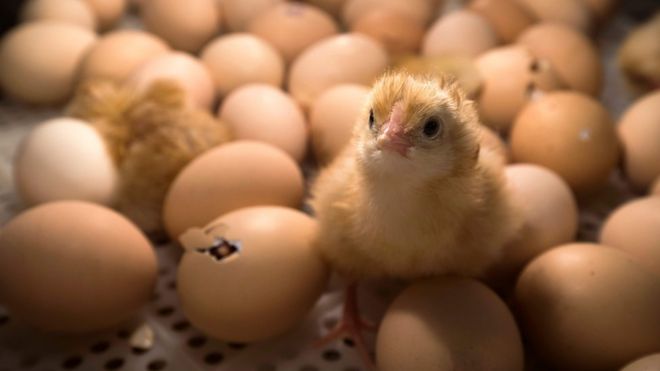
A chick stands among eggs being hatched inside an incubator at the Agriculture Fair in Paris in February 2017.Image copyrightAFP
Image captionAn estimated seven billion unwanted male chicks are killed each year

France has pledged to outlaw the practice of culling unwanted male chicks by the end of 2021, as part of animal welfare reforms.

About seven billion male chicks – not wanted for meat or eggs – are killed around the world each year, usually in shredding machines or by gas.

The government said new methods were emerging that would make it possible to test the sex of embryos inside the egg.

But some campaigners said the reforms did not go far enough.

What are the changes in France?

French Agriculture Minister Didier Guillaume announced the reforms at a press conference in Paris on Tuesday.

“From the end of 2021, nothing will be like it was before,” he said.

Mr Guillaume said he hoped a method would soon be developed that would allow the gender of a chick to be determined before it had hatched.

Researchers have been working on the issue for years, but are yet to come up with a solution that works on an industrial scale.

The 2021 ban will make France one of the first countries to outlaw the practice of culling male chicks. A ban in Switzerland came into effect earlier this year, while a top court in Germany has ruled that the practice can continue on a temporary basis until an alternative can be found.

France and Germany last year said they would work together to put an end to mass chick culling.

Mr Guillaume also announced on Tuesday that the practice of castrating piglets without anaesthesia would be banned by the end of 2021.

Castration is performed to prevent “boar taint” – a potent smell or taste that can occur in the meat of non-neutered pigs. Several countries have already made the use of anaesthesia obligatory.

How widespread is male chick culling?

The mass-killing of male chicks shortly after birth is common practice in food production around the world.

For the billions of hens used in egg and poultry farming every year, a similar number of male chicks are killed shortly after birth.

Male chicks are viewed in the industry as commercially useless, because they grow more slowly than hens so are deemed unsuitable for meat production.

After sorting, the most common methods of killing involve asphyxiation by gassing or maceration in high-speed grinders.

What has the response been?

Many animal rights activists welcomed the changes in France but said they did not go far enough.

They are “a step in the right direction, but still inadequate”, Anissa Putois of the campaigning group People for the Ethical Treatment of Animals (Peta) told AFP news agency.

French animal protection group L214 said the measures were “not ambitious” and “do not address the basic problems”.

“There is nothing on slaughter conditions, nor on how to exit from intensive animal farming,” it said, according to AFP.

Presentational grey line

You might be interested in wa

Big Meat is one of the biggest abusers of undocumented immigrants

http://www.intrepidreport.com/archives/27838

Last week’s ICE raids on chicken slaughter plants in Mississippi raise an issue that traditional media like to ignore. Undocumented immigrants keep the US in cheap meat.

Few to no Americans want slaughterhouse jobs like knockers, stickers, bleeders and tail rippers. In fact, when Smithfield’s slaughterhouse in Tar Heel, NC, offered inmates work release to work at the local slaughterhouse, the inmates said they would rather stay in their cells. Think about that.

A 2008 ICE raid on the Iowa-based slaughterhouse Agriprocessors wiped out almost the whole work force: 296 Guatemalans, 93 Mexicans, two Israelis, and four Ukrainians were arrested. Initial charges against Agriprocessors included harboring illegal aliens, use of child labor, document fraud, identity theft, physical and sexual abuse of workers, unsafe working conditions, wage and hour violations, and shorting workers’ pay.

According to the search warrant, 1,000 discrepancies between worker names and Social Security numbers occurred in three years. There was even a methamphetamine production plant existing within the slaughterhouse, sanctioned by management. Barack Obama, then an Illinois senator, weighed in on the situation during a campaign stop in Davenport, Iowa. “They have kids in there wielding buzz saws and cleavers. It’s ridiculous,” he said

Undaunted after the raid, recruitment firms hired by Agriprocessors canvassed homeless shelters, bus stations, chapel services, and other slaughterhouses, and ran ads in Spanish-language newspapers and on Mexican radio stations in the Rio Grande Valley to replenish the workforce. One recruitment firm, Labor Ready, says it recalled 150 workers, days after placing them, over Agriprocessors’s “safety conditions.”

Years ago, meatpackers JBS Swift, Tyson Foods and Gold’n Plump began hiring Somalis, fleeing civil war, for their slaughterhouse workers. Sudanese and Pacific Islanders also became popular slaughterhouse employees. Employees fleeing poverty and violence, like those from Central American, are willing to accept low wages and no on-the-job protections or worker rights.

Are conservatives who deplore immigrants ready to give up the cheap meat immigrants make possible? Are progressives and clergy who “love” immigrants okay with jobs with no security that regularly cause workers to lose their hands—to keep Americans in cheap meat? (We won’t even talk about what happens to the animals under these conditions.)

Ten years ago, a Texas AgriLife Research study of 5,005 dairy farms estimated that the US economy would suffer an $11 billion loss with the loss of foreign workers. Since then, that number has only grown.

Are Big Food corporations—and the lawmakers who serve them—ready to pay real wages to workers and stop hiring undocumented immigrants while bashing them? Are Americans addicted to cheap meat ready to see how their eating habits support the exploitation of undocumented immigrants? No talk about undocumented immigrants is honest if it leaves out the fact that US slaughterhouses are balanced on their backs.

Chicken plants raided by ICE ‘willfully and unlawfully’ hired unauthorized workers: court documents

Almost all of the Mississippi chicken plants raided by Immigration and Customs Enforcement (ICE) officials on Wednesday were “willfully and unlawfully” employing people without proper work documentation authorizing them to hold jobs in the U.S., according to unsealed court documents.

Federal investigators who executed the raid on seven plants in all arrested 680 people, drawing in part on informant information — in what’s been described as the largest immigration raid in a decade. (Roughly 30 of those arrested were released on humanitarian grounds, while another 270 were released after being processed by ICE, the U.S. Attorney’s Office for the Southern District of Mississippi said Thursday.)

ICE RAIDS ON MISSISSIPPI FOOD PROCESSING PLANTS RESULT IN 680 ARRESTS

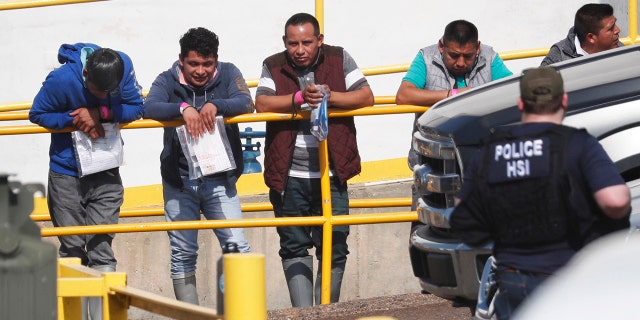
Handcuffed workers await transportation to a processing center following a raid by U.S. immigration officials at Koch Foods Inc., plant in Morton, Miss. U.S. immigration officials raided several Mississippi food processing plants on Wednesday and signaled that the early-morning strikes were part of a large-scale operation targeting owners as well as employees. (AP Photo/Rogelio V. Solis)

Handcuffed workers await transportation to a processing center following a raid by U.S. immigration officials at Koch Foods Inc., plant in Morton, Miss. U.S. immigration officials raided several Mississippi food processing plants on Wednesday and signaled that the early-morning strikes were part of a large-scale operation targeting owners as well as employees. (AP Photo/Rogelio V. Solis) (AP)

An informant posing as a worker at the latter of two chicken processing plants, PH Food Inc. in Morton and A&B Inc. in Pelahatchie, told Homeland Security investigators that both are owned by a Chinese man from California, Huo You Liang, more commonly referred to as Victor by his employees in Mississippi. The informant contended that Victor, as well as managers at other plants, did not follow state regulations which require employers to utilize E-Verify, a federal electronic verification system, to validate the authenticity of work documents including identification, Social Security numbers and tax information.

“The payroll companies as well as PH Food Inc. and A&B Inc. do not verify the authenticity of their documents,” the informant told investigators, according to court documents, allowing employees to use their real names supported by fake documents to get hired.

Another informant at PH Food said that the majority of the 240 employees at PH’s plant as well as 80 employees at A&B’s plant employed many Guatemalan immigrants lacking in proper work authorizations and documentation.

NEARLY HALF OF ALL ILLEGAL IMMIGRANTS NABBED IN MISSISSIPPI ICE RAID RELEASED ON ‘HUMANITARIAN GROUNDS’

In addition, investigators gathered evidence from electronic monitoring bracelets from migrants who had previously been arrested for immigration violations — thus barring them from employment in the U.S. — and noted that all seven raided plants employed these immigrants illegally.

Three members of the House Oversight Committee Friday sent a letter to Attorney General William Barr and Acting Secretary of Homeland Security Kevin McAleenan asking that, among other things, documents and information be turned over showing whether the companies involved in the Mississippi raids would be facing criminal charges or other fines and penalties for hiring illegal immigrants.

The letter, signed by panel chairs Rep. Elijah Cummings, D-Md., Bennie Thompson, D-Miss., and Rep. Jamie Raskin, D-Md., requested documents on “whether any owners, employers or individuals otherwise responsible for hiring at targeted worksites were charged and the nature of those charges.”

“It appears that these DOJ and ICE enforcement actions are targeting only immigrant workers and not their employers,” the letter said.

Bringing criminal charges against companies that illegally hire workers is difficult because prosecutors must prove that the employer did so knowingly, a claim easily rebutted via claims of being duped by fraudulent documentation.

The Associated Press contributed to this report.