Exposing the Big Game

Forget Hunters' Feeble Rationalizations and Trust Your Gut Feelings: Making Sport of Killing Is Not Healthy Human Behavior

Exposing the Big Game

Earth’s carbon dioxide levels highest in 3 million years, study says


Who emits more methane in Colorado: natural gas producers or cows?

Posted: 6:43 PM, Mar 29, 2019
Updated: 6:02 PM, Mar 29, 2019

CU mobile Solar Occultation Flux

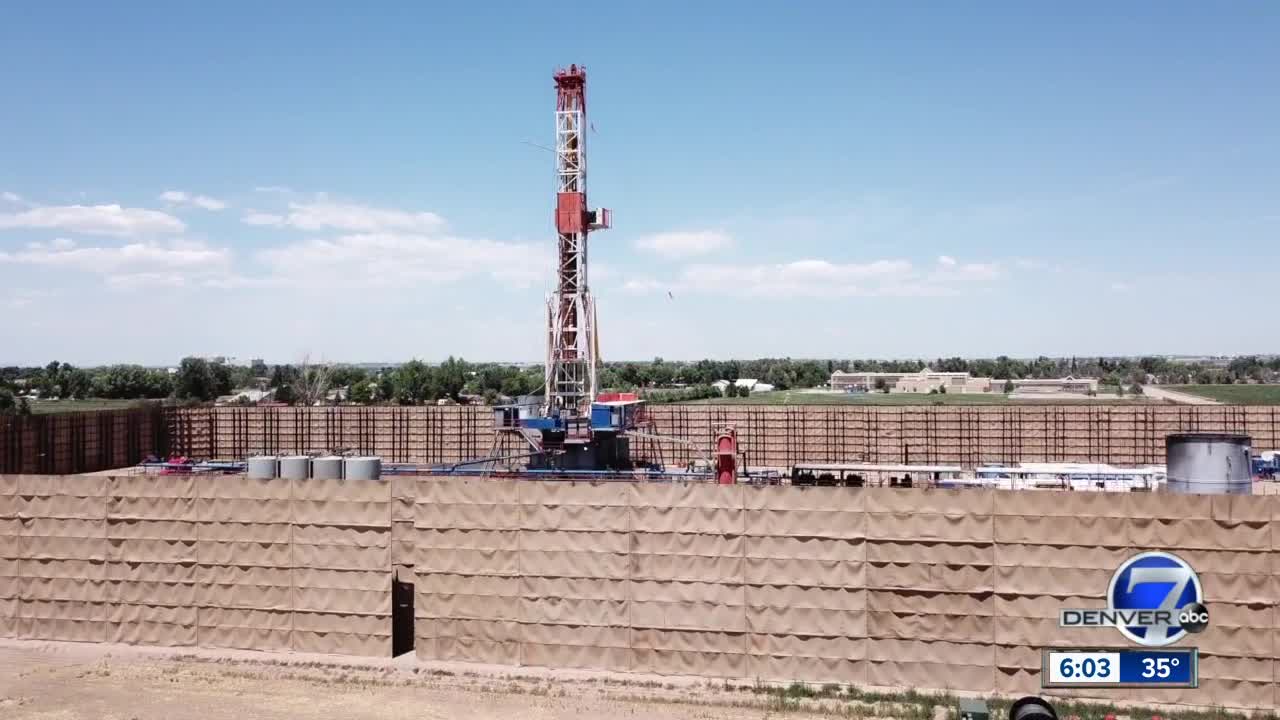
BOULDER, Colo. — While lawmakers at the Colorado state capitol debate a bill to change the way oil and gas production is regulated in the state, researchers at the University of Colorado Boulder have come up with a way to better track methane emissions.

Methane is a greenhouse gas that traps heat in the environment and contributes to climate change.

“Methane is kind of complicated because it’s a global problem,” said Rainer Volkamer, an associate professor of chemistry at CU Boulder. “We want to be able to keep track of it and what are the important sources.”

Methane lives in the atmosphere for about ten years, traveling from the North Pole to the South Pole before eventually being destroyed in the tropics.

Colorado has two main sources of methane emissions: natural gas production and livestock.

“Methane is the same whether it’s emitted from oil and gas or whether it’s emitted from a cow.” Volkamer said.

For years, it has been difficult for industries to determine whether livestock or natural gas production emits more methane.

“They need to know what their impact is on the environment,” Volkamer said.

In the past, methane emissions were measured by an airplane.

However, Volkamer and others created the CU mobile Solar Occultation Flux to help measure methane emissions from the ground and determine exactly where they are coming from. It was developed as part of the Cooperative Institute for Research in Environmental Sciences (CIRES).

“With our technique, we could show that the majority is produced from oil and gas and that the agricultural sources are a significant minor source for methane in the region,” Volkamer said.

The conclusion came from data Volkamer and study co-author Natalie Kille, a PhD student at CU Boulder, gathered over a five-day period in 2015 and have been working to analyze.

The researchers measured not only methane, but also ethane emissions, which is co-emitted from oil and gas producers. On the livestock side, the box measures ammonia that is co-emitted from the cows. By measuring all three, researchers can determine who is emitting what.

The machine is tiny compared to its predecessors; it’s about the size of a car engine. It’s also a much more cost-effective way to measure methane.

“This instrument is a tenth of the cost of another instrument that fills an entire room and it’s mobile, so it’s cost-effective for that reason,” Volkamer said.

It is also, in principle, able to perform the same functions inside of an airplane if researchers want to use that method.

Beyond that, the technique can determine exactly what methane was created in Colorado and which emissions were created elsewhere to give the state a better idea of its contributions to climate change.

Eventually, this data could help natural gas producers, cattle farmers and state regulators figure out how to mitigate air pollution. The researchers are hoping to build on this data with a long-term study over several seasons to see how methane emissions change over time.

Ocasio-Cortez: We reacted to 9/11, so where’s the reaction on climate change?

U.S. Rep. Alexandria Ocasio-Cortez, D-N.Y., appeared on MSNBC Friday to address the Green New Deal with host Chris Hayes and discussed the dire world she’s convinced lies ahead for Americans if climate change is not addressed.

“So this issue is not just about our climate. First and foremost we need to save ourselves. Period. There will be no future for the Bronx. There will be no livable future for generations coming, for any part of this country in a way that is better than the lot that we have today if we don’t address this issue urgently and on the scale of the problem,” said Ocasio-Cortez.

POLL SHOWS: OCASIO-CORTEZ MOSTLY UNLIKED OR UNKNOWN

The freshman congresswoman believes America has seen dire situations before and mobilized, but mostly in connection with conflict and war. “Historically speaking, we have mobilized our entire economy around war. But I thought to myself it doesn’t have to be that way, especially when our greatest existential threat is climate change,” Ocasio-Cortez said.

“First and foremost we need to save ourselves. Period.”

— U.S. Rep. Alexandria Ocasio-Cortez, D-N.Y.

“And so to get us out of this situation, to revamp our economy to create dignified jobs for working Americans, to guarantee health care and elevate our educational opportunities and attainment, we will have to mobilize our entire economy around saving ourselves and taking care of this planet.”

Ocasio-Cortez also addressed critics of the Green New Deal legislation she’d co-sponsored, after MSNBC played a montage of Republicans and pundits, including some on Fox News, criticizing her and talking about “cow farts” and accusing her of wanting to take away their “hamburgers.”

“I didn’t expect them to make total fools of themselves,” Ocasio-Cortez said, saying she expected the criticism.

CLICK HERE TO GET THE FOX NEWS APP

The congresswoman also said Hurricane Maria and the devastation caused on Puerto Rico was a sign that climate change problems are “here,” invoking the Sept. 11, 2001, terror attacks and criticizing the government for the lack of response.

“You know that this is here. This is not something that’s coming. … On the events of September 11 2001, thousands of Americans died in one of the largest terrorist attack on U.S. soil. And our national response — whether we agree with that or not — our national response was to go to war in one, then eventually two countries. Three thousand Americans died in Puerto Rico in the aftermath of Hurricane Maria. Where’s our response?” Ocasio-Cortez said to loud applause.

David Attenborough Isn’t Sure We Can Save the Natural World. But at 92, He’s Not Giving Up Trying

Sir David Attenborough poses for a portrait at the Royal Botanic Gardens, Kew, London, in February.

Sir David Attenborough poses for a portrait at the Royal Botanic Gardens, Kew, London, in February.
Jackie Nickerson for TIME
BY DAN STEWART 

MARCH 28, 2019

Play Video

YOU MIGHT LIKE
OUR PLANET TRAILER NETFLIX
REP. ALEXANDRIA OCASIO-CORTEZ RESPONDS TO CRITICISM OF GREEN NEW DEAL

It’s the voice you notice first. In person, David Attenborough speaks in the same awestruck hush he has used in dozens of nature documentaries, a crisp half whisper that is often mimicked but seldom matched. Ninety-two years of use may have softened its edges, but still it carries the command of authority. Sitting in his home in the Richmond neighborhood of west London for one in a series of conversations, I feel compelled to drink a second cup of tea when he offers. It somehow seems wrong to say no.

In his native U.K., Attenborough is held in the kind of esteem usually reserved for royalty. Over decades–first as a television executive, then as a wildlife filmmaker and recently as a kind of elder statesman for the planet–he has achieved near beatific status. He was knighted by the Queen in 1985 and is usually referred to as Sir David. As he walked into the Royal Botanic Gardens for TIME’s portrait shoot on the day of our interview, the mere sight of him caused members of the public and staff alike to break into goofy smiles.

Attenborough pioneered a style of wildlife filmmaking that brought viewers to remote landscapes and gave them an intimate perspective on the wonders of nature. Frans de Waal, the renowned Dutch primatologist, says he regularly uses clips from Attenborough’s shows in lectures. “He has shaped the views of millions of people about nature,” he says. “Always respectful, always knowledgeable, he takes us by the hand to show us what is left of the nature around us.”

In the autumn of his life, Attenborough has largely retreated from filmmaking on location but lends his storytelling abilities to wildlife documentaries in collaboration with filmmakers he has mentored. His most famous work, the 2006 BBC series Planet Earth, set a benchmark in the use of high-definition cameras and had a budget equal to that of a Hollywood movie. Among its highlights was the first footage of a snow leopard, the impossibly rare Asian wildcat that hunts high in the Himalayas. More than a decade after its initial release, Planet Earth remains among the all-time best-selling nonfiction DVDs.

Attenborough with orangutans at the London Zoo

Attenborough with orangutans at the London Zoo
REX/Shutterstock

Now Attenborough is putting his voice and the weight of authority he has accumulated to greater moral purpose. In recent months he has stood in front of powerful audiences at the 2018 U.N. climate talks in Katowice, Poland, and the 2019 World Economic Forum at Davos, in Switzerland, to urge them into action on climate change. These kinds of events are not his chosen habitat, Attenborough tells TIME. “I would much prefer not to be a placard-carrying conservationist. My life is the natural world. But I can’t not carry a placard if I see what’s happening.”

Attenborough and his frequent collaborators, filmmakers Alastair Fothergill and Keith Scholey, will attempt to show the world exactly what is happening on April 5, when Netflix launches Our Planet–a new, blockbuster eight-part documentary series that aims not just to present the majesty of the world around us but also raise awareness of what the changing climate is doing to it.

Filmed across every continent over four years, the show takes viewers from remote steppes to lush rain forest to the ocean floor. It has vertiginous ambitions in both its scope and intent. “The idea was not just to make another landmark show, but also to move the dial,” says Scholey, who served as an executive producer. “Not only do we engage a large audience but also actually get to the point of changing policy that would lead to global change.”

It’s a show perfectly timed for a global moment in which politicians are prioritizing climate change as never before, students are skipping school to attend climate marches, and governments are attempting to rein in carbon emissions to meet Paris Agreement targets. Although he has been criticized for not speaking up earlier, Attenborough now says that if he has the opportunity to speak truth to power, he has to take it. “It is important, and it is true, and it is happening, and it is an impending disaster,” he says.

Attenborough promoting his BBC show 'The Tribal Eye'

Attenborough promoting his BBC show ‘The Tribal Eye’
Jeremy Grayson—Radio Times/Getty Images

Long before he was a world-famous documentarian, Attenborough was a trailblazer in the medium of television. He went from being a junior producer at the BBC in the 1950s, making programs about “gardening and cooking and knitting,” he says, to becoming one of the first controllers of BBC Two, the corporation’s eclectic second flagship channel. Among his commissions was a quirky comedy-sketch show called Monty Python’s Flying Circus. He was prouder, he recalls, of commissioning an opera by the composer Benjamin Britten.

Having studied natural sciences at the University of Cambridge, Attenborough juggled his TV duties with making wildlife films every few months; his series Zoo Quest, which ran from 1954 to 1963, followed the London Zoo’s attempts to gather rare animals for its menagerie from West Africa, South America and Southeast Asia. “I’d go away for three months and make some programs, which was lovely,” he says. “But in between, I had to do all these other things … politics and finance and engineering, which was never my bag.”

In the early 1970s, he resigned from the BBC to dedicate himself full time to wildlife filmmaking. He soon began work on Life on Earth, the seminal 1979 series that traced the arc of evolution from primordial ooze to Homo sapiens. The 13-part broadcast took viewers around the world, bringing them into close contact with a range of animals and using then cutting-edge filming techniques like the slow-motion capture of animal movements. Its most famous sequence shows Attenborough cavorting with a family of mountain gorillas in Rwanda.

But while Attenborough’s filmography made him a household name in the U.K., his fame didn’t immediately transfer stateside. He remembers being in a pitch session with a major U.S. network trying to describe Life on Earth to an executive. “I remember saying, ‘We’re going to start from the very beginning of the primordial oceans and see when life begins to appear.’ And he said, ‘You mean the first program’s all about green slime?’ I said, ‘Well, yes.’ ‘No, thank you,’ he said.”

Attenborough with Queen Elizabeth II

Attenborough with Queen Elizabeth II
BBC

This skepticism about his appeal would last for decades. When the Discovery Channel decided to broadcast Planet Earth in 2007, his voice-over was replaced with one by the actor Sigourney Weaver. Yet the incredible popularity of the DVD collection–carrying Attenborough’s narration, it sold 2.6 million copies in its first year of release–won him a narrow yet fervent U.S. fan base. Among his admirers was President Barack Obama, who invited him to the White House in 2015 to discuss the threat of climate change in a televised interview.

Attenborough initially assumed he would be the one interviewing Obama. But he was astonished to discover the President wanted it the other way round. “I thought, I mean apart from my work, what’s he doing talking to me?” he says. He desperately boned up on figures on climate change, even calling the U.K. environment ministry to check statistics.

His profile is evidently now high enough for Netflix to tout him as the narrator of Our Planet for English-speaking viewers (Penélope Cruz and Salma Hayek narrate for Spanish-language audiences), although he admits his creative role was mostly limited to the voice-over. He didn’t travel to remote locations for the new series, focusing his efforts instead on helping producers craft a script that would suit his signature narrative style while also fulfilling the show’s brief to sound the alarm about a changing planet. “In the old days I wrote every shot,” he says. “These days it’s a lot more … professional.”

Although Planet Earth, as well as his other acclaimed BBC series Blue Planetand Frozen Planet, did raise concerns among some viewers about the state of the environment, Our Planet is more explicit in its messaging. This is in part because the filmmakers, freed from the rigorous impartiality of the state-funded BBC, teamed up with the World Wide Fund for Nature (WWF), a conservation NGO. In one jaw-dropping sequence, after thousands of Pacific walruses are forced by vanishing ice sheets to crowd on a rocky strip of land, hundreds leap off a cliff to their doom, a scene Attenborough says is “almost heartbreaking” to watch.

Yet there are also scenes of hope that remind viewers that at least some environmental damage can be reversed. We see that Chernobyl–the Ukrainian region depopulated after a nuclear disaster in the 1980s–now has seven times more wolves than the surrounding countryside. Drone-mounted cameras show us one of the largest gatherings of humpback whales ever filmed, illustrating how marine preservation has permitted the species to bounce back from near extinction. To accompany the series, the WWF has created an online information hub so viewers can learn more about how to get involved in such efforts.

And yet even as he tries to spur action, Attenborough confesses that he has trouble staying optimistic. “The question is, Are we going to be in time, and are we going to do enough? And the answer to both of those is no,” he says. “We won’t be able to do enough to mend everything. But we can make it a darn sight better than it would be if we didn’t do anything at all.”

Attenborough with an anesthetized polar bear in Svalbard, Norway

Attenborough with an anesthetized polar bear in Svalbard, Norway
BBC

The reality of our changing planet is something Attenborough, who has seen more of it than most people alive, has long been aware of. For decades, he has decried the tendency of human development to crowd out natural habitats. He was present at the founding of the WWF in 1961, he says, even though he was just a “junior pipsqueak” at the time.

But it wasn’t until relatively recently that Attenborough became certain of mankind’s role in climate change. It sounds surprising given his body of work, but as he tells it, he didn’t want to base his judgment on observation alone. “It’s very dangerous to take a worldwide phenomenon and think you’re going to find just one scene in one locality that will prove it’s actually happening,” he says.

It was a 2004 presentation by the late U.S. environmental scientist Ralph Cicerone that convinced him of what was happening. “He showed a series of graphs that showed, with no doubt whatsoever, how population growth and industrial affluence had sent the content of noxious gases in the upper atmosphere,” he says. “And I had no hesitation after that.”

Still, some critics have argued that Attenborough and his colleagues have not done enough in their films to show the devastating effect of climate change. In a column for the Guardian in November, for instance, the environmental writer George Monbiot attacked the veteran broadcaster for “his consistent failure to mount a coherent, truthful and effective defense of the living world he loves,” and said wildlife television “cultivates complacency, not action,” by focusing on beauty rather than destruction.

“What George does is preach to the converted,” Attenborough says in response. By contrast, he explains, television makers have to speak to a wider audience. “You cannot do every program saying the world is in danger. Because they’ll say, ‘O.K., O.K., we get the message’ and go back to listening to something else. But we can say that the natural world is a wonder and a thrill and an excitement. And that’s what we do.”

A wild horse in 'Mongolia in Our Planet'

A wild horse in ‘Mongolia in Our Planet’
Ben Macdonald—Silverback Films/Netflix

There’s evidence this approach is as capable of sparking change as outright activism. Blue Planet II, the 2017 BBC series that explored life deep below the ocean’s surface, inspired a groundswell of activity after its final episode showed in detail how plastics are getting into the marine food chain. At the show’s conclusion, Attenborough told the audience “the future of all life now depends on us.” The resulting public outcry helped pressure the British government to enact restrictions on single-use plastics.

Blue Planet II moved the dial in this country more than anything I’ve ever seen,” says Fothergill, an executive producer on Our Planet. “For a long time, conservation and wildlife filmmaking was about pretty animals. Now it’s about saying that without this biodiversity there won’t be air to breathe or water to drink. It is about empowering people.”

At the age of 92, Attenborough remains committed to that mission. The BBC has announced new sequels to Planet Earth and Frozen Planet, and he says he was recently contacted about a show due to air in 2026, when he will turn 100. After seven decades in the business, Attenborough marvels at the life he’s still able to lead. “I’m very surprised I’m still employed,” he says. “But I’m just very grateful I am.”

http://time.com/5560233/david-attenborough-climate-documentary-netflix/

Trees release flammable methane—here’s what that means for climate

There are more reasons than ever to conserve forests, but the surprising role of trees as a methane source adds a complication.

This article was created in partnership with the National Geographic Society.

In 1907, Francis W. Bushong, a chemistry professor at the University of Kansas, reported a novel finding in the journal Chemical and Physical Papers. He’d found methane, the main ingredient in natural gas, in a tree.

Years earlier, he wrote, he’d cut down some cottonwood trees and “observed the formation of bubbles in the sap upon the freshly cut trunk, stump and chips.” When he struck a match, the gas ignited in a blue flame. At the university, he replicated the flame test on a campus cottonwood and this time captured gas samples. The concentration of methane was not much below the level measured in samples from Kansas’s natural gas fields.

The finding was reported mainly as a novelty and faded into obscurity.

Tree methane is back, in a big way.


An expanding network of researchers has discovered methane flowing out of trees from the vast flooded forests of the Amazon basin to Borneo’s soggy peatlands, from temperate upland woods in Maryland and Hungary to forested mountain slopes in China.

Even as they strap $50,000 instruments to trees to record gas flows, more than a few of these researchers have been unable to resist using a lighter or match to produce the same blue flame that took Professor Bushong by surprise more than a century ago.

But the research now is driven by far more than novelty. Methane is second only to carbon dioxide in its importance as a greenhouse-gas emission linked to global warming. In a natural gas pipeline, methane is a relatively clean fossil fuel. But it is a powerful heat-trapping addition to the planet’s greenhouse effect when it accumulates in the atmosphere.

Methane released by a tree lights on fire.

Natural sources have always produced large amounts of the gas—currently on a par with those from agriculture. The main source is microbial activity in oxygen-deprived soggy soils and wetlands. (Increasingly, human-driven warming appears to be expanding wetlands, particularly in high latitudes, adding even more methane emissions.)

The full climate impact of methane from trees is nowhere near that of the tens of billions of tons of carbon dioxide released annually from smokestacks and tailpipes, or the methane from, say, humanity’s vast cattle herds or gas fields. But there is sufficient uncertainty in the estimates setting the “global methane budget” that trees could turn out to be a substantial source.

For the moment, this is a newly revealed frontier, said Kristofer Covey, a Skidmore College scientist focused on the chemistry and ecology of forests.

“At the global scale this could be huge”

“The emissions from an individual tree are small,” Covey said. “But there are several trillion trees. At the global scale this could be huge.” Covey organized an international workshop last spring to identify research priorities and just published a paper in New Phytologist that is, in essence, a call for help from a host of disciplines not yet focused on this issue. His coauthor is J. Patrick Megonigal, a tree researcher at the Smithsonian Environmental Research Center in Maryland.

New papers are being published month by month with remarkable rapidity, with each field measurement essentially constituting a new publishable finding.

“We’re very much still in the stamp collecting phase,” Covey said.

The findings are already challenging old norms. Dry upland forests were long assumed to be removing methane from the air through the action of a class of soil microbes called methanotrophs. But work by Megonigal and others is showing tree emissions can exceed that methane-scrubbing capacity.

Misled by “a flat world”

How did this effect, measured by Bushong in 1907 and noted informally by forestry scientists for generations, stay hidden so long?

For decades, scientists studying flows of methane between terrestrial ecosystems and the air had set their instruments on the ground, never thinking trees might be involved, said Vincent Gauci, a professor of global change ecology at Britain’s Open University and an author of a string of recent papers on trees’ methane role.

What everyone had missed is that the stems and trunks and leaves of trees are surfaces, too, and the gas can flow there as well. “We’d been looking at a flat world,” Gauci said.

No more. Much of the methane now found to be escaping from trees in such wet conditions is thought simply to be microbial methane pumped up and out as oxygen flows down to the roots. But Gauci and other scientists are finding many instances in which trees produce their own methane—sometimes from microbes in the heartwood or other tissues and in other cases from a remarkable direct photochemical reaction thought to be driven by the ultraviolet wavelengths in sunlight.

The tree emissions measured in some regions are enormous, with an international team led by Sunitha Pangala of Lancaster University last year estimating in Nature that just the trees in the Amazon’s seasonally flooded forests were the source of between 14 million and 25 million metric tons of the gas annually—an amount similar to estimates for methane emissions from tundra all around the Arctic.

It might not seem so surprising to think of trees in Amazon forests as conduits for this gas, given that soggy soils, peat bogs, and other low-oxygen environments are the domain of microbes that generate this gas. But other studies have found trees generating substantial methane even in dry upland ecosystems—in some cases within the trunk of the tree, not the soil.

Such findings have spurred even more work, and it seems that everywhere someone looks, the more consequential, and confounding, the picture becomes.

At every scale, from whole forests to clusters of similar trees in a forest to the dynamics in individual trees, the one constant is variation, said Megonigal, at the Smithsonian research center in Maryland.

Covey described forests where similar trees in similar soils have been measured with a fiftyfold difference in methane emissions.

Some trees have been measured to be emitting methane near the base and absorbing it higher up the trunk.

But that’s not the least of it. Closer analysis has found that a single tree can be absorbing methane near the base through microbial processes and emitting it higher up the trunk.

The study surveyed methane flows in trees in wet and dry soils from Central America and the Amazon to Britain and Sweden. Trees in wet soils uniformly were net emitters of methane but those in drier conditions in some regions actually were net absorbers of the gas.

Lessons for climate policy

The emerging findings on methane and forests are likely to stir discussions about next steps for climate policy related to forests, which has long focused on trees’ capacity to absorb and store carbon dioxide, with little attention to other properties.

“The thing we know about forests is that they sequester carbon,” Covey said. “That’s what you learn, what’s in a third grader’s cartoon drawing of a forest.”

The reality for climate is more complicated. “There is global warming but there’s no global forest,” he said.

The 2015 Paris Agreement on climate change supports forest projects as a way to draw down carbon dioxide emissions that countries have so far failed to constrain at the source. The United Nations has launched a Trillion Tree Campaign. There are a host of ways for companies and consumers to spend money on forest projects through “carbon offsets” to compensate for emissions from travel and the like.

In interviews, Covey and other researchers looking at the tree methane question stress they aren’t arguing that such efforts should pause, noting the many benefits of forest conservation, including carbon storage, resilience against floods, and safeguarding species-rich ecosystems.

Independent of climate diplomacy, countries around the world are working to accelerate forest conservation under a separate agreement, the Convention on Biological Diversity, to safeguard their value as home to vast arrays of species.

But the methane findings do highlight the importance of assessing the full range of climate impacts—for better or worse—of different forest and tree types in different regions. As with better understanding of forest ecology, this can then guide projects to maximize benefits and limit risks.

In recent years, other studies looking at the full impact of forests on the climate system have illuminated how a CO2-centered focus can miss significant additional cooling benefits of forests and—in some regions and forest properties—significant warming effects.

“For some forests all the arrows point in the same direction,” Covey said, describing the various ways trees can affect climate. “There are other places where the arrows don’t line up much.”

He and other researchers said a clearer view can improve climate models and also help insure that programs centered on the climate value of forests are as effective as possible.

In higher latitudes, the simple shift from light-reflecting open land to dark, rough-surfaced tree canopies can warm the local climate by absorbing more sunlight. Forests in the tropics are particularly valuable for local climate, cooling the air around them as their metabolic machinery results in enormous evaporation—and that also can result in more sun-blocking cloud cover and precipitation.

Other work has shown how a complicated array of volatile organic compounds emitted by trees react to create haze and clouds, influencing temperature and precipitation in a variety of ways. In 2014, debate erupted over over-distilled headlines implying that this work, particularly studies by the atmospheric chemist Nadine Unger, then at Yale, meant forests should not be saved.

No one interviewed for this story, including Unger, sees that as the case. Now at Exeter University, she said what’s needed are comprehensive assessments of forests and climate accounting for the full suite of properties.

What’s particularly notable now is that she and some of her past critics are all stressing that the prime focus of the world needs to be cutting emissions of carbon dioxide at the source, even as forests are saved for all the benefits they provide.

“Our best shot at achieving Paris Agreement global temperature targets is a laser focus on reducing CO2 emissions from energy-use in the wealthy mid-latitude countries,” Unger said.

Her point echoes a commentary by a range of scientists in the March 1 edition of Science on making sure “natural climate solutions”—including forest-focused projects—are not seen as an alternative to pursuing deep, prompt cuts in greenhouse-gas emissions. Both will be needed, they said.

William R. Moomaw, an emeritus professor of international environmental policy at Tufts University, said there will always be uncertainties in gauging the full mix of climate influences of forests. But that should not stand in the way of moving forward with programs to expand them or boost their carbon-holding capacity. The weight of evidence still points to forests as a key to maintaining a safe climate, Moomaw said.

Faith activists urge UN Environment Assembly to address human side of climate change

A man pedals past an art installation of a boat made from plastic waste during the United Nations Environment Assembly in Nairobi, Kenya, on March 15, 2019. RNS photo by Fredrick Nzwili

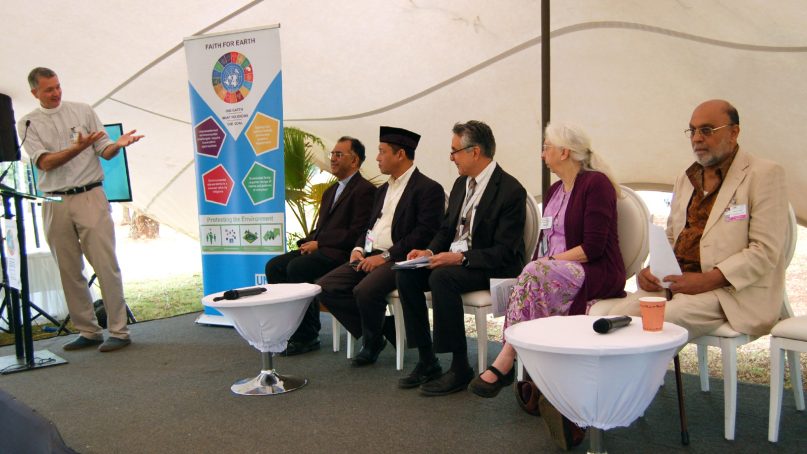
NAIROBI, Kenya (RNS) — At a small tent on the edge of the U.N. campus here, environmental activists from the world’s faith traditions huddled on the sidelines of last week’s March 11-15 meeting of some 5,000 environmental scientists, politicians and civil society, the fourth gathering of the United Nations Environment Assembly.

As the official delegates discussed current environmental challenges, sustainable consumption and production, the faith leaders, who joined the assembly for the first time in a U.N.-sponsored event called “Faith for Earth Dialogue,” talked about what religion’s role is in environmental protection.

“Religious leaders have a unique role to play in promoting ecological sustainability, especially because 85 percent of the (world’s) people are affiliated with a religion,” said Rabbi Yonatan Neril, who is the founder and executive director of the Interfaith Center for Sustainable Development in Jerusalem and attended the event.

The faith-based group unexpectedly served as a spiritual presence after the Ethiopian Airlines crash, which particularly affected the U.N.’s offices in Nairobi, a hub of the international aid community that lost several members in the disaster.

The assembly, which represented more than 170 United Nations member states, said it had delivered a bold blueprint for change that directs a radical shift in the approach to tackling environmental challenges.

The group also agreed on a series of non-binding resolutions, key among them a proposal to protect oceans and fragile ecosystems.

But those attending the Faith for Earth Dialogue urged the U.N. to recognize the growing religious wave of concern and called for dramatic steps while saying that enough was not being done to address climate change and related environmental challenges.

The Rev. Fletcher Harper, left, addresses panelists during the U.N.-sponsored event called “Faith for Earth Dialogue” at the U.N. Environment Assembly in Nairobi, Kenya, on March 15, 2019. RNS photo by Fredrick Nzwili

“There should be no mistake that more and more religious communities are clear that we face a clear emergency,” said the Rev. Fletcher Harper, the executive director of GreenFaith, an American interfaith coalition for the environment.

“We need a stronger representation of values, combined with science, to underlie the policies of the world in relationship to the environment,” said Harper.

At the same time, Harper said, it was not easy for intergovernmental bodies like the U.N. to integrate faith voices because their audiences are nation states, for whom religion can be a complicated subject.

The world’s religions can look for ways to change their own cultures to make faith itself more sustainable, said Neril.


RELATED: Clergy divided as Kenya moves to save forest, evict 40,000 settlers


“Meat in particular has a disproportional impact on climate change because cows emit methane from their digestive systems,” said the rabbi. Changing diets can be difficult, but religious teaching can have a powerful effect on what we put in our mouths and can support compassion toward animals.

Rev. Joshtrom Isaac Kureethadam, coordinator of the Sector on “Ecology and Creation” at the Vatican Dicastery for Promoting Integral Human Development, said he took hope from the increasing spiritual response to climate change, including the indigenous communities around the world who view themselves as the protectors of the land or planet.

He cited climate change as one reason Pope Francis has called a special synod for October of this year of Roman Catholic bishops from the Pan-Amazonian region.

“He (Pope Francis) believes at the period of planetary emergency, the answer can come from these people, who have defended our common home for thousands of years. We can learn from their indigenous wisdom,” said the priest. “It is a time when the whole world will sit at the feet of the indigenous people and learn from them to take care of our common home.”

Experts say tropical forests that are home to other indigenous groups in the Congo Basin, Asia and Central America also help regulate regional and international weather patterns.

Above all, the faith activists urged the U.N. delegations to the assembly to approach climate change as an urgent human problem as much as a scientific one.

Bright Mawudor, the deputy general secretary of the African Conference of Churches, said in a speech to her fellow faith leaders that climate change was the world’s common future. “It’s as real as the food that we eat or as the clothes we wear. We need to tackle it with urgency,” Mawudor said.

America Cares About Climate Change Again

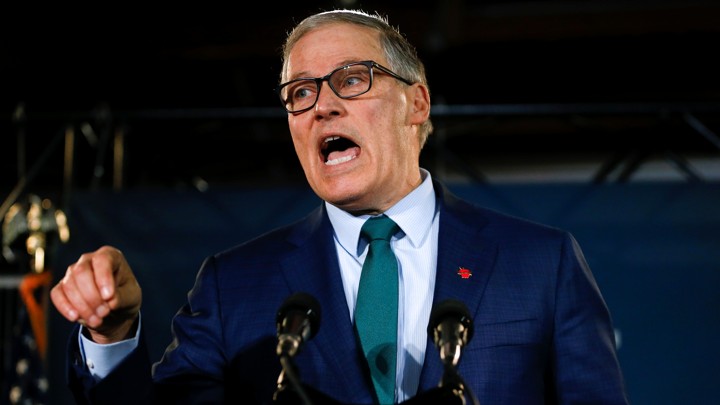
Jay Inslee, Democratic governor of Washington, launches his presidential campaign in Seattle.
Jay Inslee’s long-shot, climate-focused presidential campaign is only one of several new campaigns, run by Democrats across the ideological spectrum.LINDSEY WASSON / REUTERS

Suddenly, climate change is a high-profile national issue again.

It’s not just the Green New Deal. Around the country, the loose alliance of politicians, activists, and organizations concerned about climate change is mobilizing. They are deploying a new set of strategies aimed at changing the minds—or at least the behaviors—of a large swath of Americans, including utility managers, school principals, political donors, and rank-and-file voters.

They make a ragtag group: United by little more than common concern, they don’t agree on an ideal federal policy or even how to talk about the problem. They do not always coordinate or communicate with one another. And while their efforts are real, it remains far too early to say whether they will result in the kind of national legislative victories that have eluded the movement in the past.

But for the first time since November 8, 2016, if not far earlier, climate advocates are once again playing offense.

This mobilization starts at the top of the U.S. political system. Earlier this month, Washington State Governor Jay Inslee announced that he would run for president to elevate climate change as a pressing national issue. Inslee’s launch did not mention his White House–ready biography—he’s a former star athlete who married his high-school sweetheart—and focused entirely on his decades-long climate focus.

“I’m the only candidate who will make defeating climate change our nation’s number-one priority,” Inslee said in his launch video. His campaign raised $1 million in its first three days, a surprisingly large figure for a single-issue underdog candidate.

Other national political leaders are trying different strategies. Michael Bloomberg, the former New York mayor who has made climate a signature issue, announced that he would not run for president because his considerable fortune would be better spent fighting carbon pollution directly. Instead, he will fund a new campaign called Beyond Carbon for the Sierra Club, an extension of the club’s wildly successful Beyond Coal campaign, also bankrolled by Bloomberg. Beyond Coal says it has helped close 285 of the country’s 530 coal plants, a major reason for the overall decline in U.S. carbon emissions.

This widespread public concern about climate change is already being reflected in policy made at the state level. New Mexico will soon become the third state to set a goal for 100 percent carbon-free electricity. Last week, lawmakers passed a mandate that by 2045, 80 percent of the state’s power must come from renewable sources and 20 percent from carbon-free sources. The governor cheered the measure and is expected to sign it.

California, Hawaii, and the District of Columbia have adopted similar goals, all pegged to 2045. And their ranks could soon expand. Twelve more Democratic governors have promised to mandate the same 100 percent target, according to Rob Sargent, a campaign director at Environment America, a consortium of state-level environmental groups. “Six governors got elected in November running on 100 percent renewables,” he told me. “That wouldn’t have happened four or even two years ago.”

Excitement is also coming from the grassroots. On Friday, thousands of U.S. students refused to go to school, participating in a worldwide student strikefor climate action. The Sunrise Movement, a youth-led group that brought national attention to the Green New Deal in November, plans to hold 100 town-hall meetings in support of the plan across the country, organized by local chapters.

This massive protest in Lisbon was one of hundreds of “climate strike” events held worldwide on Friday. The class boycott spilled into the United States for the first time last week. (Rafael Marchante / Reuters)

Much of this activity is concentrated among Democrats. But public opinion has shifted in their favor on the issue. Nearly two-thirds of Americans say that the Republican Party’s position on climate change is “outside the mainstream,” according to an NBC/Wall Street Journal poll conducted last month. That represents a nine-point bump since October 2015, when the question was last asked.

That poll was conducted in February, when the Democratic-led Green New Deal dominated media coverage. But a majority of Americans said that month that Democratic positions on climate change were “in the mainstream.”

Within the party, rank-and-file Democrats seem to be taking the issue more seriously. Eighty percent of likely Iowa Democratic caucus-goers say that primary candidates should talk “a lot” about climate change—a result that suggests climate change is one of the Democratic Party’s top two issues, according to a CNN/Des Moines Register poll conducted by Selzer and Company this month. Only health care merited such consensus concern among the group.

That points to a potential upheaval in how important voters consider climate policy. In May 2015, when the same polling firm last posed a similar question to likely Democratic caucus-goers, climate change did not rank among the top five most important issues.

And several recent polls have also identified a huge, nearly 10-point surge in worry about climate change among all Americans. “We’ve not seen anything like that in the 10 years we’ve been conducting the study,” Anthony Leiserowitz, a researcher at Yale, told me in January.

Those national surveys found that Americans were motivated by a series of urgent new reports about climate science and an outbreak of extreme weather.

Some Republicans say they’re taking notice. “I think we’re moving from the science of climate to the solutions of addressing climate, and that is a big shift in particular for Republicans,” says Heather Reams, the executive director of Citizens for Responsible Energy Solutions, a nonprofit that encourages GOP politicians to support renewable energy.

This shift, if it is occurring, has yet to result in concrete policy proposals. Nor is it shared across the party. Some Senate Republicans have embraced “innovation” as a possible solution to climate change, but the Trump administration last week proposed zeroing out the budget for two major Department of Energy innovation programs. The programs will survive, however, in part because they have the support of Lamar Alexander, a powerful Republican from Tennessee who chairs the Senate Appropriations Subcommittee on Energy and Water Development.

In the House, Republicans are far more skeptical of climate action. Representative Rob Bishop, a conservative lawmaker from Utah, has said the Green New Deal is nearly “tantamount to genocide.” The House GOP has offered very few climate policies of its own. An exception: Two Republicans—Representative Brian Fitzpatrick of Pennsylvania and Representative Francis Rooney of Florida—last year co-sponsored a bipartisan bill to tax carbon emissions without increasing the federal budget.

It’s still unclear whether the spike in public concern will translate to any lasting GOP shift. The Green New Deal, in all its ambition and haziness, has reframed the climate conversation around solutions, where Democrats have more to say right now; if moderate Democrats fell back to insisting on the acceptance of climate science alone, Republicans might be happy to meet them there.

In any case, the views of the country’s most powerful Republican, President Donald Trump, seem extremely unlikely to change. So it’s left to his would-be 2020 opponents to heighten the contrast. At least eight candidates have made climate change a top issue, according to The New York Times. And announcing his candidacy for president last week, the former Representative Beto O’Rourke of Texas said that “interconnected crises in our economy, our democracy, and our climate have never been greater.” (He has yet to offer a concrete proposal on the issue.)

Whether this focus on climate change produces new policy ideas remains to be seen. Yet even so, environmental groups and their allies are feeling whiplash at how far the conversation has come since 2016. Says Alex Trembath, the deputy director of the Breakthrough Institute, an environmental research center based in Oakland: “If you had asked me a year ago if we would’ve been talking this much about climate change now, I would’ve said, ‘Absolutely not.’”

‘Devastating’ Arctic warming of 9-16°F now ‘locked in,’ UN researchers warn

“A sleeping giant awakes” as carbon-rich permafrost starts to thaw.

A polar bear looks for food at the edge of the pack ice north of Svalbard, Norway. CREDIT: Wolfgang Kaehler/LightRocket via Getty Images.
A POLAR BEAR LOOKS FOR FOOD AT THE EDGE OF THE PACK ICE NORTH OF SVALBARD, NORWAY. CREDIT: WOLFGANG KAEHLER/LIGHTROCKET VIA GETTY IMAGES.


Rapid and “devastating” Arctic warming is now almost unstoppable, United Nations researchers warn in a major new report.

Unless humanity makes very rapid and deep pollution cuts, Arctic winter temperatures will rise 5.4° to 9.0°F (3° to 5°C) by 2050 — and will reach an astounding 9° to 16°F (5° to 8.8°C) by 2080 — according to a report by the U.N. Environment Program released Wednesday.

Even worse, the report, “Global Linkages: A graphic look at the changing Arctic,” warns that warming will in turn awaken a “sleeping giant” in the form of vast quantities of permafrost carbon. This carbon has been frozen in the permafrost for up to thousands of years, but as the atmosphere warms, the permafrost will thaw. This will release the trapped carbon, and trigger more planet-wide warming in a dangerous feedback loop.

As the report explains, warming in the Arctic is occurring at least twice as fast as warming across the planet as a whole, thanks to Arctic amplification. One reason for this amplification is that  when highly reflective snow and ice melts due to higher temperatures, it is replaced by the dark blue sea or darker land, both of which absorb more solar energy than they reflect, leading to more melting.

The Arctic warming and sea ice feedback loop. CREDIT: NASA.
THE ARCTIC WARMING AND SEA ICE FEEDBACK LOOP. CREDIT: NASA.

“Arctic amplification is most pronounced in winter and strongest in areas with large losses of sea ice during the summer,” researchers explain, so winter warming in the region is projected to rise three times faster than the world as a whole.

But as this feedback loop plays out, it also triggers another one: the thawing of the Arctic permafrost and the release of the carbon that it contains.

Thawing permafrost is an especially dangerous amplifying feedback loop because the global permafrost contains twice as much carbon as the atmosphere does today . The permafrost, or tundra, is soil that stays below freezing (32°F or 0°C) for at least two years. It acts like a freezer for carbon, but now humanity has decided to leave the freezer door open.

The thawing releases not only carbon dioxide but also methane — a far more potent greenhouse gas — thereby further warming the planet. And as the planet continues to warm, more permafrost will melt, releasing even more greenhouse gases in a continuous feedback loop.

“New evidence suggests that permafrost is thawing much faster than previously thought,” the report warns. Indeed, a recent study found that Siberian permafrost at depths of up to 30 feet warmed a remarkable 1.6°F (0.9°C) from 2007 to 2016.

The U.N. report quotes the saying: “What happens in the Arctic does not stay in the Arctic.”

For instance, the Arctic’s rapid warming is weakening the jet stream, which leads weather patterns to stall, and that drives more extreme weather in this country, such as heavy precipitation on the East Coast and extreme drought on the West Coast.

And the quicker the Arctic heats up, the quicker the land-based Greenland ice sheet melts and the quicker sea levels rise. One 2017 study concluded that Greenland ice mass loss has tripled in just two decades.

But the authors of the U.N. report explain that simply meeting the initial emissions reduction targets in the 2015 Paris Climate Accord will not be enough to stop “devastating” warming and the loss of nearly half the permafrost this century. Those initial targets would not limit total warming to 2°C (3.6°F), which is why the agreement calls for ratcheting down those targets over time in order to keep warming “well below 2°C.”

So, to avoid accelerated warming, massive permafrost loss, ever-worsening extreme weather, and multi-feet sea level rise, the nations of the world must not only make deep cuts in CO2 emissions over the next decade, but also they must then keep ratcheting down global emissions to near zero around mid-century.

Yet, President Donald Trump is taking the country in the dangerously wrong direction by starting the process of withdrawing from the Paris agreement and rolling back domestic climate efforts.

What humanity needs to avert catastrophe are the kind of rapid emissions reductions envisioned in the Green New Deal, which aims for a carbon-free power sector by 2030 and the decarbonization of all other sectors as fast as technically possible.

Arla Foods aims for 30% cut in emissions from milk as part of net-zero vision

Plans to reduce greenhouse gas (GHG) emissions by 30% per kilo of milk in the next decade have been developed by Arla Foods as part of its sustainability strategy.

Arla has a wide ranging plan to reduce its global emissions impact from dairy farming

Arla has a wide ranging plan to reduce its global emissions impact from dairy farming

The ambitious target accelerates the firm’s transition to sustainable dairy production and is part of its overall aim to be carbon net zero by 2050, with strategies to address climate, air, water and nature.

Issues around the impact of dairy farming on the climate have consistently been one of the big topics for addressing climate change globally. A cow can produce around 70 to 120kg of methane each year – the equivalent of 2,300kg of CO2 – with the Food and Agriculture Organisation of the United Nations (FAO) stating the overall agriculture sector is responsible for 18% of global emissions.

Arla Foods aims to mitigate the issue of emissions from a dairy value chain comes by reducing a cow’s methane emissions through a series of techniques, such as optimised feed composition. Additionally, the food firm is working with its farmers to quantify and increase the carbon captured and stored in the soil.

According to a recent analysis from the FAO, global milk production has become more sustainable with a global average of 2.5kg CO2 per kilo of milk, but Arla farmers aim, on average, for 1.15kg CO2 per kilo or half of the global level.

The company has conducted 5,000 climate assessments on its 10,300 farms since 2013, and now is accelerating the work through the use of a digital documentation system where farmers can input data about their herd, milking system, feed, grazing, land use, and animal welfare. It claims to be one of the largest dairy farm benchmarking datasets in Europe.

Dairy farmer and chairman of Arla Foods, Jan Toft Nørgaard, said: “The climate assessment is highly motivating because it identifies your farms’ potential for CO2 reductions, which will often lead to cost savings.

“A next step is to include parameters that will indicate the farm’s impact on climate and environment. This will give us an opportunity to see in which areas we have the biggest potential, to identify best practice farms that we can learn from across our cooperative.”

Farming initiatives

The news follows a number of initiatives by farmers and agriculture firms to mitigate the impact on the environment of their businesses.

In 2016, Wyke Farm, the UK’s largest independent cheese producer and milk processor, became the first British dairy farm to hold a Carbon Trust Standard triple certification for improving environmental performance across carbon emissions, water use and waste. It followed work that the business had done since 2013 to become the first national cheddar brand to use 100% green energy.

Additionally, last August, Northern Ireland-based dairy manufacturer Dale Farm announced it was now running one of its cheese manufacturing plants with 100% renewable energy after bringing a self-consumption solar farm online.

James Evison

Does Alexandria Ocasio-Cortez really want to get rid of ‘farting cows’? Not yet, at least

  • The ambitious “Green New Deal” resolution put forward by freshman Rep. Alexandria Ocasio-Cortez, D-N.Y., and Sen. Ed Markey, D-Mass., aims to fundamentally reimagine the U.S. economy with the environment at top of mind.
  • Among its proposals, the resolution would have the U.S. creating “net-zero” greenhouses gases in 10 years.
  • Why “net zero”? “We set a goal to get to net-zero, rather than zero emissions, in 10 years because we aren’t sure that we’ll be able to fully get rid of farting cows and airplanes that fast,” a summary of the proposal says.

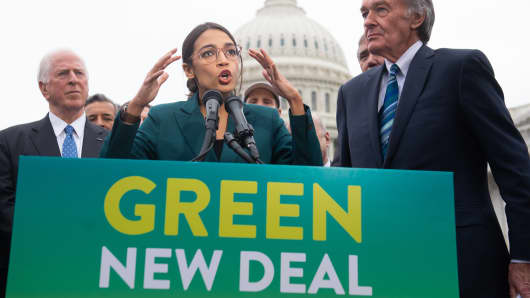
US Representative Alexandria Ocasio-Cortez, Democrat of New York, and US Senator Ed Markey (R), Democrat of Massachusetts, speak during a press conference to announce Green New Deal legislation to promote clean energy programs outside the US Capitol in Washington, DC, February 7, 2019.

Saul Loeb | AFP | Getty Images
US Representative Alexandria Ocasio-Cortez, Democrat of New York, and US Senator Ed Markey (R), Democrat of Massachusetts, speak during a press conference to announce Green New Deal legislation to promote clean energy programs outside the US Capitol in Washington, DC, February 7, 2019.

The “Green New Deal,” unveiled Thursday, sets sky-high goals to cut greenhouse gases to nearly zilch — but it’s not committed to getting rid of “farting cows” just yet.

That’s according to an initial outline of the ambitious new resolution put forward by freshman Rep. Alexandria Ocasio-Cortez, D-N.Y., and Sen. Edward Markey, D-Mass., which aims to fundamentally reimagine the U.S. economy with the environment at top of mind.

Markey and Ocasio-Cortez, the 29-year-old democratic socialist, called for completely ditching fossil fuels, upgrading or replacing “every building” in the country and “totally overhaul transportation” to the point where “air travel stops becoming necessary.”

They also aimed to have the U.S. creating “net-zero” greenhouse gases in 10 years.

LIVE, NEWS-MAKING DISCUSSIONS
UNIQUE, IN-PERSON EXPERIENCES

Why “net zero”? The lawmakers explained: “We set a goal to get to net-zero, rather than zero emissions, in 10 years because we aren’t sure that we’ll be able to fully get rid of farting cows and airplanes that fast.”

At the time this story was published, the FAQ page with the phrase “farting cows” appeared to have been removed from Ocasio-Cortez’s website. Fox News’ John Roberts reported that the language was tweaked to “emissions from cows” in an update, which also appears to have been deleted.

John Roberts

@johnrobertsFox

The FAQ’s released by @AOC ‘s office regarding the “Green New Deal” include the following passage: “We set a goal to get to net-zero, rather than zero emissions, in 10 years because we aren’t sure that we’ll be able to fully get rid of farting cows and airplanes that fast”

John Roberts

@johnrobertsFox

The latest version of FAQ’s on her blog has removed the “f” word in favor of “emissions from cows”

Holy cow

498 people are talking about this

Language notwithstanding, greenhouse gas emissions from cows have a bigger environmental impact than one might expect.

Methane gas produced by bovine flatulence contributes a significant portion of the greenhouse gases contributing to global warming, according to the United Nations.

Livestock farming produces about 18 percent of all those environmentally damaging gases — and about a quarter of that chunk comes from cow farts and burps, the U.N. says.

The lawmakers appear to recognize this. One of the Green New Deal’s 14 infrastructure and industrial proposals is to “work with farmers and ranchers to create a sustainable, pollution and greenhouse gas free, food system that ensures universal access to healthy food and expands independent family farming.”

Spokespersons for Markey and Ocasio-Cortez did not immediately respond to CNBC’s questions about the reference to cow farts in the summary of their Green New Deal.

In the meantime, America’s nearly 100 million cows can look forward to years of munching grass and passing gas still ahead of them.