PINEDALE, Wyo. (Reuters) – Hotter, drier conditions have led to more severe wildfires in Yellowstone National Park, while growing numbers of visitors have harmed everything from prized hydrothermal features to its famed grizzly bears, the park said in a report on Monday.
FILE PHOTO: A bison walks in Yellowstone National Park in Wyoming, U.S. on August 10, 2011. REUTERS/Lucy Nicholson/File Photo
Average temperatures in Yellowstone, which has been designated as both World Heritage and Biosphere Reserve sites by a United Nations panel, are exceeding historical norms even as climate change is blamed for a string of fires that have increased in size and which last longer, according to the study.
The 60-page “The state of Yellowstone vital signs and select park resources, 2017” report is one of just four compiled in the past decade. They are designed to track one of the largest, nearly intact temperate ecosystems in the world.
Yellowstone is celebrated for geothermal areas that contain about half the world’s active geysers, as well as forests, mountains, meadows, rivers and lakes considered a crucial sanctuary for the largest concentration of diverse wildlife in the Lower 48 states. The report shows it has seen warmer summers with less moisture and shorter winters in recent years.
At Mammoth Hot Springs in the northwest of the park, for example, the average annual daily minimum temperature has increased by 3.9 degrees Fahrenheit from 1941 to 2016 even as total annual precipitation has for the most part been below the long-term mean of 15.3 inches and snowpack has generally declined, scientists found.
Researchers noted an increase in the size of wildfires that impact vegetation and degrade air quality and said the future holds more of the same.
“If climate trends continue along their current trajectory, fires within the park will continue to be larger (and) burn for longer durations,” according to the report.
The millions of visitors who flock to Yellowstone each year from around the globe are behind a trend that includes vandalism to unique thermal features.
The thermal features have been subjected to everything from a drone crashing into one of them to crowds surging onto fragile grounds surrounding the features.
And while the grizzly population in the Yellowstone area is considered stable at roughly 700 bears, humans engaged in such pastimes as driving, hiking, camping and cycling can disrupt bear activities and even contribute to their deaths.
Yellowstone, most of whose 2.2 million acres sit in Wyoming but which also encompasses portions of Idaho and Montana, saw a record 4.2 million visits in 2016 and recorded its second busiest year in history in 2017.
Rice is a vital crop that provides people with more calories in total than any other food ( STR/AFP/Getty Images )
Rice farming is known to be a major contributor to climate change, but new research suggests it is far bigger a problem than previously thought.
Techniques intended to reduce emissions while also cutting water use may in fact be boosting some greenhouse gases, meaning the impact of rice cultivation may be up to twice as bad as previous estimates suggest.
Scientists at the US-based advocacy group the Environmental Defense Fund suggest the short-term warming impact of these additional gases in the atmosphere could be equivalent to 1,200 coal power plants.
Considering the importance of rice as a staple food crop, providing more calories to the global population than any other food, the researchers have recommended ways to adapt farming practices and make its cultivation more climate-friendly.
Past estimates have suggested that 2.5 per cent of human-induced climate warming can be attributed to rice farming.
The main culprit is methane, a potent greenhouse gas emitted from flooded rice fields as bacteria in the waterlogged soil produce it in large quantities.
However, there is another gas produced by rice fields that can have a harmful climate effect. Nitrous oxide, commonly known as laughing gas, is also produced by soil microbes in rice fields.
10 photographs to show to anyone who doesn’t believe in climate change
10show all
Partly in a bid to reduce methane emissions, several international organisations have promoted intermittent flooding of rice fields, but this practice comes with problems of its own.
“The full climate impact of rice farming has been significantly underestimated because up to this point, nitrous dioxide emissions from intermittently flooded farms have not been included,” said Dr Kritee Kritee from the Environmental Defense Fund, who led the research.
Analysis by the team showed that process of alternately wetting and drying rice fields – while reducing methane levels – is producing up to 45 times more nitrous oxide than constantly flooded fields.
The intermittent flooding and airing of the fields results in pulses of microbial activity that in turn leads to increased nitrous oxide levels.
“Increasing pressure on limited water resources under a changing climate could make additional rice farming regions look to intermittent flooding to address water limitations and concerns about methane emissions,” said Dr Kritee.
“Water management on rice farms needs to be calibrated to balance water use concerns with the climate impacts of both methane and nitrous oxide emissions.”
Despite being a powerful greenhouse gas in its own right that traps even more heat in the atmosphere than methane over long time periods, most rice producing countries do not report their nitrous oxide emissions.
Dr Kritee said it was essential that scientists began investigating this overlooked threat so that nations can tackle it effectively.
“We now know nitrous oxide emissions from rice farming can be large and impactful,” said Richie Ahuja, a co-author of this study.
By considering each farm individually and taking into account their methane, nitrous oxide and water use, the scientists suggest that specific strategies can be used that can minimise emissions of climate harming gases.
“We now also know how to manage the problem. Major rice producing nations in Asia are investing to improve the agriculture sector and could benefit from the suggested dual mitigation strategies that lead to water savings, better yields, and less climate pollution,” said Mr Ahuja.
Estimated global greenhouse gas emission (GHG) targets to keep within a 1.5°C rise in temperature compared to emissions from global meat and dairy production based on business-as-usual growth projections. Credit: Emissions impossible
Researchers at the Institute for Agriculture and Trade Policy and GRAIN have released a report titled “Emissions impossible – How big meat and dairy are heating up the planet.” The report is a discussion regarding an analysis the groups did on the impact the meat and dairy industries have on global warming. One of their major findings is that large meat and dairy corporations are set to overtake large oil companies as the largest emitters of greenhouse gases. In the report, the researchers also suggest that it is time to expand the field of corporations that get the major share of attention surrounding global warming. They make the case that that meat and dairy producers have flown under the radar for years, and that now, the time has come to include them.
Researchers for the two groups report that they conducted an extensive review of production numbers released by the largest meat and dairy producers and used those numbers to calculate greenhouse gas emissions. They note that very few of the largest meat and dairy corporations offer emissions data and that those that do fail to include data regarding the supply chain. They suggest further that the supply chain in the industry typically accounts for up to 80 percent of greenhouse gas emissions—it typically includes emissions from activities related to growing crops as well as methane emitted directly from livestock.
The researchers also report that a very large share of meat and dairy production occurs in just a few regions: Argentina, Brazil, the U.S., the European Union, Canada, Australia and New Zealand. They also claim that five of the biggest meat and dairy corporations are already responsible for more greenhouse gas emissions than BP, ExxonMobil or Shell. They further claim that their analysis of the industry showed that approximately 80 percent of the global allowable greenhouse gas emissions budget would be taken up by just the meat and dairy industry by 2050, if production is not reduced.
The researchers conclude their report by suggesting that soon there will be no choice—if we are to curb greenhouse gas emissions to meet targets set by agreed upon protocols, meat and dairy production will have to be greatly reduced.
New official research suggest we need 10-22 per cent reduction of livestock emissions
New Zealand would need to reduce livestock methane emissions by up to 22 per cent by 2050 to stop any additional global warming, official research shows.
This would likely require a serious reduction in the number of livestock farmed, unless new and untried technologies can be shown to work.
Livestock contribute the vast majority of our methane emissions, mostly through belching.
The release from the Parliamentary Commissioner for the Environment throws a wrench into an emerging consensus across the country that “stabilising” NZ’s short-lived methane emissions at current levels could be a viable option to stop warming.
It suggests that actual “stabilisation” would still require a reduction in livestock or the success of new methods to lower emissions, such as special feeds, vaccines or tweaking livestock breeding.
Climate Change Minister James Shaw is currently consulting on plans for a Zero Carbon Act, which would set some kind of reduction target in law.
Parliamentary Commissioner and former National Party Environment Minister Simon Upton is working on a wider report concerning the Zero Carbon Act but decided to put out this research from Andy Reisinger early in order to inform debate.
Federated Farmers vice-president Andrew Hoggard said the key point of the report was reductions of 10-22 per cent were needed by 2050, whereas earlier reports before said they just needed to be stabilised.
There are three goals for 2050 currently on the table – and none of them consider “no more warming” to be the actual goal.
One is exactly what it says on the tin: net zero carbon, but nothing else, meaning agriculture’s “short-lived” methane emissions would be left alone. The second or middle option is net zero long-lived gases, like carbon dioxide and nitrous oxide, and “stabilised” short-term gases, like methane.
Finally, the third option is simply net zero for all greenhouse gas emissions by 2050.
“To me the report is saying we don’t need to go to complete net zero,” Hoggard said.
The middle option of “stabilisation” has attracted a lot of interest but has not yet been made completely clear. The idea behind it is that since methane emissions decay in the atmosphere much faster than carbon, the Government could keep a steady level of methane emissions over time and, because of the drop-off from emissions ten years ago, simply keep the level consistent without contributing much to further warming, recycling the decaying methane with new emissions.
About 43 per cent of New Zealand’s greenhouse gases are caused by methane and 11 per cent by nitrous oxide, the first generated by all livestock burping, the latter mainly by cows urinating.
The research released by Upton is careful not to suggest policy, but to simply make clear that while methane mostly decays within a decade or so, its lasting effects are such that a significant reduction would still be needed for New Zealand to contribute to no further warming.
“It shows that holding New Zealand’s methane emissions steady at current levels would not be enough to avoid additional global warming,” Upton said.
“If New Zealand’s emissions of livestock methane were held steady at 2016 levels, then within about ten years the amount of methane in the atmosphere from that source would level off. However the warming effect of that methane would continue to increase at a gradually declining rate for more than a century.”
KELLY HODEL/FAIRFAX NZ
Livestock contribute the vast majority of our methane emissions, mostly through belching.
Hoggard said if cow efficiency could be improved as it has, and farmers reduced stock, the reductions could occur.
“There are things I could do but might not be allowed. One the things that holds me back are dry conditions. Irrigation would help but that’s a dirty word, and a herd home would help but people get upset if cows are in there for a length of time.”
“People say cut cow numbers but they have an ideological view of the sector and don’t understand the trade-offs in operating a biological system,” Hoggard said.
The research shows that even if stabilised at 2016 levels warming from methane would increase by 10-20 per cent by 2050, and 25-40 per cent by 2100.
To avoid this New Zealand would need to reduce livestock methane emissions by between 10 and 22 per cent by 2050 and then 20-27 per cent by 2100.
The range of options depends on the amount that other countries reduce their emissions, as methane interacts with other gases in complex ways.
National climate change spokesman Todd Muller welcomed the report, saying it showed New Zealand needed to reduce agricultural emissions by “just” 10-22 per cent.
“The research released today shows that reducing methane emissions by just 10 – 22 per cent will mean New Zealand’s methane emissions have a neutral impact on global temperature,” Muller said.
“If we reduce methane by 10 – 22 per cent, and reduce all other gases to zero, it is equivalent to a 54 – 60 per cent reduction in our total emissions which is in line with New Zealand’s existing 2050 target.”
Muller and party leader Simon Bridges have made clear they want to work with the Government on setting a target not likely to be changed the moment the Government does.
“We are working with the Government to make meaningful bi-partisan progress on climate change. National wants an independent, non-political Climate Change Commission established so we have a framework through which we address climate change issues in the future,” Muller said.
Acting Climate Change Minister Eugenie Sage said it was a useful contribution to the policy debate, and the reduction was achievable.
“This report shows New Zealand’s methane emissions would need to reduce by about 10 to 22 per cent below 2016 levels (ie the latest year for which emissions data is available) by 2050, with further reductions between 20 to 27 per cent by 2100, if we want to ensure methane emissions from livestock don’t contribute to additional global warming,” Sage said.
She noted some in the sector believed the reduction was possible with existing technology.
“That is seen as achievable by some in the agricultural sector, given that methane output per unit of production has been in decline by about 1 per cent per year for the last few decades, and given some leaders in the sector believe they can reduce methane output by as much as 30 per cent using existing technology and best practice.”
Greenpeace sustainable agriculture campaigner Gen Toop disagreed, saying a reduction in cow numbers was the only viable path forwards.
“The dairy industry say there are no easy solutions for reducing methane emissions from ruminants but they deny the obvious solution is to reduce livestock numbers. Fewer cows means fewer emissions,” Toop said.
“The simple truth is there are already too many cows for our climate to cope with, yet the Government is still allowing dairy conversions to continue – even in fragile and unique places like the Mackenzie country.”
Upton himself said the country and world needed to focus on reducing emissions.
“This whole debate started off in the early 1990s and we all said ‘we’re going to plant pine trees in the mean time because we don’t have an easy set of technologies, we’re going to use that time to find the technologies to find a way out,'” Upton said.
“We’ve used up 25 years, we still haven’t found the technologies. We haven’t focused on reducing emissions. We have to now focus on that.”
“2050 is not far away. You can’t turn things around overnight.”
He said there were encouraging technological breakthroughs, particularly on the carbon side of the issue, but actual reduction would still be needed.
Upton expected Governments would make peace with some level of warming from methane emissions, but should aim to get carbon down to net zero.
Photo by Donald Hobern
via: freeforcommercialuse.org
Australian farmers in New South Wales (NSW) are being given permission to kill increased numbers of larger species of kangaroos. There is already a kangaroo product industry that sees numbers of the animals hunted down for meat and leather, but now drought has decreased herbage required by both cattle and kangaroos.
Long ago, it was recognized that market hunting – killing wildlife for profit – was a fast track to extinction and thus not sustainable within capitalism, which demands continued growth in profits to work properly. But, so insatiable is the gastronomic demand for parts of dead animals that wild animals were simply replaced by domestic ones, which in turn are major sources of greenhouse gases. Animal protectionists have sought to convince environmentalists, including scientists able to understand complex processes that seem to challenge the cognitive abilities of the likes of U.S. president Donald Trump (who is still mired in denial over climate change), that reducing consumption of meat and dairy in favor of a more, even exclusively, plant-based diet is one of the easiest and most effective ways we have to reduce greenhouse gases.
No matter. Instead of attempting to reduce the source of the problem, the meat industry is instead encouraged, and kangaroos must give way so folks won’t have to think twice about their steaks and burgers.
There already is a commercial kangaroo hunt, but with regard NSW, Niall Blair, NSW Minister of Primary Industries, claims that without massive slaughter of kangaroos the kangaroos themselves will first eat all the food, and then starve. Such “pre-emptive euthanasia” is a commonly provided rationale for such culls. Major die-offs, both “natural” and human-caused, do occur in wildlife and natural selection generates adaptation to changing conditions, which are inevitable if we are so unable to control our own contribution to the problem, and clearly that is the case.
Put another way, we, not kangaroos, are the problem. Australia is earmarking $141 million to assist farmers, not only with compensation for lost income, but for mental health support. It will, however, not contribute to the solution to those parts of the problem we can influence, if only we had the intelligence and will to do so.
13,000 livestock, mostly cattle, have been in areas affected by evacuation orders and alerts
The Canadian Press ·
Cattle run on a ranch as the Shovel Lake wildfire burns in the distance sending a massive cloud of smoke into the air near Fort St. James. (Darryl Dyck/Canadian Press)
British Columbia’s agriculture minister says critical lessons learned from last year’s wildfires that had ranchers and producers suffering devastating losses will help save animals during another season that could force more people from their properties.
Lana Popham said Wednesday the province’s premises identification program, which was meant to trace cattle back to an operation during a disease outbreak, allowed animals to be rescued last year after evacuation orders were issued.
“As the fires increased last summer and this program seemed to have so much value we saw those numbers increase significantly,” she said of more farmers and ranchers registering for the program.
“That’s allowing us to get into areas that have been identified as heavy agricultural, livestock areas and be able to assess a situation and move those animals out as needed.”
In some cases, grazing cattle remained safe in certain areas after ranchers have left due to encroaching fires, Popham said, adding 35,000 livestock were on the loose last year at the height of the worst wildfire conditions.
“This program allows them to re-enter into evacuation zones and tend to their livestock so it’s extremely important for people to be registered for this program and I think over the last two years, especially, that message has hit home.”
So far this season, 13,000 livestock, mostly cattle but also sheep, horses and pigs, have been in areas affected by evacuation orders and alerts, Popham said, adding ministry staff are working with the B.C. Cattlemen’s Association to co-ordinate alternate grazing sites, organizing emergency feeds and helping with the relocation of animals.
“We won’t often know if they’ve been lost until they don’t come home later in the fall,” Popham said. “I have heard reports of cattle that have been burned, but no numbers on that yet.”
Williams Lake is one of the hardest-hit areas, Popham said.
“The emotional toll that these farmers and ranchers are feeling is tremendous. And we saw this last year. You see some of the strongest farmers you know break down when they realize some of their animals aren’t coming home.”
After the 2017 wildfires, the federal government provided $20 million in funding to help farmers and ranchers, but Popham said her ministry has not made any requests for financial help so far this year as it awaits assessments on areas that weren’t affected last year.
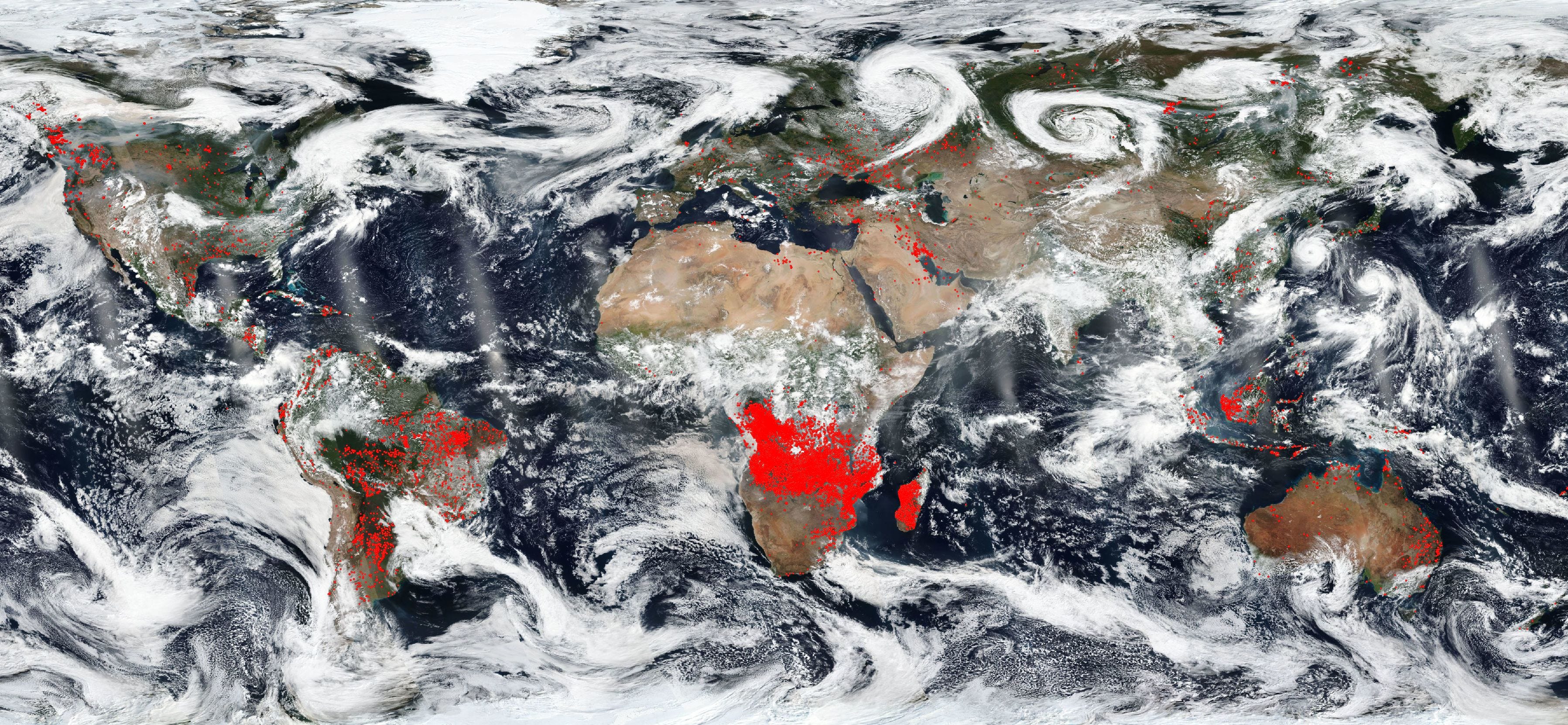
Satellite imagery of Earth is cool because it gives us a different perspective of our home, but it can also be quite disturbing. This week on Twitter, NASA shared an image that shows not only brown and green continents, vast oceans, and swirling white clouds, but also red dots that show a large number of fires currently burning over the world.
The red blobs are most concentrated in central Africa, but extend to parts of every other continent except for Antarctica. “The world is on fire,” read NASA’s tweet. In a blog post, the agency explained that the image was taken using the Earth Observing System Data and Information System (EOSDIS) Worldview, and that the areas that appear to be completely engulfed in flames were detected by thermal bands and are likely from agricultural burns. “The location, widespread nature, and number of fires suggest that these fires were deliberately set to manage land,” NASA writes. “Farmers often use fire to return nutrients to the soil and to clear the ground of unwanted plants. While fire helps enhance crops and grasses for pasture, the fires also produce smoke that degrades air quality.”
Other areas of red are likely wildfires, like the ones that continue to ravage parts of California. Northern Africa is largely untouched because there is not much to burn in the Sahara, and the poles are fine because of the low temperatures. NASA’s Worldview website allows users to go back in time to see how the burning areas have changed over the course of the summer, and there is even a feature that will animate a set period of time so that you can watch the red dots accumulate. The site also tracks major events like volcano eruptions, iceberg splits, and typhoons. The purpose is obviously not to revel in the destruction of the Earth as seen from above, but there is something cool about seeing the planet from this perspective and being able to witness its changes over time while tracking their natural and human causes.
IMAGE: METHANE BUBBLES UP FROM THE THAWED PERMAFROST AT THE BOTTOM OF THE THERMOKARST LAKE THROUGH THE ICE AT ITS SURFACE. view more
CREDIT: KATEY WALTER ANTHONY/ UNIVERSITY OF ALASKA FAIRBANKS
New NASA-funded research has discovered that Arctic permafrost’s expected gradual thawing and the associated release of greenhouse gases to the atmosphere may actually be sped up by instances of a relatively little known process called abrupt thawing. Abrupt thawing takes place under a certain type of Arctic lake, known as a thermokarst lake that forms as permafrost thaws.
The impact on the climate may mean an influx of permafrost-derived methane into the atmosphere in the mid-21st century, which is not currently accounted for in climate projections.
The Arctic landscape stores one of the largest natural reservoirs of organic carbon in the world in its frozen soils. But once thawed, soil microbes in the permafrost can turn that carbon into the greenhouse gases carbon dioxide and methane, which then enter into the atmosphere and contribute to climate warming.
“The mechanism of abrupt thaw and thermokarst lake formation matters a lot for the permafrost-carbon feedback this century,” said first author Katey Walter Anthony at the University of Alaska, Fairbanks, who led the project that was part of NASA’s Arctic-Boreal Vulnerability Experiment (ABoVE), a ten-year program to understand climate change effects on the Arctic. “We don’t have to wait 200 or 300 years to get these large releases of permafrost carbon. Within my lifetime, my children’s lifetime, it should be ramping up. It’s already happening but it’s not happening at a really fast rate right now, but within a few decades, it should peak.”
The results were published in Nature Communications.
Using a combination of computer models and field measurements, Walter Anthony and an international team of U.S. and German researchers found that abrupt thawing more than doubles previous estimates of permafrost-derived greenhouse warming. They found that the abrupt thaw process increases the release of ancient carbon stored in the soil 125 to 190 percent compared to gradual thawing alone. What’s more, they found that in future warming scenarios defined by the Intergovernmental Panel on Climate Change, abrupt thawing was as important under the moderate reduction of emissions scenario as it was under the extreme business-as-usual scenario. This means that even in the scenario where humans reduced their global carbon emissions, large methane releases from abrupt thawing are still likely to occur.
Permafrost is ground that is frozen year-round. In the Arctic, ice-rich permafrost soils can be up to 260 feet (80 meters) thick. Due to human-caused warming of the atmosphere from greenhouse gas emissions, a gradual thawing of the permafrost is currently taking place where the upper layer of seasonally thawed soil is gradually getting thicker and reaching deeper into the ground. This process wakes up microbes in the soil that decompose soil organic matter and as a result release carbon dioxide and methane back into the atmosphere. This gradual thaw process is accounted for in climate models and is thought to have minimal effect as thawed ground also stimulates the growth of plants, which counterbalance the carbon released into the atmosphere by consuming it during photosynthesis.
However, in the presence of thermokarst lakes, permafrost thaws deeper and more quickly. Thermokarst lakes form when substantial amounts of ice in the deep soil melts to liquid water. Because the same amount of ice takes up more volume than water, the land surface slumps and subsides, creating a small depression that then fills with water from rain, snow melt and ground ice melt. The water in the lakes speeds up the thawing of the frozen soil along their shores and expands the lake size and depth at a much faster pace than gradual thawing.
“Within decades you can get very deep thaw-holes, meters to tens of meters of vertical thaw,” Walter Anthony said. “So you’re flash thawing the permafrost under these lakes. And we have very easily measured ancient greenhouse gases coming out.”
These ancient greenhouse gases, produced from microbes chewing through ancient carbon stored in the soil, range from 2,000 to 43,000 years old. Walter Anthony and her colleagues captured methane bubbling out of 72 locations in 11 thermokarst lakes in Alaska and Siberia to measure the amount of gas released from the permafrost below the lakes, as well as used radiocarbon dating on captured samples to determine their age. They compared the emissions from lakes to five locations where gradual thawing occurs. In addition, they used the field measurements to evaluate how well their model simulated the natural field conditions.
Team members with the Alfred Wegener Institute (AWI) for Polar and Marine Research in Germany then used U.S. Geological Survey-NASA Landsat satellite imagery from 1999 to 2014 to determine the speed of lake expansion across a large region of Alaska. From this data they were able to estimate the amount of permafrost converted to thawed soil in lake bottoms.
“While lake change has been studied for many regions, the understanding that lake loss and lake gain have a very different outcome for carbon fluxes is new,” said co-author Guido Grosse of AWI. “Over a few decades, thermokarst lake growth releases substantially more carbon than lake loss can lock in permafrost again [when the lake bottoms refreeze].”
Because the thermokarst lakes are relatively small and scattered throughout the Arctic landscapes, computer models of their behavior are not currently incorporated into global climate models. However, Walter Anthony believes including them in future models is important for understanding the role of permafrost in the global carbon budget. Human fossil fuel emissions are the number one source of greenhouse gases to the atmosphere, and in comparison, methane emissions from thawing permafrost make up only one percent of the global methane budget, Walter Anthony said. “But by the middle to end of the century the permafrost-carbon feedback should be about equivalent to the second strongest anthropogenic source of greenhouse gases, which is land use change,” she said.
Disclaimer: AAAS and EurekAlert! are not responsible for the accuracy of news releases posted to EurekAlert! by contributing institutions or for the use of any information through the EurekAlert system.
Only 2 baby penguins from a colony of 40,000 survived in Antarctica last year! And scientists say the whole ecosystem could collapse unless we protect it from massive fishing fleets and climate destruction. Countries are about to vote to create a HUGE sanctuary. European leaders want it, but to get them to drive it home we’ve got to show it is a massive public priority.Join now — let’s get a million voices, opinion polls and media ads before the vote.
Dear friends,
18,000 beautiful baby penguins hatched in an Antarctic colony last winter. But just two survived!
The rest starved — and industrial-scale fishing and climate change threaten to wipe out countless other polar species. Scientists say the only way to save Antarctica’s ocean is by urgently protecting it — and if just two more governments give their backing, we can create a massive network of ocean sanctuaries there.
The vote is coming up, and European leaders can bring the blockers on board — if we quickly show massive public support, we can make sure they step up.Let’s make this huge, then run opinion polls, take out media ads, and deliver our voices directly to President Macron and the EU, calling on them to save this penguin paradise, before it’s too late.
In 2016, millions of us helped rally public pressure to create the first Antarctic Ocean sanctuary, in the Ross Sea. It is the largest marine protected area on the planet. But it represents only a small portion of the fragile ocean that surrounds Antarctica.
The wildlife there is already struggling because of climate change — and industrial fishing fleets could push this fragile ecosystem over the edge. At least three more sanctuaries are needed to keep this precious wilderness safe. And they could be created if we make sure EU leaders feel this is a public priority.
Whether we win another marine sanctuary there comes down to a single decision. Russia and China are the two main blockers — but experts say that French President Macron and the EU Commission can win them over. Let’s inspire them to action by raising a million beautiful voices to save this polar paradise — join now and share this everywhere.
Avaaz means voice in many languages and speaking up for our fragile planet is one of the things we do best. We have helped secure massive marine reserves all around the world — but this time, it’s not just one more sanctuary — we’re going for the entire Antarctic network and this petition will keep building until it is fully established.
With hope and determination,
Lisa, Pascal, Bert, Christoph, Mike, Nataliya and the whole Avaaz team
The awful news that all but two penguin chicks have starved to death out of a colony of almost 40,000 birds is a grim illustration of the enormous pressure Antarctic wildlife is under. The causes of this devastating event are complex, from a changing climate to local sea-ice factors, but one thing penguins, whales and other marine life don’t need is additional strain on food supplies.
Over the next year we have the opportunity to create an Antarctic Ocean Sanctuary – the largest protected area on Earth – which would put the waters off-limits to the industrial fishing vessels currently sucking up the tiny shrimp-like krill, on which all Antarctic life relies.
In 1990, the Voyager 1 space probe looked back at Earth from six billion kilometres away and took a historic selfie of our solar system. What it saw, according to renowned astrophysicist Carl Sagan, was a “pale blue dot”.
“Our planet is a blue planet,” echoed David Attenborough, in his opening words to the BBC’s landmark Blue Planet series. With over 70% of our world covered by water, this is no exaggeration. Our oceans can be seen from across the solar system.
The majority of this water falls outside of national borders. In fact, almost half of our planet is a marine natural wonder outside the boundaries of flags, languages and national divisions. These vast areas cover 230 million square kilometres, and they belong to us all. To give a sense of scale, that’s the size of every single continent combined, with another Asia, Europe and Africa thrown in for good measure. The size of our oceans may seem overwhelming. Our collective responsibility to protect them, however, should not.
It wasn’t long ago that the oceans were thought to be too vast to be irrevocably impacted by human actions, but the effects of overfishing, oil drilling, deep sea mining, pollution and climate change have shown that humans are more than up to the task of imperilling the sea and the animals that live there.
A humpback whale dives for krill in Wilhelmina Bay, off the Antarctic Peninsula. ‘The creeping expansion of industrial fishing is targeting the one species on which practically every animal in the Antarctic relies: krill.’ Photograph: Charles Littnam/WWF/EPA
All of us who live on this planet are the guardians of these environments, not only to protect the wildlife that lives in them, but because the health of our oceans sustains our planet and the livelihoods of billions of people.
Here’s the good news. The tide of history is turning. We on the blue planet are finally looking seriously at protecting the blue bits. Just a few months ago, in a stuffy room far from the sea, governments from around the world agreed to start a process to protect them: an ocean treaty.
This ocean treaty won’t be agreed until at least 2020, but in the meantime momentum is already building towards serious and binding ocean protection. Just last year a huge 1.5 million sq km area was protected in the Ross Sea in the Antarctic. In a turbulent political climate, it was a momentous demonstration of how international cooperation to protect our shared home can and does work.
Over the next two weeks, the governments responsible for the Antarctic are meeting to discuss the future of the continent and its waters. While limited proposals are on the table this year, when they reconvene in 12 months’ time they have a historic opportunity to create the largest ever protected area on Earth: an Antarctic Ocean sanctuary. Covering the Weddell Sea next to the Antarctic peninsula, it would be five times the size of Germany, the country proposing it.
The Antarctic is home to a great diversity of life: huge colonies of emperor and Adélie penguins, the incredible colossal squid with eyes the size of basketballs that allow it to see in the depths, and the largest animal on the planet, the blue whale, which has veins large enough for a person to swim down.
The creeping expansion of industrial fishing is targeting the one species on which practically every animal in the Antarctic relies: krill. These tiny shrimp-like creatures are crucial for the survival of penguins, whales, seals and other wildlife. With a changing climate already placing wildlife populations in the Antarctic under pressure, an expanding krill industry is bad news for the health of the Antarctic Ocean. Even worse, the krill industry and the governments that back it are blocking attempts at environmental protection in the Antarctic.
Ocean sanctuaries provide relief for wildlife and ecosystems to recover, but it’s not just about protecting majestic blue whales and penguin colonies. The benefits are global. Recovering fish populations spread around the globe and only now are scientists beginning to fully understand the role that healthy oceans play in soaking up carbon dioxide and helping us to avoid the worst effects of climate change. Sanctuaries encourage vital biodiversity, provide food security for the billions of people that rely on our oceans, and are essential to tackling climate change. Our fate and the fate of our oceans are intimately connected.
Creating the world’s largest ever protected area, in the Antarctic Ocean, would be a signal that corporate lobbying and national interests are no match for a unified global call for our political leaders to protect what belongs to us all. The movement to protect over half our planet begins now, and it begins in the Antarctic.


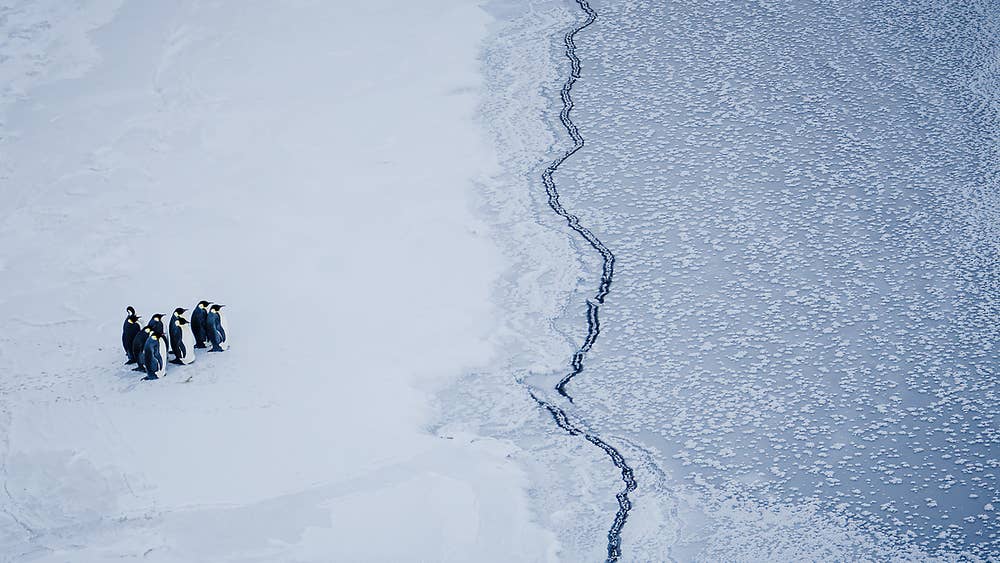


 Photo by




 Exposing the Big Game