Exposing the Big Game

Forget Hunters' Feeble Rationalizations and Trust Your Gut Feelings: Making Sport of Killing Is Not Healthy Human Behavior

Exposing the Big Game

Antarctica’s Largest Iceberg Is About to Die … Near the Equator

Antarctica's Largest Iceberg Is About to Die ... Near the Equator
After 18 years of drifting, Antarctica’s largest iceberg is about to melt away near South America.

Credit: NASA/ International Space Station

If being far from home ever gets you down, just be glad you aren’t also melting.

NASA scientists reported that, after drifting for nearly 20 years, the largest iceberg ever to break away from Antarctica’s Ross Ice Shelf is about to disappear forever.

Now floating northwest of the South Georgia islands near the tail of South America, the iceberg — named B-15 — has traveled more than 6,600 miles (10,000 kilometers) from the ice shelf and is veering dangerously close to the equator. [Photos: Diving Beneath Antarctica’s Ross Ice Shelf

Satellite images taken from the International Space Station (ISS) on May 22 confirm that the remains of the iceberg are on a crash course with warm tropical waters, where growing pools of meltwater will soon “work [their] way through the iceberg like a set of knives,” NASA glaciologist Kelly Brunt said in a statement.

The freewheelin’, formerly Connecticut-size iceberg first embarked on its long cruise after breaking away from the Ross Ice Shelf in 2000, NASA said. At the time, it was the largest single chunk of ice ever to split off from the shelf, measuring 160 nautical miles long and 20 nautical miles wide. (That’s a total area of 3,200 square nautical miles — larger than the island of Jamaica.)

Iceberg B-15 broke off of the Ross Ice Shelf in 2000, floated three quarters of the way around Antarctica and is now veering north toward its doom.

Credit: NASA/ International Space Station

Currents swept the berg three-quarters of the way around Antarctica; then, it suddenly shifted northward into the southern Atlantic Ocean within the past year or two, NASA said.

The stately raft of ice has gradually splintered into many smaller pieces, most of which have already melted. Today, only four chunks remain with a large enough surface area to be trackable by the National Ice Center (20 square nautical miles is the minimum).

The chunk observed from the ISS last month (its name is B-15Z) still has a surface area of about 50 square nautical miles, but it is likely nearing the end of its journey as it floats ever closer to the equator. According to NASA, icebergs have been known to rapidly melt once they drift into this region. A large fracture is already visible at B-15Z’s center, and smaller pieces are crumbling away from its edges.

B-15 will be missed. But its fans may take solace in knowing that, thanks to climate change, another “largest iceberg ever” will probably break away soon enough.

Climate Change Has Run Its Course

Its descent into social-justice identity politics is the last gasp of a cause that has lost its vitality.

Climate Change Has Run Its Course
ILLUSTRATION: DAVID GOTHARD

Climate change is over. No, I’m not saying the climate will not change in the future, or that human influence on the climate is negligible. I mean simply that climate change is no longer a pre-eminent policy issue. All that remains is boilerplate rhetoric from the political class, frivolous nuisance lawsuits, and bureaucratic mandates on behalf of special-interest renewable-energy rent seekers.

Judged by deeds rather than words, most national governments are backing away from forced-marched decarbonization. You can date the arc of climate change as a policy priority from 1988, when highly publicized congressional hearings first elevated the issue, to 2018. President Trump’s ostentatious withdrawal from the Paris Agreement merely ratified a trend long becoming evident.

A good indicator of why climate change as an issue is over can be found early in the text of the Paris Agreement. The “nonbinding” pact declares that climate action must include concern for “gender equality, empowerment of women, and intergenerational equity” as well as “the importance for some of the concept of ‘climate justice.’ ” Another is Sarah Myhre’s address at the most recent meeting of the American Geophysical Union, in which she proclaimed that climate change cannot fully be addressed without also grappling with the misogyny and social injustice that have perpetuated the problem for decades.

The descent of climate change into the abyss of social-justice identity politics represents the last gasp of a cause that has lost its vitality. Climate alarm is like a car alarm—a blaring noise people are tuning out.

This outcome was predictable. Political scientist Anthony Downs described the downward trajectory of many political movements in an article for the Public Interest, “Up and Down With Ecology: The ‘Issue-Attention Cycle,’ ” published in 1972, long before the climate-change campaign began. Observing the movements that had arisen to address issues like crime, poverty and even the U.S.-Soviet space race, Mr. Downs discerned a five-stage cycle through which political issues pass regularly.

The first stage involves groups of experts and activists calling attention to a public problem, which leads quickly to the second stage, wherein the alarmed media and political class discover the issue. The second stage typically includes a large amount of euphoric enthusiasm—you might call it the “dopamine” stage—as activists conceive the issue in terms of global peril and salvation. This tendency explains the fanaticism with which divinity-school dropouts Al Gore and Jerry Brown have warned of climate change.

Then comes the third stage: the hinge. As Mr. Downs explains, there soon comes “a gradually spreading realization that the cost of ‘solving’ the problem is very high indeed.” That’s where we’ve been since the United Nations’ traveling climate circus committed itself to the fanatical mission of massive near-term reductions in fossil fuel consumption, codified in unrealistic proposals like the Kyoto Protocol. This third stage, Mr. Downs continues, “becomes almost imperceptibly transformed into the fourth stage: a gradual decline in the intensity of public interest in the problem.”

While opinion surveys find that roughly half of Americans regard climate change as a problem, the issue has never achieved high salience among the public, despite the drumbeat of alarm from the climate campaign. Americans have consistently ranked climate change the 19th or 20th of 20 leading issues on the annual Pew Research Center poll, while Gallup’s yearly survey of environmental issues typically ranks climate change far behind air and water pollution.

“In the final stage,” Mr. Downs concludes, “an issue that has been replaced at the center of public concern moves into a prolonged limbo—a twilight realm of lesser attention or spasmodic recurrences of interest.” Mr. Downs predicted correctly that environmental issues would suffer this decline, because solving such issues involves painful trade-offs that committed climate activists would rather not make.

A case in point is climate campaigners’ push for clean energy, whereas they write off nuclear power because it doesn’t fit their green utopian vision. A new study of climate-related philanthropy by Matthew Nisbet found that of the $556.7 million green-leaning foundations spent from 2011-15, “not a single grant supported work on promoting or reducing the cost of nuclear energy.” The major emphasis of green giving was “devoted to mobilizing public opinion and to opposing the fossil fuel industry.”

Scientists who are genuinely worried about the potential for catastrophic climate change ought to be the most outraged at how the left politicized the issue and how the international policy community narrowed the range of acceptable responses. Treating climate change as a planet-scale problem that could be solved only by an international regulatory scheme transformed the issue into a political creed for committed believers. Causes that live by politics, die by politics.

Mr. Hayward is a senior resident scholar at the Institute of Governmental Studies at the University of California, Berkeley.

What killed the dinosaurs

[Well, isn’t this hopeful (for humans)]

https://www.cnn.com/2018/05/25/opinions/we-are-the-dinosaurs-of-today-opinion-brusatte/index.html

(CNN)The desert of northwestern New Mexico, in the vicinity of the Four Corners, is my special place. The high-altitude sun sparkles off the badlands, illuminating rocky pastels of red, green and brown that seem to extend indefinitely in all directions. No wonder that Georgia O’Keeffe — who painted here for decades — found this landscape as her muse.

Not many people live here, making it feel like a remote backwater within the world’s most industrialized country. But that’s the way I like it. I’m a paleontologist, and I visit here at least once a year, to hunt for fossils of dinosaurs and other long-extinct creatures. The fewer buildings, roads and houses to cover up the treasure we seek, the better.
Most of the candy-striped badlands in this part of New Mexico are carved from rocks laid down in rivers and lakes between about 84 and 56 million years ago. These were lush environments, teeming with life during a time when the Earth was much warmer and there were no ice caps on the poles. Bones, teeth, shells, and other parts of animals would often get buried in mud or sand and turn to stone, becoming the fossils that provide the only clues that these lost worlds ever existed.
You can find many dinosaurs here. We often come across the railroad spike teeth of T. rex and the gargantuan limb bones of long-necked sauropods of the Brontosaurus mold, some of which weighed more than a Boeing 737, easily making them the largest animals to ever thunder across the land.
The New Mexico desert where fossils can be found.

We find the skull domes that horse-sized omnivores called pachycephalosaurs used to head butt each other, and the jaws that horned and duck-billed dinosaurs sliced up plants with. So many species, big and small, living together.
I usually prospect these colorful hills with one of my best friends in science, Tom Williamson, a curator at the New Mexico Museum of Natural History and Science in Albuquerque. Sometimes, we walk for days and can’t get away from the dinosaur bones, because they are so common. By now we know the best places to find them: a layer-cake series of rock strata, formed during the very end of the Cretaceous Period (84-66 million years ago).
You can read the layers like the pages in a novel, and although the characters are fascinating, the story is fairly uneventful. During this whole stretch of time, dinosaurs were in control. History seemed to be standing still, and it appeared that dinosaurs would keep on ruling the world forever, as they had done for over 150 million years.
But then, suddenly, their bones disappear. We can pinpoint the exact place in the rock sequence. It’s where the cyclical mudstones and sandstones, records of that stable Cretaceous world, abruptly give way to coarser boulder-strewn rocks characteristic of fast-moving currents and corrosive storms. Something dramatic happened to the local environment, and the dinosaurs were gone.
A feathered dinosaur skeleton discovered in China.

The same pattern is seen halfway around the world, in the chalky-colored limestones of Gubbio, Italy. Underneath a medieval aqueduct that clings to the sides of a deep gorge, the geologist Walter Alvarez noted that the Cretaceous rocks at the bottom of the canyon are chock full of small fossils of ocean plankton.
Above these rocks, however, are nearly barren limestones, sprinkled with a few tiny, simple-looking fossils. The knife-edge separation between these two rocks is a dainty strip of clay, only about half an inch thick.
The clay is the cockpit voice recorder that reveals the fate of the plankton, and the dinosaurs: it is full of iridium, an element common in outer space but rare on Earth. It was delivered by a 6-mile-wide asteroid the size of Mount Everest, which was moving faster than a jetliner when it collided with the Earth 66 million years ago, punching a crater more than 100 miles wide and causing a chain reaction of volcanoes, wildfires, tsunamis, earthquakes and climate change that wiped out some 70% of all living things.
The dinosaurs couldn’t cope, and all of them (except for a few birds) died. They were soon replaced, and we see the evidence in New Mexico. The chaotic boulder-filled rock layer quickly gives way to the same types of mudstones and sandstones that had been formed during the Cretaceous, a sign that environments returned to normal within a few thousand years. But there are no dinosaur bones to be found in these newer Paleocene-aged rocks (66-56 million years old).
Instead, there are countless jaws, teeth, and skeletons of the things that took over from the dinosaurs, the species that went on to start the next great dynasty of Earth history: mammals.
It’s a sobering story, and one of relevance to us today, as our climate and environment are changing rapidly.
Just within the last few months studies have shown that sea level is rising twice as fast as we thought, the Antarctic ice sheets are melting at alarming rates, and temperature is increasing so fast that humans may make the Earth warmer than it has been in more than 50 million years.
There are consequences to all of this upheaval: we are in the age of the so-called “sixth extinction,” with species dying out at hundreds or thousands of times the usual rate. Faster, perhaps, than even during the five mass extinctions of Earth history, including the one that killed the dinosaurs.
Maybe dinosaurs can help save us. We’re used to thinking of them as movie monsters, skeletons that wow tourists at museums, and objects of childhood fascination. But they are so much more than that. They were real living, breathing, evolving animals that had to deal with rising and fall temperatures, fluctuating sea levels, volcanoes and asteroids.
After all, none of the environmental changes going on today is new. The Earth has been through them before, and dinosaurs and other extinct animals can tell the story of what happened. What died, what survived, how long it took to recover.
Among the mammals that Tom Williamson has discovered in those dinosaur-free, post-extinction rocks in New Mexico is a skeleton of a puppy-sized creature called Torrejonia.
It had a slender body, gangly limbs and long fingers and toes, and you can almost envision it leaping through the trees. It is one of the oldest primates — a fairly close cousin of ours, and a reminder that we humans had ancestors that were there on that terrible day, that saw the rock fall from the sky, that survived the cataclysm while the dinosaurs did not, probably because they were small, agile, adaptable and able to eat many types of food.
There is something almost poetic about it. In a sense, we are the dinosaurs. Before creatures like Torrejonia started the domino chain of evolution that led to humans, the dinosaurs ruled. They evolved superpowers like big brains, keen senses and the ability to grow to enormous sizes. There were probably many billions of them, living in all corners of the globe, that woke up on that day 66 million years ago confident of their undisputed place at the pinnacle of nature.
Follow CNN Opinion

Join us on Twitter and Facebook

We humans now wear the crown that once belonged to the dinosaurs. We are confident of our place at the pinnacle of creation, even as our actions are rapidly changing the planet around us. It leaves me uneasy, and a troubling thought lingers as I walk through the New Mexico scrublands, seeing the bones of dinosaurs give way so suddenly to fossils of Torrejonia and other mammals.
If it could happen to the dinosaurs, could it also happen to us?
Dinosaurs, of course, had no way to prevent the asteroid that killed them. But we have a choice — we can still stop, or at least slow down, pumping toxins into the atmosphere. Our choice will dictate whether we really are the dinosaurs: whether we go the way of T. rex and Triceratops, or whether we have learned from their sad story.

An Extreme Climate Forces Extreme Measures as Worst-Case Predictions Are Realized

Dahr Jamail, Truthout | Report

Mt. Rainier. (Photo: George Artwood; Edited: LW / TO)Mt. Rainier. (Photo: George Artwood; Edited: LW / TO)

“One of the penalties of an ecological education is that one lives alone in a world of wounds. Much of the damage inflicted on land is quite invisible to laymen. An ecologist must either harden his shell and make believe that the consequences of science are none of his business, or he must be the doctor who sees the marks of death in a community that believes itself well and does not want to be told otherwise.” — Aldo Leopold

Mountaineering, which has become more of a balm and solace for me than ever before, is an increasingly bittersweet experience. While the internal freedoms experienced continue to match the external while up in the high country, being on and amongst glaciers today entails being on one of the most dramatic front lines of anthropogenic climate disruption (ACD).

A small team of us worked our way across icy slopes of Mount Rainier in Washington State en route to a satellite peak recently, weaving our way through and around crevasses, only to find our route ultimately made impassible. According to route photos and information from just a few years ago, the third glacier we were to traverse had melted and broken up dramatically, leaving us with no choice but to turn around and plan another route, for another day.

Despite Mount Rainier being the most glaciated peak in the contiguous 48 US states, it is losing its ice rapidly now. Like most glaciers around the world, we are watching them vanish before our very eyes. At current rates of planetary warming, we will almost assuredly be hard pressed to find an active glacier in the 48 US states by 2100.

But it becomes obvious that these dramatic changes should be expected when we look at the bigger picture of ACD today.

Earth’s worst-case warming scenarios are probably the most likely now. Ice and glaciers around the world are melting far more quickly than believed possible even just a short while ago — the Greenland Ice Sheet is threatening to collapse, and is already slowing ocean currents, which could collapse far faster than expected as well.

We are losing potentially dozens of species every day.

Sea levels are rising at an increasingly rapid pace, and projections have already doubled for this century alone, not even to speak of what the next century will bring. The seas are warming as well, with each of the last five years having set a new record for the warmest they have ever been since humans have been on the planet. Widespread death of marine life is at a record pace, and we are likely already on the edge of an anoxic event as oceans are depleted of oxygen. Half of all the marine life on the planet has already been lost since just 1970.

Already in the Sixth Mass Extinction Event Earth has known, this one triggered by humans, we are losing potentially dozens of species every day already.

The Great Barrier Reef, the single largest reef system on Earth, has been changed “forever,” according to scientists, who have described the bleaching events that are wiping out the reef as “unprecedented” and “catastrophic.”

Freshwater from melting glaciers is likely already shifting the circulation of the oceans, causing scientists to warn that one of the worst-case predictions about ACD could already be happening. This circulation shift will ultimately lead to faster-rising seas and superstorms, along with shifting of entire climates for vast swaths of the planet.

Bizarre phenomena are already happening to what ice is left in the Arctic, and the sea ice of the Bering Sea never melted out so quickly or early in the season as it did this year.

Esteemed 86-year-old social scientist Mayer Hillman recently told the Guardian, humans are “doomed” due to what we have done to the planet. “The outcome is death, and it’s the end of most life on the planet because we’re so dependent on the burning of fossil fuels. There are no means of reversing the process which is melting the polar ice caps. And very few appear to be prepared to say so.”

While people like Hillman and dispatches like this continue to show us how very far along we already are regarding ACD, the time to savor our relationship to the planet — and each other — has never been more pressing than it is right now.

We must take this information in if we are to have an accurate map of reality, so as to better navigate the time we have left on Earth.

Earth

While it’s long been known that nations emitting the least carbon around the world are those most damaged by ACD, a recent study showed another layer to this effect: “tropical inequality,” is how the study puts their finding, which shows that the countries emitting the least carbon are also typically those which experience the greatest temperature swings from ACD, along with their respective impacts like droughts, floods, wildfires and extreme weather events.

While the UN has projected, conservatively, 200 million ACD refugees by 2050, even within the US, thousands of people are already facing displacement, and the number is sure to grow.

Marine salvage experts are hoping to use ships to tug icebergs from the Antarctic to Cape Town in order to help create a temporary solution to that city’s ongoing drought.

Yet another study has shown how ACD is shifting the times nature is able to eat, this time focusing in on 88 specific species that are being impacted. The study showed that these species’ biological feeding times are moving out of sync an average of six days every decade. For example, nearby where I live, Lake Washington’s plant plankton are blooming 34 days earlier than the zooplankton that eat them, which means the entire base of that ecosystem’s food chain is being deleteriously impacted.

Another report showed that as the planet continues to warm apace, energy demand for air conditioners and refrigeration are projected to jump 90 percent over 2017 levels. This also, of course, brings about a corresponding increase in CO2 emissions from the increased use of such devices.

Lastly in this section, as glacier melting around the planet continues to increase, the melting is destabilizing mountain slopes and literally causing mountainsides to collapse, sometimes falling into the sea.

Water

Rising sea levels are now threatening to burst a more than $1 trillion real estate bubble, as a recent study has shown a “pricing signal from climate change.” The study revealed how in Miami, housing values of homes located at lower elevations have not kept apace with rates of appreciation of homes located at higher elevations along the coastal areas. Another even broader study, “Disaster on the Horizon: The Price Effect of Sea Level Rise,” showed that homes which are exposed to sea level rise are already being priced 7 percent lower than homes the same distance from the coast but which are less exposed to flooding.

Given that most people’s savings are tied up in their home, when the home loses all of its value from sea level rise causing an economic bubble to burst, one can imagine the myriad problems this will generate across South Florida.

Large portions of the Western US are expected to have “above-average” potential for “significant” wildfire activity this year.

Almost needless to say, Florida’s Everglades National Park is under threat not just from sea level rise (the highest point in the park is four feet), but from the fact that the mangroves there are facing death also from the rising seas, according to a recent study.

The mangroves are literally being drowned by rising seas, and consequently, the land they hold steady from the sea is being washed away, allowing the seas to encroach upon more land even faster. “They are done,” Randall Parkinson, affiliated with the study, told the Guardian of the mangroves. “The sea will continue to rise and the question now is whether they will be replaced by open water. I think they will. The outlook is pretty grim. What’s mind boggling is that we are facing the inundation of south Florida this century.”

Up the coast from Florida in North Carolina, “sunny day flooding” (caused by sea level rise) is happening decades sooner than previously predicted, according to a recent report. “Sunny day flooding” is tidal flooding, which is a (for now) temporary inundation of low-lying areas during high tides.

Another recent study showed how Galveston, Texas, is under increasing threat from sea level rise, as this will make the island that much more vulnerable to more extreme hurricanes in the future. The study showed how hurricanes of the future will cause 65 percent more people there to become displaced, and five times as many buildings to be damaged. The study also showed how, already, more than 60 percent of the Gulf Coast and most of the bay shorelines are already retreating in those areas where 25 percent of the entire population of Texas lives.

The NOAA recently confirmed a sharp rise in methane — a greenhouse gas 100 times more potent than CO2 — in the atmosphere over a 10-year time frame.

Meanwhile, the US military paid for a study on sea level rise, and the results are sobering. The study showed that thousands of these low-lying tropical islands’ populations will become rootless; and their water supplies are already threatened “in the very near future” — an issue that will, of course, bring security concerns of its own.

The other side of the coin of ACD’s impacts in the watery realms is drought.

recent report showed that droughts across the Southwestern US will continue and prolong the threat of wildfires in that region. With mountain snowpacks already low in many of those states, such as Colorado and New Mexico, this summer will likely prove to be yet another exceptional wildfire season.

Another recent study showed how farmers along the arid-humid boundary that runs along the 100th meridian in the US will most likely be hit by dramatic ACD impacts like drought. The arid-humid boundary has shifted 100 miles eastward, bringing arid conditions further into what was formerly farmland.

Ongoing drought across Kansas has set the stage for what could be that state’s smallest wheat crop since 1989, likely a harbinger of things to come as that region continues to dry further.

In California, another study has underscored what we’ve known for years now, which is that extreme droughts and floods there are set to worsen as ACD progresses. The frequency of what the study refers to as “precipitation whiplash events” of shifting from droughts to floods will worsen across the state, but in Southern California, will double by 2100.

Over in Afghanistan, the lowest snowfall and rain in years over this last winter has led to the onset of a major drought that is already sounding alarms across that US-occupied war-torn country. Twenty of the 34 provinces of that country are already “suffering badly,” according to a report.

Climate Disruption Dispatches

An overheated atmosphere is able to hold more moisture, hence the ongoing increase of dramatic rainfall events like the recent one in India, where a rainstorm killed at least 91 people, and injured more than 160 as houses collapsed and trees were toppled.

Meanwhile, up in Alaska, this winter saw a record low in sea ice coverage. Winter sea ice cover across the Bering Sea was literally half that of the previous record low. “There’s never ever been anything remotely like this for sea ice,” Rick Thoman, an Alaska-based climatologist with the National Oceanic and Atmospheric Administration (NOAA), told Scientific American about the new record-low.

Signs of the times of extremity we are living in abound, like in South Africa, where marine salvage experts are hoping to realize a plan to use ships to tug icebergs from the Antarctic all the way to Cape Town in order to help create a temporary solution to that city’s ongoing drought and water crisis.

Oslo, Norway, has moved forward with banning all cars from the city by 2019.

Lastly in this section, scientists recently discovered yet another ACD-related feedback loop: This one is a result of warming temperatures around the globe contributing to increasing growth in freshwater plants within the world’s lakes in recent decades, which will cause the amount of methane emitted from lakes to double.

Fire

The National Interagency Fire Center with the USDA Forest Service has predicted that this year will be a “challenging” wildfire year across the country. Large portions of the Western US are expected to have “above-average” potential for “significant” wildfire activity this year, including Arizona, California, Colorado, Idaho, Kansas, Montana, Nevada, New Mexico, Oregon, Texas, Utah and Washington.

Not included in that list of states was Florida, where by early May, wildfires in Big Cypress National Park had burned more than 38,000 acres, and a fire in the Texas panhandle had burned more than 30,000 acres.

Air

In Pakistan, recent temperatures are reported to have cracked 50.2 degrees Celsius (122.3 degrees Fahrenheit) in Nawabshah, located about 127 miles northeast of Karachi. A regional newspaper there reported that the heat was so intense it caused people to pass out and that “business activities came to a halt” in a district of 1.1 million people. That area saw a record of 45.5° C (113.9° F) in March, setting an all-time March record for the entire country.

Warmer than normal temperatures in the US are afflicting places like Miami, where it is now warmer and wetter for far more of the year than it used to be. This sets the stage for that region to become more friendly to mosquitoes, hence increasing the likelihood that the Zika virus could return to Miami. Meanwhile, tick-borne diseases like Lyme disease are rapidly spreading across the US, with some fearing that Lyme disease could already be the first epidemic related to ACD.

The NOAA recently confirmed a sharp rise in methane — a greenhouse gas 100 times more potent than CO2 — in the atmosphere over a 10-year time frame. The atmosphere already has two and a half times more methane than it did before the industrial revolution began, and now scientists are working to understand how in just the past decade, methane levels have increased as rapidly as they have.

Atmospheric CO2 concentrations have, for the first time ever recorded, surpassed 410 parts per million (ppm), and sustained that increase for more than a month.

Another interesting unintended consequence of ACD is how it is likely to cut down on the amount of dust being blown into the atmosphere from the Sahara Desert by up to 100 million tons every year. This would act to starve the Amazon rainforest of much-needed nutrients, in addition to causing temperatures to rise across the North Atlantic. The amount of dust will decrease because warmer temperatures mean less wind, and hence less dust. The lack of dust means the rainforest will not get as much iron and phosphorous in the dust for its plants and marine life.

Denial and Reality

In April, the US Senate confirmed ACD-denying Republican Rep. Jim Bridenstine from Oklahoma as the head of NASA. Bridenstine has no scientific credentials and does not believe humans are to blame for ACD.

Wasting no time, by early May, the agency, under Bridenstine, had ended NASA’s Carbon Monitoring System, which had been, at least up until then, a $10 million annual effort to fund programs intended to improve the monitoring of carbon emissions around the world.

While this is just the latest in ACD-denial antics from the Trump administration that are having catastrophic impacts on the environment and climate, the denialism is thankfully grossly outweighed by reality.

The city of Oslo, Norway, has moved forward with banning all cars from the city by 2019.

Pakistan is attempting to plant 1 billion trees, and the World Bank has announced it will no longer fund oil and gas exploration.

Meanwhile, deeply troubling signs of how far along the planet is regarding ACD continue apace.

Atmospheric CO2 concentrations have, for the first time ever recorded, surpassed 410 parts per million (ppm), and sustained that increase for more than a month.

It is worth noting that human beings did not exist on the planet the last time there was this much CO2 in the air. CO2 is now over 100 ppm higher than any of the direct measurements that have been taken from Antarctic ice cores over the last 800,000 years, and most likely substantially higher than anything Earth has experienced for at least 15 million years, including eras when the planet was mostly ice-free.

Copyright, Truthout. May not be reprinted without permission.

The meaty side of climate change

 / 

BY SHEFALI SHARMA

Last year, three of the world’s largest meat companies — JBS, Cargill and Tyson Foods — emitted more greenhouse gases than France and nearly as much as some big oil companies. And yet, while energy giants like Exxon and Shell have drawn fire for their role in fueling climate change, the corporate meat and dairy industries have largely avoided scrutiny. If we are to avert environmental disaster, this double standard must change.

To bring attention to this issue, the Institute for Agriculture and Trade Policy, GRAIN and Germany’s Heinrich Boell Foundation recently teamed up to study the “supersized climate footprint” of the global livestock trade. What we found was shocking. In 2016, the world’s 20 largest meat and dairy companies emitted more greenhouse gases than Germany. If these companies were a country, they would be the world’s seventh-largest emitter.

Obviously, mitigating climate change will require tackling emissions from the meat and dairy industries. The question is how.

Around the world, meat and dairy companies have become politically powerful entities. The recent corruption-related arrests of two JBS executives, the brothers Joesley and Wesley Batista, pulled back the curtain on corruption in the industry. JBS is the largest meat processor in the world, earning nearly $20 billion more in 2016 than its closest rival, Tyson Foods. But JBS achieved its position with assistance from the Brazilian Development Bank and apparently, by bribing more than 1,800 politicians. It is no wonder, then, that greenhouse gas emissions are low on the company’s list of priorities. In 2016, JBS, Tyson and Cargill emitted 484 million tons of climate changing gases, 46 million tons more than BP, the British energy giant.

Meat and dairy industry insiders push hard for pro-production policies, often at the expense of environmental and public health. From seeking to block reductions in nitrous oxide and methane emissions, to circumventing obligations to reduce air, water and soil pollution, they have managed to increase profits while dumping pollution costs on the public.

One consequence, among many, is that livestock production now accounts for nearly 15 percent of global greenhouse gas emissions. That is a bigger share than the world’s entire transportation sector. Moreover, much of the growth in meat and dairy production in the coming decades is expected to come from the industrial model. If this growth conforms to the pace projected by the U.N. Food and Agriculture Organization, our ability to keep temperatures from rising to apocalyptic levels will be severely undermined.

At the November United Nations Climate Change Conference (COP23) in Bonn, Germany, several U.N. agencies were directed, for the first time ever, to cooperate on issues related to agriculture, including livestock management. This move is welcome for many reasons, but especially because it will begin to expose the conflicts of interest that are endemic in the global agribusiness trade.

To skirt climate responsibility, the meat and dairy industries have long argued that expanding production is necessary for food security. Corporate firms, they insist, can produce meat or milk more efficiently than a pastoralist in the Horn of Africa or a small-scale producer in India.

Unfortunately, current climate policies do not refute this narrative, and some even encourage increased production and intensification. Rather than setting targets for the reduction of total industry-related emissions, many current policies create incentives for firms to squeeze more milk from each dairy cow and bring beef cattle to slaughter faster. This necessitates equating animals to machinery that can be tweaked to produce more with less through technological fixes and ignoring all of this model other negative effects.

California’s experience is instructive. Pursuing one of the world’s first efforts to regulate agricultural methane, the state government has set ambitious targets to reduce emissions in cattle processing. But California is currently addressing the issue by financing programs that support mega-dairies rather than small, sustainable operators. Such “solutions” have only worsened the industry’s already-poor record on worker and animal welfare, and exacerbated adverse environmental and health-related effects.

Solutions do exist. For starters, governments could redirect public money from factory farming and large-scale agribusiness to smaller, ecologically focused family farms. Governments could also use procurement policies to help build markets for local products and encourage cleaner, more vibrant farm economies.

Many cities around the world are already basing their energy choices on a desire to tackle climate change. Similar criteria could shape municipalities’ food policies, too. For example, higher investment in farm-to-hospital and farm-to-school programs would ensure healthier diets for residents, strengthen local economies, and reduce the climate impact of the meat and dairy industries.

Dairy and meat giants have operated with climate impunity for far too long. If we are to halt global temperature spikes and avert an ecological crisis, consumers and governments must do more to create, support and strengthen environmentally conscious producers. That would be good for our health — and for the health of our planet.

America’s Biggest Beef Eaters Responsible for Large Chunk of Climate Emissions

20 percent of Americans account for nearly half of all U.S. food-related emissions, and their diets are heavy on meat, a new study shows.

A new study matched what people reported eating with the carbon footprint of those foods and then ranked them. Beef was a big part of the difference. Credit: Jeff Swensen/Getty Images

A new study matched what people reported eating with the carbon footprint of those foods and then ranked their diets. The top 20 percent were responsible for eight times more emissions than the lowest 20 percent, and beef was a big part of the difference. Credit: Jeff Swensen/Getty Images

The biggest eaters of burgers, steaks and ribs contribute the largest hunk of diet-related greenhouse gas emissions in the United States, according to a new study that examined individual eating habits across the country.

New research from the University of Michigan and Tulane University finds that 20 percent of American eaters accounted for nearly half of total diet-related emissions, and that their diets were heavy on beef.

If those people consumed fewer calories and shifted to a more moderate diet with less beef, that could achieve almost 10 percent of the emissions reductions needed for the U.S. to meet its targets under the Paris climate agreement, the researchers found.

The study, published Tuesday in Environmental Research Letters, adds to a growing pile of evidence linking beef with high greenhouse gas emissions, but it is the first to look at what people ate—or recalled eating—rather than at data from the U.S. Department of Agriculture, which measures how commodities flow through the economy.

“USDA tracks how much of a commodity is imported and exported, what gets used for non-food purposes, and applies food waste losses to those numbers. What comes out of that is divided by the population,” said Martin Heller, the study’s lead author. “What we looked at is what an individual said they ate on a particular day.”

With the “recall survey” approach, Heller and his co-authors were able to examine what and how certain portions of the population ate, providing data they believe could be more useful in developing diet-related recommendations that might drive consumers toward more sustainable food choices.

The study comes as more countries are recommending lowering beef consumption for environmental reasons, and as some contemplate taxes on beef, in part to help reach their emissions targets under the 2015 Paris Agreement.

Comparing Diets, Low-Impact to Beefy

To develop their estimates, Heller and his team built a database that looked at the environmental impacts of producing 300 commonly eaten foods. They then linked the database to the National Health and Nutrition Examination Survey (NHANES), a nationally representative survey that includes self-reported dietary data for more than 16,000 Americans.

The researchers were able to rank those diets by their greenhouse gas emissions. They found that the top 20 percent, with the highest carbon footprint, was responsible for eight times more emissions than the lowest 20 percent, and that beef consumption accounted for 72 percent of the difference.

Meat production overall—largely from beef, but also including pork and chicken—accounted for 70 percent of the greenhouse gas emissions in the highest-impact group, but only 27 percent in the lowest-impact group. And while the highest-impact group consumed an average of nearly 3,000 calories a day and the lowest just above 1,300, when the researchers adjusted the findings based on caloric intake, the highest-impact group still represented five times more emissions.

The researchers did not look specifically at how the beef was produced, which can influence its carbon footprint. “That information is not available on the dietary side,” Heller said. “People aren’t saying where their beef is coming from or how it was raised. It was just beef.”

Where Do Those Emissions Come From?

Agriculture accounts for about 9 percent of U.S. greenhouse gas emissions, according to the USDA and Environmental Protection Agency. Globally, food production is responsible for 30 percent of total emissions.

Of the 14.5 percent of global emissions from the livestock industry, more than two-thirds come from beef, largely from fertilizer used to grow grain and from cattle belching.

The study notes research that says dietary choices will become critical to meeting emissions targets under the Paris climate agreement as global demand for food rises with a growing population.

BEEF EATERS CONTRIBUTE ALMOST HALF OF THE U.S.’S DIET-RELATED GREENHOUSE GAS EMISSIONS

Nearly half of the United States’ diet-related greenhouse gas emissions result from only 20 percent of Americans’ dietary choices, a new study finds.

The study, published in Environmental Research Letters, finds that Americans with the highest levels of beef consumption account for 72 percent of the increase in diet-related emissions between the highest- and lowest-impact groups in the study, which produces about eight times the amount of emissions compared to the lowest-impact group. The study’s researchers attribute this to the fact that animal-based foods, particularly cow-based, contribute significantly higher levels of greenhouse gas emissions per pound than plant-based foods.

“Reducing the impact of our diets could achieve significant reductions in greenhouse gas emission in the United States,” said lead author Martin Heller, a researcher at the University of Michigan’s Center for Sustainable Systems, in a press release. “It’s climate action that is accessible to everyone, because we all decide on a daily basis what we eat.”

This study is one of the few to break down the environmental impacts of individual self-selected diets, as opposed to other studies that evaluate environmental effects of diets at the aggregate level. “Such work is essential for estimating a distribution of impacts, which, in turn, is key to recommending policies for driving consumer demand towards lower environmental impacts,” the study states.

If we stopped emitting greenhouse gases right now, would we stop climate change?

Best-case scenario, how much are we locked into? Kletr/Shutterstock.com

One of the goals of the international Paris Agreement on climate changeis to limit the increase of the global surface average air temperature to 2 degrees Celsius, compared to preindustrial times. There is a further commitment to strive to limit the increase to 1.5℃.

Earth has already, essentially, reached the 1℃ threshold. Despite the avoidance of millions of tons of carbon dioxide emissions through use of renewable energyincreased efficiency and conservation efforts, the rate of increase of carbon dioxide in the atmosphere remains high.

International plans on how to deal with climate change are painstakingly difficult to cobble together and take decades to work out. Most climate scientists and negotiators were dismayed by President Trump’s announcement that the U.S. will withdraw from the Paris Agreement.

But setting aside the politics, how much warming are we already locked into? If we stop emitting greenhouse gases right now, why would the temperature continue to rise?

Basics of carbon and climate

The carbon dioxide that accumulates in the atmosphere insulates the surface of the Earth. It’s like a warming blanket that holds in heat. This energy increases the average temperature of the Earth’s surface, heats the oceans and melts polar ice. As consequences, sea level rises and weather changes.

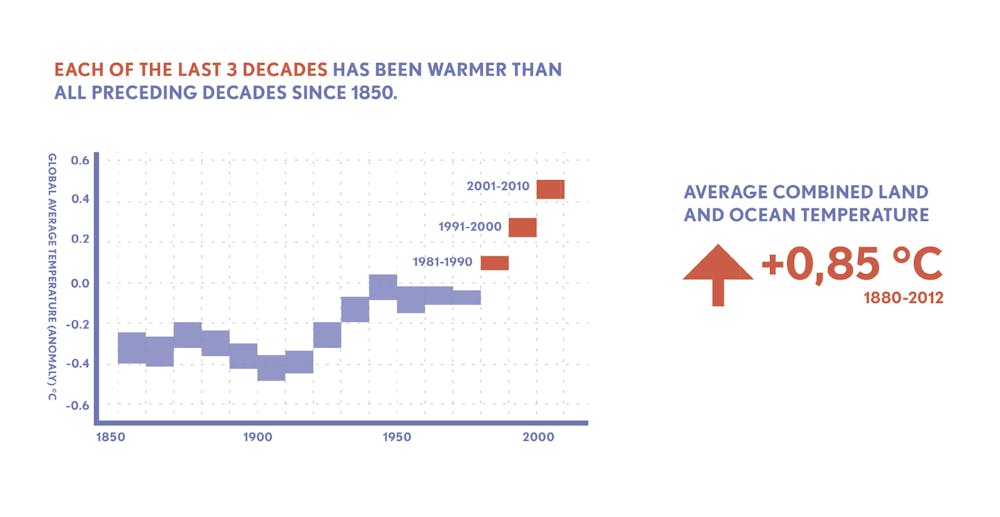
Global average temperature has increased. Anomalies are relative to the mean temperature of 1961-1990. Based on IPCC Assessment Report 5, Working Group 1. Finnish Meteorological Institute, the Finnish Ministry of the Environment, and Climateguide.fiCC BY-ND

Since 1880, after carbon dioxide emissions took off with the Industrial Revolution, the average global temperature has increased. With the help of internal variations associated with the El Niño weather pattern, we’ve already experienced months more than 1.5℃ above the average. Sustained temperatures beyond the 1℃ threshold are imminent. Each of the last three decades has been warmer than the preceding decade, as well as warmer than the entire previous century.

The North and South poles are warming much faster than the average global temperature. Ice sheets in both the Arctic and Antarctic are melting. Ice in the Arctic Ocean is melting and the permafrost is thawing. In 2017, there’s been a stunning decrease in Antarctic sea ice, reminiscent of the 2007 decrease in the Arctic.

Ecosystems on both land and in the sea are changing. The observed changes are coherent and consistent with our theoretical understanding of the Earth’s energy balance and simulations from models that are used to understand past variability and to help us think about the future.

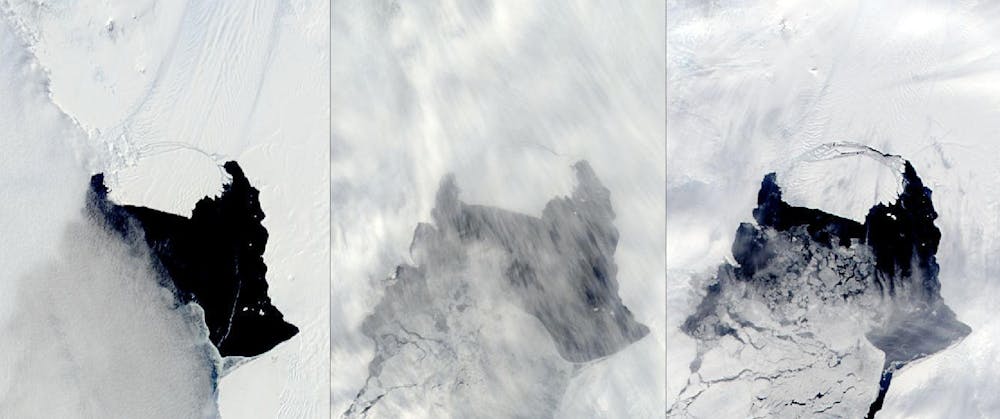
A massive iceberg – estimated to be 21 miles by 12 miles in size – breaks off from Antarctica’s Pine Island Glacier. NASACC BY

Slam on the climate brakes

What would happen to the climate if we were to stop emitting carbon dioxide today, right now? Would we return to the climate of our elders?

The simple answer is no. Once we release the carbon dioxide stored in the fossil fuels we burn, it accumulates in and moves among the atmosphere, the oceans, the land and the plants and animals of the biosphere. The released carbon dioxide will remain in the atmosphere for thousands of years. Only after many millennia will it return to rocks, for example, through the formation of calcium carbonate – limestone – as marine organisms’ shells settle to the bottom of the ocean. But on time spans relevant to humans, once released the carbon dioxide is in our environment essentially forever. It does not go away, unless we, ourselves, remove it.

In order to stop the accumulation of heat, we would have to eliminate not just carbon dioxide emissions, but all greenhouse gases, such as methane and nitrous oxide. We’d also need to reverse deforestation and other land uses that affect the Earth’s energy balance (the difference between incoming energy from the sun and what’s returned to space). We would have to radically change our agriculture. If we did this, it would eliminate additional planetary warming, and limit the rise of air temperature. Such a cessation of warming is not possible.

So if we stop emitting carbon dioxide from burning fossil fuels today, it’s not the end of the story for global warming. There’s a delay in air-temperature increase as the atmosphere catches up with all the heat that the Earth has accumulated. After maybe 40 more years, scientists hypothesize the climate will stabilize at a temperature higher than what was normal for previous generations.

This decades-long lag between cause and effect is due to the long time it takes to heat the ocean’s huge mass. The energy that is held in the Earth by increased carbon dioxide does more than heat the air. It melts ice; it heats the ocean. Compared to air, it’s harder to raise the temperature of water; it takes time – decades. However, once the ocean temperature is elevated, it will release heat back to the air, and be measured as surface heating.

Scientists run thought experiments to help think through the complex processes of emissions reductions and limits to warming. One experiment held forcing, or the effect of greenhouse gases on the Earth’s energy balance, to year 2000 levels, which implies a very low rate of continued emissions. It found as the oceans’ heating catches up with the atmosphere, the Earth’s temperature would rise about another 0.6℃. Scientists refer to this as committed warming. Ice, also responding to increasing heat in the ocean, will continue to melt. There’s already convincing evidence that significant glaciers in the West Antarctic ice sheets are lost. Ice, water and air – the extra heat held on the Earth by carbon dioxide affects them all. That which has melted will stay melted – and more will melt.

Ecosystems are altered by natural and human-made occurrences. As they recover, it will be in a different climate from that in which they evolved. The climate in which they recover will not be stable; it will be continuing to warm. There will be no new normal, only more change.

Runaway glaciers in Antarctica.

Best of the worst-case scenarios

In any event, it’s not possible to stop emitting carbon dioxide right now. Despite significant advances in renewable energy sources, total demand for energy accelerates and carbon dioxide emissions increase. As a professor of climate and space sciences, I teach my students they need to plan for a world 4℃ warmer. A 2011 report from the International Energy Agency states that if we don’t get off our current path, then we’re looking at an Earth 6℃ warmer. Even now after the Paris Agreement, the trajectory is essentially the same. It’s hard to say we’re on a new path until we see a peak and then a downturn in carbon emissions. With the approximately 1℃ of warming we’ve already seen, the observed changes are already disturbing.

There are many reasons we need to eliminate our carbon dioxide emissions. The climate is changing rapidly; if that pace is slowed, the affairs of nature and human beings can adapt more readily. The total amount of change, including sea-level rise, can be limited. The further we get away from the climate that we’ve known, the more unreliable the guidance from our models and the less likely we will be able to prepare.

It’s possible that even as emissions decrease, the carbon dioxide in the atmosphere will continue to increase. The warmer the planet gets, the less carbon dioxide the ocean can absorb. Rising temperatures in the polar regions make it more likely that carbon dioxide and methane, another greenhouse gas that warms the planet, will be released from storage in the frozen land and ocean reservoirs, adding to the problem.

If we stop our emissions today, we won’t go back to the past. The Earth will warm. And since the response to warming is more warming through feedbacks associated with melting ice and increased atmospheric water vapor, our job becomes one of limiting the warming. If greenhouse gas emissions are eliminated quickly enough, within a small number of decades, it will keep the warming manageable and the Paris Agreement goals could be met. It will slow the change – and allow us to adapt. Rather than trying to recover the past, we need to be thinking about best possible futures.

This article was updated on July 7, 2017 to clarify the potential effects from stopping carbon dioxide emissions as well as other factors that affect global warming.


This article has been updated from an original version published in December 2014, when international climate talks in Lima were laying the foundation for the2015 Paris Agreement.

Grass-fed beef is bad for the planet and causes climate change

Cows grazing

Still a problematic part of the menu

FLPA/John Eveson/REX/Shutterstock

https://www.newscientist.com/article/2149220-grass-fed-beef-is-bad-for-the-planet-and-causes-climate-change/

Prince Charles is wrong to support grass-fed beef. The idea that beef from cows raised on bucolic pastures is good for the environment, and that we can therefore eat as much meat as we want, doesn’t add up. New calculations suggest cattle pastures contribute to climate change.

“Sadly, though it would be nice if the pro-grazers were right, they aren’t,” says lead author Tara Garnett of the University of Oxford’s Food Climate Research Network. “The truth is, we cannot eat as much meat as we like and save the planet.”

Many meat eaters have long felt guilty that the beef steaks they love are bringing environmental disaster.

A key problem is that microorganisms in the guts of cattle emit millions of tonnes of methane every year. A typical cow releases 100 kilograms of methane a year and the world has about a billion of them. Since methane is a greenhouse gas, this exacerbates global warming.

Meanwhile, feeding the beasts destroys forests by taking land for pasture or to grow feed – and this deforestation also contributes to greenhouse gas emissions.

But a counter-view has gained currency. First popularised by Zimbabwean ecologist and livestock farmer Allan Savory, and supported by organic farmers like Prince Charles, it argues that grazing cattle on pastures is actually good for the climate.

The idea is that plants on pastures capture carbon from the air, especially when fertilised by manure. Pastures should also reduce our need for food crops grown on land that releases carbon when ploughed.

Doing the sums

Confused by conflicting claims, Garnett and her colleagues calculated the flow of greenhouse gases into and out of pastures. She found that “in some circumstances, you can get carbon capture, but not always and the effect is small. You cannot extrapolate from a nicely run Dorset farm to a global food strategy.”

At best, carbon capture only offsets 20 to 60 per cent of greenhouse gas emissions from grazing, mostly the methane from cattle. “And the carbon capture stops after a few decades,” says Garnett, when the carbon-enriched soils reach equilibrium with the air. “Meanwhile, the cattle continue to belch methane.”

Her findings are published in a report, Grazed and Confused?

The analysis is more comprehensive than past studies, says Tim Benton at the University of Leeds, UK. “It asks, if we are to eat meat, is there a better way to grow it? The answer is: not really.”

Less meat

Supporters of cattle grazing aren’t giving up just yet, though. Some say cattle have simply replaced wild ruminants, which also release methane. But Garnett points out that many cattle, especially in the tropics, graze on former forest land. In places such as the Brazilian Amazon, clearing trees for cattle causes massive greenhouse gas emissions.

At low densities of around one animal per hectare, carbon capture in soils could still exceed methane emissions, says Richard Young of the Sustainable Food Trust in Bristol, UK, which supports cattle grazing. However, he concedes that this isn’t true at higher densities.

Garnett’s conclusion is supported by a study published on 29 September, which found that methane emissions from cattle are 11 per cent larger than older methods would suggest, and thus a bigger contributor to global warming (Carbon Balance and Management, doi.org/cdpz).

“We need to reduce emissions from livestock,” says Benton. “That needs to come from dietary change.”

If McDonald’s is serious about reducing its carbon footprint, it may need to rethink the hamburger

The company has an ambitious-sounding plan to curb its emissions. But can it really take a meaningful stance on climate change while selling more Big Macs?

ENVIRONMENT FARM NEWS POLICY

In late March, McDonald’s issued a bold press releaseannouncing major cuts to its greenhouse gas emissions—a plan that will require the company to rethink not only how it lights and fuels its restaurants, but also how it sources its beef, which the company says amounts to 29 percent of its carbon footprint.

The changes will “enable McDonald’s to grow as a business without growing its emissions” through 2030, according to the press release, which offers some dazzling figures: a 36 percent reduction in greenhouse gas emissions from restaurants and offices, and a 31 percent reduction in “emissions intensity” from its supply chain (including  beef), which will prevent the release of 150 million metric tons of greenhouse gas.

But a closer look at the company’s “science-based” plan, which is completely voluntary and largely unverifiable, raises questions about how meaningful the emissions cuts will be.

McDonald’s has to contend with a body of science that suggests we need to reduce our beef consumption.

The company’s announcement, nevertheless, speaks to the company’s growing awareness of the economic challenges that climate change is expected to bring in the decades ahead.  Changing weather patterns will create more inconsistent agricultural conditions, while government regulators—in any of the 120 countrieswhere McDonald’s operates—could impose carbon taxes that also raise production costs.

The company is also thinking about consumers. As noted in its most recent annual report to investors: “the ongoing relevance of our brand may depend on the success of our sustainability initiatives, which require system-wide coordination and alignment.”

Given its burger-centric business model, McDonald’s may have a tough row to hoe trying to brand itself as a leader on climate change. Beef production emits more greenhouse gas than almost any other food we produce. And McDonald’s is one of the largest buyers in the world, last year reporting using 1.6 billion pounds of beef, a mountain of meat that casts an enormous carbon footprint.

When pressed for details about how it intends to reduce emissions from beef, McDonald’s would not offer many specifics.

“We are looking for ways to incorporate soil health initiatives into our supply chain sustainability programs through managed grazing practices and regenerative agricultural practices,” said Terri Hickey, McDonald’s senior manager of global corporate communications, in an email. She directed me toward materials that appear focused on the company’s previous beef sustainability goal, which was aimed at 2020.

McDonald’s overall carbon footprint may not change much, even if the company meets its proposed “reductions.”

As McDonald’s trumpets the “science” surrounding its greenhouse gas mitigation plan, the company increasingly has to contend with a body of science that suggests many of us need to reduce our beef consumption. This prescription is coming not just from public-health experts but also from climate scientists, who point to the high environmental costs of beef production.

Climate change doesn’t augur the end of red meat in our diets, or the collapse of McDonald’s, but it could mean significant dietary changes for many of us in the future.  While it seems unthinkable that the company would retire its iconic Big Mac and beefy Double Quarter Pounder with Cheese, our changing climate is a good reason to wonder whether cheap beef will still be the centerpiece on McDonald’s menu in the decades ahead.

Beef’s big impacts

Animal agriculture, as a whole, contributes around 15 percent of global greenhouse gas emissions, with beef cattle being the largest emitters, according to the Food and Agriculture Organization of the United Nations (UNFAO). Because cows digest food via enteric fermentation, they produce methane, a potent greenhouse gas, in their burps. Cattle production’s carbon footprint also includes the greenhouse gases from growing and fertilizing feed corn, as well as manure-related emissions.

Cows also have high environmental impacts because they give birth to one calf at a time instead of producing litters like pigs, says Gidon Eshel, an environmental science professor at Bard College in New York.

This biological reality may be difficult to change, but Eshel says if McDonald’s is serious about making emissions reductions, there are a lot of little things the company’s beef suppliers could do to become “less inefficient.” Still, reducing emissions meaningfully also likely means reducing consumption, he says.

Beef cattle require 28 times more land and 11 times more water than other farm animals on average, and emit five times more greenhouse gas

“The real question one must ask first about any environmental choice is not how large it is, but how easy would it be to cut it by an order of magnitude,” Eshel says.

For example, Eshel says, a modern, fuel efficient vehicle might get three times more miles to the gallon than an old gas-guzzler, presenting as much as a three-fold reduction in emissions.  Even more significant emissions cuts might be gained by shifting agriculture from beef cattle to almost any other kind of food production, he says. (That being said, beef cattle can be raised on marginal lands where it is difficult to grow other foods).

2014 study Eshel co-authored reported that beef is the second most commonly consumed source of calories in the U.S., but, according to his estimates, beef cattle require 28 times more land, 11 times more water, and emit five times more greenhouse gas than other farm animals, on average.

According to Eshel’s estimates, the 1.6 billion pounds of beef that McDonald’s used last year would produce around 22 million metric tons of greenhouse gas emissions. That’s equivalent to the average emissions you’d see from 4.8 million cars in a given year. Or, viewed another way, it amounts to one-third of one percent of total U.S. greenhouse gas emissions, says Eshel.

Reducing emissions meaningfully would also mean reducing consumption.

“One product, served by a single company, is a third of a percent of the total,” Eshel says. “I think it’s worth pausing and absorbing this.”

Emissions estimates, however, are not an exact or settled science—and the actual footprint of McDonald’s beef could be much lower or higher than Eshel estimates. Scientists are always rethinking how to calculate emissions, but they are clear that current beef production has a larger carbon footprint than most other foods we eat.

A groundbreaking study published last year and funded by NASA’s Carbon Monitoring System research initiative, found that methane emissions from livestock are probably higher than previously estimated—as much as 11 percent higher than prevailing estimates offered by the Intergovernmental Panel on Climate Change (IPCC) in 2006. It’s a finding that should factor into McDonald’s greenhouse gas targets.

Ghassem Asrarone of the study’s co-authors and the director of the Joint Global Change Research Institute, nevertheless, is sanguine about the “basket” of interventions livestock producers can draw on to reduce methane emissions, like better manure management.

Some of these interventions could increase the cost of production, however, which could also mean increasing the cost of burgers at McDonald’s, emblematic of the trade-offs that will work against the fast-food giant.

While Asrar thinks there are many ways the beef industry can and should reduce emissions, he is also clear that reducing consumption is part of the solution.

“That’s the general conclusion that the majority of published research reached,” says Asrar. “We have to manage our meat consumption if you want to reduce our footprint.”

The beef industry, citing its own science, sees things slightly differently.

Our changing climate is a good reason to wonder whether cheap beef will still be the centerpiece on McDonald’s menu in the decades ahead.

“Reducing consumption of beef, especially in the U.S. will do little towards mitigating climate change, and could cause significant sustainability issues with our entire system,” according to the U.S. Roundtable for Beef Sustainability, which hails U.S. beef as the “most efficient production system in the world.”

The Roundtable, citing its goal to “be the trusted global leader in environmentally sound, socially responsible and economically viable beef,” recently released a “sustainability framework” that addresses greenhouse gas emissions.  Its draft recommendations include things like the use of pharmaceuticals to promote faster animal growth.

Administered, in part, by the National Cattlemen’s Beef Association, a beef lobby group, the Roundtable’s members include meatpackers like JBS and Tyson, as well as a host of other companies that feed into the beef production model—like seed and animal pharmaceutical companies—and whose business interests are threatened by dietary shifts away from beef. It also includes fast-food companies like McDonald’s.

Fact-checking McDonald’s science

McDonald’s press release used the word “science” seven times, noting that its “science-based” program will “prevent 150 million metric tons of greenhouse gas emissions from being released into the atmosphere by 2030,” equal to taking “32 million passenger cars off the road for an entire year.”

But the science that informs the company’s emissions reduction program merits scrutiny.

McDonald’s annually reports data about its carbon footprint through a non-profit group called the CDP (previously the Carbon Disclosure Project). The CDP, however, charges companies an administrative fee to participate in its disclosure process, creating financial ties that erode the scientific independence of the project.

McDonald's quarter pounder with cheeseMcDonald’s

Avoiding the worst impacts of our changing climate means making major emission reductions—real, verifiable, science-based reductions—that may include Americans eating fewer burgers

Independence is paramount because carbon footprint calculations are subject to variations in how the data are measured, reported, and interpreted by regulatory bodies and accountability initiatives, as well as to political and economic influence.

For example, McDonald’s told me it has already “reassessed” its 2015 emissions data (it wouldn’t provide a copy), which will serve as a baseline for its planned emissions reductions through 2030. But how do we have confidence that McDonald’s data reporting and reassessments aren’t just clever accounting and paper trading?

“It’s a good method to get the most credits for your cuts: You inflate your baseline and then whatever cuts you make are much greater,” says Shefali Sharma, director of the European arm of an advocacy group called the Institute for Agriculture and Trade Policy. “Independent verification is key to understanding whether McDonald’s 2015 data is reliable.”

McDonald’s press release prominently notes that its emissions-reduction program has been “approved” by the “Science-Based Target Initiative,” which is managed by the World Resources Institute and the United Nations Global Compact—and also the World Wildlife Fund and CDP (both of which McDonald’s funds). In other words, it’s also not independent of McDonald’s.

Alberto Pineda, director of the initiative (and also associated with the World Wildlife Fund and CDP), says conflicts of interest are managed in a few ways, including through a “consensus” process where all of the initiative’s partners have to agree on emissions targets.

How do we have confidence that McDonald’s data reporting and reassessments aren’t just clever accounting and paper trading?

Pineda also clarifies that McDonalds’ supply chain emissions—the large bulk of the company’s carbon footprint, including its beef supply—are expected to “flatline” through 2030. That means McDonalds’ overall carbon footprint may not change much, even if the company meets its proposed “reductions.” Rather than reducing emissions, it may be more accurate to say the company’s plans are focused on not increasing emissions. If you squint at the press release, and look past the impressive-sounding 36 percent cuts in emissions, you’ll see that the company notes that its plan will “enable McDonald’s to grow as a business without growing its emissions.”

But avoiding the worst impacts of our changing climate doesn’t just mean not growing emissions; it means making major emission reductions—real, verifiable, science-based reductions. And that may include Americans eating fewer burgers.

“Coming up with proxy targets for companies that volunteer to do so on a self-reporting basis does not get us there,” notes Sharma, who is skeptical of industry taking the lead on climate change. “Moreover, it actually has the potential of deceiving consumers that indulging in this company’s products is helping the planet, when in effect, it may actually be increasing the company’s absolute emissions.”

The economic threat of climate change

As early as 2009, McDonald’s began advising investors about the potential liabilities the company faces related to climate change. In the most recent annual report it filed with the Securities and Exchange Commission, the company notes “there is a possibility that governmental initiatives, or actual or perceived effects of changes in weather patterns, climate, or water resources, could have a direct impact on the operations of the System in ways which we cannot predict at this time.”

While beef remains cheap and abundant, McDonald’s may quietly be rethinking its burger-as-usual business model.

Climate change is expected to manifest increasingly volatile weather, like droughts and rising temperatures, that could interfere with feed grain (corn) production, the building blocks of beef in the current U.S. feedlot production model. At the same time, as McDonald’s hints, “governmental initiatives“ could start asking the agricultural sector to pay the greenhouse-gas costs associated with all the manure that beef cattle produce, the methane they belch, and the fertilizers used to grow the corn that feeds them. This would almost certainly raise the price of beef, possibly substantially.

Government initiatives could also target McDonald’s customers, like publishing nutritional guidelines recommending reduced beef consumption. China, a major growth market for the Golden Arches, recently revised its national dietary guidelines in an effort to reduce meat consumption by 50 percent, a prescription widely cited as having both public health and environmental import. Similar guidelines were underway in the U.S., but were foiled by an intense lobby effort from the meat industry.

As these pressures loom over the company, beef remains cheap and abundant, for the moment, in places like the U.S. Still, McDonald’s may quietly be rethinking its burger-as-usual business model.

Just before McDonald’s announced its greenhouse emissions plan, the company shared a major marketing initiative to promote sales of chicken—a meat that Americans eat far more of than beef, and that, in current production models, has a far smaller carbon footprint than beef. A veggie burger on the menu could reduce emissions even further.

“I would be quite surprised if, in the short-term, McDonald’s or other burger joints abandoned beef altogether, and I don’t really think that is necessary for meeting either their targets or societal [climate] targets,” says Martin Heller, a researcher in the Center for Sustainable Systems at the University of Michigan. “It may mean offering menu options with smaller beef portions, and/or discontinuing large portion options. It likely will also mean introducing more non-beef options including (one would hope) plant-based alternatives.”

Climate change is expected to manifest increasingly volatile weather, like droughts and rising temperatures, that could interfere with feed grain (corn) production, the building blocks of beef in the current U.S. feedlot production model

In this regard, McDonald’s appears decidedly behind the curve, as many of its competitors have already begun expanding menus in this direction. This year, the drive-in fast-food chain Sonic introduced a new burger made from 25 percent mushrooms, marketed not only as environmentally friendly but also healthier than an all-beef patty. Burger King has long had a veggie burger on its menu; Carl’s Jr. has a meatless sandwich called the “Veg it Guacamole Thickburger;” and White Castle sells a veggie-patty version of its famous sliders.

McDonald’s is still in the courtship phase with veggie burgers in different markets. After a short test run in Finland last fall with a new, soy-based McVegan burger, the company made it a permanent menu option last December—but only in Finland and Sweden. “As the main ingredient is plant-based, the McVegan is considered to have a smaller climate impact,” a McDonald’s spokesperson told reporters.

As Heller suggests, another option fast-food restaurants could pursue to reduce beef-related emissions is simply shrinking the size of their burgers. That would reduce costs for the companies, and presumably make it easier to keep cheap burgers at the center of their menus going forward.

Right now, McDonald’s menu seems to focus on getting customers to buy more burger, not less. A Quarter Pounder with Cheese, fries, and a drink comes in just under $7 at my local McDonald’s. You can add another quarter-pound patty (making the burger a half-pounder) for only about a dollar more.

A grass-fed Big Mac?

Though McDonald’s has yet to publicize specific details about how it will reduce emissions from its beef supply, the company has pledged a $4.5 million grant to Arizona State University to study the climate benefits of Adaptive Multi-Paddock (AMP) grazing.

All cattle in the U.S. spend the first part of their lives grazing on pasture, but the vast majority are “finished” on crowded feedlots where they are fattened with corn. A recent study published in the journal Agricultural Systems found that keeping cattle on pasture their entire lives, and intensively rotating them across grasslands in the AMP model, could lead to major reductions in the carbon footprint of beef.

“It is hard to imagine that the very powerful commodity crop and beef organizations would back any beef/climate related policy.”

The study challenges previous research showing that feedlot cattle have a smaller carbon footprint than those finished on pasture. But even if AMP finishing is widely adopted and can deliver emissions reductions, it comes with a major tradeoff; it produces far less beef than feedlots.

I asked the lead author of the new AMP grazing study how much of the current volume of beef production could be sustained if finishing moved from the dominant feedlot model to AMP grazing.

“It’s safe to say that more than half could be produced,” says Paige Stanley, an environmental science graduate student at the University of California, Berkeley, who acknowledges the political and economic implications of slashing production by close to half.

“There are many actors and driving forces that will determine the future of beef production,” Stanley told me later via email. “It is hard to imagine that the very powerful commodity crop and beef organizations would back any beef/climate related policy.”

These powerful interests are some of McDonald’s closest partners in its work on beef sustainability (see herehere, and here), and these groups are unlikely to allow the highly productive corn-fed feedlot beef model go quietly into the night. Under current U.S. agricultural policy, feedlot beef is inexpensive and plentiful, which feeds McDonald’s business model and the customers who buy from its dollar menu.

That may be why McDonald’s research funding is limited to comparing the benefits of AMP grazing to other grazing models. Reconsidering feedlot finishing, project lead Peter Byck of Arizona State University tells me, is off the table.