Further research must now confirm in vitro findings in live animals.
Successive in vitro studies have shown up to 100% reduction in the emissions of the potent greenhouse gas from grass digestion.
A new study by Australian-based researchers shows that adding freeze-dried Asparagopsis taxiformis to test tubes replicating the fermentation process at work in a ruminant’s gut “completely inhibited the production of CH4” (methane).
The study led by James Cook University academic Matthew Vucko looked into various post-harvest treatments of the tropical red algae and found that “frozen and subsequently freeze-dried was the most effective processing method to maintain antimethanogenic activity”. It links the methane-inhibiting effect of the seaweed to the presence of the chemical compound bromoform.
Seaweed not only helped improve the cows’ health and growth, but also reduced their methane production
It builds upon research published last year, in which scientists added various types of seaweed to the fluid extracted from cattle’s rumen and observed gas emissions from the digestion of Rhodes grass. At the time, they found that adding 2% of asparagopsis taxiformis to the organic matter fed into the digestion process reduced methane emissions by at least 70% and up to 99%.
The latest study refined earlier findings to identify the treatment of seaweed most efficient at stopping methane formation.
According to Michael Battaglia of the Australian-based Commonwealth Scientific and Industrial Research Organisation, which supports the research, investigations started after a Canadian farmer noted the benefits of cattle grazing seaweed in 2005.
“Canadian researchers Rob Kinley and Alan Fredeen have since found that seaweed not only helped improve the cows’ health and growth, but also reduced their methane production by about 20%,” Battaglia wrote.
Climate change targets
The findings made since then are promising as agriculture represents one third of Ireland’s greenhouse gas emissions, most of these under the form of methane from ruminants. EU targetsimpose cuts on these emissions to combat climate change.
Further research is needed to confirm the potential of seaweed in controlling methane emissions from live animals as opposed to laboratory apparatus.
Side effects may be an issue as bromoform “is toxic to aquatic life with long lasting effects, is harmful if swallowed, causes serious eye irritation and causes skin irritation,” according to the European Chemicals Agency. The US National Library of Medicine adds that “chronic (long-term) animal studies indicate effects on the liver, kidney, and central nervous system (CNS) from oral exposure to bromoform,” which is also a “probable human carcinogen”.
Extreme heat struck across the Southwest U.S. this week, sending temperatures in Phoenix soaring to near 120°F and grounding airplanes that were unable to operate in such warm weather.
Heat waves are nothing new, but they have increased in frequency and severity in recent decades as a result of climate change. And each extreme heat event reveals another way our society simply isn’t built for such high temperatures, from our transport systems to the agriculture industry.
“We’ve built entire infrastructures with particular temperatures in mind,” says Matthew T. Huber, an associate professor of geography at Syracuse University. “When temperatures get really high, we don’t have the material capacity to deal with that.”
Still, humans continue to relocate to warm places like the Southwest, drawn by the temperate climate. In the coming decades, many climate researchers expect that pattern to reverse, as those once-desirable locations become too hot, flooded or otherwise uninhabitable. In some locations, particularly in the West, people will soon need to decide whether to rebuild for the new reality — or relocate elsewhere.
“There seems to have been a tendency for people to move to warmer locations with warm pleasant conditions,” says Jeremy Pal, a professor of civil engineering and environmental science at Loyola Marymount University. “If heatwaves become more frequent and/or severe or temperatures and humidity conditions become too extreme for an extended part of the year, I would expect populations to move to locations with less severe conditions.”
Here are four big ways we’re affected by extreme heat:
Transportation
Humans have constructed essentially every element of the modern transportation sector to operate under certain temperature conditions. Airplanes — like those in Phoenix — cannot safely take off under extreme heat conditions that affect how the engine operates. Amtrak monitors temperatures closely and reduces the speed of trains when it gets too hot. Roads and highways can buckle as concrete expands.
These problems are not necessarily unsolvable. Take the issue of airplanes, for instance. Aviation companies can build planes to withstand higher temperatures, and airports can extend runways to address engine issues. But all those changes would be costly and require a wholesale rethinking of many aspects of the industry.
Pulling the United States out of the Paris climate deal would have unforeseen consequences for President Trump, his international agenda and U.S. climate policy.
It would leave the world’s superpower outside an accord meant to reduce greenhouse gas emissions that includes nearly every other country in the world, aside from Syria and Nicaragua.
While it is not entirely clear that Trump has made up his mind to end U.S. participation in the deal, sources say that at a minimum, he is leaning in that direction.Here’s how to interpret and understand the decision.
Trump is playing to the base
Trump has called the pact a “bad deal” for the United States, and made withdrawing from it a key component of his “America First” campaign platform.
At an April rally, he called the agreement “one-sided,” and said “the United States pays billions of dollars while China, Russia and India have contributed and will contribute nothing.”
Given his past statements and promises, it isn’t hard to see why Trump would want to pull the United States out of the deal.
Yet the decision has provoked a furious internal battle within the White House, pitting Trump’s family members Ivanka Trump and Jared Kushner against adviser Steve Bannon and EPA administrator Steve Pruitt.
Pulling the United States out of the deal means Trump is siding with Bannon and his base over the objections of centrists in his government — and the business community.
Exxon Mobil Corp. and many large American businesses urged Trump to stay in the deal, arguing it would maintain U.S. influence over future talks.
“By remaining a party to the Pars agreement, the United States will maintain a seat at the negotiating table to ensure a level playing field so that all energy sources and technologies are treated equitably in an open, transparent and competitive global market,”
Exxon CEO Darren Woods wrote in a May 9 letter to Trump.
By pulling out of the Paris accord, Trump would be signaling he’s willing to take on supporters of the deal who are usually his allies — in order to back his core base of supporters.
Many Republicans on Capitol Hill are likely to support pulling out of Paris — 20 leading Senate Republicans, including Majority Leader Mitch McConnell (R-Ky.) asked Trump to do just that last week.
Withdrawing from Paris would greatly please conservative groups, who have orchestrated an all-out push in opposition to the pact.
Tuesday 30 May 2017 11.43 EDTLast modified on Tuesday 30 May 2017 11.44 EDT
Robert De Niro has said that the US has become a “tragic, dumbass comedy” under Donald Trump, and urged students to “work to stop the insanity” of his presidency. The actor made the comments during a commencement ceremony speech at Brown University in Rhode Island, where he was receiving an honorary doctorate of fine arts.
“When you started school, the country was an inspiring, uplifting drama,” he told students. “You are graduating into a tragic, dumbass comedy. My advice is to lock the [university’s] Van Wickle Gates and stay here.
“But if you do leave, work for the change. Work to stop the insanity. Start now so the class of 2018 will graduate into a better world.”
Watch Robert De Niro’s speech to Brown University students
De Niro has been highly critical of Trump since his election win last November. Earlier this month he said that the Trump administration had shown “mean-spiritedness” in its budget proposal, which advocated cutting arts funding. De Niro also suggested that Charlie Chaplin would not be allowed into the US todaydue to Trump’s strict immigration policy.
Before Trump’s election win, De Niro came under fire for saying he would like to punch him in the face. He later revised his comments, adding that he would have to “respect” the fact that Trump was president.
My first thought, on entering the hall, was, “Wow, she doesn’t look like an endowed-chair environmental law professor.” This was back in the fall of 2006, when I went to hear Mary Christina Wood speak. She was about my age, with long chestnut hair, a warm expression, and no makeup. I’ve since marveled that I was even there that night. I live in a college town, and good talks are not unusual. But I had a young daughter at the time, and this may have been the only evening lecture I attended that entire year.
Wood, also the mother of young children, was eloquent. She understood in a way I was just starting to grasp that climate change, if left unchecked, would soon threaten the health, safety and life support systems of our own kids, as well as that of future generations and everything else in the natural world. I left the lecture hall deeply shaken.
“Climate change, if left unchecked, would soon threaten the health, safety and life support systems of our own kids.”
Three things I remember clearly: First, I was impressed with her moral clarity. Second, in an answer to a question about what to do about the approaching climate crisis, she said, “Do something, do anything, just don’t do nothing.” And third, I remember that I lay awake that night, fearing for my daughter’s future.
In an effort to compel the government to protect the climate on behalf of present and future generations, Wood was developing a legal theory based on the “public trust doctrine.” I had heard of this doctrine when I worked on water issues in national parks. But I don’t believe anyone had tried to apply it to the earth’s atmosphere before.
The basic idea is that the government has a responsibility to protect vital natural resources for the benefit of all. By allowing polluters to destroy a stable climate, the government is failing to do its duty, and the courts can compel the government to act. It seemed like an elegant argument.
At that moment, I was contemplating a career change, from conservation biologist to environmental writer. I contacted Wood, interviewed her and wrote one of my first stories, “Climate Revolutionary: Creating a legal framework for saving our planet,” which was published in High Country News on May 12, 2008. I have no doubt that encountering Mary Wood helped inspire me to become a climate writer and, in time, a climate activist.
Meanwhile, Wood wrote a book, Nature’s Trust: Environmental Law for a New Ecological Age, developing her legal theory. Her work provides the theoretical foundation for the global litigation approach advanced by an organization called “Our Children’s Trust.” It works with youth across the country and around the world to bring legal action to compel governments to reduce greenhouse gas pollution and stabilize the climate system.
Just two days after this year’s election, a group of 21 young Americans won the right in federal court in Eugene, Oregon, to sue the fossil-fuel industry and the U.S. government based on Wood’s approach. According to U.S. District Judge Ann Aiken, these young people have the right to seek the protection of the climate on behalf of all youth and future generations. Similar lawsuits are being brought in other states and countries as well.
As for me, one thing led to another. Replaying Wood’s words, “Do something, do anything, just don’t do nothing,” started a shift in my heart and my head. I began learning and writing more about climate change. In time, this led me to writing a book about responding to climate change and becoming a volunteer climate activist. Today, I spend a large portion of my time lobbying for a carbon fee and dividend law to reduce greenhouse gas emissions.
So this is a story about how a lucky meeting changed my life. It is also a story about how one woman — an extraordinary environmental law professor — has influenced the world. This doesn’t take into account all the other ways she may have changed lives. So this is really a lesson about hope.
The only lesson I learned from Donald Trump’s election is that we cannot ever know the future. All the professional pundits predicted he would lose, and many of us believed them. I think I finally understand that there is absolutely no way to know what will happen tomorrow or next week or next year.
But it is possible to look back and see the small choices that mattered, to realize you never know where they may lead. So my advice is to do something, do anything, just don’t do nothing. This is the only way to plant seeds that might — just might — grow into progress toward a world in which our children can survive and thrive.
Sunday 9 April 2017 17.01 EDTLast modified on Sunday 9 April 2017 23.27 EDT
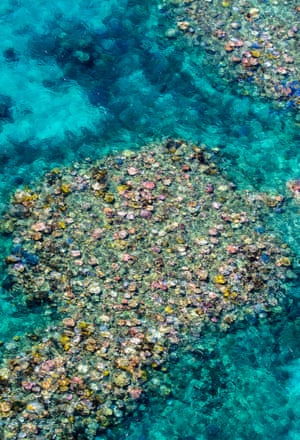
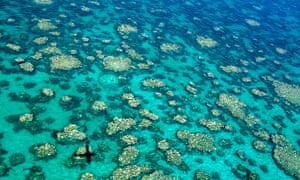
Back-to-back severe bleaching events have affected two-thirds of Australia’s Great Barrier Reef, new aerial surveys have found.
The findings have caused alarm among scientists, who say the proximity of the 2016 and 2017 bleaching events is unprecedented for the reef, and will give damaged coral little chance to recover.
Scientists with the Australian Research Council’s Centre of Excellence for CoralReef Studies last week completed aerial surveys of the world’s largest living structure, scoring bleaching at 800 individual coral reefs across 8,000km.
The results show the two consecutive mass bleaching events have affected a 1,500km stretch, leaving only the reef’s southern third unscathed.
Mass bleaching – a phenomenon caused by global warming-induced rises to sea surface temperatures – has occurred on the reef four times in recorded history.
Prof Terry Hughes, who led the surveys, said the length of time coral needed to recover – about 10 years for fast-growing types – raised serious concerns about the increasing frequency of mass bleaching events.
“The significance of bleaching this year is that it’s back to back, so there’s been zero time for recovery,” Hughes told the Guardian. “It’s too early yet to tell what the full death toll will be from this year’s bleaching, but clearly it will extend 500km south of last year’s bleaching.”
But Hughes said its slow movement across the reef was likely to have caused destruction to coral along a path up to 100km wide. “It added to the woes of the bleaching. It came too late to stop the bleaching, and it came to the wrong place,” he said.
The University of Technology Sydney’s lead reef researcher, marine biologist David Suggett, said that to properly recover, affected reefs needed to be connected to those left untouched by bleaching.
He said Hughes’ survey results showed such connectivity was in jeopardy. “It’s that connection ultimately that will drive the rate and extent of recovery,” Suggett said. “So if bleaching events are moving around the [Great Barrier Reef] system on an annual basis, it does really undermine any potential resilience through connectivity between neighbouring reefs.”
Some reef scientists are now becoming despondent. Water quality expert, Jon Brodie, told the Guardian the reef was now in a “terminal stage”. Brodie has devoted much of his life to improving water quality on the reef, one of a suite of measures used to stop bleaching.
ARC conducted an aerial and underwater survey of the reef which concluded that two-thirds of it has been hit by mass coral bleaching for second time in 12 months. Photograph: Ed Roberts/ARC
He said measures to improve water quality, which were a central tenet of the Australian government’s rescue effort, were failing.
“We’ve given up. It’s been my life managing water quality, we’ve failed,” Brodie said. “Even though we’ve spent a lot of money, we’ve had no success.”
Brodie used strong language to describe the threats to the reef in 2017. He said the compounding effect of back-to-back bleaching, Cyclone Debbie, and run-off from nearby catchments should not be understated.
“Last year was bad enough, this year is a disaster year,” Brodie said. “The federal government is doing nothing really, and the current programs, the water quality management is having very limited success. It’s unsuccessful.”
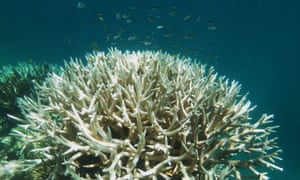
Bleached coral at Mission Beach Reefs. Photograph: Bette Willis/ARC Centre of Excellence for Coral Reef Studies
Others remain optimistic, out of necessity. Jon Day was a director of the Great Barrier Reef Marine Park Authority for 16 years until retiring in 2014.
Day, whose expertise lies in protected area planning and management, said the federal government’s approach to protecting the reef was sorely lacking. He said it was taking too relaxed an approach to fishing, run-off and pollution from farming, and the dumping of maintenance dredge spoil.
“You’ve got to be optimistic, I think we have to be,” Day said. “But every moment we waste, and every dollar we waste, isn’t helping the issue. We’ve been denying it for so long, and now we’re starting to accept it. But we’re spending insufficient amounts addressing the problem.”
A diver over bleached coral at Orpheus Island. Photograph: Greg Torda/ARC Centre of Excellence for Coral Reef Studies
The Queensland tourism industry raised questions about the reliability of the survey, saying scientists had previously made exaggerated claims about mortality rates and bleaching.
“There is no doubt that we have had a significant bleaching event off Cairns this time around,” said Col McKenzie, of the Association of Marine Park Tourism Operators.
“The far north probably did a little bit better, Port Douglas to Townsille has seen some significant bleaching,” he said. “Fortunately we haven’t seen much mortality at this time, and fortunately the temperatures have fallen.”
McKenzie said more money needed to be invested in water quality measures, and criticised what he saw as a piecemeal and uncoordinated approach to water quality projects up and down the coast.
Snails are a known carrier of rat lungworm disease Photo: Getty
Health officials in Hawaii have been warning residents not to touch snails or slugs with their bare hands because of an increase in cases of people coming into contact with a rare parasitic infection known as a rat lungworm. Experts are blaming its sudden spread across the United States on climate change and globalization.
In the last two decades, there have only been two documented cases of rat lungworm infections in Hawaii. But in the past three months, six more cases have occurred in rapid succession. Other states where it has recently popped up include California, Alabama, Louisiana and Florida. According to the Atlantic, the first known case of the disease occurred in Taiwan in 1944 but in the past few years, it’s believed to have spread to the U.S. by way of rats in cargo ships.
Pretty much everything about this disease is nasty. Rat lungworm is a parasitic nematode (Angiostrongylus cantonensis) that begins its life as an infection in rat’s lungs, blood, and brains. From there, the rats defecate worm larvae that are spread to other creatures like snails, slugs, and freshwater shrimp. Humans might eat one of these infected hosts or they might eat produce that has had the worm transferred to it by a host. Next thing you know, your brain is being invaded and it doesn’t sound good at all. Once rat lungworm disease moves into the brain it can cause meningitis and its symptoms include tremors, pain, and inflammation. It is often fatal.
The Maui News reported on the recent cases this week and spoke with local residents about the spread of the invasive semi-slug on the island, and the infectious disease that it carries. Locals say that they’ve become increasingly paranoid about eating produce and they line their yards with slug bait. And for an area that thrives on tourism, paranoia about eating the local food can be an economic nightmare.
A local preschool teacher described her experience with parasitic meningitis that was a result of rat lungworm to the Honolulu Civil Beat:
The parasites are in the lining of my brain, moving around. Because I work with children I try to tell stories through word pictures. My visual graphic for what’s happening is that every once in a while somebody opens the top of my head, sets a hot iron inside my brain, then pushes the steam button.
I have a half dozen medicine bottles, several for pain because any movement of my head spikes my pain level to 12. I don’t see any improvement, just that every day is a different day, different pain.
The severity of the disease can vary wildly, there’s no known treatment, and it’s notoriously difficult to diagnose.
Cases of rat lungworm infections have been documented in over 30 countries and health officials are worried about its appearance in areas where previously the habitat was believed to be unsuitable. One recent surprise location was in Oklahoma. Scientists fear that this is just another consequence of climate change. A 2004 World Health Organization report warned that “most new infections seem to be caused by pathogens already present in the environment, which have been brought out of obscurity, or given selective advantage, by changing ecological or social conditions.”
Infectious disease researchers say that some low-income areas of the globe are perfectly situated as transmission zones for tropical diseases that are on the rise. The fear is that these countries are the least prepared to deal with an outbreak. But that doesn’t mean that they aren’t worried about wealthy countries like the United States. We have our own problems because our leaders constantly refuse to acknowledge the threats that come along with climate change. The current head of the Environmental Protection Agency doesn’t believe in climate change and has vowed to destroy environmental regulations. The current budget proposal is hoping to cut the EPA’s funding by 31 percent by focusing on killing climate change programs. And just yesterday, it came to light that the agency was eliminating its climate adaptation program which helps states and localities adjust to the changes that are already occurring their areas. Unfortunately, these fools don’t appear to have a brain parasite, they simply don’t give a shit.
Beef consumption across the county has dropped, according to national research, and it’s helping to combat climate change.
According to a March report by the Natural Resources Defense Council, Americans consumed 19 percent less beef in 2014 than in 2005, eliminating an approximate 185 million metric tons of greenhouse gas emissions. The council is a New York City nonprofit international environmental advocacy group.
The drop in beef consumption could be because some people are trying to help the climate, but it might also be because people are realizing that red meat can be harmful, said H.S. Udaykumar, a University of Iowa professor of mechanical engineering. He described it as a “happy coincidence.”
Some students, such as UI sophomore Logan Grant, became vegetarian for more personal reasons. She has been a vegetarian for five months after she realized that being an animal lover and supporting meat companies made her a hypocrite. Although she originally became a vegetarian because of ethical reasons, she soon learned about the environmental benefits.
Like Grant, Pete Akers, a UI visiting assistant professor of geography, noted that it isn’t usual for people to become a vegetarian because of the environment.
“Most people don’t typically switch to a vegetarian diet to initially help climate change, but a lot of people are consuming more sustainable foods with less carbon and methane emissions, which increases the ambit of food supply for everyone,” Akers said.
Additionally, he said, the amount of methane a single cow can produce with its four stomachs is extremely harmful to the planet. Methane has a greenhouse effect 25 times more powerful than carbon dioxide, according to the report.
“Cows, to a bigger extent, convert gas to methane,” Udaykumar said.
Akers said that pigs are a better choice over beef, because pigs require about eight to 10 pounds of grain to produce one pound of pork, rather than the 25 pounds of grain to produce one pound of beef, and the hundreds of gallons of water needed for the cow to grow.
Hog farming is a huge industry in Iowa. According to statistics, it alone represents $7.5 billion in total economic activity for Iowa. The numbers are based on the 2012 U.S. Census of Agriculture and analysis by the Spencer Parkinson of Decision Innovation and Iowa State University on the Iowa Pork Producers Association website.
Akers also said chickens are even better than pigs because they only need two to three pounds of grain to produce one pound of meat.
Additionally, there’s an “unreasonable effectiveness” of the Chick-Fil-A campaign stating that chicken is better for humans than beef, Udaykumar said.
“Farmed fish are the most efficient, and if people chose to order fish over beef, it would make a pretty big impact, largely because they’re cold-blooded and have different metabolisms,” Akers said. “Also, fish don’t have to burn energy to stay alive.”
But the decrease in beef consumption isn’t the only meat that could help climate change, he said. Essentially, all meat from fish to cattle is going to have a greater impact on climate change because of the extra steps needed to help the animals grow, he said.
The reason is that all animal products take far more land, water, and fossil fuels to grow, Udaykumar said.
Additionally, he said, Iowa land is used to produce biofuels for cars using corn and soy, and a significant amount is used to as animal feed, then what is left is used to produce food for humans.
The effect that this has on the environment is that the crops fill soils with chemicals, which run into rivers and eventually ends up in the ocean, killing fish, Udaykumar said.
Grant said she’s glad to be a vegetarian because the feed fed to animals is what humans ultimately end up consuming.
Akers said that if the trend of consuming less beef continues, there will be more land to designate for human food. Therefore, he said, there will be more food for humans, because now, so much land is used to grow animal feed.
This is it. The battle over the future of US climate policy is officially underway.
In a sweeping new executive order, President Trump ordered his Cabinet today to start demolishing a wide array of Obama-era policies on global warming — including emissions rules for power plants, limits on methane leaks, a moratorium on federal coal leasing, and the use of the social cost of carbon to guide government actions.
Everyone knew this was coming: Trump has said repeatedly that he wants to repeal US climate regulations and unshackle the fossil fuel industry. But Tuesday’s order is only a first step. Trump’s administration will now spend years trying to rewrite rules and fend off legal challenges from environmentalists. And it’s not clear they’ll always prevail: Some of President Obama’s climate policies may prove harder to uproot than thought.
Trump’s order, meanwhile, doesn’t say anything about whether he wants the US to stay in or withdraw from the Paris climate deal, the key international treaty on global warming. Although Trump vowed to pull out of the accord during the campaign, some of his advisers, like Secretary of State Rex Tillerson, have reportedly warned that he’d face immense diplomatic backlash if he did so. A White House official said that’s “still under discussion.”
The order also doesn’t challenge the Environmental Protection Agency’s fundamental authority to regulate greenhouse gases via the so-called “endangerment finding,” a power that Obama used to craft climate policy after early attempts to pass legislation failed. That’s important: If the EPA’s regulatory authority survives the Trump era, then a future president could use it to write new rules to curb US emissions. That’s what happens when climate policy is crafted through the executive branch, as it currently is in the United States — things can change drastically with a new president.
The key components of Trump’s new climate and energy order
The gas-powered Valley Generating Station is seen in the San Fernando Valley on March 10, 2017, in Sun Valley, California.Photo by David McNew/Getty Images
There’s a lot in Trump’s order, so let’s break down its key features. Trump is telling the EPA and other relevant federal agencies to:
1) Start rolling back the Clean Power Plan. The Clean Power Plan was Obama’s signature climate policy, a major EPA rule aiming to cut emissions from existing US power plants 32 percent below 2005 levels by 2030. This rule is currently on hold while the DC Circuit Court looks it over, and Trump’s Department of Justice will ask the court to suspend the case until the EPA can review and write a new version of the rule. (It’s unclear if the court will do so; it may still issue an opinion that will influence what can actually be done to rescind or rewrite the plan.)
As I explained at length here, Trump’s new EPA head, Scott Pruitt, will now begin the laborious process of trying to write a new rule — either by insisting that the EPA doesn’t need to regulate greenhouse gas emissions from existing power plants (a legally risky approach) or by replacing Obama’s rule with a more modest version that only requires incremental cuts at coal plants. No matter what approach Pruitt takes, he’ll have to go through the formal rulemaking process, justify the change in court, and survive legal challenges from environmental groups. This could take years to resolve.
2) Reconsider carbon standards for new coal plants. In addition to regulating existing power plants, Obama’s EPA also set CO2 standards for anyone who wants to build a newpower plant. The Obama-era standards basically make it impossible to build a new coal-burning facility in the United States unless it can capture its carbon emissions and sequester them underground, a costly and still-nascent technology known as CCS.
By law, Pruitt likely needs to set some sort of standards for new plants, but he could try to rewrite Obama’s rule so that new coal plants merely have to use ultra-supercritical technology, which is less effective at reducing emissions than CCS but is also somewhat cheaper. (Under the Clean Air Act, standards for new plants have to be based on the “best available control technology,” and Pruitt could argue that CCS is not yet widely available.) No matter what approach the EPA takes, however, it’s unlikely utilities will be building many new coal plants soon — especially since natural gas is so cheap.
3) Reconsider regulations on methane emissions from oil and gas operations. Carbon dioxide isn’t the only major greenhouse gas — there’s also methane, a key ingredient in natural gas that can seep into the atmosphere during oil and gas extraction. Obama set a goal of reducing these emissions 40 percent below 2012 levels by 2025, and both the EPA and the Bureau of Land Management set various rules forcing drillers to detect and plug their leaks. The Trump administration may now try to rewrite these rules, though, again, they’ll have to justify any changes through the courts.
4) Revisit the “social cost of carbon” estimate used to justify climate regulations. Back in 2007, a federal judge ordered the Department of Transportation to take climate change into account when weighing the costs and benefits of new regulations.
So in 2009, Obama’s White House gathered a dozen agencies together and tried to assign a dollar value to the cost of emitting a ton of carbon dioxide — taking into account scientific modeling on the damage caused by aspects of global warming, such as droughts and floods. They settled on a central estimate of around $36 per ton in 2015, rising over time. This “social cost of carbon” (SCC) can help justify regulations that reduce emissions — such as the Department of Energy’s efficiency standards for appliances — since there’s a clear way to quantify the benefits.
The Trump administration will now explore ways to redo and possibly lower the SCC estimate, which will make it harder for stringent climate rules to pass cost-benefit analysis — though, again, they may face court challenges. One route they may take: Take into account only the damages that climate change causes the United States, instead of the damage globally. That would produce a smaller SCC. Note, however, that the National Academy of Sciences disagrees with this approach, and many experts think the SCC should be higher, not lower.
5) Lift the moratorium on federal coal leasing. The federal government owns more than 570 million acres of land with coal reserves buried below, which it leases out to mining companies. Environmentalists and other critics have argued that the feds hand out these leases much too cheaply, which amounted to a backdoor taxpayer subsidy to fossil fuels. In 2016, Obama’s Department of Interior put a moratorium on new federal coal leases until they could review and revamp the program.
In his executive order, Trump will tell the Interior Department to lift the moratorium, a fairly straightforward step that can be done with the stroke of a pen. In the short term, this won’t have a huge practical impact, because there’s currently a coal supply glut and mining companies aren’t really pursuing new federal leases right now. The big question is how Trump handles the results of that review, and whether he alters the leasing program to try to get a better deal for taxpayers in the future.
6) Repeal guidance for factoring climate change into NEPA reviews. Under the National Environmental Policy Act (NEPA), federal agencies are supposed to do formal environmental reviews of all major actions they take, like coal leasing or permitting new pipelines. And in many cases, the courts have ordered these agencies to take climate impacts into account. (The agencies don’t necessarily have to do anything to mitigate these impacts, but they do have to account for them and post them publicly.)
Under Obama, the Council on Environmental Quality issued some guidance to the agencies on how to follow these legal guidelines when incorporating climate into their NEPA reviews. Trump is now rescinding this guidance, which can be done with a simple signature.
It’s unclear how much practical impact this will have. Agencies will still be required to follow the law and consider greenhouse gas impacts when conducting environmental reviews of projects like coal leasing, says Michael Burger, executive director of the Sabin Center for Climate Change Law at Columbia University. If they don’t, they can still get sued in court. If anything, the lack of guidance from Trump’s White House may well cause more confusion around proper procedures to follow — leading to more litigation, not less. What this does signal, though, is that the federal government is going to be a little less diligent about thinking through climate impacts going forward.
7) Rescind a bunch of Obama’s other executive orders on climate. The Obama White House issued a number of other executive orders and documents related to climate change, such as: the Climate Action Plan (basically laying out the administration’s goals on global warming); an order urging federal agencies to reduce their CO2 output; and an orderurging federal agencies to help communities strengthen their resilience to climate impacts. Trump can and will undo all of these with a stroke of a pen.
8) Tell agencies to review all rules inhibiting energy production. Finally, under the auspices of promoting “energy independence,” Trump will instruct all federal agencies to review all of their rules, policies, and guidances and see if there’s anything that inhibits the development of domestic energy production — from coal to oil and gas to nuclear power and renewables. In the next 180 days, the agencies will send their findings to the White House, which will decide how to proceed from there.
Trump is chipping away at Obama’s climate policies — but it’s hard to repeal everything
Good luck erasing everything I’ve done.Photo by Chip Somodevilla/Getty Images
This executive order is part of a much broader assault on Obama-era climate policies. Earlier this month, Trump announced the EPA would review (and possibly weaken) the Obama’s fuel economy standards for cars and light trucks in the post-2022 period. And the White House is crafting a budget proposal that requests sharp cuts to a variety of climate programs at the EPA, Department of Energy, NASA, NOAA, and elsewhere.
Overturning everything Obama has done on climate will be difficult, however. Some rules, like the fuel economy standards, can only be weakened — not killed entirely. Other regulatory rollbacks may get thwarted by federal judges. And Congress will have final say over the EPA’s budget, with even some Republicans now balking at the steep cuts Trump has been mulling to clean energy programs.
So it’s too soon to say how successful Trump will be in killing all of Obama’s policies — or what the ultimate impact on emissions and global warming will be. But a new research notefrom the Rhodium Group tries to model what would happen if Trump manages to eviscerate all the climate policies mentioned in Tuesday’s executive order.
If that happened, the group found, the US is very unlikely to meet its Paris treaty pledge of cutting greenhouse gas emissions 26 percent below 2005 levels by 2025. Instead, emissions would stall out at around 14 percent below 2005 levels — a shallower drop than would’ve been expected if Obama’s policies had stayed in place:
What’s notable about this chart is that that Trump’s executive order can’t halt all climate progress. Emissions would still decline gently in the coming years, thanks to market forces and policies that Trump can’t really touch.
For example: Many US utilities are increasingly moving away from coal and toward cleaner (and often cheaper) sources such as gas, wind, and solar — that shift will almost certainly continue no matter what the White House does, since it’s being driven by more than EPA rules. (Trump isn’t going to roll back federal tax credits for wind and solar or the fracking boom that’s driving natural gas prices down.) Meanwhile, states like New York and California will keep pursuing their own more stringent climate policies.
What Trump can do, however, is bog down any momentum that may have been building toward deep decarbonization. After all, if we want to halt climate change, it’s not enough for US emissions to continue to drop slowly or flatline. They have to drop dramatically. That would’ve been a huge challenge even if Hillary Clinton had been elected president — she was mainly planning to expand some of Obama’s EPA programs at the margins. But it now looks extremely unlikely under Trump.
Further reading:
— Note that the Trump administration is promising that the order will bring back all the coal jobs lost since 2009. But that’s unlikely — as I explained in detail here. At best, Trump might slow the decline of US coal production by repealing the Clean Power Plan. But automation and the glut of cheap gas from fracking will continue to cause mining jobs to dwindle.
— I asked legal experts how Trump could kill Obama’s Clean Power Plan. Here’s what they said.
— This interview with Harvard’s Jody Freeman delves into all the obstacles Trump and Pruitt may face in trying to repeal EPA regulations.
— If you want to see what a major push to stop global warming would actually look like, check out this eye-opening decarbonization “road map” that was recently published in Science
As major exponents of greenhouse gases that warm the Earth, what cows consume is increasingly gaining attention from scientists trying to apply the brakes to global methane emissions. The latest promising discovery in this area comes from an international team of researchers, who have found that livestock plant food grown in warmer climates leads to higher methane releases, and could potentially be inhibiting milk and meat production at the same time.
Methane emitted by cows, or from any source for that matter, is a problem because it is 25 times more potent than carbon dioxide as a greenhouse gas, due to its superior heat-trapping abilities. Meanwhile, global meat production is on the rise, from 71 million tons in 1961 to 318 million tons in 2014.
So scientists have been looking at the effects of livestock diets, and how they might be tweaked to reduce the amount of methane produced by the world’s growing bovine population. Last year, Australian scientists identified a strain of seaweed that can reduce methane emissions by 99 percent, while earlier this year another research team discovered that feeding cows tropical leaves in addition to regular food could cause also cause sharp decline.
The latest research doesn’t unearth new dietary supplements, rather it reveals an already existing culprit. Scientists from Royal Botanic Gardens, Kew, Scotland’s Rural College, and the Senckenberg Biodiversity and Climate Research Centre in Frankfurt studied published data on forage quality, and found that nutritional value of grass was reduced at higher temperatures.
This is turn makes it harder for grazing livestock to digest the plants, and the scientists say there are a few reasons that might be. The extra heat causes plants to adapt and they may flower earlier, produce thicker leaves or possibly allow tougher invasive plants to spread into new areas and replace more nutritious species. With the plants tougher to digest, they spend longer inside the animal and produce more gas, and the scientists say this is setting in motion a vicious cycle.
“The vicious cycle we are seeing now is that ruminant livestock such as cattle produce methane which warms our planet,” says Dr. Mark Lee, a research fellow at Royal Botanic Gardens, Kew. “This warmer environment alters plants so they are tougher to digest, and so each mouthful spends more time in the animals’ stomach, producing more methane, further warming the planet, and the cycle continues. We need to make changes to livestock diets to make them more environmentally sustainable.”
With an eye to the future, the scientists used published empirical models to estimate how changes to the climate will impact global methane production. They found that methane production increased by 0.9 percent with a 1 °C temperature rise (1.8 °F), and by 4.5 percent with a 5 °C rise (9 °F). They expect this to be a worldwide trend, but did identify hotspots in North America, Central/Eastern Europe and Asia, places where livestock farming is increasing and climate change is expected to hit hardest.
“Now is the time to act, because the demand for meat-rich diets is increasing around the world,” says Lee. “Our research has shown that cultivating more nutritious plants may help us to combat the challenges of warmer temperatures.”
The research paper was published in the journal Biogeosciences.

 Further research must now confirm in vitro findings in live animals.



/cdn0.vox-cdn.com/uploads/chorus_image/image/53925817/632935720.0.jpg)
/cdn0.vox-cdn.com/uploads/chorus_asset/file/8148743/651935530.jpg)
/cdn0.vox-cdn.com/uploads/chorus_asset/file/8158253/632311492.jpg)
/cdn0.vox-cdn.com/uploads/chorus_asset/file/8234839/Screen_Shot_2017_03_27_at_10.22.10_PM.png)
 Exposing the Big Game