Exposing the Big Game

Forget Hunters' Feeble Rationalizations and Trust Your Gut Feelings: Making Sport of Killing Is Not Healthy Human Behavior

Exposing the Big Game

A Depressing Thought

Some climate scientists (for example Gaia theorist, James Lovelock and grandfather, James Hansen), have embraced nulclear power as the carbon-neutral answer to our high energy needs in this modern world. They feel we’ve gone too far to turn back now–a depressing thought if there ever was one. Of course, almost no one is willing to point out that maybe there’s just too many people here on the planet today…


The fact that nuclear power plants will inevitably all have meltdowns if no one’s around to keep them going and keep them cool with thousands of gallons of water seems clearly the biggest threat to the future of Earth’s other species if humans were to suddenly check out (from say, nuclear war or pandemic, or starvation due to climate change, etc.).


Also, if jet traffic with its global cooling, cloud-like contrails in the stratosphere were to come to an abrupt end (the oil is going to run out some day, after all), the planet would quickly warm up to temperature levels not seen in hundreds of thousands of years (known as the Venus effect).


Sadly, there’s no easy answer.


We’re addicted to speed, madly shovelling coal into a freight train headed for a brick wall. It’s too late for the wish that humans would just go away and let nature take back over, putting things right again. At this point, the train is going to crash and there’s  no place left for humans to safely jump off.


No Surrender

http://www.greanvillepost.com/2017/03/06/no-surrender-a-critique-of-guy-mcphersons-prediction-of-near-term-human-extinction/

by Guy McPherson on March 1, 2017

SAN ANTONIO Belize—(Weekly Hubris)—March 2017—I’m routinely accused of giving up. Worse, it is often written that the message of near-term human extinction encourages people to give up. As the primary messenger of this devastating message, I’m often at the receiving end of messages fueled by ignorance and its frequent companion, hatred.

For what it’s worth—and I suspect my two cents is overpriced this time—this essay serves as a correction to my detractors. I’m neither giving up on the living planet nor encouraging others to do the same.

Giving up is not giving in: accepting our fate is not synonymous with jumping into the absurdly omnicidal mainstream. Just because we’re opossums on the roadway doesn’t mean we should play possum. Resistance is fertile, after all. To employ a bit of The Boss: “In the end, what you don’t surrender, well, the world just strips away.”

Or, to employ a bit of Zen: Let go, or be dragged.

Or, to employ a bit of popular culture: Carpe diem.

Or, to employ a bit of Nietzsche: “Live as though the day were here.”

Climate chaos is well under way, and has become irreversible over temporal spans relevant to humans because of self-reinforcing feedback loops (so-called positive feedbacks). Such is the nature of reaching the acceleration phase of the non-linear system that is climate catastrophe.

As a result of ongoing, accelerating climate change, I’m letting go of the notion that Homo sapiens will inhabit this planet beyond 2026. I’m letting go of the notion that, within a few short years, there will remain any habitat for humans in the interior of any large continent. I’m letting go of the notion we’ll retain even a fraction of one percent of the species currently on Earth beyond 2030. But I’m not letting go of the notion of resistance, which is a moral imperative.

I will no longer judge people for buying into cultural conditioning. It’s far easier to live in a city, at the height of civilization’s excesses, than not. I know how easy it is to live in a city surrounded by beautiful distractions and pleasant interactions, and I fully understand the costs and consequences of dwelling there, as well as the price to be paid in the near future. I spent about half my life in various cities, and I understand the physical ease and existential pain of living at the apex of empire.

Also, I know all about the small joys and great pains associated with living in the country. I spent the other half of my life in the country and in towns with fewer than 1,000 people. I understand why the country bumpkin is assigned stereotypical labels related to ignorance and, paradoxically, self-reliance.

It’s clearly too late to tear down this irredeemably corrupt system and realize any substantive benefits for humans or other organisms. And yet I strongly agree with activist Lierre Keith: “The task of an activist is not to navigate systems of oppressive power with as much personal integrity as possible; it is to dismantle those systems.”

If it seems I’m filled with contradictions, color me fully human in a Walt Whitman sort of way: “Do I contradict myself? Very well, then I contradict myself, I am large, I contain multitudes.”

Our remaining time on this orb is too short to cast aspersions at those who live differently from ourselves, as most people in industrialized countries have done throughout their lives. Most people in the industrialized world became cultural crack babies in the womb. There is little hope of breaking the addiction of ingestion at this late point in the era of industry, and I’m throwing in the towel on changing the minds of willfully ignorant Americans. No longer will I try to convince people to give up the crack pipe based on my perception of reality.

My continued efforts to speak and write will represent personal perspectives and actions. I’ll no longer recommend to others the path I’ve taken.

Nietzsche’s comment about seizing the day, every day, brings to mind the final words of Joseph Campbell’s 1949 book, The Hero with a Thousand Faces: “It is not society that is to guide and save the creative hero, but precisely the reverse. And so every one of us shares the supreme ordeal—carries the cross of the redeemer—not in the bright moments of his tribe’s great victories, but in the silences of his personal despair.”

With the preceding dire news in mind, it would be easy to forget how fortunate we are. After all, we get to die. This simple fact alone is cause for celebration because it indicates that we get to live. As I wrote many years ago, our knowledge of DNA assures us that the odds of any one of us existing are greater than the odds against being a particular grain of sand on all the world’s beaches. No, the odds are much greater than that: they exceed the odds of being a single atom plucked from the entire universe. To quote the evolutionary biologist Richard Dawkins, “In the teeth of these stupefying odds it is you and I that are privileged to be here, privileged with eyes to see where we are and brains to wonder why.”

It’s quite a deal, and no surrender is necessary. We get to live. Let’s live. Let’s be fully present. Let’s live here now.

Appraisal:  http://www.greanvillepost.com/2017/03/06/no-surrender-a-critique-of-guy-mcphersons-prediction-of-near-term-human-extinction/

IMPENDING TRAGEDY IN THE GULF OF ST. LAWRENCE

by Captain Paul Watson

Sea Shepherd and I have navigated into the ice into the Gulf of St. Lawrence in 1979, 1981, 1982,1983, 1994,1995,1998, 2005 and 2008. That was nine times between 1979 and 2008. Never did I see the area so free of ice as it is now.

Two decades ago the idea of clear ice free sailing trough the Gulf was simply not possible. It took us days to break through the ice pack.

All over the world I have seen the evidence of rapid climate change and you really have to be in willful denial to believe this is not happening or have a vested financial interest in denial.

What is alarming for me is that this is one of the primary areas where harp and hood seals give birth to their pups on the ice. Without ice, thousands of pups will drown at sea and if they are forced to give birth on shore fast ice, the sealers will have easier access to kill them.

These two sat images, one from February 2015 and one for this same day in February 2017 illustrates the concern.

 Image may contain: outdoor

Warming ponds could accelerate climate change

https://phys.org/news/2017-02-ponds-climate.html

February 20, 2017
Warming ponds could accelerate climate change
Ponds used in the experiment. Credit: University of Exeter

Rising temperatures could accelerate climate change by reducing the amount of carbon dioxide stored in ponds and increasing the methane they release, new research shows.

The scientists experimentally warmed an array of over seven years by 4-5ºC and studied the impacts on and rates of metabolism.

Changes observed after the first year became “amplified” over a longer period, according to the study by the University of Exeter and Queen Mary University of London

After seven years, a pond’s ability to absorb carbon dioxide (CO2) was reduced by almost half, while release almost doubled.

Lakes and ponds cover about 4% of Earth’s surface (excluding areas covered by glaciers and ice sheets) but they are disproportionately large sources of methane and CO2 to the atmosphere.

Ponds of less than one square metre are responsible for releasing about 40% of all methane emissions from inland waters.

“This is the first experiment to investigate the long-term effects of warming in aquatic ecosystems,” said lead author Professor Gabriel Yvon-Durocher, of the Environment and Sustainability Institute on the University of Exeter’s Penryn Campus in Cornwall.

“Given the substantial contribution small ponds make to the emission of greenhouse gases, it is vital to understand how they might respond to .

“Our findings show that warming can fundamentally alter the carbon balance of small ponds over a number of years, reducing their capacity to absorb and increasing emissions of methane.

“This could ultimately accelerate climate change.”

Such effects are known as “positive feedbacks” – where the effects of global warming on components of the biosphere lead to changes that further climate change.

“The amplified effects of experimental warming we have observed in ponds are different to those we typically see on land, where large initial effects of warming appear to diminish over the long term,” Professor Yvon-Durocher said.

“This accelerating effect in ponds, which could have serious impacts on , is not currently accounted for in Intergovernmental Panel on Climate Change models.”

The paper, entitled “Long-term warming amplifies shifts in the carbon cycle of experimental ponds”, is published in the journal Nature Climate Change.

Explore further: Global warming may increase methane emissions from freshwater ecosystems

More information: Long-term warming amplifies shifts in the carbon cycle of experimental ponds, Nature Climate Change, nature.com/articles/doi:10.1038/nclimate3229

Read more at: https://phys.org/news/2017-02-ponds-climate.html#jCp

Could abrupt climate change lead to human extinction within 10 years?

http://www.straight.com/news/868051/could-abrupt-climate-change-lead-human-extinction-within-10-20-years

  • null
2 of 2
  • There’s been a dramatic reduction in Arctic sea ice in recent years, which could trigger nonlinear climate change.NATIONAL OCEANIC AND ATMOSPHERIC ADMINISTRATION

One of the world’s most outspoken climate-change Cassandras is U.S. conservation biologist Guy McPherson.

A professor emeritus of natural resources and the environment at the University of Arizona, he’s warned that sharply rising methane emissions are going to create a catastrophe in our lifetimes.

McPherson, author of Going Dark, has even predicted the near-term extinction of many species, including human beings, by the middle of 2026.

It’s because of something called abrupt climate change, also known as nonlinear climate change.

This results when feedback loops caused by rising atmospheric greenhouse gas levels cause the climate system to rapidly transition to a different mode, occurring on a scale that human or natural systems cannot adapt to.

In the first two decades after methane is released into the atmosphere, it’s about 85 times more powerful as a heat-trapping gas than carbon dioxide.

Large amounts of methane are stored in “clathrates”, which are chemical substances along the Arctic continental shelves storing methane molecules.

McPherson and coauthor Carolyn Baker addressed this in their 2014 book, Extinction Dialogs: How to Live with Death in Mind.

On his website, McPherson criticizes scientists, who know about this problem, for not doing nearly enough to educate the public. He also blames politicians and the leaders of corporations and nongovernmental organizations for not raising the alarm.

“Worse than the aforementioned trolls are the media,” MacPherson writes. “Fully captured by corporations and the corporate states, the media continue to dance around the issue of climate change. Occasionally a forthright piece is published, but it generally points in the wrong direction, such as suggesting climate scientists and activists be killed (e.g., James Delingpole’s 7 April 2013 hate-filled article in the Telegraph). Leading mainstream outlets routinely mislead the public.”Author and former professor Guy McPherson fears that methane releases could lead to the demise of humankind.

Writer says jet stream changes are having an effect

A recent post on the Arctic News blog by its editor, Sam Carana, has even declared that human extinction could occur within a decade. Carana cites “the decreasing difference in temperature between the Equator and the North Pole causes changes to the jet stream, in turn causing warmer air and warmer water to get pushed from the North Atlantic into the Arctic”.

“Warmer water flowing into the Arctic Ocean in turn increases the strength of further feedbacks that are accelerating warming in the Arctic,” Carana writes. “Altogether, these feedbacks and further warming elements could trigger a huge abrupt rise in global temperature making that extinction of many species, including humans, could be less than one decade away.”

At the root of this extinction prediction is methane, which is being released from sea floors along continental shelves in the Arctic as a result of melting ice.

The Counterpunch website has an article by Dave Lindroff explaining how this could rapidly increase the average global temperature by three degrees Celsius over pre-industrial times.

Lindroff suggests this would be “enough to actually reverse the carbon cycle, so that plants would end up releasing more carbon into the atmosphere rather than absorbing it”.

This is what abrupt climate change looks like.

McPherson has maintained that abrupt climate change could even result in the average global temperature soon rising four degrees Celsius over pre-industrial times. Many scientists warn that increases of just two degrees will cause enormous havoc; four degrees is unfathomable.

“As we’ve known for years, scientists almost invariably underplay climate impacts (James Hansen referred to the phenomenon at “scientific reticence” in his 24 May 2007 paper about sea-level rise in Environmental Research Letters,” McPherson writes on his website. “And in some cases, scientists are aggressively muzzled by their governments.”

McPherson challenged by science blogger

Not everyone subscribes to McPherson’s views.

Geoscience educator Scott K. Johnson maintains on his blog that McPherson has falsely interpreted data that doesn’t indicate an exponentially growing release of methane from the East Siberia arctic shelf.

Actual measurements of methane in the atmosphere don’t show any such sudden, accelerating spike, and climate scientists don’t believe anything like this ‘clathrate gun’ scenario is underway,” Johnson writes.

He adds that methane levels are always higher above the Arctic, which is why global averages are what scientists rely on.

“So when McPherson claims that ‘the clathrate gun has fired‘, he does so without any evidence whatsoever,” Johnson insists. “Rather, he relies on elementary mistakes made by a blogger who doesn’t appear to understand the science. Not data. And not published research. Not only do climate scientists not think that such a thing is underway, most don’t think it’s likely to be a worry this century.”

McPherson has fired back on his blog, accusing Johnson of being paid to produce evidence that backs the status quo, clinging to preconceptions, and ignoring the work of legitimate scientists.

Johnson retorted on his blog that McPherson “is aware of my criticism of his argument, but has declined to consider the problems I pointed out (instead choosing to accuse me of being paid to disagree with him, which would be news to my bank account)”.

Late last year, the U.S. National Snow & Ice Data Center reported that the extent of Arctic and Antarctic sea ice reached record lows in 2016 for the month of November.

Both areas were tracking two standard deviations from the norm for that time of year.

Clearly, something terribly wrong is taking place in these areas, as well as in Greenland, where ice is melting more quickly than previously forecast.

If it’s an indication of abrupt climate change, we will all have to be prepared to rethink our futures.

Beef production to drop [but only 16%] under climate change targets – EU Commission

http://www.farmersjournal.ie/beef-production-to-drop-under-climate-change-targets-eu-commission-255277

By Thomas Hubert on 13 February 2017
2

  • Beef production drop expected under 2030 climate targets according to the European Commission.
    Beef production drop expected under 2030 climate targets according to the European Commission.

The European beef herd could shrink by up to 16% under the cost 2030 greenhouse gas emission targets, but subsidies could help alleviate the burden, according to the European Commission.

Dan Burgar Kuzelicki, policy officer at the Environment, climate change, forestry and bio-economy department of the European Commission, presented the figures at the Agricultural Science Association’s climate change conference in Portlaoise last week.

According to him, the EU’s beef herd size is expected to fall by between 6.6% and 16% across the EU by the time 2030 climate targets are implemented. This is the result of a European Commission model illustrated by the map above.

In Ireland, the cost of implementing greenhouse gas emission cuts on beef farms would result in a drop in cattle numbers by up to 5% in the southern half of the country and up to 8% in the northern half.

However, targeting CAP subsidies to cover 80% of the costs associated with better climate efficiency in beef farming would mitigate the impact, with herd size expected to drop by up to 2% in the south and up to 5% in the north under this scenario.

In all cases, beef production is expected to drop.

Additives and grass quality to cut emissions from livestock

Tommy Boland, associate professor of ruminant nutrition at UCD, presented some of the latest research into techniques exploerd to reduce greenhouse gas emissions from cattle and sheep.

A number of inhibitors are being tested as additives to feed to reduce methane production. While some have shown detrimental side effects, a chemical called 3-nitrooxypropanol (3-NOP) is showing promising results. Feeding 2G/day of 3NOP to beef cattle has shown to reduce methane emissions from over 20g/kg to under 10g/kg of weight gain. Meanwhile, methane emissions from dairy cattle receiving 3-NOP have dropped from 18g/kg to 12g/kg of milk solids.

Feeding soya oil and, to a greater extent, linseed oil was also found to reduce the rate of methane emissions from dairy cows, Boland said.

However, he questioned the sustainability of those oil sources and pointed out that grass was an alternative source of fatty acids, with further research required in this area. Boland’s own research shows that improving grass quality has a direct impact on the methane emissions of dairy cow.

Read more

Full coverage: agriculture and climate change

Climate change impacts on endangered wildlife massively under reported

WILDLIFE CONSERVATION SOCIETY Public Release: 13-Feb-2017

A team of scientists reporting in the journal Nature Climate Change say that negative impacts of climate change on threatened and endangered wildlife have been massively underreported.

Said co-author Dr James Watson of the Wildlife Conservation Society and University of Queensland: “Our results clearly show that the impact of climate change on mammals and birds to date is currently greatly under-estimated and reported upon. We need to greatly improve assessments of the impacts of climate change on species right now, we need to communicate this to wider public and we need to ensure key decisions makers know that something significant needs to happen now to stop species going extinct. Climate change is not a future threat anymore.”

JOURNAL
Nature Climate Change
http://www.nature.com/nclimate/journal/vaop/ncurrent/full/nclimate3223.html

c1986-1485390555143

Trump transition team limits EPA at environmental forum

AA

The Environmental Protection Agency halved the number of staffers attending an annual Anchorage forum on issues like climate change in response to a request from President Donald Trump’s transition team.

Trump transition official Doug Ericksen told Alaska’s Energy Desk in an email that the EPA was directed to limit staff at the conference to save money on travel. “This is one small example of how EPA will be working cooperatively with our staff and our outside partners to be better stewards of the American people’s money,” Ericksen wrote.

Alaska Forum on the Environment Director Kurt Eilo says even some Anchorage-based EPA employees were pulled, as were some who would have traveled from Seattle and Washington, D.C.

Climate change is a major issue in Alaska. One town has had to move further back from its shoreline position because of rising seas caused by climate change.

“We got a phone call from the local office of EPA, and we were informed that EPA was directed by the White House transition team to minimize their participation in the Alaska Forum on the Environment to the extent possible,” Eilo said.

Eilo said he was given three days’ notice that 17 instead of 34 staffers would attend.

One session had to be canceled as a result.

From @NPR – EPA Halves Staff Attending Environmental Conference In Alaska http://n.pr/2lz1oJQ 

Photo published for EPA Halves Staff Attending Environmental Conference In Alaska

EPA Halves Staff Attending Environmental Conference In Alaska

The Trump administration’s transition officials ordered the Environmental Protection Agency to cut its presence at the event. The team cited travel costs in explaining the abrupt move.

npr.org

He said there is concern about what the halved EPA delegation foreshadows.

“There’s a lot of uncertainty among folks here at the forum,” Eilo said. “There’s concern about the tribal programs, there’s concern about how we’re going to address things like climate change in the next upcoming administration.”

Science doesn’t care if you believe in it or not

http://www.aljazeera.com/indepth/opinion/2017/01/science-climate-change-170127115338110.html

Whether you believe in climate change or not, the laws of physics will continue to work and ice will continue to melt.

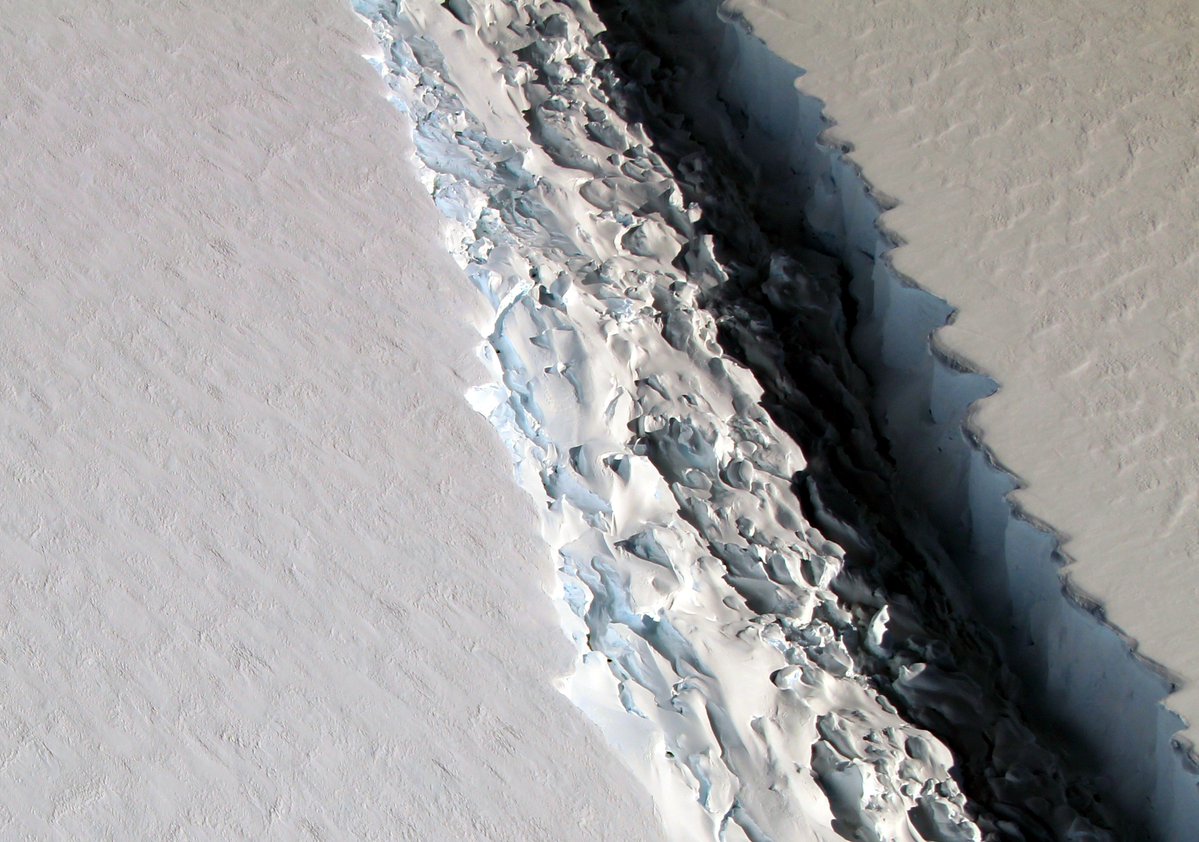
A photo made available by NASA shows a view of a massive rift in the Antarctic Peninsula's Larsen C ice shelf [EPA]
A photo made available by NASA shows a view of a massive rift in the Antarctic Peninsula’s Larsen C ice shelf [EPA]

by

an

Prof Mark McCaughrean is the Senior Advisor for Science and Exploration at the European Space Agency.

On October 31 last year, a large crack opened in the Larsen C ice shelf in Antarctica and a huge iceberg, 5,000 square kilometres in size, will likely soon calve into the Southern Ocean.

Although visible at ground-level and from the air, the full extent of the crack can be properly appreciated only from space, and monitoring with satellites, including Europe’s Sentinel-1, shows that it has grown rapidly in the past few months.

Although it is impossible to be sure, many scientists are concerned that the imminent collapse of the Larsen C shelf (and that of Larsen B in 2002) is linked to climate change. Regardless of this specific question, however, the temperature of Earth’s air and the quantity of heat trapped in its oceans continue to grow relentlessly, with 2016 just recently declared the hottest year on record. The likely consequences for our civilisation owing to unchecked climate change are truly alarming.

But the Larsen C episode serves as a wider metaphor for climate change and a whole host of other pressing issues around the world. It is taking place in a remote location and, by the standards of attention spans these days, happening rather slowly. Thus, as it flickers by on the news, most people consider it to be a curiosity that doesn’t concern them much, if at all.

As a result, it seems to many as if this modern-day “canary in the coalmine” can be safely ignored or, if it suits a particular short-term and/or self-serving agenda, perhaps denied altogether.

There are many forms such denial can take. For example: who knows whether those satellite radar images are real or fake? We’re all familiar with the wonders of Photoshop: perhaps they’ve been adjusted?

Or even if the crack in the Larsen C shelf is real, what about the underlying causes? Is it just “noise” due to weather. Even if it’s getting warmer in Antarctica, it’s cold today in Western Europe, so perhaps it’s all just swings and roundabouts.

REPORTER’S NOTEBOOK: Braving 15-metre high waves on board Antarctica research vessel

Or even if the world is getting warmer, it’s happening slowly enough that it’s hard for humans to really feel the difference year on year, so it can’t be important. Perhaps it’s due to the Sun or other causes we have no control over, and nothing to do with the massive amounts of greenhouse gases that humans are pouring into the air. If so, then it seems reasonable just to shrug your shoulders and mumble “What can you do?”

Or maybe, just maybe, it is our fault and we are marching the world over a precipice to a place where it will be very hard for human civilisation to survive. But the response then seems to be that it’s far too complicated and scary a problem to deal with, and what can I do about it as one person anyway? Let’s watch the football.

Climate change is happening

Welcome to the world in 2017: for many, scientific facts and measurements and their consequences seem remote. Some consider them complicated and boring, best left to others to worry about. Or so large-scale and terrifying that we’re paralysed, seeking solace in distraction. Perhaps progress has rendered scientific processes and complexity invisible, hidden behind a shiny user interface and working like magic.

For others, science and its predictions may be viewed as inconvenient with respect to a specific belief or agenda. In such cases, science must be doubted, repudiated, and undermined by any means possible.

But do you know what? Science doesn’t care. It really doesn’t.

The laws of physics are going to continue heating up the planet in response to increased levels of CO2 whether we’d like them to or not. Whether we deny them or not.

Left to their own devices in a world of growing fossil fuel consumption, ice shelves will melt and glaciers will run into the oceans at increasing rates. Sea levels will rise, cities will flood, weather will become increasingly unstable, and crops will fail. Millions will struggle for resources, leading to mass migration and war.

None of that will be nice, but science doesn’t care much about “nice” either.

Whether we like them or not, whether they fit our agendas or not, science, facts, measurements, and rational thinking lie at the very core of the modern world. They keep our energy, fresh water and sewage systems running; they keep our aircraft flying; and they help us to keep mutating bacteria and disease at bay. With a sense of cruel irony, they even provide us with the tools of mass distraction, including our 4K TVs, smartphones, and Clash of Clans.

To some extent, ignoring these realities is manageable, as long as some benign Wizard of Oz keeps things running behind the curtain for us. But clearly there’s a limit to this and we’re edging ever closer to it. In today’s complex world, people need to be more aware of how all of this works, not less – to have some understanding of the possible consequences of inaction.

Inconvenient facts are still facts

Humans are smart, with demonstrated ability to take on big challenges. Thanks in part to science and technology, the world’s population continues to rise, along with living standards, leading to increased pressures on essential resources such as food, water, housing, and energy. There are ways of addressing such concerns.

But many of the key issues facing us today, not least climate change, are no respecters of lines drawn on maps or other artefacts of human history. To solve them, we need more international cooperation and integration, for the good of humankind and our communal natural environment as a whole. We need to build a more educated, rational society where evidence-based policy is developed, understood, and embraced by citizens and their governments, even when complex.

It would be naive to suggest that this is simple, but it seems immoral to suggest that we shouldn’t even try. As our world grows evermore complex, it asks a lot of our governments, institutions, and the public as well, and inevitably things will creak and groan as the pressures continue to increase. But again, we must try: the alternatives are unacceptable.

In particular, we cannot allow facts, evidence, and the laws of physics to become contingent, negotiable, or discarded as inconvenient.

Denying the facts won’t change the facts. Doing so can, however, make it much more difficult for society to deal with the consequences of those facts, and in areas such as climate change, we only have a narrow window in which to make critical decisions and act on them before it’s too late.

We need to embrace science and the information and insight it offers us. There are many examples of where science is critical to the wellbeing of humankind. Returning to the example of space, satellites provide a short-term view of the weather, but also long-term monitoring of climate and the Earth’s environment, and how they are changing in response to human activity. They can also provide vital, near-instant information and communications in times of disaster and crisis, whether natural or man-made.

OPINION: A heatwave in the Arctic, a Trump in the White House

Beyond Earth itself, space exploration provides a clear demonstration of the power of international collaboration in coming together to meet extraordinary challenges, whether it’s astronauts working together on the International Space Station or robotic missions such as Rosetta’s landing on a comet.

These great adventures can also inspire children and bring them into STEM subjects. There they learn the tools needed to make sense of our complex world and to help provide solutions to its many problems. It will also, we hope, ensure that they will bring a rational, deliberative approach to their role as citizens.

It’s the job of those citizens to weigh up the evidence and act responsibly. They need to build and support governments and institutions they believe will take the best approach to looking after their interests, but also those of the wider world we all live in together. They also need to hold them to account if they fail to do so.

Again, science doesn’t care whether or not we do this.

But our children and grandchildren will. If we hope to survive as a species, we humans should be open, honest, and completely pragmatic about the clear advice science is offering us about the problems we are facing and cooperate internationally to find solutions. To do otherwise is a gamble we cannot afford.

Professor Mark McCaughrean is the Senior Adviser for Science and Exploration at the European Space Agency. The opinions expressed in this article are his own and do not necessarily reflect those of the Agency.

Gas Sensing – Monitoring Agricultural Methane Emissions

Shutterstock | irin-k

The second most prevalent greenhouse gas emitted as a result of human activities is methane (CH4). In 2014, CH4 accounted for 11% of all US greenhouse gas emissions, and the majority of these emissions were the result of agriculture.

Methane is emitted from a wide range of natural sources including marshlands, livestock farming, and leakage from natural gas systems.1 Domestic livestock including sheep, goats, and cattle produce substantial amounts of CH4 due to the normal digestive processes in the ruminant stomach system.

Bacteria are present in gastrointestinal systems of ruminant animals, such as cattle, to help the breakdown of plant material. Some of the microorganisms (methanogens) use the acetate available from the plant material to produce methane.1,2

Whenever the animal defecates or eructates (burps), it simultaneously emits a substantial amount of methane. Rotting animal manure stockpiled for use by farms in fertilizing fields can be another potent source of the gas. From a global perspective, agriculture is the chief source of CH4 emissions, and methods to measure the effect and reduce the overall emissions are constantly being made.3

The Environmental Impact of Methane

Methane is an active part of the carbon cycle but the natural processes in soil and chemical reactions in the atmosphere that help to remove it from the environment are being overtaken by gas production and industrial-scale farming activities.4

In the atmosphere, methane has a lifetime that is much shorter than carbon dioxide (CO2), which is the best known greenhouse gas and lasts for about 12 years. However, CH4 traps radiation more efficiently than CO2.5 Over a hypothetical 100-year period, the impact of CH4 on climate change is over 25 times more than CO2.

Methane produces a dominant greenhouse gas effect, and approximately 44% of anthropogenic livestock emissions (3.1 Gigatonnes CO2 equivalents in a year) are in the form of CH4.

The rest of the emissions are shared between nitrous oxide (N2O, 29%) and carbon dioxide (CO2, 27%). Methane is more devastating to the climate than CO2, although it doesn’t remain in the atmosphere for as long. For effective reduction of the impact of climate change, CO2 and CH4 emissions must be addressed.6

Methane has a 25 times greater impact on climate change than CO2. Shutterstock | JeffreyRasmussen

Monitoring Agriculture Methane Levels

It is well known that dairy and beef herds are important producers of CH4. Protracted experiments involving a cow in a respiration chamber have to be conducted for several days to accurately determine the amount of the CH4 produced. One method being developed is the use of gas sensors in cow sheds and milking parlors to monitor the CH4produced by animals over a set time.

Although the respiration chamber is the benchmark, the gas sensor technique provides accurate and quick estimates of CH4 emissions which, in contrast to a respiratory chamber, do not disrupt agricultural activities.7

The emission measurements are generally made during ‘milking’, which is done 3 – 6 times daily. The data is invaluable for developing methane-reducing diets and identifying low emission cow species.


Cattle are a significant source of agricultural methane emissions. Shutterstock | andaq