Exposing the Big Game

Forget Hunters' Feeble Rationalizations and Trust Your Gut Feelings: Making Sport of Killing Is Not Healthy Human Behavior

Exposing the Big Game

Green movement ‘greatest threat to freedom’, says Trump adviser

Climate-change denier Myron Ebell says he expects Trump to withdraw the US from the global climate change agreement
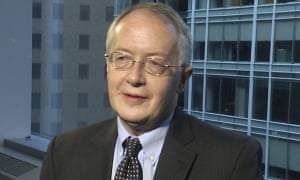
Myron Ebell.
Myron Ebell said he rejects the ‘expertariat’ who ‘have been wrong about one thing after another, including climate policy’. Photograph: AP

The environmental movement is “the greatest threat to freedom and prosperity in the modern world”, according to an adviser to the US president Donald Trump’s administration.

Myron Ebell, who has denied the dangers of climate change for many years and led Trump’s transition team for the Environmental Protection Agency (EPA) until the president’s recent inauguration, also said he fully expected Trump to keep his promise to withdraw the US from the global agreement to fight global warming.

Ebell said US voters had rejected what he dubbed the “expertariat” and said there was no doubt that Trump thinks that climate change is not a crisis and does not require urgent action.

Trump has already replaced the climate change page on the White House websitewith a fossil-fuel-based energy policy, resurrected two controversial oil pipelinesand attempted to gag the EPA, the Agriculture Department and the National Parks Service.

Trump, who has called climate change a “hoax” and “bullshit”, has packed his administration with climate-change deniers but appeared to soften his stance after his election win, saying there is “some connectivity” between human activity and climate change. However, he also claimed action to cut carbon emissions was making US companies uncompetitive.

Ebell, who has returned to his role at the anti-regulation thinktank the Competitive Enterprise Institute, said on Monday: “The environmental movement is, in my view, the greatest threat to freedom and prosperity in the modern world.”

The CEI does not disclose its funders but has in the past received money from the oil giant ExxonMobil. “Our special interest is, I would say, freedom,” Ebell said.

During the US presidential campaign, Trump pledged to withdraw from the climate change deal agreed by 196 nations in Paris in 2015, making the US the only country considering doing so. “I expect President Trump to be very assiduous in keeping his promises,” Ebell said.

Trump’s pick for secretary of state, the former ExxonMobil boss Rex Tillerson, appeared to contradict the president about leaving the climate agreement at his confirmation hearing, saying the US should keep “its seat at the table”.

“Who is going to win that debate? I don’t know but the president was elected and Tillerson was appointed by the president, so would guess the president will be the odds-on favourite,” said Ebell. “The people who elected him don’t want a seat at the table.”

“The people of America have rejected the expertariat, and I think with good reason because I think the expertariat have been wrong about one thing after another, including climate policy,” he said. “The expert class, it seems to me, is full of arrogance or hubris.”

“I don’t think there is any doubt that [Trump] thinks that global warming is not a crisis and does not require drastic and immediate reductions in greenhouse gas emissions,” he said. The deal agreed by the world’s nations in Paris aims to hold the global temperature rise to well below 2C, a target that requires dramatic cuts in carbon emissions. Without this, the world’s climate experts concluded there will be “severe, widespread, and irreversible impacts” on people and the natural world.

Ebell, speaking in London, claimed that the motivation for climate action was protecting a special interest: “The climate-industrial complex is a gigantic special interest that involves everyone from the producers of higher priced energy to the academics that benefit from advancement in their careers and larger government grants.” The IMF has calculated that fossil fuels receive $10m every minute in subsidies, while the fossil fuel industry spends at least $100m a year on lobbying.

China’s president, Xi Jinping, recently reaffirmed his nation’s commitment to tackling climate change and said the nation’s green investments were already “paying off”. China pledged earlier in January to invest $360bn in renewable energy by 2020.

In an echo of Trump’s claim that climate change was a hoax invented by China, Ebell said: “China is making big investments in producing more solar panels and windmills, which they sell to gullible consumers in the western world, so that power and electricity prices will become higher and the Chinese economy will become more competitive.”

Many experts say that the best way to “make America great again” would be to invest in the fast expanding, trillion-dollar market for clean technologies and that failing to tackle climate change will destroy economic growth.

Sam Hall of Bright Blue, a liberal conservative thinktank in the UK, said: “Despite the attempt by fringe elements to import ‘alternative facts’ from the US, mainstream conservatives in the UK support tackling climate change cost-effectively. Only last week, Theresa May’s Conservative government set out how she wants Britain to take advantage of the economic opportunities of new low carbon industries, such as battery storage and electric vehicles.”

Scott Pruitt, Donald Trump’s pick to lead the US EPA, is a climate change sceptic and has sued the agency he is now set to lead 14 times over the EPA’s smog, mercury and other pollution regulations. His confirmation vote in the Senate is expected on Wednesday.

Al Gore is a climate change James Bond in urgent, exhilarating ‘Inconvenient Sequel’

 http://mashable.com/2017/01/20/inconvenient-sequel-review-al-gore-sundance-movies/#OxfG7C2cqPqP

Al Gore in 'An Inconvenient Sequel'

Al Gore in ‘An Inconvenient Sequel’
IMAGE: SUNDANCE INSTITUTE
PARK CITY, Utah — Al Gore is angry. Really angry. He’s also swathed in burning hope.

With uncharacteristic fire and brimstone — but also steely resolve and a concrete plan — the former vice president opened the Sundance Film Festival on Thursday night with An Inconvenient Sequel, a daring, urgent and exhilarating follow-up to his 2007 film An Inconvenient Truth.

And what a decade it’s been since that groundbreaking, Oscar-winning documentary. “Climate-related events have gotten so much worse in the 10 years since,” Gore argues at the top of Sequel — and the evidence is splattered all over the screen.

Where Truth was a wonky if ultimately startling slideshow on the bigscreen, Sequel plays more like a taut political thriller with an apocalyptic streak, interlacing heart-stopping cinematography, adrenalized music cues and a dashing main character — Al Gore 3.0 — that you’ll wish had been president for oh, about eight years or so.

On top of it all, Sequel has genuine stakes that are pointedly of the moment: A crucial climate deal is coming together in its final moments, a real-life event that went down just months ago. What’s more, filmmakers Bonni Chen and Jon Shenk clearly took great pains to stick the landing firmly on events that go down, well … today, technically.

Gore, for his part, is a joy to watch. Yes, he stands on stages and stiffly clicks through PowerPoint presentations here and there — but at this point in his third act as a climate-change superhero, he’s also jet-setting around the world, observing atrocious evidence that the planet has long since teetered toward catastrophe.

Greenland’s fast-collapsing Jakobshavn Glacier, where raging rivers of melted snow carve explosive rifts in the ancient ice sheet. Miami Beach, where that same water sends city officials on the fool’s errand of building taller streets. Silicon Valley, where Solar City leads a stunning corporate charge for renewables. India, where energy ministers are desperately erecting “dirty coal” plants to support the population explosion. The Philippines, where Super Typhoon Yolanda killed more than 6,000 people.

And one very ominous, if fleeting, elevator ride up Trump Tower.

By the end, Gore and his stalwart staff finally descend on Paris, where in April a watershed international climate deal was forged — but stands to be swiftly dismantled by the incoming administration.

The former VP is a central figure in each of these scenes, tirelessly flying around in helicopters, boats, planes, cars (in one case ditching traffic for a subway to make a meeting on time) because this is what he does now.

And these are no empty gestures. He’s a climate change James Bond, using his wits and gadgets and sheer will to save the day at every turn.

This, despite the fact that there’s much to be discouraged about. Gore wistfully visits and re-visits his personal despair about fighting a battle that any reasonable human might declare long lost. After all, things really have gotten measurably worse since An Inconvenient Truth.

But while Gore pays his despair its due, he never gives in to it.

Standing on various stages before his armies of global acolytes, he passionately tears through the facts: 2016 continued the trend of hottest years on record, giving strength to cataclysmic storms, devastating droughts and raging fires. Desperate conditions give rise to desperate acts of violence and atrocity. It’s a lot.

“Future generations will look back,” Gore growls, “and say ‘What were you thinking?’ Couldn’t you hear what the scientists were saying? Couldn’t you hear Mother Nature screaming at you?”

It’s a whole new, more forceful side of Gore — one that, frankly, might’ve been handy in the 2000 election. Gone is the professorial, aw-shucks Senator from Tennessee, and before us instead is a highly motivated, focused, and sometimes-Hulk-smash-mad John Brown of the climate movement.

It’s scary at times. But ultimately, it is hopeful. There are reasons to lift your head during Sequel.

Solar and wind power, in particular, play the film’s strongest grace notes; despite mighty opposition from the oil/coal/gas industries, these renewable energy resources have seen staggering, exponential growth since Truth, and by the sound of it, they’ve done so largely on their own merit. They’re just good business, and good business seems to prevail.

What also prevails about Sequel: it’s simply a better movie than Truth, in terms of entertainment value, urgency and shock value. A half-dozen belly-laugh moments — and Gore’s boyish buoyancy — keep things light, the footage from around the world is as good as anything National Geographic could ever hope to produce, and the villain (no spoilers here, sorry) barely has to show his face to make an impact.

So much climate-change filmmaking descended on Park City this year that Sundance organizers gave it a section all to itself. If An Inconvenient Sequel is the foundation, then they’re off to a raging storm of a start.

10 IMPORTANT FACTS ABOUT CLIMATE CHANGE WORTH SHARING

http://www.washingtonnature.org/fieldnotes/2017-climate-change-facts-about-climate-change-to-share-social-media

There has been a lot of interest this week about the science of climate change. We’ve rounded up 10 of the most important factoids about climate change — some may surprise you. Share these with your friends on social media and spread the word about this critical issue.

1950: Year when atmospheric CO2 levels broke records from the previous 400,000 years, sharply rising and continuing to grow.

6.7 inches: Rise in global sea levels over the last century. The rate of rise has doubled in the last decade.

16: Number of record-breaking hottest years since 2000. 2016 was the hottest year yet.

1.5 degrees: The average worldwide temperature increase in Fahrenheit compared to a century ago.

21: Average annual number of wildfires in Central and Eastern Washington — up from an average of six per year in the 1970s.

19th century: When the heat-trapping nature of CO2 was first demonstrated.

30 percent: The increase in acidity of the world’s oceans.

$180 billion: Estimated economic losses to the United States by end of the century if no action is taken on climate change.

Sources: NASA, Environmental Protection Agency

Trump’s EPA pick: Human impact on climate change needs more debate

http://www.cnn.com/2017/01/18/politics/scott-pruitt-epa-hearing/

By Dan Merica and Rene Marsh, CNN

Washington (CNN)Scott Pruitt, Donald Trump’s pick to lead the Environmental Protection Agency, broke with the President-elect Wednesday and said he doesn’t believe climate change is a “hoax.”

But in testimony before the Senate Committee on Environment and Public Works, Pruitt didn’t indicate he would take swift action to address environmental issues that may contribute to climate change. Instead, the Oklahoma attorney general said there is still debate over how to respond.
“Science tells us the climate is changing and human activity in some matter impacts that change,” Pruitt said. “The ability to measure and pursue the degree and the extent of that impact and what to do about it are subject to continuing debate and dialogue.”
That stance puts Pruitt in line with the climate change views of several other Trump Cabinet picks, including Rex Tillerson and Ryan Zinke, who have acknowledged the issue but haven’t committed to an aggressive response.
Trump once called climate change a “hoax” invented by the Chinese and, during his campaign for president, repeatedly questioned scientific conclusions that human activity has caused global warming. More recently, he has acknowledged “some connectivity” between human activity and climate change.
Pruitt, who has long viewed the EPA skeptically and has sued the agency repeatedly as Oklahoma attorney general, is a lightning rod of a pick. As the hearing got underway, protesters criticizing Pruitt for his ties to the oil industry outside the room were clearly audible. A handful of protesters were escorted out of the hearing.
Pruitt said the EPA serves a critical mission and detailed how the agency under his leadership would take a dramatically different approach than under President Barack Obama. He accused the agency under Obama of flouting congressional rules and ignoring the desires of states.
Pruitt said “rule of law matters” and that as EPA director he would “follow the law” and regulations set out by Congress, a suggestion that the current leadership has not done that.

Views on climate change

It is likely that Pruitt, despite views that are abhorrent to many Democrats, will be confirmed as the next head of the EPA. But Democrats want to make him pay for it and plan to push the Republican on some of his past comments about climate and his ties to energy companies.
Pruitt wrote last year that climate change scientists “continue to disagree” about whether climate change is real, despite the fact that 97% or more of climate scientists believe climate change is real and linked to human activity.
And lawyers with the Environmental Defense Fund tell CNN that Pruitt filed at least 12 lawsuits challenging environmental protections as attorney general. Pruitt, in particular, sued over the EPA’s clean power plan, which seeks to curb carbon emissions from power plants and attempts to curb methane emissions from the oil and gas industry.
Bernie Sanders, the liberal Vermont senator who railed against the fossil fuel industry during his 2016 presidential campaign, hammered Pruitt for questioning the impact humans have on climate change.
Pruitt said his personal views on climate change are “immaterial” to whether he should lead the EPA, arguing that his prospective job is about following Congress’ guidance, not his own personal beliefs.
“Really?” Sanders asked incredulously. “You are going to be the head of the agency to protect the environment and your personal feelings about whether climate change is caused by human activity and carbon emission is immaterial?”
Pruitt stood by the statement, telling Sanders that his job as administrator would be to “carry out statutes passed by this body.”

Probed for ties to energy companies

He sought to beat back concerns about his ties to the energy industry by arguing it is wrong to say someone who is pro-energy is inherently anti-environment.
“First, we must reject the false paradigm that if you are pro-energy, you are anti-environment and if you are pro-environment, you are anti-energy,” he said. “I utterly reject the narrative.”
But environmental activists call Pruitt dangerous and Democrats on the committee will look to put his views of science and climate change on trial.
Sen. Tom Carper of Delaware, the top Democrat on the committee, has labeled the Oklahoma Republican “Polluting Pruitt” since his nomination was announced and argued that an EPA head that does not “recognize the damaging effects of climate change on our environment and economy” is not qualified for the job.
Sen. Sheldon Whitehouse, a Rhode Island Democrat, hammered Pruitt for his ties to a number of oil companies through his campaigns for attorney general, his super PACs and the Republican Attorneys General Association.
Whitehouse called some of his ties “a complete black hole” of money, alleging that Pruitt could be conflicted when dealing with some energy companies due to his fundraising.
Pruitt denied soliciting money from Koch Industries and others for the Rule of Law Defense Fund and noted that, as attorney general, he also sued energy companies.
According to the National Institute on Money in State Politics, Pruitt has received more than $300,000 from interests close to the fossil fuel industry since 2002.
Many Senate Republicans, however, see Pruitt as the right person to lead what they view as a wasteful agency that over-regulates, especially because Oklahoma is the biggest oil and natural gas-producing state in the nation.

Pledging action

Pruitt said he believes mistakes were made in the handling of lead poisoning in Flint, Michigan, blaming the Obama administration’s EPA for not moving faster.
“As you know, the Clean Water Act and The Safe Drinking Water Act, if there is an emergency situation, the EPA can enter an emergency order to address those kind of concerns,” Pruitt said. “I think there should have been a more fast response, a more rapid response to Flint, Michigan.”
Pruitt’s main argument during the start of his hearing has been that the states should have more power within the EPA, but on this issue, he argued that the federal government agency should have had more power to respond.
Sen. Ben Cardin, a Maryland Democrat, pressed Pruitt on his lawsuits against the EPA, charging the body with overreach in state matters.
Pruitt said on issues of air quality and water quality and inter-state issues, the EPA is particularly necessary.

Join the Resistance to Trump’s Attack on Our Environment and Civil Rights

http://www.biologicaldiversity.org/campaigns/earth2trump/index.html
The Earth2Trump Roadshow is coming to a town near you in January.

The roadshow is rallying and empowering defenders of civil rights and the environment to resist Trump’s dangerous agenda. Stopping in 16 cities on its way to Washington, D.C., it will bring thousands of people to protest at the presidential inauguration.

Click on the map below to RSVP for an event near you. Invite your friends, family and activist networks. Forward this webpage widely on Facebook, Twitter and email.

Beginning in Oakland and Seattle on Jan. 2, the Earth2Trump Roadshow will tour the country bringing speakers, musicians, outrage, fun and hope to 16 cities as it progresses toward the presidential inauguration on Jan. 20.

The shows will feature national and local speakers, great musicians, and an opportunity to join a growing movement of resistance to all forms of oppression and all attacks on our environment. We must stand and oppose every Trump policy that hurts wildlife; poisons our air and water; destroys our climate; promotes racism, misogyny or homophobia; and marginalizes entire segments of our society.

At each show, you can:

  • Sign the national Pledge of Resistance to Trump’s dangerous agenda.
  • Write a personalized #Earth2Trump message that will be carried to D.C. inside a massive three-dimensional globe and delivered to Trump.
  • Create a huge, viral social media #Earth2Trump messaging campaign.
  • Connect with people in your community resisting oppression and find out how to join the million people who will protest in Washington, D.C., on Inauguration Day.

Join us in your community to send a powerful, unwavering #Earth2Trump message that oppression and environmental destruction must not be tolerated.

Click on locations in the map below to RSVP so we know you’re coming and then share this page with your family, friends and social networks.

Trump is a threat to the Paris agreement. Can states like California defend it?

Mayors could override Trump on the Paris climate accord — here’s how (Business Insider)
http://www.businessinsider.com/mayors-could-override-trump-on-paris-accord-2016-11?IR=T

American Mayors Pledge Climate Leadership In Response To United States Presidential Election (C40 Cities)
http://www.c40.org/blog_posts/american-mayors-pledge-climate-leadership-in-response-to-united-states…

Trump is a threat to the Paris agreement. Can states like California defend it? (The Guardian)
https://www.theguardian.com/commentisfree/2016/nov/21/trump-threat-paris-agreement-california-climate-change

Google says it will hit 100% renewable energy by 2017 (TechCrunch)
https://techcrunch.com/2016/12/06/google-says-it-will-hit-100-renewable-energy-by-2017/

India’s silence on Trump noted at Marrakech climate talks (Climate Change News)
http://www.climatechangenews.com/2016/11/18/indias-silence-on-trump-noted-at-marrakech-climate-talks/

Trump, Putin, and ExxonMobil team up to destroy the planet (Think Progress)
https://thinkprogress.org/trump-putin-and-exxonmobil-team-up-to-destroy-the-planet-fb88650acfa1#.ghwab1ulw

Leonardo DiCaprio, Trump talk climate change

http://www.cnn.com/2016/12/08/politics/leonardo-dicaprio-trump-climate-change-meeting/index.html

(CNN) Leonardo DiCaprio met with President-elect Donald Trump on Wednesday to discuss climate change — adding to the mixed signals from the President-elect on the environment.

“We presented the President-elect and his advisors with a framework … that details how to unleash a major economic revival across the United States that is centered on investments in sustainable infrastructure,” Terry Tamminen, CEO of the Leonardo DiCaprio Foundation, said in a statement. “Our conversation focused on how to create millions of secure, American jobs in the construction and operation of commercial and residential clean, renewable energy generation.
DiCaprio’s meeting with Trump only added to the mixed messages coming out of Trump Tower, particularly on the issue of climate change.
On the same day of his meeting with DiCaprio, Trump tapped Oklahoma attorney general Scott Pruitt — a climate change denier — to head the Environmental Protection Agency. Pruitt is an opponent of many of the Obama EPA’s environmental regulations, and sued the agency over its regulations of power plants in his capacity as attorney general.
Coupled with Trump’s own history of climate change skepticism, environmentalists see dim prospects for action that scientists say is necessary to avert the most devastating consequences of climate change. Trump has called climate change a “hoax” but in a recent interview allowed for the possibility that human activity may be contributing to global warming.
Trump held a separate meeting this week with another high-profile environmental activist — former Vice President Al Gore, who has also championed the fight against climate change in his career after politics.
DiCaprio has used his celebrity to champion environmental causes. He emphasized the threat of climate change in his 2016 Academy Awards acceptance speech — “Climate change is real, it is happening right now,” he said — and produced a documentary on the subject, titled “Before the Flood,” which was released this year. According to “The Independent,” DiCaprio gave Ivanka Trump a copy of the documentary at the meeting.
The statement from his foundation added that “climate change is bigger than politics, and the disastrous effects on our planet and our civilization will continue regardless of what party holds majorities in Congress or occupies the White House.”
And according to the foundation, there may be another meeting.
“The President-elect expressed his desire for a follow up meeting in January, and we look forward to continuing the conversation with the incoming administration as we work to stop the dangerous march of climate change, while putting millions of people to work at the same time,” Tamminen said in the statement.
The Trump campaign did not respond to a request for comment on the DiCaprio meeting.
How drastic might Trump’s climate change policy changes be? A report released in Novemberby the International Energy Agency (IEA) outlines two key scenarios for emissions and global warming in the coming decades.
The first scenario assumes world leaders keep the promises made in Paris last year at the United Nation’s COP21 summit. The agreement between more than 175 countries introduced environmentally friendly policies to slow the increase in emissions and global warming.
The second scenario assumes no real action is taken and agreements are brushed aside, resulting in a 36% surge in carbon dioxide emissions by 2040, nearly three times the increase expected under the first scenario. While that would be a nightmare for environmentalists, it’s unlikely that all Paris signatories would abandon their pledges.
Still, according to a recent United Nations Environment report, the world is still heading for a temperature rise of 2.9 to 3.4 degrees Celsius this century, even with the Paris pledges.

Trump Meets With Al Gore on Climate Change

UPDATED 12:41 PM

President-elect Donald J. Trump and his daughter Ivanka met with former Vice President Al Gore on Monday to discuss human-caused climate change.

A meeting on climate change.

Continue reading the main story

Photo

Al Gore, the former vice president, arrived at Trump Tower in Manhattan on Monday.CreditHilary Swift for The New York Times

Al Gore thought he would be bending the ear of the adviser Mr. Trump trusts most, his daughter Ivanka.

Instead, the man bearing “The Inconvenient Truth” went straight to the source: the president-elect himself.

“I had a lengthy and very productive session with the president-elect,” Mr. Gore, the former vice president, told reporters at Trump Tower. “It was a sincere search for areas of common ground. I had a meeting beforehand with Ivanka Trump. The bulk of the time was with the president-elect, Donald Trump. I found it an extremely interesting conversation, and to be continued.”

Full Story: http://www.nytimes.com/2016/12/05/us/politics/donald-trump-transition.html?_r=0

Cat alerts Tennessee man to Gatlinburg fires

http://www.usatoday.com/story/news/nation-now/2016/12/05/gatlinburg-fires-cat-alerts-man/94983594/

KNOXVILLE, Tenn. — A Tennessee man who owns a store in Gatlinburg is so naturally laid back, the first word that wildfires were near the communitydidn’t unnerve him.

Mark Burger, 60, figured his cellphone would get an evacuation alert if the situation became dangerous, he said.

After inquiries, officials have since said no evacuation alert was sent to mobile devices.

Tennessee’s monthslong drought and wildfire emergency culminated Nov. 28 when hurricane-force winds sent unpredictable fires racing through the Gatlinburg area.

On Nov. 28, Burger was relaxing in his mountainside Gatlinburg condo with Tiger, his Siamese cat, for company. Burger’s son, Tanner, found Tiger as a kitten abandoned. Tanner rescued Tiger and gave him to Burger as a gift.

Now, it seems Tiger has repaid Burger for his life.

More: http://www.usatoday.com/story/news/nation-now/2016/12/05/gatlinburg-fires-cat-alerts-man/94983594/

Ecological Drought in the South Central United States: Time is Not on Our Side

Drought is not uncommon in the South Central U.S. Encompassing the states of New Mexico, Texas, Oklahoma, and Louisiana, the region has experienced its share of multi-year droughts – including the infamous Dust Bowl of the 1930s. Yet while the South Central is no stranger to drought, the summer of 2011 was the hottest ever recorded in the region, and conditions like these may become the new norm.

As climate changes, the South Central U.S. is expected to experience more frequent and severe droughts. In light of these projected future conditions, the Department of Interior South Central Climate Science Center (CSC) is working to identify how drought will manifest itself in the region, and what these changing conditions will mean for both people and nature. In March 2016, a group of climate and ecological experts met to discuss the issue, and agreed on several core challenges that drought poses in the region:

 
1. Forecasted climatic changes will vary across this diverse region  Photo of the Pecos River, TX
The South Central region is comprised of a variety of ecosystems, from deserts in New Mexico to coastal marshes in Texas and Louisiana. Forecasted changes in temperature and precipitation are expected to vary across this diverse region. For example, the spring of 2011 was the wettest on record in the northern Great Plains, but was exceptionally dry in the southern Great Plains.
 
2. Reduced water availability will affect wildlife, ecosystems, and people
From coastal ecosystems that provide critical habitat to wildlife, sequester carbon, and support fisheries, to agriculture in the High Plains, reduced flows of freshwater will have wide-reaching ecological, economic, and cultural impacts. For example, reduced soil moisture can impact agriculture, while reduced river flow can increase the salinity of sensitive coastal ecosystems.
 
3. Land management practices will need to adapt to changing conditions
Image of the newsletter produced as a result of the workshop
Innovations in land management will be required to address the range of drought-related impacts. Management solutions will be challenged by the need to consider the cultural, economic, and ecological diversity of the region, but are vital if the cascading impacts of drought are to be mitigated. For example, in New Mexico, drought could result in increased tree mortality, providing additional fuel for wildfires. Areas impacted by fire are then at higher risk for flash floods, which transport large amounts of sediment downstream and can impact ecological and human communities alike.
 
This workshop was hosted in partnership by the South Central CSC (Climate Science Center), the University of Maryland Center for Environmental Science Integration & Application Network, and the USGS National Climate Change and Wildlife Science Center.
 
The workshop was the fourth in a series of eight workshops being held across the U.S., each in a different region. Each workshop results in a brief informational document that synthesizes the current understanding of ecological drought in the region. Click the graphic on the right to view the informational document from the South Central workshop.