Exposing the Big Game

Forget Hunters' Feeble Rationalizations and Trust Your Gut Feelings: Making Sport of Killing Is Not Healthy Human Behavior

Exposing the Big Game

This could explain all those strange happenings in Alaska’s waters

Bears feeding on a fin whale carcass in Larson Bay, Alaska. Photo: NOAA© Provided by WP Company LLC d/b/a The Washington Post Bears feeding on a fin whale carcass in Larson Bay, Alaska. Photo: NOAA

http://www.msn.com/en-us/news/us/this-could-explain-all-those-strange-happenings-in-alaska%e2%80%99s-waters/ar-BBpA0Cf?ocid=spartanntp

The Washington Post
by Ryan Schuessler

New research is shedding light on how far toxic algae blooms have spread in Alaska, and surprised scientists are saying this is just the beginning.

A study from the National Oceanic and Atmospheric Administration’s Northwest fisheries center found domoic acid and saxitoxin – algae-produced neurotoxins that are deadly in high doses — in 13 marine mammal species across Alaska, including as far north as the Beaufort and Chukchi seas.

Researchers say the study is just the latest piece of evidence that warming ocean temperatures are allowing these blooms to stretch into Arctic ecosystems, threatening marine life and the communities who rely on the sea to survive.

“The waters are warming, the sea ice is melting, and we are getting more light in those waters,” said Kathi Lefebvre, NOAA Fisheries research scientist. “Those conditions, without a doubt, are more favorable for algal growth. With that comes harmful algae.”

Suggested from Windows Store

Wikipedia

Learn more about algae blooms

The study, which analyzed more than 900 samples taken from stranded or harvested marine mammals in Alaska between 2004 and 2013, found algal toxins in all species sampled, including bowhead whales, fur seals and sea otters.

“We were surprised,” Lefebvre said. “We did not expect these toxins to be present in the food web in high enough levels to be detected in these predators.”

“There seems to be a potential risk for marine mammal health,” she added. “Then there’s also a seafood security risk, in that these communities rely on and depend on these animals for food.”

“I think that’s going to have a huge impact on the Native communities and coastal communities in Alaska,” said Bruce Wright, senior scientist for the Aleutian and Pribilof Island Association, the federally recognized tribal organization of Alaska’s indigenous Aleut citizens. “I think that we’re going to see a number of shifts in our ecosystem as a consequence of warming, and I think some species will be displaced by other species, and others will disappear. There [are] going to be consequences and people are going to have to adapt.”

NOAA’s new study, released last week, comes after months of strange marine life die offs in Alaska. Last year, NOAA declared the deaths of more than 30 whales in the Gulf of Alaska to be an unusual mortality event. Just last month, thousands of dead birds began washing ashore in Prince William Sound.

“I’m pretty sure that’s associated with these algal blooms,” Wright said of the bird die offs and other events. Toxic algal blooms in the region, particularly 2015’s, likely wipe out entire parts of the lower food chain, he added, the effects of which reverberate through the ecosystem.

A massive toxic algal bloom, believed the largest ever recorded, reaped havoc in the Pacific in 2015. Stretching from southern California north to the Aleutian Islands and Bering Sea, it prompted the closure of recreational and commercial fisheries across the American and Canadian coastlines.

“It really does point out that there is a need for more monitoring,” Lefebvre said.

Increasingly warm waters in the north Pacific are believed to be behind other strange disease outbreaks as well. A recent study from the University of Puget Sound found that warmer waters in 2014 contributed to an epidemic of sea star wasting disease in the North Pacific, which decimated starfish populations in the north Pacific.

“My thought is, absolutely, the environment is changing very rapidly in Alaska,” Lefebvre said. “And it’s warming, and there are changes in fundamental parts of the ecosystem.”

She added: “And these ecosystems have developed over millions of years, so when they’re rapidly changing, the chances they’re going to be changed for the better, over all, are very slim.”

http://www.msn.com/en-us/news/us/this-could-explain-all-those-strange-happenings-in-alaska%e2%80%99s-waters/ar-BBpA0Cf?ocid=spartanntp

Marine experts seek answers in death of humpback whale

A whale washed up Sunday evening on the beach in Seaside. — Kyle Spurr/The Daily Astorian


SEASIDE — The dead 24-foot humpback whale that washed ashore on the north end of Seaside’s beach Sunday caused quite a stir.

A couple of dozen onlookers stopped to watch Tuesday as a team of marine experts from Portland State University and Oregon Marine Mammal Stranding Network volunteers performed a necropsy on the animal, which had been moved slightly inland and north on the beach. Some came to town specifically to see the whale.

The team collected biological samples that will be used to help determine a cause of death. If there are no “smoking guns,” such as bullet holes or something stuck in the mammal’s throat, then it can take days or weeks to determine a cause of death, said Keith Chandler, the general manager of Seaside Aquarium.

It was clear the animal did not die from old age, as it was only about a year old, Chandler said. He said it is not unusual to see a whale wash ashore on the North Coast, but they tend to be gray whales. Humpbacks are rare — Chandler said he has only see a few in his 20 years with the stranding network — but the species was spotted in nearby waters recently.

“There were a few humpbacks hanging out in the mouth of the Columbia River last year,” he said. “They are usually further offshore. It could have died offshore and with the storm, washed in.”

The whale was one of at least five cetaceans to wash up in the area in three days. A harbor porpoise and two striped dolphins were found Saturday. One dolphin was found in Cannon Beach and the other in Ocean Park, Washington. A third striped dolphin washed ashore in Seaside Monday. Chandler said it is “quite unusual to get them all together,” especially the striped dolphins.

The Ocean Park dolphin showed signs of being entangled in a net and had a hole in its tail that appeared to be from a gaff, Chandler said. The dolphin from Seaside had a similar hole in the same area, but it had not undergone a necropsy by Tuesday. Chandler said it could be a single event — getting caught in the net — that caused the unusual occurrence of killing multiple dolphins at once. If a single event is the cause of death, Chandler said, then “we know it’s just an accident,” as opposed to persistent conditions impacting a species, like disease.

City crews planned to bury the whale at the beach by Wednesday morning.

http://www.dailyastorian.com/Local_News/20160203/marine-experts-seek-answers-in-death-of-humpback-whale?utm_source=Daily+Astorian+Updates&utm_campaign=b5c32b3710-TEMPLATE_Daily_Astorian_Newsletter_Update&utm_medium=email&utm_term=0_e787c9ed3c-b5c32b3710-109860249

Excerpts from Freak Storms and Butterfly Die-Offs: This Is Your Climate on Fossil Fuels

Monday, 01 February 2016 00:00
Written by 
Dahr Jamail By Dahr Jamail, Truthout | Report

http://www.truth-out.org/news/item/34631-freak-storms-and-massive-animal-die-offs-this-is-your-climate-on-fossil-fuels

…In late December 2015, a freakish oceanic storm moved into the Arctic where it pushed temperatures 50 degrees above normal, even causing melting at the North Pole in the dead of winter.

Large die-offs of birds, whales, antelope and other animals across the globe are now being attributed, in large part, to ACD.

December brought wild weather events in other places too, as the UK saw its single wettest month ever recorded, with nearly double the average rainfall. That month in the UK also shattered temperature records, with an average temperature that was 4.1 degrees Celsius higher than the long-term average.

Worldwide, December saw the planetary temperature increased to 1.4 degrees Celsius above the 1890 average. The annual increase of warming for that month, compared to the previous December, according to Japan’s Meteorological Agency, was the equivalent of cramming 20 years of anthropogenic warming into just one 12-month warming period.

And warming trends are not slowing down. They are, instead, continuing to speed up.

The UK’s Meteorological Office recently released its global temperature forecast, and the agency is already predicting that 2016 will most likely be even warmer than 2015.

A look at recent scientific reports, coupled with extreme weather events around the world, show that this prediction is already well on its way to becoming a reality.

Earth

In parts of California, so much groundwater has been pumped from the earth that the land is literally sinking, an issue that is now costing that state billions of dollars as it struggles to repair damaged infrastructure.

Of course, humans are not the only ones affected by these rapid, sweeping changes. Large die-offs of birds, whales, antelope and other animals across the globe are now being attributed, in large part, to ACD.

ACD is even affecting the behavior of our planet as it makes its way around the solar system.

“Unprecedented” numbers of murre seabirds have met their fate in a massive die-off across large areas of Alaska, and scientists are attributing it to starvation caused by ecosystem changes fueled by ACD. This isn’t a huge surprise; data from studies from both 2007 and 2012 warned that melting snow and permafrost were causing huge drops in lemming populations, which would impact food sources for many species, causing a rippling effect across the entire ecosystem of that part of the world.

It’s not just fauna that is threatened – flora is also experiencing ACD-fueled die-offs. Across the US Southwest, a recent study warns that ACD could likely trigger a “massive” die-off of coniferous trees, including junipers and pinon pines, sometime during this century.

In the UK, the Butterfly Conservation charity recently released a study showing that three-quarters of the UK’s butterfly species have declined in just the past 40 years. Along with habitat destruction and the increased use of pesticides, ACD was named as one of the primary culprits.

ACD is even affecting the behavior of our planet as it makes its way around the solar system. Climate disruption has now been shown to be causing the rotation of the entire planet to slow, thus making days longer in length. This is due to the amount of melting taking place across the world’s glaciers, which is adding to global sea level rise from that melt water, which is what is slowing down rotation.

Melting ice in Antarctica, both on land and in the water, is causing a large number of countries to position themselves on the icy continent in an effort to exert influence, looking forward to the day when the treaties that currently protect that continent from resource extraction and militarization expire.

Water

In Europe, the future of most of the continent’s ski industry is in doubt, as ACD-fueled temperatures are resulting in less snow and seasons are shortening.

Increasing planetary temperatures are now heating up all of the oceans – much faster than we previously thought. In fact, a recent study shows that the deep ocean has warmed as much in the last 20 years as it had during the previous 100 years combined.

Those warming water temperatures cause the water to expand, adding to rising sea levels already augmented by the ongoing melting of the planetary ice. The rising sea levels are particularly evident in Miami, where multimillion-dollar homes, roads and businesses are already being encroached upon by the sea. Eventually, they will be abandoned.

Making matters worse, even the depletion of groundwater from aquifers in places like California has recently been shown to be adding to rising sea levels, since much of it ends up flowing into the oceans.

“Where there were fish for decades, now there is very little.”

Meanwhile, within the oceans themselves, life as we’ve always known it is well on its way to being completely transformed. The extreme El Niño we are experiencing now, amplified by ACD, is warming water temperatures so much that major coral bleaching events, along with coral death events, are becoming widespread.

Water temperatures have already increased enough in the Indian Ocean that there has been a reduction in phytoplankton (the base of the food chain) by 20 percent, which means the food chain is rapidly diminishing. Thus, scientists are warning that the entire ocean could well become an “ecological desert” if things continue as they are.

“We seem to be spending more and more time out at sea looking for catch,” a 54-year-old fisherman who operates his boat up to 90 miles off the coast of Sri Lanka told Reuters recently. “Where there were fish for decades, now there is very little. It is strange, but all of us have been noticing that.”

A recent study by 16 authors shows that Greenland alone has lost more than 9 trillion tons of ice since 1900. And the rate of ice loss is increasing dramatically, with a doubling of ice loss per year between 2003 and 2010, compared to what the rate was throughout the last century.

To make matters worse, another recent study shows that Greenland is going to contribute in yet another way to global sea level rise, by the fact that rising global temperatures are changing Greenland’s ability to store excess water, which means more melting ice is likely running into the ocean than was previously believed.

Greenland saw a recent major melting event in January, of all months, which is disconcerting, to say the least.

Denial and Reality

It should come as little surprise that Sen. Ted Cruz leads the denial section in this month’s climate dispatch. The Republican presidential candidate, in the wake of the COP21 climate summit in Paris, said that if he were elected president he would withdraw the United States from the climate agreement.

In direct contradiction to Cruz’s statement, a Reuters/Ipsos poll shows that the majority of US Republicans actually support collaborating with other countries to work to mitigate ACD, and are even willing to take steps to do so.

More: http://www.truth-out.org/news/item/34631-freak-storms-and-massive-animal-die-offs-this-is-your-climate-on-fossil-fuels

Beavers may be part of answer to climate change

Beavers may be part of answer to climate change

by on • 8:59 pm No Comments

Photo courtesy of Methow Beaver Project Methow Beaver Project team members release a beaver in a high mountain meadow that has since become a new beaver colony site that holds millions of gallons of water.

Photo courtesy of Methow Beaver Project

Methow Beaver Project team members release a beaver in a high mountain meadow that has since become a new beaver colony site that holds millions of gallons of water.

Local relocation project returns animals to natural habitat

By Ann McCreary

Can a rodent species native to the Methow Valley help solve problems created by climate change?

Absolutely, according to a local biologist who leads the Methow Beaver Project.

Beavers, the animal kingdom’s version of the Army Corps of Engineers, build dams that store water in mountain streams. And that could help mitigate the impacts of diminishing winter snowpacks and warmer temperatures that are anticipated as a result of climate change, said Kent Woodruff.

beaver-quoteThe Methow Beaver Project, now in its ninth year, relocates beavers to tributaries in the upper reaches of the Methow watershed. The goal is to restore beavers to their historical habitat and allow them to do what comes naturally — build dams and create ponds that store water both above and below ground.

Water held in those storage basins is released gradually throughout the warm months when it is needed for fish, wildlife and irrigation. That slow release has the added benefit of keeping water in tributaries cooler, which enhances habitat for fish and other creatures, said Woodruff, a biologist with the U.S. Forest Service.

Climate change models predict dramatically lower snowpacks in the future. As humans consider ways to adapt to the changes resulting from a warming climate, beavers have some lessons to offer, according to Woodruff.

“One of the things I’m excited about is the Beaver Project provides an example and inspiration for climate adaptation,” he said.

Woodruff provided an overview of the Methow Beaver Project last Thursday (Jan. 14) in a presentation at the North Cascades Basecamp near Mazama.

With predictions of diminishing mountain snowpacks as a result of climate change, it is important to find ways to hold water high in the watershed. That’s precisely what beavers do when they build dams in streams, Woodruff said.

The ponds created by beavers support a complex and diverse ecosystem, and help restore the function of the mountain watersheds, he said.

Well adapted

Beavers are well adapted to areas like the Methow Valley that experience wildfires, because their favorite food  — Aspen trees  — thrive in riparian areas that have been burned, Woodruff said. And dams built by beavers may help reduce damage from post-fire flooding, he said.

Since the Methow Beaver Project began in 2007, team members used satellite imagery and computer modeling to survey hundreds of tributary drainages in the Methow Valley and identified 161 sites that would provide a good home to beavers, and where beavers could improve the surrounding watershed.

About 240 beavers have been relocated at 51 sites within the watershed. Despite the project team’s efforts to select locations that provide excellent habitat, some beavers choose not to stay at their release site.

The animals that have remained at or near their release sites, however, are responsible for creating 176 ponds, Woodruff said.

“I like the fact that we’re putting little tiny reservoirs all over this watershed,” he said.

A biologist last year measured the amount of water stored at 62 of the ponds created by beavers released into the watershed. She found they stored 5 million gallons of water, which she calculated as enough for an average Twisp household for five years, Woodruff said.

Woodruff estimated that as much as 65 million gallons of water is stored behind the beaver dams annually. That’s enough water to serve an average household in Twisp for 24 years, Woodruff said.

Studying impacts

Beaver Project team members are studying the impacts that beavers have on water storage and temperature, water quality, and overall impacts on the ecosystem.

Beavers that are relocated through the program are often trapped and removed from private property, where their industrious tree cutting may not appreciated by homeowners, and occasionally results in trees falling on rooftops and vehicles, Woodruff said.

They are taken to the National Fish Hatchery in Winthrop where they are temporarily housed in ponds until they are relocated to a chosen site.

The team prepares the relocation site by building a shelter of logs, branches and mud to simulate a beaver lodge, giving the beavers a place to escape predators when they are released.

A PIT (passive integrated transponder) tag is implanted in the beavers’ tails before release, which allows biologists to track the animals’ movements. Team members have been surprised by how far beavers travel, Woodruff said.

“Beavers are much more mobile than we thought,” he said. For instance, a beaver that was released in the upper part of the Methow Valley swam to the mouth of the Methow River, then up the Okanogan River almost to the Canadian border. Records show that some beavers have traveled almost 100 kilometers in a four-month period.

“We don’t know for sure why” they travel so far, Woodruff said. “We want them to stay” at the release site.

Beavers were nearly exterminated by the early 1900s in the Methow Valley as a result of fur trapping, and Woodruff said there is still a legal trapping season in Washington. A beaver pelt is worth about $20 he said.

Woodruff said the project is working to re-establish a beaver population in the Methow Valley “that will be able to take care of itself.”

Biologists have tried to estimate the value of habitat restoration that beavers provide by storing water, and have put the number at about $3,000 per beaver, Woodruff said.

The Methow Beaver Project has generated interest from many agencies and organizations around the country, he said. Team members have provided information to help launch similar projects in the Yakima and Skykomish river drainages, in Idaho, Colorado, Utah and northern California.

Starving sea lion pups likely to begin washing up on beaches soon

There was a sick, starving or injured sea lion on the beach, right off the Ocean Park, WA approach. She was able to raise up whenever a driver would stop and hassle her, but she couldn’t get back to the surf and away from the hundreds of clam diggers who were driving right past her.

Hopefully someone won’t run her over, as happened (purposely, maliciously) to a seal and her newborn pup last year on that same stretch of beach. This sea lion was either wounded by having been shot (likely by one of the crabbers or fishermen in boats offshore), or she had a buildup of domoic acid from the red tide that’s still around and is directly linked to warmer ocean temperatures and a resultant massive toxic algae bloom off the Pacific Northwest coast.


……………………………………………………………………………………

http://www.scpr.org/news/2015/12/30/56356/starving-sea-lion-pups-likely-to-begin-washing-up/

December 30 2015

Malnourished and dying California sea lion pups are likely to be seen again in high numbers on California beaches this winter and spring.  Scientists with the National Oceanic and Atmospheric Administration have been monitoring sea lion rookeries on the Channel Islands and have found the lowest weights in pups in 41 years of recorded history.

“We’re preparing for higher than normal numbers, because the information that’s coming from the islands, from the scientists, are saying that the pups are the smallest that they’ve really ever been,” said Justin Viezbicke, stranding coordinator for the National Marine Fisheries Service in California.

Since January 2013, starving California sea lion pups have been washing up on beaches at alarmingly high numbers. The cause is believed to be a wide swath of abnormally warm water that has depressed the number of sardines in typical hunting areas. Sardines are important food sources for nursing mothers.

A screenshot of a NOAA Fisheries website shows the number of stranded California sea lions has increased in recent years.
A screenshot of a NOAA Fisheries website shows the number of stranded California sea lions has increased in recent years. NOAA Fisheries


Viezbicke said strandings on the mainland could be high, because many pups are continuing to survive in the rookeries. When they leave, they’re not able to forage successfully and end up washing ashore on mainland beaches. Those strandings could begin occurring in late December and early January.

“If that’s similar to what we were having last year, where the pups are good enough to get off the island but not overall healthy enough to last within the system that they’ve got because of their situation, then we’re anticipating seeing higher than normal strandings again this year,” Viezbicke said.

The “blob” of warm water that has extended for thousands of miles into the Pacific Ocean from the West Coast has cooled in recent months. That would normally be a good sign for returning sardines. However, Nate Mantua, a research scientist with NOAA Fisheries, said the strong El Niño is likely to warm up the water near the coast again.

“It’s expected to have stronger and stronger influences on ocean currents and weather patterns off the West coast that are likely to keep it really warm for the next few months,” Mantua said. “That means that the marine food webs are still going to be disrupted near shore and really around those rookeries.”

Additional factors could complicate the care of sea lions. Another unusual mortality event has been declared for Guadalupe fur seals, a threatened species of seal that began stranding in abnormally higher numbers last January. Viezbicke said the protected status of the fur seal requires more space and isolation for animals receiving care. That could reduce the capacity facilities have to care for California sea lion pups.

“It’s a little bit more challenging space-wise, when you add other species,” Viezbicke said.

Adding to that challenge is the lingering domoic acid in ocean waters after a record toxic algal bloom that stretched from Southern California up into Alaska. The neurotoxins dumped into the water from the bloom can persist for months and concentrate in the flesh and viscera of shellfish.

Viezbicke said adult sea lions and fur seals needing treatment could further complicate care, since pups cannot be safely housed with adults.

Despite the multiple consecutive seasons of strain on young California sea lions and the subsequent low survivorship, scientists said the overall population remains healthy at around 300,000 individuals.

“At this time, the health of that population remains really good and really strong and much better than it was just a few decades ago,” Mantua said.

Viezbicke said scientists will continue monitoring the population in coming years.

“If it keeps happening, there will be concerns, but with a robust population of 300,000 animals, the reality is that it’s not a population concern at this point, but it’s something that we’re definitely keeping an eye on,” Viezbicke said.

Despite the overall wellbeing of California sea lions, the sight of starving sea lion pups will be difficult for many beachgoers. People who do encounter sea lions or fur seals they believe are suffering should not approach the animals but should contact the Marine Mammal Stranding Network at 1-866-767-6114.

Viezbicke said even so, the public should be aware that with the limited capacity to help the animals, many will not be able to receive care.

“You really want to temper the public’s expectations in those scenarios, because we understand that there’s concern, but the reality is we can only take so many animals in. And that’s really for the better of those animals that are currently in the facilities,” Viezbicke said. “It’s more of a quality thing.”

101939 full

Pakistan turns to coal to keep factories running

http://climatenewsnetwork.net/pakistan-turns-to-coal-to-keep-factories-running/

January 19, 2016, by Kieran Cooke

Tharparkar

Tharparkar, in Sindh, where Pakistan and China will exploit an opencast mine
Image: Zaferauf via Wikimedia Commons

Share on FacebookShare on Google+Tweet about this on TwitterShare on LinkedIn

To tackle chronic energy shortages Pakistan plans to mine and burn millions of tonnes of coal, helped by China’s money and expertise.

LONDON, 19 January, 2016 – Till now, Pakistan has not used the bulk of its coal reserves – some of the largest in the world – for power generation. Not any more.

Within the last month the government in Islamabad has signed a number of financial and technological agreements with China aimed at exploiting massive coal reserves at the Tharparkar mine in Sindh province, in the south of the country.

Under the terms of the agreements, 3.8 million tonnes of coal will be produced each year at the Tharparkar open-cast mine to fuel a 660MW power plant and other facilities.

The estimated cost of the project is US$2bn: China’s banks and private companies will supply US$1.5 billion in loans, while Pakistan will contribute US$500 m in both private and public finance.

High risk

Scientists say the mining and burning of coal is one of the main drivers of climate change from human causes. The coal at Tharparkar is mainly lignite – one of the least energy-intensive and most polluting types of coal. 

Pakistan is thought to be one of the countries most at risk from climate change: in recent years it has endured a number of floods and droughts, and in the summer of 2015 more than 1,200 people died in a searing heatwave

Despite government declarations that it would prioritise climate change, Pakistan has shown little appetite for tackling the issue.

At the recent climate summit in Paris, Pakistan pledged to reduce its emissions of climate-changing greenhouse gases by 5% over 2012 levels by 2030 – a figure sharply criticised as being far too modest by a number of the countrys own climate experts.  

The energy produced by the lignite deposits at Tharparkar will be mainly directed at helping alleviate serious power shortages in Karachi, a city of more than 20 million people which is Pakistan’s main industrial centre.

Oil and water

At present Pakistan depends on imported oil for 65% of its energy, while hydro makes up an additional 30% of the national energy mix: there are also three nuclear power plants, and wind and solar are fast-growing energy sources.

Environmentalists say the new coal-powered power plants will only worsen the country’s serious pollution problem. Karachi is already among the world’s most polluted cities

The development of the Tharparkar coal field is part of an ambitious multi-billion dollar Pakistan/China economic development programme aimed at linking the remote western provinces of China to Karachi and other ports on the Arabian Sea. 

China – the world’s biggest emitter of greenhouse gases – has pledged to cut back on the use of coal for power generation.

But critics say Beijing is pursuing contradictory policies – cutting back on pollution at home, while encouraging heavily polluting projects abroad. – Climate News Network

December auto sales soar 9% in record year

[It seems some folks aren’t getting the message about climate change…]

by Nattan Bomey and , USA TODAY 7:08 p.m. EST January 5, 2016

Automakers posted a solid 9% sales gain in December, an exclamation point that sealed 2015 as the biggest sales year ever for the industry, they reported Tuesday.

All told, automakers sold 17.47 million new vehicles for the year, Autodata reported, besting the previous record set in 2000 by 68,138 vehicles. Low gas prices, cheap credit, low unemployment, soaring consumer confidence and warm weather fueled a rush into showrooms in December.

“The U.S. economy continues to expand, and the most important factors that drive demand for new vehicles are in place, so we expect to see a second consecutive year of record industry sales in 2016,” said Mustafa Mohatarem, GM’s chief economist, in a statement.

Meanwhile…

Porter Ranch Methane Leak Spreads Across LA’s San Fernando Valley

http://ecowatch.com/2016/01/15/porter-ranch-methane-leak-spreads/

It now looks like the catastrophic Porter Ranch gas leak, which has spewed more than 83,000 metric tons of noxious methane for nearly three months, has spread across Los Angeles’s San Fernando Valley.

On Wednesday, Los Angeles City Councilman Mitchell Englander called on the Southern California Gas Co. to extend residential relocation assistance to residents in Granada Hills, Chatsworth and Northridge who live near the Aliso Canyon gas leak above Porter Ranch. These residents reported symptoms related to the exposure of natural gas such as nausea, vomiting, headaches and respiratory problems.

porterranchgasleakmap
The researchers have developed the Valley’s first comprehensive map of methane exposure. Photo credit: HEET

More: http://www.usatoday.com/story/money/cars/2016/01/05/auto-sales-2015/78302038/


Is the hydrocarbon economy too big to fail?

Is the hydrocarbon economy too big to fail?

If the woefully inadequate outcome of the Paris climate conference is any indication, the answer is still a resounding “Yes!” That’s because the overly optimistic agreement conspicuously ignored the core issue driving up the earth’s temperature and warping the world’s already misshaped markets.

The problem is Big Oil.

Simply put, Big Oil is a bad investment fueled by irrational exuberance, chronic cronyism and an increasingly indefensible misallocation of capital. And decades of throwing good money after bad has produced a distorted economic system that socializes risk, privatizes profits, externalizes costs and misallocates capital. This continues because policy makers sustain it with taxpayer-funded subsidies, costly tax breaks and low-overhead access to publicly held resources.

By failing to institute much-needed cost internalization mechanisms and by completely avoiding the key problem of government subsidization, the cork-popping cadre of COP21 tacitly admitted what most cynics already knew – policy makers still believe “Big Oil” is far too big to fail. But, like other distorted markets in history, the correction is coming. The growing impact of climate change is exposing the key fallacy at the heart of the hydrocarbon economy: Big Oil cannot simply exempt itself from the natural economy governing all things in this closed system called planet Earth.

It’s Only Natural

Since Adam Smith published The Wealth of Nations in 1776, few ideas have captured the capitalist imagination like the notion that “an invisible hand” directs enterprising, self-interested individuals to produce a widely distributed wealth of social goods in spite of their self-serving intentions.

When the “self-serving” butcher, brewer or baker sells quality products at a fair price, they each profit from the returning patronage of their customers. Their customers enjoy good meat, fine ale and fresh bread. An invisible hand rewards these enlightened purveyors with enough money to eat well and drink well, too. And in the process, the whole village eats and drinks and thrives. But unenlightened sellers – those who peddle unnatural combinations of poor products at high prices – are driven out of business by the unsustainable inefficiencies produced by bad decisions and ill intentions.

This market correction happens, in no small part, because they’ve thrown the whole town – which is itself a mini financial ecosystem – completely out of balance with their bad meat and the lost wages from food-borne illnesses. Even worse is the disruption to the ethical butcher who gets undercut by malicious pricing from unscrupulous sellers. But, according to the theory, an invisible hand restores order to the town’s financial ecosystem when consumers react and economic balance is restored.

It’s taken a while for all those bad debts and poor investments to fill up the ecological balance sheet with red ink.

Over time, free-market devotees transformed Smith’s original theory of “an invisible hand” into “the invisible hand.” They believe “the hand” is a universal, natural force governing markets, meting out economic justice and controlling the fate of humankind. And they may be right. But they may also be surprised to find that “the hand” is connected to the right arm of Mother Nature and she’s using it to punish one of history’s most inefficient and least “enlightened” business models. By turning up the thermostat, filling the seas, altering climactic patterns and disrupting food chains, nature’s increasingly visible hand is “correcting” the shortsighted, heavily subsidized use of hydrocarbons to power an unsustainable, ecosystem-denuding industrial system.

Back in 1776, Adam Smith bemoaned the problem of unenlightened short-term thinking in investment and the distortions caused by corporate influence in politics. Like the seller of bad meat at an artificially low price, Big Oil has profited mightily from a short-term emphasis on high returns while its disproportionate political influence ensured the global village subsidized everything it’s been selling.

But Mother Nature is not a day trader…

More:

http://www.truth-out.org/news/item/34409-mother-nature-s-invisible-hand-strikes-back-against-the-carbon-economy


The Dangers of Willful Denialism

A good friend and blog reader posited that perhaps humankind allowing anthropogenic global warming to run further and further amok is facilitated by the same ingrained denial that people employed as they saw Nazi Germany take control of more and more of Europe and carry out their brutal holocaust.

Maybe what the modern human world is doing to Nature by changing the climate so fast that wild species can’t adapt in time—resulting in mass extinction—is just too unbearable to comprehend or believe. Denial, she theorized, is “our forte”—the traditional fallback position.

I have to take it a step further by adding that such denial is willful. I read the blasé reactions to the shattering, unprecedented news that tropical wintertime hurricanes were now invading the arctic. CNN and FOX News set the tone by sounding a collective “ho hum.” Who can be bothered by calls to halt our carbon goose-steps? We humans have an appointment with a brick wall and nothing’s going to stop us until D-day.

Willful denialism allows folks to look the other way while the animal holocaust provides them with their methane-marinated meals of tortured beef cows, or tormented pigs, fish and chickens.

Possibly the epitome of willful denialism: the more people degrade their environment, the more they want to have babies.

1451324_650954518277931_1616731734_n

The Real Climate Change Hoax‏

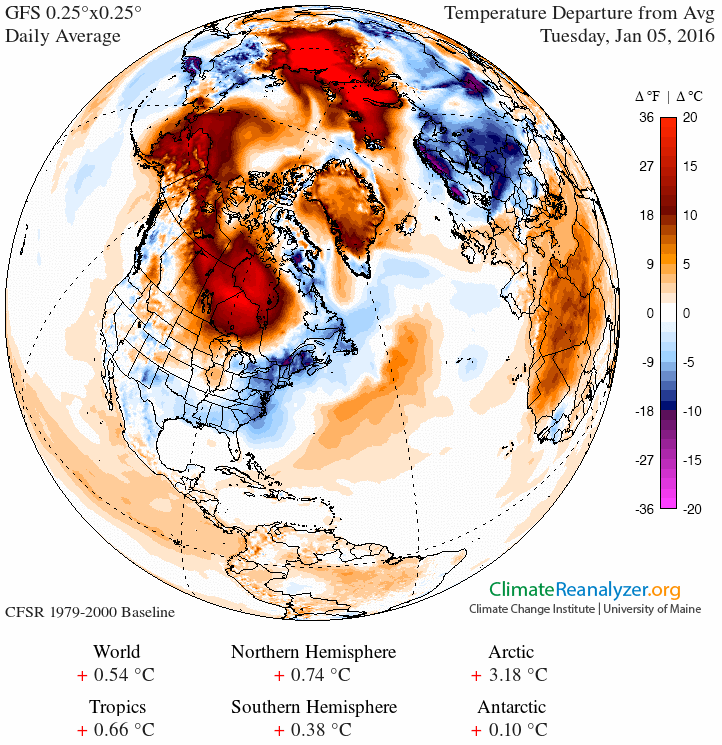
Extreme Arctic Warmth on January 5 2016

http://www.huffingtonpost.com/john-sanbonmatsu/the-real-climate-change-hoax_b_8920048.html

As a performing magician, I naturally take a keen interest in deception. So it was also with a professional, not merely personal, interest that I watched the spectacular fraud perpetrated on the world’s public in Paris last month, as political leaders from nearly 200 nations signed the first universal treaty to limit the carbon gases causing global warming.

Politicians described the agreement in triumphal terms, as a “turning point” in history. Humanity had dodged a bullet, they said. Now, we could all breathe easier. “Climate justice has won & we are all working towards a greener future,” as President Modi of India put it in a Tweet.

In reality, the happy talk by elites in Paris resembled a skilled magician’s use of patter to misdirect his audience, only on a global scale. A top stage illusionist like David Copperfield can make a Lamborghini vanish right under the noses of his audience. But that is nothing compared to what played in Paris, where the world’s political elites made the global warming crisis itself disappear — by creating the illusion of decisive action, where in fact there was nothing.

Ostensibly, the Paris agreement commits its signatories to hold warming of the earth’s atmosphere to 1.5% degrees Celsius above preindustrial levels. But as Bill McKibben recently pointed out, even if the signatories stay true to their promises — and the agreement has no enforcement mechanism to ensure that they do — the earth’s atmosphere is still expected to warm to at least 6.3 degrees Fahrenheit above preindustrial levels.

How bad would that be? Consider that today we are at just one degree Celsius, or about 1.5 degrees Fahrenheit, above preindustrial levels. That one degree has already melted many of the world’s glaciers, turned the North Pole into a temperate zone, and produced droughts, floods, and wildfires of Biblical proportions across the globe. One degree has radically increased the acidity of the world’s oceans — by 30% — and imperiled the planet’s fresh water resources.

Here in Boston, I spent a surreal Christmas Eve bicycling around my neighborhood clad in jeans and a T-shirt. It was the same story throughout much of the US, where nearly 6,000 temperature records were shattered over the holidays. Tornadoes ravaged parts of Texas, Arkansas, Mississippi, and Tennessee, rivers flooded their banks throughout the Midwest. Meanwhile, portions of England, Ireland, Scotland, Wales, Argentina, Brazil, and Uruguay lay submerged under floodwaters.

The most frightening news, though, came out of the Arctic, where temperatures on New Year’s Day were projected to be more than 60 F. degrees above normal. That made the North Pole, as one reporter observed, “hotter than Chicago, Vienna or Istanbul.”

Such radical gyrations in the climate are already causing unseen suffering and hardship for countless of the earth’s inhabitants. Millions of people have been displaced from their homes or lost their livelihoods as a result of one degree of warming. Farmers in Bangladesh have watched helplessly as ocean water inundates their rice fields. Whole Inuit communities had to be relocated after melting permafrost caused their homes to sink into the ground. In Iraq this summer, the temperature soared to 120 degrees Fahrenheit — 159 degrees with humidity factored in — and remained there for days. Scientists believe that large portions of the Middle East, currently home to 200 million people, will be inhospitable to human life by the end of the century.

But it is the other beings we share the earth with who are losing the most. Everywhere, animals are struggling in vain to adapt to the rapidly changing climate. In Europe and Asia, bears have stopped hibernating. In Alaska, walruses are crowding on shore, and trampling each other, because the sea ice they depend upon to survive has vanished. Whales and dolphins are dying in droves. Sea lions in California are starving. Penguins, lost and disoriented, have washed up on the beaches of Rio de Janeiro. Tens of millions of bats have perished from white nose fungus. Hundreds of monkeys in Costa Rica starved to death, or succumbed to illness, when ceaseless winter rains kept them from coming down from their trees to forage.

And on and on, across the phylogenetic spectrum. Homo sapiens is causing the greatest mass species extinction event in over 60 million years. And global warming is radically accelerating the process.

All of this, and much more, from atmospheric warming of less than 1.5 degrees Fahrenheit. Now, imagine ratcheting that up by an additional five, or six, degrees. Or, in all likelihood, more than that. Because there is no reason to believe that the countries that signed the Paris agreement will fulfill even their existing inadequate promises.

What will so hot a world look like? Which of the many thousands of species clinging today to the knife’s edge of survival will survive?

In the absence of decisive international action, clearly, we are going to turn the planet into a living Hell. Meanwhile, the closer one looks at the details of the Paris accord, the more the latter resembles a stage illusion — a hollow shell carefully constructed to resemble something solid.

Much has been made of the pledge of the wealthy nations to help poorer ones offset the cost of shifting to renewable energy sources. But the same promises have been made by the wealthy countries before, and they have not been kept. Though vague about how they are going to help the peoples of the global South, wealthy nations were nonetheless careful to include language in the treaty allowing them to offset future C02 emissions through so-called “carbon sinks” — planting trees to recapture CO2. However, since it takes decades for forests to mature, such “sinks” are viewed by most experts as the equivalent of the magician’s legerdemain, a clever manipulation to create the appearance of something out of nothing.

The agreement also says nothing about animal agriculture — the second leading cause of global warming, responsible for more emissions than all cars and trucks combined. The absence of any recommendation to reduce or eliminate animal agriculture is a clear concession to the factory farming and cattle ranching lobbies, which doubtlessly worked hard to keep animal agriculture off the table in climate negotiations.

And so on. Such omissions led James Hansen, the former NASA scientist and a leading authority on climate change, rightly to denounce the Paris agreement as a “fraud” and a “fake.” As Hansen and others suggest, the illusion of action in Paris may in fact prove worse than no action at all. For it has left the public with the mistaken impression that the climate crisis is now going to be dealt with, perhaps even solved, on the cheap, in half-measures, and without disturbing the powerful economic and social forces that profit from ecological destruction. And that is the greatest deception of all.

CORRECTION: This post has been updated to clarify the language used to describe the role of animal agriculture in reference to climate change.