Tropical Hurricane in Late December at the North Pole? That’s Not Funny, That’s Fucked Up!

I understand if folks are getting tired of hearing about global warming or historic, record-breaking, weather events that crop up every few days. But you’d think a thousand-mile wide tropical hurricane invading and bringing rain to normally-frozen Arctic regions like the North Pole would be newsworthy, if only for what it portends for our future. Yet, a search of the subject produces almost nil in the way of useful information, as if the mainstream media is clueless or not allowed to talk about this with the general public for fear of causing a mass panic.

When I resorted to a local news source, I found they’d tried to turn it into a joke. Here’s what KOMO TV had to say about the situation:

“A storm that brought severe weather to the southeast over Christmas has moved out into the Atlantic, re-strengthened into another monster storm bearing down on Iceland…

“And has somehow managed to make it to where Santa’s elves at the North Pole are enjoying a warmer Wednesday morning than Seattleites rushing out the door to work…computer projections show temperatures were to be in the mid 30s around the pole, a bit warmer than the 30 degrees Seattle had Wednesday morning. (Tacoma could brag it was probably 10 degrees colder than the North Pole Wednesday as they were around 25 at daybreak.)”

Rather than suggesting what this kind of warm weather will mean to the life adapted to arctic conditions, the silly Seattle station summed up the report glibly with:

“So how is it that for the first time in forever, polar bears might just be able to indulge on a Frappuccino?”

To get a glimpse into just how these warm weather events can affect high Arctic wildlife, one might do better to check with people who make the habitat their home.Following a rainy winter in 2012 on Svalbard in Norway, unprecedented numbers of reindeer died after ice blocked their access to plants.

In an article in Science Mag, entitled, Arctic Faces an Ice-pocalypse,  reports:

“Ecologist Brage [Hansen of the Norwegian University of Science and Technology in Trondheim] and his co-authors focused on the rainy warm spell that brought record-high temperatures and prolonged rain to Svalbard over 2 weeks in January and February 2012. Temperatures during that period were routinely 20°C higher than normal, and on one day, the study notes, a Svalbard weather station recorded a daily average temperature of 4°C, which was “higher than at any weather station in mainland Norway on that day.” Another Svalbard station recorded 272 mm of rain during the 2 weeks; that station’s average for the whole year is 385 mm.

“The water created thick pools of slush and melted snow, kept cold by the frozen ground, known as permafrost. Then temperatures dropped and everything froze, leaving Svalbard’s fjords and towns coated in thick ice, terrorizing its roughly 2000 inhabitants and decimating the most abundant animals on the archipelago—wild reindeer. Scientists measured ground ice between 10 and 20 cm thick in 200 test sites, and more than half of the ground area they monitored was still covered in the ice 5 months later.

“The impact on Svalbard’s reindeer was severe, as ice prevented the animals from digging through the snow to eat plants.”

Meanwhile: “Winter rain in the Arctic may alter marine ecosystems as well as terrestrial ones, says Cecilia Bitz, an atmospheric scientist at the University of Washington, Seattle. The sea ice is where ringed seals live. Rain on snow “can collapse their snow caves where they raise their young,” she says. Along with the declining amount of floating ice, she adds, rain on snow is a reason the animals have been listed as threatened.”

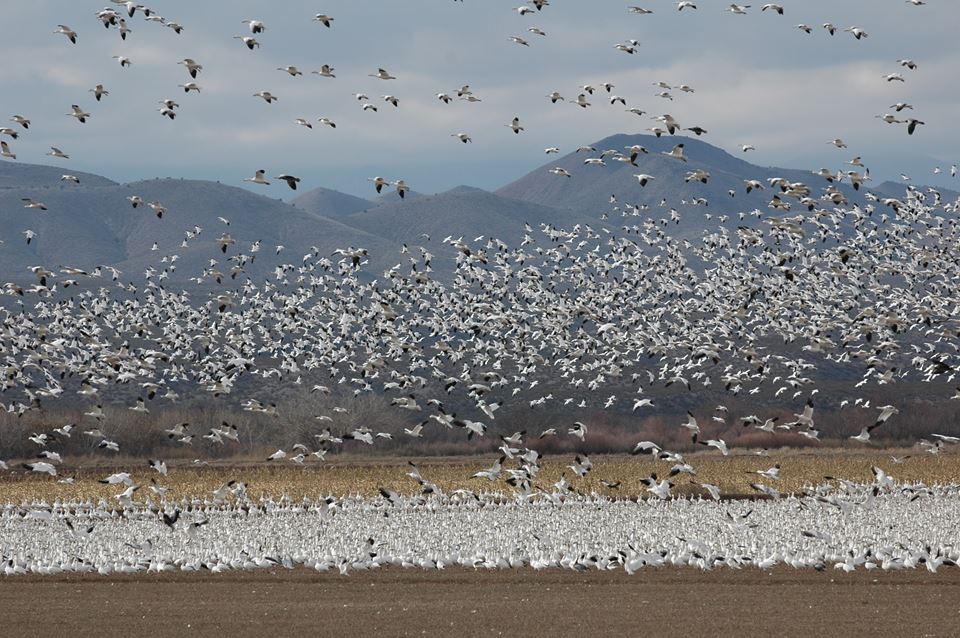
I don’t expect to hear of any polar bears ordering Frappuccino since the last polar warm spell, but let’s hope the caribou and seal pups make it through unscathed. At the same time, the U.S.’s southern border is seeing an unprecedented snowpack that may spell trouble for wintering waterfowl in areas such as the Bosque del Apache National Wildlife Refuge. Although the birds pictured here are called “snow geese”, it’s not because snow is their preferred habitat. 12196349_10153256579521188_5652107754797511661_n

GOP Candidates Receive Failing Grades on Climate as 2015 Smashes Global Temperature Records


by Dahr Jamail, Truthout: With the Paris climate conference concluded, none of the pledges by countries to cut emissions are binding, causing leading climate scientist James Hansen to label them a “fraud.” Meanwhile, sea level rise, Arctic melting, temperature records and the climate disruption denial movement – including much of the GOP presidential field – continue to increase.

More: http://www.truth-out.org/news/item/34090-gop-candidates-receive-failing-grades-on-climate-as-2015-smashes-global-temperature-records

Paris talks a fraud: Watered down climate agreement is too little, too late

by Sea Shepherd’s Captain Paul Watson

COP 21 – The Positives and the Negatives

The positive: (1) The attention of the world has been focused on the issue of climate change. (2) The issue has been given great credibility through the recognition and participation of 195 nations. (3) there will most likely be a surge in support for alternative energy technologies. (4) It could have been worst.

The negatives: (1) Having attended these international conferences since 1972 I’ve yet to see any past agreements translated into action. So we shall see. Promises are cheap. (2) the Ocean was virtually ignored. (3) Oxygen depletion was completely ignored as was phytoplankton diminishment. (4) the issue of animal agriculture was not only ignored it, the food concessions at the events contradicted that concern 100%. Serving fish and chips during an ocean forum and hamburgers at forums dealing with greenhouse gas emissions was a disconnect that was painfully obvious. You would think the delegates and the NGO’s could have weathered a meat free two weeks considering that the animal agriculture industry slaughtering 65 billion animals a year produces more greenhouse gas emissions than the entire transportation industry. (5) and no one wanted to hear about cutting off the 75 + billion dollar government subsidies to the industrialized fishing industry.

In the agreement signed in the COP21 climate deal: the words “fossil fuels” do not appear. Neither do the words “oil” or “coal.” I find that quite revealing.

My two solutions to address climate change were two solutions that no one wanted to hear. (1) shut down industrialized fishing and allow the ocean ecosystems to repair themselves. And (2) convert the majority of the 7.5. billion humans on the planet to a plant based diet.

My summation is that this watered down agreement is too little, too late, and what is on paper will most likely not see any realistic application in practice.

Hopefully I will be proven wrong.

11214207_829677830435133_118593585578390559_n

Also: James Hansen, father of climate change awareness, calls Paris talks ‘a fraud’

The former Nasa scientist criticizes the talks, intended to reach a new global deal on cutting carbon emissions beyond 2020,

“It’s a fraud really, a fake,” he says, rubbing his head. “It’s just bullshit for them to say: ‘We’ll have a 2C warming target and then try to do a little better every five years.’ It’s just worthless words. There is no action, just promises. As long as fossil fuels appear to be the cheapest fuels out there, they will be continued to be burned.”

Are we disarming a bomb that’s already gone off?

Excerpt from: Why the Paris talks won’t prevent 2 degrees of global warming

 http://www.pbs.org/newshour/updates/why-the-paris-talks-wont-prevent-2-degrees-of-global-warming/

BY Nsikan Akpan, William Brangham and Eric Osman  December 2, 2015

…the planet will inevitably surpass the 2 degree Celsius benchmark during this century, even with the calculations and intended pledges of the officials involved with the UN Convention on Climate Change and this week’s talks.

“These calculations show that even if countries fulfill their pledges, emissions will keep rising globally through 2030, and without any sign of stopping,” Barrett said. “And there’s no way you can meet any temperature target as long as emissions keep rising. The only way you can stabilize the climate is if global emissions head toward zero.”

Oppenheimer said the tipping point for reaching zero emissions greenhouse gases comes somewhere near the mid-century.

“The projections suggest that sometime after 2050 or 2060, but perhaps as late as 2100, we need to get close to zero emissions,” Oppenheimer said.

Man-made contributions to the global carbon budget. Illustration by the Global Carbon Project

Man-made contributions to the global carbon budget. Illustration by the Global Carbon Project

By then, humans need to have stopped emitting greenhouse gases, figured out how to sap these pollutants from the atmosphere or established some combination of the two.

The first option would require a massive shift to clean energy, and there are hints that this transition has started. A European report issued last week says the global growth of greenhouse gas emissions almost stalled in 2014. This shift was mainly due to China’s slow economic growth and switch to clean energy, though declining emissions in Europe, Japan and Australia helped too. The U.S. mirrored China in almost reaching stable levels.

Despite these achievements, emissions still grew and the planet still broke the world record for greenhouse gas concentrations in 2014, according to the The World Meteorological Organization. Renewable energy has made tremendous strides. Solar energy has boomed over the last decade, and wind energy has taken off in the United States, China, Europe and many other places around the world. On some days, Germany produces almost all its electricity with renewable energy.

Yet the U.S. Energy Information Administration (EIA) estimated in 2013 that only 11 percent of world’s marketed energy consumption came from renewable energy sources – biofuels, biomass, geothermal, hydropower, solar, and wind — and project that this value will only rise to 4 percent by 2040.

The prospects look grim for the second option of remediation: sucking carbon out of the sky. Carbon sequestration could, in theory, solve global warming. But the technology to date is too expensive and not ready for action on a global or regional scale, Oppenheimer said. Environmental reporter David Roberts takes things even further for Vox:

The mechanism for negative emissions is supposed to be bioenergy — burning plant mass — coupled with carbon capture and sequestration. The combo is called BECCS, and in theory, it buries more CO2 than it emits.

If you work enough BECCS into your model, you can almost double humanity’s “carbon budget” — the amount of carbon we can still pump in the atmosphere without passing 2°C. After all, if you can suck half the carbon out, you can afford to pump twice the carbon in.

But is large-scale BECCS plausible? There’s the problem of finding a source of biomass that doesn’t compete with food crops, the harvesting of which does not spur additional emissions, and which can be found in the enormous quantities required. The IPCC scenarios that come in below 2°C require BECCS to remove between 2 and 10 gigatons of CO2 a year from the atmosphere by 2050. By way of comparison, all the world’s oceans combined absorb about 9 gigatons a year; all the world’s terrestrial carbon sinks combined absorb about 10 gigatons a year.

That’s daunting given that the technology isn’t available. Investment in these innovations may be the champion of this week’s deliberations. On Monday, Bill Gates, Mark Zuckerberg and other business entrepreneurs announced a new fund to boost private sector interests in clean energy technology. A sister program recruited 20 nations to promise $20 billion for similar projects in the public sector. And on Tuesday, France pledged 2 billion euros over the next four years to African countries to develop in renewable energy sources.

Shutting off lights when you leave a room, switching to solar or driving a hybrid can help the cause. But cutting the emissions to zero would require an international commitment on par with the World Wars. Unlike the Kyoto agreement, the Paris talks are non-binding from a legal perspective.

“I think countries will come to an agreement in Paris because the obligations are based on voluntary pledges,” Barrett said. “It’s easy to agree to something when you know you’re not really going to be held accountable. And it’s somewhat I think deceptive to think that this is a success.”

But even binding agreements, like Kyoto, have failed to stop emissions in many nations. Plus, three of the biggest perpetrators — the U.S., China and India — wouldn’t ratify or wouldn’t agree to binding emissions targets with the Kyoto protocol.

Oppenheimer compares the situation to the threat of nuclear annihilation in 1950s and 1960s, which never came to fruition because of international diplomacy.

“We haven’t completely put the [nuclear weapon] genie back in the bottle, but cooler heads prevailed in countries that found a way to see their mutual interest in not annihilating each other,” Oppenheimer said.

But oddly, the atomic bomb provides a historical example of the type of innovation needed to save the planet from greenhouse gases. The Manhattan Project took five decades of atomic research and created a weapon in just four years that quite literally shook the world. The globe would see a tidal shift — either in renewable energy or carbon capture — on par with the scale of the atomic bomb to rectify our current situation.

That could happen with a major investment in renewable and carbon capture technology, Oppenheimer said, adding that he remains hopeful, despite the challenges:

As a whole, I think humans will in their own messy way start dealing with the problem. We throw up lots of obstacles for ourselves, create lots of mess, and then we clean up after ourselves. Climate change is like that. Some of the clean up is ugly and some of the mess really doesn’t go away, but my expectation is if you look back a century from now on what happened, we’ll probably say this is the period of time where we actually got seriously started, and we averted the worst kinds of outcomes.

Cattlemen fed up with fires

Capital Press

Published:November 19, 2015 8:12AM

Courtesy of Nicole Kuchenbuch
Rancher Casey Kuchenbuch herds cattle toward his home field during the Okanogan fire on Aug. 18. Ranchers in Washington are critical of how state and federal officials fought summer fires.

<!–

–>

Washington cattlemen blame state and federal agencies for their livelihoods being jeopardized by large wildfires.


CLE ELUM, Wash. — A panel of ranchers at the Washington Cattlemen’s Association annual meeting unloaded frustration and anger at state and federal agencies, saying their land management practices and inept fire fighting are to blame for massive losses of rangeland, cattle and fencing in the last two years.

The losses threaten the cattle industry, particularly in Okanogan County where more than 1 million acres burned in the last two summers.

That totals one third of the entire acreage of the county which, at 5,315 square miles, is larger than some states. Millions of dollars of public and private timber have been lost. About 1,000 head of cattle died in the Carlton fire last year in Okanogan County while the tally so far this year is under 300. Hundreds of miles of fencing were lost both years but probably the biggest impact is loss of grazing on thousands of acres for several years causing ranchers to buy more hay and sell off cattle.

“There’s got to be some change or this will ruin our industry,” said Vic Stokes, a Twisp rancher, who lost 250 head of cattle and 90 percent of his grazing in the Carlton fire.

The convention panel, Nov. 12 at Suncadia Resort, faulted the U.S. Forest Service and state agencies for not thinning forests and not allowing grazing which would reduce fire fuel loads.

The ranchers said local firefighters do good work but are restrained when state and federal agencies take over. The panel cited multiple examples of state Department of Natural Resources and USFS-led interagency fire teams refusing to attack fires last summer, watching them burn and in two cases backburning private timber and pastures without permission of the landowner or in direct defiance of their pleas not to do it.

Contacted later, USFS and DNR spokespeople said those agencies are working to reduce fire loads by thinning and prescribed burns.

Cathy Dowd, a USFS Okanogan-Wenatchee National Forest spokeswoman, said when the USFS doesn’t attack a fire its because there is no safe place from which to do so.

“Folks may not think we are doing anything, but we are definitely managing and monitoring from the air and in other ways and looking for ways to engage and suppress it,” Dowd said. “All this year’s fires were suppression fires, meaning the goal was to put them out,” she said.

DNR Northeast Region Manager Loren Torgerson said it was the toughest fire season the state has experienced, that firefighters risk their lives daily and three died doing so. “We saved many people, homes and ranches and earned their heartfelt thanks,” he said.

He said DNR needs more resources for preventative thinning and fire fighting and urged the Cattlemen’s Association to support that request.

Traditional fire suppression slowly begins behind fires and fire lines are built along flanks, Jim DeTro, Okanogan County commissioner and a smoke jumper from 1967 to 1973, said at the meeting.

“Eventually, the beast wanes. They encircle it and claim victory but only when nature allows. But the dragon takes its toll. Firefighters earn overtime and hazardous duty pay and they accept failure and loss with no regard to how the loss could be prevented on the next event,” DeTro said.

In Pine Creek, Gerald Scholz and other ranchers built a fire line with bulldozers that held, but agencies wanted to backburn the area, including private ground, DeTro said. They did so even after they promised not to in response to Scholz’s pleas, he said.

The next day DeTro confronted the official who said he wouldn’t backburn and he “said I didn’t understand the difference between backburn and backfire,” DeTro said.

A backburn is suppose to be relatively small, but the area was not tied together by fire lines, he said. “We warned them about the wind, but they did it anyway and it got away from them,” he said.

“Guys are getting way to happy with their drip torches (for backburning). If these agencies have that kind of attitude they might as well backfire to the Pacific Ocean,” DeTro said.

One third of the 600,000 acres burned this year in the Okanogan, Tunk Block and North Star fires was caused by backburning, he said.

Craig Vejraska, an Omak rancher and former Okanogan County commissioner, said agencies burned his private timber, which is his bank account, without asking permission and just a week ago burned what grass he had left to complete a blackened area.

“It could have saved our bacon and now we have 700 cattle looking for a home,” he said.

“We should take the incident command away and give it and the money to the Riverside Fire Department. They put out a hell of a lot more fire than DNR,” he said.

He yelled at two USFS officials for being part of the problem. Earlier they talked about forest management and they responded that was their arena, not fire fighting.

Dowd, of the USFS, didn’t know anything about Scholz and Vejraska’s claims. DNR spokeswoman Sandra Kaiser said DNR staff contacted Scholz but he was unable to provide any names or details about his claims. Scholz could not be reached for comment, but his wife, Bobbi, said she’s not aware of DNR contacting him. The fire had been stopped, then DNR backburned in the wind despite their pleas not too, destroying their timber and shed full of hay, she said.

“We can blame USFS all we want. USFS is dysfunctional, but who makes it so?” asked state Rep. Joel Kretz, R-Wauconda, and a rancher. He said Congress has to change forest management.

“We are in a critical situation right now where virtually every rancher is burned out. We need every inch of WDFW land made available for grazing to maintain an industry,” Vejraska said.

While state agencies are asking for more money to fight fires, Kretz said they shouldn’t get any until they perform.

In the 2014 Carlton fire, “huge (public) resources sat in town,” Brewster, while Gebbers Farms bulldozers and 180 Gebbers orchard sprayers with water saved the town, Kretz said.

“If you look at a map of that fire, you see a big green donut hole in the middle. Part of it was private (Gebbers) and part of it was public that had been thinned. But the big difference was Gebbers crews got in there and actually fought fire,” Kretz said.

“I went up on the fire with Gebbers folks. We saw occasional state rigs looking at maps and smoke and when they did see any smoke they headed for town. Gebbers headed toward the fire,” he said.

“What you hear from the state is that it’s catastrophic. That they can’t fight them. They talk safety. You can’t go in when its crowning out (in tree tops) at 40 mph winds, but watching Gebbers they didn’t go into the teeth of the fire but got ahead of it and didn’t put in scratchy thin fire lines but two D-8s (Caterpillar dozers) side by side,” Kretz said.

“I saw a complete and utter inability (by fire officials) to make a decision. They would say you can put in a fire line but can you use a D-4, not a D-8? They’re worried about environmental impacts, but it’s a fire,” he said.

DNR officials have a “smug” attitude when questioned later, saying they’ve heard stories and will have to run them down to see if they are true, he said.

Local residents had a fire line around the Cougar Flat fire, which became part of the Carlton fire, but were waived off by the DNR which then let it get out of hand, Alex Thomason, a Brewster attorney has said.

The DNR is directed by state Public Lands Commissioner Peter Goldmark who is also an Okanogan rancher. There’s “a lot of sentiment against him” in Okanogan over politics, DeTro said.

“We have the crown jewel of initial attack in our backyard, the North Cascades Smoke Jumper base in Winthrop, but it’s under-utilized because of too much bureaucracy,” DeTro said.

He has audio tapes, he said, proving smoke jumpers on their way from the base to Oregon spotted the starts of the Carlton fire from the air but were told to keep going to Oregon by interagency dispatchers in Wenatchee.

Kretz said he passed a bill in the Legislature last year that allows people to fight fires on public lands.

“We have to get back to locals grabbing their tools and fighting fires. I had a bill to let counties opt out of (the state) fire suppression tax and use it for their own resources. We will run more bills this year,” he said.

Doug Grumbach, a Ferry County rancher near Curlew, said a decision was made to let large portions of the Colville National Forest burn, including 33 percent of his grazing allotment. He said he’s suspicious but doesn’t know if proposals to designate the area as wilderness had anything to do with letting it burn.

He said he lost 21 cows and miles of fencing.

“You do everything you can to save these animals and to lose them is devastating. There needs to be a change. I don’t ever want to go through this again. It ages you real fast,” Grumbach said.

Neil Kasyer, a Centerville rancher near Mt. Adams in southcentral Washington, said he was moving cattle out of the way of fire for four days before he saw anyone trying to put it out.

“DNR and tribal were bickering over who was in charge. Neither wanted to step up because they didn’t know if they would get reimbursed until it was big enough,” he said.

The fire burned some 55,000 acres around the base of the mountain for 20 days until rain put it out, he said.

He’s still looking for some of his 700 head of cattle, he said. A lot of riparian wildlife habitat has been destroyed for years by the wildfires, he said. 
“More money (for fire suppression) won’t help. What will help is controlling the fuel load, changing forest practices and getting locals back on initial attack,” Kasyer said. “Sitting there watching it for four days, deciding which way it will go and how big you want it to get is not the answer.”

Excerpt from: Will Paris Climate Talks Be Too Little, Too Late?

By Dahr Jamail, Truthout | Report

The faux goal of 2 degrees Celsius continues to be discussed. Meanwhile, the planet burns.

During the first week of December, delegations from nearly 200 countries will convene in Paris for the 21st Conference of the Parties (COP21) climate conference. It has been billed, like the last several, as the most important climate meeting ever. The goal, like that of past COPs, is to have governments commit to taking steps to cut carbon dioxide emissions in order to limit planetary warming to within 2 degrees Celsius above the preindustrial temperature baseline.

Yet this is a politically agreed-upon limit. It is not based on science.

Climate Disruption DispatchesRenowned climate scientist James Hansen and multiple other scientists have already shown that a planetary temperature increase of 1 degree Celsius above preindustrial baseline temperatures is enough to cause runaway climate feedback loops, extreme weather events and a disastrous sea level rise.

Furthermore, the UK meteorological office has shown that this year’s global temperature average has already surpassed that 1 degree Celsius level.

Well in advance of the Paris talks, the UN announced that the amount of carbon dioxide already in the atmosphere has locked in another 2.7 degrees Celsius warming at a minimum, even if countries move forward with the pledges they make to cut emissions. Hence, even the 2 degree Celsius goal is already unattainable. However, similar to the way in which national elections in the United States continue to maintain the illusion that this country is a democracy, and “We the People” truly have legitimate representation in Washington, DC, illusions must be maintained at the COP21.

Thus, the faux goal of 2 degrees Celsius continues to be discussed. Meanwhile, the planet burns.

Japan’s meteorological office announced that this past September was, by far, the warmest September on record, and records now show that October has also become the hottest recorded October. As a whole, 2015 remains easily on course to become the hottest year ever recorded.

As if to place an exclamation point on all of this information, atmospheric carbon dioxide levels hit a new milestone in excess of 400 parts per million in early 2015 – a 45 percent increase over preindustrial levels.

Extreme weather events propelled by anthropogenic climate disruption (ACD) abound in this month’s dispatch.

Hurricane Patricia tore into the West Coast of Mexico, becoming the strongest hurricane ever recorded, with sustained winds of 200 miles per hour.

Yemen was struck by its first hurricane in recorded history, dumping what is normally a decade’s worth of rain in a matter of merely two days. As if that is not enough to show how intensely ACD is ramping up global weather events, less than a week later the second hurricane in Yemen’s recorded history made landfall, bringing fresh hurricane-force winds, torrential rains, flash flooding and death.

ACD is, quite literally, extinguishing oceanic life across the planet.

An ACD-driven El Niño brought October storms that wreaked havoc across southern California. Record storms in the high desert and mountains of the southern part of that state brought massive mudflows across major highways, which trapped hundreds of vehicles in mud that was 20 feet deep in places, stranding motorists overnight. The rainfall from the storm, which in one area fell at a rate of 1.81 inches in just 30 minutes, was described by the National Weather Service as a “1,000-year event.”

Meanwhile, a recent report shows that marine food chains are at risk of collapse due to ACD impacts, overfishing and pollution. ACD is literally erasing species from coral reefs, the open ocean, Arctic and Antarctic waters, and the tropics.

Moreover, another recent report reveals that bleaching and disease are combining to destroy the largest coral reef in the continental United States, a 150-mile reef found off the coast of Florida. According to the National Oceanic and Atmospheric Administration, it is the third-largest barrier reef ecosystem on the planet.

Read more: http://www.truth-out.org/news/item/33756-cop21-too-little-too-late-temperature-co2-thresholds-breached-as-climate-disruption-intensifies


Demand Climate Action

From NRDC.org:

As we all reel from the terrorist attacks in Paris, our hearts go out to the victims of this unspeakable violence.

These attacks happened just weeks before hundreds of world leaders gather in Paris for the UN Climate Summit — or COP21.

The UN has announced that the climate summit will continue. World leaders, including President Obama, still plan on attending to lay out their plans for confronting the growing dangers of climate change.

Climate change is a threat to our common destiny — a threat to the global good. With so much at stake, it’s vital that the world works together now to solve the climate crisis.

So please sign the petition to Demand Climate Action from world leaders meeting at COP21 in Paris.

Already, over 150 countries are coming with commitments to act for a clean energy future.

These nations are working together to ensure we keep the planet from heating by another two degrees Celsius. That rise in temperature would be enough to turn our agricultural heartlands into deserts… increase the frequency of extreme droughts and torrential floods… and impact everything from what we eat to where we live.

In short, two degrees changes everything about how we live on this planet.

But when the margin between success and failure is so slim, it also means that one person can make a difference.

So if you’re ready to Demand Climate Action, add your voice here.

When we work together, amazing things happen. Last year, NRDC supporters helped send a record 8 million letters supporting the U.S.’s first-ever limits on climate-wrecking carbon pollution from power plants. Now, President Obama is taking the Clean Power Plan to Paris as the cornerstone of our climate action blueprint.

The progress you’ve helped us achieve puts us on the verge of doing something big and lasting — and now your voice can make a difference globally.

Sign the petition to Demand Climate Action — and we’ll deliver your name and the names of millions of other signers to world leaders in Paris.

Climate change: a survivors’ guide

http://www.theguardian.com/environment/2013/oct/13/climate-change-survivors-guide-global

As warnings of global climate change grow ever more dire, John Vidal offers 10 tips on how to prepare for an apocalyptic future
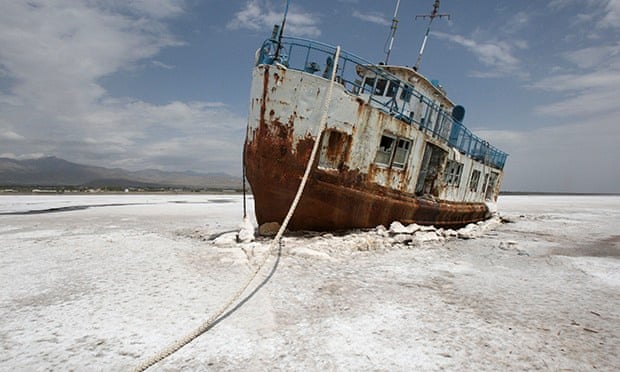
ship stuck on salt flats
Without a paddle … in the parched future, it may be wise to move to somewhere with a good water supply. Photograph: Vahid Salemi/AP

1 Stay cool, dry

Britain is expected to get more extremes of heat and rainfall, so prepare for more severe floods, longer droughts and more powerful storms. No one knows quite what the effect over time will be of a slowing Gulf stream, or the melting of arctic sea ice, but climate scientists confidently expect temperatures to rise up to 4C by 2100. That could mean big shifts in rainfall patterns and a more unpredictable climate. So clear your drains, fix your roof and move to Wales – or at least to somewhere with good water supply. The worst that could happen? Your grandchildren will inherit inexorably rising temperatures that render much of the Earth uninhabitable. Their problem? Yes, but yours, too.

2 Move

Sea levels are rising gradually and by the end of the century could be nearly 2ft higher than they are today. So don’t pass on that beach hut to your children, and expect to lose acres if you live near the coast in East Anglia and other low lying areas. You won’t have to head for the hills for many years, but prepare to view the seaside from behind higher walls and from the dykes that will be needed to protect many coastal towns. By 2100 the map of Britain will be smaller and many cities are likely to be besieged by climate “refugees” arriving from low-lying areas such as Norfolk.

3 Adapt

Climate change is going to be very, very expensive, and the poor, the old and the vulnerable will be the most affected because they are least likely to have the money to move house or adapt. Economists such as Lord Stern and Jim Yong Kim, the new president of the World Bank, expect a 4C temperature rise to result in global economic meltdown – unless countries rapidly shift their economies towards less energy-intensive industries. Stern predicts that warming will knock at least 5% off GDP per year and Kim expects food shortages and conflicts over natural resources and water. Abnormal events such as Hurricane Sandy, which cost $65bn (£40bn) and the 2011-12 US drought, which cost $35bn (£21bn) may be just foretasters of the price to be paid. On the other hand, there’s serious money to be made adapting cities and industries to climate change and reducing emissions.

4 Grow your own

More heat and a longer growing season should make it easier to grow some crops in northern countries such as Britain, Russia and Canada, and more carbon dioxide in the atmosphere theoretically should increase plant growth. But don’t expect climate change to feed the world. You are likely to have to change diets because bigger droughts, flash floods, heatwaves and storms may devastate harvests and reduce the amount of foods available. Countries such as Britain, which depend heavily on food grown abroad, may be able to grow fruit that farmers only ever dreamed about, but there will be less land on which to grow and imported grub will be much more expensive because other climate-affected countries will keep their smaller harvests for themselves. If coral reefs vanish there will be fewer fish in the sea and if the oceans continue to soak up CO2 they will become more acidic. That would be very, very bad, but the scientists say this won’t impact heavily in the next few lifetimes.

5 Take a shower

Don’t take fresh water for granted. Longer droughts are likely to dry up large parts of southern and eastern England, and underground water suplies will be more stressed. We’ve always muddled through heatwaves and droughts, but as temperatures climb, a run of dry winters becomes more and more likely. So prepare for droughts not just once a decade but perhaps every other year. Get used to yellow lawns, taking showers with chums and watering your garden with waste water.

6 Be charitable

Humanitarian groups such as Oxfam expect many more food shortages and natural disasters in countries where even a small shift in the rainfall pattern or increase in temperature is enough to reduce harvests and leave millions more hungry. Worst-case scenarios? A shift in the Asian monsoons is expected to reduce the amount of water in rivers coming off the Himalayas, and because this is needed for nearly a third of the world’s population, there could be disastrous food shortages. Further drying out of the Sahel and African rangelands will force millions of people to move.

7 Get a spanner

Things are going to go wrong much more often, so expect mini-disasters. Cars, trains, roads, and buildings, flood barriers, drains, underground systems, reservoirs, power stations, ports and all are designed for existing temperatures, sea levels and rainfall, and may be overwhelmed in future. Railway lines will buckle more easily, nuclear power stations will get flooded more easily, building cooling systems will be inadequate, flat roofs will leak more and concrete structures will be like ovens. Designers will have to rethink the way things are made.

8 Watch your health

Warmer winters mean fewer deaths among the old, but far more heart and respiratory diseases in the hot summer nights. Even worse, the warmer, wetter conditions will encourage the fungal, algal, tick-and-mosquito-borne diseases we usually only see in the tropics: Dengue fever was detected in France and Croatia in 2010; West Nile virus and Rift valley fever have become common in the US; and a 4C increase in Britain probably means malaria-carrying mosquitoes, and ticks infected with Lyme disease. Equally possibly, the already crumbling system of urban drains is likely to be overwhelmed by extreme weather events, which will discharge pathogens into heavily used rivers and seas, possibly heralding the return of diseases such as typhus.

9 Don’t get angry

Life in many of the world’s cities is already nearly unbearable in some months. The scorching urban nights expected with climate change will be a recipe for social disorder, ill–health and mass grumpiness. If there are water and power cuts, as expected, then get ready for migrations out of urban areas to cooler countryside. Best advice? Stay out of town.

10 Prepare for the big burn

A 4C temperature rise doesn’t sound much, but it is quite enough to kill off trees, wildlife, garden plants, insects, and river life. On the positive side, we may get faster-growing rainforests and enhanced plant growth, but many animals will not be able to adapt to higher temperatures. Don’t expect to grow the same plants in your garden, or see the same trees in the parks. Change will be gradual, but profound.

Watch “Mission Blue,” Before It’s Too Late!

mission-blue-globe

I saw it the other night. Excellent, extremely important documentary–I highly recommend it!!

http://www.mission-blue.org/

I wish you would use all means at your disposal—films, expeditions, the web, new submarines—to create a campaign to ignite public support for a global network of marine protected areas; Hope Spots large enough to save and restore the blue heart of the planet.

Mission Blue is an initiative of the Sylvia Earle Alliance (S.E.A.) to ignite public support for the protection of Hope Spots—special places that are vital to the health of the ocean, the blue heart of our planet. We draw inspiration from the vision of our founder, Dr. Sylvia Earle, and are uniting a global coalition of partners to inspire an upwelling of public awareness, access and support for a worldwide network of marine protected areas. From the seamounts of the high seas to the shallow sunlit reefs, Mission Blue seeks to bring about a significant increase in ocean protection from less than four percent today to 20% by the year 2020.  Under Dr. Earle’s leadership, the Mission Blue team has embarked on a series of expeditions to further this vision and shed light on these ocean Hope Spots. We also bring the discoveries and stories of a network of ocean experts to the public through documentaries, social and traditional media, and innovative tools like Google’s “Explore the Ocean” layer. Additionally, we support the work of many conservation NGOs with whom we share the basic mission of ocean protection and public awareness. Currently, the Mission Blue coalition includes over 100 respected ocean conservation groups and like-minded organizations — from large multinational companies down to individual scientific teams doing important research. Decades of overfishing, pollution, climate change, acidification and other human pressures threaten the fundamental nature of the ocean—and therefore threaten the future of humankind. We encourage all global citizens who care about our ocean to reach out and support Mission Blue in any way they can. Presently, less than four percent of the ocean is fully protected; just years ago, that number was around 1 percent. With concerted effort and passionate people, we can continue this positive trend and help create a global network of Hope Spots, the seeds of tomorrow’s healthy ocean.

http://www.mission-blue.org/