Mind-blowing” die off of seabirds underway from California to Alaska — Experts: “This is unprecedented…

http://tribelive.ning.com/forum/mind-blowing-die-off-of-seabirds-underway-from-california-to-alas

by CTN on October 16, 2015

Experts: “This is unprecedented… Worst I’ve ever seen… Why they’re dying, I’m still baffled” — “Every bird we’re seeing is starving to death… Basically withering away” — “Catastrophic molting” due to unknown cause (VIDEO)

San Francisco Chronicle, Oct 15, 2015 (emphasis added): [T]housands of common murres… have been found dead… “all signs point to starvation from a lack of forage fish,” [Marine ecologist Kirsten Lindquist] said, adding that the same problem has been documented along the Oregon, Washington and Alaska coastlines… many endemic marine birds and mammals are suffering.

International Bird Rescue, Sep 22, 2015: An unprecedented number of exhausted, hungry seabirds continue to flood International Bird Rescue’s San Francisco Bay Center… The sight of so many starving seabirds has raised red flags among seabird scientists…

Santa Cruz Sentinel, Sep 25, 2015: A troubling number of starved and weak seabirds are washing ashore on beaches from the Monterey Bay to Alaska… “There’s been die-offs in the past, but this is one of the worst ones I’ve ever seen,” said Lupin Egan, an animal technician… “it’s been really crazy,” said spokesman Russ Curtis. “They’re really sick — just feather and bone.”… “At Waddell and Greyhound (Rock) beaches, I saw the most murres I’ve ever seen in 10 years,” said Cori Gibble, seabird health coordinator with the UC Davis Wildlife Health Center in Santa Cruz. “You see them on the tide line. They’re kind of strewn all over the beaches… It’s been a really strange year“…

ABC San Francisco, Sep 22, 2015: The number of birds being delivered to the rescue center daily is the number that usually comes over the entirety of a month, center officials said. “The sheer number of birds we’re seeing is pretty mind-blowing“… Curtis said. “This is unprecedented. Sometimes we get spikes and it dissipates. But it has not stopped.”

Sacramento Bee, Sep 24, 2015: Rescue center overwhelmed with starving seabirds… Fairfield rescue center has seen 25 times more common murres than normal… Across Northern California… malnourished seabirds have been appearing in alarming numbers, some shrunken to little more than feather and bone… The murres’ presence is significant to scientists because they’re considered a marker species, whose movements and numbers signal changes in the ocean’s food supply… “Our gut tells us there is something going on in the marine environment.”… Some of the birds that are being brought into the center are showing symptoms of catastrophic molting, where large patches of their bodies are missing feathers, said Kelly Berry, wildlife manager with the center. The cause is unknown

Santa Cruz Sentinel, Sep 2, 2015: A huge influx of weak, starving seabirds have been overwhelming a Fairfield bird rescue center… “They’re like the canaries in the coal mines,” Curtis said… “the first ones to tell us if… there’s something wrong with our environment.”

KTVU, Sep 25 2015: Up and down the West Coast, thousands of starving sea birds are washing up… [The murres] resemble penguins, but can fly… “They are washing up extremely skinny… They’re starving to death,” lead rehabilitation technician Isabel Luevano told KTVU… “they’re basically withering away“… More heron and egret hatchlings have needed care this summer as well…

Half Moon Bay Review, Sep 30, 2015: [T]he magnitude of and reason for this die-off is perplexing to experts… [Gerry McChesney, of the Farallon National Wildlife Refuge said] “we’ve had a strip of cold water near the coast (of Half Moon Bay), concentrating anchovies and mackerel. With what seems to be all this food up against the coast, why these murres are dying, I’m still baffled by.”

Daily Astorian, Aug 25, 2015: “There’s a pretty raging debate among seabird biologists at the moment,” [Julia Parish of the U. of Washington] added…“Every bird we’re seeing is starving to death,” [Josh Saranpaa, of the Wildlife Center of the North Coast] said. “It’s pretty bad.” Many are adults… The high number of starving adults along the North Coast, even experienced scavenger birds, indicates a “serious sign of a stressed ecosystem,” Parish said… “When you see so many starving, something is not quite right out there,” Saranpaa said… It’s also “been a really odd year,” Parish said, with multiple regional scale events

KMXT (Alaska), Sep 16, 2015: Massive seabird die-off hits Kodiak… [National Wildlife Refuge bird biologist Robin Corcoran] said she doesn’t know what could have caused the deaths.

KMXT, Sep 15, 2015: “It does look like the birds are emaciated, which means they don’t have any fat on their bodies, and they don’t have any food in their digestive systems“… [Corcoran] says it could be connected to the whale die-offs, and they’ll be considering environmental factors… Corcoran says the Refuge’s survey data has also indicated that several other bird species’ numbers have declined

Petition: 2015 UN Climate Conference must address the impact of animal agriculture on climate change

2015 UN Climate Conference must address the impact of animal agriculture on climate change

There is irrefutable evidence that animal agriculture is a key cause of climate change. It is a leading cause of greenhouse-gas emissions, water waste, water pollution, ocean dead zones, deforestation, habitat destruction and species extinction that each significantly impacts the climate. Any global policy that claims to address climate change without addressing the catastrophic impact of animal agriculture is neither honest nor effective. While awareness about the fossil fuel industry is gaining momentum, the impact of animal agriculture on the climate has not received the same global attention.
We call on Ban Ki Moon and the leaders of the 2015 UN Climate Change Conference to ensure that the impact of animal agribusiness on our global climate is comprehensively addressed, and that an urgent action policy be created and made effective immediately.

SIGN THIS PETITION: https://secure.avaaz.org/en/petition/Ban_Ki_Moon_and_the_Leaders_of_the_United_Nations_Climate_Change_Confere_UN_Climate_Change_Summit_2015_must_address_the_/?fVYyJab&pv=44

Scientists: Earth Endangered by New Strain of Fact-Resistant Humans

By

MINNEAPOLIS (The Borowitz Report) – Scientists have discovered a powerful new strain of fact-resistant humans who are threatening the ability of Earth to sustain life, a sobering new study reports.

The research, conducted by the University of Minnesota, identifies a virulent strain of humans who are virtually immune to any form of verifiable knowledge, leaving scientists at a loss as to how to combat them.

More worryingly, Logsdon said, “As facts have multiplied, their defenses against those facts have only grown more powerful.”

While scientists have no clear understanding of the mechanisms that prevent the fact-resistant humans from absorbing data, they theorize that the strain may have developed the ability to intercept and discard information en route from the auditory nerve to the brain. “The normal functions of human consciousness have been completely nullified,” Logsdon said.

While reaffirming the gloomy assessments of the study, Logsdon held out hope that the threat of fact-resistant humans could be mitigated in the future. “Our research is very preliminary, but it’s possible that they will become more receptive to facts once they are in an environment without food, water, or oxygen,” he said.

http://www.newyorker.com/humor/borowitz-report/scientists-earth-endangered-by-new-strain-of-fact-resistant-humans

Featured Image -- 10139

Marine population halved since 1970 – report

http://www.bbc.com/news/science-environment-34265672?SThisFB

Northern bluefin tuna. File photoImage copyright Science Photo Library
Image caption The report analysed more than 1,200 species of marine creatures in the past 45 years

Populations of marine mammals, birds, fish and reptiles have declined by 49% since 1970, a report says.

The study says some species people rely on for food are faring even worse, noting a 74% drop in the populations of tuna and mackerel.

In addition to human activity such as overfishing, the report also says climate change is having an impact.

The document was prepared by the World Wildlife Fund and the Zoological Society of London.

A sea cucumber feeds on algae. File photoImage copyright PA
Image caption Sea cucumbers – seen as luxury food throughout Asia – have seen a significant fall in numbers

“Human activity has severely damaged the ocean by catching fish faster than they can reproduce while also destroying their nurseries,” said Marco Lambertini, head of WWF International.

The report says that sea cucumbers – seen as a luxury food throughout Asia – have seen a significant fall in numbers, with a 98% in the Galapagos and 94% drop in the Red Sea over the past few years.

The study notes the decline of habitats – such as seagrass areas and mangrove cover – which are important for food and act as a nursery for many species.

Climate change has also played a role in the overall decline of marine populations.

The report says carbon dioxide is being absorbed into the oceans, making them more acidic, damaging a number of species.

The authors analysed more than 1,200 species of marine creatures in the past 45 years.

“I’m Mad as Hell and I’m Not Going to Take This Any More!”

Many of you may recognize that title as a line from a movie. It was one of the two great movies I’ve seen in the past few days, which seem to go together yet are completely different in style and content.

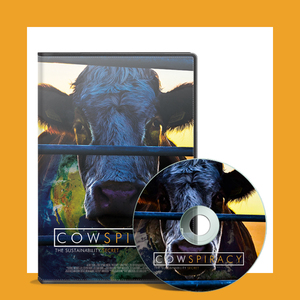
The first was an excellent documentary, Cowspiracy, which just came out in streaming1442633447556 Netflix form, in addition to DVD as well as a downloadable version on their website. This absolutely-must-see is not just an expose of the kind of cruelty that the human species is capable of and complicit in toward animals on a daily basis (as if that weren’t enough). It mainly focuses on the massive carbon footprint of animal agriculture (51% of all anthropogenic greenhouse gas emissions) and the fact that no one—not the powers that be, not the industry chiefs and spokesmen, not the current cattle flesh-food purveyors, not even the heads of major corporate environmental, household-name, supposed green groups, like Greenpeace, the Sierra Club, NRDC or the rainforest action group—is willing to take a stand on or even acknowledge it. They were all too busy laying the blame for climate change on unstoppable oil companies, pinning all their hopes on renewable energies for everyone—all 7.4 billion and counting.

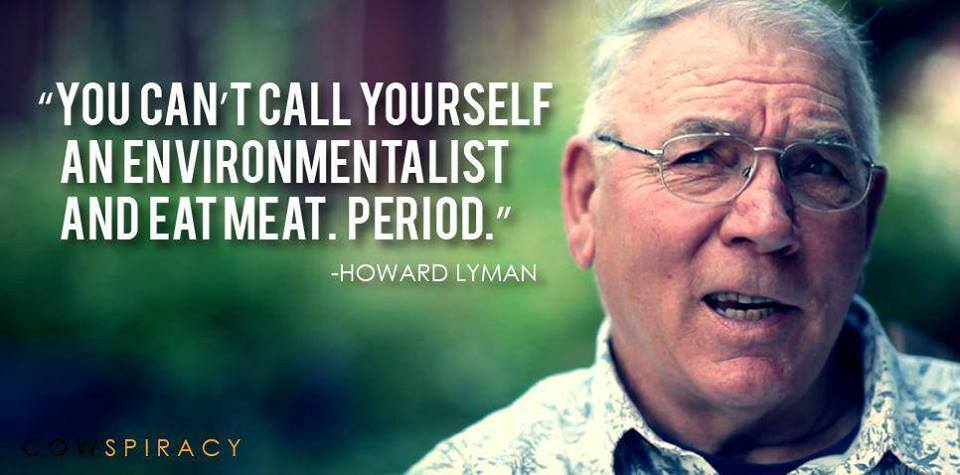
But as one interviewee pointed out, those energy sources won’t see the light of day in a big way for at least 20 years (sorry, we don’t have 20 years, people) and not until after 43 trillion dollars have been invested. Yet all we have to do, as this movie shows us (through the words of ex-rancher Howard Lyman and others) is stop eating animals today. (And stop breeding, I might add.) Problem solved. Then we just have to wait for the feed-back loops to play themselves out and hope that Mother Nature forgives us for our avariciousness in reducing all other animal life to fodder for our one-species-takes-all, suicidal free-for-all.

The issue of hunting was quickly laid to rest with the statement that back when humans may have been “sustainably” killing other species for their sustenance, there were only around 10 million people. Now there’s over 500 million on this continent alone. This is no time for a resurgence in popularity of the mindset that got us into this mess in the first place. We need to move forward, not back.

Meanwhile, a mouthpiece for the fishing industry tries to deny the ongoing collapse of fisheries across the globe by invoking a feeble economic analogy, hoping we’ll believe that every time they kill thousands of fish, they are replaced by even more new fish as if by some miraculous, infinite, deep-sea upwelling—like they’re only taking the interest, not the principal. The fact is, climate change is already warming ocean waters so fast that toxic algae blooms are rapidly replacing the traditional, edible phytoplankton—the basis of the ocean’s food chain. At the same time, run-off from animal agriculture is creating dead zones wherever once-fresh water meets the sea.

The other movie I saw recently (although it came out in 1977), Network, was also inspirational, in its own way. It summed up how I felt after watching Cowspiracy. Worked into the middle of the script were the lines of a newscaster run amok, who was trying to get the brain-washed, brain-dead sleepwalkers riled up by telling it like it is. It was the kind of shaking into reality that people need about what’s really going on nowadays.

Here are is a sequence from the movie wherein Howard Beale, a network anchorman played by Peter Finch (in an Oscar-winning performance), has mysteriously disappeared before he’s scheduled to go on the air with the evening news. He shows up just in time, stepping in from the pouring rain, wearing only his pajamas under a raincoat………………………………..

Still of Peter Finch in Network (1976)Still of Peter Finch in Network (1976)Still of Faye Dunaway in Network (1976)Still of Faye Dunaway and Peter Finch in Network (1976)

“—and, suddenly, the obsessed face of Howard Beale, gaunt, haggard, red-eyed with unworldly fervor, hair streaked and plastered on his brow, manifestly mad, fills the monitor screen.

HOWARD (on monitor):

I don’t have to tell you things are bad…shopkeepers keep a gun under the counter, punks are running wild in the streets, and there’s nobody anywhere that seems to know what to do, and there’s no end to it. We know the air is unfit to breath and our food is unfit to eat, and we sit and watch our tee-vees while some local newscaster tells us today we had fifteen homicides and sixty-three violent crimes, as if that’s the way it’s supposed to be. We all know things are bad. Worse than bad. They’re crazy. It’s like everything’s going crazy. So we don’t go out anymore. We sit in the house, and slowly the world we live in gets smaller, and all we ask is, please, at least leave us alone in our own living room. Let me have my toaster and my tee-vee and my hair dryer and my steel-belted radials, and I won’t say anything, just leave us alone. Well, I’m not going to leave you alone. I want you to get mad. I don’t want you to riot. I don’t want you to protest. I don’t want you to write to your Congressman. Because I wouldn’t know what to tell you to write. I don’t know what to do about the depression and inflation and the defense budget and the Russians and crime in the street. All I know is first you got to get mad. You’ve got to say, ‘I’m mad as hell and I’m not going to take this any more. I’m a human being goddamn it. My life has value.’ So I want you to get up now. I want you to get out of your chairs and go to the window. Right now, I want you to go to the window, open it, and stick your head out and yell. I want you to yell: ‘I’m mad as hell and I’m not going to take this any more!’

[This is going out live to 67 stations across the country.]

HOWARD: (on monitor)

Get up from your chairs. Go to the window. Open it. Stick your head out and yell and keep yelling—First, you have to get mad.

(They’re yelling in Baton Rouge.)

HOWARD: (on monitor)

Things have got to change. But you can’t change unless you’re mad. You have to get mad. Go to the window, stick your head out and yell. I want you to yell: ‘I’m mad as hell and I’m not going to take this anymore!’ Right now.

(A distant thunderclap crashes somewhere off and lightning shatters the dank darkness. In the sudden hush following the thunder, a thin voice can be heard shouting.)

THIN VOICES: (off screen)

I’m mad as hell and I’m not going to take this any more!

HOWARD: (on TV set)

…Open your window…

(An occasional window opens and from his apartment house, a MAN opens the front door of a brownstone—)

MAN: (shouting)

I’m mad as hell and I’m not going to take this anymore!

(OTHER SHOUTS are heard.)

VOICES:

I’m mad as hell and I’m not going to take this any more!”

—————————————————————————————————

Now, substitute Howard Beale’s name for mine and exchange whatever he’s mad about for the issue we should all be talking (SHOUTING) about: the selfless message of animal rights and the conspiracy of silence that keeps 70 billion cows and other animals captive, as slaves, constantly bred and butchered as products of an industry that won’t even fess up to their enormous carbon footprint. To paraphrase Howard Lyman, it’s time to change—or else.

But first, you may have to get mad. If you’re not already mad—as hell—watch Cowspiracy.

1508517_10155698578665314_6658310035003500226_n

How to Save the World? James Cameron says Go Vegan

http://www.shellethics.com/environment/how-save-world-james-cameron-says-go-vegan/

How-to-Save-the-World-James-Cameron-says-Go-Vegan

Oscar-winning director James Cameron is promoting the best way to fight climate change—eliminating animal meat and dairy from one’s diet.

James Cameron is a famed director, a well-known climate change activist and he has a message for the masses: go vegan to fight climate change. Cameron spoke at the US-China Climate Leaders Summit in Los Angeles on 15th of September. During the summit, leading cities from both countries will share city-level experiences with planning, policies, and use of technologies for sustainable, resilient, low-carbon growth.

Cameron conducted his talk titled “Food for Sustainable Nations”, with Sam Kass, the former White House senior nutrition policy adviser. Cameron, who went completely vegan four years ago along with his family, focused on food systems (consumption and production) and the relationship between food and climate change. He explained how cutting out meat and dairy products can help lower carbon emissions in an interview with Fortune.

The thing that became abundantly clear to us when we met with the experts who are working in nutrition and energy sustainability and climate change is that we can’t actually meet our emission goals if we don’t address animal agriculture, and that’s the thing that’s been left out of the conversation. Everybody’s focusing on the energy sector, which of course is huge, and to a lesser extent the transportation section, but they’re missing the second biggest single contributor to greenhouse gas emissions. This is a thermostat that we can turn down just by our personal choices. We can do it instantly.
— James Cameron

This message is crucial because many people who care about the environment still have no idea that raising animals for food is so incredibly destructive. Animal agriculture is actually responsible for a much higher amount of global greenhouse gas emissions than what is most commonly quoted. At the 2014 UN Climate Summit, startling new estimates by the UN Conference on Trade and Development (UNCTAD) put the estimates of agriculture being responsible for 43-57% of global emissions.

It takes 2,500 gallons of water to produce just one pound of beef. Agriculture operations on land have created more than 500 nitrogen flooded dead zones around the world in our oceans. Farmed animal production accounts for 70% of all agricultural land and 30% of the land surface of the planet. 80% of land deforested in the Amazon is for raising cattle. The rapid deforestation of the Amazon Rainforest is actually causing a drought in many major urban communities in South America.

Droughts-In-Brazil

Our world is in a big feedback loop where climate will effect food security among many things because of drought, desertification, saltification, loss of acreage and deltas, which are some of our most fertile areas because of sea water rise. It’s going to negatively impact our food supply and our food security at exactly the same time that we need to increase our food production by 70%. By 2050 we’re supposed to have 9 billion people on this planet. These two things are moving in the wrong direction and yet the second biggest way we can control climate change is by reducing our reliance on animal meat and dairy.

While the outlook may look grim, James Cameron’s advice echoes that of many people:

The simple resounding message is you can be healthier and your planet can be healthier based on a very simple thing that you can do today. It’s cheaper to produce plants. It’s less carbon footprint, less water footprint, less money footprint and better for you.

“America Is Not a Planet”: The Only Accurate Thing Said About Climate Change at GOP Debate

http://www.truth-out.org/buzzflash/commentary/america-is-not-a-planet-the-only-accurate-thing-said-about-climate-change-at-gop-debate

2015.17.9 BF mellino(Photo: DonkeyHotey)COLE MELLINO OF ECOWATCH FOR BUZZFLASH AT TRUTHOUT

Unlike last month’s GOP primary debate, where climate change was not mentioned at all during the prime time debate and only briefly mentioned in the so-called “happy hour” debate, the topic finally received some airtime at last night’s debate. Held at the Ronald Reagan Presidential Library in Simi Valley, California, the debate was hosted by CNN. Over the course of the three-hour debate, there was one question on climate change. It lasted about four minutes, which is only slightly longer than the amount of time devoted to candidates picking out their secret service names.

“We received a lot of questions from social media about climate change,” says CNN moderator Jake Tapper. One group, NextGen Climate pushed very hard ahead of the debate for the candidates to talk about climate change. They rolled out a three-figure ad campaign ahead of the debate, invoking Ronald Reagan’s “Common Sense” speech to urge CNN moderator Jake Tapper to ask candidates how they would address climate change—specifically what their plans are to get the country to 50 percent renewables by 2030.

More: http://www.truth-out.org/buzzflash/commentary/america-is-not-a-planet-the-only-accurate-thing-said-about-climate-change-at-gop-debate

Ocean warming puts fish, orcas in peril

http://www.dailyastorian.com/Local_News/20150910/salmon-nightmare-ahead-pending-ocean-warming-puts-fish-orcas-in-peril?utm_source=Daily+Astorian+Updates&utm_campaign=f6f6c5539f-TEMPLATE_Daily_Astorian_Newsletter_Update&utm_medium=email&utm_term=0_e787c9ed3c-f6f6c5539f-109860249
It’s too early to say for certain, but this year’s warm weather could have a big impact on future salmon runs as well as the animals that rely on the fish for food.
LONG BEACH, Wash. — Oregon and Washington will experience two big El Niño-like events in combination this year, scientists and fishery managers say. This has never happened before and the events could have major impacts on commercial and recreational fisheries — and ocean species from salmon to orcas — for years to come.

One of these events is a true El Niño — a big one — and brings with it the likelihood of less precipitation and warmer temperatures in the Pacific Northwest.

The other event, the “Blob,” is a warm expanse of water that has persisted off the West Coast for more than a year and only resembles El Niño.

It is an anomaly, a mystery. Formed by a completely different set of circumstances, it has brought about similar results as an El Niño. Scientists believe it could be one reason why Washington has experienced such unusually mild weather since spring 2014. It has certainly warmed the water off the West Coast, driving various ocean species farther north in search of cold water and drawing tropical species to the area.

So there is what everyone knows: The ocean is unusually warm right now and has been for the last two years. When El Niño arrives in full force, the ocean will likely continue to be warm. And warm water is never good for salmon.

Then there are the questions no one can answer yet.

Oregon and Washington are already beginning to see the effects of this big El Niño cycle, though the event itself has yet to arrive in full here in the North Pacific. When the Blob and El Niño meet — as scientists believe they will — what will happen?

And, after this year’s drought, record-breaking heat, massive toxic algal blooms off the West Coast and no snowpack in the mountains, what will life in the ocean look like next year?

Bill Peterson, an oceanographer with National Oceanic and Atmospheric Administration Fisheries, has a guess: “It’s going to be a nightmare, is what I suspect we’re going to see. … It’s kind of beyond our experience and all we can say is it’s not going to be good.”

Delicate chains

Heat up the ocean and many West Coast species begin struggling almost immediately.

Coho salmon, for example, have been “acting strange” this year, said Doug Milward, ocean salmon fishery manager for the Washington Department of Fish and Wildlife. He and others believe the fish are staying out in deeper water, waiting until the very last minute to enter Washington’s river systems where they will spawn. They are waiting for cooler water.

Sockeye, among the first salmon to run from the ocean to rivers and streams, were in trouble early on this season.

In July, more than a quarter million sockeye, approximately half of the 500,000 sockeye expected to return from the ocean, were dead or dying in the Columbia River and its tributaries due to warm water temperatures.

Meanwhile, salmon that were ocean-bound this spring and the ones that will head out next spring will face unknown conditions when they return several years later, but biologists say they are going into conditions that do not favor their survival; warm temperatures mean the salmon’s regular food sources may not be thriving either. The fish leaving next spring, reared in these conditions, may be even worse off. As for fish laid as tiny eggs in stream and river beds this year — no one knows.

Young salmon were certainly in trouble this summer, though. The warm temperatures led to outbreaks of bacterial diseases in hatcheries, killing off hundreds of thousands of young fish in Washington, Oregon and California.

Trouble for orcas?

Beyond salmon, biologists worry what this all could mean for the ocean species that rely on these fish for food.

Orcas often visit the communities near the Columbia River, but this year it seemed like people were spotting them constantly — NOAA wildlife biologist Brad Hanson says the number of sightings are probably not much higher than any other year; people are just paying more attention.

But, he added, salmon are an important part of an orca’s diet, likely one big reason why orcas flock to the region.

“With this year, with the drought occurring coastwide, it certainly is going to have an impact down the road. If not in the next couple of years, certainly in three or four years,” said Hanson, who was the chief scientist for a NOAA killer whale research cruise this spring. “… We are going to enter a period here in the not too distant future where we’re going to have reduced (salmon) run sizes. So the question is: How will the whales respond?”

Orcas must eat continuously. They can’t starve for extended periods of times the way other ocean mammals can, such as gray whales, living off fat reserves.

Orcas eat many kinds of fish, so Hanson and other biologists believe the large mammals could travel elsewhere for food. As the salmon change where and when they travel, the orcas might follow.

Still, Hanson added, if orcas are eating fish other than salmon, as the data suggests, how abundant is this other prey?

“It’s going to be critical for us to monitor that as best we can in the coming years,” he said.

Inland troubles

In the meantime, salmon fishing has been strong this summer. The Buoy 10 sport fishery near the mouth of the Columbia River ended with record catch rates, surpassing last year’s total catch within the opening weeks. Commercial fishing on the ocean has been brisk and conditions near shore have been normal, or as normal as the ocean, a shifting, swirling black box, ever is.

“When I look at this, I don’t see the warning signs I saw in the ’90s,” Milward said.

In the early ’90s, it was quickly becoming obvious that they were fishing on a very small pool of fish and that there were issues in the wide world beyond: climate shifts and damaged freshwater habitat.

“It’s been a wonderful fishing year in the ocean where I manage,” Milward said.

But it is in the areas beyond his management where he begins to worry.

From a human point of view, communities in Oregon and Washington had a beautiful spring and summer, the best longtime locals can remember.

For many, though, the summer’s beauty was marred by massive wildfires and drought. And with no snowpack to fuel streams and rivers in Washington and little rain, streams and rivers are running at an all time low. In June, the Washington Department of Ecology reported that the state’s snowpack was at zero percent of normal. Though there was still snow at higher elevations and in the glaciers, rivers and streams did not receive the boost they’d normally get from melting snow high in the mountains.

State and tribal fishery managers went into the summer worried about the effects of low-flow conditions on salmon-bearing streams and rivers in the Columbia Basin, conditions that can hamper fish passage and lead to high water temperatures (adding another stress on fish already stressed from their migration inland from the ocean). High temperatures and low flow can lead to less oxygen and put salmon more at risk of bacterial or fungal infection.

“I mean, those fish in the ocean now have no idea that we had no snowpack in the winter and no rain in the summer,” Milward said. The salmon are headed toward areas where “their native stream looks more like a creek than river.”

Red light, green light

Each year, Peterson and other NOAA scientists gather information that informs how fisheries will be run in the next season. They look at more than a dozen different indicators of ocean and fish health. They look at what is in the water, and they note what is missing. For each indicator, they put a red light or a green light next to it. Just like with traffic signals, green light means go. In the 1998 El Niño, all the indicators were red: Stop! In 2008, everything was green. In years where there’s a mix of red and green, it means, Peterson said, “basically we don’t know what’s going on (in the ocean).”

This year, he and state and federal fishery managers are ready for everything to come back red.

“I’m guessing redder than anything we’ve seen before,” Peterson said.

But the ocean is vast, he added, and scientists’ predications have been wrong before. “This could be an environmental disaster, or a blip on the screen that we forget in a couple of years.”

This year, sockeye — the salmon that had half of its total run wiped out by warm water when returning to the Columbia River and its tributaries — found other places to spawn. They ran up streams they’d never used before, streams where the water was still cold, where their young might survive.

To Peterson, salmon are a metaphor for resiliency.

“If you think about what they’ve put up with for the last 50 years and we still have them,” he said. “… They will find a way.”

A Giant Glob of Deadly Algae Is Floating off the West Coast

A Giant Glob of Deadly Algae Is Floating off the West Coast

From the air, the Pacific algal bloom doesn’t look like much of a threat: a wispy, brownish stream, snaking up along the West Coast. But it’s causing amnesia in birds, deadly seizures in sea lions, and a crippling decline in the West Coast shellfish industry. Here’s what you need to know about it, from what this bloom has to do with the drought to why these toxins could be a real threat to the homeless.

“These are the highest levels of toxicity we’ve ever seen,” says one expert.

What’s causing it? The culprits are single-celled, plant-like organisms called pseudo-nitzschia, a subset of the thousands of species of algae that produce more than 50 percent of the world’s oxygen through photosynthesis. They’re a hardy variety usually found in cool, shallow oceans, where they survive on light and dissolved nutrients, including silcates, nitrates, and phosphates. “They’re sort of like the dandelions of the sea,” says Vera Trainer, who manages the Marine Biotoxin Program at the Northwest Fisheries Science Center in Seattle. “They’re always there in some low numbers, just waiting for nutrients to be resupplied to the ocean’s surface.” In most years, blooms in the eastern Pacific are contained near “hot spots” that dot the West Coast—relatively shallow and sheltered places like California’s Monterey Bay or the Channel Islands. They usually flare up in April or May as trade winds cycle nutrient-rich waters from offshore depths to the coast in a process called “upwelling,” but they fade after only a few weeks.

Why is it sticking around so long? The jury’s still out, but scientists are beginning to get a clearer idea. These past few years have been “incredibly weird” in the northeast Pacific, says Nate Mantua, a research scientist at the National Oceanic and Atmospheric Administration’s Southwest Fisheries Science Center in Santa Cruz. He points to the same “ridiculously resilient ridge” of high pressure that’s been causing the historic drought in the western United States: This pressure also resulted in a pool of exceptionally warm water in the Pacific (known as “the blob”), with little weather to disperse it. Those conditions, along with prevailing winds and colder currents that ferry nutrients back to the coast, seem to be supplying the algae with a seemingly endless feast.

That makes the source of this bloom different from its cousin in the Gulf of Mexico, where fertilizers flowing from as far as Iowa are feeding a zone of algae that’s as large as New Jersey. “We’re seeing them in relatively pristine waters of the US West Coast,” Trainer explains, though she adds runoff and sewage discharge may be playing some role in the blooms off Southern California.

So just how big is this thing? Bigger than researchers have ever seen: a patchy stream that stretches from Southern California up along the Alaskan coast. The hot spot blooms that appear each spring are merging for the first time, Trainer explains. Though the combined mass has ebbed and flowed over the past four months, it hasn’t let up; her team finds algae each time they journey out to sea, with no signs of abatement soon. And it’s also unusually potent. “These are the highest levels of toxicity we’ve ever seen,” says Raphael Kudela, a professor of ocean sciences at the University of California-Santa Cruz. “It’s a truly extraordinary phenomenon.”

Levels of chlorophyll, viewed from space, indicate where algae is present in the waters of the Pacific. NOAA

How deadly are these “dandelions”? The algae produce a compound called domoic acid, a type of amino acid that leads to a condition commonly known as “amnesic shellfish poisoning” in humans. Shellfish and some small fish, like sardines and anchovies, feed on the algae and concentrate the toxin in their flesh. When animals further up the food chain—like birds—eat those fish and shellfish, the domoic acid seeps into the bloodstream and eventually the brain, where it attacks cells in the hippocampus, the brain’s command center for memory and learning. The result: amnesia-stricken birds that will repeatedly fly into windows, and sea lions that writhe on the shore, plagued by seizures. Both are symptoms of rapidly firing neurons in the hippocampus, which will eventually burn out and kill the animal. Beaches have been littered with dead fish, birds, and sea lions up and down the Pacific coast since May—all the way up to Alaska, where NOAA is investigating the deaths of fin whales in connection with the toxin.

More: http://www.motherjones.com/environment/2015/08/heres-everything-you-need-know-about-deadly-algae-california-coast


Climate change denier Rupert Murdoch just bought National Geographic, which gives grants to scientists

Climate change denier Rupert Murdoch just bought National Geographic, which gives grants to scientists

The National Geographic magazine has been a nonprofit publication since inception in 1888, but that ends today. The long-running American publication becomes very much for-profit under a $725 million dollar deal announced today with 21st Century Fox, the entertainment company controlled by the family of Rupert Murdoch.

Murdoch is a notorious climate change denier, and his family’s Fox media empire is the world’s primary source of global warming misinformation. Which would be no big deal here, I guess, were it not for the fact that the National Geographic Society’s mission includes giving grants to scientists.

Or had you forgotten? Here’s a refresh for you, a fun little interview with Murdoch on his climate change views.

From today’s deal coverage in WaPo:

The partnership, which will also include the National Geographic cable channel and the National Geographic Society’s other media assets, will be called National Geographic Partners. Fox will own 73 percent of the partnership, and Washington-based National Geographic Society will own the balance. Fox will pay $725 million to the Society for its stake in the partnership. This will push the Society’s endowment to more than $1 billion.

Let the “National Geographic Covers Designed by Rupert Murdoch” Photoshop Wars begin.

More coverage: New York Times, Variety.

20-year Nat Geo vet Declan Moore becomes CEO. Gary Knell, president-CEO of the Society, will serve as the first chairman. Buried in the press announcement:

“The value generated by this transaction, including the consistent and attractive revenue stream that National Geographic Partners will deliver, ensures that we will have greater resources for this work, which includes our grant making programs that support scientists and explorers around the world,” Knell said. “As media organizations work to meet the increasing demand for high quality storytelling across multiple platforms, it’s clear that the opportunity to grow by more closely aligning our branded content and licensing assets is the right path. We now will have the scale and reach to continue to fulfill our mission long into the future. The Society’s work will be the engine that feeds our content creation efforts, enabling us to share that work with even larger audiences and achieve more impact. It’s a virtuous cycle.”

So Rupert Murdoch will be to some large extent controlling a $1 billion organization whose stated mission includes giving grants to scientists.

Rupert Murdoch is a raging asshole, but he is also a very much on-the-record climate change denier. A climate change denier with now even more power and influence over science grants in the United States.