Exposing the Big Game

Forget Hunters' Feeble Rationalizations and Trust Your Gut Feelings: Making Sport of Killing Is Not Healthy Human Behavior

Exposing the Big Game

How Can We Make People Care About Climate Change?

  Thursday, 20 August 2015 00:00
Written by 
Richard Schiffman By Richard Schiffman, Yale Environment 360 | Interview

Per Espen Stoknes, a Norwegian psychologist and economist, has been doing a lot of thinking about a question that has bedeviled climate scientists for years: Why have humans so far failed to deal with the looming threat posed by climate change?

That question is the focus of his recent book, What We Think About When We Try Not To Think About Global Warming, in which he analyzes what he calls the five psychological barriers that have made it difficult to deal realistically with the climate crisis. Those include: the distant nature of the problem (it’s far off in time and often in other parts of the globe); the doom-and-gloom scenarios about the impacts of climate change, which make people feel powerless to do anything about it; and the psychological defenses that people have to avoid feeling guilty about their own contributions to fossil fuel emissions.

In an interview with Yale Environment 360, Stoknes – who co-founded three clean energy companies and helps lead the BI Center for Climate Strategy at the Norwegian Business School – talks about these barriers and about how the discussion of climate change needs to be reframed. “We need a new kind of stories,” he says, “stories that tell us that nature is resilient and can rebound and get back to a healthier state, if we give it a chance to do so.”

Yale Environment 360: Scientists and journalists have been warning us for years about climate change. But you say the message is not getting across. Why not?

Per Espen Stoknes: My work starts with what I call the psychological climate paradox. Long-term surveys show that people were more concerned with climate change in wealthy democracies 25 years ago than they are today. So the more science, the more Intergovernmental Panel on Climate Change (IPCC) assessments we have, the more the evidence accumulates, the less concerned the public is. To the rational mind this is a complete mystery.

You’re suggesting that the initial impact of news about climate change actually moved the meter a bit, but after the initial alarm the meter went back to the default position, and people became unconcerned again?

Absolutely. In the late 1980s this was a novel scare, we hadn’t heard much about it before. [Scientist] Jim Hansen really broke the story in the international news media in 1988. … At that point there was a wave of environmental concern. The earth came to seem fragile in a new way. But as this news was out there for longer, we started habituating to it. And when it began to be clear that our own lifestyle was responsible for these new threats, then several psychological barriers started to introduce themselves and create a backlash of denial.

Why did you write this book?

It gradually became clear that the time has come when we need to shift from talking about the climate system to talking about people’s responses to climate science. How can it be that we are behaving in such a self-destructive way, that we are seemingly inevitably pushing the planet way beyond the 2-degree [Celsius] limit that scientists have proposed [for avoiding dangerous climate change]?

Climate scientists have been trying to educate us on this for so long that they are frustrated and exhausted and feeling exasperated. Some have become cynical saying that it seems as if humans are wired to self-destruct, maybe our genes aren’t well equipped to deal with these long-term issues. It seems we prefer to eat all our cake today and not care about the coming decades.

Is there any way around this inability to think in the long term?

The question that really drives me and that fuels my research is: Is humanity up to the task, or are we inevitably short-term thinkers? Or to put it a bit more constructively, what are the conditions under which humans will begin to think and act for the long term as far as the climate is concerned? Is it possible to pinpoint the mechanisms or functions in the human psyche that would enable us to act for the long term? And if so, what are they and how can they be strengthened?

Is the rejection of climate science a global phenomenon?

We need to be clear that this is a cultural phenomenon. Because in countries like Thailand and the Philippines, or in Latin America and countries in Southern Europe, the concern about climate change is very high. So it is an issue that particularly pertains to people in wealthy democracies. It is much more difficult for somebody in Bangladesh who is acutely vulnerable, who lives on the coast, to say that sea level rise is not happening, because they are actually experiencing it. If a drought takes away a farmer’s crops or a monsoon fails, it means destitution. But here [in the United States and Western Europe], we can always go to a store and buy stuff produced elsewhere, because we have the money to distance ourselves from the immediate impact of weather disruptions.

It is much more difficult to allow that cultural psychology to interfere when you are face-to-face with a failed monsoon or a drought, and your seeds are lost.

Why is it so hard for people in the developed world to come to terms with climate change?

There are five main psychological barriers: distance, doom, dissonance, denial, and identity. This is what the book is about. And the reason climate science communication is so difficult is that it triggers these barriers one after the other.

The first barrier is distance. If you look at the IPCC report or other science, they are using graphs charting different variables which typically end with the year 2100. So you are positioning the facts in a way that creates a psychological distance – it is so far in the future that it feels less important, and the sense of urgency goes down. I mean, when is the last time you made a decision for the next century?

People think this is far off – it is not here and now, it’s also up there in the Arctic or Antarctica, it affects other people, not me, I’ll be old before this really happens, other people are responsible, not me. We distance ourselves from it in so many ways that the pure facts are not sufficient to generate a sustained sense of risk.

Another factor that discourages people from dealing with climate change is the fact that it is so often presented as a doom-and-gloom scenario. Studies show that more than 80 percent of news articles relating to the IPCC assessment reports primarily employed the catastrophe frame. Only 2 percent were using what I call the opportunity frame.

What we know from psychological studies is that if you overuse fear-inducing imagery, what you get is fear and guilt in people, and this makes people more passive, which counteracts engagement. This includes creativity as well. If you give people a guilt or fear-inducing message and then ask them to solve a problem that requires creative thought, there is a statistically significant reduction in the amount of creativity that people come up with to formulate solutions.

Another of the barriers you cite is dissonance. What do you mean by that?

Dissonance is the inner discomfort when I feel like a hypocrite – when my knowledge of climate change is not matched by my actions to stop it. We know that our fossil energy use contributes to global warming, yet we continue to drive, fly, eat beef, or heat with fossil fuels, then dissonance sets in.

Psychologists have found that people are pretty creative in finding ways to defuse this tension between thoughts and deeds. One strategy to deal with this might be to say, “Well, I don’t personally emit that much carbon, it’s the Chinese, the corporations or somebody else who does that. It’s my neighbor with the big SUV, or my friend who flies more than I do.” Another strategy is to doubt. So we say that it is really not certain that C02 causes global warming. Or some physicist said that it’s the sun activity that is causing it.

We can understand why the fossil fuel industry might have an economic interest to spread such ideas, but why do people want to believe this misinformation? If I can believe the doubters, then my dissonance goes away. I don’t need to feel bad about myself.

That’s where denial fits in?

Yes. The next level is the full out denial, where we negate, ignore, or otherwise avoid acknowledging the unsettling facts about climate change. The word denial has perhaps been overused as a pejorative against the other side who are [portrayed as] immoral, or ignorant, or the enemy. But psychological denial is a process that we all have and use. It is a way that we defend ourselves.

Those who reject climate change are getting back at those who criticize their lifestyles, and want to tell them how to live. So when Ted Cruz or Marco Rubio talk about climate change, they are not necessarily stupid or ignorant or immoral, but they are reinforcing a social contract that says this is an issue that we are not supposed to take seriously.

This ties into our sense of identity. Each of us has a sense of self that is based in certain values – a professional self, a political self, a national identity. We just naturally look for information that confirms our existing values and notions, and filter away whatever challenges them.

Psychologists know that if you criticize people to try to make them change, it may only reinforce their resistance. This has been empirically demonstrated by Dan Kahan at Yale, who found that the more science conservative ideologues know, the more likely they were to get it wrong on climate change. They use all they know about science to criticize climate science and defend their values.

So what are your recommendations in terms of how we need to reframe the discussion of climate change to be more effective in reaching people?

We need a new kind of stories, stories that tell us that nature is resilient and can rebound and get back to a healthier state, if we give it a chance to do so. We need stories that tell us that we can collaborate with nature, that we can, as Pope Francis has urged, be stewards and partners of the natural world rather than dominators of it. We need stories about a new kind of happiness not based on material consumption.

Since we have a pretty good understanding of the barriers, that is a good place to start. We need to flip the barriers over so they become successful strategies. Rather than something distant, communicators need to make climate change feel like something that is near, personal, and urgent. Rather than doom, we need to emphasize the opportunities that the crisis affords us.

Climate change is an opportunity for economic development – an entire energy system has to be redesigned from the wastefulness of the previous century to a much smarter mode of doing things. It’s a great opportunity to improve global collaboration and knowledge sharing and to create a more just society. So climate change is a fantastic opportunity to encourage our global humanity to emerge. We need to be talking about this.

http://www.truth-out.org/opinion/item/32445-can-we-make-people-care-about-climate-change
Half of Columbia River sockeye salmon dying due to hot water

http://www.msn.com/en-us/weather/topstories/half-of-columbia-river-sockeye-salmon-dying-due-to-hot-water/ar-AAdxQ7H?ocid=sf

By KEITH RIDLER, Associated Press7/27/2015

Amid California drought, fears rise of trees dying, falling
Sockeye salmon battle their way upstream as part of their annual migration.© Alex Mustard/Solent News/REX Sockeye salmon battle their way upstream as part of their annual migration. BOISE, Idaho — More than a quarter million sockeye salmon returning from the ocean to spawn are either dead or dying in the Columbia River and its tributaries due to warming water temperatures.

Federal and state fisheries biologists say the warm water is lethal for the cold-water species and is wiping out at least half of this year’s return of 500,000 fish.

“We had a really big migration of sockeye,” said Ritchie Graves of the National Oceanic and Atmospheric Administration. “The thing that really hurts is we’re going to lose a majority of those fish.”

He said up to 80 percent of the population could ultimately perish.

Elsewhere in the region, state fisheries biologists in Oregon say more than 100 spring chinook died earlier this month in the Middle Fork of the John Day River when water temperatures hit the mid-70s. Oregon and Washington state have both enacted sport fishing closures due to warm water, and sturgeon fishing in the Columbia River upstream of Bonneville Dam has been halted after some of the large, bottom dwelling fish started turning up dead.

Efforts by management teams to cool flows below 70 degrees by releasing cold water from selected reservoirs are continuing in an attempt to prevent similar fish kills among chinook salmon and steelhead, which migrate later in the summer from the Pacific Ocean.

The fish become stressed at temperatures above 68 degrees and stop migrating at 74 degrees. Much of the basin is at or over 70 degrees due to a combination that experts attribute to drought and record heat in June.

“The tributaries are running hot,” Graves said. “A lot of those are in the 76-degree range.”

In Idaho, an emergency declaration earlier this month allowed state fisheries managers to capture endangered Snake River sockeye destined for central Idaho and take them to a hatchery to recover in cooler water. Of the 4,000 fish that passed Bonneville Dam on the Columbia River, less than a fourth made it to Ice Harbor Dam on the Snake River. An average year is 70 percent.

“Right now it’s grim for adult sockeye,” said Russ Kiefer of the Idaho Department of Fish and Game. He said sockeye will often pull into tributary rivers in search of cooler water, but aren’t finding much relief.

“They’re running out of energy reserves, and we’re getting a lot of reports of fish dead and dying,” he said.

Thirteen species of salmon and steelhead are listed as endangered or threatened in the Columbia River basin.

Don Campton of the U.S. Fish and Wildlife Service said fish congregating in confined areas trying to find cool water makes them a target for pathogens.

“When temperatures get warm, it does stress the fish out and they become susceptible to disease,” he said.

Graves said that this year’s flow in the Columbia River is among the lowest in the last 60 years. But he said the system has experienced similar low flows without the lethal water temperatures. He said the difference this year has been prolonged hot temperatures, sometimes more than 100 degrees, in the interior part of the basin.

“The flow is abnormally low, but on top of that we’ve had superhot temperatures for a really long time,” he said.

Russian Permit of Passage for the Winter Bay is a Dark Day for North Atlantic Whales

page20

__________________________________________________________

Paul Thompson 2/8/15

As the Winter Bay slipped out of Tromso this afternoon heading north there was confusion about whether the Russian Government was allowing passage of the vessel with its 1700 tonnes of endangered Fin whale meat through Russian waters to Japan. Clarification has now ben provided and its confirmed that a Russian Permit has been granted allowing passage through the waters of the Northen Sea Route from West to East and return East to West. This in effect establishes a “safe” trade route of whale products from the North Atlantic whaling nations of Iceland and Noway through to Japan and is a dark day for Fin and Minke whales in the northern hemisphere.

Ice conditions from the latest satellite data would indicate that conditions may be suitable for the vessel to pass despite the fact it is only single hulled and contact with ice could have serious consequences for the structural integrity of the vessel

http://www.paulthompson.info/blog/2015/8/russian-permits-the-icelandic-bay-to-travel-through-the-northern-sea-route-to-japan

Half of Columbia River sockeye dying due to hot water

Half of Columbia River sockeye dying due to hot water
BOISE, Idaho (AP) – More than a quarter million sockeye salmon returning from the ocean to spawn are either dead or dying in the Columbia River and its tributaries due to warming water temperatures.

Federal and state fisheries biologists say the warm water is lethal for the cold-water species and is wiping out at least half of this year’s return of 500,000 fish.

“We had a really big migration of sockeye,” said Ritchie Graves of the National Oceanic and Atmospheric Administration. “The thing that really hurts is we’re going to lose a majority of those fish.”

He said up to 80 percent of the population could ultimately perish.

Elsewhere in the region, state fisheries biologists in Oregon say more than 100 spring chinook died earlier this month in the Middle Fork of the John Day River when water temperatures hit the mid-70s. Oregon and Washington state have both enacted sport fishing closures due to warm water, and sturgeon fishing in the Columbia River upstream of Bonneville Dam has been halted after some of the large, bottom dwelling fish started turning up dead.

Efforts by management teams to cool flows below 70 degrees by releasing cold water from selected reservoirs are continuing in an attempt to prevent similar fish kills among chinook salmon and steelhead, which migrate later in the summer from the Pacific Ocean.

The fish become stressed at temperatures above 68 degrees and stop migrating at 74 degrees. Much of the basin is at or over 70 degrees due to a combination that experts attribute to drought and record heat in June.

“The tributaries are running hot,” Graves said. “A lot of those are in the 76-degree range.”

In Idaho, an emergency declaration earlier this month allowed state fisheries managers to capture endangered Snake River sockeye destined for central Idaho and take them to a hatchery to recover in cooler water. Of the 4,000 fish that passed Bonneville Dam on the Columbia River, less than a fourth made it to Ice Harbor Dam on the Snake River. An average year is 70 percent.

“Right now it’s grim for adult sockeye,” said Russ Kiefer of the Idaho Department of Fish and Game. He said sockeye will often pull into tributary rivers in search of cooler water, but aren’t finding much relief.

“They’re running out of energy reserves, and we’re getting a lot of reports of fish dead and dying,” he said.

Thirteen species of salmon and steelhead are listed as endangered or threatened in the Columbia River basin.

Don Campton of the U.S. Fish and Wildlife Service said fish congregating in confined areas trying to find cool water makes them a target for pathogens.

“When temperatures get warm, it does stress the fish out and they become susceptible to disease,” he said.

Graves said that this year’s flow in the Columbia River is among the lowest in the last 60 years. But he said the system has experienced similar low flows without the lethal water temperatures. He said the difference this year has been prolonged hot temperatures, sometimes more than 100 degrees, in the interior part of the basin.

“The flow is abnormally low, but on top of that we’ve had superhot temperatures for a really long time,” he said.

It’s time to make your final plans

And you thought I was negative…

http://itisoverforhumanity.blogspot.ca/

You are not going to like this news

 Lately in the Climate News (the real stuff that they are afraid to print or talk about) there has been new developments.  It comes down to this.  It is WORSE than we thought.  Although this video clip may be just a well done simulation, perfect for a Movie on the subject, it is more true, than it is really just a play, a show, a piece of entertainment, a shocker.

Some people do not want to go through hours of a PowerPoint Presentation, and for that purpose I will give you both.  First a short film that IS factual and relating the small amount that anything called “Mainstream Media” is reporting on
 
Then I am going to give you the actual Document of FACTS for more intensive study here:

 
Then I will give you a brief explanation right here which is NOT so detailed, but get’s to the point.  This is no longer about Fossil Fuels and releasing CO2 into the atmosphere.  It is not about Polar Bears or other Species going Extinct on a Grand Scale.  This is OLD news now.  Yesterday stuff.  So 1990 ok?
 
What we have learned in the past decade is that the Climate Deniers, with all their “Al Gore Rants” from quoting stuff he said more than a Decade Ago, were full of crap (of course) and simply proving themselves as Sheep of the Energy Cartel Propaganda.  All brought to you (of course) by the likes of the Koch Brothers and their addiction to wealth.  Money.  This seems to be a worse addiction than any of the other ones that we might see as destructive.  Worse than heroin, or cocaine, this addiction does not show in the deterioration of the body.  Or the face.  It destroys the mind.  Something that does not show. It is far more destructive obviously, as is pays no mind to extinction of all of mankind.
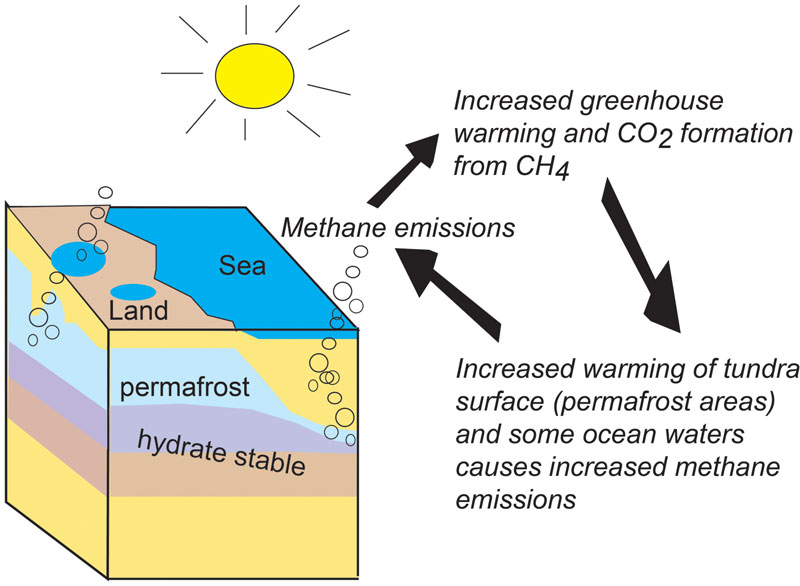
As it does here.  Basically it comes down to this.  Methane is a far greater greenhouse gas than that of CO2.  It is given off in many forms (gas from every living creature) but it is kept in Vast Amounts in Ice.  This Ice is most easily found in the Arctic and Antarctic, but also deep down on the Ocean floor.  It consists of decomposed plant and animal life, since the Earth began.  If the permafrost begins to melt (as it is melting) it releases its methane, and when it does, it is 100 times the greenhouse gas that CO2 is.  After some time, it’s potency lowers to 25 times the greenhouse gas effect of CO2 (which is often what  people wanting to lower the alarm on quote) but that in effect will take effect, long after the major warming has been done by the methane.
 
This in turn warms the Ice (containing Methane Hydrate) more, with Global Warming, making more Ice melt, causing a runaway effect which never ends, and will not end, until virtually all human life no longer exists on this Planet.  This is no longer in dispute.  We ARE in the process of the Earth’s sixth mass extinction.  How soon can it happen?  You had better HOPE that Guy McPherson has overestimated, but then again, he does not make up his OWN data.
So this is what is happening, while Mainstream Media ignores it.  Not really WORTH news-play is it?  I mean if you were expecting some decent reporting on an important issue, what do you think it might be?  Harper’s new pitch on Child Care Benefits?  The Senate?
 
Since we are talking Politicians, let’s not forget that there is not just The Harper running in this upcoming Federal Election.  No in fact, there are others running as well.  Now given YOUR LIFE depends on what they are doing about this, what are THEY talking about?  The OTHER Candidates?  Home Mail Delivery?  Are they talking Senate too?  Are these important issues? 
 
So important that they should not mention
 
The End of all Life on this Planet?

Sockeye fishing closure considered as half of Upper Columbia’s run apparently dies in warm waters

http://www.spokesman.com/blogs/outdoors/2015/jul/24/sockeye-fishing-closure-consider-half-upper-columbias-run-apparently-dies-warm-waters/

JULY 24, 2015

By Rich Landers

UPDATE, 2:20 p.m.:  Sockeye closure has been announced starting Sunday, July 26, a half our after sunset  upper Columbia from Rocky Reach Dam upstream to Chief Joseph Dam.  More details coming.

FISHING — Despite an early facade of excellent sockeye fishing success, the third-largest run on record is in dire straits and Washington fish managers are considering a possible early closure of the prized season in the upper Columbia River.

About half the sockeye run appears to have perished in the low flows and warm water conditions they’ve endured this year in their taxing migration up the Columbia toward spawning areas, says Jeff Korth, Washington Department of Fish and Wildlife regional fisheries manager based in Ephrata.

State fish managers have not responded so far today regarding the status of the proposal.

Oregon and Washington have both enacted emergency fishing rules for some waters that might help fisheries to some degree in this freak year of low snowpack and early runoff that’s ravaged the region’s summer river flows.

Sturgeon fishing was closed this month after dozens if not hundreds of the decades-old giants were found dead in mid-Columbia reservoirs. The sturgeon were stuffed with sockeye and at least some of those sockeye were suffering from bacterial infections promoted by the warm waters.

In early July, biologists were already trying to figure out why 200,000 of the sockeye counted over Bonneville Dam did not make it upstream with their peers to swim over McNary Dam.

  • To date, 503,000 sockeye have been counted swimming over Bonneville, the first dam they encounter on the Columbia on their migration from the ocean.  About 270,000 have been counted over McNary as they enter the upper Columbia at the Tri-Cities.

Last week, government fish scientists monitoring the Columbia, Snake and Southwest British Columbia sockeye returns began coming up with enough evidence to describe the situation among themselves in terms such as “catastrophic.”

Columbia water temperatures have started to tick downward a degree or two and may continue in cooler weather forecast through this weekend. Whether that’s enough change to enable more sockeye to survive remains to be seen.

Korth said the forecast weatehr isn’t going to be enough. “We desperately need the cooler weather,” he said in an email, “but it’s to get the remaining fish up the Okanogan River and through Osoyoos Lake.”

Idaho began trucking some of its endangered Snake River sockeye upstream to hatcheries in hopes of saving enough broodstock to continue a run they’ve had encouraging results in rebuilding from virtually nothing.

The salmon seasons attract thousands of anglers to the Columbia system rivers. A closure would be a huge blow to local economies in towns such as Brewster.

Summer chinook, which are moving up the Columbia in record numbers, apparently are not suffering so much in the warm flows and there’s been no discussion of closing chinook fishing.

But the sockeye run is hurting and future sockeye runs may be in jeopardy, Korth said.

On July 1, Korth had a gut feeling things could get bad as I interviewed him for a story about the upper Columbia salmon season opener, which produced very good success rates.

“More than three salmon per angler is darned good opening-day fishing,” Korth said. But he couldn’t ignore the other numbers on his radar.

Even then, the sockeye were stalled below the mouth of the Okanogan River, which was far above mean temperatures and well above the 72-degree threshold that prevents the fish from continuing their run. Normally the fish rush when they can uptream to the deep, cool waters in Canada’s Osoyoos Lake where they hunker until conditions are right for them to spawn.

This week, Columbia River water out of Wells Dam below Brewster was a livable 65 degrees for sockeye (71 at Bonneville).  However, Okanogan River temps were as high as 84 degrees.

“We had 15,000 (sockeye) try to make the run up (the Okanogan) the other day and they all died,” Korth says in a story Thursday about the proposed closure by Northwest Sportsman editor Andy Walgamott.

Korth knew anglers would do well in catching the sockeye stacking up below the Okanogan and looking for a cool place to go.

“It’s going to be a dicey year for managing that stock – but a good year for fishing,” he said.

Now he’s wondering how fish managers can assure that enough sockeye survive disease and fishermen to make it upstream to spawn and continue the run for the future.

Korth, who says he’s waiting today for a response from fisheries officials in Olympia, explained to Northwest Sportsman:

  • With the hot water providing ideal conditions for culimnaris bacteria to thrive, a fish’s wounds from scraping on rocks and fish ladders are quickly infected, leading to lesions.
  • Migrating salmon need more oxygen because of the high metabolic rate needed to swim against currents, but warm waters tend to have less dissolved oxygen.
  • Lake Wenatchee sockeye may not even meet escapement goals, much less return in numbers high enough for a fishing season, which had been scheduled to open last weekend. Korth believes half of the Lake Wenatchee run has died, too. Fewer than 12,000 of the 106,000 forecast have returned so far over Tumwater Dam.
  • Half of the sockeye in the Brewster pool are likely to die instead of reaching Canada’s Okanagan and tributaries to spawn in September and October.
  • Upper Columbia salmon anglers so far have caught around 20,000 sockeye during a fishery that’s been described as “nothing short of fantastic.”  (Anglers caught about 40,000 during the entire 2014 season.)

“I just hope it’s not too much,” Korth told Walgamott. “Just a couple months ago we were all rejoicing because of the (salmon) forecasts.” 

Korth says he’s proposed closing the Upper Columbia for sockeye, but a final decision is up to state fishery managers in Olympia.

They have not responded to queries this morning.

Montana wildfire rages unchecked for third day in Glacier National Park

The Reynolds Creek Wildland Fire burns in Glacier National Park, Montana

.

View gallery

The Reynolds Creek Wildland Fire burns in Glacier National Park, Montana in this photo taken July 21, …

By Emmett Berg

KALISPELL, Mont. (Reuters) – Flames roared unchecked through heavy timber for a third day in Montana’s Glacier National Park, where the main road has been closed through the eastern half of the park, along with two campgrounds, during its busiest time of year.

The first major wildfire to hit Glacier in nearly a decade has charred roughly 4,000 acres (1,600 hectares) since igniting on Tuesday just east of the Continental Divide at Logan Pass, officials said, and has defied firefighters’ attempts to contain it.

http://news.yahoo.com/strong-winds-slow-efforts-contain-montana-wildfire-091550071.html?soc_src=mediacontentsharebuttons&soc_trk=fb&fb_ref=Default

Obama Administration Grants Shell Final Permits to Start Drilling in Arctic Ocean

| July 23, 2015

Royal Dutch Shell was granted federal permits yesterday that clear the way for the oil company to begin drilling in the Arctic Ocean. The U.S. Department of the Interior granted the permits for Shell to drill off the coast of Alaska in the Chukchi Sea.

The company is only permitted to drill the top sections of its wells because it lacks the equipment to cap the wells in case of emergency. The ice breaker carrying the required capping stack for the wells, is receiving repairs to its damaged hull in Portland, Oregon. The permits also restricts Shell to drilling only one well at a time, due to a U.S. Fish and Wildlife regulation.

This announcement comes on the heels of a nationwide protest last weekend where people in 13 states gathered for a ShellNo” Day of Action asking President Obama to revoke oil and gas exploration leases in the Chukchi Sea.

Many environmental organizations are irate over the granting of the final permit to Shell. Here are several of their responses:

Greenpeace:

“This approval for Shell to drill in Alaska from the Obama administration is just the latest in a string of concessions for Shell, a company that cannot even make it to the Alaskan Arctic without significantly damaging its equipment,” said Tim Donaghy, Greenpeace senior research specialist. “By opening up the Arctic to oil drilling, President Obama is courting disaster and undermining his legacy on climate change. The world cannot afford to burn Arctic oil, and the consequences of a spill would be enormous.”

More: http://ecowatch.com/2015/07/23/obama-grants-shell-arctic-drilling/?utm_source=EcoWatch+List&utm_campaign=11f020c89b-Top_News_7_22_2015&utm_medium=email&utm_term=0_49c7d43dc9-11f020c89b-85955433

Western Drought conditions prompt fishing

http://wdfw.wa.gov/news/jul1615b/

OLYMPIA – State fishery managers are closing or restricting fishing on more than 30 rivers throughout Washington to help protect fish in areas where drought conditions have reduced flows and increased water temperatures.  

The closures and restrictions take effect Saturday (July 18) at 12:01 a.m. The changes will remain in effect until further notice.

Fishing will be closed in some waters, and limited in others each day to the hours between midnight and 2 p.m. These “hoot-owl” restrictions will go into effect on rivers where fishery managers want to reduce stress on fish during the hottest time of day.

High water temperatures can be deadly for fish, such as trout, while diminished stream flows can strand migrating salmon and steelhead, said Craig Burley, fish program manager for the Washington Department of Fish and Wildlife (WDFW).

“With such extreme drought conditions in several areas of the state, we needed to take these steps to help protect vulnerable fish in waters where we have concerns,” Burley said. “We’ll continue monitoring stream conditions throughout Washington this summer and take additional actions if necessary.”

For details on the closures and restrictions, check the emergency regulations, which will be posted tomorrow on WDFW’s webpage at https://fortress.wa.gov/dfw/erules/efishrules/.

Fishing closures and restrictions are listed by region below. Today’s action does not include any rivers in Region 6 (South Sound/Olympic Peninsula). However, earlier this summer, the department closed fishing on a section of the Sol Duc River to protect returning chinook during drought conditions.

Region 1 – Eastern Washington

Closed to fishing:

  • North Fork Touchet River above Spangler Creek.
  • South Fork Touchet River from the mouth to Griffen Fork and above Griffen Fork.
  • Wolf Fork Touchet River from the mouth to Coates Creek and Robinson Fork.
  • Asotin Creek and tributaries (Asotin Co.) from the mouth to headwaters.
  • Kettle River and all tributaries (Ferry Co.) from the Barstow Bridge to the headwaters, all portions contained within Washington.

Hoot-owl restrictions:

  • Walla Walla River (Walla Walla Co.) from McDonald Road Bridge to the Oregon State Boundary.
  • Touchet River (Columbia/Walla Walla Co.) from the mouth to the confluence of the North and South forks.
  • North Fork Touchet River from the mouth to Spangler Creek.
  • Tucannon River (Columbia/Garfield Co.) From the Highway 12 Bridge to Cow Camp Bridge.
  • Spokane River (Spokane/Lincoln Co.) from upstream boundary at Plese Flats Day Use Area to the Idaho State Boundary.
  • Spokane River tributaries, including Little Spokane River and tributaries (Spokane/Pend Oreille/Stevens Counties) from the State Route 25 Bridge upstream to Monroe Street Dam.
  • Colville River and all tributaries (Stevens Co.) from the mouth to the headwaters.
  • Sullivan Creek and all tributaries (Pend Oreille Co.) from the mouth to the headwaters.

Region 2 – North Central Washington

Closed to fishing:

  • Wenatchee River (Chelan Co.) from the mouth to the Icicle River Road Bridge.
  • Icicle River (Chelan Co.) from the mouth to 500 feet downstream of the Leavenworth National Fish Hatchery Barrier Dam.
  • Lake Wenatchee (Chelan Co.)
  • Okanogan River from the Hwy 97 bridge upstream to Zosel Dam, except open to game fish fishing.
  • Similkameen River from the mouth upstream to Enloe Dam.

Region 3 – South Central Washington

Closed to fishing:

  • Ahtanum Creek, including the north and middle forks
  • Little Naches River
  • Teanaway River, including west, middle and north forks

Hoot-owl restrictions:

  • Naches River from Tieton River to Bumping River/Little Naches River
  • Rattlesnake Creek

Region 4 – North Puget Sound

Closed to fishing:

  • Raging River (King Co.) from the mouth upstream.
  • Skykomish River (Snohomish Co.) from the mouth upstream closed to all fishing, except the section around Reiter Ponds remains open from the Gold Bar/Big Eddy Access (Hwy. 2 Bridge) upstream to the confluence of the North and South forks.
  • Wallace River (Snohomish Co.). From the mouth upstream including all tributaries.
  • Stillaguamish River (Skagit/Snohomish Co.) From Marine Drive upstream including the North and South forks and all tributaries.
  • South Fork Nooksack (Whatcom Co.) From the mouth to Skookum Creek, and from Wanlick Creek to headwaters including Wanlick and all tributaries.
  • Suiattle River (Skagit Co.) Tributaries Buck, Downey and Sulpher Creeks.

Hoot-owl restrictions:

  • North Fork Skykomish River (Snohomish Co.) From the mouth upstream including all tributaries.
  • South Fork Skykomish River (Snohomish/King Co.) From Sunset Falls upstream and all tributaries, including the Beckler, Foss, Miller and Rapid rivers and their tributaries.
  • Sauk River (Skagit/Snohomish Co.) Above the Suiattle River including the North Fork to the falls and the South Fork to headwaters.
  • Samish River (Skagit Co.) From I-5 to headwaters, and Friday Creek upstream.

Region 5 – Southwest Washington

Closed to fishing:

  • East Fork Lewis River from Lewisville Park downstream.
  • Washougal River from Mt. Norway Bridge downstream.

Hoot-owl restrictions:

  • East Fork Lewis River from Lewisville Park upstream.
  • Washougal River from Mt. Norway Bridge upstream.

WDFW has also closed fishing for spring chinook on the Grande Ronde River in eastern Washington due to low river flows.

For more information about drought’s impact on fish and wildlife, visit WDFW’s drought webpage at http://wdfw.wa.gov/conservation/drought/.