A child born today may live to see humanity’s end

http://blogs.reuters.com/great-debate/2015/06/18/a-child-born-today-may-live-to-see-humanitys-end-unless/

Humans will be extinct in 100 years because the planet will be uninhabitable, said the late Australian microbiologist Frank Fenner, one of the leaders in the effort to eradicate smallpox during the 1970s. He blamed overcrowding, denuded resources and climate change.

Fenner’s prediction, made in 2010, is not a sure bet, but he is correct that there is no way emissions reductions will be enough to save us from our trend toward doom. And there doesn’t seem to be any big global rush to reduce emissions, anyway. When the G7 called on Monday for all countries to reduce carbon emissions to zero in the next 85 years, the scientific reaction was unanimous: That’s far too late.

And no possible treaty that emerges from the current United Nations Framework Convention on Climate Change in Bonn, Germany, in preparation for November’s United Nations climate conference in Paris, will be sufficient. At this point, lowering emissions is just half the story — the easy half. The harder half will be an aggressive effort to find the technologies needed to reverse the climate apocalypse that has already begun.

For years now, we have heard that we are at a tipping point. Al Gore warned us in An Inconvenient Truth that immediate action was required if we were to prevent global warming. In 2007, Sir David King, former chief scientific advisor to the British government, declared, “Avoiding dangerous climate change is impossible – dangerous climate change is already here. The question is, can we avoid catastrophic climate change?” In the years since, emissions have risen, as have global temperatures. Only two conclusions can be drawn: Either these old warnings were alarmist, or we are already in far bigger trouble than the U.N. claims. Unfortunately, the latter seems to be the case.

Lowering emissions and moving to cleaner energy sources is a necessary step to prevent catastrophic temperature rises. The general target is to keep global temperatures from rising more than 2 degrees Celsius. Higher increases — like the 5C increase currently projected by 2100 — run the risk of widespread flooding, famine, drought, sea-level rise, mass extinction and, worse, the potential of passing a tipping point (frequently set at 6C) that could render much of the planet uninhabitable and wipe out most species. Even the 2C figure predicts more than a meter’s rise in sea levels by 2100, enough to displace millions. It is no wonder that the Pentagon calls climate change a serious “threat multiplier” and is considering its potential disruptive impact across all its planning.

This is where the U.N. talks fall short — by a mile. The targets proffered by the United States (a 26 percent to 28 percent decrease from 2005 levels by 2025), the European Union (a 40 percent decrease from 1990 levels by 2030) and China (an unspecified emissions peak by 2030) are nowhere near enough to keep us under the 2C target. In 2012, journalist Bill McKibben, in a feature for Rolling Stone, explained much of the math behind the current thinking on global warming. He concluded that the United Nations’ figures were definitely on the rosy side. In particular, McKibben noted that the temperature has already increased 0.8C, and even if we were to stop all carbon-dioxide emissions today, it would increase another 0.8C simply due to the existing carbon dioxide in the atmosphere. That leaves only a 0.4C buffer before hitting 2C. Even assuming the Paris conference implements everything that’s promised, we will be on track to use up the remaining “carbon budget” — the amount of carbon we can emit without blowing past the 2C threshold — within two to three decades, not even at mid-century.

These emissions-reduction frameworks, it is safe to say, are simply insufficient. By themselves, they only offer a small chance of preventing the earth from becoming mostly uninhabitable – for humans at least — over the next few centuries. For the talks to be more than just a placebo, they need to encompass aggressive plans for climate mitigation, with the assumption that current wishful targets won’t be met.

Apart from coordination to cope with climate-driven crises and associated instability, climate-change leadership needs to encourage and fund the development of technologies to reverse what we are unable to stop doing to our planet. Many of these technologies fall under the rubric of “carbon sequestration” — safely storing carbon rather than emitting it. Riskier strategies, like injecting sulfates into the air to reflect more of the sun’s heat into space and ocean iron fertilization to grow algae to suck in carbon, run a high risk of unintended consequences. Better and safer solutions to reduce CO2 concentrations in the atmosphere don’t yet exist; we need to discover them and regulate them, to avoid the chaos of what economists Gernot Wagner and Martin L. Weitzman term “rogue geoengineering” in their book Climate Shock.

None of these approaches are substitutes for emissions reductions. Achieving a carbon-neutral society is a necessary long-term goal regardless of other technological fixes. Technology could buy us the time to get there without our planet burning up. Ultimately, we need a Cold War-level of investment in research into new technologies to mitigate the coming effects of global warming. Without it, the United Nations’ work is a nice gesture, but hardly a meaningful one.

Food for Thought

“Twenty More Years of Roaring Growth” for China?

The following is an excerpt from http://www.truth-out.org/news/item/31478-china-s-communist-capitalist-ecological-apocalypse :

In The Wall Street Journal of August 20, 2014, Justin Yifu Lin, an economist and close adviser to senior leaders in Beijing, stated that he’s confident China can sustain its recent 8 percent per year growth rate for the foreseeable future. He predicts “20 years of roaring growth” for China. Really? Where does Yifu think the resources are going to come from for this scale of consumption? As it happens, in 2011, the Earth Policy Institute at Columbia University calculated that if China keeps growing by around 8 percent per year, Chinese average per capita consumption will reach the current US level by around 2035. But to provide the natural resources for China’s 1.3 billion to consume on a per capita basis like the United States’ 330 million consume today, the Chinese – roughly 20 percent of the world’s population – will consume as much oil as the entire world consumes today. It would also consume more than 60 percent of other critical resources.

Production Consumption* Commodity Unit Consumption Latest Year Projected Consumption 2035
U.S. China China World
Grain Million Tons 338 424 1,505 2,191
Meat Million Tons 37 73 166 270
Oil Million Barrels per Day 19 9 85 86
Coal Million Tons of Oil Equivalent 525 1,714 2,335 3,731
Steel Million Tons 102 453 456 1,329
Fertilizer Million Tons 20 49 91 214
Paper Million Tons 74 97 331 394

*Projected Chinese consumption in 2035 is calculated assuming per-capita consumption will be equal to the current US level, based on projected GDP growth of 8 percent annually. Latest year figures for grain, oil, coal, fertilizer and paper are from 2008. Latest year figures for meat and steel are from 2010. Source: Earth Policy Institute, 2011

How can this happen? What would the rest of the world live on? Already, as resource analyst Michael Klare reviews in his latest book, The Race for What’s Left (2012), around the world existing reserves of oil, minerals and other resources “are being depleted at a terrifying pace and will be largely exhausted in the not-too-distant future.”

B. Airpocalypse Now

Decades of coal-powered industrialization combined with the government-promoted car craze since the 1990s have brought China the worst air pollution in the world. Scientists have compared north China’s toxic smog to a “nuclear winter” and the smog is also sharply reducing crop yields. Lung cancer is now the leading cause of death in Beijing and nationally pollution-induced lung disease is taking the lives of more than 1.2 million people a year. With 20 percent of the world’s population, China now burns as much coal as the rest of the world put together. Twenty of the world’s 30 smoggiest cities are in China.

As domestic food grows increasingly unsafe, alarmed middle-class Chinese strip supermarkets of imported food.

Ironically, China is also a “green technology” leader, the world’s largest producer of both windmills and solar panels. Yet in China these account for barely 1 percent of electricity generation. Coal presently supplies 69 percent of China’s total energy consumption; oil accounts for 18 percent; hydroelectric, 6 percent; natural gas, 4 percent; nuclear, less than 1 percent; and other renewables including solar and wind, 1 percent. (27) China currently burns 4 billion tons of coal a year; the US burns less than 1 billion; the European Union, about 0.6 billion. China has marginally reduced the carbon intensity of production in recent years by installing newer, more efficient power plants but these gains have been outstripped by relentless building of more power plants. To make matters worse, even when power plants are fitted with scrubbers to reduce pollution, operators often don’t turn on the scrubbers because these cut into their profits.

While government plans call for reducing coal’s share of the energy mix from 69 percent to 55 percent by 2040, it projects that China’s absolute coal consumption will still rise by more than 50 percent in the same period in line with China’s projected economic growth of around 7.7 percent per year. The World Health Organization considers air pollution above 25 micrograms of particulate matter per cubic meter (PM2.5) to be unsafe. China’s current national average is 75 micrograms but particulate levels in many cities average in the hundreds.

In the winter of 2013, China suffered from the worst air pollution in its history as half of the country, nearly the whole of northern and eastern China, was smothered in dense smog for weeks at a time. Smog alerts were called in 104 cities in 20 of China’s 30 provinces as schools and airports closed in Beijing, Shanghai and other cities. In January, PM2.5 levels in Beijing reached 900 micrograms per cubic meter. As Beijing was choking in smog in the winter of 2013, Deutsche Bank analysts gloomily concluded that even if China’s economy slowed to 5 percent growth per year from it’s current 7.6 percent rate, coal consumption would still nearly double and China’s smog could increase by as much as 70 percent by 2030. (28)

China’s leaders thus face an intractable dilemma. They can’t keep growing the economy without consuming ever more coal, oil and gas. Yet the more fossil fuels they burn, the more uninhabitable China’s cities become, the more Chinese people flee the country, and the faster China’s emissions are driving global warming.

More: http://www.truth-out.org/news/item/31478-china-s-communist-capitalist-ecological-apocalypse

How the US Navy Plans to War Game the Arctic

Destroying What Remains: An Animal Rights Article from All-Creatures.org

FROM

Dahr Jamail, Truthout.org / TomDispatch.com
June 2015

[NOTE from All-Creatures.org: PLEASE visit WAR OF THE WHALES for detailed, sad, horrifying information about the effects of sonar on sea animals!]

Now, a dozen years after I left my home state and landed in Baghdad to begin life as a journalist and nine years after definitively abandoning Alaska, I find myself back. I wish it was to climb another mountain, but this time, unfortunately, it’s because I seem increasingly incapable of escaping the long and destructive reach of the US military.

Here’s just one example of the kinds of damage that will occur: the cyanide discharge from a Navy torpedo is in the range of 140-150 parts per billion. The Environmental Protection Agency’s “allowable” limit on cyanide: one part per billion.

Given that the Navy has been making plans for “ice-free” operations in the Arctic since at least 2001, their June “Northern Edge” exercises may well prove to be just the opening salvo in the future northern climate wars, with whales, seals, and salmon being the first in the line of fire.

Species affected will include blue, fin, gray, humpback, minke, sei, sperm, and killer whales, the highly endangered North Pacific right whale (of which there are only approximately 30 left), as well as dolphins and sea lions.

I lived in Anchorage for 10 years and spent much of that time climbing in and on the spine of the state, the Alaska Range. Three times I stood atop the mountain the Athabaskans call Denali, “the great one.” During that decade, I mountaineered for more than half a year on that magnificent state’s highest peaks. It was there that I took in my own insignificance while living amid rock and ice, sleeping atop glaciers that creaked and moaned as they slowly ground their way toward lower elevations.

Alaska contains the largest coastal mountain range in the world and the highest peak in North America. It has more coastline than the entire contiguous 48 states combined and is big enough to hold the state of Texas two and a half times over. It has the largest population of bald eagles in the country. It has 430 kinds of birds along with the brown bear, the largest carnivorous land mammal in the world, and other species ranging from the pygmy shrew that weighs less than a penny to gray whales that come in at 45 tons. Species that are classified as “endangered” in other places are often found in abundance in Alaska.

Now, a dozen years after I left my home state and landed in Baghdad to begin life as a journalist and nine years after definitively abandoning Alaska, I find myself back. I wish it was to climb another mountain, but this time, unfortunately, it’s because I seem increasingly incapable of escaping the long and destructive reach of the US military.

That summer in 2003 when my life in Alaska ended was an unnerving one for me. It followed a winter and spring in which I found myself protesting the coming invasion of Iraq in the streets of Anchorage, then impotently watching the televised spectacle of the Bush administration’s “shock and awe” assault on that country as Baghdad burned and Iraqis were slaughtered. While on Denali that summer I listened to news of the beginnings of what would be an occupation from hell and, in my tent on a glacier at 17 thousand feet, wondered what in the world I could do.

In this way, in a cloud of angst, I traveled to Iraq as an independent news team of one and found myself reporting on atrocities that were evident to anyone not embedded with the US military, which was then laying waste to the country. My early reporting, some of it for TomDispatch, warned of body counts on a trajectory toward one million, rampant torture in the military’s detention facilities, and the toxic legacy it had left in the city of Fallujah thanks to the use of depleted uranium munitions and white phosphorous.

As I learned, the US military is an industrial-scale killing machine and also the single largest consumer of fossil fuels on the planet, which makes it a major source of the greenhouse gas carbon dioxide. As it happens, distant lands like Iraq sitting atop vast reservoirs of oil and natural gas are by no means its only playing fields.

Take the place where I now live, the Olympic Peninsula in Washington state. The US Navy already has plans to conduct electromagnetic warfare training in an area close to where I moved to once again seek solace in the mountains: Olympic National Forest and nearby Olympic National Park. And this June, it’s scheduling massive war games in the Gulf of Alaska, including live bombing runs that will mean the detonation of tens of thousands of pounds of toxic munitions, as well as the use of active sonar in the most pristine, economically valuable, and sustainable salmon fishery in the country (arguably in the world). And all of this is to happen right in the middle of fishing season.

This time, in other words, the bombs will be falling far closer to home. Whether it’s war-torn Iraq or “peaceful” Alaska, Sunnis and Shi’ites or salmon and whales, to me the omnipresent “footprint” of the US military feels inescapable.

sonar war arctic
All of Southeast Alaska’s pristine coastline would be impacted by the Navy’s upcoming planned war games in the Gulf of Alaska. (Photo: Dahr Jamail/Truthout)

The War Comes Home

In 2013, US Navy researchers predicted ice-free summer Arctic waters by 2016 and it looks as if that prediction might come true. Recently, the National Oceanic and Atmospheric Administration (NOAA) reported that there was less ice in the Arctic this winter than in any other winter of the satellite era. Given that the Navy has been making plans for “ice-free” operations in the Arctic since at least 2001, their June “Northern Edge” exercises may well prove to be just the opening salvo in the future northern climate wars, with whales, seals, and salmon being the first in the line of fire.

In April 2001, a Navy symposium entitled “Naval Operations in an Ice-Free Arctic” was mounted to begin to prepare the service for a climate-change-induced future. Fast forward to June 2015. In what the military refers to as Alaska’s “premier” joint training exercise, Alaskan Command aims to conduct “Northern Edge” over 8,429 nautical miles, which include critical habitat for all five wild Alaskan salmon species and 377 other species of marine life. The upcoming war games in the Gulf of Alaska will not be the first such exercises in the region — they have been conducted, on and off, for the last 30 years — but they will be the largest by far. In fact, a 360 percent rise in munitions use is expected, according to Emily Stolarcyk, the program manager for the Eyak Preservation Council (EPC).

The waters in the Gulf of Alaska are some of the most pristine in the world, rivaled only by those in the Antarctic, and among the purest and most nutrient-rich waters anywhere. Northern Edge will take place in an Alaskan “marine protected area,” as well as in a NOAA-designated “fisheries protected area.” These war games will also coincide with the key breeding and migratory periods of the marine life in the region as they make their way toward Prince William Sound, as well as further north into the Arctic.

Species affected will include blue, fin, gray, humpback, minke, sei, sperm, and killer whales, the highly endangered North Pacific right whale (of which there are only approximately 30 left), as well as dolphins and sea lions. No fewer than a dozen native tribes including the Eskimo, Eyak, Athabascan, Tlingit, Sun’aq, and Aleut rely on the area for subsistence living, not to speak of their cultural and spiritual identities.

The Navy is already permitted to use live ordnance including bombs, missiles, and torpedoes, along with active and passive sonar in “realistic” war gaming that is expected to involve the release of as much as 352,000 pounds of “expended materials” every year. (The Navy’s EIS lists numerous things as “expended materials,” including missiles, bombs, torpedoes.) At present, the Navy is well into the process of securing the necessary permits for the next five years and has even mentioned making plans for the next 20. Large numbers of warships and submarines are slated to move into the area and the potential pollution from this has worried Alaskans who live nearby.

“We are concerned about expended materials in addition to the bombs, jet noise, and sonar,” the Eyak Preservation Council’s Emily Stolarcyk tells me as we sit in her office in Cordova, Alaska. EPC is an environmental and social-justice-oriented nonprofit whose primary mission is to protect wild salmon habitat. “Chromium, lead, tungsten, nickel, cadmium, cyanide, ammonium perchlorate, the Navy’s own environmental impact statement says there is a high risk of chemical exposure to fish.”

Tiny Cordova, population 2,300, is home to the largest commercial fishing fleet in the state and consistently ranks among the top 10 busiest US fishing ports. Since September, when Stolarcyk first became aware of the Navy’s plans, she has been working tirelessly, calling local, state and federal officials and alerting virtually every fisherman she runs into about what she calls “the storm” looming on the horizon. “The propellants from the Navy’s missiles and some of their other weapons will release benzene, toluene, xylene, polycyclic aromatic hydrocarbons, and naphthalene into the waters of twenty percent of the training area, according to their own EIS [environmental impact statement],” she explains as we look down on Cordova’s harbor with salmon fishing season rapidly approaching. As it happens, most of the chemicals she mentioned were part of BP’s disastrous 2010 oil spill in the Gulf of Mexico, which I covered for years, so as I listened to her I had an eerie sense of futuristic déjà vu.

Here’s just one example of the kinds of damage that will occur: the cyanide discharge from a Navy torpedo is in the range of 140-150 parts per billion. The Environmental Protection Agency’s “allowable” limit on cyanide: one part per billion.

The Navy’s EIS estimates that, in the five-year period in which these war games are to be conducted, there will be more than 182,000 “takes” — direct deaths of a marine mammal, or the disruption of essential behaviors like breeding, nursing, or surfacing. On the deaths of fish, it offers no estimates at all. Nevertheless, the Navy will be permitted to use at least 352,000 pounds of expended materials in these games annually. The potential negative effects could be far-reaching, given species migration and the global current system in northern waters. p>

In the meantime, the Navy is giving Stolarcyk’s efforts the cold shoulder, showing what she calls “total disregard toward the people making their living from these waters.” She adds, “They say this is for national security. They are theoretically defending us, but if they destroy our food source and how we make our living, while polluting our air and water, what’s left to defend?”

Stolarcyk has been labeled an “activist” and “environmentalist,” perhaps because the main organizations she’s managed to sign on to her efforts are indeed environmental groups like the Alaska Marine Conservation Council, and the Alaskans First Coalition.

“Why does wanting to protect wild salmon habitat make me an activist?” she asks. “How has that caused me to be branded as an environmentalist?” Given that the Alaska commercial fishing industry could be decimated if its iconic “wild-caught” salmon turn up with traces of cyanide or any of the myriad chemicals the Navy will be using, Stolarcyk could as easily be seen as fighting for the well-being, if not the survival, of the fishing industry in her state.

War Gaming the Community

The clock is ticking in Cordova and others in Stolarcyk’s community are beginning to share her concerns. A few like Alexis Cooper, the executive director of Cordova District Fishermen United (CDFU), a non-profit organization that represents the commercial fishermen in the area, have begun to speak out. “We’re already seeing reduced numbers of halibut without the Navy having expanded their operations in the GOA [Gulf of Alaska],” she says, “and we’re already seeing other decreases in harvestable species.”

CDFU represents more than 800 commercial salmon fishermen, an industry that accounts for an estimated 90 percent of Cordova’s economy. Without salmon, like many other towns along coastal southeastern Alaska, it would effectively cease to exist.

Teal Webber, a lifelong commercial fisherwoman and member of the Native Village of Eyak, gets visibly upset when the Navy’s plans come up. “You wouldn’t bomb a bunch of farmland,” she says, “and the salmon run comes right through this area, so why are they doing this now?” She adds, “When all of the fishing community in Cordova gets the news about how much impact the Navy’s war games could have, you’ll see them oppose it en masse.”

While I’m in town, Stolarcyk offers a public presentation of the case against Northern Edge in the elementary school auditorium. As she shows a slide from the Navy’s environmental impact statement indicating that the areas affected will take decades to recover, several fishermen quietly shake their heads.

One of them, James Weiss, who also works for Alaska’s Fish and Game Department, pulls me aside and quietly says, “My son is growing up here, eating everything that comes out of the sea. I know fish travel through that area they plan to bomb and pollute, so of course I’m concerned. This is too important of a fishing area to put at risk.” p>

In the question-and-answer session that follows, Jim Kasch, the town’s mayor, assures Stolarcyk that he’ll ask the city council to become involved. “What’s disturbing is that there is no thought about the fish and marine life,” he tells me later. “It’s a sensitive area and we live off the ocean. This is just scary.” A Marine veteran, Kasch acknowledges the Navy’s need to train, then pauses and adds, “But dropping live ordnance in a sensitive fishery just isn’t a good idea. The entire coast of Alaska lives and breathes from our resources from the ocean.”

That evening, with the sun still high in the spring sky, I walk along the boat docks in the harbor and can’t help but wonder whether this small, scruffy town has a hope in hell of stopping or altering Northern Edge. There have been examples of such unlikely victories in the past. A dozen years ago, the Navy was, for example, finally forced to stop using the Puerto Rican island of Vieques as its own private bombing and test range, but only after having done so since the 1940s. In the wake of those six decades of target practice, the island’s population has the highest cancer and asthma rates in the Caribbean, a phenomenon locals attribute to the Navy’s activities.

Similarly, earlier this year a federal court ruled that Navy war games off the coast of California violated the law. It deemed an estimated 9.6 million “harms” to whales and dolphins via high-intensity sonar and underwater detonations improperly assessed as “negligible” in that service’s EIS.

As a result of Stolarcyk’s work, on May 6th Cordova’s city council passed a resolution formally opposing the upcoming war games. Unfortunately, the largest seafood processor in Cordova (and Alaska), Trident Seafoods, has yet to offer a comment on Northern Edge. Its representatives wouldn’t even return my phone call on the subject. Nor, for instance, has Cordova’s Prince William Sound Science Center, whose president, Katrina Hoffman, wrote me that “as an organization, we have no position statement on the matter at this time.” This, despite their stated aim of supporting “the ability of communities in this region to maintain socioeconomic resilience among healthy, functioning ecosystems.” (Of course, it should be noted that at least some of their funds come from the Navy.)

Government-to-Government Consultation

At Kodiak Island, my next stop, I find a stronger sense of the threat on the horizon in both the fishing and tribal communities and palpable anger about the Navy’s plans. Take J.J. Marsh, the CEO of the Sun’aq Tribe, the largest on the island. “I think it’s horrible,” she says the minute I sit down in her office. “I grew up here. I was raised on subsistence living. I grew up caring about the environment and the animals and fishing in a native household living off the land and seeing my grandpa being a fisherman. So obviously, the need to protect this is clear.”

What, I ask, is her tribe going to do?

She responds instantly. “We are going to file for a government-to-government consultation and so are other Kodiak tribes so that hopefully we can get this stopped.”

The US government has a unique relationship with Alaska’s Native tribes, like all other American Indian tribes. It treats each as if it were an autonomous government. If a tribe requests a “consultation,” Washington must respond and Marsh hopes that such an intervention might help block Northern Edge. “It’s about the generations to come. We have an opportunity as a sovereign tribe to go to battle on this with the feds. If we aren’t going to do it, who is?”

Melissa Borton, the tribal administrator for the Native Village of Afognak, feels similarly. Like Marsh’s tribe, hers was, until recently, remarkably unaware of the Navy’s plans. That’s hardly surprising since that service has essentially made no effort to publicize what it is going to do. “We are absolutely going to be part of this [attempt to stop the Navy],” she tells me. “I’m appalled.”

One reason she’s appalled: she lived through Alaska’s monster Exxon Valdez oil spill of 1989. “We are still feeling its effects,” she says. “Every time they make these environmental decisions they affect us… We are already plagued with cancer and it comes from the military waste already in our ground or that our fish and deer eat and we eat those… I’ve lost family to cancer, as most around here have and at some point in time this has to stop.”

When I meet with Natasha Hayden, an Afognak tribal council member whose husband is a commercial fisherman, she puts the matter simply and bluntly. “This is a frontal attack by the Navy on our cultural identity.”

Gary Knagin, lifelong fisherman and member of the Sun’aq tribe, is busily preparing his boat and crew for the salmon season when we talk. “We aren’t going to be able to eat if they do this. It’s bullshit. It’ll be detrimental to us and it’s obvious why. In June, when we are out there, salmon are jumping [in the waters] where they want to bomb as far as you can see in any direction. That’s the salmon run. So why do they have to do it in June? If our fish are contaminated, the whole state’s economy is hit. The fishing industry here supports everyone and every other business here is reliant upon the fishing industry. So if you take out the fishing, you take out the town.”

The Navy’s Free Ride

I requested comment from the US military’s Alaskan Command office, and Captain Anastasia Wasem responded after I returned home from my trip north. In our email exchange, I asked her why the Navy had chosen the Gulf of Alaska, given that it was a critical habitat for all five of the state’s wild salmon. She replied that the waters where the war games will occur, which the Navy refers to as the Temporary Maritime Activities Area, are “strategically significant” and claimed that a recent “Pacific command study” found that naval training opportunities are declining everywhere in the Pacific “except Alaska,” which she referred to as “a true national asset.”

“The Navy’s training activities,” she added, “are conducted with an extensive set of mitigation measures designed to minimize the potential risk to marine life.”

In its assessment of the Navy’s plans, however, the National Marine Fisheries Service (NMFS), one of the premier federal agencies tasked with protecting national fisheries, disagreed. “Potential stressors to managed species and EFH [essential fish habitat],” its report said, “include vessel movements (disturbance and collisions), aircraft overflights (disturbance), fuel spills, ship discharge, explosive ordnance, sonar training (disturbance), weapons firing/nonexplosive ordnance use (disturbance and strikes), and expended materials (ordnance-related materials, targets, sonobuoys, and marine markers). Navy activities could have direct and indirect impacts on individual species, modify their habitat, or alter water quality.” According to the NMFS, effects on habitats and communities from Northern Edge “may result in damage that could take years to decades from which to recover.”

Captain Wasem assured me that the Navy made its plans in consultation with the NMFS, but she failed to add that those consultations were found to be inadequate by the agency or to acknowledge that it expressed serious concerns about the coming war games. In fact, in 2011 it made four conservation recommendations to avoid, mitigate, or otherwise offset possible adverse effects to essential fish habitat. Although such recommendations were non-binding, the Navy was supposed to consider the public interest in its planning.

One of the recommendations, for instance, was that it develop a plan to report on fish mortality during the exercises. The Navy rejected this, claiming that such reporting would “not provide much, if any, valuable data.” As Stolarcyk told me, “The Navy declined to do three of their four recommendations, and NMFS just rolled over.”

I asked Captain Wasem why the Navy choose to hold the exercise in the middle of salmon fishing season.

“The Northern Edge exercise is scheduled when weather is most conducive for training,” she explained vaguely, pointing out that “the Northern Edge exercise is a big investment for DoD [the Department of Defense] in terms of funding, use of equipment/fuels, strategic transportation, and personnel.”

Arctic Nightmares

The bottom line on all this is simple, if brutal. The Navy is increasingly focused on possible future climate-change conflicts in the melting waters of the north and, in that context, has little or no intention of caretaking the environment when it comes to military exercises. In addition, the federal agencies tasked with overseeing any war-gaming plans have neither the legal ability nor the will to enforce environmental regulations when what’s at stake, at least according to the Pentagon, is “national security.”

Needless to say, when it comes to the safety of locals in the Navy’s expanding area of operation, there is no obvious recourse. Alaskans can’t turn to NMFS or the Environmental Protection Agency or NOAA. If you want to stop the US military from dropping live munitions, or blasting electromagnetic radiation into national forests and marine sanctuaries, or poisoning your environment, you’d better figure out how to file a major lawsuit or, if you belong to a Native tribe, demand a government-to-government consultation and hope it works. And both of those are long shots, at best.

Meanwhile, as the race heats up for reserves of oil and gas in the melting Arctic that shouldn’t be extracted and burned in the first place, so do the Navy’s war games. From southern California to Alaska, if you live in a coastal town or city, odds are that the Navy is coming your way, if it’s not already there.

Nevertheless, Emily Stolarcyk shows no signs of throwing in the towel, despite the way the deck is stacked against her efforts. “It’s supposedly our constitutional right that control of the military is in the hands of the citizens,” she told me in our last session together. At one point, she paused and asked, “Haven’t we learned from our past mistakes around not protecting salmon? Look at California, Oregon, and Washington’s salmon. They’ve been decimated. We have the best and most pristine salmon left on the planet, and the Navy wants to do these exercises. You can’t have both.”

Stolarcyk and I share a bond common among people who have lived in our northernmost state, a place whose wilderness is so vast and beautiful as to make your head spin. Those of us who have experienced its rivers and mountains, have been awed by the northern lights, and are regularly reminded of our own insignificance (even as we gained a new appreciation for how precious life really is) tend to want to protect the place as well as share it with others.

“Everyone has been telling me from the start that I’m fighting a lost cause and I will not win,” Stolarcyk said as our time together wound down. “No other non-profit in Alaska will touch this. But I actually believe we can fight this and we can stop them. I believe in the power of one. If I can convince someone to join me, it spreads from there. It takes a spark to start a fire, and I refuse to believe that nothing can be done.”

Three decades ago, in his book Arctic Dreams, Barry Lopez suggested that, when it came to exploiting the Arctic versus living sustainably in it, the ecosystems of the region were too vulnerable to absorb attempts to “accommodate both sides.” In the years since, whether it’s been the Navy, Big Energy, or the increasingly catastrophic impacts of human-caused climate disruption, only one side has been accommodated and the results have been dismal.

In Iraq in wartime, I saw what the US military was capable of in a distant ravaged land. In June, I’ll see what that military is capable of in what still passes for peacetime and close to home indeed. As I sit at my desk writing this story on Washington’s Olympic Peninsula, the roar of Navy jets periodically rumbles in from across Puget Sound, where a massive naval air station is located. I can’t help but wonder whether, years from now, I’ll still be writing pieces with titles like “Destroying What Remains,” as the Navy continues its war-gaming in an ice-free summer Arctic amid a sea of offshore oil drilling platforms.
DSC_8029

Massive algae bloom causing seizures in sea lions

http://www.king5.com/story/tech/science/environment/2015/06/16/noaa-toxic-algae-bloom-domoic-acid-sea-lion/28841659/

Alison Morrow 6:51 a.m. PDT June 17, 2015

In recent video from Long Beach, a sea lion does something researchers have never seen before on Washington’s coast.

“A sea lion with his head arched back, he’s basically having seizures,” said NOAA Fisheries Research Oceanographer Vera Trainer.

The reason for the seizure is in a laboratory refrigerator at NOAA’s Northwest Fisheries Science Center in Seattle.

It’s an algae called pseudo-nitzschia, and while each cell is microscopic, millions together on Washington’s are massively destructive.

“We’re seeing effects on marine ecosystem we haven’t seen before,” Trainer said.

The algal bloom is unprecedented in size. It extends from southern California to Alaska. Though invisible, it produces a toxin called domoic acid.

The toxin has already closed crab and razor clam fisheries. Now, its effects are spreading to mammals.

“I think it’s scary,” Trainer said. “When we see marine mammals suffering from these toxins, they’re not that far in the food chain from us.”

NOAA fisheries scientists have deployed to study it. They’re joining other researches to trace where the toxic cells are, just how toxic they are, and what’s feeding their growth.

They believe “the blob” is partially to blame, a large expanse of warmer water off the coast.

With the information, they suspect they may not be able to stop the algae, but learn how to live with it.

“But we’re able to figure out how to live with them,” Trainer said. “This is just one animal found on the beach. You wonder what animals that aren’t on the beaches, what’s happening to them.”

24 activists detained as Arctic oil rig heads out of Seattle

http://www.komonews.com/news/local/Activists-form-human-chain-as-Arctic-oil-rig-heads-out-of-port-307363311.html

by KOMO Staff Published: Jun 15, 2015

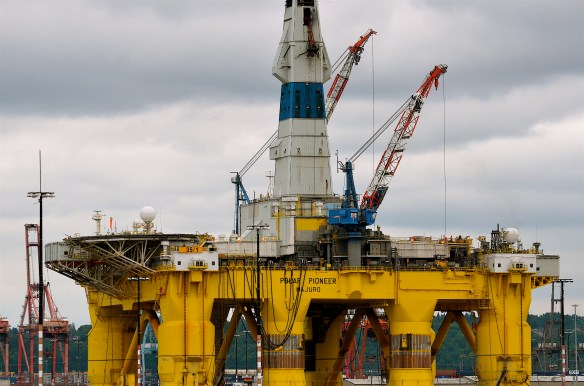
SEATTLE – A massive oil-drilling rig pulled out of Seattle on Monday and headed for the environmentally sensitive Arctic Ocean despite a last-ditch effort by protesters to block it from leaving by forming a waterborne blockade of the harbor.

The Coast Guard says 24 people were detained while taking part in the blockade of the Polar Pioneer.

Many of those detained were in kayaks – including Seattle City Councilman Mike O’Brien, said a Greenpeace spokesman. Around 50 other protesters on the water were not arrested, Greenpeace said.

The Polar Pioneer’s owner, Royal Dutch Shell, plans to tow the rig to the Arctic Ocean off Alaska to drill for undersea oil deposits during relatively calm summer weather conditions.

The first wave of “kayaktivists” headed out in the predawn darkness, as soon as they got word the Polar Pioneer would be on the move. Protesters accused Shell of trying to sneak the rig out of town during the darkness of night.

“Shell was trying to get the Polar Pioneer out of Seattle under cover of darkness, but the kayaktivists prevented them from leaving for several hours and exposed what they were doing to the world,” said Greenpeace’s Arctic Communications Manager Travis Nichols.

Several tugs guided the Shell-owned oil rig out of Elliott Bay as the sun rose over the city.

The petroleum giant’s plans to drill in the waters off Alaska drew a similar kayak protest in May. Activists also have chained themselves twice to a support ship in Bellingham, north of Seattle.

Shell spokesman Curtis Smith says the company remains “committed to operating in a safe, environmentally responsible manner.”

The Coast Guard didn’t immediately respond to a phone message seeking comment.

—–

This is a developing news story. More information will be posted as it becomes available.

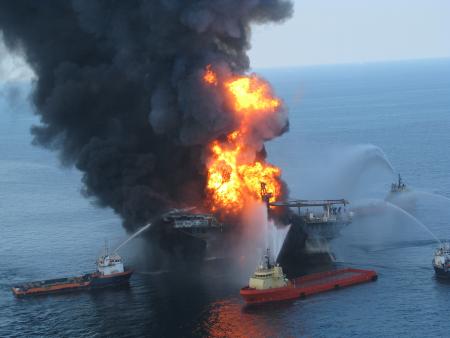
Deepwater-Horizon-CDVIDS

(Can you say Deepwater Horizon?)

The Late John Livingston on the Arctic Oil Debate

I was surprised to learn that the late Canadian naturalist, author and part-time misanthropist, John Livingston, wrote a book on Arctic Oil back in 1981, long before hardly anyone knew for sure if or when the ice sheet was going to melt off and how dire the consequences of that would actually be.

On page one of chapter one of Introduction to the Arctic Debate:

“Each of the ‘constituents’—if only because of (even unilateral) individual involvement has a very real vested interest in what is going to happen in the north. But they all have one thing in common. They consist of both northerners and southerners, but they are all people.

“There are still others, however, with legitimate vested interest who neither voice their views nor hear ours. On the admittedly preposterous assumption that a walrus were to achieve standing before some tribunal, no doubt he would have many things to say on behalf of the inarticulate classless clams and mussels of the ocean bed. A shrimp like crustacean called an amphipod might rise on the part of the minute squid like copepods he depends upon, and the sea birds of Lancaster Sound would have a compelling case for the helpless amphipod. Ivory gulls would plead for their benefactors the polar bears, bears for seals, seals for arctic cod. Foxes would argue for lemmings, and lemmings for grasses. Caribou would be represented by wolves, and wolves by ravens, eagles, gulls and jaegers. Grizzly would fight for ground squirrels; snow geese would speak for sedge meadows, which in turn explicate their vested interest in the sun and the rivers and the permafrost itself.

“Arctic beings and processes are not of course voiceless; we simply choose not to hear them. We elect not to recognize them. Complicated as discussion over northern policy has become, it has not yet entertained the addition complication that would arise were it to become anything more than a unidimensional proceeding, with any more than one interest represented. There is after all only one protagonist, and he is talking to himself. The arctic ‘debate’ is not a debate at all; it is a monologue. The singe participant is ourselves. Were the implications and possible outcomes not so tragic, the whole charade could be dismissed as mere absurdity. But of course absurdity is never ‘mere’; it can be dangerous.”

DSC_8160

Scientists Warn of Mass Ocean Die-Offs

TV: Scientists warning of mass die-off along California coast — Official: Seafloor littered with dead fish, washing up “as far as I could see” — Toxin has spread all up and down West Coast — Experts: “Very, very unusual… Really extraordinary” (VIDEO)

Published: June 2nd, 2015 at 11:59 pm ET
By

KSBW, May 29, 2015 (emphasis added): Monterey Bay National Marine Sanctuary: Mass die-off could happen – “We are beginning with continuing coverage of that algae bloom in the Monterey Bay. Scientists say they’re seeing the highest levels of red tide in more than a decade, and they’re worried it will have grave impacts on marine life… [It] spreads all up and down the West Coast. Researchers in Santa Cruz have already recorded a mass die-off of anchovies and they expected more species could follow.”

KSBW, May 29, 2015: Scientists with the Monterey Bay National Marine Sanctuary are predicting a mass die-off on the Central Coast… Up and down the West Coast, a large algal bloom of Pseudo-nitzschia is growing rapidly.

Chris Scholin, Monterey Bay Aquarium Research Institute (MBARI), May 28, 2015: Very Toxic Algal Bloom in Monterey Bay — I wanted to let you know we have been following a very big bloom of Pseudo-nitzschia over the past couple of weeks here in the bay, and the amount of associated domoic acid is really extraordinary… Yesterday I noticed anchovies washing up on the beach in front of MBARI as far as I could see. There’s also lines of fish scales (anchovy?) marking the high tide line… One of the staff went snorkeling off the beach here, and saw the seafloor littered with anchovies… keep an eye out for seizuring sealions, sick birds, maybe sick otters… We think this is a very large event… Don’t eat shellfish or forage fish from MB — very nasty right now!!!

KSBW, May 29, 2015: “New tonight… researchers say a large algae bloom has taken over the Monterey Bay“… Jim Birch, MBARI: “We’re seeing these really high domoic acid levels in both locations, which is very, very unusual“… “Scientists with MBARI say the toxins from the algae bloom are going to have a chain reaction on marine animals, and they’ve already seen more dead seabirds on Central Coast beaches… It has started to really grow in the last few days.

KSBW, May 29, 2015: Raphael Kudela, a researcher at [UCSC] said the bloom… is being found from Washington to Santa Barbara… reports of dead seabirds are already coming in.

Monterey Herald, May 28, 2015: A mysterious neurotoxin… returned with a vengeance… “This is an unusual one,” said Raphael Kudela… “We haven’t seen a bloom this big in 15 years.”… why the toxin periodically blooms in Monterey Bay is still a marine mystery… scientists are getting closer to pinning down the reason for the blooms, with human impacts among the range of possibilities… Domoic acid is also suspected in a recent spate of bird deaths.

UC Santa Cruz, June 2, 2015: The toxin was first detected in early May, and by the end of the month researchers had detected some of the highest concentrations of domoic acid ever observed in Monterey Bay. “It’s a pretty massive bloom. The domoic acid levels are extremely high right now… the event is occurring as far north as Washington state. So it appears this will be one of the most toxic and spatially largest events we’ve had in at least a decade,” said Raphael Kudela, [UCSC] professor of ocean sciences.

MBARI, Jun 1, 2015: Researchers measured some of the highest concentrations of harmful algae and their toxin ever observed in Monterey Bay… During a normal [bloom] 1,000 nanograms per liter would be considered high… [It’s] reached 10 to 30 times this level. On May 27, 2015, very high levels… were found in dead anchovies… The researchers do not know if the anchovies died because of domoic acid poisoning.

Watch: KSBW’s broadcast | San Diego 6 News broadcast

North American Moose dying in droves as climate warming fuels disease, pests

North American moose are dying by the thousands as they struggle with soaring temperatures and health problems linked to disease and parasites that thrive in the heat, scientists are finding.

In north east Minnesota alone, moose numbered about 8,000 a decade ago. Today, the population is down to 3,500. The story is similar throughout Canada, New Hampshire and Maine.

“All across the southern edge of the range, from Nova Scotia, New Brunswick, Minnesota, Michigan, all across the southern fringe of their range, moose numbers are in a significant decline,” Eric Orff, biologist with the National Wildlife Federation, told PBS.

Biologist Seth Moore has been taking samples of the Minnesota population since 2009. Of the 80 percent of collared moose that have died, 40 percent died from an infection known as brain worm, 20 percent died from a heavy winter tick load that sucks the blood from the animals, and the rest died from a combination of both, reports Motherboard. Both scourges are linked to warmer temperatures.

Minnesota has had unusually warm winters for the last few years. Warmer temperatures also overheat the shaggy, cold-loving animals.

In addition, calves appear to be far weaker now, or abandoned, leaving them more vulnerable to predators.

The population of moose in New Hampshire has fallen from 7,600 in 1996 to 4,000 last year. But the tick population and calf deaths seem to be down this season. But the Kristine Rines, the state’s moose biologist, believes the moose will be in danger as long as climate change is a factor.

“There’s no mystery at all as far as I’m concerned,” said Rines, who believes climate change is clearly to blame for plunging moose populations.  “It’s as clear cut as you can get in examining the natural world.”

A study earlier this year predicts that up to 97% of birds and mammals living in the vast region of northwest Alaska will experience major habitat affects from climate change. The northern climes tend to show more radical changes that serve as a blueprint for what’s eventually ahead for other regions, scientists believe.

The Science of Global Warming

Six Things Michael Mann Wants You to Know About the Science of Global Warming

2 Scientists Drown Measuring Artic Sea Ice–Mother Jones

These Scientists Just Lost Their Lives in the Arctic. They Were Heroes.

These Scientists Just Lost Their Lives in the Arctic. They Were Heroes.

| Thu May 7, 2015
Philip de Roo (left) and Marc Cornelissen.

Early last month, veteran polar explorers and scientists Marc Cornelissen and Philip de Roo set out on skis from Resolute Bay, a remote outpost in the patchwork of islands between Canada and Greenland. Their destination was Bathurst Island, a treacherous 70-mile trek to the northwest across the frozen sea, where they planned to document thinning Arctic sea ice just a few months after NASA reported that the winter ice cover was the lowest on record.

It wasn’t hard to find what they were looking for, according to a dispatch Cornelissen uploaded to Soundcloud on April 28.

“We’re nearing into the coast of Bathurst,” he said. “We think we see thin ice in front of us…Within 15 minutes of skiing it became really warm. In the end it was me skiing in my underwear…I don’t think it looked very nice, and it didn’t feel sexy either, but it was the only way to deal with the heat.”

His next message, a day later, was an emergency distress signal picked up by the Royal Canadian Mounted Police. According to the Guardian, a pilot flying over the spot reported seeing open water, scattered equipment, and a lone sled dog sitting on the broken ice. By last Friday, rescuers had called off the search. The pair are presumed to have drowned, victims of the same thin ice they had come to study. Cornelissen was 46; de Roo had just turned 30.

Yesterday, Cold Facts, the nonprofit with whom the pair was working at the time, dispatched a snowmobile expedition to attempt to recover their belongings. You can follow their progress on Twitter here. The dog, Kimnik, was found a few days ago and is doing fine, the group said.

In a blog post on the website of the European Space Agency, Cornelissen was remembered by former colleagues as “an inspirational character, an explorer and a romantic. He had fallen in love with the spellbinding beauty of the poles and had made it a personal mission to highlight the magnitude of the human fingerprint on this last wilderness.”

It’s not clear whether the ice conditions the pair encountered were directly attributable to climate change, according to E&E News:

That the region had thin ice is evident. Perhaps the ice had been thinned by ocean currents that deliver warm water from below, or by the wind, which could generate open water areas. It is difficult to know. Climate change may have played a role, or it may not have…the impacts of the warming on ice thickness regionally can be unpredictable, [ESA scientist Mark] Drinkwater said.

Still, the Arctic is warming twice as fast as anywhere else on Earth. We rely on the work of scientists like these to know exactly what is happening there and how it will affect those of us who choose to stay safe in warmer, drier places. Their deaths are a testament to the dedication and fearlessness required to stand on the front lines of climate change.

Rest in peace, guys.