Exposing the Big Game

Forget Hunters' Feeble Rationalizations and Trust Your Gut Feelings: Making Sport of Killing Is Not Healthy Human Behavior

Exposing the Big Game

Nature Plays for Keeps

00-intro

Humans are going to extinctify themselves in the near future; that much is a fact, not a speculation. It isn’t a matter of if, but when. The only question is whether they take every other life form with them on their one-way train to extinction.

That nature has been willing to part with a great many incredible species of animals over the years leaves me no doubt that Homo sapiens will eventually join the long list of beings we bring down with us.

But people need to take a good, hard look in the mirror before we call other species “invasive”—all humans are invasive to this hemisphere, including those said to be “indigenous.” And there’s nothing noble about setting fires and driving herds off cliffs. That’s a part of our past which we’d understandably want to forget. (It was the beginning of the sixth mass extinction event—man’s greatest achievement, and now his legacy.) Yet to acknowledge human nature is to understand why the Earth has grown tired of us as a species.

The thought that, thanks to anthropogenic climate change, our planet may become uninhabitable for humanity within our lifetimes may seem unfair unless you stop to think how humans have taken advantage of and mistreated Mother Earth when she’s so generous.

In the end, whether she will forgive us or resent us for all time is perhaps debatable. 

Endangered Perspective: The Alarming Case of the Atlantic Puffin

http://www.alternativesjournal.ca/community/blogs/wild-side/endangered-perspective-alarming-case-atlantic-puffin

Puffins by Brian Gratwicke via Flickr

Puffins by Brian Gratwicke \ CC BY 2.0 via Flickr

There’s perhaps no seabird more iconic to the Maritimes than the Atlantic puffin, a bird as modest and beautiful as the region itself.

At first glance this seabird resembles the penguins of Antarctica, with a black back and white underbelly, but what sets the Atlantic puffin apart is the spectacular colouration of its bill and face, which blossom with sharps reds, yellows and blues during mating season. When the season ends, however, this rainbow beak sheds much of its bulk and becomes a dull, uniform grey. This transformation is so dramatic it was originally thought the Atlantic puffin was two separate species.

The Atlantic puffin is a poor flier, beating its wings 300-400 times a minute just to stay airborne. They’re even prone to crash landings. But what they lack in flight, they make up for at sea. The puffin spends the majority of its life in water, either floating on the waves or diving to extreme depths in pursuit of its fishy food. Its wings are used as powerful flippers and it can snatch several dozen fish with each dive.

The exploitation of these adorable mariners began in the 1600s and took the usual forms.

The exploitation of these adorable mariners began in the 1600s and took the usual forms. We hunted them for their meat, fat and feathers; we destroyed their breeding groups and robbed their burrows of eggs; we introduced invasive pests like feral cats and rats to their remote island colonies; we even caught scores of them with our fishing gear, first by accident and later on purpose.

It’s nearly impossible to tell how abundant puffins used to be on the east coast, but they certainly numbered in the millions. 365,000 breeding pairs is the best modern estimate I could find, encompassing colonies from northern Maine to the Canadian Arctic. Approximately 60 per cent of those 365,000 pairs are found on three islands in Witless Bay, Newfoundland, about half an hour south of St. John’s.

There are smaller colonies dotting the east coast, ranging from the 10,000 puffins nesting on Machias Seal Island in New Brunswick to the few hundred living across the entire province of Nova Scotia, mainly on Cape Breton and on Pearl Island in Lunenburg County.

We don’t hunt them anymore. We don’t touch their eggs or fish irresponsibly in their waters, but there’s still something very insidious taking place in the aforementioned island reserves, something which is claiming the lives of thousands of puffin babies and putting the species at risk.

They’re starving to death.

The stomachs of recently deceased babies were filled with gravel and dirt, a sure sign of starvation.

This phenomena was first observed in the 1960s in Norway, with its coastal islands home to one of the largest colonies of Atlantic puffin in the world. Fewer and fewer babies were surviving each year, culminating in a 99.9 per cent mortality rate by 1977. The stomachs of recently deceased babies were filled with gravel and dirt, a sure sign of starvation.

This tragedy was linked to the collapse of fish stocks, namely herring, due to overfishing in the region. Similar drops in survival rates were observed in the 1980s in Witless Bay following the collapse of capelin stocks. Now with climate change warming the oceans and remaining fish stocks migrating to cooler waters, puffin parents are left with no fish small enough to feed their children.

Only in the last couple years, starvation has been observed among puffins in both Maine and New Brunswick, a terrifying testament to the state of our coast.

For the sake of this seabird, Atlantic Canada must do its part to encourage sustainable fishing practices and to combat climate change. Either that or, heaven forbid, we stop using the Atlantic puffin in our tourism ads.

Jane Goodall: “We’re Destroying the Planet”

Jane Goodall: “We’re Destroying the Planet”

April 21, 2015 by

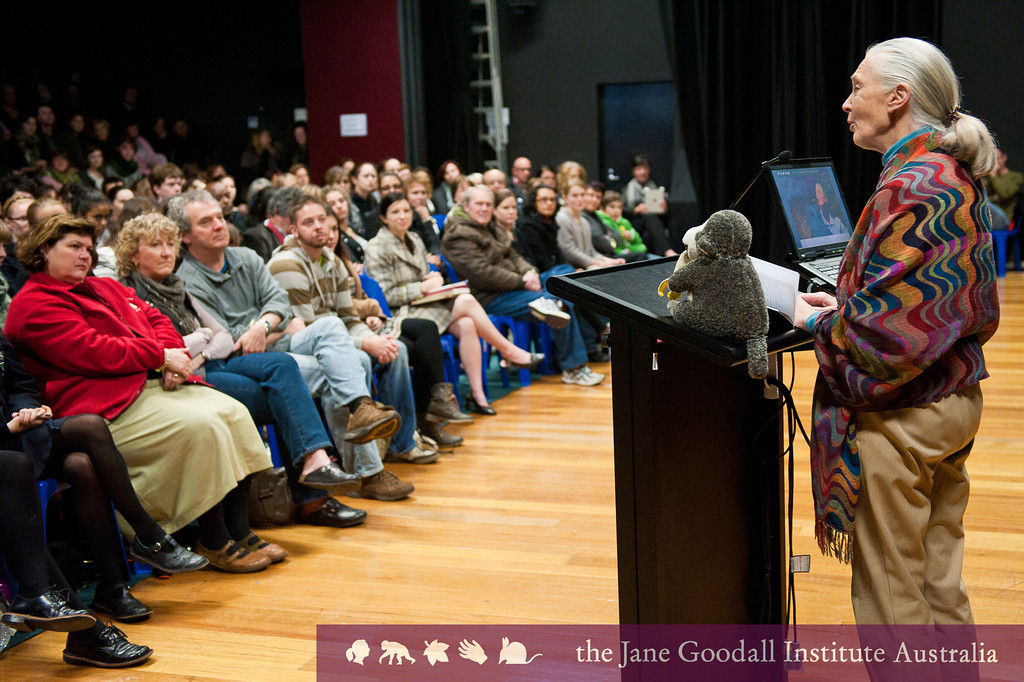
On the topic of our planet’s future, Jane Goodall, the legendary chimpanzee researcher, does not mince words: “How is it possible that the most intellectual creature that has ever walked on planet earth is destroying its only home?” Dr. Goodall, who is 81, spends 300 days year traveling the world in an effort to save it. The biggest problem, she says, is climate change. And the biggest culprit? Animal agriculture.

Jane-Goodall

In a lecture to hundreds of fans in NYC on April 15th, Dr. Goodall explained that agribusinesses are clearing rainforests in the Amazon to graze cattle and grow crops to feed them. Without rainforests – the “lungs of the earth” – the planet’s ability to convert carbon dioxide (CO2), a greenhouse gas, into oxygen is compromised.

Clearing Amazon rainforest for cattle grazing (photo: Universal Images Group/Getty Images)

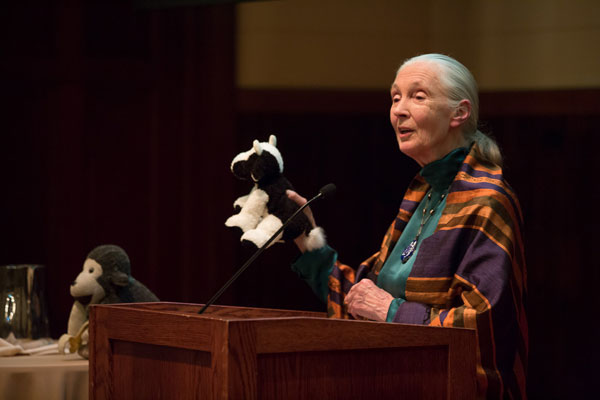
Even more harmful than CO2, Goodall said, is the methane gas emitted in cow farts. As developing countries adopt Western diets heavy in animal protein, more methane and CO2 are released into the atmosphere, further warming the planet and jeopardizing our ability to inhabit it.

Jane Goodall uses a stuffed cow to point out that methane gas is emitted in cow farts.

During her talk, Dr. Goodall described some of the other destructive effects of animal agriculture, including land and water pollution, antibiotic resistance, depletion of fresh water resources and animal cruelty, which is was motivated her to go veg. In a recent interview with the Toronto Globe & Mail, she said, “I became a vegetarian because of the horrendous suffering on factory farms and in abattoirs.”

Jane Goodall paints a grim picture of the state of the planet, but she is hopeful that humans will work together to save ourselves from ourselves. And she offers some advice that each of us can put into action today:

  • Go vegetarian.
  • Consume less. The more we buy, she argues, the more natural resources we extract from the planet. How much stuff do we really need?
  • Improve the environment in our own communities. Goodall’s Roots & Shoots program, which has chapters in 130 countries, is helping people plant trees, clean rivers and perform other community services in their own backyards.

Roots & Shoots has chapters in 130 countries

At the end of her presentation, Dr. Goodall showed a video of a newly-released captive chimpanzee hugging her when she emerged from her crate and realized she was home in the jungle. Goodall uses this remarkable event to point out that, as intelligent as chimps are, their brains are far less powerful than those of humans. And she left the audience with a challenge — to harness the brainpower that we’ve used to damage the planet to save it.

Drought Jeopardizes Western Birds

from Audubon.com

An unprecedented 15-year drought is drying out the Colorado River Basin, threatening the birds and people that live there. The Colorado River provides drinking water for millions of people, world-class recreation, irrigation on working lands, and life-sustaining habitat for hundreds of species of migrating, nesting, and wintering birds. With less water in the Basin, birds will be in trouble as habitat simply begins to fade away. We are calling on people across the country to contact their U.S. Senators, urging them to address this critical situation.

Email your Senators today and ask them to help save water and restore habitat in the Colorado River Basin and across the West.

In the water-scarce West, birds rely on ribbons of rivers and streams, essential wetlands, and the vegetation they nourish. Many nesting species are already in serious trouble due to the loss of habitat from the drought. The Western Yellow-billed Cuckoo and Southwestern Willow Flycatcher have been pushed to the brink and were recently listed under the Endangered Species Act.

The health of the Colorado River is vital to the well-being of the West and the nation. It provides drinking water for more than 36 million people, irrigates 15 percent of US crops, and sustains hundreds of species of birds and other wildlife. Numerous federal programs can help provide short-term and long-term solutions, such as WaterSMART, which supports locally-driven efforts to save water across the West, and the Multi-Species Conservation Program, which helps restore thousands of acres of vital habitat for birds and other wildlife in the Colorado River Basin.

Write to your Senators today and urge them to support water conservation and habitat restoration programs like these in order to secure a sustainable future for the people and birds of the West.

55026060ac29d.preview-300

Don’t be fooled by Jeb Bush’s new rhetoric on climate change

http://grist.org/climate-energy/dont-be-fooled-by-jeb-bushs-new-rhetoric-on-climate-change/?utm_source=newsletter&utm_medium=email&utm_term=EDIT%20Weekly&utm_campaign=weekly

Jeb Bush said some stuff about climate change on Friday that sounded “moderate.” That is a shift from past statements that put him pretty squarely in the denier camp. But resist the urge to be impressed. He still doesn’t actually want to do anything about the problem.

Speaking at an event in New Hampshire, Bush said:

The climate is changing and I’m concerned about that. But to be honest with you, I’m more concerned about the hollowing out of our country, the hollowing out of our industrial core, the hollowing out of our ability to compete in an increasingly competitive world.

With that, he promotes the stale old idea that climate action will inevitably hurt the U.S. economy. But of course, ignoring climate change comes with its own huge costs. And aggressively shifting to clean energy and efficiency would offer huge economic benefits.

Bush went on:

Right now we are one of the countries that has reduced carbon emissions because of the natural gas revolution, converting from coal, and conservation — the two things that have driven a reduction in CO2 emissions. We can continue to reduce carbon emissions by taking advantage of the abundance of natural gas.

Translation: Keep on fracking!

And more from Bush:

We need to restore our competitive posture, which I think our energy revolution will allow us to do, and then simultaneously with that, be cognizant of the fact that we have this climate change issue and we need to work with the rest of the world to negotiate a way to reduce carbon emissions. We are reducing it. The rest of the world is the place where, certainly in the emerging world, where you have greatest challenges.

So in there he talks about negotiating with the rest of the world, which might sound nice. You can almost imagine Jeb pushing for a strong U.N. climate deal in Paris later this year! Except not. Because almost in the same breath he criticizes “the emerging world” — read: China, India, et al. — for really being the source of the problem. This is another stale old idea Republicans like to push — that China and India are slacking so there’s no point in the U.S. doing more. Republicans keep pushing this line even though China is taking pretty dramatic action these days.

And Republicans like Bush, of course, don’t acknowledge that the U.S. has spewed far more carbon dioxide into the atmosphere since 1850 than any other nation, making us the single biggest cause of global warming. Nor do they acknowledge that the U.S., as a wealthy nation with some of the highest per capita emissions, has more of a moral responsibility to act than countries like India, where 400 million people still don’t even have electricity.

NextGen Climate, Tom Steyer’s political group, chose to see Bush’s comments in a positive light: “Jeb Bush demonstrated leadership today on the issue of climate change—distancing himself from the other Republican presidential hopefuls and demonstrating why climate change doesn’t have to be a partisan issue.” If all you have to do to be a Republican climate “leader” is not be a denier, then I guess Bush qualifies.

I take a more skeptical view. Jeb is just adopting the new strategy preferred by the GOP establishment (as explained last week by David Roberts): stop denying the science, because that makes Republicans look stupid, and instead criticize all proposed solutions for costing too much or being ineffective or unfair. You get the same gridlock, the same lack of action, but you’re less of a target for mockery. We can already see other Republican presidential wannabes, like Carly Fiorina and Lindsey Graham, adopting the same approach.

This might look like progress, but it’s not.

—–

Mystery blob in the Pacific messes up US weather and ecosystems

Thousands of seabirds called Cassin’s auklets have been found dead along the Pacific shore, and conservationists have had to rescue scores of starving sea lions on beaches in southern California.

http://www.newscientist.com/article/dn27362-mystery-blob-in-the-pacific-messes-up-us-weather-and-ecosystems.html#.VTFO22d0y1t

16 April 2015 by Eli Kintisch

An unusual threat is looming off the Pacific coast of North America from Juneau in Alaska to Baja California. Now roughly 2000 kilometres wide and 100 metres deep, a mass of warm water that scientists are calling “the blob” has lingered off the coast for a year and a half and has set temperature records, with waters between 1 °C and 4 °C warmer than normal.

Fresh research published in Geophysical Research Letters has examined the causes and impacts of this area of water, which has grown more recently.

The blob has changed water-circulation patterns, affected inland weather and reshuffled ecosystems at sea. Although scientists say the planet’s warming oceans may not be responsible for the mysterious and long-lived anomaly, some see it as an early warning of changes that might be coming to the Pacific in the next few decades.

Satellite imagery first alerted scientists to the strange formation in August 2013, when the roundish blob was seen over the Gulf of Alaska. Researchers think that a long-lasting weather pattern called a high-pressure “ridge” deflected winds that stir up cool waters from the deep and bring cool air and water from high latitudes.


<a href=”http://ad.doubleclick.net/N6831/jump/NewScientist/ns_section_environment;key=environment+dn27362+nologin+News+blob+Pacific+US+thunderstorms+salmon+sea-lions+marine-ecosystem+Pacific-Decadal-Oscillation+climate-change;tile=7;sz=450×250;ord=1234567890?”><img src=”http://ad.doubleclick.net/N6831/ad/NewScientist/ns_section_environment;key=environment+dn27362+nologin+News+blob+Pacific+US+thunderstorms+salmon+sea-lions+marine-ecosystem+Pacific-Decadal-Oscillation+climate-change;tile=7;sz=450×250;ord=1234567890?” /></a>

Unusually warm sea-surface temperatures are being observed in the North Pacific. The darker the red colouring, the more above average the temperature (Image: NOAA)

Months later, fishermen and officials around Alaska reported sightings of species found in more temperate or even tropical waters, including skipjack tuna, thresher sharks and sunfish. Other marine species showed up thousands of kilometres north of their normal ranges, including pygmy killer whales and tropical species of copepods – tiny crustaceans that are key to marine food webs.

“I’ve never seen some of these species here before,” says plankton expert Bill Peterson of the Northwest Fisheries Science Center in Seattle, Washington – part of the National Oceanic and Atmospheric Administration.

Spreading warmth

The anomaly has spread out over the last 12 months, with warm water showing up all the way from Alaska to the central Mexican coast. Physical oceanographers have speculated that the blob is influenced by a major climate pattern known as the Pacific Decadal Oscillation (PDO), a combination of several phenomena that have the effect of warming water across the eastern Pacific for periods of 4 to 20 years.

Yet the patterns of warming seem to be different this time round, says oceanographer Mark Ohman of Scripps Institution of Oceanography in San Diego, California. “This is a phenomenon beyond the typical PDO-like oscillations we’ve seen for the recent decades,” he adds. “I’m in a state of confusion.”

Inland, the blob contributed to a number of unusual weather events along the Pacific Northwest last summer, including an uptick in thunderstorms and lightning – and the resulting forest fires.

But the biggest impacts so far have concerned marine species. Peterson fears that a big drop in copepod populations in waters off the Pacific Northwest could doom harvests of various species of salmon – a multibillion-dollar industry – for years to come. “They had nothing to eat,” he says of juveniles that ventured out from rivers into the blob last year.

Thousands of seabirds called Cassin’s auklets have been found dead along the Pacific shore, and conservationists have had to rescue scores of starving sea lions on beaches in southern California.

Journal reference: Geophysical Research Letters, DOI: 10.1002/2015GL063306

Also See: http://www.grindtv.com/wildlife/wind-sailors-litter-west-coast-beaches/#6kzccAsk8UihaDOz.97

The Beef Burden: How Cows Greatly Hurt the Environment

[Listen to this Crap (in bold text)]

by Brian Stallard

http://www.natureworldnews.com/articles/8180/20140722/beef-burden-cows-greatly-hurt-environment.htm

According to a recent study published in the Proceedings of the National Academy of Sciences, beef cattle require 28 times more land and 11 times more irrigation water than pork, eggs, poultry or even diary.

“We have a sharp view of the comparative impact that beef, pork, poultry, dairy and eggs have in terms of land and water use, reactive nitrogen discharge, and greenhouse gas emissions,” lead author Gidon Eshel, from Bard College in New York, told BBC News.

To reach their findings, Eshel and his team collected and analyzed data on five edible livestock industries from 2000 to 2010, as provided by the US Department of Agriculture. Based on consumption models, they then calculated what kind of burden each of these industries placed on the environment.

Being exceptionally inefficient energy converters and a hugely popular source of food, cattle have long been known to have a greater environmental impact compared to other livestock. However, this is the first time that their impact has been quantified.

According to the report, land and irrigation burden aside, the emissions from cattle alone nearly make up the ten-fold impact seen, compared to other livestock.

Methane gas (CH4) has increased in average world volume by an estimated 50 percent compared to pre-industrial levels, according to the US Environmental Protection Agency (EPA). Alarmingly, this gas is far more potent than carbon dioxide (CO2).

“Pound for pound, the comparative impact of CH4 on climate change is over 20 times greater than CO2 over a 100-year period,” the EPA reports.

“The result is that the researchers estimate that over 60 percent of the environmental burden of livestock in the US results from beef,” commenting expert Mark Sutton, from the UK’s Centre for Ecology and Hydrology, told BBC. “Although the exact numbers will be different for Europe, the overall message will be similar: Cattle dominate the livestock footprint of both Europe and US.”

10405311_308608659330466_3235603653435958062_nBut don’t go thinking about veganism just yet. A past Nature World News report detailed a new proposed solution for the environmental burden of sheep in Europe – genetically tweaking the animals to reduce their methane footprint. If a similar technique could be used in cattle populations, we all can keep munching on hamburgers even as the “beef burden” is lightened.

Also see: http://www.natureworldnews.com/articles/14060/20150414/methane-and-climate-change-scientists-struggle-to-solve-four-corners-mystery.htm

This roadkill map says a lot about California’s drought

<img src=”https://grist.files.wordpress.com/2015/04/screen_shot_2015-04-03_at_3-58-02_pm-0.png?w=775&h=576&crop=1″>

  6 comments

California’s drought is taking a toll on the state’s wildlife. Not a huge surprise, given that the widespread dry spell is beating up just about everything, save aiding a resurgence in gold-panning and an increase in wine alcohol content. (Three cheers for the drought! No? Too soon. OK.) What’s more surprising than the drought’s effect on wildlife, though, is one way some researchers are observing it: by mapping roadkill across the state.

According to a recent article in Vox, the un-peer-reviewed observations of UC Davis professor Fraser Shilling, who operates the state’s largest roadkill monitoring system, show that there was a spike in roadkill numbers in the drought’s early stages. Shilling suspects this is because animals were roaming in search of food and water.

But, Vox reported, Shilling’s recent data showed an opposite trend: Roadkill numbers are decreasing because — yep, you guessed it — there are simply fewer critters overall.

It’s sad, I know. But get all your cries out now so you can pay attention, because Shilling and his team have gleaned a few other interesting tidbits about the state’s animals by tracking its dead ones. For instance, by pinpointing flattened animals, researchers can see the regions where different species are most abundant, track the spread of invasive species, and identify wildlife corridors that are going unused.

You can see for yourselves on the interactive map powered by California Roadkill Observation System, which shows where amphibians, birds, mammals, and reptiles have been struck in the past 90 days. It’s volunteer-powered, so if you’re a Californian with wheels, you can help the researchers by submitting any of your own, erm, hits.

But, note: If you want to help both the climate and all those thirsty Californian critters, it may be best just not to drive at all.

More Methane-Producing Cattle NOT a Climate Fix

1901554_284296371763676_1407902016671406791_n

by Mike Hudak,

Ranching’s boosters, in addition to telling the public how great their product tastes, have often promoted their cause by citing ranching’s supposed benefits to the landscape—cattle’s removal of weeds and fertilization of the soil among other things. Then they’d claim that all this cattle activity provided abundant habitat for wildlife. And, oh yes, they’d also mention that THEIR approach to ranching would increase a rancher’s profits.

But now ranching advocates (and even climate-change leader Bill McKibben) have jumped on the “climate change” bandwagon with claims that ranching can reduce greenhouse gasses. Grazing guru Allan Savory (of Holistic Management fame) even stated in his TED Talk of February 2013 (and I’m paraphrasing here) that grazing under Holistic Management is the ONLY chance we have to avert the virtual collapse of civilization from climate change. (For Savory’s verbatim statement, see footnote #11 of my essay http://mikehudak.com/Articles/HM_Memo_131113.html.)

To support such claims, ranching advocates have often cited scientific, peer-reviewed articles, such as the one by Franzluebbers & Stuedemann: “Soil-Profile Organic Carbon and Total Nitrogen During 12 Years of Pasture Management in the Southern Piedmont USA,” Agriculture, Ecosystems and Environment 129 (2009): 28–36. This article’s take-away message is that a properly cattle-grazed pasture that was previously cropland (and originally forest) sequesters more atmospheric carbon than does a similar pasture without cattle. In sequestering this carbon the landscape is helping to lessen global climate change. And the cattle are an essential component in that process.

I was recently asked by a member of the Sierra Club’s Grazing Team to examine the Franzluebbers & Stuedemann article for errors or omissions that would negatively impact its conclusions. Consequently, I did find deficiencies that render meaningless the article’s claimed benefit of a cattle-grazed landscape sequestering atmospheric carbon, even if that conclusion is true.

My essay about the article is now installed at
http://mikehudak.com/Articles/FranzluebbersAndStuedemannCritique.html

You can also view the essay in PDF format which is more suitable for printing:
http://mikehudak.com/Articles/FranzluebbersAndStuedemannCritique.pdf

I encourage you to read my article and to forward it to people who might find it of interest.

Climate Change is a Bore; Shooting Poachers, a Turn-On

This blog is living proof that, as the media tells us, “we’re bored with climate change” (The BBC suggests today that we’ve moved on from caring about climate change because we’re tired of it). It’s not that there’s nothing new to learn about the issue of whether we, and the Earth, will survive to see another century.

An overview, Melting Accelerates in Antarctica: So Far, 2015 Is Hottest Year Yet, in Truthout.org by Dahr Jamail posted just last night spells out what’s new, and will fill you in on what you may have missed. If you haven’t read the latest reports on anthropogenic climate disorder (or even if you have), I highly recommend it: http://truth-out.org/news/item/30063-melting-accelerates-in-antarctica-so-far-2015-is-hottest-year-yet It can begin to give you an appreciation of the magnitude of this dire situation.

Coincidentally, on April 7th I wrote a semi-satirical post about the lack of interest in climate change and how business as usual will bring it on, entitled, “C’mon Nature, Show Us a Sign!”  https://exposingthebiggame.wordpress.com/2015/04/07/cmon-nature-show-us-a-sign/  As if to prove my point, so far it’s been read by only 31 people. That could almost make one wonder if overpopulation itself is just a hoax. How can there be 7 and a quarter billion people on the planet when only 31 read that post?

Meanwhile the post, “Chorus of Outrage as Obama Administration Approves Arctic Drilling for Shell Oil” only received 23 views.

Now, compare those figures to the 53,436 people so far (6,652 on the first day, followed by 15,094 the next) who have read the article I posted on April 1 about a woman who hunts poachers in Africa.

(Note to anyone writing to spread the word about climate change: You might want to include a photo of a lady cradling a machine gun in front of an American flag, they seem to attract an awful lot of interest.)

Poacher-Hunters-6