Exposing the Big Game

Forget Hunters' Feeble Rationalizations and Trust Your Gut Feelings: Making Sport of Killing Is Not Healthy Human Behavior

Exposing the Big Game

Thousands of koalas feared dead in raging Australia wildfires, officials say

Thousands of koalas are feared to have died in the wildfires raging in parts of Australia, with officials saying they believe up to a third of the iconic marsupial population may have been lost.

The mid-northern coast of New South Wales was home to up to 28,000 koalas before the blazes began scorching the region last month.

Businesses in over 100 countries have documented 100,000+ training processes with Trainual. Are you ready to get your business out of your brain?

Sussan Ley, Australia’s environment minister, told the Australian Broadcasting Corporation on Saturday that “up to 30 percent of their habitat has been destroyed.”
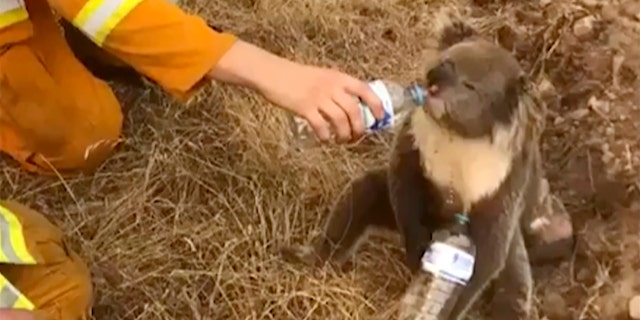
In this image made from video taken on Dec. 22, 2019, and provided by Oakbank Balhannah CFS, a koala drinks water from a bottle given by a firefighter in Cudlee Creek, South Australia. Around 200 wildfires were burning in four states, with New South Wales accounting for more than half of them, including 60 fires not contained. (Oakbank Balhannah CFS via AP)

In this image made from video taken on Dec. 22, 2019, and provided by Oakbank Balhannah CFS, a koala drinks water from a bottle given by a firefighter in Cudlee Creek, South Australia. Around 200 wildfires were burning in four states, with New South Wales accounting for more than half of them, including 60 fires not contained. (Oakbank Balhannah CFS via AP)

“We’ll know more when the fires are calmed down and a proper assessment can be made,” she added. “In the meantime, I’ve convened experts, scientists, people who understand koala behavior, to work out how we build those corridors in the habitats and how best we reintroduce koalas from the hospitals.”

KOALA RESCUED FROM AUSTRALIA WILDFIRES DIES AFTER INJURIES WORSEN

Koalas are native to Australia and are one of the country’s most beloved animals. However, their natural habitat, Eucalyptus forests, has been threatened by wildfires and a years-long drought.

The dramatic rescue of a koala in New South Wales last month captured the hearts and attention of people around the world. A video of a woman pulling the badly burned, wailing koala from a brushfire and dousing it with water went viral.

But the severely injured koala, named Lewis by Port Macquarie Koala Hospital, woud die days later.

Images shared on social media in recent days showed koalas drinking water out of tubs and bottles after being rescued.

“I get mail from all over the world from people absolutely moved and amazed by our wildlife volunteer response and also by the habits of these curious creatures,” Ley said, adding that other native animals have also been heavily impacted by the fires.

AUSTRALIA WILDFIRES EXPECTED TO WORSEN AS ANOTHER ‘EXTREME HEAT WAVE’ LOOMS

Officials said more than 12.35 million acres of land have burned nationwide during the crisis. Nine people – including two firefighters – have been killed and more than 1,000 homes destroyed.

The fire danger in New South Wales – just north of Sydney – was upgraded to “severe” Saturday, as temperatures topped 100 degrees in parts of the region.
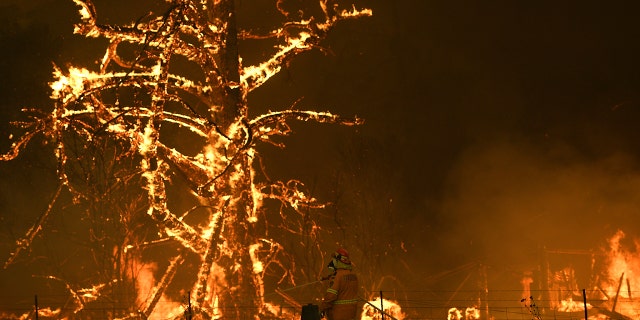
In this Saturday, Dec. 21, 2019, photo, NSW Rural Fire Service crew fight the Gospers Mountain Fire as it impacts a property at Bilpin, New South Wales state, Australia. Prime Minister Scott Morrison on Sunday, Dec. 22, apologized for taking a family vacation in Hawaii as deadly bushfires raged across several states, destroying homes and claiming the lives of two volunteer firefighters.(Dan Himbrechts/AAP Images via AP)

In this Saturday, Dec. 21, 2019, photo, NSW Rural Fire Service crew fight the Gospers Mountain Fire as it impacts a property at Bilpin, New South Wales state, Australia. Prime Minister Scott Morrison on Sunday, Dec. 22, apologized for taking a family vacation in Hawaii as deadly bushfires raged across several states, destroying homes and claiming the lives of two volunteer firefighters.(Dan Himbrechts/AAP Images via AP)

The high temperature in Sydney was expected to reach 88 degrees Sunday and 95 on Tuesday.

Canberra, Australia’s capital, peaked at 100 degrees Saturday, with more oppressive heat expected throughout next week.

CLICK HERE TO GET THE FOX NEWS APP

The hot weather, which has come in the first part of Au

Greta Thunberg to interview David Attenborough as part of BBC takeover

Swedish environmental activist Greta Thunberg attends a climate march in Turin, Italy, December 13, 2019. (AP Photo/Antonio Calanni)

Greta Thunberg will interview environmentalist and broadcaster David Attenborough as part of a special BBC radio takeover, it has been announced.

The 16-year-old Swedish climate activist will speak with the Seven Worlds, One Planet documentarian on BBC Radio 4’s Today programme, to air on Monday. They will discuss topics including the environment and the natural world, she said.

Nobel Prize nominee Thunberg had previously announced she would be a guest editor for the show, one of five people to guest edit the daily current affairs programme during the festive period.

David Attenborough smiles at a ceremony for the naming of the RRS Sir David Attenborough at Camel Laird shipyard, Birkenhead, England, Thursday, Sept. 26, 2019. (Asadour Guzelian/Pool Photo via AP)

Each programme will include an interview with the guest editor, with Thunberg speaking to Attenborough, 93, one of the UK’s most revered documentary makers.

The official BBC Radio 4 twitter announced the interview with a video of Thunberg.

Read more from Yahoo News UK:
Greta Thunberg stuck on floor of crowded German train after climate summit
Brazilian president calls activist Greta Thunberg a ‘brat’
Sir David Attenborough’s new BBC show recycles footage from Netflix series

Artist Grayson Perry, rapper George The Poet, Charles Moore, a critic of the BBC, and Supreme Court president Lady Hale will also guest edit the high-profile news show.

Previous guest editors have included Prince Harry, Angelina Jolie, John Bercow, Sir Lenny Henry and Professor Stephen Hawking.

Earlier this month, Brazilian President Jair Bolsonaro called Thunberg a “brat” after she expressed concern about the killings of indigenous Brazilians in the Amazon.

The environmental activist became a symbol for youth over the last 12 months, demanding radical change to confront climate change when she sparked global school strikes.

Opinion: Your electric car and vegetarian diet are pointless virtue signaling in the fight against climate change

Getty Images
Enjoy your Tesla for the right reasons.

By

BJORNLOMBORG

MALMÖ, Sweden (Project Syndicate) — Switch to energy-efficient light bulbs, wash your clothes in cold water, eat less meat, recycle more, and buy an electric car: We are being bombarded with instructions from climate campaigners, environmentalists and the media about the everyday steps we all must take to tackle climate change.

Unfortunately, these appeals trivialize the challenge of global warming, and divert our attention from the huge technological and policy changes that are needed to combat it.

For example, the British nature-documentary presenter and environmental campaigner David Attenborough was once asked what he as an individual would do to fight climate change. He promised to unplug his phone charger when it wasn’t in use.

Attenborough’s heart is no doubt in the right place. But even if he consistently unplugs his charger for a year, the resulting reduction in carbon-dioxide emissions will be equivalent to less than one-half of one-thousandth of the average person’s annual CO2 emissions in the United Kingdom. Moreover, charging accounts for less than 1% of a phone’s energy needs; the other 99% is required to manufacture the handset and operate data centers and cell towers. Almost everywhere, these processes are heavily reliant on fossil fuels.

Although I am a vegetarian and don’t own a car, I believe we need to be honest about what such choices can achieve.

Attenborough is far from alone in believing that small gestures can have a meaningful impact on the climate. In fact, even much larger-sounding commitments deliver only limited reductions in CO2 emissions. For example, environmental activists emphasize the need to give up eating meat and driving fossil-fuel-powered cars. But, although I am a vegetarian and don’t own a car, I believe we need to be honest about what such choices can achieve.

Going vegetarian actually is quite difficult: One large U.S. survey indicates that 84% of people fail, most of them in less than a year. But a systematic peer-reviewed study has shown that, even if they succeed, their vegetarian diets reduce individual CO2 emissions by the equivalent of 540 kilos — or just 4.3% of the emissions of the average inhabitant of a developed country. Furthermore, there is a “rebound effect,” as money saved on cheaper vegetarian food is spent on goods and services that cause additional greenhouse-gas emissions. Once we account for this, going entirely vegetarian reduces a person’s total emissions by only 2%.

Likewise, electric cars are branded as environmentally friendly, but generating the electricity they require almost always involves burning fossil fuels. Moreover, producing energy-intensive batteries for these cars invariably generates significant CO2 emissions. According to the International Energy Agency (IEA), an electric car with a range of 400 kilometers (249 miles) has a huge carbon deficit when it hits the road, and will start saving emissions only after being driven 60,000 kilometers. Yet, almost everywhere, people use an electric car as a second car and drive it shorter distances than equivalent gasoline vehicles.

Despite subsidies of about $10,000 per car, battery-powered electric cars represent less than one-third of 1% of the world’s 1 billion vehicles. The IEA estimates that with sustained political pressure and subsidies, electric cars could account for 15% of the much larger global fleet in 2040, but it notes that this increase in share will reduce global CO2 emissions by just 1%.

We already spend $129 billion per year subsidizing solar and wind energy, yet these sources meet just 1.1% of our global energy needs.

As IEA Executive Director Fatih Birol has said, “If you think you can save the climate with electric cars, you’re completely wrong.” In 2018, electric cars saved 40 million tons of CO2 worldwide, equivalent to reducing global temperatures by just 0.000018°C — or a little more than a hundred-thousandth of a degree Celsius — by the end of the century.

Individual actions to tackle climate change, even when added together, achieve so little because cheap and reliable energy underpins human prosperity. Fossil fuels currently meet 81% of our global energy needs. And even if every promised climate policy in the 2015 Paris climate agreement is achieved by 2040, they will still deliver 74% of the total.

We already spend $129 billion per year subsidizing solar and wind energy to try to entice more people to use today’s inefficient technology, yet these sources meet just 1.1% of our global energy needs. The IEA estimates that by 2040 — after we have spent a whopping $3.5 trillion on additional subsidies — solar and wind will still meet less than 5% of our needs.

The real action that’s needed

That’s pitiful. Significantly cutting CO2 emissions without reducing economic growth will require far more than individual actions. It is absurd for middle-class citizens in advanced economies to tell themselves that eating less steak or commuting in a Toyota TM, +0.13% Prius will rein in rising temperatures. To tackle global warming, we must make collective changes on an unprecedented scale.

By all means, anyone who wants to go vegetarian or switch to an electric car should do so, for sound reasons such as killing fewer animals or reducing household energy bills. But such decisions won’t solve the problem of global warming.

The one individual action that citizens could take that would make a difference would be to demand a vast increase in spending on green-energy research and development, so that these energy sources eventually become cheap enough to outcompete fossil fuels. That is the real way to help fight climate change.

Bjørn Lomborg, a visiting professor at the Copenhagen Business School, is director of the Copenhagen Consensus Center. His books include “The Skeptical Environmentalist,” “Cool It,” “How to Spend $75 Billion to Make the World a Better Place,” “The Nobel Laureates’ Guide to the Smartest Targets for the World,” and, most recently, “Prioritizing Development.” Follow him on Twitter @BjornLomborg. This column was first published by Project Syndicate — “Empty Gestures on Climate Change”.

WHAT ARE HUMAN CAUSES OF CLIMATE CHANGE?

DECEMBER 17TH, 2019
by: Murat Suner
https://www.fairplanet.org/story/what-are-human-causes-of-climate-change/

We are experiencing long shifts of climatic conditions that are characterised by a change in temperature, rainfall, winds, and other indicators.

Currently, the level of greenhouse gases in the atmosphere is much higher than in the past years, and its ability to trap heat is changing.

Burning fossil fuels and deforestation are the primary causes of climate change. It presents a substantial threat to humans and animals now and in the future. The following are some of the biggest human causes of climate change:

GREENHOUSE GAS EMISSION

These gases accumulate in the atmosphere, blocking heat from escaping, and they don’t respond to the temperature changes (the greenhouse effect). When they remain for an extended period in the atmosphere, they are likely to cause climate change.

Greenhouse gas emission is a major human causes of climate change, and their sources include transportation, electricity production, burning fossil fuel in industries, commercial and residential application, agriculture, and land use. These gases include;

• CARBON IV OXIDE

Carbon dioxide (CO2, or Carbon IV Oxide) is the main greenhouse gas produced through human activities that leads to adverse climate changes. It is a result of burning fossil fuels like coal, oil, and gas. Fossil fuel generates electricity worldwide, leading to high emissions of CO2. Locomotion is the second-largest source of carbon emission; humans contribute daily to CO2 emissions by use of transport vehicles either for leisure or business purposes.

Carbon stored in the form of fossil fuels is more stable, and when heated, they release the stored carbon in the form of CO2. If humans couldn’t burn these fuels for energy, the carbon is unlikely to reach the atmosphere.

We use fossil fuel to power cars, machines, and generate electricity, and as the human population increases, more fuel is used, leading to higher CO2 emissions.

• METHANE

Methane accounts for about 16 percent of greenhouse gas emissions. The petroleum industry and agriculture emit methane, especially from the digestive systems of grazing animals, manure management, and rice cultivation.

It also accumulates through waste decomposition in landfills. It is a far more active greenhouse gas than CO2.

• NITROUS OXIDE

Cultivation practices like the use of organic and commercial fertilisers lead to the emission of nitrous oxide. It also accumulates in the atmosphere through fossil fuel combustion, nitric acid production, and biomass burning.

• CHLOROFLUOROCARBONS

Chlorofluorocarbons and hydrofluorocarbons are used in home appliances like the refrigerator and industrial applications. They are associated with severe atmosphere impacts like ozone layer depletion and heat-trapping.

• SULPHUR HEXACHLORIDE

They are primarily used in dielectric materials like the dielectric liquids and for special medical procedures. Also, they act as insulators in high voltage applications like the transformers and grid switching gear.

DEFORESTATION

Deforestation is one of the major human causes of climate change; trees capture greenhouse gases such as CO2, preventing them from accumulating on the atmosphere, which could result in warming our planet. Most forests are getting cleared to create space for agriculture, buildings, and other human activities.

Trees take in carbon dioxide and release oxygen to the atmosphere during photosynthesis; hence, surplus carbon iv oxide is stored in the plants to help in growth and development. When we cut trees, their stored CO2 gets emitted to the atmosphere, which contributes to global warming.

Trees also help in regulating regional rainfall which prevents floods and drought in the area, cutting down trees influences the rainfall patterns globally. Deforestation also leads to changes in the landscape and the earth’s surface’s reflectivity, which leads to increased absorption of energy from the sun that results in global warming leading to changes in climate patterns.

AGRICULTURE

Food is a basic human need, but before you get it on your table, it goes through production, storage, processing, packaging, transportation, and preparation. Every stage of food production releases substantial amounts of greenhouse gases. Agriculture is one of the most common human causes of climate change through emissions of gases and the conversion of forests to agricultural land.

The modern agriculture practices and food production method using synthetic fertilisers are great contributors to greenhouse gas emissions, global warming, and climate change. The introduction of large scale farming has led to deforestation and machine intensive farming, which contributes to carbon emissions.

In livestock farming, ruminant animals digest their food through enteric fermentation that results in methane production; there are also substantial methane emissions from irrigated rice fields. Generally, agriculture contributes to climate change through deforestation, biodiversity loss, acidification of the oceans through agricultural chemical wastes, and accelerated soil erosion.

INDUSTRIALISATION

Although the industrial revolution, and industrialisation, has led to improved living conditions in various aspects, it is associated with adverse environmental effects that cause climatic changes. With recent innovations, human labour has been replaced with machinery that uses new sources of energy in the industries.

Manufacturing involves the use of large amounts of power and the alteration of natural systems; it is directly responsible for domestic emissions and indirect emissions through electricity and fuel use. The manufacturing operations are linked to direct greenhouse gas emissions, for instance, in the production of chemicals, iron, or steel, which are highly energy-intensive.

People are moving to urban areas in search of employment; urbanisation is another great contributor to climate change. It results in overcrowding, pollution, and poor sanitation; massive urbanisation can also lead to deforestation, emission of more greenhouse gases.

Increased commercialisation and industrialisation increase the use of fossil fuels leading to global warming and climate change.

CONCLUSION

Human emissions and activities have caused the highest percentage of global warming, which has resulted in climate change, in recent years. The global warming indicators are clear from increased temperature, humidity changes, sea level rising, showing that the land is warming up very fast due to fossil emissions, and thus changing the climate.

Any farmer can tell that the weather patterns have been altered, which is likely to affect food security worldwide. The fingerprints that humans have left on the environment through industrial activities and civilisation can be seen in the oceans, atmosphere, and the earth’s surface.

ARTICLE WRITTEN BY:
murat sw portrait
Murat Suner
Co-founder, Editorial Board Member, Author

THE AMAZON HAS REACHED A TIPPING POINT WHERE IT HAS BEGUN TO ‘SELF-DESTRUCT’

—BUT MAJOR REFORESTATION COULD SAVE IT

Pause

Unmute

Current Time 1:28
Duration 2:45
Loaded: 53.09%

QualityHD

Fullscreen

The Amazon has reached a “tipping point” where the rainforest has begun to self-destruct—and a “major reforestation project” is required to save it, according to the editors of a leading scientific journal.

In an editorial, Thomas Lovejoy and Carlos Nobre wrote that deforestation and fires are increasingly threatening the functioning of the rainforest, hampering its ability to act as a crucial carbon sink, a stronghold of biodiversity and critical link in the global water cycle.

“Although 2019 was not the worst year for fire or deforestation in the Amazon, it was the year when the extent of fires and deforestation in the region garnered full global attention,” the authors wrote in the Science Advances editorial. “The precious Amazon is teetering on the edge of functional destruction and, with it, so are we.”

In many parts of the Amazon, deforestation—which now affects around 17 percent of the basin—is helping to convert the landscape in many areas into tropical savannah, hindering the forest’s ability to sustain itself by producing its own rainfall.

Ads by scrollerads.com

“Researchers predict that deforestation will lead to developing savannahs mainly in the eastern and southern Amazon, perhaps extending into central and southwestern areas, because these zones are naturally close to the minimum amount of rainfall required for the rain forest to thrive,” the authors wrote.

This process is being exacerbated by human-driven global warming which is leading to reduced rainfall and increased temperatures in the region.

The authors say there are already signs the tipping point is “at hand”: for example, a lengthening and hotter dry season, periodic historically unprecedented droughts and the shifting composition of tree species towards those which favor drier climates.

Studies are showing that the role of the Amazon as a carbon sink is declining over time as deforestation spreads—a process that will have significant implications for global warming.

“The atmospheric carbon dioxide removal rate has declined over percent in comparison to the 1990s,” Nobre—a member of the Brazilian Academy of Sciences from the University of Sao Paulo—told Newsweek. “The occurrence of a sequence of very severe droughts in 2006, 2010 and 2015-16 also increased tree mortality and emission rates. Considering removals and emissions—including deforestation and fires—the Amazon has moved from being a relevant sink to being a source of about 400 million tons of carbon dioxide in the last decade.”

Furthermore, the destruction of the Amazon would also harm its role as a provider of freshwater for every country in South America—except for Chile, which is blocked by the Andes mountains.

“Bluntly put, the Amazon not only cannot withstand further deforestation but also now requires rebuilding as the underpinning base of the hydrological cycle if the Amazon is to continue to serve as a flywheel of continental climate for the planet and an essential part of the global carbon cycle as it has for millennia,” the authors wrote.

Amazon rainforest deforestation
View of a burnt area near Moraes Almeida—a town along a section of the trans-Amazonian highway—in Itaituba, Para state, Brazil, on September 14, 2019. The BR230 and BR163 are major transport routes in Brazil that have played a key role in the development and destruction of the world’s largest rainforest.NELSON ALMEIDA/AFP VIA GETTY IMAGES

In order to “build back a margin of safety,” Lovejoy and Nobre recommend a “major reforestation project,” particularly in the southern and eastern Amazon.

“Any additional increment of deforestation should be matched by three times as much reforestation, with details tailored at national levels,” they said. “Citizens and leaders across South America and around the world must create and promote a new vision of the Amazon, one that recognizes that the natural and economic assets of the region must be managed to maintain its essential role for South America and in sustaining the health of the planet.”

“This new vision will need to respect and protect its natural infrastructure and include a thoughtful review of all related commercial activities.”

This new vision would require putting a stop to “illogical and short-sighted” agricultural practices such as monocultures of cattle, soybeans and sugarcane. Instead, the authors advocate sensible use of intact forests, the harnessing of power from its massive flowing rivers, or the sustainable harvesting of biological assets.

But how successful could such measures be when it comes to stopping or reversing the destruction being wrought in the Amazon, especially given the apparent lack of concern of the Brazilian government—whose territory hosts the majority of the forest.

“If the matter is taken with the seriousness it deserves—and it is recognized the Amazon must be managed as a system—then it should be possible,” Lovejoy—a professor in the Department of Environmental Science and Policy at George Mason University—told Newsweek. “We don’t believe the current [Brazilian] government is interested in going down in history as the administration which tipped the system into dieback/savannahization.”

Nobre added: “All the Amazonian countries have forest restoration in their commitments towards reaching the Paris agreement targets. For instance, Brazil intends to restore 12 million hectares of forest by 2030. The big open question is still the financing of such activities and progress was not achieved at the 25th U.N. Climate Change Conference on how to fund such urgent mitigation actions.”

The authors conclude the article by arguing that we currently stand in a “moment of destiny.”

“The tipping point is here, it is now,” they wrote. “The peoples and leaders of the Amazon countries together have the power, the science, and the tools to avoid a continental-scale, indeed, a global environmental disaster. Together, we need the will and imagination to tip the direction of change in favor of a sustainable Amazon.”

Huge amounts of greenhouse gases lurk in the oceans, and could make warming far worse

Stores of methane and CO2 in the world’s seas are in a strange, icy state, and the waters are warming, creating a ticking carbon time bomb.

Scientists are finding hidden climate time bombs—vast reservoirs of carbon dioxide and methane—scattered under the seafloor across the planet.

And the fuses are burning.

Caps of frozen CO2 or methane, called hydrates, contain the potent greenhouse gases, keeping them from escaping into the ocean and atmosphere. But the ocean is warming as carbon emissions continue to rise, and scientists say the temperature of the seawater surrounding some hydrate caps is within a few degrees of dissolving them.

That could be very, very bad. Carbon dioxide is the most common greenhouse gas, responsible for about three-quarters of emissions. It can remain in the atmosphere for thousands of yearsMethane, the main component of natural gas, doesn’t stay in the atmosphere as long as CO2—about 12 years—but it is at least 84 times more potent over two decades.

The oceans absorb a third of humanity’s carbon dioxide emissions and 90 percent of the excess heat generated by increased greenhouse gas emissions; it’s the largest carbon sink on the planet. If warming seas melt hydrate caps, there’s a danger that the oceans will become big carbon emitters instead, with grave consequences for climate change and sea level rise.

“If that hydrate becomes unstable, in fact melts, that enormous volume of CO2 will be released to the ocean and eventually the atmosphere,” says Lowell Stott, a paleoceanographer at the University of Southern California.

The discovery of these deep ocean CO2 reservoirs, as well as methane seeps closer to shore, comes as leading scientists warned this month that the world is now surpassing a number of climate tipping points, with ocean temperatures at record highs.

The few CO2 reservoirs that have been found so far are located adjacent to hydrothermal vent fields in the deep ocean. But the global extent of such reservoirs remains unknown.

“It’s a harbinger, if you will, of an area of research that is really important for us to investigate, to find out how many of these kinds of reservoirs are out there, how big they are, and how susceptible they are to releasing CO2 to the ocean,” Stott says. “We have totally underestimated the world’s total carbon budget, which has profound implications.”

Jeffrey Seewald, a senior scientist at Woods Hole Oceanographic Institution who studies the geochemistry of hydrothermal systems, questioned the magnitude of hydrate-capped reservoirs.

“I don’t know how globally significant they are as most hydrothermal systems that we know of are not associated with large accumulations of carbon, though there’s still a lot to be explored,” he says. “So I would be a little careful about suggesting that there are significant accumulations of CO2 that are just waiting to be released.”

A threat closer to home

Other scientists are far more concerned about potential climate time bombs much closer to home—methane hydrates that form on the shallower seafloor at the margins of continents.

Hydrothermal vents like this one can have reservoirs of liquid CO2 nearby, kept in place by icy hydrate caps. If those caps melt, the carbon could seep into the ocean, and ultimately into the atmosphere.

PHOTOGRAPH COURTESY NOAA PMEL EOI PROGRAM

For one thing, there apparently are a lot of them. Between 2016 and 2018, for instance, researchers at Oregon State University and the National Oceanic and Atmospheric Administration (NOAA) deployed a new sonar technique to discover 1,000 methane seeps off the Pacific Northwest coast of the United States.

In contrast, just 100 had been identified between 2015 and the late 1980s, when scientists first stumbled across methane deposits. There are likely many more to be located, given that as of 2018, researchers only had mapped 38 percent of the seafloor between Washington State and Northern California.

“Because a lot of methane is stored on the continental margins in relatively shallow water, the effects of ocean warming will get to it sooner and potentially destabilize the methane hydrates that are present in the sediment,” says Dave Butterfield, a senior research scientist and hydrothermal vent expert at NOAA’s Pacific Marine Environmental Laboratory in Seattle.

He noted that these methane seeps likely constitute a far larger global reservoir of greenhouse gases than pools of carbon dioxide under the deep ocean floor.

“This idea is that if you destabilize the methane hydrates, that methane would be injected into the atmosphere and cause more extreme global warming,” says Butterfield, who in 2003 was part of an expedition that discovered a hydrate-capped reservoir of liquid CO2 at a hydrothermal system on the Mariana Arc in the Pacific.

Stott and colleagues earlier this year published a paper presenting evidence that the release of carbon dioxide from hydrothermal seafloor reservoirs in the eastern equatorial Pacific some 20,000 years ago helped trigger the end of the last glacial era. And in a new paper, Stott finds geological indications that during the end of Pleistocene glaciations, carbon dioxide was released from seafloor reservoirs near New Zealand.

The spike of atmospheric temperatures during previous periods when ice ages were ending mirrors today’s rapid rise as a result of greenhouse gas emissions. While the oceans have long been suspected as significant contributors to ancient global warming, the prevailing consensus was that the CO2 was released from a layer of water resting deep in the ocean. But research from Stott and other oceanographers over the past decade points to a geological culprit.

Like a needle in a haystack

Take the hydrate-capped liquid CO2 reservoir found by Butterfield and his colleagues on a volcano in the Pacific. They calculated that the rate that liquid CO2 bubbles were escaping the seafloor equaled 0.1 percent of the carbon dioxide emitted on the entire Mid-Ocean Ridge. That may seem like a small amount, but consider that the CO2 is escaping from a single, small site along a 40,390 mile-long system of submerged volcanoes that rings the planet.

“That’s an astonishing number,” says Stott.

Scientists believe such reservoirs can be formed when volcanic magma deep beneath the ocean floor interacts with seawater to produce superheated fluids rich in carbon or methane that rise toward the surface. When that plume collides with cooler water, an ice-like hydrate forms that traps the carbon or methane in subsurface sediments.

This newly discovered methane seep contained two different phases of methane: gas (bubbles) and solid form (hydrate, methane frozen in water). It is a rare occurrence to observe solid hydrates above the sediment like this. Typically these formations are buried under sediment layers.

PHOTOGRAPH COURTESY OCEAN EXPLORATION TRUST

The risk the reservoirs pose depends on their location and depth. For example, rising ocean temperatures could in coming years melt a hydrate capping a lake of liquid CO2 in the Okinawa Trough west of Japan, according to Stott. But the absence of upwelling currents there means a mass release of carbon dioxide at a depth of 4,600 feet would likely acidify the surrounding waters but not enter the atmosphere for an extremely long time.

Stott notes that finding CO2 and methane reservoirs in the deep ocean is a “needle and haystack situation.”

But in a paper published in August, scientists from Japan and Indonesia revealed that they had detected five large and previously unknown CO2 or methane gas reservoirs under the seafloor in the Okinawa Trough by analyzing seismic pressure waves generated by an acoustical device. Since those waves travel more slowly through gas than solids under the seafloor, the researchers were able to locate the reservoirs. The data indicates that hydrates are trapping the gas.

“Our survey area is not broad, so there could be more reservoirs outside of our survey area,” Takeshi Tsuji, a professor of exploration geophysics at Kyushu University in Japan and a co-author of the paper, says in an email.

Trump’s North America Trade Deal Is Poised to Worsen Climate Change

While Congressional Democrats made clear that they would not bring the United States-Mexico-Canada Agreement (USMCA) to a vote until it had the backing of the AFL-CIO, support they finally secured last week, Democrats appear comfortable voting on the replacement trade deal that has virtually no support from leading environmental groups.

A House vote could come in the next few days and on Friday December 13, ten environmental organizations, representing 12 million members, sent a letter urging Congressional representatives to vote against the proposed deal, which will replace the 25-year-old North America Free Trade Agreement (NAFTA).

“This final deal poses very real threats to our climate and communities and ignores nearly all of the fundamental environmental fixes consistently outlined by the environmental community,” the letter stated. The groups — which include the Sierra Club, Greenpeace and 350.org — noted that “the deal does not even mention climate change, fails to adequately address toxic pollution, includes weak environmental standards and an even weaker enforcement mechanism, supports fossil fuels, and allows oil and gas corporations to challenge climate and environmental protections.” The groups link to a two-page analysis produced by the Sierra Club that goes into greater detail about what the group sees as the deal’s environmental shortcomings.

According to the environmental news organization E&E News, at a Politico event last week, House Speaker Nancy Pelosi described the USMCA as “substantially better” than NAFTA and said “we are very pleased with the environment [provisions].” While she conceded “we want more,” she stressed, “but we don’t have to do it all in that bill” and praised it for “talk[ing] about the environment in a very strong way.”

Rep. Suzanne Bonamici (D-Ore.), who co-led the House working group focused on environmental trade issues, told reporters at a press conference last week that “this is going to be the best trade agreement for the environment” and cheered its monitoring and enforcement provisions. Rep. Bonamici did not return In These Times’s request for comment.

Back in May, every Democrat on the House Ways and Means Committee, chaired by Rep. Richard Neal (D-Mass.), sent a letter to President Trump criticizing the draft agreement for its language around the environment, including its lack of “any apparent provisions directed at mitigating the effects of climate change.” Now the Committee is championing its work to shape the final text, saying the “revised version will serve as a model for future U.S. trade agreements.”

Having so many members of Congress support this agreement is especially frustrating for climate advocates because, in September, more than 110 House Democrats, including 18 full committee chairs, sent a letter to the president urging the new trade deal to “meaningfully address climate change” and to “include binding climate standards and be paired with a decision for the United States to remain in the Paris Climate Agreement.”

“While Democrats claim this deal improves on some environmental provisions, they have yet to explain how it meaningfully addresses climate change,” said Jake Schmidt, the managing director for the International Program at the Natural Resources Defense Council.

Climate advocates point to the growing problem of “outsourced” pollution — where wealthier countries like the United States and Japan take credit for improving their own domestic environmental standards, while then importing more goods from heavy-polluting countries. Critics say the current draft of USMCA does nothing meaningful to address this problem.

The trade agreement is being hailed for rolling back the Investor-State Dispute Settlement, controversial private tribunals that have enabled corporations to extract huge payments for government policies that may infringe on their profits. But Ben Beachy, a trade expert with the Sierra Club, says the agreement includes a major loophole for Mexico, where oil and gas companies will still be able to sue in those private tribunals.

“The approach the NAFTA 2.0 deal takes is recognizing there’s a problem but then allowing some of the worst offenders to perpetuate it,” he told In These Times. “It’s an unabashed handout to Exxon and Chevron: It’s like saying we’ll protect the hen house by keeping all animals out, except for foxes.”

Beachy says the deal overall “dramatically undercuts” the ability of the U.S. to tackle the climate crisis. “By failing to even mention climate change, it’ll help more corporations move to Mexico, and this is not a hypothetical concern,” he said. “We cannot simultaneously claim to fight climate change on one hand and enact climate-denying trade deals on the other. Do we really want to lock ourselves into a trade deal for another 25 years that encourages corporations to shift their pollution from one country to another?”

Karen Hansen-Kuhn, the program director at the Institute for Agriculture and Trade Policy, told In These Times the final agreement represents an even worse situation for farmers than under NAFTA. “On food and farm issues it’s definitely several steps back,” she said, pointing as an example to how USMCA will make it easier for companies to limit the information they provide to consumers about health and nutrition.

Emily Samsel, a spokesperson with the League of Conservation Voters (LCV), told In These Times that her organization informed members of Congress “that [they] are strongly considering scoring their USMCA vote when it comes to the House floor on LCV’s Congressional scorecard.” LCV was one of the ten environmental groups to sign the letter opposing the trade deal last week.

USMCA does include language requiring parties to adopt and implement seven multilateral environmental agreements, but the 2015 Paris Agreement is not among them. Getting the president to agree to putting anything about climate change or the Paris Agreement was always going to be a tough sell, considering Trump has promised to withdraw from the landmark climate pact. Still, environmental advocates insist House Democrats have real leverage that they should use more aggressively, particularly since getting the trade deal through Congress is Trump’s top legislative priority for 2019.

Democratic supporters of USMCA say the existing language is good enough for now, and that it will position the government well for when Trump is out of office. A spokesperson for Nancy Pelosi told The Washington Post that “the changes Democrats secured in USMCA put us on a firm footing for action when we have a President who brings us back into the Paris accord.” Earlier this year 228 House Democrats voted for a bill to keep the U.S. in the Paris Agreement.

U.S. labor groups have thus far remained mostly silent on the concerns raised by environmental organizations.

The International Association of Machinists and Aerospace Workers, which opposes the deal on labor grounds, did not return request for comment on the USMCA’s environmental provisions. The Communications Workers of America released a statement on Friday saying the deal includes some “modest improvements” for workers over NAFTA, but a spokesperson for the union told In These Times, “We don’t have any comment on the environmental provisions.” The BlueGreen Alliance, a national coalition which includes eight large labor unions and six influential environmental groups, has issued no statement on the trade deal, and did not return request for comment.

And the AFL-CIO issued a statement last week praising the deal, though noted “it alone is not a solution for outsourcing, inequality or climate change.” A spokesperson for the labor federation did not return request for comment.

Kate McKinnon crashes ‘Saturday Night Live’ cold open as Greta Thunberg with a message for Trump

USA TODAY

After scenes of families debating the impeachment inquiry over their holiday dinners, Kate McKinnon hilariously crashed the “Saturday Night Live” cold open as Greta Thunberg.

As Aidy Bryant (dressed as a snowman) was wrapping up the segment with jokes about the dinner-table debates, McKinnon appeared as the Swedish climate-activist teenager, who said she also had a “Christmas message.”

“In 10 years, this snowman won’t exist,” McKinnon warned, gesturing to Bryant’s character. “Santa, reindeer, the North Pole, all of it, gone. The ice caps will melt and the elves will drown.”

She continued, “So, merry maybe our last Christmas to all. And Donald Trump, step to me, and I’ll come at you like a plastic straw comes at a turtle. I can’t believe I”m saying this to a 70-year-old man, but grow up!”

More ‘SNL’:‘Saturday Night Live’ imagines film about Kellyanne Conway, her husband in ‘Marriage Story’ spoof

The skit comes after Thunberg made headlines for being named Time magazine’s “Person of the Year,” which prompted a negative reaction from President Donald Trump.

“So ridiculous,” Trump tweeted. “Greta must work on her Anger Management problem, then go to a good old fashioned movie with a friend! Chill Greta, Chill!”

Thunberg responded swiftly, changing her Twitter profile to read: “A teenager working on her anger management problem. Currently chilling and watching a good old fashioned movie with a friend.”

The teen has received an outpouring of praise and support since she earned the coveted title from Time.

Former first lady Michelle Obama had words of wisdom to share with Thunberg and took to Twitter to share her support.

“.@GretaThunberg, don’t let anyone dim your light. Like the girls I’ve met in Vietnam and all over the world, you have so much to offer us all. Ignore the doubters and know that millions of people are cheering you on,” Obama tweeted early Friday.

Leonardo DiCaprio posted a video on Instagram of Thunberg and congratulated her on the honor, including Time’s description of why she was selected. Actress Alyssa Milano, meanwhile, bashed Trump for his reaction.

Contributing: David Jackson, Leora Arnowitz

Previously:Melania Trump responds to POTUS attack on Greta Thunberg; she says she communicates ‘differently’

We May Have Gravely Underestimated The Threat of ‘Dead Zones’ in The World’s Oceans

Scientists call them ‘dead zones‘: vast expanses of ocean water that contain little or no oxygen, making it almost impossible for many marine life-forms to survive within them.

The conventional view on dead zones (aka oxygen minimum zones [OMZs] and sometimes also called ‘shadow zones‘) is that their hypoxic conditions are produced when excess nutrient pollution from human activities flows into coastal waters, encouraging the growth of algae blooms, which in turn decompose into organic material that sinks to the seafloor.

As that organic material slowly plummets into the abyss, it attracts and consumes oxygen in a process that deprives marine life of the same vital resource.

This overall process is viewed as the primary cause of dead zones, but there could be another important factor behind the problem that we’ve overlooked until now, according to an international team of researchers led by biogeochemist Sabine Lengger from the University of Plymouth, UK.

“Our study shows that organic matter that sinks to the seafloor is not just coming from the sea surface, but includes a major contribution from bacteria that live in the dark ocean and can fix carbon as well,” Lengger says.

According to the researchers, who analysed sediment cores extracted from the floor of the Arabian Sea – the site of what is thought to be the largest dead zone in the world – anaerobic bacteria that dwell in deep waters could be responsible for producing almost one-fifth of the organic matter that exists on the seabed.

The implications, the team says, is that current models don’t take this factor, called ‘dark carbon fixation’, into account when they attempt to simulate and predict how dead zones may evolve in the future – meaning we’ve been missing a pretty big piece of the dead zone puzzle.

“Biogeochemical models that operate on the assumption that all sinking organic matter is photosynthetically derived, without new addition of carbon, could significantly underestimate the extent of remineralisation,” the authors write in their paper.

“Oxygen demand in oxygen minimum zones could thus be higher than projections suggest, leading to a more intense expansion of OMZs than expected.”

The findings come only days after the release of a stark scientific report published by the International Union for Conservation of Nature (IUCN), which concluded dead zones are spreading like an oceanic plague, numbering around 700 today, whereas less than 50 had been identified in the 1960s.

Hopefully these new findings give us a better way of identifying the true extent of this troubling phenomenon, so that we can do something about it before it’s too late.

The findings are reported in Global Biogeochemical Cycles.

Trump mocks 16-year-old Greta Thunberg a day after she is named Time’s Person of the Year

Commentary by Captain Paul Watson:

GRETA THUNBERG HAS MASTERED THE ART OF MEDIA AIKIDO WITH A BRILLIANT RESPONSE TO ANAL TANGERINUS AND HIS BIZARRE TWEETS.

In response to Greta being named Time magazine’s Person of the year, the President angrily attacked her because he wanted to be Man of the Year.

But the “Man” who failed to be is furious that a 16 year old Swedish girl got the goden egg that he so desired and tweeted:

Donald J. Trump

@realDonaldTrump
So ridiculous. Greta must work on her Anger Management problem, then go to a good old fashioned movie with a friend! Chill Greta, Chill!

Greta, not to be intimidated by a narcissistic sociopath intent upon ushering in all the perils of unaddressed climate change by opportunistic world leaders like himself responded brilliantly.

Without hesitation she replied on her Twitter profile with: “A teenager working on her anger management problem. Currently chilling and watching a good old fashioned movie with a friend.”

This young lady was born to be a leader and what she has done has been incredibly stunning. She skipped school to cross the Atlantic twice by sail, she addressed the United Nations, she toured North America including Standing Rock and the Tar Sands in Canada, she told Prime Minister Justin Trudeau he was not doing much, she stared down the President of the United States and just recently addressed the Climate Change Conference in Spain.

And I don’t thing she has (in the immortal words of Captain John Paul Jones) even begun to fight.

I can honestly say that over the last 50 years of activism I have ever met or seen someone so focused and unrelenting with her message. I have had the privilege of speaking with her and what impressed me was her courage, her passion, her commitment and her exceptional mind.

Over the next 50 years as humanity slides towards a future most cannot even comprehend or imagine, her vision hopefully will help to navigate us towards a safe harbor.

She is an incredible leader today and she will be an exceptionally inspiring leader in the years to come.

I wonder if that good old fashioned movie she will be watching with a friend will be “Soylent Green”.

WASHINGTONPOST.COM
In a morning tweet, the president said the Swedish climate activist needs to work on anger management and suggested she see a movie with a friend.